
The short answer first
A Hi3751 request should be resolved as a complete output-and-integration requirement, not as a SoC preference. The SoC, operating system, panel timing, input interface, brightness, viewing angle, backlight, power, and target deployment all have to match. An RFQ that says only “Hi3751 android display” leaves the electrical, mechanical, and acceptance criteria open.
For the supplied DataMax platform, the relevant model is the DS43H. Its production facts identify a Hisilicon Hi3751 quad 32-bit A53, AOSP Android 9, 1GB / 8GB, and a 43-inch TFT LED panel at 1920x1080 and 300 cd/sqm. The platform also provides HDMI in, LVDS in, four USB2.0 ports, RJ45 100M with 1G optional, and dimensions of 989x578.5x60.3mm. Those values form the current datasheet baseline; the catalog conflicts identified for this SKU must not be silently blended into it.
android display is therefore best treated as the headline requirement in a staged qualification process. First freeze the target output path and panel architecture. Then create an approved golden sample. Next verify software, electrical, thermal, and mechanical behavior on the production configuration. Finally freeze the SKU-specific bill of materials and acceptance evidence in the purchase order. The Hi3751 android display question buyers get wrong covers the broader buying interpretation.
For DS43H, the procurement answer is direct: use the datasheet configuration unless the supplier confirms a different SKU in writing. Confirm the power option and any catalogue-to-PDP discrepancy against the production datasheet before approval. Do not assume a newer Android version, alternate SoC, higher memory configuration, or different luminance from a catalogue entry.
A purchasing team should also distinguish qualification from quotation. A quotation can identify a commercial configuration, but qualification requires a sample that demonstrates the specified image path, software baseline, physical fit, power behavior, and operating environment. If the procurement record contains only “Hi3751 android display,” the receiving team has no defensible reference for rejecting a unit with the wrong panel input, Android release, brightness, or mechanical revision. The requirement therefore belongs in a configuration annex, not only in an email subject line.
Buyer situations, ranked by what they punish
Hospitality signage, hospital deployment, restaurant menu systems, and retail digital-signage projects all encounter android display, but they expose different failure modes. A hospital installation may punish thermal instability and service access; a restaurant deployment may punish ambient-light readability; a branded retail rollout may punish logo, color, and panel-consistency problems. The matrix below ranks the situations by the first operational issue that most often invalidates a quotation.
| Situation | Requirement that dominates | Model direction |
|---|---|---|
| Hospital digital signage | Defined panel, input path, power, and stable Android configuration | Use DS43H as the baseline for the supplied Hi3751 requirement; confirm the production datasheet. |
| Hotel and hospitality wall signage | Continuous display use, remote content operations, and controlled appearance | Evaluate DS43H for the stated 43-inch TFT LED configuration; validate the mounting and content workflow in a pilot. |
| Restaurant menu boards | Readable panel output, input compatibility, and repeatability across units | Use the exact DS43H SKU specification, not a generic “43-inch Android signage” description. |
| Retail digital signage | Golden-sample color and finish consistency across the order | Freeze one approved configuration and production evidence against it. |
| Operator or IPTV distribution | DRM, decoding, middleware, and operator-grade release control | Use DM21P for 4K IPTV or operator middleware set-top-box work; use DM21S for a 4K Android TV box. |
| Non-Google-TV commercial deployment | Certified application distribution and Google Mobile Services | Evaluate DM21RTD, which is listed as a GMS-certified AOSP platform. |
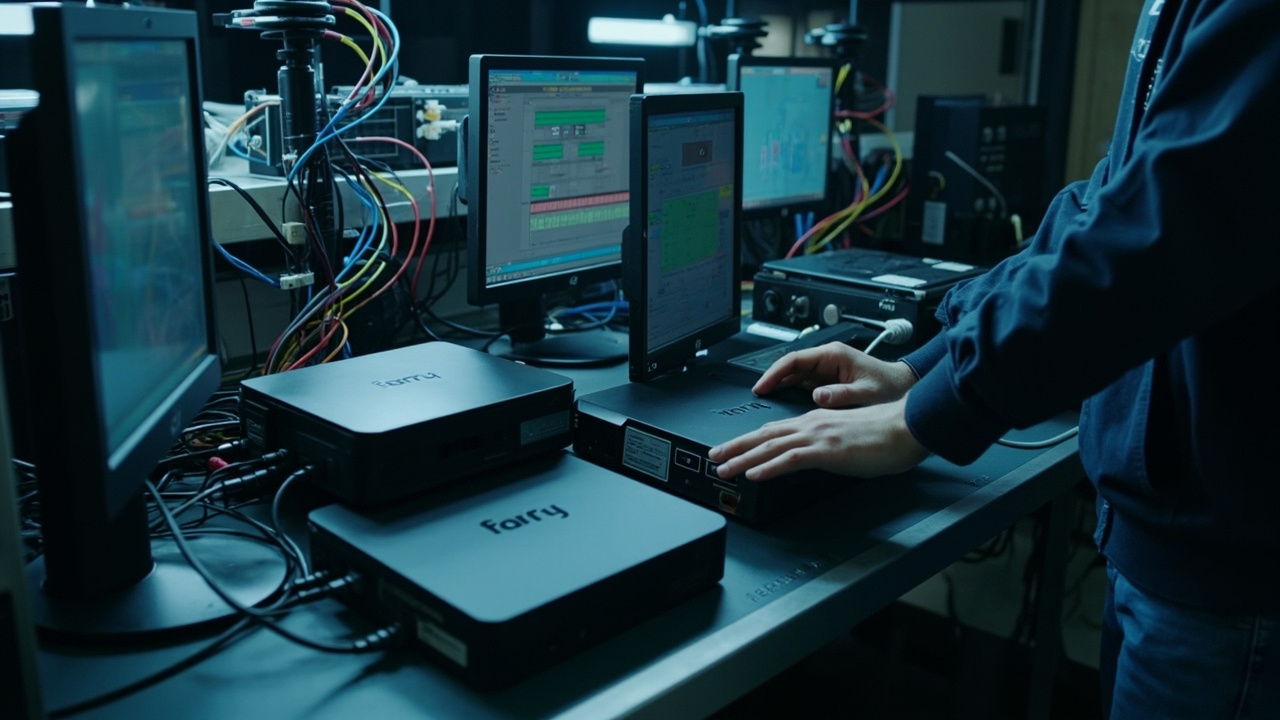
The photo shows the point at which these distinctions become measurable: a production-like bench where multiple boxes, displays, cables, and instruments must be evaluated together rather than by isolated datasheet fields.
For an operator, the main requirement may be the set-top-box path, not a panel. The DM21P fits 4K IPTV and operator middleware set-top-box deployments, while DM21S fits 4K IPTV/OTT white-label work. If the requirement instead calls for a GMS-certified non-Google-TV SKU, DM21RTD is the relevant direction. These models must not be presented as interchangeable with the DS43H wall-signage platform.
The practical consequence is that a quotation should separate three scopes: panel hardware, playback hardware, and software distribution. A vendor that combines all three under one generic android display description may be quoting a different architecture. Buyers should require the exact model, panel, output topology, software build, and intended deployment in the RFQ header.
Consider three concrete RFQs. A hospital ward requires a wall-mounted 43-inch panel, 1920x1080, HDMI input, AOSP Android 9, and a controlled power supply. A restaurant operator may require an integrated panel plus a content workflow, but can also consider an external player if the enclosure and service access are controlled. An IPTV operator seeking DRM and 4K decoding has a different requirement altogether and should use DM21P or DM21S rather than DS43H. A valid response to each RFQ must name the architecture before it lists optional components.
Environmental use also changes the acceptance procedure. DS43H is listed for 0-50C, which is an environmental fact rather than a universal deployment guarantee. A hospital, restaurant, or retail buyer should confirm whether the installed location stays within that range, whether airflow is restricted by the enclosure, and whether the selected mounting method preserves cable access. If the installation falls outside the stated range, the buyer needs a separately validated configuration rather than an unsupported assumption.
A decision path for the RFQ
The correct sequence starts by deciding what “display” means in the project. Is it a fixed-format digital-signage panel with HDMI or LVDS input, or a television-oriented box that drives a separate display through HDMI? The answer determines the entire comparison set. It also prevents an IPTV set-top box from being compared mechanically with a panel product.
- Define the product class State whether the RFQ covers a fixed 43-inch signage platform, an operator set-top box, a white-label TV box, or a GMS-certified AOSP box.
- Freeze output requirements Specify resolution, refresh rate, interface, orientation, panel construction, viewing requirement, and whether the display accepts content from an external player.
- Freeze platform requirements Record the required SoC, Android/AOSP release, memory configuration, codec path, DRM position, network interfaces, and update mechanism.
- Resolve mechanical and electrical inputs Include dimensions, mounting method, power input, cable access, thermal conditions, and installation clearances in the same document as the display specification.
- Define the evidence set State which golden sample, factory records, aging result, inspection report, and production-audit evidence the supplier must provide for acceptance.
- Freeze the order line Identify the exact SKU, panel, memory option, firmware baseline, accessories, and approved sample reference so procurement receives one traceable configuration.
These lines can be pasted into an RFQ:
- Product class: fixed-format digital-signage platform or TV/set-top-box platform; do not substitute across classes.
- Display: 43-inch TFT LED, 1920x1080, 300 cd/sqm, 1500:1, 6ms, 89deg, backlight 50,000h.
- Platform: Hisilicon Hi3751 quad 32-bit A53, AOSP Android 9, 1GB / 8GB.
- Inputs and interfaces: HDMI in, LVDS in, USB2.0 x4, RJ45 100M with 1G optional.
- Mechanical: 989x578.5x60.3mm.
- Power: DC12V/2A as listed for the supplied PDP; confirm against the production datasheet and PO because an alternate power option exists in the source material.
- Environment: 0-50C as listed; confirm enclosure, mounting, and installation conditions.
- Acceptance: approved golden sample plus inspection, aging, and production traceability evidence.
The final RFQ line should identify the approved sample by serial number and revision. A phrase such as “same as sample” is useful only when the sample, firmware build, panel label, cable set, and order configuration remain attached to the purchase order. Otherwise, the buyer has transferred the ambiguity from sales to receiving inspection.
The sequence can be divided into three commercial gates. Gate 1 is documentary: the supplier returns a current production datasheet, an exact SKU, and a line-by-line compliance matrix. Gate 2 is physical: the supplier builds or identifies an approved golden sample and documents its configuration. Gate 3 is production: a pilot lot is tested against that sample, deviations are closed, and only then is the PO released for volume. Each gate has a distinct decision. A supplier that can answer Gate 1 but cannot identify the unit used for Gate 2 has not demonstrated production equivalence.
A practical RFQ should also define what happens when an option is selected. For example, “RJ45 100M, 1G optional” must be converted into either “RJ45 100M” or a separately selected 1G configuration. “HDCP 2.2 optional” belongs in the same way: the PO must identify whether protection is fitted and which playback chain it supports. An option field without an order decision leaves the acceptance test unable to distinguish a compliant unit from an equivalent unit with a different bill of materials.
The traps in this category
The first trap is chipset-led substitution. A buyer asks for a Hi3751-based platform, while a catalogue or channel SKU lists a different processor, memory combination, or brightness. One configuration may appear more attractive, but it is not equivalent until the engineering and purchasing teams approve the change and the production datasheet is reconciled.
Field trap
Do not merge the DS43H catalogue entry with the PDP entry. The supplied facts identify conflicting SoC, memory, luminance, and power descriptions. The procurement consequence is a nonconforming receipt: the unit may meet the catalogue line but fail the approved panel, firmware, or installation requirement.
The second trap is assuming that Android version or certification follows from a model name. AOSP Android 9 is a software statement, not proof of an application-distribution path. Conversely, a GMS-certified AOSP platform addresses a different product class and does not turn a set-top box into a fixed signage panel.
Field trap
The cost of an undefined display path appears during integration: the external player, panel timing, EDID, LVDS cable, input mapping, and supplied controller may not form a tested chain. The error then becomes a firmware, cabling, or hardware change across an entire deployment batch.
Other quotation divergences need explicit fields. Some suppliers may treat brightness as a free production option even though the panel is part of the bill of materials. Others may quote the enclosure without defining mounting clearance, input accessibility, or the power source. Network language also needs precision: RJ45 100M with 1G optional does not establish that every shipment will use 1G.
The third failure mode is the unit of measure. Brightness may be quoted in cd/sqm, while viewing angle may be expressed as “89deg” without identifying the measurement basis. A quotation can therefore appear compliant even though the buyer and supplier are checking different documents. The buyer should ask for the panel specification from which the quoted values are taken and require the acceptance inspection to use that same revision.
The fourth failure mode is the “current” product trap. Both catalogue and PDP pages can be correct for different revisions, and a new product revision can inherit an old model name. Procurement should record the datasheet revision, factory work-order configuration, and approved sample as separate identifiers. If a factory later changes the panel or Android baseline without written engineering approval, that change is a configuration deviation, not a routine inventory update.
Verification you can ask for on paper
Verification starts with the build record, not the shipping carton. The factory should be able to relate the shipped unit to the production configuration through work-order, board, panel, and firmware records. For a fixed signage platform, the panel identity and input configuration are as important as the SoC population step.
The process should form an evidence chain:
- SMT and component traceability Link the populated board to the approved BOM and work order, with inspection results for the Hi3751 platform and installed memory configuration.
- AOI and board inspection Attach the inspection record for solder and assembly defects, including the disposition of any deviation from the approved process.
- Firmware and configuration loading Record the Android build, panel or output parameters, network configuration method, and identity of the approved firmware package.
- Functional and display verification Test the required input path, image output, interface operation, and relevant playback behavior on the exact production configuration.
- Aging and environmental record Document the defined burn-in or aging regime, observed failures, corrective action, and release decision.
- Final audit and golden-sample comparison Compare the finishing unit with the approved sample and retain a traceable acceptance record.
Request an evidence index that states the test item, sample quantity, procedure, result, equipment reference where applicable, date, line, and approval authority. A screenshot without the underlying configuration is weak evidence because it does not prove which panel, board, or firmware produced the result.
A factory audit can test whether this process is operational rather than documentary. The buyer should select one production lot, walk it from material issue to final inspection, and verify that the records describe the same unit revision. For display acceptance, the audit should include a live comparison against the golden sample, not only an inspection of a carton label.
Ask the supplier for a video factory audit or a request for SMT, AOI, aging, and final-audit evidence tied to the exact SKU. The DataMax manufacturing capability page can provide a starting point for the audit scope, while the purchase order should state the specific records required for acceptance.
The inspection plan should distinguish three tests. First, a static identity check confirms the model, RAM/ROM configuration, panel label, ports, and power marking. Second, a functional test confirms the selected HDMI or LVDS path, image presentation, network behavior, and installed Android build. Third, a sample-level visual comparison checks the unit against the approved golden sample for panel appearance and intended content. These checks prove different things and should not be represented by one generic “pass” entry.
For an android display acceptance file, the records should also permit a receiving auditor to reconstruct the test condition. Include the input signal or content source, selected display mode, operating duration, observed result, and disposition of any anomaly. A blank result field is worse than an explicitly failed or waived test because it gives the auditor no basis for deciding whether the unit is usable.
The audit should sample more than the final visible feature. Trace one serialized unit from work order to shipment, then compare that work order with the BOM, panel record, firmware load log, aging record, and final inspection. If any record points to a different panel revision or software baseline, the discrepancy must be resolved before the sample is accepted as representative of the production process.
Entry tier versus commitment tier
The meaningful tier distinction is not a longer feature list. It is the amount of evidence and configuration control attached to the order. A requirements-only quotation is suitable for market discovery, but it cannot support production commitment. A pilot batch with signed golden samples can; an approved sample and documented sign-off reduce the number of variables that remain unresolved.
The figures above are editorial planning scores, not production measurements. Their operational value is sequencing: add evidence before adding volume.
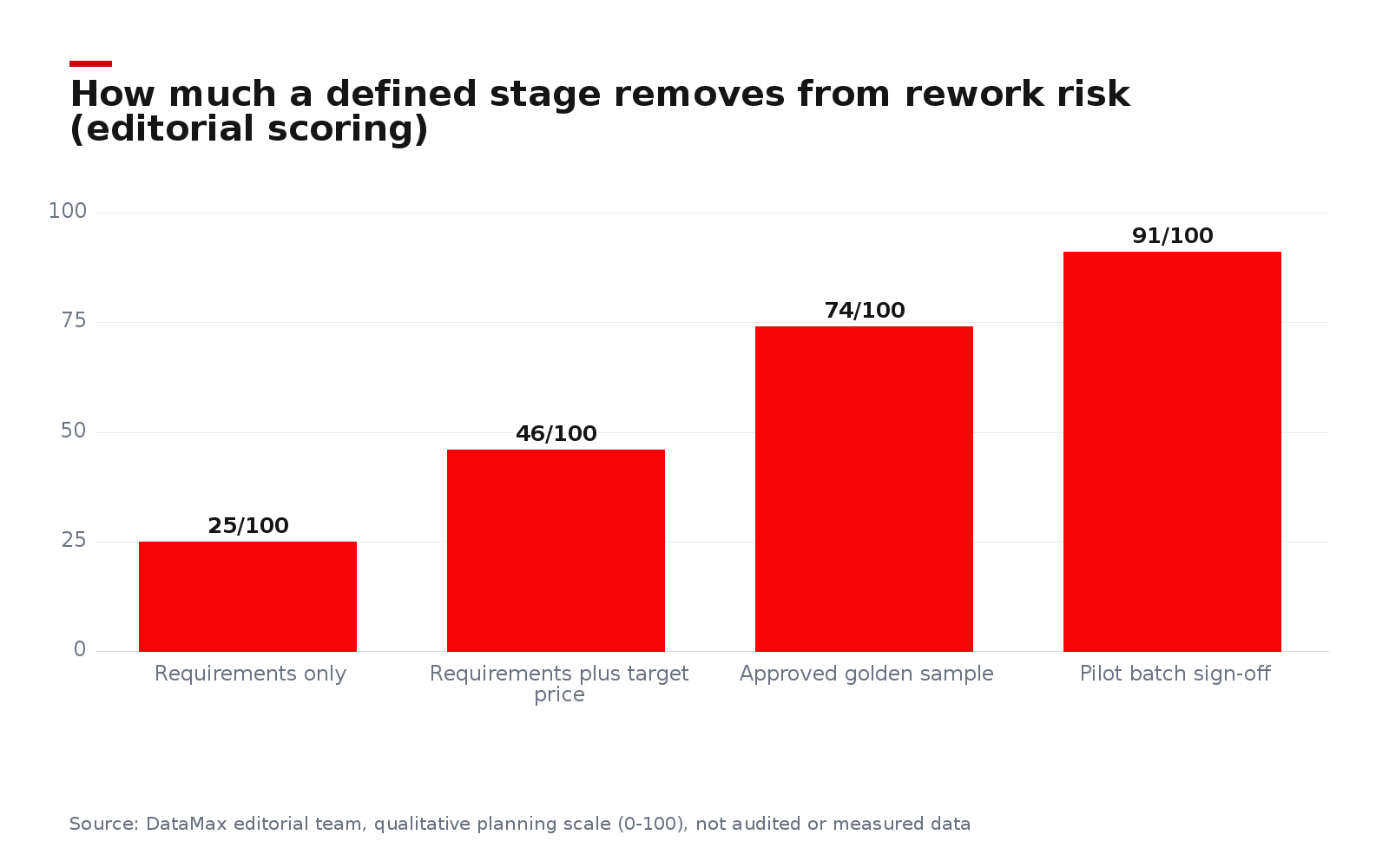
The same figures, in searchable form:
| Stage | Editorial score |
|---|---|
| Requirements only | 25 |
| Requirements plus target price | 46 |
| Approved golden sample | 74 |
| Pilot batch sign-off | 91 |
For the DS43H, the commitment tier must include the 43-inch TFT LED panel, 1920x1080 output class, 300 cd/sqm, 1500:1, 6ms, 89deg, backlight 50,000h, and the stated inputs. It must also identify AOSP Android 9, 1GB / 8GB, 989x578.5x60.3mm, and the confirmed power selection. These are acceptance anchors, not descriptive options.
An entry tier for discovery can request the current datasheet, target unit configuration, interface list, proposed evidence package, and sample plan. It should not authorize volume assembly. The commitment tier adds a signed golden sample, pilot-batch sign-off, serial traceability, inspection results, and a configuration annex incorporated into the PO.
| Control point | Discovery scope | Commitment scope |
|---|---|---|
| Configuration identity | Model family and preliminary datasheet | Exact SKU, panel, memory, firmware, and power option |
| Technical comparison | Headline resolution, OS, and interfaces | Full panel, timing, input, mechanical, and environmental acceptance fields |
| Physical reference | No production equivalence claim | Approved golden sample linked by serial number and revision |
| Factory evidence | Generic quality capability summary | SMT, AOI, firmware-load, aging, functional, and final-audit records for the SKU |
| Order authority | Engineering review only | Configuration annex incorporated into the PO and receiving plan |
| Change management | Informal inquiry response | Written approval required before panel, OS, memory, or power changes |
For operator and OTT programs, compare the set-top-box products separately. DM21P, DM21S, and DM21RTD serve different platform and software-distribution directions. Their presence in the same table would create a false equivalence because the DS43H integrates a fixed panel while the other products output video to separate displays.
A tier can also be expressed as a responsibility matrix. Procurement owns the commercial line and configuration annex. Engineering owns display timing, interface, firmware, and pilot acceptance. Quality owns the evidence package and deviation records. Manufacturing owns the work-order, BOM, panel, SMT/AOI, loading, aging, and final-audit links. The supplier signs the production equivalence, while the buyer signs the specification and golden sample. This allocation prevents an unsigned catalogue screenshot from becoming an implied production specification.
The mechanism behind the spec
A fixed-panel Android product and an HDMI-output Android box meet at different architectural points. DS43H combines the display and playback system in one product, with HDMI in and LVDS in as the listed signal paths. The panel is described as 43-inch TFT LED at 1920x1080, with specified optical and timing characteristics. Linux/Android manages the device, while panel initialization, timing, input mapping, and content presentation must operate as one controlled configuration.
The specified SoC is Hisilicon Hi3751 with a quad 32-bit A53 and Mali-450. AOSP Android 9 provides the operating-system baseline for the supplied datasheet. This platform fact does not imply GMS certification, Widevine level, PlayReady support, AV1 decoding, or 4K playback. The supplied DS43H facts instead state 1080P@60 and VP9 10-bit, with no 4K or AV1.
That distinction matters because android display can describe a display-capable device without defining the source of video. On DS43H, the input topology and integrated panel define the design. On DM21P, HDMI 2.0b out x1 sends video to a separate display, and the stated decode path reaches VP9/H.265 4K@60 and H.264 4K@30. Its listed DRM path is Widevine L1 / PlayReady / HDCP 2.2 optional. The word “optional” must remain attached to the quotation and order line.
The same issue applies to connectivity. DS43H lists RJ45 100M with 1G optional. DM21P lists RJ45 100M, while DM21S lists RJ45 100M with 1G optional. A product-level requirement for 1G therefore requires an explicit configuration and verification, not an inference from the family.
Output resolution, panel resolution, codec capability, and commercial content protection are separate controls. Procurement should specify the intended content source, licensed service, DRM requirement, external display or integrated panel, and operating-system release. That chain prevents a feature-led comparison between products that cannot satisfy the same content workflow.
At the signal level, the buyer should distinguish content resolution from interface capability. A 1920x1080 panel requirement concerns the image surface presented to viewers, while a codec requirement concerns the bitstream the platform can decode. The listed DS43H 1080P@60 capability is compatible with the stated 1920x1080 panel class, but neither statement creates 4K support. Similarly, a 4K decoder in an external set-top box does not change the native resolution of the attached signage panel.
The software architecture also requires operational ownership. AOSP Android 9 identifies the platform baseline, but content applications, update methods, network configuration, and recovery procedures still need named owners. Hospital signage may require a controlled image and remote operation; restaurant menus may use a simpler application workflow; operator boxes may require middleware integration and content protection. The technical RFQ should identify the intended software distribution and management path without inferring a certification that the supplied facts do not state.
Finally, “optional” is a configuration-control term, not a promise of equivalence. For 1G networking, HDCP 2.2, or other selectable interfaces, the PO should state the selected state. If engineering needs the optional item, the acceptance test should exercise it. If engineering does not need it, the supplier should price and document the standard configuration without leaving the option open for substitution.
Which DataMax models actually sit here
The supplied DataMax facts contain one fixed-panel Hi3751 platform and three set-top-box platforms. The model fit matters more than family resemblance. Every value in the table below is taken from the supplied product facts; any option or unresolved conflict remains qualified.
| Model and fit | SoC and OS | Memory | Display and decode | Interfaces and other stated facts |
|---|---|---|---|---|
| DS43H Hospitality, hospital, and restaurant wall signage | Hi3751 quad 32-bit A53, Mali-450 AOSP Android 9 (datasheet) | 1GB / 8GB | 43-inch TFT LED, 1920x1080, 300 cd/sqm, 1500:1, 6ms, 89deg, backlight 50,000h 1080P@60 + VP9 10-bit; no 4K/AV1 | HDMI in, LVDS in, USB2.0 x4, RJ45 100M (1G opt), DC12V/2A, 989x578.5x60.3mm, 0-50C |
| DM21P 4K IPTV and operator middleware set-top box | Amlogic S905Y4, quad Cortex-A35 AOSP Android 11 | 2GB / 8GB; 4GB; 16/32/64GB optional | AV1 [email protected], VP9/H.265 4K@60, H.264 4K@30 | HDMI 2.0b out x1, USB2.0 x2, TF, S/PDIF, 3.5mm AV, RJ45 100M, Wi-Fi6 2x2 + BT5.4, DC 5V/2A Widevine L1 / PlayReady / HDCP 2.2 optional |
| DM21RTD Operators and retail requiring a GMS-certified non-Google-TV SKU | Realtek RTD1325 GMS-certified AOSP | Confirm against the production datasheet | AV1 capable | Other specifications are not supplied here; confirm against the production datasheet. |
| DM21S 4K Android TV box for IPTV/OTT white-label | Amlogic S905Y5, quad Cortex-A55 AOSP Android 14 | 2GB / 16GB; 2/4/8GB; 16/32/64GB optional | AV1 / H.265 [email protected] 4K@60 | HDMI 2.0b out, S/PDIF, AV, USB2.0 x2, TF, RJ45 100M (1G optional), Wi-Fi6 2x2 + BT5.4 Widevine L1 / PlayReady optional; Dolby Vision/DTS |
DS43H is the only listed match for a fixed 43-inch Hi3751 wall-signage requirement. Its source material contains conflicting catalogue and PDP descriptions involving the SoC, memory, brightness, and power option; confirm the ordered configuration against the production datasheet and fix it by SKU in the PO. Do not substitute Android 11 for the stated AOSP Android 9 baseline.
The other models answer an external-display set-top-box requirement. Their availability of AV1, 4K, Wi-Fi6 2x2, BT5.4, DRM, or optional interfaces does not change DS43H’s stated capabilities. For DS43H, any other platform direction, complete port list, decoder claim, cellular option, or unlisted configuration should be confirmed against the production datasheet.
The procurement fit can be reduced to four questions. Does the project require an integrated 43-inch panel? Does it require an external HDMI display path? Does the content workflow require GMS-certified AOSP? Does the commercial service require 4K decoding or listed DRM? DS43H answers the integrated-panel question for the supplied Hi3751 requirement. DM21P addresses 4K IPTV and operator middleware set-top-box work. DM21RTD addresses the stated GMS-certified non-Google-TV direction. DM21S addresses 4K IPTV/OTT white-label work.
This separation also prevents a misleading shortlist. An operator may initially search for an android display and add the three box models, then ask why the integrated DS43H lacks the 4K and DRM fields shown elsewhere. The answer is architectural: DS43H is a fixed-panel signage platform, whereas the other models output to a separate display. The correct shortlist is built by product class and workflow, not by the shared operating-system family.
The order record should identify DS43H by its approved configuration, including the 43-inch TFT LED panel, AOSP Android 9, 1GB / 8GB, selected input path, selected network rate, selected power option, and the approved sample revision. The unresolved catalogue conflicts must not be silently carried into production. A change to the SoC, Android release, memory, panel brightness, or power arrangement requires a revised datasheet, a new golden sample where the change affects hardware or behavior, and written engineering approval.
To move this requirement into quotation, send [email protected] with the exact SKU list, target-market certification requirements, the panel and mechanical drawing, the middleware/DRM checklist, and the requested inspection evidence. Engineering can then return a configuration-aligned response rather than treating android display as a shorthand for incompatible products.
Further reading
- Hi3751 Android Display: The Question Buyers Get Wrong
- AOSP vs Google TV guide
- HDR10+ Android TV box guide
- DTS:X Android TV box guide
- DRM compliance solutions
- DataMax DM21P specifications and fit
- DataMax DM21RTD specifications and fit
FAQ
Is a Hi3751 Android 9 sign necessarily a set-top box?
No. The supplied DS43H combines a Hisilicon Hi3751 quad 32-bit A53 with AOSP Android 9 in a fixed 43-inch TFT LED signage platform. Its listed 1920x1080 output, panel characteristics, HDMI and LVDS inputs, enclosure dimensions, and operating range must be assessed together. A separate HDMI-output set-top box has a different mechanical and signal architecture.
Which DataMax model matches the supplied Hi3751 requirement?
The DS43H matches the supplied fixed-panel requirement. Its facts specify a 43-inch TFT LED panel at 1920x1080 and 300 cd/sqm, AOSP Android 9, 1GB / 8GB, HDMI in, LVDS in, and four USB2.0 ports. Because catalogue and PDP entries conflict on several fields, confirm the production datasheet and freeze the ordered SKU in the PO.
Does the DS43H support 4K or AV1 playback?
The supplied DS43H facts state 1080P@60 and VP9 10-bit, with no 4K or AV1. Its Hi3751 platform should not be credited with the 4K or AV1 capabilities listed for DM21P or DM21S. If 4K is mandatory, define it in the RFQ and evaluate a matching set-top-box platform rather than assuming chipset equivalence.
Does AOSP Android 9 include Google certification?
The supplied DM21RTD facts identify a separate GMS-certified AOSP model, while DS43H is identified as AOSP Android 9. Do not infer Google certification, Widevine level, or PlayReady support for DS43H from that separate platform. State the target-market certification and content-protection requirements explicitly, then confirm the selected configuration against its production datasheet.
Which evidence should accompany the production quotation?
Request the SKU and panel configuration, approved golden sample, serial traceability, SMT record, AOI result, firmware/configuration record, functional display test, aging result, and final audit. The evidence must identify the production configuration tested. A generic factory report that cannot be linked to the ordered model, panel, board, and firmware does not close an android display acceptance requirement.
What should happen when catalogue and datasheet specifications conflict?
Stop the approval cycle at the affected field and request a written resolution from the factory against the current production datasheet. For DS43H, the conflict includes SoC, memory, brightness, and power descriptions. The resolved configuration must identify the exact SKU in the PO, and any hardware-affecting change should pass through golden-sample review and pilot sign-off before volume assembly.


