

What Saudi Arabia hospitality TV requirements hinge on
A hospitality TV manufacturer procurement decision in Saudi Arabia hinges on more than the Android box specification: the supplier must connect the hardware, software, DRM, network, certification and evidence requirements to the deployment site. With no third-party market statistic available for this angle, the defensible opening is a pair of conflicting project requirements: a hotel operator may require 4K secure playback and a signed operator middleware, while a cellular hospitality site may need LTE or 5G because its building network cannot reach the guest room. Both requirements can arrive in the same RFQ, but they lead to different platform selections.
The short answer is to separate four decisions before comparing quotations. First, identify whether the unit is an IPTV set-top box, an OTT white-label box, a cellular TV dongle or a premium UHD/cloud-gaming platform. Second, record the Saudi deployment dependencies that the manufacturer must evidence, including power, connectivity, physical installation, content security and regulatory conformity. Third, identify which requirements are mandatory at the site and which are optional configurations. Fourth, require a traceability package that connects the production unit to its hardware revision, firmware build, component substitutions and final test.
DataMax should be treated as a manufacturing candidate, not as evidence of local certification by itself. Confirm Saudi-specific radio, electrical, customs and content requirements against the production datasheet and the applicable authority documentation before treating the quotation as deployable. Use the platform evidence in this article to build that RFQ, not to bypass it. A manufacturer can demonstrate factory capability, yet the buyer must still validate the exact Saudi configuration, service integration and local compliance status.
Which DataMax models actually sit here
The supplied platform facts identify 4 candidates for this procurement angle. The table separates the fit statement from the specifications that can be quoted. No model below should be represented as Saudi-approved without the relevant production and compliance evidence.
| Model | Fit | SoC and OS | Memory | DRM | Ports and connectivity |
|---|---|---|---|---|---|
| DM21P | 4K IPTV / operator middleware set-top box | Amlogic S905Y4, quad Cortex-A35; AOSP Android 11 | 2GB / 8GB; 4GB; 16/32/64GB optional | Widevine L1 / PlayReady / HDCP 2.2 optional | HDMI 2.0b out x1, USB2.0 x2, TF, S/PDIF, 3.5mm AV, RJ45 100M, Wi-Fi6 2x2 + BT5.4, DC 5V/2A |
| DM33H | Cellular 4G/5G TV dongle: RV, hospitality, no-Wi-Fi signage | Allwinner H618, quad Cortex-A53; AOSP Android 14 | 2GB / 16GB; 4GB / 32GB optional | No Widevine row on datasheet | HDMI 2.0b out, 2x Type-C, SIM x1, 4G Quectel EG915N, 5G optional, Wi-Fi6 2T2R, no RJ45, 70x70x17mm |
| DM21S | 4K Android TV box for IPTV/OTT white-label | Amlogic S905Y5, quad Cortex-A55; AOSP Android 14 | 2GB / 16GB; 2/4/8GB; 16/32/64GB optional | Widevine L1 / PlayReady optional; Dolby Vision/DTS | HDMI 2.0b out, S/PDIF, AV, USB2.0 x2, TF, RJ45 100M with 1G optional, Wi-Fi6 2x2 + BT5.4 |
| DM21T | Premium UHD / cloud-gaming box | Amlogic S905X5, quad Cortex-A510 (ARMv9); AOSP Android 14 | 4GB / 64GB; family options | Widevine L1 / PlayReady optional | HDMI 2.0b out with no HDMI input, USB2.0 x1 + USB3.0 x1, TF, S/PDIF, AV, RJ45 100M with 1G optional, Wi-Fi6 + BT5.4 |
The procurement logic is functional. DM21P aligns with an operator-controlled 4K IPTV rollout and exposes the optional HDCP 2.2 requirement. DM21S supports an Android 14-based IPTV/OTT white-label program, while its Dolby Vision/DTS designation still needs a written licensing and implementation scope. DM33H is the direct candidate where a TV dongle must operate over cellular, but the absence of a Widevine row prevents a commercial-content security claim. DM21T fits premium UHD or cloud-gaming briefs that specify 120 Hz decoding and USB3.0, not a basic hotel-room economics exercise.
Each platform also creates a quotation boundary. DM21P is based on AOSP Android 11, which may require a middleware compatibility review before a large estate rollout. DM21T has no HDMI input and must not be described as an 8K output product. DM33H has no RJ45 and has a catalogue/PDP port discrepancy, so the buyer must freeze the production PDP configuration. Confirm against the production datasheet before release.
For a 300-room operator deployment, the manufacturer should be asked to quote one controlled part number rather than several substitutions hidden behind a model name. The line should identify the selected memory configuration, Wi-Fi module, Ethernet controller, power path and connector set. DM21P’s “4GB; 16/32/64GB optional” language needs a single accepted population; DM21S’s “2/4/8GB; 16/32/64GB optional” language needs the same treatment. DM33H should be tied to the exact Type-C arrangement, SIM slot, 4G module or 5G option, antenna specification and mechanical drawing. DM21T should be tied to its base 4GB/64GB family configuration and its no-HDMI-in limitation.
A second procurement task is to identify what the manufacturer changes for the Saudi market. Ask for the approved country image, default language set, time-zone behavior, regulatory labels, power adapter, packaging, serial-number format and accessory list. Do not assume that “Middle East” is a sufficient configuration code. If the manufacturer cannot state the responsible document and model linkage, the quotation remains incomplete.
Deployment scenarios and the spec each needs
A hotel group, an IPTV operator and a signage integrator are not purchasing the same category even when all three describe the box as “hospitality TV.” The operator controls service activation, entitlement and middleware; the hotel group controls room economics and device presentation; the integrator controls installation, network access and physical security. Their RFQs should therefore share a site list but not a single configuration sheet.
| Buyer situation | Primary requirement | Model direction | Evidence or qualification |
|---|---|---|---|
| Operator-deployed 4K IPTV rooms | Operator middleware, secure delivery, Ethernet service integration | DM21P direction; compare DM21S for white-label requirements | HDCP 2.2 optional only; request middleware and DRM configuration proof |
| RV or hospitality site without usable Wi-Fi | Cellular path and compact TV dongle form | DM33H | SIM configuration, antenna choice and cellular coverage must be validated at site level |
| White-label OTT room service | Brand launcher, Android TV behavior and mixed peripheral set | DM21S | Freeze launcher, branding, content licensing and update ownership |
| Premium suite or cloud-gaming zone | 4K120 decode path, high-speed peripheral and premium positioning | DM21T | Validate display mode, HDMI2.0 bandwidth, source format and thermal behavior |
| AV integrator handling estate-wide rollout | Consistent SKU, labeling, cabling and recovery procedure | Selected platform plus controlled BOM | Request serialized test records and an approved substitute list |
The scene in a Saudi hotel can change by wing, building or network segment. Wired Ethernet, captive-port Wi-Fi and cellular fallback create different paths for device management. A unit with RJ45 can simplify deployment, but the presence of a port does not prove that the service-management architecture supports it. A cellular dongle may solve physical connectivity, yet it introduces SIM provisioning, coverage, data-cost ownership and activation procedures that must appear in the operating model.
The real-world production reference is a modern SMT line: automatic pick-and-place equipment should place components onto black printed circuit boards moving on a conveyor, with component reels and a clean industrial background. That scene matters because the scale of the line is only useful when linked to serial traceability, inspection records and approved engineering changes. The manufacturer should be able to explain how that line maps a board revision to a finished serial number.

A practical site segmentation rule is to freeze 1 golden-sample configuration per room and building type rather than allow “equivalent” models. Then record network method, HDMI path, audio path, mounting method, service ownership and content entitlement. If two sites share a player but not a network, they do not share a deployable SKU. The matrix should carry a site identifier, room range, network method, display model, service owner and approved manufacturer part number.
Consider a new hotel with 120 rooms split between two wings. Wing A may use managed Ethernet and operator middleware, while Wing B uses a cellular-supported hospitality location where local Wi-Fi installation is delayed. DM21P and DM33H then represent two procurement lines, not interchangeable options. For a 20-suite property requiring cloud gaming, DM21T may fit the technical brief, but the buyer must verify source format, display mode and the absence of HDMI input.
Signage and guest-room playback also require different controls. A signage player may prioritize unattended recovery, while guest-room service requires entitlement, personalization and secure logout. The manufacturer should state whether the selected image supports the required recovery mechanism, account separation and remote management. A generic “Android 14” line does not answer either requirement.
Turning the question into a spec line
Convert the commercial request into a sequence that prevents a feature list from outrunning the operational design. The buyer should not ask only whether a box supports Wi-Fi or DRM. The RFQ should identify the service, version, interface and evidence required for that feature.
- Name the product role Write “4K IPTV / operator middleware set-top box,” “cellular TV dongle,” “IPTV/OTT white-label box” or “premium UHD/cloud-gaming box.” This prevents cross-category comparisons.
- Freeze the display target State output resolution, refresh rate, color/DRM expectation and physical output path. For DM21T, specify 4K120 behavior and confirm the production display chain rather than repeating an unsupported 8K claim.
- Freeze connectivity State Ethernet speed or cellular generation, SIM ownership, Wi-Fi topology, antenna arrangement, VPN/proxy requirements and the service-provider boundary.
- State content security Identify Widevine L1, PlayReady, HDCP 2.2 or Dolby Vision/DTS only where applicable, then require the exact license and hardware configuration to be demonstrated.
- Write an auditable SKU line Require model, SoC, Android version, RAM/ROM, storage, ports, power input, firmware branch, label artwork and operating region on the same line.
- Attach acceptance evidence Define the test sample, burn-in method, imaging audit, dark-room display test, connectivity test and document package required before production release.
A pasteable specification line should read: “DM21S, Amlogic S905Y5, AOSP Android 14, 2GB/16GB, HDMI 2.0b out, S/PDIF, AV, USB2.0 x2, TF, RJ45 100M, Wi-Fi6 2x2 + BT5.4, plus the approved operator image and artwork; manufacture under revision X.” Optional capabilities need an unambiguous status: “1G optional” is not the same as an included 1G port, and “HDCP 2.2 optional” is not evidence that every shipped unit is protected.
For cellular programs, add SIM slot generation, module configuration, antenna path, data plan ownership and remote-activation responsibility. For premium programs, add display capability at the target refresh rate and the exact controller configuration. For all programs, add firmware ownership, patch process, bootloader policy and incident evidence. Use the broader TV box vendor selection checklist to decide whether the commercial relationship, communication and delivery structure support the technical requirement.
A useful RFQ includes 3 levels of language. “Base” identifies the production configuration without optional population. “Mandatory” identifies a capability that must be present and tested. “Development” identifies a firmware, mechanical or certification task requiring a dated response from the manufacturer. This structure prevents a feature marked optional in a datasheet from appearing as delivered in a purchase order.
For example: “Base: DM33H, Allwinner H618, AOSP Android 14, 2GB/16GB, HDMI 2.0b out, SIM x1 and approved 4G module. Mandatory: Wi-Fi6 2T2R, no RJ45, production dimensions 70x70x17mm, site-tested antenna arrangement. Development: confirm against the production datasheet the exact approved 5G option and all associated module, antenna and certification implications.” The same discipline applies to operator middleware, branding and firmware ownership.
Failure modes that reach the field
The most expensive quotation mismatch is not a missing headline feature. It is a mismatch that passes a paper review and fails after installation, firmware provisioning or content activation. For a manufacturer, the quotation must therefore include the conditions under which each optional feature is populated.
Field trap
A cellular model can be quoted with 5G while its standard production configuration uses a 4G module. If the RFQ omits the SIM module, antenna and fallback behavior, sample approval and estate deployment may diverge. Require the production BOM and a photographed configuration record for every approved variant.
Field trap
DRM names can conceal missing licensing or implementation work. “Widevine L1” does not establish the requested service’s device provisioning, licence-server policy or display path; “HDCP 2.2 optional” does not establish that protection is fitted. Require a test on the supplied hardware and image, with the protected output and failure behavior recorded.
Connectivity drift is another recurring failure. A design with RJ45 100M and a proposed 1G option can leave installers, switches and software profiles on different assumptions. DM33H has no RJ45, so a cellular deployment plan must not silently depend on an Ethernet path. DM21T has no HDMI input, preventing a capture or pass-through workflow unless the application does not need it.
Thermal and display problems tend to surface during sustained use. A specification listing 4K120 decode does not prove stable output at that rate through the selected HDMI chain, power supply and room temperature. The acceptance method should define input signal, display model, duration, ambient conditions and observation criteria. Likewise, Android 11 on DM21P may be adequate for its operator middleware, but it must be accepted by the software owner rather than inferred from the platform category.
Logistics divergence appears at the physical boundary. The DM33H production dimensions of 70x70x17mm are usable in the decision record, but enclosure drawings, port orientation and mounting method still need approval. A unit may pass electrical testing and still be unserviceable behind furniture or difficult to connect with the planned adapter. Include approved mechanical drawings, packaging drawings and labelled port maps in the golden-sample package.
Finally, do not let a broad Android statement obscure application ownership. AOSP Android 11 or 14 identifies the base platform, not the operator launcher, middleware version, content agreements, account provisioning or update process. A production release is not complete until the application image and its upstream dependencies are frozen.
Another failure occurs when the accepted sample and the production image diverge. The sample may contain a launcher, VPN profile or DRM configuration that is not automatically restored after the manufacturer flashes a later build. Require image hashes, boot-state settings, factory-reset behavior and a repeatable flashing procedure. If the hotel expects 500 rooms to receive the same recovery path, the manufacturer should demonstrate that procedure on a production-intent device rather than a development sample.
Update ownership can produce a similar field incident. The hardware may remain operational while the customer image, certificate, middleware or operator service becomes incompatible. The purchase document should identify who may sign firmware releases, which Android security patch level is required, how regressions are triaged and whether the operator has a controlled rollback point. A model number does not resolve that responsibility.
The evidence trail from SMT to shipment
Factory evidence should connect the physical unit to the specification that was approved. SMT placement proves that components were attached, but it does not by itself prove correct polarity, correct component identity, electrical function or long-term stability. The useful evidence chain combines process inspection, traceability and final configuration review.
- Incoming and BOM control Match approved parts, alternates and supplier records to the frozen production BOM. Review changes before they enter the line.
- SMT and AOI evidence Retain the placement program, inspection result, line identification and serial linkage for each production lot.
- Functional test Verify display output, USB, Ethernet or SIM, Wi-Fi, audio, storage and required boot behavior against the golden sample.
- Aging Apply the agreed stress profile and define the duration, workload, temperature condition and rejection rule in the purchase specification.
- Dark-room visual inspection Inspect the specified display areas under controlled conditions, with the agreed defect classes and sample plan recorded.
- Software and security audit Record the image hash, installed applications, launcher, middleware, bootloader state, update configuration and required DRM implementation.
- Final audit and shipment release Check label artwork, serial number, accessories, packaging, regulatory documents and the production revision before authorization to ship.
Request an evidence index that maps each document to a lot, date, model and hardware revision. A video factory audit can verify that the documented process matches the line, while the indexed records support remote review between audits. The requirement should state exactly which samples, lots and failure records the buyer may inspect.
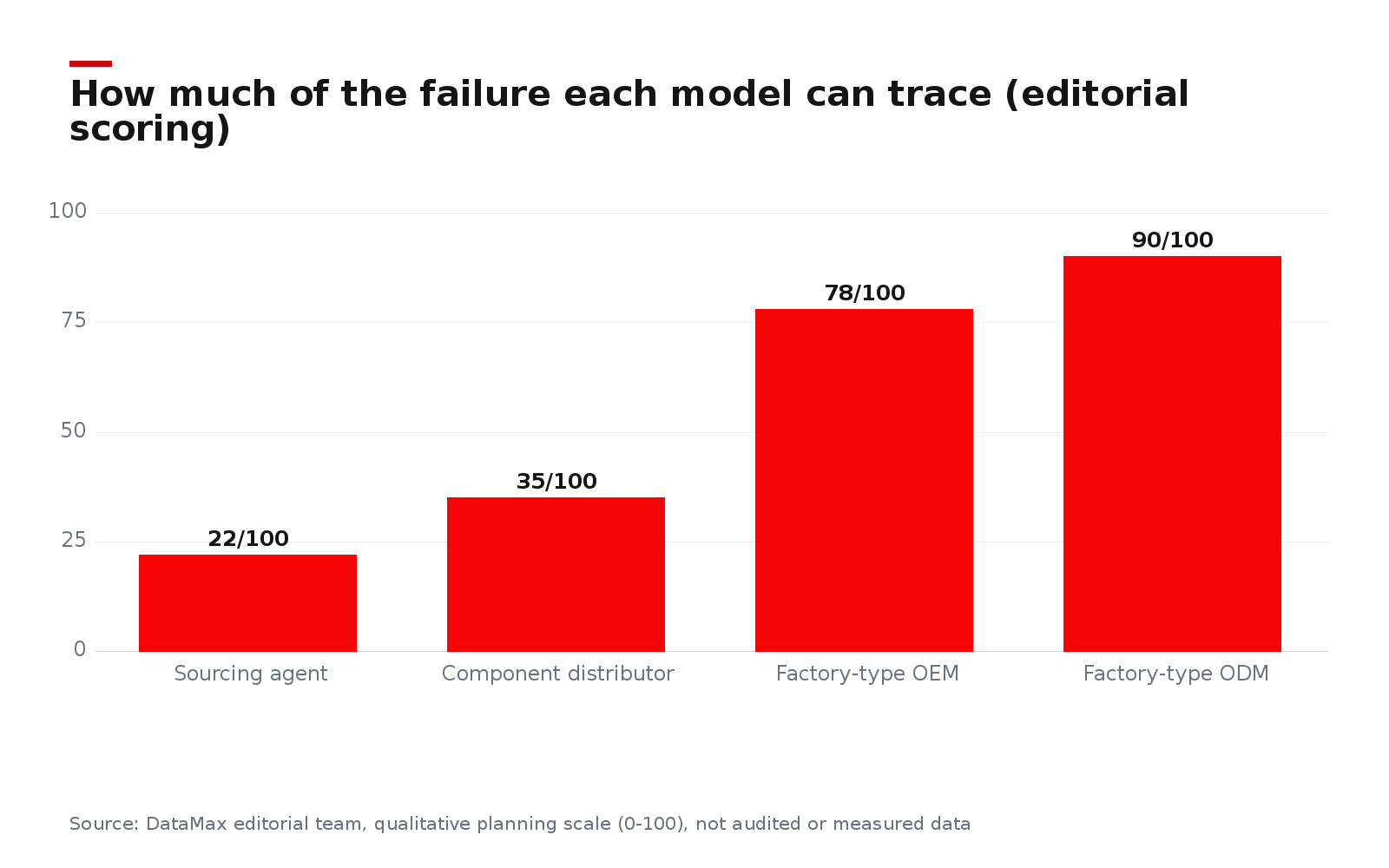
| Supply model | Editorial score |
|---|---|
| Sourcing agent | 22/100 |
| Component distributor | 35/100 |
| Factory-type OEM | 78/100 |
| Factory-type ODM | 90/100 |
The chart is a qualitative planning scale, not measured performance, and it must not be used as an audit score. Its procurement meaning is limited: the more control the operating model places over design, software and production, the more direct the traceability route may become. A factory-type OEM still requires site-specific validation; a factory-type ODM still requires contract clarity. For the evidence package, use the factory quality evidence route to request SMT, AOI and aging records before issuing the final purchase specification.
A complete evidence index should have 6 document classes: approved BOM, board and firmware revision, SMT and AOI results, functional and aging records, software-image manifest, and final shipment audit. For a 500-unit hotel order, the buyer can request 2 or 3 serialized sample records and define random lot access rather than demanding impractical document volume. For a pilot, every unit should map to a serial record because the sample population itself is small.
The manufacturer should also define the authority that can release an engineering change. If a Wi-Fi module, PMIC, display interface or cellular module changes, the evidence index should show whether the change received a new approval, whether firmware was updated and whether the golden sample was regenerated. Without change control, the quote and the factory record may remain valid while the delivered configuration no longer matches them.
Options placed side by side
The model decision should compare architecture and configuration, not a generic “premium” label. DM21P is the operator-middleware route; DM33H is the cellular route; DM21S is the Android 14 white-label route; DM21T is the premium decode route. Each can be valid, but the application and installed base determine which one is operationally coherent.
| Decision dimension | DM21P | DM33H | DM21S | DM21T |
|---|---|---|---|---|
| Primary role | 4K IPTV / operator middleware set-top box | Cellular 4G/5G TV dongle | 4K Android TV box for IPTV/OTT white-label | Premium UHD / cloud-gaming box |
| Android base | AOSP Android 11 | AOSP Android 14 | AOSP Android 14 | AOSP Android 14 |
| Compute profile | Amlogic S905Y4, quad Cortex-A35 | Allwinner H618, quad Cortex-A53 | Amlogic S905Y5, quad Cortex-A55 | Amlogic S905X5, quad Cortex-A510 (ARMv9) |
| Base memory | 2GB / 8GB | 2GB / 16GB | 2GB / 16GB | 4GB / 64GB |
| Network decision | RJ45 100M and Wi-Fi6 2x2 | SIM x1, 4G Quectel EG915N, 5G optional; no RJ45 | RJ45 100M, 1G optional; Wi-Fi6 2x2 | RJ45 100M, 1G opt; Wi-Fi6 |
| Content-security evidence needed | Widevine L1 / PlayReady / HDCP 2.2 optional | No Widevine row on datasheet | Widevine L1 / PlayReady optional; Dolby Vision/DTS | Widevine L1 / PlayReady optional |
| Physical/configuration watchpoint | HDMI 2.0b out x1; DC 5V/2A | 70x70x17mm; catalogue and PDP ports differ materially | 2x USB2.0 and other ports | HDMI 2.0b out with no HDMI input; USB3.0 x1 |
A lower-complexity IPTV program may justify DM21P when Ethernet, operator middleware and 4K service requirements dominate. A white-label hotel program may justify DM21S because its AOSP Android 14 base and 2GB/16GB starting point align with that application profile. A no-Wi-Fi hospitality location may justify DM33H only after the cellular module, SIM and antenna are frozen. A premium suite may justify DM21T where 4K120, USB3.0 and higher decoding capability are mandatory rather than aspirational.
The commercial comparison must use identical acceptance criteria. A cheaper quotation based on 2GB/8GB does not beat a 2GB/16GB configuration if the image, middleware, storage endurance or update process differs. A 5G option is not comparable with an included 5G configuration until the module and antenna are specified. A wider port list is not a quality metric unless every included port is tested and the installer’s workflow is mapped.
The operating model changes the comparison. A sourcing agent may arrange components, but the buyer may have less direct access to the production line and software image. A component distributor can provide a platform but may not own the complete customer build. A factory-type OEM or factory-type ODM can shorten the traceability route, yet each still needs contract-level definition of firmware, change control and acceptance. The editorial chart above informs planning only; it cannot replace an audit of the actual manufacturer.
For an estate with both ordinary rooms and premium suites, split the RFQ into 2 acceptance lots. The ordinary-room lot can use the model that matches operator middleware and Ethernet. The premium-suite lot can use the model that matches the required decode, refresh-rate and peripheral profile. A single model does not have to serve every room, provided the manufacturer documents the partition and maintains separate configuration control.
Definitions a buyer cannot outsource
A hospitality television requirement is a controlled operating specification, not a synonym for “Android box.” It includes the physical terminal, installed software, service connectivity, content entitlement, site integration, update policy and evidence that a production unit matches the approved sample.
Operator middleware is the software layer that integrates the terminal with the operator’s service, identity, entitlement, channel, guide and device-management systems. It must be named by version and owner. AOSP Android 11 on DM21P identifies the base OS but does not confirm a particular middleware release.
DRM is a content-protection mechanism, while HDCP protects the video output path. Widevine L1 and PlayReady support require the correct device and service configuration. HDCP 2.2 optional requires confirmation of the fitted production option. Dolby Vision and DTS on DM21S involve both hardware-path and commercial/content requirements. A compliance statement without an acceptance test is not sufficient evidence.
IPv4/IPv6, VPN and captive-port behavior belong to the network acceptance test. Wi-Fi6 2x2, Wi-Fi6 2T2R and cellular generation describe different radio and connectivity paths; they do not replace the site’s SSID, SIM, antenna, proxy, DNS and service-enrollment procedures. Ethernet speed is also a port statement, not proof that the operator middleware supports or uses that speed.
AOSP Android is the base software source used for the platform, not the complete customer image. The buyer must also define launcher, middleware, applications, accounts, update channel, bootloader state, branding, language, time zone and support escalation.
Compliance must be separated by market and mechanism. Ask the manufacturer for the exact Saudi documentation, test reports, certificate scope, responsible party, model linkage and validity status. Also confirm local electrical, radio and content requirements with the relevant authorities or qualified compliance partners. DataMax’s certification and compliance pages can provide the appropriate starting point for document review.
A complete Saudi hospitality RFQ therefore names the product role, freezes the SKU, defines the site and service boundaries, sets measurable acceptance tests and requires traceable production evidence. That package gives procurement, engineering and operations one shared definition of “approved.”
The term operator-grade should be reserved for evidence rather than used as a marketing label. It can mean the unit supports a named operator middleware, survives the defined workload, logs the required events and can be recovered through the operator’s process. It can also mean the manufacturer controls firmware release, serial traceability and change notification. Each of those capabilities needs a document or test method.
Likewise, a manufacturer claiming certification does not transfer responsibility to the buyer. The approval document must identify the legal manufacturer, model, radio configuration, power input and market scope. If the quote uses an optional cellular module, ask whether the cited document covers that exact module and antenna arrangement. Where the production facts do not provide that linkage, the buyer must obtain it from the responsible manufacturer before deployment.
Further reading
- Guide tv box vendor selection checklist
- TV box vendor selection checklist
- AOSP vs GMS solution notes
- Telecom and pay-TV operator solutions
- Allwinner Android TV boxes
- DataMax DM21P specifications and fit
- DataMax DM33H specifications and fit
FAQ
What is the first document to request from a hospitality TV manufacturer?
Request a frozen SKU specification that names the model, SoC, Android version, RAM/ROM, populated options, ports, power input, firmware branch, country image and regulatory scope. Add a configuration-control statement identifying which changes require approval. This establishes a common reference for sample approval, production testing and shipment inspection.
Which model fits a Saudi hotel room with no reliable Wi-Fi?
DM33H is the DataMax candidate whose stated fit includes cellular 4G/5G TV dongle, RV and hospitality use without Wi-Fi. It includes SIM x1, a 4G Quectel EG915N module, 5G optional, Wi-Fi6 2T2R and no RJ45. Coverage, antenna, SIM provisioning and the exact 5G configuration require site and production validation.
Does Widevine L1 in a quotation prove the content service will work?
No. It identifies a DRM capability, but the deployed device image, licence-server policy, output path and protected-content test must also be correct. HDCP 2.2 optional is not proof that every unit includes the option. Require the manufacturer to demonstrate the exact approved hardware and software configuration on an acceptance sample.
Should one hospitality TV model cover every room type?
Not necessarily. An operator-middleware room, cellular-only location, branded OTT room and premium gaming suite have different requirements. The buyer can divide the estate into configuration-controlled lots, provided each lot names its model, service, network path, acceptance tests and production evidence. This avoids forcing an unverified premium specification onto ordinary rooms.
How can a buyer verify factory evidence before shipment?
Request an indexed package linking SMT/AOI results, functional tests, aging, dark-room inspection, software-image manifests, labels and regulatory documents to the production lot and serial number. A video factory audit can compare the documented process with the active line. The manufacturer should also identify change-control and shipment-release authority.
What should be confirmed against the production datasheet?
Confirm the selected RAM/ROM population, optional Ethernet and 1G status, cellular module, antenna arrangement, ports, mechanical dimensions, included power and connectivity, DRM implementation, Saudi document scope and customer-image revision. The cited PDP facts are a selection aid, not a substitute for the frozen production datasheet and acceptance package.


