

Why commercial WiFi projector selection differs from home buying
A WiFi projector combines 4 subsystems that must be qualified as one installed product: an optical engine, a display platform, a network control plane, and a mechanical enclosure. A home buying guide normally evaluates visible brightness, advertised resolution, app access and convenience. An installed project must instead qualify usable light on the designated surface, screen geometry, sustained thermal performance, network isolation, content security, recovery after power loss, service access and fleet maintenance.
The project team should identify 7 non-negotiable constraints before comparing models: room illuminance, screen dimensions, throw distance, content rights, operating hours, central-management policy and acoustic limit. A model meeting 1,000 advertised lumens can still fail if only 700 lumens reach a 120-inch matte-white surface after alignment and input losses. Conversely, an ultra-short-throw model with lower nominal output can be correct where ceiling area, cabling or furniture prevents a long-throw installation.
- Installed-use baseline: validate light, contrast, focus stability, input latency, reboot behavior and service procedures at every designated screen.
- Fleet baseline: validate OTA enrollment, captive-portal handling, certificate deployment, device identity, telemetry, rollback and head-office ownership.
- Content baseline: validate Google TV certification where applicable, Widevine security level, HDCP path, application packaging and commercial-use terms.
- Mechanical baseline: validate dimensions, ventilation, noise at the operator position, ceiling bracket load and cable routing.
- Commercial baseline: define sample approval, AQL, PCN process, accessory supply, warranty RMA and spare-unit ratios.
| Home-guide variable | Installed-project requirement | Procurement evidence |
|---|---|---|
| Maximum or nominal brightness | Measured usable lumens at the required picture mode and operating temperature | Photometer report with screen size, color mode and test duration |
| Wireless casting | Managed SSID, VLAN, proxy or certificate enrollment and repeatable casting procedure | Network test log and operator runbook |
| “4K projector” | Native panel resolution plus supported input and decode modes | EDID and source-device test matrix |
| Wall mount included | Site-specific bracket, load rating, service clearance and anti-fall provision | Installation drawing and structural sign-off |
| Warranty | Failure codes, RMA SLA, advance replacement and version support period | Warranty matrix signed by supplier |
How a WiFi projector works from source to screen
The projector first recovers video pixels from an HDMI source or a wireless-cast session, decodes them in its SoC, scales them to the active display raster, drives the light engine and projects the image through a lens or folded optical path. Wireless transport changes the source connection, not the optical principle. Miracast, AirPlay or Chromecast-class operation introduces dependence on WiFi quality, client operating-system policy, graphics output and, for protected streaming, DRM licensing.
In a managed commercial deployment, use a wired control and AV backbone even when user casting is wireless. The access network should place projectors on dedicated SSIDs or VLANs, apply access-control lists, use 802.1X where available, and expose only the DNS, NTP, licensing, application and management endpoints required. A common segmentation model separates guest casting, device management, content delivery, building operations and corporate users.
- The source negotiates a display mode over HDMI or joins a managed wireless session through a documented casting service.
- The projector receives RGB, YCbCr or compressed video and validates the active-frame timing against its scaler and panel limits.
- The platform separates display transport from service access: HDMI input remains available even if the management VLAN is unavailable.
- The SoC decodes or receives frames, applies scaling, keystone correction, color processing and frame output.
- The optical engine converts the electronic image into a 30-200-inch projected image whose real brightness depends on operating mode and ambient light.
- The fleet controller updates firmware or applications, monitors health, records faults and preserves a tested rollback package.
The architecture should separate 4 paths: AV input, wireless casting, device management, and power/control. Failure of one path must not disable local display, service access or safe shutdown. IP-based control should use documented APIs or protocols rather than screen-scraped UI automation.
| Layer | Representative components | Failure mode | Design control |
|---|---|---|---|
| Presentation source | Room PC, BYOD laptop, encoder, media player, casting gateway | No EDID, unsupported HDR or source sleep | Permanent HDMI input plus controlled wireless fallback |
| AV transport | HDMI, display port converter, audio return | Black screen after hot-plug | EDID override and 24-hour hot-plug test |
| Platform | Google TV, AOSP build, application container | DRM, app or service failure | Version pinning and upgrade authorization |
| Network | SSID, VLAN, DHCP, DNS, proxy, certificates | Discovery failure after guest login | Network acceptance test |
| Management | MDM, vendor console, telemetry, logging | Unapproved update or lost device identity | Signed release and rollback policy |
| Mechanical | Optical engine, fan, heatsink, bracket, dust filter | Thermal throttle or shutdown | Temperature logging and service clearances |
Optical and measurement fundamentals for procurement
ANSI lumens quantify luminous output under a defined projector measurement procedure rather than arbitrary “LED brightness.” Procurement evidence should identify the test standard or method used, measurement configuration and whether the value is typical, minimum or peak. It should not combine projector output with a screen gain or ambient-light allowance. For engineering selection, calculate the required lumens on screen before comparing devices.
A first-pass screen requirement is:
L_screen = (S × E_screen × F) ÷ (683 × G × R)
where S is screen area in square metres, E_screen is target illuminance in lux, F is the maintenance factor, G is screen gain, and R is optical efficiency including throw, alignment, lens and operating-mode effects. This simplified screening model must be replaced by a photometric simulation for procurement of large or high-ambient installations.
| Parameter | Definition | Procurement treatment |
|---|---|---|
| ANSI lumens | Light output measured under defined test conditions | Request test method, mode, sample count and uncertainty |
| Native resolution | Active pixels produced by the display panel or imager | Separate from input or decode resolution |
| Contrast ratio | Ratio of measured luminance between specified white and black states | State ANSI/FOFO or manufacturer test method and room conditions |
| Throw ratio | Projection distance divided by image width | Use for geometry and installation, not brightness alone |
| Keystone correction | Digital geometry correction applied to the raster | Quantify resolution and brightness loss |
| Focus | Sharpness over the active image plane | Measure center and corners after thermal stabilization |
| Light-source life | Time or operating condition until output or color reaches a specified endpoint | Require minimum, median and ambient-temperature definitions |
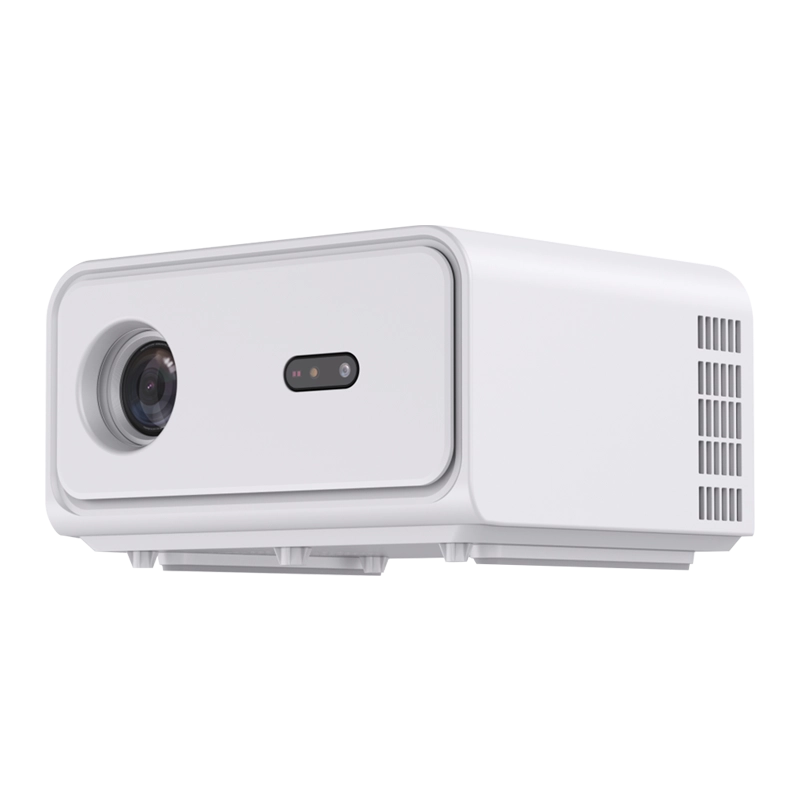
Throw distance follows D = R × W, where D is lens-to-image distance, R is throw ratio and W is image width. For a 1.2:1 projector and a 2.214 m-wide 100-inch 16:9 screen, nominal distance is 2.657 m before keystone or obstacle-avoidance offsets. For the GP8’s 0.24:1 ratio, the corresponding nominal distance is approximately 0.531 m. A UST model reduces depth but demands close placement, controlled wall flatness and a clean optical path.
Native resolution must not be conflated with decoding or marketing labels. A 1920×1080 native panel can accept higher-resolution signals, but those signals do not create additional native detail. Geometry correction reduces effective pixel density; acceptance tests should therefore capture native and operating-mode screenshots rather than relying only on the source menu.

DataMax WiFi projector comparison from supplied production data
The following comparison uses only the supplied DataMax records. Where a record omits a field, “not supplied” is intentional. It must not be interpreted as unsupported. Two items require explicit confirmation: GP8 is titled “400 ANSI Lumens” while its display record states “450 ANSI lumens”; GP94C is titled “550 ANSI” while its display record states “500 ANSI lumens.” Confirm the current rating against the production datasheet before issuing an RFP, comparing samples or publishing installation criteria.
| Model | Platform | Native output | Optical geometry | Installation and controls | Key procurement note |
|---|---|---|---|---|---|
| GP8 | Amlogic T972; Android 9; 2 GB RAM; 32 GB ROM; dual-band WiFi 6; Bluetooth 5.0 | 1920×1080 WVGA; 400/450 ANSI conflict; contrast 1200:1 | 0.23-inch DMD; throw 0.24:1; 15-116 cm; 30-200 inches; LED | Front projection; auto focus; auto keystone; 89 W; 30 dB; AirPlay, Miracast and EShare | Contrast the title rating of 400 ANSI with 450 ANSI in the record; confirm production datasheet |
| Portable 1080P model, exact model number not supplied | Android 13; WiFi; Bluetooth 5.2; 230 ANSI in product title | 1080P in title; contrast, throw ratio, image size and light-source life not supplied | Not supplied | Not supplied | Do not award a technical compliance score without a controlled datasheet |
| 1080P WiFi projector, exact model number not supplied | Android 13; auto focus; auto keystone | 1080P in title; brightness and contrast not supplied | Not supplied | Not supplied | Confirm all optical and mechanical data against production datasheet |
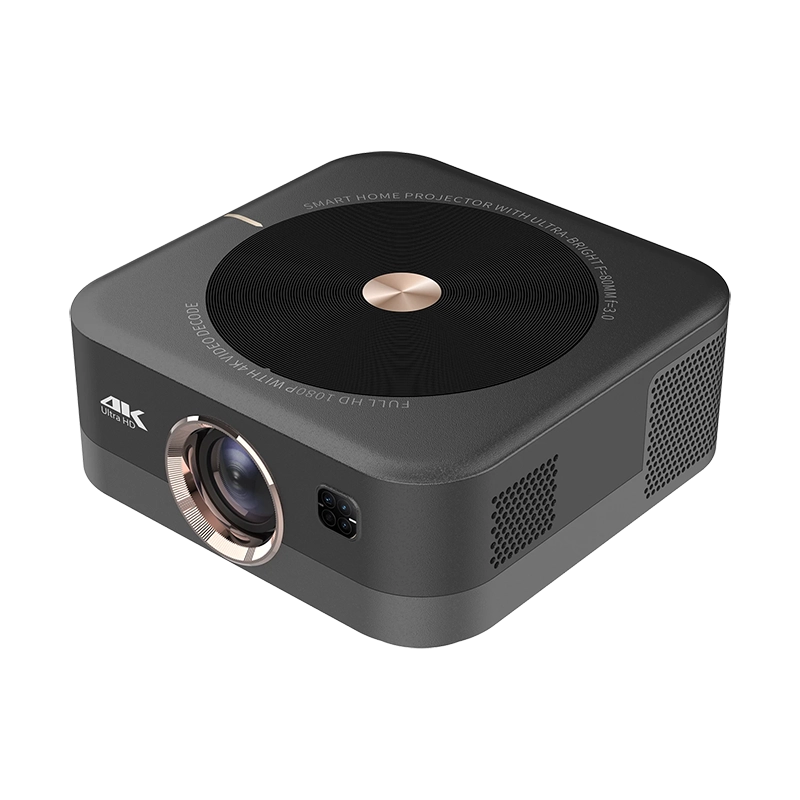
| GP96-GTV | Google TV 11 or 14; dongle Allwinner H137 / XuanTie C906 RISC-V with S805X2 or RTD1332; 1 GB DDR4; 8 GB eMMC; dual-band WiFi; Bluetooth 5.0 | 1000 ANSI; 1920×1080; contrast 1600:1; 4.45-inch LCD | Throw 1.2:1; 1.26-3.5 m stated; 80-120 inches; LED stated as 10,000-10,500 lumens | Front, rear or hang; auto focus; auto keystone; auto alignment; obstacle avoidance; 130 W; 32 dB | Clarify whether Google TV version is selectable or customer-specified; LED lumen figure requires manufacturer definition |
| GP94C | MTK9269; Android 9; 1 GB RAM; 32 GB ROM; dual-band WiFi 6; Bluetooth 5.1; 100M Ethernet | 1920×1080; 550/500 ANSI conflict; contrast 1500:1; 4.0-inch LCD | Throw 1.35:1; best distance 1.15-6 m; 29-150 inches; LED stated as 10,000-10,500 lumens | Front, rear or hang; auto focus; auto keystone; auto alignment; obstacle avoidance; 86 W; 32 dB | Confirm title rating of 550 ANSI against record of 500 ANSI; verify platform lifecycle and Ethernet use case |

Quantitative selection method and worked installation example
The selection sequence should proceed from screen physics to installation geometry, then platform and operations. Apply a margin for lamp or LED lumen depreciation, dirt accumulation, alignment and operating-mode variability. Record assumptions rather than accepting a catalog value as a guaranteed site result.
- Measure screen width, height, gain and surface condition.
- Measure or specify ambient light reaching the active image area.
- Set the acceptable on-screen illuminance for the content and viewing seats.
- Calculate required lumens with a maintenance factor, for example 0.80 for a controlled institutional environment; validate the factor against the supplier’s life curve and cleaning interval.
- Apply the optical model, then round upward to the nearest candidate that also satisfies throw, noise, thermal and software requirements.
| Worked parameter | Value | Engineering interpretation |
|---|---|---|
| Screen | 100-inch 16:9; 2.214 m × 1.245 m; area 2.756 m² | Nominal width sets throw distance |
| Ambient and target screen illuminance | 150 lux ambient; 180 lux on-screen target | Suitable only where dark or low-reflectance content is acceptable |
| Maintenance factor | 0.80 | Illustrative allowance; validate against lumen-depreciation data |
| Screen gain and assumed optical efficiency | 1.0 gain; R = 0.85 | Illustrative values only |
| Required on-screen lumens | (2.756 × 180 × 0.80) ÷ (683 × 1.0 × 0.85) = 855 lumens | Select from verified minimum output, not title value |
| Throw distance at 1.2:1 | 1.2 × 2.214 = 2.657 m | Keystone and obstacle avoidance can move the unit |
| Throw distance at 0.24:1 | 0.24 × 2.214 = 0.531 m | UST wall geometry and furniture clearance become critical |
| Candidate interpretation | GP96-GTV has 1000 ANSI lumens stated | Margin is approximately 17% over 855 lumens before additional site losses; a photometric validation remains mandatory |
This example is not a universal 100-inch rule. A classroom with 400-500 lux ambient may require a much larger output or a higher-gain screen, while a controlled cinema room may target 50-100 lux and use a dark screen. An RFQ should state target screen luminance, not only ANSI lumens.

Deployment profiles and operating risks
| Profile | Operating conditions | Mounting and connectivity | Management | Primary risks |
|---|---|---|---|---|
| Hotel and hospitality | Guests may cast within 2-5 minutes; dark rooms; service standards require rapid recovery | Conceal ceiling or rear mount; wired HDMI plus isolated guest SSID; consider GP94C 100M Ethernet where wireless casting is insufficient | PMS-linked control may require an approved API; remote power, telemetry and room-service reset | Captive portal blocks DRM, guest data exposure, audio pairing failure, false service call |
| Corporate | 8-12-hour meeting days; mixed Windows and BYOD sources; 150-300 lux room light may apply | Ceiling mount with service clearance; managed VLAN, 802.1X where supported, fixed HDMI and display adapter | Android Management or vendor endpoint tooling; inventory by serial number; staged updates by floor | EDID mismatch, source sleep, keystype reduction, meeting-room state divergence |
| Education | Long duty cycles, lower budgets per seat, teacher BYOD and fixed lesson content | Front projection for GP94C/GP96-GTV or GP8 UST where wall clearance permits; prioritize wired AV | MDM, staged classroom rings, signed OS images and application allow-lists | Vandalism, cable faults, unauthorized casting, thermal cycling, insufficient replacement stock |
| Retail and digital signage | 12-18 hours/day; high ambient or window reflections; content changes are scheduled | Ceiling mount; Ethernet preferred; isolate signage network from customer traffic | Fixed release train, remote reboot, telemetry, first-install image and health alarms | Screen burn or residue, ingress dust, unattended reboot, signage app compatibility |
| High ambient | Outdoor shade, retail daylight or glass meeting rooms; ambient may exceed 500 lux | High-output long-throw or system design, high-gain screen and local sun control; avoid assuming UST solves ambient light | Managed display with light sensor or scheduled preset control where supported | Contrast collapse, reflections, thermal load and incorrect lamp-mode planning |
Each profile has a distinct failure envelope. Hospitality prioritizes reset and content rights; corporate deployments prioritize interoperability and room control; education prioritizes abuse resistance and fleet cost; retail prioritizes unattended uptime; high-ambient installations prioritize contrast and thermal margin. These priorities should become weighted RFP criteria rather than informal preferences.
Google TV, AOSP, DRM and integration architecture
Google TV provides a managed consumer-style television platform when the exact product release, Google certification, EDLA status and application versions are identified. AOSP or an Android-based OEM image offers greater control over devices and applications but does not by itself provide Google Mobile Services, Google Play, Widevine level assurance or EDLA certification. Procurement language must require documentary certification and a named licensed distribution path.
| Requirement | Google TV / certified distribution | AOSP / Android-based OEM image | Acceptance evidence |
|---|---|---|---|
| Application access | Commercial Play policy or licensed applications | Customer APK, system image or preinstalled app store | Package list, hashes and licensing record |
| DRM | Device must meet the required Widevine security level; L1 generally supports HD protected paths, while L3 is hardware-backed at a lower-resolution path depending on platform implementation | Same principle; security level is not guaranteed by Android branding | DrmInfo module and stream playback report; see Widevine L1 vs L3 |
| HDCP | Determine whether the project requires HDCP 1.4 or 2.2/2.3 across source, display path and sink | Identical engineering requirement; operating system name is irrelevant | EDID, HDCP negotiation and protected-source test |
| Fleet control | Google-approved device management or vendor management subject to device policy | Android Management API, OEM MDM agent or vendor API | Enrollment, policy, update and rollback demonstration |
| OTA | Use approved release channels and rollback controls | Customer-controlled staging or vendor OTA service | Release manifest, signatures and recovery procedure |
Hospitality PMS integration should specify trigger, command, confirmation and timeout semantics: room check-in, welcome screen, service launch, volume limit, display wake, shutdown and do-not-disturb. CEC can provide limited power and source-control functions but is not a complete hotel-room management system. A documented API or approved IR/control gateway is preferable to undocumented menu sequences.
- Test local HDMI presentation with the guest network and internet unavailable.
- Test casting after the captive portal changes IP address or DHCP lease.
- Verify that management can recover a device without erasing licenses or user content.
- Record the device serial number, hardware revision, Android or Google TV version, build fingerprint and patch date.
- Require HDCP behavior, DRM security level and resolution output in the acceptance report.
- Measure network packet loss, association time and streaming stability at the installed location.
Mechanical, acoustic and thermal integration
The projector’s advertised noise specification requires a distance, weighting and operating mode. A 30 dB GP8 rating and a 32 dB GP96-GTV or GP94C rating cannot be compared meaningfully unless measured under the same conditions. Procurement should require an A-weighted sound-pressure level at the operator or nearest seat, plus fan-speed and picture-mode context.
At 89 W, GP8 electrical input is below the 86 W recorded for GP94C despite the lower listed figure, so power acceptance must be measured on the production hardware and configured variant. GP96-GTV is listed at 130 W. The 60 Hz difference between 130 W and 70 W equals 7.8 kWh over a 60-hour week and 3.12 kWh per 1,000 projector-hours when both devices operated at their stated consumption for 4,000 hours.
| Check | GP8 | GP96-GTV | GP94C | Acceptance procedure |
|---|---|---|---|---|
| Dimensions | 94 × 71 × 190 mm | 256 × 203 × 140 mm | 315 × 305 × 155 mm | Measure with bracket and cable bend radius |
| Product weight | 0.88 kg | 2.95 kg | 2.42 kg | Check bracket load and lift points |
| Power consumption | 89 W | 130 W | 86 W | Record at wall after 30-minute stabilization |
| Noise | 30 dB | 32 dB | 32 dB | A-weighted measurement at stated operator distance |
| Mounting | Front only in supplied record | Front, rear or hang | Front, rear or hang | Approve orientation and service clearance |
| Thermal | Not supplied | Not supplied | Not supplied | Log inlet and exhaust temperature for 8-hour duty cycle |
Do not seal intake or exhaust paths. A sealed enclosure does not permit continuous operating-hour extrapolation without evidence. For high-ambient or high-altitude installations, confirm the rated temperature range and any altitude derating; those values are not supplied in the product records.
Compliance, sealed optical engines and evidence files
Certification is a documentary control, not a model-name claim. Require the applicant, exact model number, hardware revision, destination market, laboratory report number, issue date, expiry or surveillance status and certificate scope. Applicable evidence may include CE/RED or local radio approval, FCC or equivalent, RoHS/REACH declarations, material and packaging records, IEC safety testing, energy requirements where applicable, Google EDLA/GMS certification for the precise licensed build, and customer-specific cyber documentation.
- Electrical safety: request IEC 62368-1 or the destination-market equivalent with model/variant traceability.
- EMC and radio: request the applicable EU RED or US FCC evidence for WiFi 6, Bluetooth and supplied accessories.
- Cyber and privacy: define update-signing keys, default credentials, TLS support, vulnerability-reporting channel and support life.
- Google ecosystem: request Google TV device certification and commercial licensing evidence; “Google TV” in a title alone is insufficient.
- Optical ingress: request GP96-GTV dust-free-design test scope, particulate test conditions, seal life and maintenance method.
- Materials: request supplier declarations and laboratory reports for RoHS, REACH and applicable packaging directives.
- Radio variants: map every antenna, module and enclosure change to a new regulatory assessment.
For commercial buying, a dust-free optical engine can reduce maintenance only if the seal remains effective through repeated thermal cycling, cleaning and service actions. Require evidence of ingress protection at the optical path and airflow path separately. IP rating applies to a defined enclosure condition; it does not prove internal optics remain uncontaminated over years.
Lifecycle, lumen depreciation and TCO structure
LED life claims must be normalized. GP94C and GP96-GTV both list LED life as “10,000-10,500 lumens,” a wording that describes output rather than hours. It cannot be used as a maintenance forecast. Require an L70-style definition, such as time until output declines to 70% of initial luminance under specified ambient temperature and duty cycle.
| TCO component | Calculation basis | Illustrative control | Evidence required |
|---|---|---|---|
| Energy | Average watts ÷ 1,000 × operating hours | 130 W × 4,000 h = 520 kWh | Wall-meter profile by picture mode |
| Cleaning | Technician visits per year × labor cost | For 100 units, 2 visits/year × 100 = 200 visits | Dust-load and cleaning interval report |
| Replacement | Installed base × predicted failure rate | At an illustrative 2% annual rate, 100 units imply 2 units/year | Field-failure data by hardware revision |
| Mounting | Initial bracket count + stocked replacements | 2 spare brackets per 100 installations | Bracket certification and revision control |
| Software | Engineering hours + device-management operations | Use 1 hour per site per release as a planning placeholder | Release frequency and rollback duration |
| Downtime | Failed units × hours × site disruption | 1 failure × 8 hours = 8 site-hours | RMA and advance-replacement SLA |
For a fleet of 100 GP96-GTV units operated 4,000 hours each, electrical use at the stated 130 W is 52,000 kWh: 130 ÷ 1,000 × 4,000 × 100. The same formula applied to GP94C at 86 W yields 34,400 kWh, a difference of 17,600 kWh. Actual energy varies with input voltage, brightness mode, audio, networking and standby, so validate with wall-meter data.
A spare-unit policy should be based on observed failure distributions and replacement lead time. For a remote 24-hour site, staged spares may be preferable to shipment-only replacement; for an office refresh, depot repair may be sufficient. Reserve an illustrative 2-5% fleet spares until field data is available, then update the ratio quarterly.
OEM/ODM commercial process and customization scope
An OEM/ODM program should convert an application into a controlled product configuration, not merely request a modified logo. Freeze the electrical, optical, mechanical, regulatory and software revisions before approval. Production acceptance sampling cannot authorize a safety-critical or regulatory divergence.
- Define the application profile, annual volume range, destination countries and required operating hours.
- Issue an RFQ with optical, interface, platform, compliance, RMA and evidence requirements.
- Compare samples under identical room, screen, source and network conditions.
- Complete engineering validation for mechanical fit, thermal stability, EDID, casting, audio, PMS, MDM and OTA.
- Approve a golden sample, production firmware, packaging, label, serial-number format and accessory set.
- Run pilot production with AQL inspection and retain failure samples for root-cause analysis.
- Release mass production under PCN control, incoming inspection and traceability.
- Review warranty, field-failure rate and end-of-life obligations by quarter.
| Customization area | Typical scope | Change impact | Control |
|---|---|---|---|
| Mechanical | Bracket, color, logo, port placement | Tooling, airflow, enclosure stress | Engineering change order and dimensional inspection |
| Hardware | Tuners, interfaces, memory, storage, power | EMC, thermal, certification, lifecycle | Revisioned BOM and PCN |
| Software | Boot image, apps, launcher, certificates, PMS API | Support cost and security | Signed image and release manifest |
| Networking | SSID, captive portal, MDM, VLAN assumptions | Interoperability | Customer network profile |
| Accessories | Remote, brackets, HDMI cable, power cord | Safety, shipping and spares | Accessory-specific approval |
Request an ISO 2859-1 AQL plan appropriate to the defect classification; do not accept “AQL 1.0” without critical, major and minor defect definitions and sampling lots. Require written advance notice for component, firmware, tooling, label and regulatory changes. The PCN response process should state review, qualification and field-action timing.
Warranty planning should define the RMA authorization code, fault-evidence requirement, turnaround, advance replacement, return freight, spare-unit pool, Android security support period and end-of-communication policy. No production claim should remain valid if the exact approved hardware revision cannot be sourced.
Weighted RFP scorecard and ordered decision tree
| Criterion | Weight | Scoring basis | Mandatory evidence |
|---|---|---|---|
| Optical performance and geometry | 25% | Photometric and image-quality performance under equal conditions | Report, sample and 4-hour thermal run |
| Installation integration | 15% | Fit, focus, keystone, EDID, audio and service access | Drawing and site test |
| Platform, DRM and security | 15% | Required Google TV or AOSP functions and update controls | Certification, DrmInfo and policy demo |
| Fleet operations | 15% | Enrollment, OTA, rollback, telemetry and recovery | MDM/API test and release manifest |
| Compliance and lifecycle | 10% | Traceable reports, security support and end-of-life plan | Certificate index and lifecycle letter |
| Quality and support | 10% | AQL control, PCN process, spares, RMA and traceability | Quality agreement and support SLA |
| Commercial compliance | 10% | Completeness of configuration, warranty and evidence obligations | Signed response matrix; no price-led exception |
Score each criterion from 1 to 5 and apply weighted score = rating × weight. A mandatory compliance or safety failure should override the numerical total rather than be traded against convenience features.
- Reject any model without traceable safety, EMC/radio and destination-market evidence.
- Reject any model that cannot meet the measured screen illuminance or physical throw envelope.
- Reject any platform build that cannot deliver required DRM, content licensing or MDM functions.
- Reject any model that fails 8-hour thermal, hot-plug, network and recovery testing.
- Rank the remaining candidates by weighted score.
- Run a limited pilot across each critical room type before framework approval.

Site acceptance and commissioning tests
| Test | Procedure | Pass criterion | Record |
|---|---|---|---|
| Identity and inventory | Photograph serial label; import model, hardware revision and firmware | Matches approved production configuration | Asset register and image |
| On-screen output | Measure center and four edge points after 30-minute stabilization | Meets photometric model and uniformity tolerance | Lux, distance and screen reading |
| Geometry | Display grid, inspect edges and corners | No clipping; distortion within drawing tolerance | Reference photo and measurements |
| Focus and keystone | Run text grid through intended casting and HDMI paths | Legible at defined seats; no unacceptable resolution loss | Text-grid screenshot |
| EDID and hot-plug | Cycle source 20 times; change resolution and audio | All cycles recover without service visit | Pass/fail count |
| DRM and HDCP | Play protected test streams and repeat after reboot | Required resolution, audio and output path are stable | License and stream result |
| Network and casting | Test pre- and post-captive-portal state | Casting completes within site-defined time | Logs and measured association time |
| Thermal | Operate 8 hours at intended brightness | No shutdown, unacceptable drift or blocked airflow | Hourly temperature and mode log |
| Management | Enroll, apply policy, update, rollback and reboot | All actions complete and recover | Console audit trail |
| Power recovery | Interrupt and restore AC input 5 times | Auto recovery and approved startup state | Event log |
Acceptance should use the production firmware, final bracket, final remote, actual screen and intended client platform. A laboratory demonstration using an engineering image or temporary WiFi adapter does not satisfy site acceptance.
Troubleshooting matrix for installed WiFi projectors
| Symptom | Likely checks | Diagnostic action | Corrective action |
|---|---|---|---|
| No wireless discovery | SSID, VLAN, DHCP, client isolation, proxy, guest portal | Capture association log from access controller | Correct network policy; do not bypass segmentation |
| Discovery works but protected video fails | DNS, time, DRM certificate, Widevine level and app version | Run DrmInfo and a controlled stream test | Install authorized build or correct licensing configuration |
| HDMI image intermittently absent | EDID, cable, source sleep and hot-plug timing | Repeat 20-cycle test with known-good cable | Lock EDID, replace cable or update source profile |
| Image is trapezoidal or soft | Lens-to-screen distance, keystone, focus and screen flatness | Measure D = R × W and inspect grid | Reposition, refocus or replace bracket; verify loss from correction |
| Output falls during use | Brightness mode, temperature, airflow obstruction and auto dimming | Log optical output and temperature over 8 hours | Clear airflow and validate thermal settings |
| Casting has repeated stalls | RSSI, channel congestion, multicast suppression and source power save | Measure packet loss at the installed AP | Add coverage, change channel plan or use wired input |
| Audio returns to the wrong device | Bluetooth pairing, HDMI ARC, PCM support and default route | Test each audio endpoint after cold boot | Apply controlled pairing policy or wired audio route |
| Device absent from MDM | Identity, date/time, certificates and enrollment token | Inspect serial binding and agent logs | Re-enroll from an approved factory or service workflow |
| OTA failure leaves unstable image | Power, storage, package signature and rollback partition | Inspect update journal and available recovery partition | Execute approved rollback and quarantine the failed version |
Deployment rollout and maintenance controls
A controlled rollout reduces fleet variance. Stage one unit per room type, then expand by building or floor rather than the entire estate. Store approved images, EDID profiles, captive-portal configuration, casting instructions and recovery credentials in the customer change-management system.
- Freeze hardware, software, screen, bracket and remote-control revisions before pilot approval.
- Run a 5% or statistically justified sample of each repeated installation type; increase sampling for first production lot.
- Track failure codes by model, hardware revision, firmware, room type, supplier lot and operating hours.
- Ship spare brackets, remotes and power cords under the same revision-control process as finished units.
- Retain 2-5% deployable spares initially for remote sites, then adjust using measured RMA data.
- Stage OTA updates to 1-5% pilot devices, then 10%, 50% and 100% only after defined observation periods.
- Keep a signed rollback image and a written recovery procedure for every application platform.

Eight expert questions
Does “WiFi projector” mean every function is wireless?
No. WiFi normally covers casting, management or streaming, while power, video and audio may still use HDMI, USB, Ethernet or analog connections. Installed systems should preserve a wired fallback and test local playback when internet access fails.
Are ANSI lumens enough to select a commercial projector?
No. ANSI lumens are a controlled output measurement, not delivered screen illuminance. Purchase acceptance should also use screen area, ambient light, screen gain, maintenance factor, alignment and operating mode. The ANSI lumens selection guide provides a separate sizing framework.
Does 4K input or decoding make a 1080p projector native 4K?
No. Native resolution is the physical active raster of the display panel or imager. A 1920×1080 projector can decode a 4K signal, but it cannot add native detail. State native resolution, maximum input timing and decode capability as 3 separate fields.
When is a 0.24:1 ultra-short-throw projector preferable?
A 0.24:1 UST model can reduce lens-to-screen distance and eliminate ceiling space above a display, but requires close wall placement, a flat surface, obstacle clearance and careful service access. GP8 states 30-200 inches and 15-116 cm projection distance; confirm actual geometry for each screen before approval.
Does Android 13 or Google TV automatically support commercial streaming?
No. Application availability, licensing, account management, DRM security level, HDCP path and system-update policy are separate requirements. Android 13 does not automatically provide Google Play or Widevine L1, and “Google TV” in a product title must be supported by model-specific certification evidence.
Can Miracast or AirPlay be placed on a corporate network?
Yes, with deliberate policy. Many wireless-display services rely on discovery, multicast or local network access that default client isolation can block. Test Miracast, AirPlay or the specified service through the actual SSID, captive portal and VLAN architecture; do not assume consumer-device behavior is enterprise-ready.
Does automatic keystone eliminate installation alignment?
No. Auto keystone corrects geometry digitally but can reduce effective resolution, introduce resampling and consume processing capacity. Auto focus and obstacle avoidance also move the optical path and can change throw distance. Acceptance should measure installed corners, edges and text at the operator seat.
What evidence should a projector OEM provide for a fleet award?
Require the exact model and hardware revision, safety and radio reports, Google certification where claimed, DRM and HDCP results, optical measurements, thermal and noise records, EDID profile, Android build fingerprint, OTA and MDM demonstration, AQL plan, PCN process, warranty matrix and spare-parts revision status. Generic certificates without model traceability are not sufficient.
Engineering consultation and RFQ preparation
For a project-level RFQ, provide room dimensions, screen gain, measured ambient light, mounting constraints, source-device list, content rights, network architecture, management platform, operating hours, destination markets and required certifications. An engineering review can then map each requirement to a model, optical calculation, test method, evidence item and deployment risk without relying on consumer-style feature claims.




