

The short answer first
An RFQ lands on the procurement desk with three “4K Android TV” lines, a 2 GB memory request, and the instruction to quote one factory. The quotation then changes after the product page, because “manufacturer” can mean a component reseller, a box assembler, an OEM, or an ODM that owns firmware, middleware, certification, and lifecycle control. The correct answer to android tv box manufacturer selection is therefore not the lowest unit price; it is the operating model with the clearest ownership boundary and evidence trail.
Use the following map. A sourcing agent is useful for market access but owns little of the hardware or software failure path. A component distributor adds channel flexibility without controlling board design as a complete product. A factory-type OEM builds to a buyer-controlled specification and remains responsible for manufacturing conformity. A factory-type ODM adds design, firmware, software integration, certification, and production coordination under one engineering contract. For volume IPTV, OTT, operator, and AV programs, factory-type ODM usually provides the shortest route from generic hardware to a controlled deployment, provided the contract defines who owns source files, device keys, middleware integration, and defect handling.
For an orientation to the broader market, see the canonical guide to android tv box manufacturer. This page addresses only the ownership map: who designs, who configures, who certifies, who tests, and who remains accountable after shipment.
The practical distinction can be tested with one question: if a shipped unit boots into the wrong launcher, receives an expired certificate, or cannot activate an operator entitlement, which party must reproduce the failure and own the corrective action? A source-based hardware quotation may not answer that question. A factory-type ODM can, provided the acceptance matrix and change-control process are written into the statement of work rather than implied by the word “private label.” The same discipline applies to sample requests: ask for a configuration identifier, not an unqualified model name, because optional storage, Ethernet, DRM, and output arrangements can otherwise create four non-equivalent samples under one line item.
For a volume programme, the buyer should also separate three dates: sample approval, production release, and field-service handover. A factory that supplies engineering samples but does not define how deviations transfer to production has not completed the handoff. The ownership map becomes commercially useful only when each date has an approved artefact, named owner, and rejection criterion.
Buyer situations, ranked by what they punish
Buyer context changes the acceptance test. An operator may punish failed service activation or unstable firmware updates more than a modest bill-of-materials difference. An integrator may punish missing AV outputs or an undocumented remote-control workflow. A venue operator may punish device-management failures across thousands of screens. A distributor may punish unstable lead times and an inability to protect a private label. These situations should be converted into explicit RFQ lines before any model is proposed.
| Situation | Requirement | Model direction |
|---|---|---|
| Pay-TV or IPTV operator | Operator middleware, activation path, deterministic updates, Widevine L1 where required | DM21P for 4K IPTV / operator middleware set-top box; demand middleware and DRM evidence |
| Streaming or OTT white-label program | Current AOSP baseline, branded launcher, Widevine L1 / PlayReady options | DM21S for 4K Android TV box for IPTV/OTT white-label |
| Premium UHD or cloud-gaming program | Higher decode capability, 4 GB / 64 GB memory family, premium connectivity | DM21T for Premium UHD / cloud-gaming box |
| Gaming-oriented retail or hospitality deployment | 4K@60 decoding, 4 GB / 64 GB, gaming software and input requirements | DM22Q for Gaming-oriented Android TV box |
| AV integrator or digital-signage rollout | HDMI, AV, audio, USB, network, mounting, fleet-management responsibilities | Choose by I/O and operating responsibility; confirm the production datasheet |
The photograph shows the production environment behind these decisions: components on feeder reels move through an SMT line, are placed onto black printed circuit boards, and proceed through inspection and test.

The procurement mistake is to let the buyer situation remain an adjective. “Operator grade” does not define update rollback, middleware ownership, device serialisation, or evidence retention. “Gaming” does not define accepted frame presentation, input latency, thermal limits, or app certification. “White label” does not settle whether the customer can modify the launcher, sign the platform build, or manage keys. Each row in the matrix must become a measurable specification.
A practical way to rank opportunities is to score the cost of failure rather than the appeal of the feature list. For an operator, an activation failure can interrupt service delivery and create field-return handling across an entire batch. For a signage integrator, an unstable update can require physical access to screens in retail or hospitality locations. For a distributor, an uncontrolled launcher or exposed operator identity can undermine the private-label proposition even when the hardware boots correctly. These consequences determine which evidence the buyer should demand before commercial negotiation reaches a final stage.
The matrix should also include the route to market. A retail SKU distributed through a reseller usually needs catalogue stability, packaging control, and a repeatable channel-facing configuration. A directly operated IPTV programme may need device identity, entitlement, middleware, and update integration that never appear on a distributor quotation. A project-based AV deployment may prioritise HDMI, audio, USB, and recovery behaviour over broad consumer media compatibility. The DataMax L1 models are platform directions, not substitutes for these workload decisions.
One further distinction matters to procurement: a platform fit does not prove a complete programme. DM21P being directed toward operator middleware identifies the intended use, but middleware version, provisioning interface, device-key process, and production signing remain to be confirmed against the production datasheet and programme documentation. The same rule applies to white-label software, gaming applications, and fleet-management functions.
A decision path for the RFQ
Start with deployment ownership, not the SoC. The RFQ should identify the operating organisation, sales channel, intended software distribution method, and party responsible for device provisioning. Next, define the commercial model: catalogue resale, operator middleware integration, private-label launcher, or a fully specified ODM programme. Only after those boundaries are clear should the buyer request a platform proposal.
- Write the ownership sentence State who owns industrial design, mechanical files, mainboard design, bootloader, Android build, middleware, applications, signing keys, device identities, cloud services, certification, and production test.
- Freeze the workload Specify codec profile, HDR or SDR operating mode, output frame rate, network topology, application delivery method, DRM model, and the expected update cadence.
- Freeze the physical boundary List every required port, supported resolution, audio route, wireless standard, power input, storage need, remote-control method, and mechanical accessory.
- Set the evidence contract Require build records, SMT and AOI records, functional-test results, aging records, sample identification, certification references, and traceability to the shipped serial range.
- Compare models against lines Map each candidate to the RFQ without inferring an unstated option or treating an optional feature as standard.
Concrete RFQ language should resemble this: “Provide one 4K IPTV platform with AOSP Android 11, 2 GB / 8 GB memory, AV1 [email protected], VP9/H.265 4K@60 and H.264 4K@30 decoding, Widevine L1 / PlayReady and HDCP 2.2 options, then identify every option against the production datasheet.” That wording prevents “4K Android TV box” from masking four different meanings of 4K.
A second RFQ line should state the failure-ownership path: “Identify the party that resolves a failed unit, an update regression, a certificate mismatch, and a component substitution.” A third should require traceability from the engineering sample to the production batch. DataMax can provide an OEM/ODM inquiry against these lines, but the buyer must confirm the final configuration against the production datasheet.
Do not compress the requirement set into a single attachment with no priority. A 200-page specification that does not identify mandatory, optional, or prohibited features creates commercial ambiguity. Split it into four controlled schedules: baseline hardware, software and middleware, market compliance, and acceptance evidence. Each schedule should carry revision dates and an owner on both sides. This structure allows the quote to distinguish a production-standard configuration from a development option without changing the SKU reference after technical clarification.
The sample stage should then test the same configuration intended for production. If the sample uses 64 GB storage, optional 1G Ethernet, a particular DRM option, and a specific Android build, the approval record must name all four. Otherwise, a successful sample can prove a branch that is not the branch being mass-produced. For an android tv box manufacturer review, the procurement question is not merely “does the sample work?” but “which exact configuration worked, under which firmware, against which test plan, and how will that configuration be held during volume production?”
A final RFQ gate should define the consequences of non-conformity. State the quarantine location, defect-code taxonomy, rework authority, retest scope, root-cause reporting period, and replacement rule for confirmed manufacturing defects. These clauses convert the selected operating model into enforceable accountability rather than a label on a quotation.
The traps in this category
The first trap is confusing a hardware supplier with a product owner. A quotation may exclude bootloader unlocking, signing credentials, source-code delivery, middleware adaptation, regulatory work, application certification, or field failure analysis. The unit price can therefore look complete while the launch scope is distributed across 4 parties.
Field trap
A “4K” line may refer to display output, video decode, upscaling, or a marketing label. Require the exact mode: resolution, frame rate, colour format, codec profile, and output path. For example, a platform that decodes 4K@120 still has a stated HDMI 2.0b output configuration; do not infer HDMI 2.1 bandwidth from a decode capability.
The second trap is treating optional DRM, network speeds, or storage variants as the default. An RFQ that says “L1, 1G, 64 GB” without specifying whether each is mandatory or optional produces a comparison without a common baseline. The correction is a configuration ID attached to every quotation line, firmware build, sample, and production shipment.
Field trap
Do not accept a security claim without separating hardware-backed DRM, platform certification, licence-service configuration, and application-level entitlement. Widevine L1, PlayReady, HDCP, operator middleware, and a production device-issuance process are separate controls with different evidence.
A third trap is deferring connectivity and thermal requirements until deployment. RJ45 100M may be a suitable declared baseline for one service, while a 1G option changes the RFQ; Wi-Fi6 2x2 and BT5.4 must be stated as a pair rather than as “wireless”. The cost of a late change is not only component procurement: it can invalidate tooling, certification, packaging, test scripts, and the approved golden sample.
A fourth trap is accepting a broad feature list without a common baseline. One quotation may include 4 GB / 16 GB, another 2 GB / 16 GB, and a third 4 GB / 64 GB; their apparent prices are not comparable because the storage and memory assumptions differ. The same problem occurs when one bid includes an optional Ethernet speed and another treats it as standard. Require a configuration sheet showing standard, optional, excluded, and proposed items before comparing commercial terms.
A fifth trap is assuming that “factory” means the supplier controls every upstream dependency. An assembler can build to a customer design while buying the mainboard, display interface, power subsystem, or wireless module from another source. If the factory cannot explain incoming inspection, approved-vendor controls, and component-substitution approval, the buyer has added an invisible interface to the programme. This is especially risky when a service-centre replacement unit must match an already deployed board revision.
A sixth trap is using the sample approval to freeze commercial requirements while leaving the firmware boundary open. If the ODM can change the launcher, boot image, update channel, device provisioning, or approved application set after approval without written consent, the sample no longer represents the product. Attach the approved software manifest and bootloader or image identifier to the golden-sample record.
Verification you can ask for on paper
Factory capability should be verified as an evidence chain, not as a tour. Start at incoming inspection and component traceability, continue through SMT, AOI, assembly, firmware flashing, functional test, and end with serial-number mapping to the packed unit. Each stage needs a record that identifies the batch, process, result, operator or equipment, and disposition of failures.
- Incoming inspection Request component lot traceability, inspection criteria, sample plan, and treatment of substitutions.
- SMT and AOI Ask for stencil and placement records, AOI results, defect thresholds, repair limits, and first-article approval evidence.
- Assembly and firmware loading Require the build identifier, flashing method, boot-result record, and a rule preventing an unapproved image from entering the line.
- Functional and dark-room testing Define the tested ports, video modes, network functions, remote-control actions, boot result, display output, and audio checks.
- Aging and audit trail Request the aging duration, thermal or cycling method, failure log, approved deviation process, and link from final serial number to shipment batch.
A useful audit request contains 5 concrete artefacts: the current production flow diagram, SMT/AOI inspection record, firmware-loading log, functional or dark-room test report, and serial-range traceability sample. These artefacts should cover the same unit revision. A mismatched board revision or software build is not evidence for the production design.
Video factory audit requests should be tied to observable points: reel loading, placement, AOI inspection, line-side flashing, test-station diagnostics, packaging, and final reconciliation. DataMax can support a factory-quality review or manufacturer evidence request focused on SMT/AOI/aging for the selected platform. The acceptance document must also define what happens when a test fails: quarantine, rework, retest, engineering disposition, or replacement.
The records should demonstrate flow control rather than isolated activity. An AOI result matters only if the inspection recipe belongs to the correct board revision and the line has a disposition record for detected defects. A firmware-loading log matters only if the operator cannot overwrite the approved image with an untracked file. A final-test report matters only if its fixture software, video mode, network profile, and serial-number capture are identified. Audit samples should therefore combine records from different stages rather than collecting several disconnected forms.
Request a short anomaly walkthrough in addition to the nominal process. Use a recent non-conforming unit to ask how it was detected, quarantined, investigated, repaired or scrapped, retested, and linked to the final serial range. The quality of that answer reveals whether the documented process operates in production. A facility tour can show equipment, but the anomaly record shows control.
The paper trail should also address escalation. List who may approve a deviation, what evidence is required, whether the buyer must consent, and how the deviation is communicated before shipment. Typical deviations include component substitution, PCB revision, Android patch level, bootloader version, packaging change, and test-fixture update. Some may be internally acceptable, while others alter certification or operator integration and therefore require buyer review.
For the chosen android tv box manufacturer, request evidence at the level of the approved programme, not only the factory in general. Generic capability documents do not show that the nominated line produces the specified model. Ask which line, shift, fixtures, firmware repository, and test recipes will be used, and how access to records will be provided before release.
Entry tier versus commitment tier
An entry programme minimises non-recurring engineering and preserves platform reuse. A commitment programme accepts more integration work in exchange for tighter configuration control, traceability, and launch accountability. Neither should be described solely as “low-end” or “high-end”; the differences sit in scope, evidence, and change control.
| Dimension | Entry tier | Commitment tier |
|---|---|---|
| Design ownership | Predominantly catalogue platform | Buyer or ODM controls a programme-specific design |
| Software scope | Configuration and application deployment | Build, middleware, launcher, signing, and update integration |
| Hardware changes | Constrained to published options | Controlled change process with revision impact review |
| Certification | Platform evidence reviewed against target market | Programme evidence mapped to the final configuration |
| Test evidence | Standard production report | Golden-sample, traceable test, and deviation records |
| Commercial exposure | Lower launch complexity; more platform dependency | Higher integration commitment; clearer programme accountability |
The editorial ranking below reflects where each operating model can typically place responsibility for design, firmware, manufacturing, and corrective action. It is an editorial qualitative scale, not measured data.
An entry-tier request should therefore prioritise platform reuse, standard options, and a short conformity review. A commitment-tier request should add golden-sample approval, build governance, change notification, serial traceability, middleware ownership, and escalation procedures. The 22, 35, 78, and 90 scores are planning aids, not performance claims about any supplier.
The entry tier is suited to a distributor that wants a stable catalogue SKU, standard packaging, familiar interfaces, and a limited set of branding choices. Its principal risk is platform dependency: the buyer may not control the underlying Android build, update route, or long-term component strategy. That risk can be managed with a clear configuration record and periodic conformance review, provided the commercial model does not promise custom functions that the platform does not support.
The commitment tier is suited to an operator integrating middleware, entitlement, launcher, provisioning, or fleet management. The buyer accepts more coordination effort in exchange for a controlled build, named software artefacts, change notification, and a traceable release. It is also appropriate where the product must remain distinguishable in the channel and where field diagnostics must map to a known hardware revision.
The selection should also account for the consequence of programme exit. Ask what materials the buyer receives at the end of the relationship: source files where contracted, build instructions, certificates, test fixtures, device-key procedures, update artefacts, and records needed for field service. Exit readiness is an ownership feature, not an administrative appendix.
A hybrid arrangement can be appropriate when the platform is sound but the operator-specific layer must remain under buyer control. In that case, the factory remains responsible for conformity and production evidence, while the buyer owns middleware, provisioning, and service entitlement. The contract must identify that interface precisely, including image acceptance, update ordering, and fault triage.
The mechanism behind the spec
Decode capability, output capability, display capability, and application compatibility are distinct mechanisms. AV1 [email protected] is a codec profile and level; H.265 [email protected] 4K@60 identifies a High Efficiency Video Coding profile and operating target. Neither automatically establishes that every application, DRM path, display, or HDMI sink will negotiate the intended mode. A working design therefore needs a declared display mode, an application manifest, a DRM configuration, and physical test results.
Network architecture also affects the product. A multicast IPTV service may require operator middleware, entitlement handling, channel reconciliation, and reliable LAN behaviour rather than large internet throughput. An OTT box may instead depend on Widevine L1, PlayReady where required, application installation, account management, and secure update distribution. The distinction belongs in the software and security architecture, not solely in the Ethernet port label.
HDCP 2.2 is an output-protection mechanism for high-definition content; HDCP 2.3 extends the family, but a quotation should identify the exact requirement and licensed implementation. Widevine L1 and PlayReady are DRM systems with separate licence and device-integrity flows. A model that lists “Widevine L1 / PlayReady optional” still requires the production configuration to establish which option is fitted.
Android version also does not replace a platform conformance process. AOSP Android 11 or Android 14 identifies the software baseline, but an OEM/ODM still owns build reproducibility, update policy, application signing, secure provisioning, bootloader behaviour, and compatibility testing. For a deeper evaluation of an android tv box manufacturer, map every requirement to a component, software service, test step, and responsible party.
The Wi-Fi6 2x2 + BT5.4 pairing similarly requires interface-level validation. The shared antenna environment, regulatory configuration, driver state, and enclosure placement can affect results; a printed feature label is not a deployment result. The RFQ should require the exact configuration and validation report for the production assembly.
The Android build chain explains how accountability becomes operational. The bootloader establishes the permitted image chain; the Android build provides the framework and system configuration; the launcher and middleware determine the user-facing service; the update service determines how a new image reaches deployed units; and the manufacturing record binds that image to a serial range. A private-label buyer needs to know which layer can be changed without modifying hardware and which change requires a production revision.
DRM has a parallel chain. The secure environment and device identity support the platform-level protection model, the licence service authorises use according to policy, the application requests the appropriate stream, and the output path must satisfy display-protection requirements. A Widevine L1 or PlayReady label does not answer whether entitlement provisioning is complete, whether the operator integration has passed, or whether the intended source device and display combination works.
Video capability follows a third chain. The demuxer accepts the container and elementary stream, the decoder processes the codec and profile, the compositor renders frames, and the HDMI output presents the selected mode. Decode support alone does not guarantee the complete path. An acceptance test should therefore identify the source codec, resolution, frame rate, colour format, application, display, sink, and output interface.
This mechanism-based approach prevents an android tv box manufacturer from substituting a nearby specification. It asks whether the proposed design can execute the complete chain under the declared configuration. The same discipline applies to Ethernet, wireless, storage, and audio: a published interface is an input to validation, not evidence that the programme requirement has been met.
Which DataMax models actually sit here
The DataMax L1 line provides four relevant platform directions, but they are not interchangeable substitutes. Selection should follow the workload stated in the RFQ, with every option and unlisted variant checked against the production datasheet.
| Model | Platform | Memory | Decode / DRM | Declared interfaces |
|---|---|---|---|---|
| DM21P | Amlogic S905Y4, quad Cortex-A35; AOSP Android 11 | 2GB / 8GB; 4GB; 16/32/64GB optional | AV1 [email protected]; VP9/H.265 4K@60; H.264 4K@30; Widevine L1 / PlayReady / HDCP 2.2 optional | HDMI 2.0b out x1; USB2.0 x2; TF; S/PDIF; 3.5mm AV; RJ45 100M; Wi-Fi6 2x2 + BT5.4; DC 5V/2A |
| DM21S | Amlogic S905Y5, quad Cortex-A55; AOSP Android 14 | 2GB / 16GB; 2/4/8GB; 16/32/64GB optional | AV1 / H.265 [email protected] 4K@60; Widevine L1 / PlayReady optional; Dolby Vision/DTS | HDMI 2.0b out; S/PDIF; AV; USB2.0 x2; TF; RJ45 100M (1G optional); Wi-Fi6 2x2 + BT5.4 |
| DM21T | Amlogic S905X5, quad Cortex-A510 (ARMv9); AOSP Android 14 | 4GB / 64GB; family options | H.266/VVC [email protected] 4K@120; AV1/VP9/H.265 4K@120; AVS3 4K@120; H.264 4K@60; inline AI-SR; Widevine L1 / PlayReady optional | HDMI 2.0b out; no HDMI in; USB2.0 x1 + USB3.0 x1; TF; S/PDIF; AV; RJ45 100M (1G opt); Wi-Fi6 + BT5.4 |
| DM22Q | Amlogic S905X5M, quad Cortex-A55 up to 2.5GHz; AOSP Android 14 | 4GB / 64GB; 2/4/8GB; 16/32/64GB optional | AV1/H.265 L5.1 4K@60; inline AI-SR; Widevine L1 / PlayReady optional; Dolby Vision/DTS | HDMI 2.0b out; USB2.0 x2; TF; S/PDIF; AV; RJ45 100M (1G opt); Wi-Fi6 2x2 + BT5.4 |
DM21P is the direct match for a 4K IPTV / operator middleware set-top box. DM21S addresses a 4K Android TV box for IPTV/OTT white-label. DM21T is directed toward a Premium UHD / cloud-gaming box, while DM22Q is directed toward a Gaming-oriented Android TV box. The distinction must be tested against the actual workload rather than inferred from processor naming.
The editorial traceability comparison below is a planning aid, not audited or measured data.
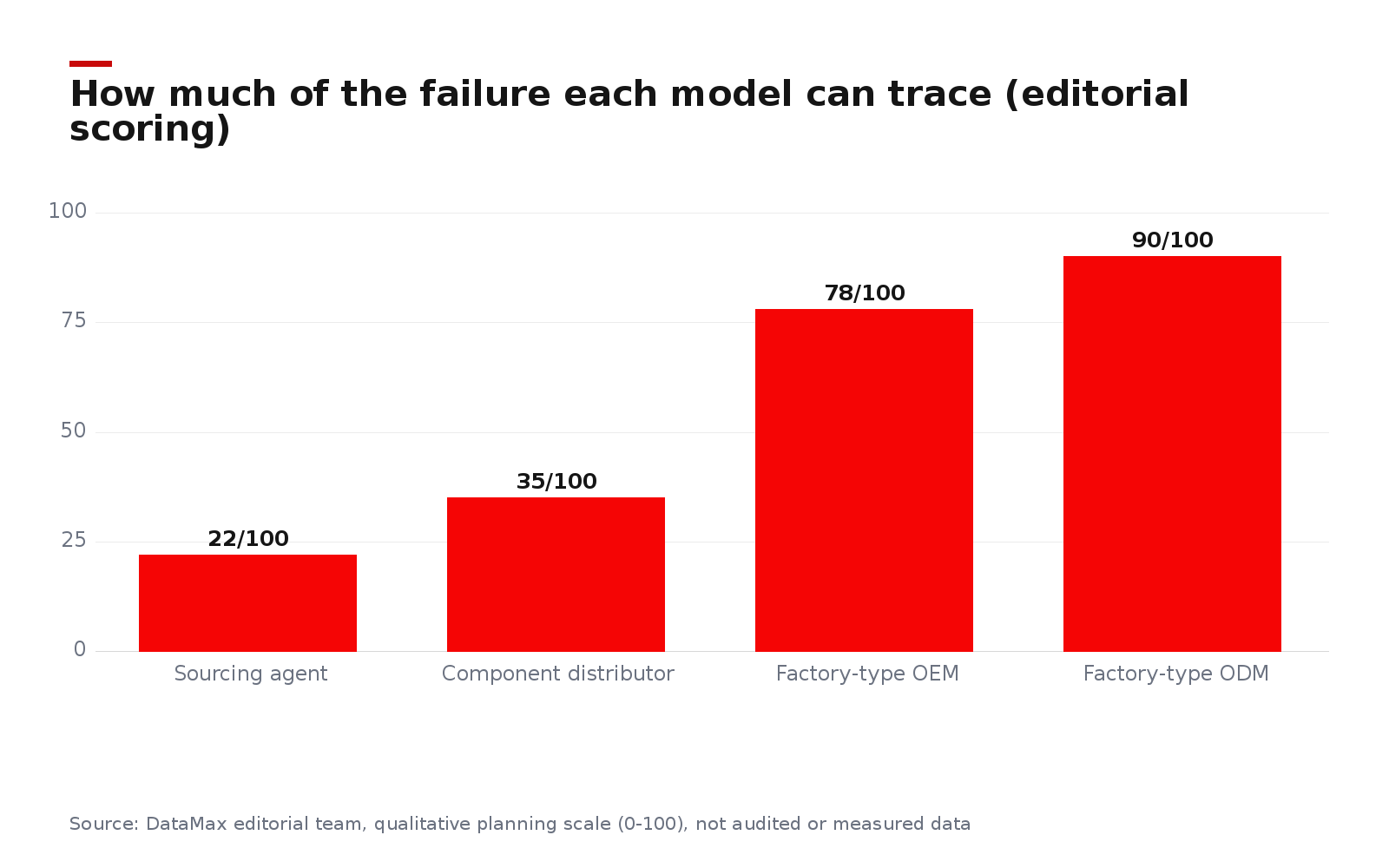
The same figures, in searchable form:
| Operating model | Editorial score |
|---|---|
| Sourcing agent | 22/100 |
| Component distributor | 35/100 |
| Factory-type OEM | 78/100 |
| Factory-type ODM | 90/100 |
Source: DataMax editorial team, qualitative planning scale (0-100), not audited or measured data.
For final selection, request samples through sample ordering, confirm the exact production configuration, and review target-market certification and compliance evidence. Email [email protected] with the SKU list, target-market certificates, middleware/DRM checklist, and required SMT/AOI/aging records so the technical and procurement teams can return one traceable response.
A model-level approval should preserve the distinction between fit and configuration. DM21P’s stated operator fit does not establish which optional memory or DRM branch is selected. DM21S’s 1G Ethernet is optional, so a programme requiring it must name it explicitly. DM21T has a stated 1G option and a USB3.0 interface, but those facts must be confirmed in the production configuration rather than assumed from a family position. DM22Q likewise requires its optional Ethernet and storage choices to be resolved.
For an android tv box manufacturer RFQ, the final model table should use the same column structure as the buyer’s requirement schedule: SKU, platform, baseline memory and storage, approved optional features, decode modes, DRM status, declared interfaces, and evidence owner. That prevents a platform statement from being mistaken for a production release. DataMax can supply the platform facts and configuration evidence, while every unlisted option remains subject to the production datasheet.
Further reading
- Guide android tv box manufacturer
- Allwinner Android TV boxes
- AOSP Android TV boxes
- H.265 HEVC Android TV box guide
- Widevine L1 certification guide
- DataMax DM21P specifications and fit
- DataMax DM21S specifications and fit
FAQ
What is the difference between OEM and ODM for an Android TV box?
OEM manufacturing builds a product to the buyer’s supplied design, while ODM development contributes the platform, hardware, firmware, and integration engineering. Commercial boundaries still require definition. An RFQ should identify who owns the design files, bootloader, Android build, signing keys, middleware integration, certification, and production test evidence for the selected android tv box manufacturer relationship.
Should a private-label operator choose a catalogue platform or a custom ODM?
Choose a catalogue platform when launch speed, standard interfaces, and limited non-recurring engineering dominate. Choose a custom ODM when device provisioning, middleware, update policy, distinctive mechanics, certification, or fleet lifecycle must be controlled. The decision should follow a mapped workload and failure-ownership matrix rather than an assumed feature count.
Which DataMax model fits an operator middleware programme?
DM21P is the stated fit for a 4K IPTV / operator middleware set-top box. It combines AOSP Android 11 with the published operator-oriented interface and codec set. Confirm the exact memory option, DRM configuration, HDCP requirement, middleware interface, and production datasheet before ordering samples or committing a deployment.
What evidence proves that an ODM controls its production line?
Request the current process flow, SMT and AOI records, firmware-loading logs, functional or dark-room test reports, aging records, and serial-range traceability for the same hardware and software revision. A tour without matching records does not close the gap. The evidence contract should also define failure quarantine, rework, retest, and engineering disposition.
Can a model advertised with 8K be treated as an 8K platform?
No. Output and decode limits must come from the production datasheet, not a live marketing name. DM21T is listed with decode modes up to 4K@120 and a HDMI 2.0b output; DM22Q is listed with AV1/H.265 L5.1 4K@60. Ask the android tv box manufacturer to specify the exact output and decode modes in writing before sample approval.
What should be attached to an ODM quotation request?
Attach the target SKU list, target-market certification requirements, middleware and DRM checklist, port or interface schedule, and SMT/AOI/aging evidence request. This gives the engineering and procurement teams enough information to map every requirement to a model, option, test method, and accountable owner rather than returning an untraceable catalogue response.
When should a buyer request a video factory audit?
Request a video audit after commercial alignment but before approving the production configuration or release gate. Focus the audit on the nominated assembly line, SMT and AOI records, firmware loading, functional testing, aging, packaging, and serial reconciliation. The evidence should cover the same board and software revisions proposed for production, not merely demonstrate that the facility has compatible equipment.


