
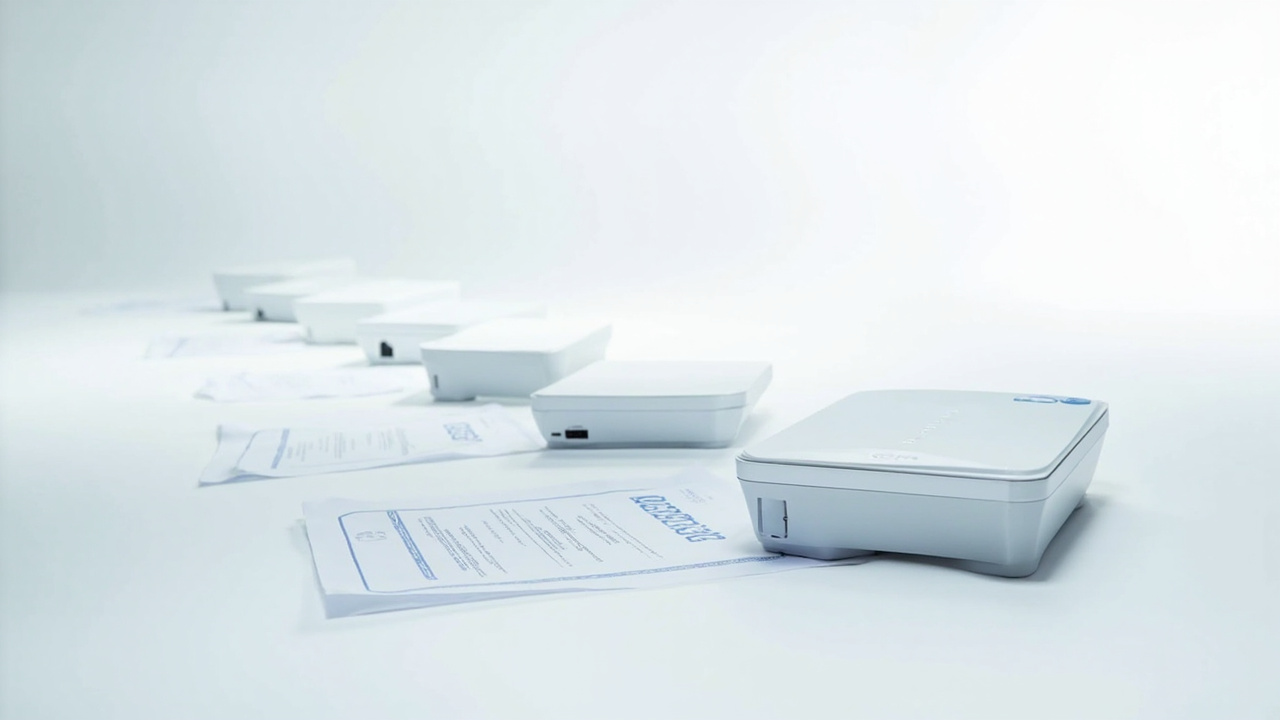
Before the terminology: the decision
An android tv box carrying Irdeto CAS is not operator-ready merely because the CAS appears in a proposal, product page, or certification statement. The defensible purchase decision requires evidence that the conditional-access client, chip architecture, middleware, secure-boot chain, storage layout, network path, and production update process work together on the specified SKU.
The practical judgment is direct: treat “Irdeto CAS integrated” as an assertion to verify, not a badge of acceptance. A buyer should obtain the exact Irdeto build target, hardware security configuration, middleware version, device identity and key-delivery procedure, test results, and field-update route. These items determine whether the unit can enter an operator network, pass head-end testing, and be reproduced across a volume order.
The specification gap is usually not the decoder. It is the chain joining secure hardware to a trusted software image and then to the operator’s entitlement system. For an OEM program, that chain must survive SMT, firmware assembly, security provisioning, burn-in, packaging, and dispatch. A hardware sample with a CAS client installed does not establish that the same result is repeatable.
This article addresses that specific angle. It does not reproduce the canonical android tv box for ISPs selection guide. The focus here is how to distinguish a genuine Irdeto CAS engineering commitment from a label that cannot survive technical audit.
Procurement decision in one screen
A purchase order should not use “Irdeto CAS compatible” as its acceptance criterion. The RFQ should name the CAS release, chipset and Android release, operator middleware, security configuration, manufacturing provisioning method, test standard, and evidence package. If the supplier cannot map each line to a production artifact, the claim remains a marketing assertion.
The required evidence has 6 parts: approved platform, controlled CAS build, device provisioning, entitlement-path testing, manufacturing configuration control, and post-shipment update procedure. Each part closes a different route by which an otherwise plausible sample can fail in the field.
The mechanism behind the spec
Conditional access is an entitlement system, not merely a decoder feature. In a satellite, cable, IPTV, or operator-OTT architecture, the head end determines which service packages an authorized subscriber may receive. Access control operates through secure messaging, device authorization, entitlement decisions, and renewal or revocation rules. Irdeto CAS is one implementation of that function; the exact client, certification route, and integration obligations must be confirmed for the operator and region.
An android tv box must therefore execute 4 separate layers coherently. First, the application layer presents the operator middleware, catalogue, playback controls, and entitlement-dependent UI. Second, the CAS client processes protected control words and service authorization. Third, the platform connects securely to the head end or entitlement backend. Fourth, the secure element, key ladder, boot process, and hardware identity establish the root of trust.
- Establish identity Assign each device a unique, auditable identity and provision the required secrets through the approved manufacturing flow.
- Establish trust Bind the authorized firmware, bootloader, partition layout, security configuration, and update policy to the device platform.
- Establish entitlement Connect the CAS client to the operator backend and verify authorization, subscription mapping, renewal, and revocation behavior.
- Establish persistence Repeat the complete configuration on production hardware after SMT, assembly, firmware loading, aging, and final test.
The distinction matters because CA integration has several independent failure surfaces. A valid client may reject the wrong chip-security configuration. A correct device may lack a provisioning record. A provisioned unit may use the wrong operator firmware variant. A passing unit may lose authorization because its update path changes partitions or signature policy. None of these failures is visible from the presence of an “Irdeto” label.
Buyer diligence should name the protocol path, backend endpoint type, test vectors, and expected responses. “Head end ready” is not testable by itself. A stronger criterion asks whether the supplier completed the operator’s defined certification or integration test, against which CA version and hardware reference, with traceable logs.
Security is also a manufacturing concern. A secure identity cannot be duplicated across units, and a development key must not survive into a shipment. The RFQ needs to define where identity assignment occurs, which station writes or verifies it, how secrets are escrowed, what happens after a failed write, and how field diagnostics distinguish an unprovisioned device from a CAS entitlement failure.
Finally, the update route belongs in the technical definition. An android tv box may boot correctly with one image but become unauthorized after an over-the-air update, factory reset, partition replacement, or service-menu change. The acceptance plan should therefore include update testing, recovery behavior, rollback policy, and the distinction between support firmware and operator-certified firmware.
Which DataMax models actually sit here
DataMax provides 4 relevant platforms, but the supplied product facts do not state that any of them includes an Irdeto CAS build. The correct conclusion is model selection followed by a separate operator/CAS integration project; the presence of Widevine L1, PlayReady, or Dolby Vision does not establish Irdeto CAS.
| Model | SoC and compute | OS | RAM / ROM | Decode | DRM | Ports and connectivity |
|---|---|---|---|---|---|---|
| DM21P | Amlogic S905Y4, quad Cortex-A35 | AOSP Android 11 | 2GB / 8GB (4GB; 16/32/64GB optional) | AV1 [email protected], VP9/H.265 4K@60, H.264 4K@30 | Widevine L1 / PlayReady / HDCP 2.2 optional | HDMI 2.0b out x1, USB2.0 x2, TF, S/PDIF, 3.5mm AV, RJ45 100M, Wi-Fi6 2x2 + BT5.4, DC 5V/2A |
| DM21S | Amlogic S905Y5, quad Cortex-A55 | AOSP Android 14 | 2GB / 16GB (2/4/8GB; 16/32/64GB optional) | AV1 / H.265 [email protected] 4K@60 | Widevine L1 / PlayReady optional; Dolby Vision/DTS | HDMI 2.0b out, S/PDIF, AV, USB2.0 x2, TF, RJ45 100M (1G optional), Wi-Fi6 2x2 + BT5.4 |
| DM21T | Amlogic S905X5, quad Cortex-A510 (ARMv9) | AOSP Android 14 | 4GB / 64GB (family options) | H.266/VVC [email protected] 4K@120, AV1/VP9/H.265 4K@120, AVS3 4K@120, H.264 4K@60; inline AI-SR | Widevine L1 / PlayReady optional | HDMI 2.0b out (no HDMI in), USB2.0 x1 + USB3.0 x1, TF, S/PDIF, AV, RJ45 100M (1G opt), Wi-Fi6 + BT5.4 |
| DM22Q | Amlogic S905X5M, quad Cortex-A55 up to 2.5GHz | AOSP Android 14 | 4GB / 64GB (2/4/8GB; 16/32/64GB optional) | AV1/H.265 L5.1 4K@60; inline AI-SR (no NPU TOPS stated) | Widevine L1 / PlayReady optional; Dolby Vision/DTS | HDMI 2.0b out, USB2.0 x2, TF, S/PDIF, AV, RJ45 100M (1G opt), Wi-Fi6 2x2 + BT5.4 |
DM21P is positioned for 4K IPTV and operator middleware set-top-box use, making it the closest starting point for a conventional operator dialogue. Its AOSP Android 11 baseline, however, must be reconciled with the operator’s supported Android, CAS, middleware, and device-certification matrix. Confirm all 3 items against the production datasheet.
DM21S fits the 4K IPTV/OTT white-label brief on Android 14. Its optional 1G Ethernet can suit deployments where the operator requires a specified wired path, but “optional” is not a production configuration. The buyer must order and test the exact Ethernet implementation used in the shipment.
DM21T prioritizes premium UHD and cloud-gaming workloads. Its stated decode profile includes 4K@120, but the production datasheet caps output and decode at 4K; marketing references to 8K are outside the approved claim. For an Irdeto program, the reason to select it must be a validated platform requirement rather than an unsupported resolution claim.
DM22Q is gaming-oriented, with an optional 1G Ethernet path. Its fit for operator CAS work depends on the operator’s hardware support policy and the selected board configuration. The supplied facts do not confirm Irdeto certification, secure-element provisioning, head-end compatibility, or operator middleware support for any model.
Specification boundary
Do not convert DRM support into a CAS statement. Widevine L1, PlayReady, HDCP 2.2, Dolby Vision, and DTS address content-protection or presentation functions; they do not prove subscriber entitlement, secure identity, head-end interoperability, or operator acceptance.
Deployment scenarios and the spec each needs
The deployment model changes which evidence matters. An operator IPTV program must align the box with its middleware, backend, security policy, and subscriber provisioning. A white-label OTT product may need a controlled Irdeto client without the same managed network assumptions. A venue integrator may primarily need stable RF behavior and deterministic configuration, while a gaming platform may impose additional performance and interface constraints.
| Situation | Primary requirement | Evidence to request | Model direction |
|---|---|---|---|
| Operator IPTV | • Irdeto CAS with operator middleware and backend • Device identity and entitlement lifecycle | • CAS certification record • Middleware version matrix • Provisioning and revocation test logs | Start with DM21P for the operator-set-top-box fit, then validate Android and platform support against the production datasheet. |
| White-label IPTV/OTT | • Controlled firmware baseline • Brand-level update and configuration management | • Golden-image definition • Over-the-air update procedure • Factory configuration report | DM21S on AOSP Android 14 matches the stated white-label fit; confirm Ethernet and DRM options. |
| Premium UHD service | • Validated 4K path • Stable middleware and display behavior | • End-to-end resolution test • HDMI and media pipeline report • Operator application regression | DM21T is the stated premium-UHD direction; do not rely on any 8K marketing claim. |
| Gaming-oriented service | • Interface performance • Wired-network option where contracted | • Application latency procedure • 1G configuration evidence if ordered • CAS regression on final build | DM22Q is the stated gaming-oriented direction; CAS suitability remains to be validated. |
| Hotel, retail, or hospitality | • Repeatable identity and room-unit recovery • Controlled operator access | • Device lifecycle policy • Re-provisioning test • Firmware rollback evidence | Select on configuration control and lifecycle evidence, not codec headline alone. |
For an operator, the critical scenario test is entitlement continuity. Test subscription activation, channel or service mapping, renewal, expiry, revocation, reboot persistence, network interruption, and recovery. A channel lineup appearing on a bench does not prove the authorization model.
For an integrator, the critical scenario test is repeatability. The same image, identity process, boot behavior, and update route must survive reinstallation and multiple hardware batches. Configuration drift between prototype and deployment is a more probable field problem than a headline codec limitation.
A real manufacturing scene captures the operational nature of the commitment: identical compact black units on warehouse shelving, neutral packaging, pallets, and a packing station.
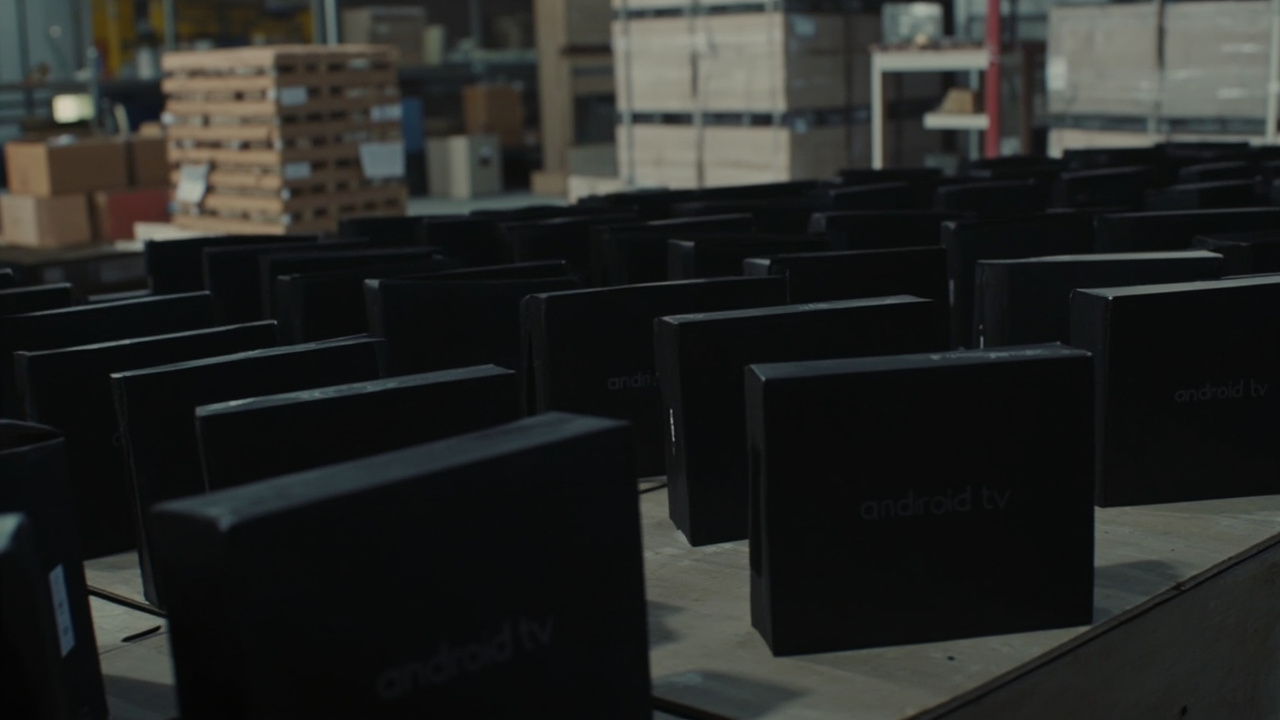
The photograph illustrates the fleet-level control point. Every visible unit may look identical while carrying a different identity, firmware state, or provisioning result. Serialization and secure assignment must therefore be controlled at the factory, not inferred from packaging.
The selection sequence that removes rework
Use a 7-step sequence that starts with operator requirements and ends with an approved production equivalent. Each step has an exit artifact. Skipping a step moves uncertainty downstream, where identity recovery and software rebuild become more expensive.
- Freeze the operator contract Record the CA product and version, certification authority, operator middleware, target region, network route, device-security rules, and update policy in a controlled requirements matrix.
- Select the platform Map the operator matrix to a DataMax base model and a specific board, RAM/ROM, Ethernet, DRM, and connectivity configuration. Do not approve from the model family name alone.
- Lock the build contract Define Android release, bootloader, partition layout, kernel, device tree, security settings, application versions, update channel, and approved golden image.
- Prove the CAS path Run client, entitlement, provisioning, persistence, revocation, recovery, and update tests against the target backend or the operator’s certified test environment.
- Prove manufacturing identity Validate unique identity assignment, secret injection, duplicate detection, failed-write handling, audit logging, and traceability from component to packed unit.
- Run production equivalence Compare the production board, firmware, test fixture, and operator environment with the approved prototype using a documented delta review.
- Release only the evidence package Archive build hashes, test reports, provisioning records, firmware hashes, unit serial mapping, and change approvals under one release identifier.
A buyer can paste the following RFQ line into a technical schedule: “State the exact Irdeto CAS product, client release, chip platform, Android baseline, operator middleware version, secure-identity method, provisioning station, factory test fixture, entitlement test standard, update/rollback procedure, and proposed evidence package for every SKU.”
The response should identify the product rather than repeat “Irdeto supported.” For each SKU, request the security configuration document, firmware manifest, provisioning flow diagram, test protocol, test report from the exact build, and field-update procedure. Require the supplier to mark any item that depends on the operator or certification body.
The model selection itself should remain conservative. DM21P aligns with the stated operator middleware set-top-box fit. DM21S aligns with a white-label IPTV/OTT direction on AOSP Android 14. DM21T and DM22Q fit premium or gaming-oriented briefs but require stronger justification where the driver is operator CAS. A stronger SoC does not automatically create a stronger CAS integration.
DataMax can support the hardware and manufacturing program around the selected platform, but the customer remains responsible for supplying the operator’s exact middleware, entitlement environment, certification expectations, and approved production configuration. If those inputs are absent, request an engineering review before ordering samples through the inquiry form.
Failure modes that reach the field
The most expensive failure is a configuration mismatch that remains invisible until subscription or service activation. It can arise from a correct CAS client paired with the wrong build target, an unsupported operator middleware version, or a test environment that differs from production networking.
Field trap 1
The prototype passes on the bench, but the production line loads a different firmware image. The field cost is not one replacement unit: it is the need to stop dispatch, identify affected serials, reprovision them, retest entitlement, and rebuild the release record. Bind firmware hashes and provisioning configuration to the approved bill of materials.
A second trap is treating one successful lab activation as proof of scalable identity management. Units may be duplicated, left with development identities, assigned to the wrong keys, or shipped with provisioning reports that cannot map a box to its operator record. These faults surface as intermittent authorization failures that operators often misclassify as backend instability.
| Quotation wording | What it may conceal | Resolution artifact |
|---|---|---|
| “Irdeto CAS supported” | No named client version, target, or certification scope | CAS product/version and integration report |
| “Operator-ready Android device” | Hardware qualification without middleware or backend proof | End-to-end entitlement test log |
| “Secure provisioning included” | No unique-identity, failed-write, or audit procedure | Provisioning flow and serialized identity record |
| “Firmware updates supported” | No signature, partition, rollback, or post-update entitlement test | Update procedure and regression report |
| “Same design as approved sample” | Uncontrolled BOM, board, or component changes | Production-equivalence and change-control record |
Software-update failure is equally important. An OTA package may overwrite a CAS-relevant partition, alter device properties, or install a generic image that lacks the operator build. A factory-reset path can erase operator-managed state. Recovery may also clear a device identity without creating a new authorized identity. The acceptance test must cover the supported update, reset, and recovery paths rather than only a normal reboot.
Hardware-fit failures are easier to prevent. Confirm the exact RJ45 option, USB allocation, output configuration, and physical connections in the production BOM. A quoted 100M path cannot satisfy a requirement for 1G; an “optional” 1G interface must be converted into a controlled ordering line. The same rule applies to codec and display claims: use only the decode and output fields documented for the selected SKU.
Operator dependency failures also require explicit ownership. The buyer must identify who supplies the middleware, CA account, certificates, test entitlement, backend access, and production credentials. DataMax cannot infer those from a hardware sample. A schedule that leaves them unassigned will show a factory delay even when the android tv box hardware is ready.
Before accepting a factory claim, request evidence specific to this topic. A video factory audit or a request for SMT, AOI, aging, and secure-provisioning evidence is available through DataMax factory quality and manufacturer information. The audit should trace the production path used for the quoted SKU, not a generic showroom line.
The evidence trail from SMT to shipment
Factory evidence turns a CAS claim into a repeatable process. The trail begins at component intake, passes through board assembly and automated inspection, continues through image loading, identity provisioning, functional and network tests, and ends with serialized packaging and shipment release.
A workable evidence chain has 7 records. Component traceability links the SoC, storage, and security-related parts to the approved BOM. AOI records support inspection of assembly quality. A build manifest identifies the firmware and application images. A provisioning record binds each unit to its authorized identity. A test record shows CAS and entitlement behavior on that unit. A configuration record identifies the production variant. A dispatch record links the released unit to its serialized packaging.
- SMT and AOI Verify assembly and inspection records for the production board, with deviations held against the approved configuration.
- Software loading Load the controlled bootloader and firmware, record image hashes, and prevent an unauthorized generic image from entering the test path.
- Secure identity assignment Provision the required device identity, verify uniqueness, and quarantine any unit that fails or repeats an identity.
- Functional and entitlement test Exercise the exact operator test path, including activation, channel authorization, reboot persistence, and the defined recovery procedure.
- Thermal and aging exposure Apply the agreed aging regime, then repeat critical boot, network, and entitlement checks.
- Configuration audit Compare hardware revision, RAM/ROM, Ethernet, software build, and operator settings with the release bill.
- Packaging and release Serialize the approved unit, retain traceability, and quarantine failed or undocumented units before dispatch.
Release record required
A production shipment should be traceable through 6 identifiers: board revision, unit serial, bootloader version, firmware hash, identity or provisioning record, and test-report reference. A missing link can prevent root-cause analysis even when the unit passes a superficial power-on check.
SMT and AOI do not validate CAS by themselves. Their value is preserving the hardware baseline on which the secure and software configuration depends. The stronger control is a closed loop: the exact production route must recreate the approved unit, while any hardware substitution triggers a documented engineering review.
Aging adds another control because firmware and connectivity behavior can change under sustained load. After the agreed exposure, operators should know whether the unit still boots, holds network connectivity, maintains its identity, and reaches the entitlement service. A pass recorded before aging does not establish the shipped state.
The factory should also define yield handling. A unit with an unavailable entitlement backend may be healthy but not releasable under an operator end-to-end test. The line needs a controlled retry or quarantine procedure that distinguishes infrastructure failure from a hardware or software failure. It must never bypass identity checks simply to meet a dispatch target.
Change control closes the trail. A new SoC stepping, RAM/ROM option, Ethernet option, boot component, firmware branch, middleware version, or CA client can alter the approved system. DataMax should state whether that change is contractual, testable, and recorded. The operator should approve the applicable delta before the revised configuration enters the same product family name.
The result is an auditable chain rather than a visual badge. Procurement can sample the records, manufacturing can isolate affected serials, and engineering can reproduce the exact configuration. That is the operational meaning of an integrated CAS deployment.
Options placed side by side
An android tv box sourcing decision can be separated into 4 roles. A sourcing agent coordinates specifications and suppliers but generally owns less of the production evidence trail. A component distributor supplies parts but does not automatically control firmware, identity, or final test. A factory-type OEM builds against a customer-controlled design and carries substantial manufacturing accountability. A factory-type ODM can combine platform selection, software integration, and production control, depending on the defined scope.
The chart below is an editorial planning comparison, not measured performance. It ranks how much of the failure can potentially be traced within each sourcing role. The score is not a supplier rating, certification result, or warranty commitment.

The same figures, in searchable form:
| Sourcing model | Editorial score | Planning-scale source |
|---|---|---|
| Sourcing agent | 22/100 | DataMax editorial team, qualitative planning scale |
| Component distributor | 35/100 | DataMax editorial team, qualitative planning scale |
| Factory-type OEM | 78/100 | DataMax editorial team, qualitative planning scale |
| Factory-type ODM | 90/100 | DataMax editorial team, qualitative planning scale |
The practical difference lies in contract control, not a label attached to the box. A lower-traceability role can still succeed if the customer creates and controls the evidence system. A higher-traceability role can still fail if the scope excludes CAS provisioning, middleware, or update ownership. The RFQ must allocate those responsibilities.
For the hardware platform, DM21P is the stated operator-set-top-box direction; DM21S is the stated 4K Android TV box for IPTV/OTT white-label direction on AOSP Android 14. DM21T serves a premium UHD/cloud-gaming brief with a 4K ceiling, while DM22Q serves a gaming-oriented brief with 4K@60 decode. Irdeto status, however, remains unconfirmed for all 4 models against the production datasheet.
| Decision | Entry-tier approach | Commitment-tier approach |
|---|---|---|
| Platform selection | Choose a family by operator use case, then validate Android and build support | Freeze exact model, board, RAM/ROM, Ethernet, and connectivity configuration |
| CAS integration | Receive a supported-client statement and test on an operator-approved build | Complete named CA, middleware, backend, provisioning, update, and recovery evidence |
| Identity | Define who provisions units and retains the identity record | Validate uniqueness, failure quarantine, audit, and serialized traceability at the factory |
| Evidence | Review samples and a generic test summary | Archive build hashes, unit mapping, test reports, and change approvals under one release |
| Model direction | DM21P for operator middleware fit; DM21S for white-label IPTV/OTT | DM21T or DM22Q only where premium or gaming requirements justify the platform |
For next steps, send the selected SKU list, target market certificates, operator middleware and Irdeto checklist, required Ethernet and RAM/ROM options, and the required test or evidence format. Email [email protected] with those 5 concrete items so engineering can distinguish a base hardware quotation from a production CAS commitment.
Further reading
- Guide android tv box for isps
- H.265 HEVC Android TV box guide
- Widevine L1 certification guide
- Dolby Atmos Android TV box guide
- TV box vendor selection checklist
- DataMax DM21P specifications and fit
- DataMax DM21S specifications and fit
FAQ
Does Widevine L1 prove that an android tv box supports Irdeto CAS?
No. Widevine L1 is a DRM capability listed separately from subscriber conditional access. Irdeto readiness also requires a supported client and build, compatible hardware security, device identity, backend entitlement integration, and operator-specific testing. Confirm the exact CA target and integration evidence against the production datasheet.
Which DataMax model is the natural starting point for an operator middleware project?
DM21P is identified as a 4K IPTV and operator middleware set-top-box platform. Its suitability still depends on the operator’s supported Android, SoC, CA, middleware, and certification matrix. Treat the model as a candidate platform, not as proof of completed Irdeto integration.
Does a successful lab subscription test authorize a production shipment?
No. A lab test proves only the tested combination of client, firmware, backend, identity, and environment. Production release also needs configuration control, unique identity assignment, manufacturing test records, update and recovery validation, and traceability from each packed unit to its test result.
What should a buyer request instead of an “Irdeto compatible” statement?
Request the named Irdeto product and client version, supported SoC and Android baseline, operator middleware version, security configuration, provisioning flow, entitlement test standard, update and rollback procedure, and production-equivalence evidence. Each statement should identify an accountable document or test report.
Can a 4K platform with 1G Ethernet optional be quoted as a 1G product?
Only when the exact production configuration includes the 1G Ethernet option and the proof defines which SKU and board are covered. DM21S, DM21T, and DM22Q list 1G as optional. The order line, BOM, test report, and production datasheet must agree before shipment.
What attachments should be included in a CAS-focused factory request?
Include the SKU list, target-market certification requirements, operator middleware and Irdeto compatibility checklist, exact RAM/ROM and Ethernet configuration, and the required evidence format. These attachments allow DataMax to separate hardware availability from software, certification, and manufacturing commitments.


