

The procurement answer in one screen
An RFQ arrives at 09:30 with four lines: “Android TV box,” “4K,” “Widevine L1,” and “best price.” By 10:00, the datasheet is open, but the real question is not which model has the longest specification. The manufacturer must be selected as an engineering-control system that can reproduce an approved configuration, not as a catalogue intermediary. A credible partner connects the SoC and AOSP release to codec ceilings, DRM implementation, middleware integration, port limits, certification scope, and a traceable production record.
The short procurement answer has 5 controls. First, select one exact SKU and its stated fit rather than a family label. Second, freeze RAM, ROM, Ethernet speed, ports, accessories, firmware, and target-market compliance line-by-line. Third, approve a golden sample that represents the production build. Fourth, verify the process through SMT, AOI, programming, aging, dark-room inspection, and serial traceability. Fifth, require advance approval for BOM, firmware, tooling, process, and sub-supplier changes.
This page covers the operational angle only. For the broader buying framework, use the TV box vendor selection checklist. DataMax provides four quoted production SKUs for operator middleware, IPTV/OTT white-label, premium UHD or cloud-gaming, and gaming-oriented Android TV requirements. The relevant manufacturer capability is the ability to make the ordered configuration consistently, not merely to present a representative sample.
A 2–4 week qualification can test whether a supplier can reproduce a reference unit. A production review must then establish whether the same controlled process produces the ordered lot. Ask whether each quotation identifies a base SKU, all selected options, firmware baseline, media limits, DRM position, port map, certification scope, and traceability records. Reject “equivalent,” “as required,” and “up to” where they leave the delivered configuration open.
Request a video factory audit or an SMT, AOI, and aging evidence package through the factory-quality review. Treat “factory direct” as a claim until records show the actual line. The decision-grade manufacturer can also state which functions come from the hardware platform and which depend on operator middleware, content licensing, the site network, or customer-installed applications. That boundary determines where qualification effort belongs and prevents a catalogue feature from becoming an unsupported production promise.
Where this matters in a deployment
The same hardware can pass a bench demonstration and fail when it meets an operator network, television, protected stream, peripheral set, or venue power condition. Begin the RFQ with the deployment consequence, not a preferred SoC.
| Situation | Primary requirement | Model direction |
|---|---|---|
| IPTV operator middleware rollout | Stable operator image, constrained network integration, and managed deployment | DM21P as the operator-oriented starting point; validate the exact middleware and release |
| IPTV/OTT white-label launch | Android 14 platform flexibility with a configurable memory and storage profile | DM21S as the white-label-oriented candidate |
| Premium UHD or cloud-gaming deployment | Higher decode targets and a stronger processing position | DM21T for 4K@120-class decode requirements |
| Gaming-oriented Android TV distribution | 4K@60 media capability with Android 14 and flexible Ethernet options | DM22Q as the gaming-oriented candidate |
| Digital-signage or hospitality integration | Stable HDMI output, controlled peripherals, and remote recovery procedures | Select by measured media, DRM, and interface requirements; do not infer suitability from the application label |
For an operator rollout, “Can it boot the middleware?” is only the first question. The manufacturer must also show that the same image can be built, upgraded, and traced across the fleet. The DM21P is defined for 4K IPTV and operator middleware set-top-box use, with AOSP Android 11. Its quoted base configuration is 2GB/8GB; 4GB RAM and 16GB, 32GB, or 64GB storage are optional. Those options belong in the order line, not merely in a quotation attachment.
For a hotel or retail installation, risk moves outward to the room and network. RJ45 100M is the stated base on DM21P, DM21S, DM21T, and DM22Q; 1G is optional on DM21S, DM21T, and DM22Q. If the access network requires 1G, the PO must say so and the sample must prove it. HDMI 2.0b output is present across the quoted family, but DM21T has no HDMI input. A design requiring source capture cannot treat it as interchangeable.
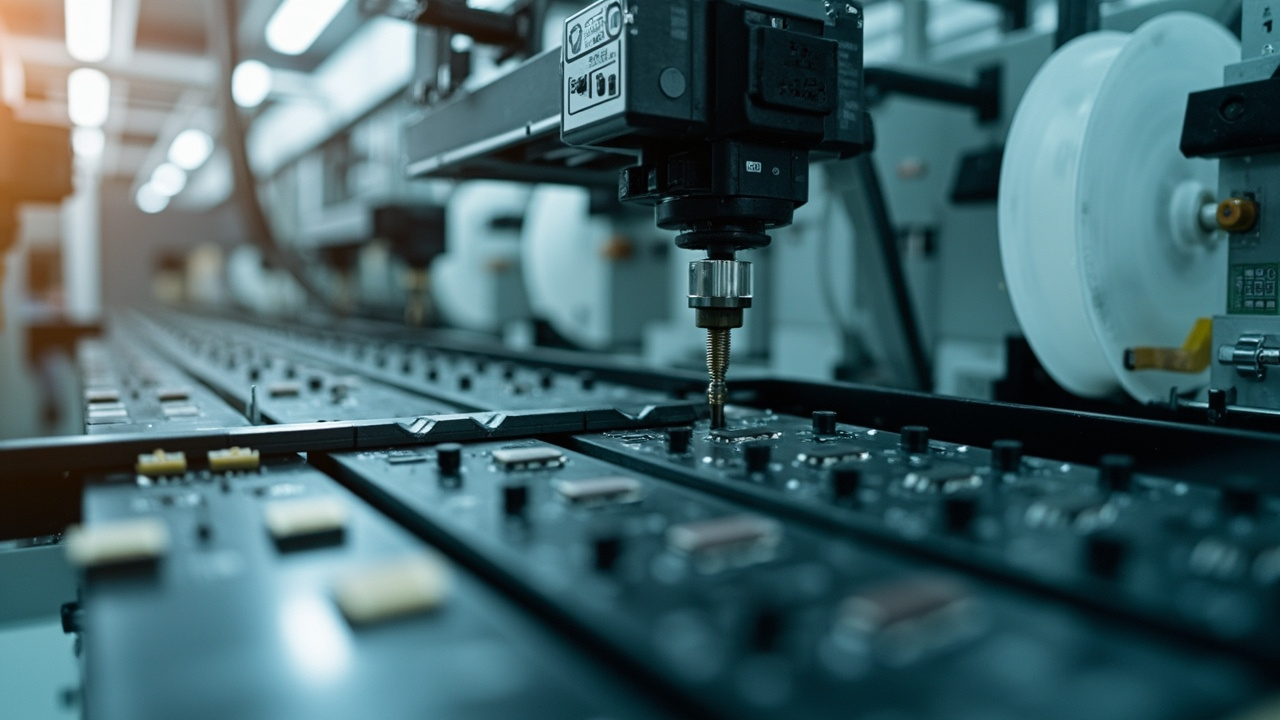
The production scene starts where visual inspection cannot resolve component identity, polarity, placement tolerance, or rework consistency: the SMT line.
Bring the deployment scenario, reference software, target display, network topology, peripheral list, and recovery requirement into the same RFQ. Then ask each candidate manufacturer to name the exact model and every configuration change required to satisfy that scenario. A 250-room hospitality order using Ethernet with one USB service appliance should specify the target display, Ethernet speed, USB count, recovery behavior, signage application, and update owner. The answer should identify one build, not a menu of possible SoCs.
Operator and integrator requirements also need distinct test paths. An operator may require DHCP, multicast, authentication, and managed firmware channels. An integrator may care about serial recovery, display wake-up, and peripheral compatibility. A venue may prioritize display matching, audio output, and local reboot behavior. None should be translated into an assumed model tier. Each becomes an explicit acceptance test.
Conversely, an IPTV program with multicast access must validate the network path and operator image rather than infer performance from a local streaming demo. The same manufacturer may quote different models for these cases; that is sound engineering when the acceptance evidence, interface limits, and qualification workload are stated explicitly.
The selection sequence that removes rework
A controlled sequence prevents the most expensive error: ordering a platform around a headline feature and discovering later that the interface, firmware, or certification evidence does not support the deployment.
The RFQ can use the following sequence:
Provide one exact base SKU for the stated application, listing the SoC, Android release, base RAM/ROM, all configured options, decode ceilings, DRM implementation, port map, power supply, accessories, packaging, and target-market compliance evidence. Identify every item not included in the quotation. Manufacture against the approved golden sample, with serial-level test traceability and advance notification for any BOM, firmware, tooling, process, or sub-supplier change.
That wording gives the manufacturer a testable response and gives the buyer a defensible record. It prevents a catalogue response from being mistaken for an order-ready offer.
A useful qualification flow is:
Do not collapse the last 2 steps. A factory can make an excellent sample and still lack line discipline to repeat it at volume. The sample validates the design; production evidence validates the operating process. If the candidate manufacturer cannot show how the sample differs from the lot build, sample approval should not authorize production.
For example, an operator might require 100M Ethernet, H.265 playback, Widevine L1, and an Android 11 middleware baseline. The answer should identify an exact model and configuration, not several possible SoCs. Separate lines must identify whether storage is 8GB, 16GB, 32GB, or 64GB, whether the cable set is fixed, and which label and packaging revision will ship. The buyer should also specify whether the quoted model is a stock configuration or a configured derivative.
A commercial-completion gate follows technical selection. Require the response to separate supplied from excluded items, identify tooling or artwork charges separately, state the firmware-release owner, and define the evidence package expected before shipment. This prevents a technically plausible platform from entering a PO whose certification scope, packaging, accessories, or service responsibility remains unresolved.
Change control closes the sequence. Each proposed alteration should identify the affected model, old and new component or build, root reason, compatibility impact, test evidence, certification impact, serial applicability, and approval authority. When the manufacturer cannot classify a change, production should remain on hold. The rule is especially relevant to radio modules, power supplies, memory, storage, enclosures, and middleware branches because each can alter evidence collected for another configuration.
Failure modes that reach the field
Most field failures originate as ambiguities in the quotation. They remain hidden until the device meets a particular operator network, television, protected stream, peripheral set, or regulatory regime.
Field trap
A quoted codec is not an end-to-end capability. Verify the display mode, television compatibility, application path, stream packaging, output configuration, and decoding boundary together. For DM21T, the production facts cap output and decode at 4K, so an “8K” marketing label must not enter the technical schedule. A mismatch can produce black screens, frame drops, or procurement rejection after shipment.
Field trap
An Ethernet port marked “RJ45” does not establish throughput or operator-network suitability. DM21P and the base configurations of DM21S, DM21T, and DM22Q state RJ45 100M; 1G is optional on DM21S, DM21T, and DM22Q. Specify speed, auto-negotiation expectations, connection method, and the target network profile, then test the exact configuration.
The first divergence usually appears in memory and storage language. One offer may list “2GB/16GB,” another “up to 16GB,” and a third may omit the base configuration. Procurement needs to know whether the notation describes one fitted unit or a family. That distinction determines application memory, local cache, update headroom, and model identification.
A second divergence concerns DRM. “Widevine L1” identifies a security level, not the complete service arrangement. The quoted platforms state Widevine L1 with optional PlayReady and, for some models, optional HDCP 2.2 or Dolby Vision/DTS. Qualification also depends on the service’s licensing, key delivery, hardware control path, firmware build, and test account. Ask the manufacturer which elements are installed, which are supplied by the content owner, and which evidence applies to the target market.
A third failure mode is firmware drift. A factory may substitute a later Android build, different middleware image, revised Wi-Fi module, or new packaging accessory without changing the commercial description. The PO needs configuration revision, firmware build, approved image identifier, and advance-change approval. Without those controls, a field replacement may contain features the certification file did not cover.
Thermal and power behavior are equally important. Decode targets such as 4K@120, Wi-Fi6 operation, sustained streaming, and the specified power input should be tested together. A brief showroom clip cannot establish stable behavior over a multi-hour session. The manufacturer review must define stress conditions, ambient range, restart recovery, and the observation recorded for each unit.
The factory may use the correct model name but not the correct BOM. Port-count differences, Ethernet speed, storage capacity, accessory omissions, and the absence of HDMI input on DM21T are readily converted into shipment disputes. Serialisation, labels, packaging, and golden-sample comparison should form part of incoming and pre-shipment inspection. This is where the manufacturer must provide evidence that distinguishes a configuration change from a cosmetic relabelling.
A related field trap is connector count. DM21T has 1 USB2.0 port and 1 USB3.0 port, while DM21P, DM21S, and DM22Q list 2 USB2.0 ports. A product sheet showing “USB” does not answer whether 2 peripherals can operate simultaneously. The manufacturer should list each port by generation and count, and the buyer should test the actual dongle, storage, controller, and display arrangement.
Another common omission is recovery behavior. Specify whether the unit recovers from application crash, network loss, HDMI reconnection, and power interruption, and define whether recovery is manual, automatic, or image-based. For an operator fleet, the answer determines whether field service needs local attendance or remote remediation.
A less visible failure is accessory compatibility. Wi-Fi6 does not establish that a supplied remote, USB receiver, HDMI adapter, or optical audio path works with the target application. Put each accessory in the golden-sample bundle, record its model, and test the intended function. The same rule applies to 3.5mm AV versus S/PDIF: specify whether analog audio, digital audio, or both are required. Ambiguous accessory language gives the manufacturer room to select a technically valid but commercially wrong bundle.
Questions to put in the supplier review
A factory review should trace 1 ordered configuration from components to dispatch. The supplier’s manufacturer capability is visible in records, not in a presentation slide.
Request evidence that can be tied to a time window, line, product revision, and responsible quality function. An undated AOI image or a generic aging photograph supports marketing, not procurement. The useful record answers what was checked, which units were checked, the acceptance rule, the result, and what happened to deviations.
For a buyer commissioning production, the practical audit should include 3 production views, 1 golden-sample comparison session, 1 review of a non-conformance case, and 1 trace from board serial to packed serial. These are review actions, not third-party performance statistics. The outcome is a control map: process, record, operator, date, product revision, and approval status.
The AOSP release also needs an owner. DM21P uses AOSP Android 11; DM21S, DM21T, and DM22Q use AOSP Android 14. Ask how source branches, proprietary components, security patches, middleware integration, and long-term release packages are handled. A binary installed by a production operator is not a maintainable firmware process. The manufacturer should identify who approves an image and how later patches are traced to affected units.
Compliance evidence must match the destination market and exact model. The review should identify which records are product-specific, which apply to a family, and which require a completed change review. If an option alters the radio, power supply, port arrangement, or enclosure, the manufacturer should state whether the prior evidence remains applicable. A file attached to the wrong hardware revision is not useful qualification evidence.
Ask for the process behind the evidence. A supplier may not disclose another customer’s identity, but it can provide sanitized records, demonstrate traceability, and explain how deviations trigger containment. That is the stronger procurement test: evidence without a control path cannot support repeatability.
Reconcile paper and physical evidence. Read a work instruction beside the active line, inspect the revision-control mark, then compare the released firmware hash with the golden sample. During the dark-room check, ask the operator to demonstrate the acceptance screen and show the recorded result for the same unit. These cross-checks expose a system that has documents but does not consistently execute them.
For every model in a mixed portfolio, request a configuration matrix covering the base SKU and each approved option. The matrix should show whether each change is hardware, software, packaging, or certification driven. That lets procurement predict which engineering review follows a customer request. The manufacturer should also show incoming-material control, approved-vendor status, component-lot traceability, substitutions, and quarantine rules.
Test the control system with 1 controlled deviation. Select a non-critical inspection record, ask how the process would respond, and trace the responsible approval. A capable manufacturer should identify containment, serial scope, root-cause evidence, corrective action, and effectiveness verification. This exercise exposes whether the documented process is operational or merely procedural.
The comparison buyers actually make
Buyers often compare an entry position against a commitment platform by listing headline decode capability and memory. The more useful comparison is the bill of differences: what changes in the device, software, qualification workload, and operating risk.
| Decision dimension | DM21P position | DM21S position | DM21T position | DM22Q position |
|---|---|---|---|---|
| Primary fit | 4K IPTV / operator middleware | 4K Android TV / IPTV-OTT white-label | Premium UHD / cloud-gaming | Gaming-oriented Android TV |
| Android baseline | AOSP Android 11 | AOSP Android 14 | AOSP Android 14 | AOSP Android 14 |
| Base RAM / storage | 2GB / 8GB | 2GB / 16GB | 4GB / 64GB | 4GB / 64GB |
| Decode emphasis | AV1, VP9, H.265 and H.264 coverage | AV1 and H.265 at 4K@60 | VVC, AV1, VP9, H.265, AVS3 and H.264 with higher refresh targets | AV1 and H.265 at 4K@60 |
| Interface distinction | RJ45 100M; Wi-Fi6 2x2; BT5.4 | RJ45 100M, with 1G optional | RJ45 100M, with 1G optional; no HDMI input | RJ45 100M, with 1G optional |
| Procurement focus | Middleware and operator-image control | White-label image and configuration flexibility | Higher-refresh media validation | Gaming-oriented Android validation |
The “entry versus commitment” distinction is not simply lower cost. It is the amount of qualification controlled by the buyer. DM21P concentrates the decision on operator middleware, Android 11 integration, and an explicitly fixed 2GB/8GB base. DM21T shifts the centre toward higher-refresh decode validation, 4GB/64GB base capacity, and the explicit absence of HDMI input. Neither is automatically better; each carries a different validation burden.
Before comparing quotations, normalize each offer to 1 configuration basis:
| Field | Required comparison treatment |
|---|---|
| Base SKU | Name the exact DataMax model rather than grouping all products as “Android boxes”. |
| RAM and storage | Separate base and optional values; identify the configuration physically shipped. |
| Connectivity | State 100M or optional 1G, plus the Wi-Fi and Bluetooth configuration. |
| Media | Use codec, profile, level, resolution, and refresh target together. |
| DRM | Separate device capability, optional feature, service licensing, and target-market evidence. |
| Firmware | Fix the Android release, image identifier, middleware version, and change policy. |
| Evidence | Attach production, aging, dark-room, compliance, and traceability records to the order scope. |
This normalization gives the manufacturer a clear basis for quotation and stops feature-rich catalogue pages from substituting for a bill of materials. It also makes two quotes technically comparable: both can state the same base SKU, fitted memory, storage, Ethernet speed, firmware build, accessory set, and acceptance evidence.
The commercial comparison should expose the engineering workload. DM21P has a fixed operator-oriented fit and a 3.5mm AV port; DM21S offers a white-label Android 14 position; DM21T adds higher-refresh decode families and a USB3.0 port; DM22Q targets gaming-oriented Android TV use with a 4GB/64GB base. The appropriate choice follows the application evidence, not the longest feature list.
Qualification effort is another line item. A 4K@60 application using DM21S or DM22Q requires different display and sustained-stream tests from a 4K@120-class requirement using DM21T. An operator image on DM21P requires integration and update-process evidence, not only media playback. These workload distinctions should appear before sample approval.
A buyer comparing DM21S and DM22Q should not treat their shared 4K@60 media position as interchangeability. Their stated fit differs, their SoCs differ, and their optional memory and storage families differ. The selection record should state which model the customer-facing software supports, whether the application requires Dolby Vision/DTS, and whether the chosen Ethernet configuration is 100M or 1G. Each answer changes the evidence bundle even when the headline display target is unchanged.
The final comparison also needs an ownership column. Identify who owns firmware release, middleware integration, content-service licensing, target-market compliance, accessory supply, incoming inspection, and field recovery. Without ownership, the manufacturer may be asked to absorb work that actually belongs to the operator or integrator. A clear responsibility map prevents that gap from becoming a launch-delay dispute.
Where the terminology comes from
The terminology matters because each term limits what the manufacturer can promise. “4K” describes resolution, not refresh rate. “L1” describes a Widevine security level, not an application’s end-to-end entitlement. “AOSP Android 14” identifies the base software lineage, not operator middleware or update cadence. “RJ45 100M” identifies the nominal Ethernet interface, not the managed access-network design.
- Software stack Adds the AOSP build, drivers, middleware, DRM integration, applications, and update mechanism.
For DRM, the relevant service path typically includes a device identity, a trusted execution or hardware-backed control path where supported, licence requests, entitlement reporting, and content decryption. Widevine L1 indicates the stated device security classification; PlayReady and HDCP 2.2 may be optional on the quoted models. The buyer must still confirm the application implementation and content-service requirements.
Codec notation is similarly layered. “H.265 [email protected] 4K@60” identifies a codec generation, profile, level, and output target. AV1 and VP9 add alternative decode paths. DM21T adds H.266/VVC [email protected] at 4K@120 and several other 4K@120 decode paths, plus inline AI-SR. The quoted facts do not establish an NPU TOPS figure, so procurement should not infer one from the AI-SR statement.
Wi-Fi6 2x2 describes a radio generation and spatial configuration, not guaranteed throughput in every installation. BT5.4 identifies the Bluetooth version. Neither replaces a site survey, interference testing, or accessory validation. The manufacturer should provide the configured module and evidence, but the integrator remains responsible for the installed radio environment.
The engineering architecture therefore has 4 layers: hardware capability, software implementation, application qualification, and production assurance. A purchase order can specify the first layer precisely, but it must also identify controlled evidence for the other 3. That is the practical meaning of platform assurance.
AOSP is the open-source platform base, not a complete operator product. The deployment layer may add middleware, conditional-access integration, service applications, update agents, network configuration, branding, and remote diagnostics. The manufacturer therefore needs to distinguish platform-supported functions from customer-integrated functions in every acceptance matrix. A request for “operator-ready” is incomplete until the operator image, conditional-access interface, update path, and diagnostics are named.
Decode capability also does not guarantee end-to-end display performance. Resolution, refresh rate, colour format, HDR path, television capability, application output selection, and cable behaviour must be tested as 1 system. A stream may decode correctly while the chosen output mode causes a blank display or repeated mode switching. For DM21T and DM22Q, a marketing label implying 8K must not override the production datasheet’s 4K ceiling.
Production assurance completes the terminology. SMT places components; AOI checks assembly appearance and, depending on implementation, component conditions. Programming records software; aging exposes early failures; dark-room display testing separates panel or output defects. These activities do not prove every user requirement, but together they provide evidence that the selected manufacturer can repeat production.
Compliance language follows the same discipline. A record is relevant only when its model, radio configuration, power supply, firmware branch, and target market match the ordered product. A family-level document does not automatically cover a configured Ethernet board or modified accessory bundle. If the manufacturer changes a relevant component, the buyer should ask whether a new review, test, or record is required and whether previously approved units remain within scope.
DRM and codec claims should likewise be linked to paths rather than labels. Widevine L1 does not guarantee that a service will issue a licence to a particular device profile. AV1 support does not guarantee that the selected application uses AV1 or that the television accepts the selected output mode. The technical schedule should identify the application version, test content profile, display configuration, and licence-service responsibility.
Five production SKUs compared
The DataMax range provides 4 quoted production positions for this engineering comparison. Each model should be selected against the application and configured line-by-line; the base values below do not authorise unreported options. The chart separates the 2GB and 4GB base RAM positions.
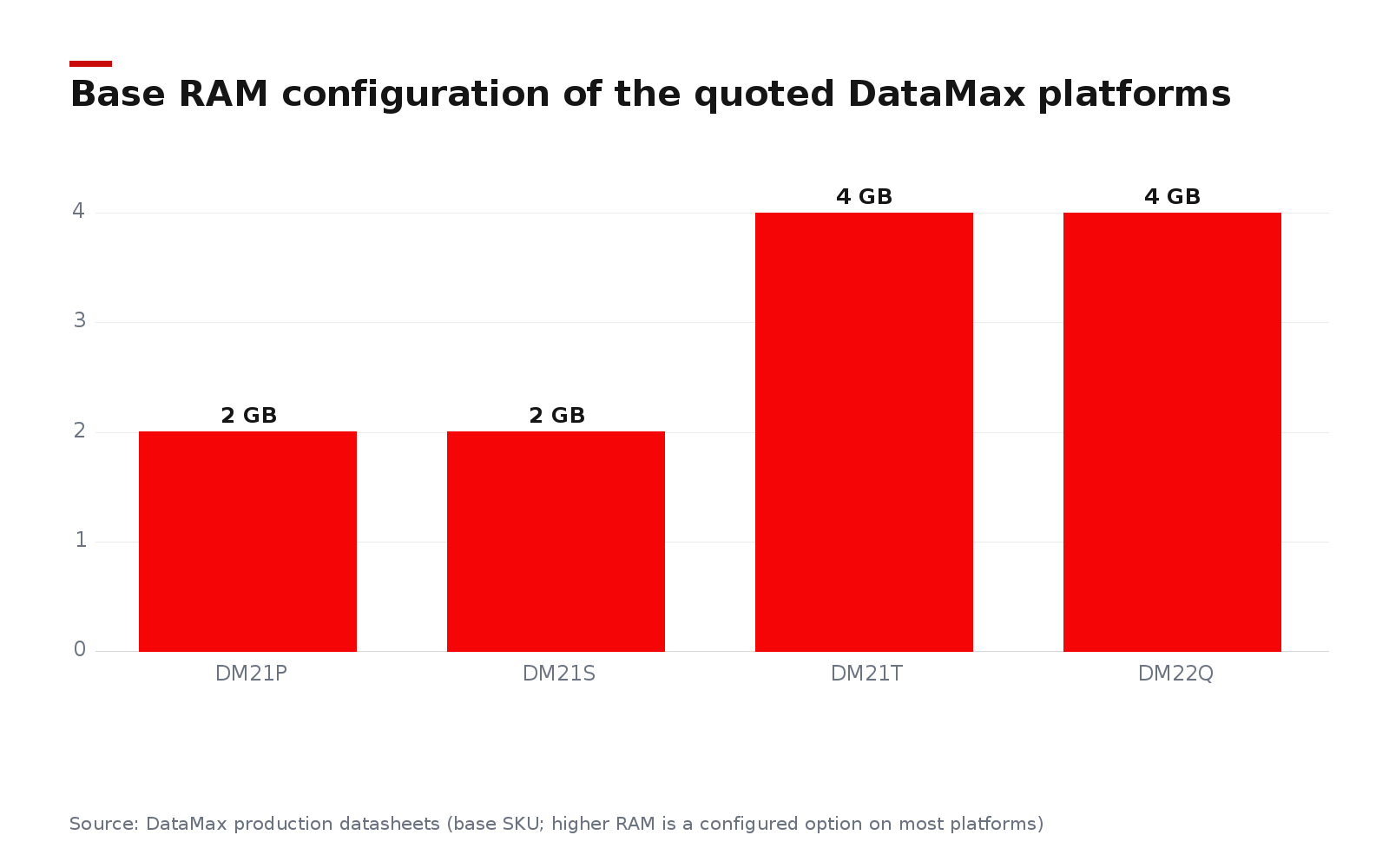
The same figures, in searchable form:
| Platform | Base RAM |
|---|---|
| DM21P | 2 GB |
| DM21S | 2 GB |
| DM21T | 4 GB |
| DM22Q | 4 GB |
| Model | SoC and OS | RAM / ROM | Decode and DRM | Interfaces and fit |
|---|---|---|---|---|
| DM21P | Amlogic S905Y4, quad Cortex-A35; AOSP Android 11 | 2GB / 8GB; 4GB RAM and 16/32/64GB storage optional | AV1 [email protected]; VP9/H.265 4K@60; H.264 4K@30; Widevine L1 / PlayReady; HDCP 2.2 optional | HDMI 2.0b out x1; USB2.0 x2; TF; S/PDIF; 3.5mm AV; RJ45 100M; Wi-Fi6 2x2 + BT5.4; DC 5V/2A. Fit: 4K IPTV / operator middleware set-top box |
| DM21S | Amlogic S905Y5, quad Cortex-A55; AOSP Android 14 | 2GB / 16GB; 2/4/8GB RAM and 16/32/64GB storage optional | AV1 / H.265 [email protected] 4K@60; Widevine L1 / PlayReady optional; Dolby Vision/DTS | HDMI 2.0b out; S/PDIF; AV; USB2.0 x2; TF; RJ45 100M (1G optional); Wi-Fi6 2x2 + BT5.4. Fit: 4K Android TV box for IPTV/OTT white-label |
| DM21T | Amlogic S905X5, quad Cortex-A510 (ARMv9); AOSP Android 14 | 4GB / 64GB; family options | H.266/VVC [email protected] 4K@120; AV1/VP9/H.265 4K@120; AVS3 4K@120; H.264 4K@60; inline AI-SR; Widevine L1 / PlayReady optional | HDMI 2.0b out, no HDMI input; USB2.0 x1 + USB3.0 x1; TF; S/PDIF; AV; RJ45 100M (1G optional); Wi-Fi6 + BT5.4. Fit: Premium UHD / cloud-gaming box |
| DM22Q | Amlogic S905X5M, quad Cortex-A55 up to 2.5GHz; AOSP Android 14 | 4GB / 64GB; 2/4/8GB RAM and 16/32/64GB storage optional | AV1/H.265 L5.1 4K@60; inline AI-SR; Widevine L1 / PlayReady optional; Dolby Vision/DTS | HDMI 2.0b out; USB2.0 x2; TF; S/PDIF; AV; RJ45 100M (1G opt); Wi-Fi6 2x2 + BT5.4. Fit: Gaming-oriented Android TV box |
For ordering, confirm each optional item against the production datasheet. The table separates documented base configuration from stated options; it does not imply that every option is appropriate for every market or deployment. DataMax can support the engineering and production review through the inquiry process.
The final comparison step is a signed line-by-line configuration sheet rather than a product-family approval. For each model, record the base SKU, selected RAM and storage, Ethernet speed, port bundle, display application, DRM requirement, Android build, operator image, accessories, and evidence package. If a field remains unresolved, keep it open rather than relying on a sales catalogue. This gives the manufacturer a production target, operations an inspection reference, and engineering a repeatable baseline for firmware and hardware changes.
Before placing a purchase order, email [email protected] with the SKU list, target-market certificates, middleware/DRM checklist, approved golden-sample configuration, and required SMT/AOI/aging evidence package. The resulting attachment set gives the manufacturer a finite scope and gives the buyer a reviewable production baseline.
Further reading
- Guide tv box vendor selection checklist
- Telecom solutions
- United States compliance notes
- Android TV boxes
- Rockchip Android TV boxes
- DataMax DM21P specifications and fit
- DataMax DM21S specifications and fit
FAQ
What should a buyer ask an OTT streaming device manufacturer first?
Ask for the exact base SKU, SoC, Android release, RAM/ROM split, optional features, media limits, DRM position, port map, and target-market evidence. Then require a golden sample and a configuration record. A catalogue-style response is insufficient because “4K,” “Wi-Fi6,” and “L1” each describe only one layer of the delivered product.
How do I verify that a production batch matches the approved sample?
Request a serial-level trace from component issue through SMT, AOI, programming, functional testing, aging, dark-room inspection, final test, and packing. Compare the packed hardware revision, firmware build, labels, accessories, and test results with the approved sample. The manufacturer should also explain its change-control and deviation-approval process.
Is 4GB RAM automatically preferable for every OTT deployment?
No. Base RAM depends on the selected DataMax SKU: DM21P and DM21S have 2GB bases, while DM21T and DM22Q have 4GB bases. Higher RAM is a configured option on most platforms. Select from the actual application, operating system, middleware, cached content, and update requirements, then freeze the option in the PO.
Which checks most likely reveal a supplier-process weakness?
Review AOI records, firmware-flashing control, aging conditions, dark-room display criteria, serial traceability, and corrective-action evidence. Also test Ethernet speed, sustained decode, protected playback, peripherals, thermal behaviour, and recovery. A sample alone cannot demonstrate that the production line repeatedly achieves the same result.
Should 1G Ethernet be assumed from the RJ45 specification?
No. The quoted DataMax configurations state RJ45 100M, with 1G optional on DM21S, DM21T, and DM22Q. Specify the required speed explicitly and verify it on the ordered sample. If the target access network has other operating requirements, record them in the acceptance test rather than relying on the connector label.
How should DRM be written into an RFQ?
State the required security level, optional implementations, content-service responsibilities, and evidence expected for the target market. Widevine L1, PlayReady, HDCP 2.2, Dolby Vision, and DTS appear in different combinations across the quoted SKUs. The manufacturer should identify what the hardware supports, what is installed, and which obligations remain with the operator or content owner.


