

The procurement answer in one screen
There are 2 decisive gates, but neither is established by the chipset name alone: the commercial service programme and the shipped device configuration. RK3576 identifies a processor platform; it does not prove that an android tv box uses AOSP, carries GMS, meets Google TV requirements, or owns the necessary commercial authorisation. For an RFQ that states only “RK3576, AOSP or GMS,” the defensible response is to qualify the programme before recommending a model.
The practical answer is therefore conditional. Specify the required application-distribution model, the Android TV form factor, the licensing or certification applicant, and the evidence package. A Google-certified non-Google-TV AOSP+GMS SKU addresses one route. A controlled operator-middleware programme can use AOSP without Google services. A Google TV product follows a separate application and device programme. These are not interchangeable labels.
The supplied DataMax product facts describe four L1 platforms, and none is identified as RK3576. Consequently, no documented model can be presented as a direct RK3576 substitute. The RFQ must classify RK3576 as mandatory, preferred, or a reference platform. If mandatory, require the proposed production datasheet and an exact model-to-SoC statement. If preferred, compare certification route, software generation, memory, decode, DRM, and interfaces.
Every android tv box quotation should identify the ordering code, Android build, hardware revision, firmware hash, optional-feature configuration, and the exact model covered by qualification evidence. “AOSP,” “GMS ready,” “Google certified,” and “RK3576” are not acceptance criteria. Attach the approved golden sample to the purchase order and prohibit substitutions without written approval.
This angle covers only the unresolved certification and platform-selection gate. For the broader operating context, use the ISP Android TV box guide; the procurement work here begins by deciding which programme the device must satisfy.
Real DataMax platforms, field by field
The available DataMax evidence describes 4 L1 platforms, none identified as RK3576. Any quote that maps the RK3576 request directly to one of them requires explicit model confirmation. The table preserves the supplied production facts and does not infer Android TV certification from the operating-system label.
| Model | SoC | OS and positioning | Memory | Decode and DRM | Interfaces |
|---|---|---|---|---|---|
| DM21RTD | Realtek RTD1325 | GMS-certified AOSP; operators/retail requiring a Google-certified non-Google-TV AOSP+GMS SKU | Confirm against the production datasheet | AV1 capable | Confirm against the production datasheet |
| DM21P | Amlogic S905Y4, quad Cortex-A35 | AOSP Android 11; 4K IPTV/operator middleware | 2GB / 8GB; 4GB; 16/32/64GB optional | AV1 [email protected]; VP9/H.265 4K@60; H.264 4K@30; Widevine L1 / PlayReady / HDCP 2.2 optional | HDMI 2.0b out x1; USB2.0 x2; TF; S/PDIF; 3.5mm AV; RJ45 100M; Wi-Fi6 2x2 + BT5.4; DC 5V/2A |
| DM21S | Amlogic S905Y5, quad Cortex-A55 | AOSP Android 14; 4K white-label IPTV/OTT | 2GB / 16GB; 2/4/8GB; 16/32/64GB optional | AV1 / H.265 [email protected] 4K@60; Widevine L1 / PlayReady optional; Dolby Vision/DTS | HDMI 2.0b out; S/PDIF; AV; USB2.0 x2; TF; RJ45 100M; 1G optional; Wi-Fi6 2x2 + BT5.4 |
| DM21T | Amlogic S905X5, quad Cortex-A510 (ARMv9) | AOSP Android 14; premium UHD/cloud-gaming | 4GB / 64GB family options | H.266/VVC [email protected] 4K@120; AV1/VP9/H.265 4K@120; AVS3 4K@120; H.264 4K@60; inline AI-SR; Widevine L1 / PlayReady optional | HDMI 2.0b out; no HDMI in; USB2.0 x1; USB3.0 x1; TF; S/PDIF; AV; RJ45 100M; 1G optional; Wi-Fi6 + BT5.4 |
Three procurement signals matter more than chipset naming alone. First, DM21RTD is the only supplied platform explicitly described as “GMS-certified AOSP,” and its SoC is Realtek RTD1325. Second, DM21P, DM21S and DM21T are explicitly AOSP products; their supplied facts do not establish GMS certification. Third, “Android 11” or “Android 14” identifies a software generation, not the Google TV program or a commercial certification status.
The word “optional” also needs contractual treatment. A quote saying “Widevine L1 optional” is incomplete until the BOM identifies the exact configuration, and “HDCP 2.2 optional” does not prove that every shipped unit carries it. Likewise, 1G Ethernet is optional on DM21S and DM21T, while the listed baseline is 100M. The factory must bind the selected memory, codec, DRM and interface options to the ordering code and test report.
A controlled operator programme can reject a technically similar unit because the Ethernet PHY, wireless module, or power supply differs from the laboratory sample. Record each selectable item as included, excluded, or an ordered alternative. A 2GB / 16GB baseline is not interchangeable with 4GB / 64GB merely because both models appear in the same family quotation.
For an RK3576-qualified programme, the immediate comparison is documentary: request the proposed model’s production datasheet, certification status and pilot evidence. Do not infer eligibility from RAM, codec support or an AOSP label. Where a DataMax quotation must select from the listed models, send an RFQ whose first message states the required application, certification programme, SoC constraint, memory tier, output mode and target volume without disclosing commercial terms.
Buyer situations, ranked by what they punish
The right DataMax model direction follows from the failure an organisation cannot absorb: a retail launch blocked by certification, an operator rollout blocked by middleware integration, or a venue deployment impaired by device behaviour. A matrix turns those situations into explicit requirements rather than chipset preferences.
| Situation | Primary requirement | Model direction | RFQ evidence to demand |
|---|---|---|---|
| Operator with controlled middleware | AOSP base, predictable APIs, fleet update control and Ethernet stability | DM21P or DM21S; consider DM21T when the decode target requires it | Exact AOSP version, update mechanism, operator middleware build and interface test report |
| Retail channel requiring Google services | Commercial GMS qualification in the required non-Google-TV form factor | DM21RTD | Certification evidence identifying the legal applicant, device and shipment configuration |
| IPTV or OTT white-label programme | Flexible branding, required DRM, 4K delivery and manageable platform cost | DM21P for 4K IPTV middleware or DM21S for Android 14 white-label | Golden sample, APK preinstallation list, DRM configuration and 4K output matrix |
| Premium UHD or cloud-gaming venue | Higher memory tier, high-frame-rate decode, USB and AV integration | DM21T | Declared output format, frame-rate test method, latency method and thermal sample report |
| Distributor carrying several regional SKUs | Traceable configuration control and shipment evidence | Direction depends on the commercial gate: DM21RTD for the stated GMS route, otherwise an AOSP model | Serial-to-SKU mapping, certification applicability and tamper-evident packing evidence |
Rank the situations by consequence rather than device count. A retail certification failure can stop the channel launch even if the hardware passes playback tests. An operator middleware defect can block activation for an entire cohort. A venue’s decoder or interface limitation can be contained to one installation if the fleet image and fallback path are controlled.
The laboratory comparison should include at least 4 paths: boot and service authorisation, network attachment, protected-content playback, and physical output. A unit may boot an AOSP build and still fail the commercial requirement. Another may include Google services yet fail DHCP, multicast, HDMI handshake, remote input, or OTA update recovery.
The target scene for this programme is

. Use the photograph as a scene description for an engineering comparison, not as evidence of certification. Certification conclusions come from the applicable dossier; playback conclusions come from a defined test matrix; physical behaviour comes from the identified sample.
For the soft technical next step, the AOSP versus Google Android TV guide helps separate software-base wording from certification-program wording. If video delivery drives the project, the AV1 Android TV box guide provides a separate check for decoder level and format constraints. Neither guide substitutes for the device-specific certificate and production evidence.
Do not let “RK3576” occupy the requirement row by default. If it is a mandatory silicon constraint, the table becomes a screening exercise: verify whether the candidate model’s production SoC matches it. If it is merely a requested reference platform, compare certification, memory and software support across available models. This distinction prevents an attractive processor label from creating a technically invalid model award.
A decision path for the RFQ
The RFQ should turn certification ambiguity into a sequence of 6 binary gates. Each gate has an owner and documentary output; “best effort” is not an acceptance criterion because it defers the commercial decision until after tooling or certification expenditure.
- Classify the distribution requirement Write “GMS-certified AOSP non-Google-TV,” “Google TV,” or “AOSP without Google services” into the specification. Include the required legal applicant and target territories.
- Confirm the silicon constraint Mark RK3576 as mandatory, preferred or remove it. Reconcile the requested SoC with each proposed DataMax model’s production datasheet.
- Set the video contract Specify output resolution, refresh rate, chroma format, HDR mode and required decoder profile. Avoid accepting “4K capable” or “8K” marketing language without an output test limit.
- Bind the commercial configuration Define the exact RAM/ROM, storage variant, Ethernet speed, DRM set, codec set, ports, preinstalled applications and firmware update path in the ordering code.
- Approve evidence before pilot entry Request the certification dossier applicability statement, golden sample, test report and traceability map against the proposed SKU.
- Convert approval into contract text Attach the approved sample, serial number, software build and hardware revision to the purchase order; require notification before any change.
The practical flow is requirement → documented platform → golden sample → pilot gate → purchase order. Do not move a platform to the purchase order merely because a distributor describes it as “GMS ready.” The acceptable evidence depends on the programme: certification records for the commercial requirement, Android compatibility and CTS/CDD evidence where applicable, and operator-specific interoperability reports.
A procurement example shows why Gate 2 cannot be skipped. If the operator insists on RK3576 but DM21S is proposed because its AOSP Android 14 build fits the launcher, the award cannot proceed on performance alone. The RFQ response must state that the proposed production SoC is Amlogic S905Y5 and either remove RK3576 or require a compliant candidate. A processor preference is not a waiver for a mandatory requirement.
Pasteable RFQ lines should be unambiguous:
- “The device shall use the following certified service layer and Android TV programme: [state exact requirement]. Certification evidence shall identify the applicant, model and shipment configuration.”
- “The processor shall be [mandatory/preferred]: [RK3576 or another specified SoC]. Any substitution requires written approval before sample acceptance.”
- “The shipped configuration shall be [RAM/ROM], [Ethernet], [DRM], [codec profile], [output format] and [preinstalled applications]. ‘Optional’ features are not treated as supplied.”
- “The golden sample serial number, hardware revision, Android build and firmware image hash shall be referenced in the purchase order and test report.”
A first RFQ message should contain the target programme, deployment country, operator middleware or app model, required resolution and refresh rate, RAM/ROM, interface list, DRM and certification documents, plus the requested sample quantity. Use the inquiry form or the sample-order route to submit that package. The request should ask for a response that separates confirmed facts from assumptions.
The final gate should define what happens when evidence is incomplete. Write “no purchase-order release” or “pilot entry blocked” rather than allowing the buyer to waive a programme requirement informally. Record substitutions, optional features, certification scope, and firmware changes as controlled deviations with named approvers.
What goes wrong after the PO
The most expensive divergence is semantic. One quotation interprets “AOSP” as sufficient for Google Play distribution; the buyer intended a fully qualified commercial programme. The quotation may be technically valid yet commercially unusable. A clause that says “AOSP or GMS equivalent” cannot define the legal applicant, certification scope or required evidence.
Field trap
A processor specification does not establish Google certification. If the programme requires GMS-certified AOSP in a non-Google-TV form factor, demand the device-specific qualification evidence and verify that the certificate or authorisation applies to the proposed model, hardware revision, firmware and commercial applicant. The cost of correction is programme delay, relabelling, a new application or resubmission, depending on the discrepancy.
Field trap
An “optional” feature becomes a line-item dispute when the BOM omits it. Widevine L1, PlayReady, HDCP 2.2, 1G Ethernet, Dolby Vision, DTS, memory variants and decode modes must be identified as included, excluded or priced alternatives in the ordering code. A sample showing one feature does not bind the production shipment.
Configuration drift creates a second class of failure. The approved golden sample contains an operator application, remote-control mapping and a specific firmware build; production arrives with a different Android image, Wi-Fi module or power supply. Interfaces that passed bench testing may then fail in the field because Ethernet negotiation, HDMI handshake, optical output or USB peripheral behaviour differs.
A third class of failure is codec-level ambiguity. “AV1 capable” does not identify profile or level. “4K@60” may conceal decoder format, output format and chroma-subsampling differences. A procurement clause must define what the device decodes, what it outputs and what the display must render. For DM21T, the supplied datasheet caps its stated output and decode claims at 4K even if older marketing uses “8K”; the purchase specification must never inherit an 8K output promise.
A fourth class of failure is certification scope mismatch. A certificate may identify a device family while the production unit differs in RAM, storage, radio module, firmware or branding. The evidence request should connect the proposed configuration to the authorised subject, not merely attach an unrelated certificate.
A fifth failure appears during fleet onboarding. A device passes first boot but cannot obtain an address, join the operator backend, activate DRM, or persist its update state after a restart. These are not certification issues unless the contract assigned them there; they are integration failures. The acceptance test must include repeated network attachment, middleware login, licence acquisition, reboot recovery, and an update followed by a second restart.
A sixth failure comes from incomplete exception handling. If the display cannot negotiate the required format, does the box output black, fall back silently, or remain on a setup screen? If the operator server is unavailable, can the middleware reach a controlled offline state? Procurement language should require an agreed fallback and a retained log package for each failure mode.
The commercial safeguard is change control. State that Android version, chipset, PCB revision, memory, radio module, power adapter, preinstalled APK set, security patch level and DRM configuration require prior approval. Record the golden sample and its build hash. Where certification scope is unclear, stop pilot approval rather than accepting an interpretation over email.
Verification you can ask for on paper
Factory verification should form a traceable chain from board assembly to approved shipment. The buyer does not need every internal document, but each acceptance claim needs an owner, evidence identifier and a link to the sampled configuration.
- SMT and AOI Request the line route, SMT stencil and program version, AOI coverage and defect record for the production board revision. A process statement without the board and revision identifier is not useful.
- Boot and firmware control Tie the firmware image hash to the hardware revision, Android build, preinstalled applications and first-boot configuration. Record the approved image used for the golden sample.
- Electrical and RF verification Request test limits and pass results for power, interfaces, Ethernet, Wi-Fi and Bluetooth. Include the instrument method where RF output or regulatory compliance is a delivery gate.
- Ageing and dark-room testing Define burn-in duration, chamber conditions and sample selection in the acceptance plan. The quotation must not substitute a generic “100% tested” claim for an agreed procedure.
- Software and media playback Bind the test matrix to the required codec profiles, output modes, applications and DRM configurations. Include long-run playback, reboot, network attachment and update procedure.
- Audit and shipment traceability Request the serial-number range, model mapping, packing record and configuration-release audit. Connect the approved sample to serial and shipment records.
Define evidence granularity before sampling. For an android tv box programme, a “pass” is weak unless it identifies the board revision, serial number, software image, test station, measured value and acceptance limit. A media report should show the content profile, output mode and expected rendering; a network report should show the interface negotiation and transfer result.
Sampling rules also matter. Name whether acceptance uses a sample from the first article build, each production lot, or a defined sampling plan. State whether a failed sample stops the lot and whether corrective action requires re-test of retained units. This prevents the supplier from showing a successful engineering sample that differs from the shipping population.
Use DataMax factory-quality evidence to define the document set, and require the supplier to identify which evidence belongs to the proposed model and order. The DataMax L1 platform list used in this article does not itself establish RK3576 availability, GMS scope for an RK3576 design, or acceptance of a new programme.
The paper audit should answer 5 procurement questions without inference: What was built? Which firmware was installed? Which qualification applies? Which sample passed? Which production units match that sample? A document labelled “certificate” without an applicant, model, scope or validity information cannot close the first, fourth or fifth question.
Regulatory and compatibility claims require their own controlled evidence. certification documentation, compliance information and an audit plan can form part of the release package, but the buyer must verify applicability to the destination market and shipment configuration. For branded programmes, also check OEM and ODM manufacturing scope and custom-development controls.
Certification and manufacturing evidence solve different problems. Android programme qualification establishes compatibility or commercial-service conditions; factory QA establishes that shipped units match the approved product. A factory can manufacture a certified reference design accurately, yet a later hardware substitution can void the commercial fit. Conversely, strong QA cannot repair a programme that was never selected.
Entry tier versus commitment tier
The supplied DataMax range does not label an “entry tier” and “commitment tier.” The following comparison uses procurement position rather than inventing a commercial tier: DM21P and DM21S are baseline AOSP options, DM21T is the higher-decode and higher-memory option, and DM21RTD is the route whose supplied fit explicitly addresses GMS-certified AOSP.
| Dimension | DM21P | DM21S | DM21T | DM21RTD |
|---|---|---|---|---|
| Documented position | 4K IPTV/operator middleware | 4K IPTV/OTT white-label | Premium UHD/cloud-gaming | Google-certified non-Google-TV AOSP+GMS route |
| Software baseline | AOSP Android 11 | AOSP Android 14 | AOSP Android 14 | GMS-certified AOSP |
| SoC | Amlogic S905Y4, quad Cortex-A35 | Amlogic S905Y5, quad Cortex-A55 | Amlogic S905X5, quad Cortex-A510 (ARMv9) | Realtek RTD1325 |
| Memory position | 2GB / 8GB; other options listed | 2GB / 16GB; other options listed | 4GB / 64GB family options | Confirm against the production datasheet |
| DRM statement | Widevine L1 / PlayReady / HDCP 2.2 optional | Widevine L1 / PlayReady optional; Dolby Vision/DTS | Widevine L1 / PlayReady optional | Confirm against the production datasheet |
| Procurement consequence | Fits controlled operator middleware where AOSP is sufficient | Adds Android 14 and white-label orientation | Requires 4K@120 decode targets to justify the platform position | Use when the stated GMS certification gate is mandatory |
The chart below compares how risk reduction mechanisms typically progress. It is an editorial ranking, not measured performance, and its values must not be treated as an audit score.
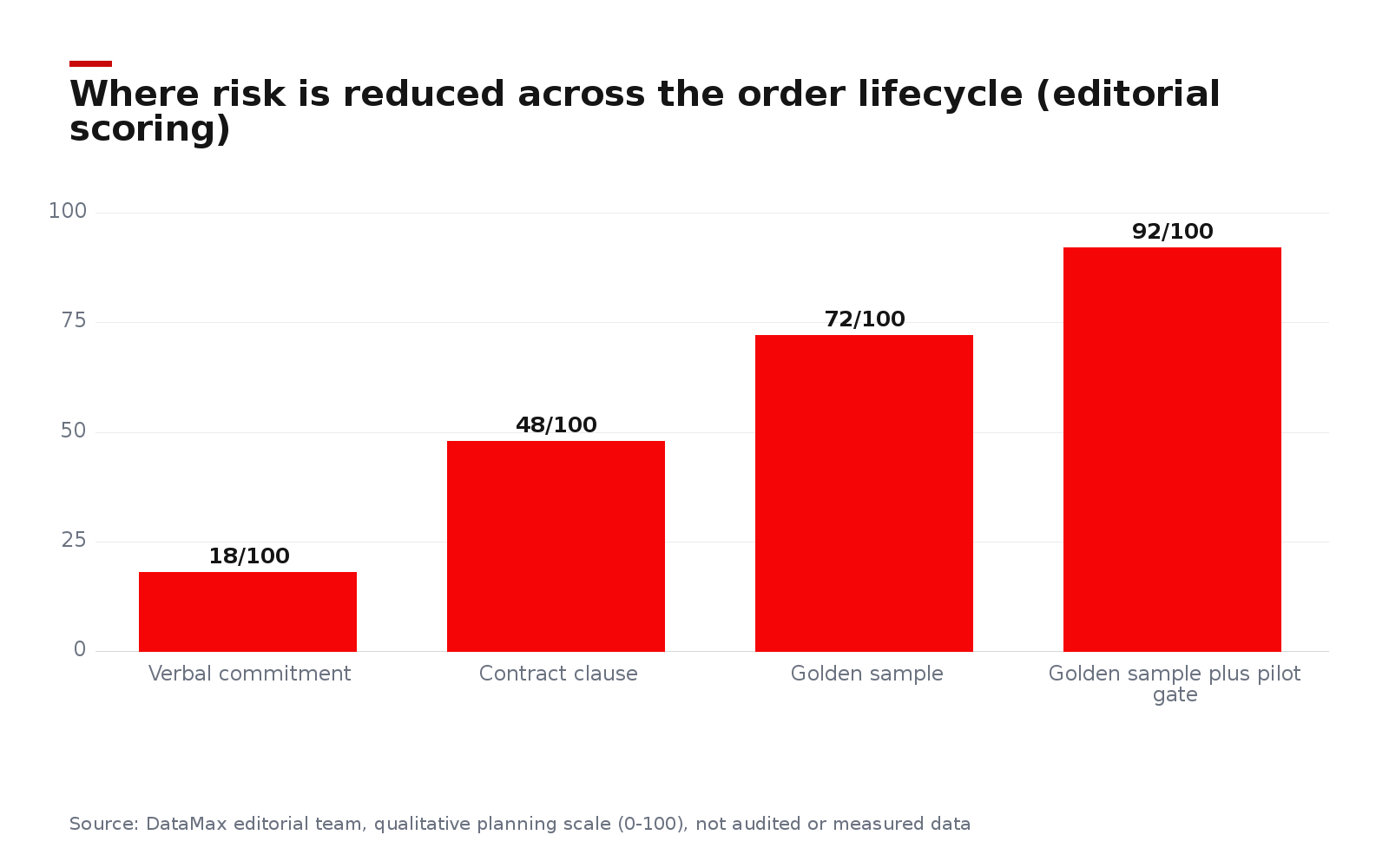
The same figures, in searchable form:
| Control mechanism | Editorial score |
|---|---|
| Verbal commitment | 18 |
| Contract clause | 48 |
| Golden sample | 72 |
| Golden sample plus pilot gate | 92 |
The practical commitment tier is therefore procedural: contract clause plus golden sample plus pilot gate. The product tier is secondary. DM21RTD is the documented commercial-service route; DM21P, DM21S and DM21T remain relevant AOSP choices where that route is unnecessary. Since the requested RK3576 platform is not established in the supplied facts, the robust award is a documented configuration and acceptance process, not an assumed chipset.
An android tv box buyer should also compare configuration control, not only headline capability. DM21P lists RJ45 100M, while DM21S and DM21T list 1G as optional. DM21T adds USB3.0 but has no HDMI input. These differences affect the bill of differences more than a generic “premium” label: network-heavy middleware, removable media, or gaming peripherals create different interface risks.
The 18-to-92 editorial progression is a planning hierarchy, not measured performance. A verbal commitment may preserve alignment until a dispute, a contract clause defines obligations, a golden sample demonstrates one approved configuration, and a pilot gate tests the production process before scale. For RK3576 specifically, the first missing evidence is model identity; every later control depends on that identity.
The mechanism behind the spec
The apparent ambiguity comes from conflating 4 layers in the device software and commercial stack.
- AOSP is the open-source Android software base.
- AOSP Android 11 or AOSP Android 14 identifies a software generation, not Google TV qualification.
- Operator middleware, white-label applications and update control can be built around an AOSP baseline.
- GMS denotes Google Mobile Services, the licensed service layer including its commercial conditions.
- A GMS-certified product needs device-specific qualification evidence; the presence of Google packages is not equivalent to a valid commercial authorisation.
- Google TV is a distinct Android TV programme and experience, not a synonym for GMS.
- A non-Google-TV AOSP+GMS product addresses a different requirement from a Google TV product.
- Codec support, output resolution, refresh rate, DRM protection and HDMI behaviour are platform-level implementation choices.
- A chipset label does not specify the shipped configuration without a datasheet and test evidence.
For operator programmes, AOSP can be advantageous when the operator controls the launcher, application distribution, authentication, middleware and updates. The trade-off is responsibility: internal teams must own more of the integration, update policy and compatibility burden. For retail distribution, GMS qualification may be commercially mandatory because the channel, application catalogue and account experience depend on Google services.
The RK3576 request probably originates from a hardware planning document where SoC capability is being treated as the decision. That moves the wrong variable to the front. The RFQ should start with distribution rights and device qualification, then test whether the proposed hardware can carry the approved software baseline and media contract.
Standards evidence must stay at the correct level. Android CDD and CTS describe platform compliance and test requirements; they do not by themselves establish every commercial condition attached to a specific programme. Widevine L1 and PlayReady concern protected-content licensing and security levels, while HDCP 2.2 concerns output protection; the final implementation must be confirmed on the exact device and display path. the 4K 60 fps Android TV box guide can support frame-rate planning, but it cannot resolve certification ownership.
Protected-content flows require a complete path: the application requests a licence, the device obtains it through the applicable service, playback uses the declared DRM configuration, and the output path maintains the required protection. A test that merely opens a protected title does not prove the exact profile or output implementation. Record the service account class, licence acquisition result, playback format, and display path.
An android tv box specification can therefore contain 3 independent release gates: a software release, a qualification release, and a manufacturing release. Each gate needs separate evidence. A new operator image, a changed radio module, or a rebranded package can affect one or more gates without changing the RK3576 processor name.
This mechanism explains why the answer remains conditional: AOSP or GMS is a requirement-design question before it is a hardware-selection question. The buyer must define the programme, the manufacturer must produce matching evidence, and the contract must bind both to the approved sample. Contact DataMax with the programme name and proposed configuration when that evidence trail is ready.
Further reading
- Guide android tv box for isps
- Amlogic Android TV boxes
- Google TV devices
- AV1 Android TV box guide
- AOSP vs Google TV guide
- DataMax DM21RTD specifications and fit
- DataMax DM21P specifications and fit
FAQ
Does RK3576 automatically mean an Android TV box is AOSP or GMS?
No. RK3576 identifies a processor platform, not its software distribution model or commercial qualification. The production OS may be AOSP, GMS-certified AOSP or another configured build. The buyer must define the required Android TV and Google services programme, then obtain evidence for the exact proposed model and configuration.
Is GMS-certified AOSP the same as Google TV?
No. GMS-certified AOSP describes a Google-certified service layer on an AOSP-based product. Google TV is a separate application and device programme with its own requirements. DM21RTD is described in the supplied facts as a GMS-certified non-Google-TV AOSP+GMS option, so it must not be presented as equivalent to a Google TV model.
Can an AOSP Android TV box run operator middleware?
Yes, when its software interfaces, update mechanism and device configuration meet the operator’s requirements. DM21P is expressly positioned for operator middleware, while DM21S supports white-label IPTV/OTT use. Approval still requires a golden sample, operator middleware test, network and update testing, plus contractual configuration control.
Which DataMax model should replace an unspecified RK3576 request?
No direct replacement can be selected from the supplied facts because none of the four documented DataMax L1 platforms is identified as RK3576. If RK3576 is mandatory, confirm against the production datasheet before comparing DM21P, DM21S, DM21T or DM21RTD. If it is only preferred, select from the required certification route, OS generation, memory, decode, DRM and interfaces.
What evidence should be attached to the purchase order?
Attach the approved golden-sample serial number, hardware revision, Android build, firmware image hash, ordering code and agreed test matrix. For certification-dependent programmes, include evidence that applies to the proposed model, firmware, applicant and shipment configuration. Also record any optional feature as explicitly included or excluded.
When should an RFQ request samples?
Request samples after the programme, configuration and test matrix are written but before the commercial commitment. The sample proves physical behaviour, interface integration and media output; the contract then binds production to it. Use the inquiry message to state the certification route, target market, OS, memory, codec and DRM needs, interface list, middleware or applications, and sample quantity.


