

The short answer first
Before approving an android tv box for IPTV operations, confirm eight linked requirements: operator middleware integration, catalogue playback, DRM level, Android release, memory configuration, connectivity, update control and manufacturing evidence. Each requirement must be verified against the production datasheet and a representative device, not inferred from a model name or generic chipset description.
Playback is more than decoding a video stream. The device must also support the operator’s catalogue, entitlement, login, EPG, catch-up and playback-state workflows. DRM must match the selected service model: a linear or transactional IPTV tier may require different capabilities from an OTT application distribution programme. Connectivity must reflect how subscribers receive service and how operators manage devices. Finally, the quotation must identify the exact production configuration and the evidence available for that SKU.
The shortlist below starts with the DataMax DM21P for 4K IPTV and operator middleware deployments. It includes the DM21RTD for a Google-certified non-Google-TV requirement, the DM21S for Android 14 IPTV or OTT white-label programmes, and the DM21T for premium UHD or cloud-gaming workloads.
For broader platform selection, compare the android tv box guide for ISPs. This article concentrates on the playback-and-catalogue plane: what the box must execute, what the operator must integrate, and what a factory must demonstrate before volume approval.
Two routes, one bill of differences
Operator programmes divide into two procurement routes. Route A starts with a production platform and controls software, middleware integration and branding. Route B assigns a larger share of product definition, firmware branching and hardware adaptation to the ODM. The commercial and engineering risk profile differs even when both routes use an android tv box as the endpoint.
| Decision area | Route A: configured production platform | Route B: committed ODM programme |
|---|---|---|
| Starting point | Published platform specification | Joint hardware and software specification |
| Operator integration | Middleware and catalogue application adaptation within defined platform boundaries | Feature-branch, interface and enclosure development through a jointly controlled roadmap |
| Branding scope | Typically launcher and boot presentation | Can include package, UI, remote control, enclosure and deployment artefacts |
| Qualification effort | Focused on application, DRM, network and device acceptance | Includes electrical, mechanical, certification and production-readiness gates |
| Change control | Configuration and software release control | Formal requirement baseline and operator approvals across disciplines |
| Principal risk | Hidden middleware assumptions or unsupported SKU combinations | Requirement churn, fragmented versions and incomplete evidence at handover |
| Evidence requested at sample approval | Exact BOM, firmware image, middleware test results and factory traceability | Requirement traceability, branch governance, validation plan, tooling approval and end-to-end factory evidence |
| Change after launch | Configuration updates and controlled application releases | Coordinated hardware, firmware, certification, documentation and field-support decisions |
The DataMax editorial assessment below ranks the scope that each engagement can support. It is a qualitative planning scale, not measured production data.

The same figures, in searchable form:
| Engagement option | Editorial score |
|---|---|
| Logo print only | 30/100 |
| Boot logo plus launcher | 55/100 |
| Firmware feature branch | 78/100 |
| Joint hardware/software ODM | 93/100 |
Route A usually requires the buyer to freeze an exact RAM/ROM, OS, DRM and connectivity combination before sampling. Route B adds a governance burden: naming, branching, documentation, update ownership and regression evidence must be agreed before artwork or tooling is locked. The higher editorial score for a joint ODM engagement does not remove validation work; it shifts more engineering decisions into the contract.
A practical procurement example illustrates the difference. An operator buying DM21P for an existing middleware release can define the acceptance set around catalogue launch, entitlement, channel change, VOD, catch-up, audio output, update recovery and Ethernet behaviour. It can issue one RFQ line for the model plus named options and require a sample report against a defined firmware image. A committed ODM programme has a wider bill of differences: the parties must also settle enclosure tooling, remote-control mapping, boot behaviour, operator-image ownership, regional labelling, firmware branch naming and the consequences of changing an Android component. The commitment is not the same as a logo change.
For route selection, the question is not simply “standard or custom”. It is whether the operator wants to own an integration against a fixed platform, or jointly own a product definition with a maintained branch. Operators with one service region and a stable middleware may favour Route A. Operators requiring differentiated hardware, a unified operator experience across retail channels, or a long-lived branded software baseline may justify Route B. Either route needs a change-control record: no later alteration to RAM, ROM, radio configuration, output hardware or firmware should occur without an engineering impact review.
How the requirement actually works
The playback-and-catalogue plane has four interacting layers.
Device foundation
The SoC, Android release, RAM/ROM and display interface determine the application runtime, local cache capacity, codec support and operator image baseline. A data-centre catalogue may be viewed through an operator application, while IPTV channels may arrive by managed IP unicast or multicast. The endpoint still needs the correct firmware, network behaviour, middleware integration and entitlement checks.
An android tv box must expose the interfaces required by the middleware. Depending on the deployment, that can include account authentication, EPG data consumption, channel-line navigation, VOD catalogue retrieval, resume position, parental control, entitlement events and device identity. Exact middleware APIs and playback integration requirements belong in the application-integration contract.
The platform baseline should also be treated as a compatibility boundary. Android 11 and Android 14 are materially different integration targets for an operator application, and AOSP does not by itself identify the operator image, build fingerprint or installed security patch level. The middleware owner should state the supported Android release and required APIs. The hardware owner should provide the image and firmware identifier. The certification owner should separately identify the target-market approval relevant to the selected SKU. Combining those records creates a reproducible starting point for catalogue testing.
Catalogue and playback
The catalogue layer maps a service identifier to assets, renditions, subtitles, audio tracks, catch-up windows and entitlement rules. The playback layer selects the correct rendition and applies the required decoder, DRM and output path. Operators should test catalogue responsiveness with the proposed RAM and ROM, because application startup, image handling and local cache pressure can affect perceived performance.
Codec declarations alone do not prove end-to-end playback. Verification should include stream startup, seek, channel change, catch-up resume, audio routing, subtitle rendering, error recovery and behaviour under constrained storage. A hardware decoder capability in the datasheet identifies potential support; it does not certify the complete middleware and stream pipeline.
A useful operator test script separates catalogue latency from rendering time. Record the interval from selecting a programme to the first visible frame, then the interval from selecting a live channel to video and matching audio. Repeat both tests with the catalogue cache in its expected initial and warmed states. Include a channel-change sequence because decoder reinitialisation can affect the result. For catch-up, verify that resume position survives application restart and matches the entitlement window. For VOD, check whether renditions use the expected codec, profile, level, resolution and frame rate.
Output behaviour belongs in the same script. Confirm HDMI mode, audio format, channel mapping, subtitles, parental control and volume control on the proposed TV or display. A platform can decode a stream correctly while the selected output, EDID negotiation or audio-routing configuration causes the subscriber-facing result to differ. The acceptance record should therefore identify the display model, firmware, middleware version, operator image and content source used for the test.
Licence and protection
DRM selection must follow the service’s licence architecture. Widevine L1, PlayReady and HDCP options appear across the relevant DataMax platforms, but optional means the quoted production SKU must identify whether the feature is fitted. The operator must also align the application’s licence requests with the content packager and rights service.
A useful acceptance matrix assigns each test item an owner: operator middleware, DataMax firmware, third-party CA or content team, and certification laboratory. That prevents an untested integration from being treated as a platform certification.
Licence testing should not stop at successful playback. Record whether the device receives a valid licence, rejects an invalid or expired entitlement, handles a service outage and recovers after a network interruption. Test secure-output requirements through the complete chain of application, DRM implementation, display adapter, cable and display. The correct evidence identifies the protected stream, the licence mode, the device build and the expected output path. Without that chain, an L1 label may only describe a capability rather than the service being sold.
Device and service operations
Provisioning, inventory, activation, telemetry, diagnostics and firmware update are part of the operating plane. Operators should agree whether devices are activated in the warehouse, at the retailer or on the subscriber network. They should also define recovery behaviour for failed updates and determine which diagnostics can be retrieved without exposing subscriber data.
The desired state is a controlled device lifecycle: manufactured unit → registered asset → installed operator image → activated subscriber service → monitored playback → patched or recovered device. Each arrow needs an owner, an input, an expected output and an audit trail.
This architecture should identify where the catalogue API runs, where entitlement is checked, which component requests DRM licences, where device identity originates and which team can approve a firmware update. It also needs a fallback path for a device that cannot activate. A support operator should be able to determine whether the failure is registration, middleware, licence, network, storage or output. That separation reduces false returns: an application issue should not trigger a board replacement, and an update failure should not be reported as a content outage.
The platform shortlist with datasheet values
This comparison uses only the supplied production facts. Optional configurations are shown as options rather than implied standard contents. Confirm the final BOM, certification status and regional radio approvals against the production datasheet.
| Model | SoC and OS | Memory | Playback and DRM | Connectivity and ports |
|---|---|---|---|---|
| DM21P | Amlogic S905Y4, quad Cortex-A35; AOSP Android 11 | 2GB / 8GB; 4GB; 16/32/64GB optional | AV1 [email protected]; VP9/H.265 4K@60; H.264 4K@30; Widevine L1 / PlayReady / HDCP 2.2 optional | HDMI 2.0b out x1; USB2.0 x2; TF; S/PDIF; 3.5mm AV; RJ45 100M; Wi-Fi6 2x2 + BT5.4; DC 5V/2A |
| DM21RTD | Realtek RTD1325; GMS-certified AOSP | Confirm against the production datasheet | AV1 capable | Confirm against the production datasheet |
| DM21S | Amlogic S905Y5, quad Cortex-A55; AOSP Android 14 | 2GB / 16GB; 2/4/8GB; 16/32/64GB optional | AV1 / H.265 [email protected] 4K@60; Widevine L1 / PlayReady optional; Dolby Vision/DTS | HDMI 2.0b out; S/PDIF; AV; USB2.0 x2; TF; RJ45 100M; 1G optional; Wi-Fi6 2x2 + BT5.4 |
| DM21T | Amlogic S905X5, quad Cortex-A510 (ARMv9); AOSP Android 14 | 4GB / 64GB; family options | H.266/VVC [email protected] 4K@120; AV1/VP9/H.265 4K@120; AVS3 4K@120; H.264 4K@60; inline AI-SR; Widevine L1 / PlayReady optional | HDMI 2.0b out, no HDMI in; USB2.0 x1 + USB3.0 x1; TF; S/PDIF; AV; RJ45 100M; 1G opt; Wi-Fi6 + BT5.4 |
DM21P is the operator-middleware starting point. Its explicit 4K IPTV fit, operator-oriented configuration and Ethernet interface make it the most direct platform for an operator service requiring a defined middleware port. The quotation must still resolve RAM/ROM, DRM and output options.
DM21RTD addresses the narrower condition in which the SKU must be GMS-certified AOSP and non-Google-TV. Its supplied facts do not define memory, ports or full decode behaviour, so those fields cannot be assumed from other models. Request the exact production configuration and certification scope.
DM21S aligns with Android 14 IPTV/OTT white-label work and adds Dolby Vision/DTS to the stated feature set. It distinguishes 100M Ethernet from an optional 1G configuration; network specification must be written into the SKU line.
DM21T targets premium UHD and cloud-gaming use. Its supplied decoding list reaches 4K@120 for specified codecs, but the production facts do not support an 8K output claim. The quoted HDMI configuration is output only, with no HDMI input. Any direct competitor feature comparison must use the same codec, resolution and frame-rate definitions.
Selection should begin with the controlling workload, not the largest specification. A managed-IP IPTV operator evaluating DM21P can use the stated 2GB / 8GB baseline as the starting configuration, while deciding whether the optional memory combinations are required by catalogue artwork, local caching and diagnostic workloads. An Android 14 white-label operator evaluating DM21S must decide whether the baseline 2GB / 16GB configuration or another stated option is operationally adequate. A premium programme evaluating DM21T should assess the stated 4GB / 64GB configuration against the application and any additional device-side processing.
The comparison also prevents invalid substitutions. DM21RTD cannot inherit DM21S memory or port claims because only the Realtek RTD1325, GMS-certified AOSP and AV1 capability were supplied. Likewise, the Wi-Fi6, Bluetooth 5.4, RJ45 and HDMI details listed for DM21P, DM21S and DM21T must not be transferred to DM21RTD. For every model, request a production configuration sheet that identifies the exact memory, network speed, output arrangement, regional radio configuration and fitted DRM implementation. The model family is the starting point; the ordered SKU is the contractual object.
Deployment scenarios and the spec each needs
The same android tv box can require different acceptance criteria across operator, integrator and venue deployments. The matrix maps each situation to a controlling requirement and a platform direction; it does not replace SKU validation.
| Situation | Primary requirement | Acceptance focus | Platform direction |
|---|---|---|---|
| IPTV operator, managed IP delivery | Operator middleware and reliable Ethernet access | Channel change, VOD catalogue, entitlement, provisioning and update recovery | DM21P; consider DM21S for Android 14 or richer multimedia requirements |
| Operator or retailer requiring GMS-certified AOSP | Correct application-distribution framework | Certification scope, non-Google-TV configuration and production identity | DM21RTD |
| Streaming integrator, custom venue interface | Launcher, catalogue application and peripheral integration | Signage workflow, remote input, schedule playback, diagnostics and recovery | DM21S or DM21T, subject to confirmed I/O and performance requirements |
| Premium UHD or cloud-gaming service | Specified high-frame-rate codec path | 4K@120 test vectors where applicable, output capability and input-device latency | DM21T |
| Wholesale white-label programme | Brand, packaging, middleware and regional compliance baseline | SKU traceability, labelling, factory burn-in and version control | DM21P or DM21S, then customise through a controlled programme |
| Hospitality room or managed venue | Central catalogue with controlled local playback | Scheduled playback, restart recovery, remote mapping, display wake and network reconnection | DM21S or DM21T, subject to confirmed I/O and operating requirements |
| Operator hybrid IPTV and OTT service | Common entitlement across linear and on-demand catalogue | Account association, catalogue refresh, licence flow, cross-service navigation and diagnostics | DM21S; DM21P remains a middleware-led alternative |
| Retailer-operated IPTV distribution | Correct certified application environment and sellable configuration | Certification scope, package identity, serial traceability, label verification and activation | DM21RTD when its stated certification condition controls |
For a telecom operator, the critical scenario is not a generic channel-change demonstration. It is a complete service path involving device registration, account association, entitlement, live playback, catalogue browsing, catch-up resume and support diagnostics. Ethernet should be tested at the same profile used in the subscriber network; the supplied DM21P, DM21S and DM21T baselines specify RJ45 100M, while 1G is optional on DM21S and DM21T.
For an AV or IT integrator operating a venue, the catalogue may be centrally managed while playback is local. The device acceptance script should then cover scheduled content, application launch after reboot, remote-control mapping, display wake-up, network reconnection and recovery from an interrupted update. Any signage-specific operating system, kiosk mode or peripheral support must be confirmed against the production datasheet rather than inferred from Android.
The photograph direction below represents a telecom engineering acceptance bench rather than a finished consumer retail scene.
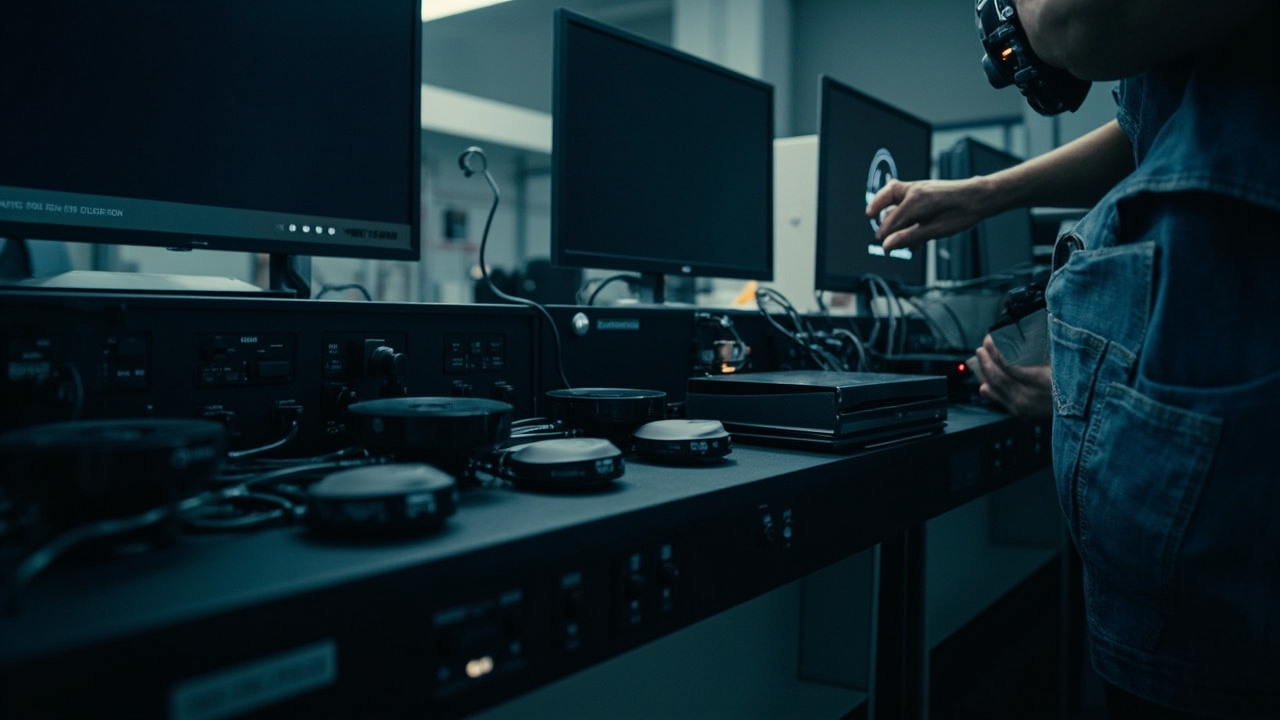
A retail programme introduces another control: the boxed unit, serial number, regulatory label, firmware identity and operator application must correspond to one sellable SKU. A manufacturing image can contain a valid platform and still be commercially wrong if the selected memory, connectivity or DRM option does not match the channel.
A venue programme also has a different failure boundary. If playback is local, network loss should not interrupt an already scheduled item, but the box must recover when connectivity returns and update its catalogue when instructed. If playback is streamed, catalogue caching and network stability become more important. A hotel operator may require a simple launcher and controlled access to a small catalogue, whereas a sports venue may prioritize high-frame-rate decode paths and stable output. The RFQ should identify which content is local, which is streamed and which controls remain available to venue staff.
Turning the question into a spec line
Turn procurement language into testable clauses. The following sequence converts a broad platform request into a configuration baseline and acceptance record.
- Define the service plane State the delivery method, catalogue source, middleware owner, live/VOD/catch-up requirements, entitlement mechanism and target geography. Attach the application version and supported OS release.
- Select the platform family Record the exact model, SoC and Android baseline. Use DM21P for operator middleware, DM21RTD for the stated GMS-certified AOSP condition, DM21S for Android 14 white-label or multimedia work, and DM21T for the specified premium UHD/cloud-gaming requirement set.
- Freeze hardware configuration Name RAM, ROM, Ethernet speed, wireless option, output configuration, DRM option and regional radio configuration. Mark unconfirmed fields “confirm against the production datasheet”.
- Define content and DRM evidence List each required codec, resolution, frame rate, audio format and licence system. Include representative streams for start, seek, channel change, resume and error recovery.
- Define operational controls State provisioning owner, update mechanism, device identity, telemetry, diagnostics access, version naming, rollback rules and recovery responsibility.
- Define production evidence Require SMT/AOI records, ageing or burn-in evidence, firmware traceability, serial/label controls, accessory checks and the agreed factory audit route.
- Lock acceptance and change control Identify golden samples, test scripts, approved firmware hashes, defect severity, retest procedure and who may approve a hardware or software change.
- Link the test to commercial release Attach the signed test record to the purchase order, sample approval and production release. State which defect classes block shipment and which can be resolved through a documented corrective-action cycle.
A pasteable specification line can use this structure:
Supply [model and exact production SKU] running [OS baseline] with [RAM]/[ROM], [wired and wireless configuration], [DRM option] and [output configuration]. Integrate [named middleware and catalogue application version]. Validate [named codecs, resolutions and frame rates] using [operator-supplied streams] and complete [licence, entitlement, catalogue, playback, update and diagnostics tests]. Release evidence shall include [SMT/AOI, ageing, traceability, labelling and firmware records].
The phrase android tv box may identify the product category, but it is not a purchase specification. A quotation that says only “Android TV box” leaves the Android release, memory, output, DRM, network and middleware boundary open. Those omissions can create two technically different SKUs with the same commercial description.
The specification should also define what is not in scope. For example, if the middleware team supplies the catalogue application but DataMax supplies the launcher and system image, both dependencies should appear in the integration plan. If HDMI input is needed for a capture workflow, a platform with output-only HDMI cannot satisfy it. If DM21S is ordered with 1G Ethernet, that option should appear in the SKU rather than in a general quotation footnote. If the programme needs a maintained feature branch, the branch owner, release naming, regression scope and update path should be written as deliverables.
A good RFQ then contains six attachments: the service-flow diagram, the catalogue and middleware versions, the protected-content matrix, the exact stream-test set, the device-management requirements and the factory-evidence list. The supplier’s response should point each requirement to a product field, software component, test result or document reference. Any unanswered item should remain visible as an open issue rather than being absorbed into the description “4K Android TV box”.
Where quotations quietly diverge
The largest divergence is usually not the visible model name. It is the unstated boundary between a base platform, an optional feature and a customer-specific build. Procurement teams need the discrepancy register below.
Field trap 1
A quotation that says “Widevine L1” may omit whether the licence is fitted on that production SKU, which application package is approved, or whether HDCP and output configuration have been tested as one chain. Require an exact SKU/BOM line, a licence test report and representative playback evidence. Otherwise the hardware capability and the deliverable service can be treated as equivalent when they are not.
Field trap 2
“4K” is not a complete playback specification. Codec profile, level, resolution and frame rate matter, as do HDMI and audio routing. For example, the DM21T facts state H.266/VVC [email protected] 4K@120 and several other 4K@120 paths, but they do not support an 8K output claim. Copy codec-specific acceptance items instead of using a generic resolution label.
| Ambiguous term | Why it diverges | Required written resolution |
|---|---|---|
| AOSP | May not identify release, certification or installed operator image | Exact OS release, certification status and image identifier |
| Optional DRM | May exclude the required licence implementation | Fitted or excluded, plus test-report reference |
| 1G optional | May change network component, validation and lead time | Exact Ethernet speed in the ordered SKU |
| Family options | May conceal the memory configuration | Exact RAM and ROM values |
| Customisation | May refer only to branding or to a maintained software branch | Logo, launcher, firmware branch, hardware and update-ownership deliverables |
| Certified | May refer to an incomplete certification scope | Certification body, target market, model identity and report scope |
| Wi-Fi6 / BT5.4 | May omit antenna, regional radio and regulatory configuration | Exact radio option, target-market approval and labelled configuration |
| Family options for memory | May refer to another platform in the same family | Exact RAM/ROM values and the ordered configuration identifier |
| Operator image | May conceal the middleware, launcher or update channel | Image name, build identifier, application version, signature method and update owner |
| Sample passed | May cover a different memory, network or DRM configuration | Golden-sample model, BOM, serial number, image hash and accepted test report |
Memory is another frequent source of late variation. A 2GB / 16GB configuration and a 4GB / 64GB configuration should not be compared solely by catalogue page, because they represent different runtime and storage behaviour. The buyer should test the exact proposed combination under the middleware, catalogue artwork and diagnostic workload it will carry.
Update ownership also needs precision. A factory image, a launcher and an operator middleware release may have different approvers and recovery procedures. Ask who signs the release, whether updates are staged, what the rollback mechanism is and how a failed activation is diagnosed. Without that answer, an android tv box can be technically compliant yet operationally difficult to support.
Other divergences appear at the handover boundary. A production unit may carry the correct board and still be loaded with the wrong image, paired with the wrong remote, packaged with an incorrect label or entered into the operator inventory under an incorrect product identity. Require the work order to bind all of those variables. The supplier should report the board revision, memory variant, radio option, firmware hash, serial number and operator-image identifier together.
Commercial language can obscure scope in a similar way. “White label” may mean only printed artwork, or it may include launcher design, boot animation, packaging, remote branding, a maintained firmware branch and operator update ownership. “Integration support” may mean access to a firmware team, an application port, a middleware interface, a certification campaign or end-to-end acceptance. The purchase order should attach a deliverable schedule with named artefacts, responsible parties and acceptance evidence. This prevents two quotations from being compared using the same label while carrying different engineering obligations.
Questions to put in the supplier review
The factory review should follow the physical and digital production chain. A request for generic quality assurance is not enough; the evidence must connect to the ordered SKU and the operator’s acceptance conditions.
- SMT and inspection Ask where SMT occurs, how AOI coverage is recorded and how defects detected after solder are isolated. Request the inspection plan for the exact board revision.
- Assembly and firmware control Verify how the correct board, memory configuration, radio option and firmware image are associated with the work order. Require traceability from serial number to component lot and image hash.
- Ageing and burn-in Define the ageing duration, workload and pass criteria for the quoted SKU. Ask for retained records or a summary showing failures and corrective action.
- Playback and I/O test Confirm that HDMI, Ethernet, USB, audio, remote-control and catalogue functions are covered at final test. The test should match the accepted operating profile.
- Dark-room or display verification Review how screen output, dead pixels or panel-related symptoms are inspected when the delivery includes a display. Do not assume every device programme uses the same test route.
- Audit trail Request access to a sample factory audit record covering line control, non-conforming material, software loading, label verification and final release.
- Delivery consistency Check how firmware, accessories, packaging and operator images are segregated for the programme, preventing a non-operator image from reaching subscribers.
Ask DataMax for a video factory audit or request SMT/AOI/ageing evidence for the exact playback-and-catalogue SKU. A useful evidence pack contains the ordered model and BOM, target-market certificate list, middleware/DRM checklist, firmware release identifier, test-script results, serial traceability sample and labelling record. Missing evidence should remain an explicit open item rather than an assumed approval.
For operators, the review should close with a control that connects production to service activation. Confirm whether a device can enter the subscriber inventory without the correct image, entitlement profile or serial record. The supplier should know the handover point: DataMax may prove hardware and firmware readiness, while the operator accepts activation and service playback.
For integrators, request a golden-unit record containing the image hash, remote configuration, display settings, application version and recovery procedure. This record becomes the comparison baseline when a later shipment behaves differently. A photographed screen is supporting evidence, not a substitute for version control.
The supplier review should also sample consistency rather than relying on one demonstration unit. Select several units from different positions in the planned build and compare their firmware hash, network configuration, output settings, remote behaviour and serial records. A mismatch can reveal that the approved sample and production process use different work instructions or loading paths. The corrective action should update the process and identify affected units before shipment.
For a first operator programme, the factory audit should be followed by a limited production sample that uses the operator’s own catalogue and protected streams. The acceptance record should identify the middleware version, operator image, content source, DRM configuration, test display and pass criteria. Only after this record matches the golden unit should the production configuration be released for broader shipment. The evidence then becomes a repeatable acceptance package rather than a one-time demonstration.
The final commercial gate should be signed against documents rather than descriptions. Before an android tv box order is released, verify model, SoC, OS, RAM/ROM, codec set, DRM option, ports, network speed and manufacturing evidence against the production datasheet. For the first programme, request a limited sample and complete the operator’s own stream and catalogue acceptance script before scaling the same configuration.
To prepare a technical review, email [email protected] with the SKU list, target-market certificates, middleware/DRM checklist, exact stream requirements and proposed factory evidence list. That package allows engineering and procurement to review one configuration baseline rather than reconcile several provisional descriptions.
Further reading
- Guide android tv box for isps
- Dolby Atmos Android TV box guide
- TV box vendor selection checklist
- AOSP vs GMS solution notes
- Telecom and pay-TV operator solutions
- DataMax DM21P specifications and fit
- DataMax DM21RTD specifications and fit
FAQ
Does Widevine L1 by itself make a set-top box suitable for IPTV?
No. Widevine L1 identifies a supported device protection level, but an IPTV deployment also depends on the operator middleware, entitlement flow, content packaging, application package, output path and device-management process. Specify the licence implementation in the exact production SKU and test complete playback and authorisation paths.
Which DataMax model is the first choice for operator middleware?
The DM21P is positioned as a 4K IPTV and operator middleware set-top box, with Amlogic S905Y4, quad Cortex-A35 and AOSP Android 11. It is therefore the clearest starting point for that requirement, but memory, DRM, middleware and connectivity must still be frozen before quotation approval.
When should DM21RTD be considered?
DM21RTD should be considered when the programme specifically requires a Google-certified non-Google-TV SKU using GMS-certified AOSP. It uses the Realtek RTD1325 and is AV1 capable. Memory, ports and detailed playback values were not supplied, so confirm them against the production datasheet.
Does DM21T support HDMI input?
No. The supplied DM21T facts specify HDMI 2.0b out and explicitly state no HDMI in. It is a premium UHD and cloud-gaming platform with specified 4K@120 decode paths; do not infer capture, pass-through or 8K output capability from the chipset class.
What should a buyer request before approving a volume order?
Request the exact model and BOM, OS and firmware identifier, RAM/ROM, DRM configuration, network speed, port list, target-market certification scope, middleware/DRM checklist, representative playback results, and SMT/AOI/ageing traceability. The evidence should identify the quoted production SKU and its approved software baseline.
Can an AV integrator use the same specification as an IPTV operator?
Only the hardware and platform fields can be reused automatically. An AV integrator may specify scheduled playback, remote control, launcher behaviour and display recovery, while an IPTV operator also needs entitlement, provisioning, EPG, catch-up and subscriber-service tests. Each deployment needs its own acceptance script.


