

The myth: one Android TV box price can cover every property
The wrong belief is that a hospitality group can negotiate one device price, then reuse that specification across every hotel, serviced apartment, resort or operator channel. That hides the variables determining whether a box can be deployed, licensed, supported and replaced across properties.
android tv box price is not one number; it is the result of a controlled bill of materials, software baseline, certification scope, memory configuration, connectivity, middleware integration and delivery evidence. The correct frame is to compare like-for-like configurations: same SoC and RAM/ROM, same Android release, same DRM proposition, same radio and interface scope, same certification evidence and same fulfillment terms. For the broader treatment, use factory price of an Android TV box as the canonical reference.
The first procurement question is not “what is the unit cost?” but “what exact configuration is being priced?” A product name leaves chipset, storage, operating system, DRM, network options and regulatory deliverables unresolved. Once the specification is written line by line, a supplier can expose quote substitutions and integration risk. For DataMax, the relevant CROSS-family direction is a model match, followed by a production BOM, compliance file and pilot gate. A request through order samples should identify the property profile, middleware environment and required evidence.
A multi-property group also needs a decision owner for every cost boundary. The operator may own entitlements and middleware certification; the integrator may own network commissioning; the venue may own room inventory and replacement. If responsibilities remain implicit, each party can treat its work as extra when rollout stalls. A quotation should identify who supplies the device, configures the software, accepts the installation, owns spare units and approves model changes.
The practical comparison unit is a “shippable property configuration,” not a model name. A 100M Ethernet device and a 1G Ethernet option are different RFQ lines even when the enclosure and SoC match. An OS release without an image revision and middleware acceptance plan is not yet deployable. This discipline prevents an apparently low figure from becoming a more expensive fleet outcome after pilot testing.
A second myth deserves correction: asking every bidder for the same model name cannot make quotations comparable. A quotation becomes comparable only when the same hardware revision, optional features, software payload, evidence package, delivery boundary and acceptance criteria are attached. Without that work, the comparison is between different commercial promises, not different production configurations.
The evidence trail from SMT to shipment
Factory price becomes reliable only when the evidence used to approve the unit matches the unit intended for shipment. The evidence trail should connect component inspection, software validation, network and RF checks, aging, compliance review and final packing. It should not rely on a catalogue image or a sample assembled outside production.
- Lock the production BOM Assign a unique revision to the SoC, RAM/ROM, Wi-Fi/BT module, interfaces, power supply and preloaded software. A quotation is not comparable after an unspecified memory or connectivity substitution.
- Verify board assembly Record SMT placement, AOI results and component traceability for each production lot. The inspection record should identify the line, date, work order and inspection coverage.
- Run software and interface checks Validate OS build identity, boot, storage, display output, Ethernet, Wi-Fi, Bluetooth, USB, audio, recovery and preinstallation. Record failures by serial number and defect code.
- Exercise network and RF behavior Check Ethernet link behavior and the specified Wi-Fi configuration, including required regulatory evidence. Do not infer certification from a Wi-Fi logo or chipset feature claim.
- Age and stress the unit Apply the agreed thermal, reboot, power-cycle and runtime regime. Save pass/fail results and attach them to the lot record rather than a generic “quality passed” statement.
- Audit compliance and packaging Match the shipment configuration to radio, EMC, safety, environmental and market-access documentation. Photograph the final label, carton and pallet mapping.
Field evidence pack: BOM revision, golden sample, AOI report, aging log, firmware hash, RF report, compliance file, serial-number allocation rule, carton mark and pallet map. Ask for the revision applicable to the production lot, not a generic factory dossier.
At the factory gate, purchasing should reconcile three identifiers: approved SKU, serial-number range and pallet or carton mark. A mismatch between firmware and hardware revision can invalidate network certification, middleware acceptance or the commercial assumption behind the quoted configuration. Evidence also needs to support failure analysis: when one property reports an issue, the team must determine whether it was a device, firmware, network, entitlement or content problem.
Production validation and qualification validation are different. Production validation asks whether a unit conforms to its approved specification. Qualification validation asks whether that specification works with operator middleware, display, room network, control system and service entitlement. A factory can pass the first test while the complete hotel workflow fails. The RFQ should name both scopes and identify the evidence expected from each party.
For a multi-property rollout, retain evidence at three levels. At unit level, record serial number, hardware revision and test result. At lot level, retain AOI, aging and packing records. At program level, retain the approved golden sample, firmware hash, property acceptance record and authorized change history. This hierarchy supports rapid answer to a field failure without making every engineer search unrelated test data.
A practical exception rule prevents undocumented drift. Any substitution affecting the SoC, memory, radio module, Ethernet option, power supply, connector set or preloaded image triggers written review by buyer, operator and factory. The review should identify whether certification, middleware acceptance, room-control testing or spare-stock assumptions must be revisited. Approval before substitution is less disruptive than discovering the difference after cartons reach regional warehouses.
Practical evidence rule: attach a short revision index to every production lot. The index should identify BOM, firmware hash, test record, packaging revision and shipment identifier on one page. A buyer can audit a carton or serial-number range without requesting every laboratory attachment for each property.
The same principle applies to the android tv box price decision. A quotation supported by a revision-indexed evidence trail is easier to approve because the buyer can see which assumptions are closed and which remain conditional. A lower figure with an undefined revision is not equivalent to a higher figure backed by a frozen production configuration.
Options placed side by side
A low quotation for a named product can still represent a lower-cost configuration than a higher quotation for a fully specified device. The difference is usually hidden in what was left out. This is a procurement structure, not a DataMax product quotation.
| Cost block | Entry tier | Commitment tier | Managed multi-property tier |
|---|---|---|---|
| Hardware definition | Model family only | SoC, RAM/ROM and fixed interfaces | Approved golden sample plus frozen production BOM |
| Software baseline | AOSP version stated | OS release, firmware hash and image policy | Signed image process, patch path and rollback rule |
| DRM and operator integration | DRM family named | Chipset-specific license path and test device | Certification, entitlement and renewal process documented |
| Connectivity | Wi-Fi or Ethernet listed | Module, antenna and Ethernet rate fixed | RF evidence, site survey support and property exception handling |
| Compliance | Generic certificate list | Country and exact model mapping | Document control across revisions and active SKUs |
| Delivery and support | Carton quantity | Lead-time assumptions and spare ratio | Lot traceability, RMA segmentation and phased deployment |
The entry tier is appropriate for laboratory comparison, but weak as an award basis. The commitment tier is the minimum useful commercial envelope: it freezes variables affecting installation and use. The managed tier adds evidence needed to run a fleet across properties without changing the unit definition after pilot approval.
A worked example shows the difference. Suppose a group compares 3 property classes: 120 operator-IPTV rooms, 80 OTT rooms and 20 premium rooms. A single model-only line obscures whether all 220 rooms need the same DRM, Ethernet rate, storage and OS release. Separate configuration lines reveal room requirements and spare numbers for each class. Procurement can assess whether a common platform reduces support work or whether one hardware family with controlled options is more realistic.
The commercial schedule should state where cost responsibility moves. The entry tier may end at carton. The commitment tier may include agreed inspection and delivery. The managed tier may include serialized inventory, regional staging, phased property waves, RMA routing and evidence handover. These are operational scopes, not optional benefits, and each requires a named RFQ line. When android tv box price is compared across factories, these boundaries prevent a factory quote from excluding work the buyer assumed was included.
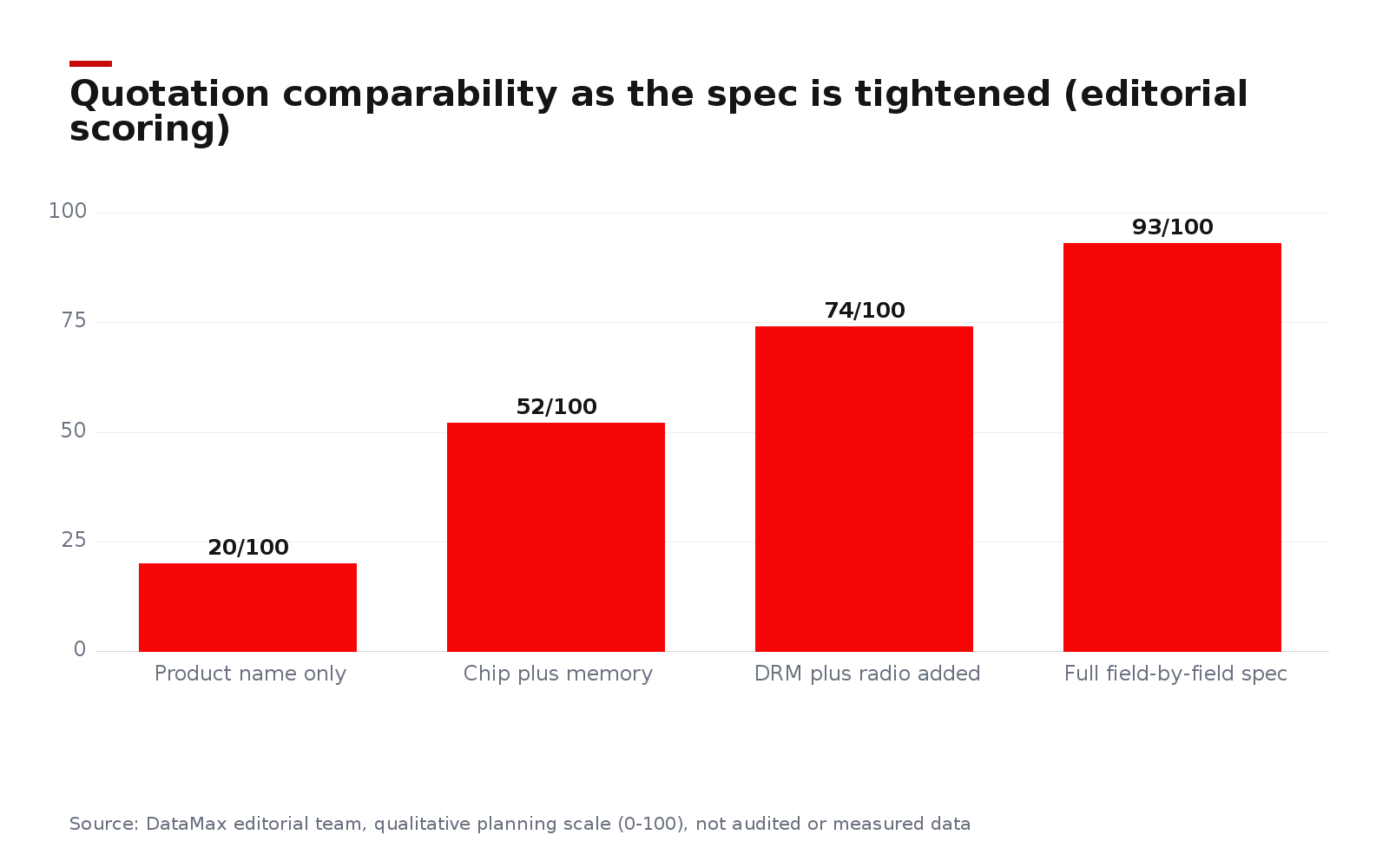
Quotation comparability improves as the specification becomes explicit. The following editorial score ranks procurement readiness, not measured performance or cost.
The same figures, in searchable form:
| Specification level | Editorial score |
|---|---|
| Product name only | 20/100 |
| Chip plus memory | 52/100 |
| DRM plus radio added | 74/100 |
| Full field-by-field spec | 93/100 |
Do not interpret the score as a predicted factory cost or measured quality rating. It answers a narrower question: how much purchasing meaning has been fixed before comparison begins. At 20/100, two suppliers can describe different devices under the same label. At 93/100, most commercial and technical interpretation errors have been removed, although pilot testing and document review remain necessary.
The score identifies the next RFQ action. A 20/100 response requires a hardware definition. A 52/100 response still needs DRM, radio, compliance and delivery boundaries. A 74/100 response needs a field-by-field delta against the fleet standard. A 93/100 response can proceed to sample validation, provided evidence and acceptance terms remain conditional and stated.
Definitions a buyer cannot outsource
A chipset is not an operating system, and an operating system is not a certified product. The device architecture must be defined at the level determining behavior, security and interoperability. AOSP is the Android Open Source Project baseline; it does not by itself establish Google certification, Widevine level, operator middleware qualification or playback rights.
DRM requires a separate chain. Widevine L1 means protected playback can occur in the defined device security configuration; it is not a substitute for PlayReady support where the service requires it. HDCP 2.2 is an output-protection requirement, while HDMI 2.0b describes an interface generation. Neither proves that a hospitality deployment has working license service, correct output behavior or an approved service workflow.
The operator stack normally includes a hardened Android image, bootloader policy, device identity, provisioning, entitlement, middleware, applications, update control and telemetry. Confirm against the production datasheet which OS, DRM and connectivity variants are production-qualified. For multi-property ownership, specify:
- Device identity: serial-number format, property tagging, asset mapping and ownership boundary.
- Software control: image source, release approval, staged rollout, rollback and patch responsibility.
- Service integration: middleware version, authentication method, entitlement platform, API and certification environment.
- Content security: required DRM systems, output-protection version, test streams and license-failure workflow.
- Network behavior: Ethernet rate, Wi-Fi configuration, captive portal support, DNS, multicast where used, VPN and telemetry.
- Compliance scope: destination market, radio module, exact model/revision, current report applicability and label artwork.
Android TV compatibility requires more than an Android logo. Demand evidence for the use case: operator middleware behavior, remote-control input, playback, network stability, recovery and OTA operations. Where devices are centrally managed, Android Management or an equivalent device-management architecture may be part of the operating model, but name it in the RFQ rather than assume inclusion.
Hardware decoding requires an exact workload statement. “4K” alone does not identify codec, color format, frame rate or output path needed for a room. The RFQ should state required decode paths and the display’s supported mode. This distinction is material when comparing a platform with AV1, H.265, H.266/VVC or AVS3 decode against one without the corresponding path. It is equally important for cloud gaming, where input latency and display behavior may matter more than the shared box specification.
Separate control planes from venue infrastructure. The control plane covers identity, images, entitlements, updates, telemetry and exceptions. The venue plane covers Ethernet switching, Wi-Fi coverage, television displays, room-control systems and physical installation. Each plane needs an acceptance owner. This prevents central IT from assuming that successful enrollment in Android Management proves the room system is operational.
Define the commercial unit explicitly. State whether the quotation covers the bare device, preloaded image, operator application, middleware license, certification, packaging, freight, installation or property acceptance. If a cost belongs to operator or integrator rather than manufacturer, identify it as excluded with an owner. Exclusions become dangerous only when ambiguous; a controlled exclusion can still be compared accurately.
Definition rule: write every acronym at first use and define the acceptance owner beside it. “Widevine L1 for the operator entitlement flow” and “HDCP 2.2 for the specified output path” are testable lines. “Google certified” or “DRM supported” without service context leaves the buyer to infer acceptance.
Five production SKUs compared
The production facts identify four DataMax CROSS-family models, not five distinct DataMax models. The fifth comparison line is the buyer-defined “fleet standard,” used to expose gaps without inventing a product. No unsupported chipset, certification or commercial term is added.
| Model | Position | SoC and OS | RAM/ROM | DRM | Key interfaces |
|---|---|---|---|---|---|
| DM21P | 4K IPTV / operator middleware set-top box | Amlogic S905Y4, quad Cortex-A35; AOSP Android 11 | 2GB / 8GB; 4GB; 16/32/64GB optional | Widevine L1 / PlayReady / HDCP 2.2 optional | HDMI 2.0b out x1, USB2.0 x2, TF, S/PDIF, 3.5mm AV, RJ45 100M, Wi-Fi6 2x2 + BT5.4, DC 5V/2A |
| DM21S | 4K Android TV box for IPTV/OTT white-label | Amlogic S905Y5, quad Cortex-A55; AOSP Android 14 | 2GB / 16GB; 2/4/8GB; 16/32/64GB optional | Widevine L1 / PlayReady optional; Dolby Vision/DTS | HDMI 2.0b out, S/PDIF, AV, USB2.0 x2, TF, RJ45 100M (1G optional), Wi-Fi6 2x2 + BT5.4 |
| DM21T | Premium UHD / cloud-gaming box | Amlogic S905X5, quad Cortex-A510 (ARMv9); AOSP Android 14 | 4GB / 64GB family options | Widevine L1 / PlayReady optional | HDMI 2.0b out (no HDMI in), USB2.0 x1 + USB3.0 x1, TF, S/PDIF, AV, RJ45 100M (1G opt), Wi-Fi6 + BT5.4 |
| DM22Q | Gaming-oriented Android TV box | Amlogic S905X5M, quad Cortex-A55 up to 2.5GHz; AOSP Android 14 | 4GB / 64GB; 2/4/8GB; 16/32/64GB optional | Widevine L1 / PlayReady optional; Dolby Vision/DTS | HDMI 2.0b out, USB2.0 x2, TF, S/PDIF, AV, RJ45 100M (1G opt), Wi-Fi6 2x2 + BT5.4 |
| Fleet standard | Buyer-defined target, not a DataMax SKU | Specify SoC and AOSP release | Specify RAM/ROM | Specify required systems | Specify ports, radio and exact configuration revision |
DM21P is the clearest operator-set-top direction in the supplied facts, particularly where operator middleware and Android 11 are fixed requirements. DM21S supports an IPTV/OTT white-label position with Android 14 and optional 1G Ethernet. DM21T moves toward premium UHD and cloud-gaming workloads, including 4K@120 decode paths and inline AI-SR, while retaining 100M Ethernet unless 1G is selected. DM22Q targets gaming-oriented use with Android 14 and a stated 4K@60 ceiling.
For DM21T and DM22Q, production facts control the claim set: the datasheet caps output and decode at 4K, so neither should be described as an 8K-output platform. The procurement RFQ should repeat the exact model, memory option, optional interface and DRM requirement. Any change to that line invalidates the comparison.
Selection should follow workload rather than model ranking. A 100-room operator property with established middleware may prioritize the DM21P direction and its specified connectivity and interface set. A mixed IPTV/OTT portfolio requiring Android 14 and configurable 1G Ethernet may point to DM21S. Premium rooms with a stated need for higher-frame-rate 4K decode may point to DM21T, subject to exact decode and output validation. Gaming-oriented requirements with a stated 4K@60 ceiling may point to DM22Q. These are model directions, not automatic awards.
Optional fields deserve special control. “1G optional,” “HDCP 2.2 optional” and “Dolby Vision/DTS optional” describe availability in the production facts, not inclusion in a quote. Mark each optional item enabled, excluded or pending validation in the RFQ response. If property classes enable different combinations, assign each combination a line and configuration code. That code should travel through the golden sample, production order, inspection checklist and deployment record.
Use the fleet-standard row as a rejection test. If a production quotation cannot populate the SoC and AOSP release, RAM/ROM, DRM, ports, radio and configuration revision, it is not yet an awardable response. The fifth row is not a fifth DataMax product, but a procurement control revealing undefined fields.
For a multi-property group, copy the table into the RFQ with a configuration code beside each model. “DM21S–Android14–1G–DRM-set” identifies a business decision, while the golden sample and production BOM identify the exact unit. Send this structure to DataMax through the RFQ inquiry channel, with the first message containing property classes, target configuration, destination market, requested evidence and sample timing. That lets a supplier return a comparable response rather than a catalogue quotation.
The operator, the integrator and the venue
Ownership changes the requirement set. A pay-TV or OTT operator focuses on device provisioning, entitlement, middleware, content security and fleet control. An AV or IT integrator focuses on display compatibility, network behavior, mounting, cabling, room automation and site handover. A hospitality group or venue owner focuses on ownership, property standards, guest experience, replacement logistics and technical variation.
| Situation | Primary requirement | Model direction |
|---|---|---|
| Operator-managed IPTV estate | Operator middleware, device provisioning, entitlement and stable recovery | DM21P direction; confirm against the production datasheet |
| IPTV/OTT white-label service | Android 14 baseline, branded image and configurable Ethernet | DM21S direction |
| Premium room or cloud-gaming proposition | High-frame-rate 4K decode and higher-memory configuration | DM21T direction |
| Gaming-oriented guest-room offer | Android 14, gaming positioning and 4K@60 media capability | DM22Q direction |
| Integrator-led, multi-brand property deployment | Stable interface set, network validation and golden-sample control | Select from the four models after I/O and network discovery |
| Group-owned standard across mixed properties | Frozen BOM, document control, asset mapping and change notification | Use a fleet standard as the purchasing baseline |
A real deployment crosses these roles. The operator may require a device-management contract; the integrator may need Ethernet rather than Wi-Fi in a wired building; the venue may impose branding, support escalation or a spare-unit process. The purchasing owner must assign responsibility for each layer.
Consider a mixed-estate example with 2 hotel brands and 1 serviced-apartment property. The operator provides middleware and entitlement for all 3 properties, but the hotels have different room-control systems and display modes, while the serviced apartments use captive-portal Wi-Fi. A single acceptance record is insufficient. The group needs a common device baseline plus property-specific checks: middleware entitlement, Ethernet behavior, display mode, remote input, captive-portal workflow and recovery. Model selection follows mapped requirements, not brand-level policy.
A shipping-dock photograph illustrates the operational point: units become inventory only after model revision, carton mark, pallet allocation and shipment evidence are reconciled.

Before deployment, run a property acceptance protocol covering boot, firmware identity, middleware login, channel lineup, DRM playback, output resolution, Ethernet throughput, Wi-Fi coverage, remote input, OTA recovery and a controlled power cycle. Store the result against property, room type and hardware revision. The same test does not transfer automatically to a model with a different memory option, OS release, radio configuration or Ethernet speed.
DataMax’s hospitality device solution is the starting point when the engagement must cover model selection, software configuration and deployment evidence rather than a catalogue item. For each property class, define a “golden room” and expand only after the acceptance file is complete.
The scene also exposes a cost-allocation issue. Freight may be quoted per carton, while installation and spares are managed per room. A low android tv box price at carton level says little if regional staging, failed-room replacement and engineering travel are excluded. Ask for a responsibility matrix covering manufacture, freight, staging, provisioning, installation, monitoring, first-line support and replacement. Each line needs a named party and acceptance evidence.
| Layer | Typical owner | Acceptance evidence | Cost-boundary line |
|---|---|---|---|
| Manufacturing and production inspection | DataMax production team | BOM revision, AOI, aging and packing record | Device and factory inspection scope |
| Middleware and entitlement | Operator or service team | Login, entitlement and recovery test | Software integration and certification responsibility |
| Network and room commissioning | Integrator or property IT | Ethernet, Wi-Fi, display and remote-control test | Installation and site acceptance scope |
| Fleet identity and spares | Hospitality group or venue | Asset map, configuration code and spare allocation | Asset administration and replacement ownership |
How to choose, step by step
Selection should proceed from service demand backward to production configuration. The objective is an RFQ that two factories can quote without changing the meaning of the device.
- Define the service and property classes Record operator versus OTT content, middleware, room count by property type, wired-network availability, display specification, management model and rollout sequence.
- Create a technical gate Specify OS baseline, SoC class, RAM/ROM, required DRM, HDMI output, USB, Ethernet rate, Wi-Fi/Bluetooth configuration and required decodes. Keep each field exact rather than using “premium” or “flagship.”
- Map candidates to workloads Use DM21P for an IPTV/operator-middleware direction, DM21S for an IPTV/OTT white-label direction, DM21T for premium UHD/cloud-gaming requirements, and DM22Q for gaming-oriented use. Verify every production detail against the current production datasheet.
- Attach the compliance and software scope Request model/revision-specific radio, EMC, safety and market-access evidence. Define image signing, provisioning, OTA, middleware, support and documentation responsibilities.
- Price identical scenarios Ask every bidder to quote the same configuration, packaging, delivery location, inspection requirement, software payload and payment milestone. Keep the quotation basis attached to the BOM revision.
- Pilot before fleet release Run at least one golden-room prototype plus a controlled property trial. Validate installation workflow, service entitlement, room recovery, support escalation and asset mapping before volume approval.
The RFQ should paste a line such as: “4K IPTV set-top box, AOSP Android 11, Amlogic S905Y4 with quad Cortex-A35, 2GB/8GB, Widevine L1 / PlayReady with optional HDCP 2.2, HDMI 2.0b x1, USB2.0 x2, TF, S/PDIF, 3.5mm AV, RJ45 100M, Wi-Fi6 2x2, BT5.4, DC 5V/2A.” State that optional features are enabled or excluded explicitly. For Android 14 candidates, substitute the exact model’s production facts rather than carrying across DM21P’s older baseline.
The first message sent through an RFQ inquiry should contain the property matrix, target model, exact RAM/ROM, OS, DRM, interface and radio requirements, destination market, estimated annual and per-property volumes, requested delivery location, required evidence, pilot timing and definition of the quoted configuration. This turns android tv box price from a generic request into a response comparable without guessing.
Build a response matrix with one row for every proposed configuration and one column for every RFQ field. Mark each cell included, excluded, optional, alternative or clarification required. Quote revisions should carry a date, BOM revision and commercial validity basis. If a supplier proposes an alternative, require a field-by-field delta. This prevents a lower headline figure from being compared against a higher-specification response.
Build a second matrix mapping ownership. Include group procurement, operator middleware team, property IT, AV integrator, DataMax production contact and certification reviewer. Add the approval needed from each party, evidence provided and stage at which approval occurs. Commercial evaluation then includes not only the device but also work required to make it operable across the estate.
RFQ wording rule: replace “latest model,” “Android TV box” and “full support” with exact model, OS release, memory, enabled options, interface list, destination market, evidence package, image responsibility, delivery point and acceptance procedure. Ambiguous commercial terms cost more review time than a precise exception field.
The final commercial step is to reconcile pilot results with the quotation. If the pilot uses a different memory option, radio module, Ethernet rate or image from the proposed production unit, create a new configuration code and update the comparison. Do not treat the pilot as evidence for a configuration that was never shipped. This keeps the android tv box price linked to the device the property will receive.
What goes wrong after the PO
The most common post-PO failure is specification drift. A memory option, Ethernet speed, radio module, Android image or packaging method changes after commercial approval. The unit then differs from the approved sample, certification file or total-cost calculation. The correction is not a new negotiation over unit cost; it is a controlled engineering change with impact analysis across certification, software, logistics and property rollout.
Field trap
A model name and an “optional” feature are not a frozen BOM. If 1G Ethernet, HDCP 2.2, Dolby Vision, DTS, RAM or ROM is required, write the exact state into the RFQ, quotation, purchase order, golden sample and inspection checklist. Otherwise, “optional” can become “included” in factory interpretation while remaining absent in property acceptance.
The second failure is evidence that does not follow the shipment. A compliance file may cover an earlier radio module or hardware revision. A firmware hash may not match the image on the pallet. A carton mark may not map to the property deployment wave. These errors surface during provisioning or certification, when replacement, freight, retesting and room downtime become material costs.
Field trap
Do not accept a generic “CE/FCC certified” statement as shipment evidence. Request the exact model/revision, destination market, laboratory report, test summary, radio module identification and label artwork, then match those records to the lot and model approved by the group.
A third failure is pilot-to-property scaling without exception handling. One model may pass in a new-build hotel but meet older Ethernet switches, captive portals, display modes, IR control systems or room-management interfaces in another property. Maintain a property compatibility register, define who owns each exception, and use the model change process before deploying a new configuration.
A fourth failure is treating all spares as interchangeable. If one property accepts 100M Ethernet while another requires the 1G option, a single spare pool creates avoidable swaps and service incidents. Maintain spares by configuration code, property class and firmware level. If the group changes the OS image, define whether existing spares must be reflashed and who performs that work before they reach a room.
A fifth failure is payment and acceptance ambiguity. If acceptance is tied only to carton arrival, the buyer loses leverage to resolve missing labels, wrong firmware or nonconforming optional features. Define inspection points at production completion, dispatch and property installation, with evidence retained for each. Any payment milestone tied to evidence should state which document and revision constitutes proof.
A sixth failure is ownership leakage after a field incident. The operator may blame the device, the integrator may blame the property network, and the venue may replace a unit without preserving serial number or failure record. Define first-line evidence capture: serial number, property, room, firmware hash, symptom, time, network state and recovery action. Without that record, recurring failures remain anecdotal and the group cannot distinguish hardware from entitlement, display or installation issues.
A seventh failure is changing the android tv box price basis while the group believes the quote remains valid. A revised memory option, packaging format, delivery term or software payload is a new commercial offer unless the supplier identifies it as an equivalent update. Require a quotation revision, field-by-field delta and approval record before amending the PO.
DataMax supports this chain through its factory-quality evidence process, while certification scope can be reviewed through certifications and compliance. Commercial comparison remains valid only when factory, laboratory, software and logistics records point to the same production configuration. For a structured request, contact the DataMax team with the frozen specification and evidence list.
Further reading
- Guide factory price android tv box
- Dolby Atmos Android TV box guide
- TV box vendor selection checklist
- AOSP vs GMS solution notes
- Telecom and pay-TV operator solutions
- DataMax DM21P specifications and fit
- DataMax DM21S specifications and fit
FAQ
What determines an android tv box price for a hotel group?
The unit cost is only one component. A comparable android tv box price must specify SoC, RAM/ROM, Android release, DRM, output and connectivity, plus the exact market, certification, software, packaging and delivery scope. Memory or radio substitutions can change compliance and integration effort, so compare quotations against one frozen configuration and one approved golden sample.
Should every property receive the same hardware model?
Not automatically. Different operators, room types, displays and network conditions can justify different CROSS configurations. Define a fleet standard, then permit controlled property variants. Each variation needs a documented reason, approved BOM revision, test result and effect on spare inventory and support ownership; otherwise hidden technical variants weaken fleet management.
Can a lower quotation offset certification and integration risk?
Only if the evidence and responsibilities are visible. A lower quotation may omit an optional DRM feature, faster Ethernet option, radio documentation, operator middleware work or production inspection. Compare the complete landed scope, including certification, freight, pilot, replacement and support ownership. A nominal saving is not realized if the unit cannot be deployed as required.
How should a buyer compare DataMax models for IPTV?
Compare workload against production facts. DM21P is positioned for 4K IPTV and operator middleware; DM21S for 4K Android TV IPTV/OTT white-label use; DM21T for premium UHD/cloud-gaming requirements; and DM22Q for gaming-oriented use. Confirm current configuration, optional features and the production datasheet before issuing the RFQ or accepting a quotation.
What evidence should accompany a volume quotation?
Request the BOM revision, golden sample, AOI and aging records, firmware identity, radio and market-access documents, packaging specification, serial-number rule and shipment traceability. For multi-property groups, add the property acceptance protocol, asset-tag format, spare-unit allocation and escalation workflow. These records connect the offer to the units entering each property.
When should a hospitality group order samples?
Order samples before fleet approval when middleware compatibility, DRM playback, display behavior, Ethernet, Wi-Fi, remote control, recovery and OTA are material risks. Use the sample as the golden reference and record its hardware and software revisions. A pilot should then validate the property installation process, not merely prove that the device boots.
@@END@@


