

The procurement answer in one screen
For a UAE prison-education deployment, confirm 6 controls before sign-off: approved Android baseline, operator middleware, DRM path, network isolation, physical security, and auditable recovery. An android tv box can serve as the classroom endpoint, but only a controlled appliance—not a general-purpose consumer device—should enter the institution. Verify the software identity through the build record; verify content access through the operator’s DRM and entitlement server; verify network isolation through VLAN, firewall, DNS, and multicast policy; verify physical durability against the documented installation method; verify recovery through an image, update, and rollback process; and verify acceptance through repeated pilot testing. Price quotations that omit these controls are not comparable.
The exact core query phrase is android tv box. For this angle, it means a fixed-purpose educational terminal controlled by the operator or integrator, with managed content and restricted local access. The canonical guide to android tv box for ISPs explains the general platform question; this guide addresses prison-education requirements in the UAE. The DataMax product family offers operator-oriented and white-label Android TV platforms, but the institution, middleware supplier, and integrator must jointly approve the final configuration. No listed platform should be treated as “prison certified” without project-specific evidence. Confirm certification scope, network policy, physical mounting, device-management controls, and content licensing against the production datasheet and acceptance plan.
A procurement file should also separate 4 decisions that quotations commonly blend: the hardware baseline, the software baseline, the operating service, and the physical installation. For example, a unit can decode a required codec yet fail because the network blocks a licence server or the middleware expects a privileged service unavailable in the quoted image. The factory configuration identifier, firmware build, hardware revision, network profile, and approved accessories must therefore travel together through sample approval, purchase order, production, delivery, and installation.
Before the technical trial begins, nominate the party that owns each failure domain. The operator should own content, entitlement, middleware, and service availability; the integrator should own enrollment, cabling, mounting, and device recovery; the venue should own display, power, physical access, and asset custody. Without that allocation, a failed classroom session can become a dispute among all three parties. The short answer is to procure a managed platform against written controls, not to procure a retail box and attempt to retrofit security after delivery.
Options placed side by side
There are 3 deployment shapes: institution-owned managed terminals, operator-supplied viewing terminals, and portable classroom kits. Their bills differ more in control responsibilities than in the set-top hardware. Compare the control boundary, not just processor class or storage.
| Option | Control boundary | Management model | Procurement fit |
|---|---|---|---|
| Institution-owned managed terminal | Operator controls enrollment, applications, updates, and content; local facility team controls custody of equipment | Central policy plus on-site recovery | Best for permanent rooms with controlled local support |
| Operator-supplied viewing terminal | Operator controls platform, DRM, middleware, and entitlement; venue provides display, power, and network | Central operations with no local administration | Best when a managed-IPTV model already exists |
| Portable classroom kit | Integrator controls device custody, pairing, storage, and return procedure | Small device pool with logged deployment and checkout | Best for workshops, rotating groups, or multi-room use |
For comparison of customization depth, DataMax’s editorial planning scale is qualitative, not measured data. It supports procurement discussion, not a benchmark or acceptance threshold.
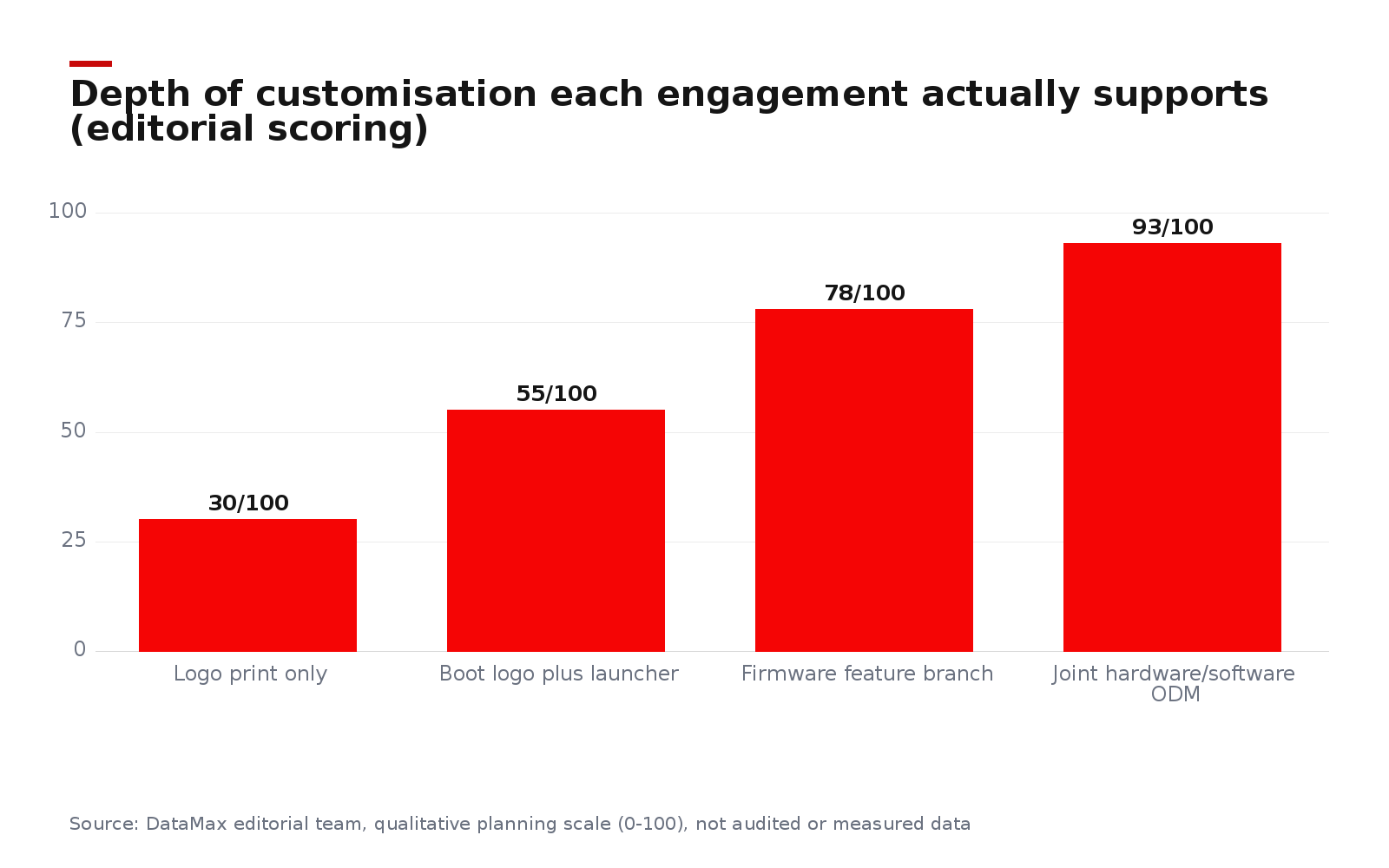
The same figures, in searchable form:
| Engagement depth | Editorial score |
|---|---|
| Logo print only | 30/100 |
| Boot logo plus launcher | 55/100 |
| Firmware feature branch | 78/100 |
| Joint hardware/software ODM | 93/100 |
A logo-only engagement leaves application, update, telemetry, and recovery responsibilities with existing teams. A firmware feature branch creates more configuration control but requires precise version governance. Joint hardware/software ODM provides the broadest design boundary, yet it also creates the largest evidence obligation: electrical, RF, thermal, software, and production-test records must still be approved. Select the smallest engagement that covers the required control points; depth beyond that increases validation work without necessarily improving classroom security.
| Decision | Logo print only | Boot logo plus launcher | Firmware feature branch | Joint hardware/software ODM |
|---|---|---|---|---|
| Application restriction | Existing platform owner | Launcher guidance only | Application policy can be integrated | Control architecture can be jointly specified |
| Update path | Vendor or existing operator process | Launcher update responsibility | Firmware branch requires governance | Joint release and rollback specification |
| Middleware integration | Not represented by branding | Basic navigation customization | Privileged interfaces may be defined | End-to-end interface can be specified |
| Evidence burden | Brand approval | Launcher and package checks | Branch build, regression, and release records | Hardware, firmware, RF, thermal, and production evidence |
| Change control | Central catalog revision | Central launcher revision | Named branch owner and version baseline | Joint change-control plan |
| Best fit | Viewing-only pilot | White-label interface | Defined operator feature set | Program-specific device and software |
A useful procurement example is a permanent classroom where the operator already manages IPTV authentication and entitlement. In that case, a brand-print-only requirement may be sufficient for a viewing terminal, while an integrator-led learning room may need a launcher with restricted entry points. A workshop kit adds asset tracking and local return control. Select the model by the required control boundary and then confirm the DataMax platform against the frozen RFQ.
Definitions a buyer cannot outsource
“Prison education” in this context means a controlled-access learning channel delivered through television screens inside a secure facility. It is not a consumer content application moved onto unmanaged hardware. The endpoint architecture normally comprises 5 layers: the display and input chain, the Android TV device, the operator middleware, the entitlement/content service, and the institutional network. Each layer has a separate owner and failure boundary.
“DRM” means digital rights management, not merely playback of an encrypted file. The contract must identify the supported service, security level, licence acquisition behavior, cached-licence policy, clock behavior, and renewal failure mode. Widevine L1, PlayReady, and HDCP are distinct control layers: Widevine and PlayReady govern software content rights, while HDCP protects the AV output path. The device, middleware, DRM server, display, cable, and playback mode must work as one chain. A quotation naming a DRM without naming the content workflow is incomplete.
“Middleware” is the operator-controlled application layer that provides channel navigation, authentication, entitlement, catalogue presentation, updates, telemetry, and device functions. Android Management API and Android Enterprise device-owner policies can manage Android-based fleets, but the deployed Android TV platform, launcher permissions, system-app privileges, and tenant controls must support the selected management architecture. Confirm the mechanism against the production software build; do not infer Android TV features from the word “Android.”
“Network isolation” covers more than hiding a screen. Require separate VLAN assignment for education endpoints, controlled egress, restricted DNS, documented service allow-lists, DHCP or static addressing rules, and multicast behavior appropriate to the IPTV design. If content is delivered over IP multicast, specify IGMP snooping, querier placement, group filtering, and egress policy. If unicast playback is used, define session capacity, proxy behavior, and certificate trust. For confidential course material, also settle whether local caching is prohibited, encrypted, or automatically expired.
“Physical security” means controlled enclosure, secured mounting, restricted exposed ports, tamper observation, and an accountable device-return process. A managed endpoint can still leak content through local storage or physical extraction unless the institution defines that boundary. The acceptance specification should state port availability, removable-media policy, boot behavior, screen privacy requirements, and the authorized maintenance action.
- Presentation layer Uses the specified launcher and service entry points
- Content layer Obtains media and rights through the approved delivery path
- Management layer Applies restrictions, updates, lock, and wipe procedures
- Evidence layer Links device identity, build, policy, and test results
- Network layer Enforces VLAN, DNS, multicast, egress, and certificate policy
- Physical layer Defines mounting, port treatment, custody, and return
The buyer should preserve these definitions in the acceptance schedule. For example, “locked screen” must identify who can unlock it, which credential is required, what local sessions are closed, and what audit event is produced. “Secure update” must identify the signed package source, installation window, failure behavior, and rollback image. “Network isolation” should include expected source and destination behavior rather than only a diagram. This converts broad security language into testable obligations.
Real DataMax platforms, field by field
The following table states only the supplied product facts. It is a platform shortlist, not a prison-education approval. Security configuration, certifications, environmental limits, and the production build remain subject to project validation and the production datasheet.
| Model and fit | SoC and OS | RAM / storage | Decode and DRM | Ports and connectivity |
|---|---|---|---|---|
| DM21P 4K IPTV / operator middleware set-top box | Amlogic S905Y4, quad Cortex-A35 AOSP Android 11 | 2GB / 8GB 4GB; 16/32/64GB optional | AV1 [email protected]; VP9/H.265 4K@60; H.264 4K@30 Widevine L1 / PlayReady / HDCP 2.2 optional | HDMI 2.0b out x1; USB2.0 x2; TF; S/PDIF; 3.5mm AV; RJ45 100M; Wi-Fi6 2x2 + BT5.4; DC 5V/2A |
| DM21S 4K Android TV box for IPTV/OTT white-label | Amlogic S905Y5, quad Cortex-A55 AOSP Android 14 | 2GB / 16GB 2/4/8GB; 16/32/64GB optional | AV1 / H.265 [email protected] 4K@60 Widevine L1 / PlayReady optional; Dolby Vision/DTS | HDMI 2.0b out; S/PDIF; AV; USB2.0 x2; TF; RJ45 100M (1G optional); Wi-Fi6 2x2 + BT5.4 |
| DM21T Premium UHD / cloud-gaming box | Amlogic S905X5, quad Cortex-A510 (ARMv9) AOSP Android 14 | 4GB / 64GB family options | H.266/VVC [email protected] 4K@120; AV1/VP9/H.265 4K@120; AVS3 4K@120; H.264 4K@60; inline AI-SR Widevine L1 / PlayReady optional | HDMI 2.0b out (no HDMI in); USB2.0 x1 + USB3.0 x1; TF; S/PDIF; AV; RJ45 100M (1G opt); Wi-Fi6 + BT5.4 |
| DM22Q Gaming-oriented Android TV box | Amlogic S905X5M, quad Cortex-A55 up to 2.5GHz AOSP Android 14 | 4GB / 64GB 2/4/8GB; 16/32/64GB optional | AV1/H.265 L5.1 4K@60; inline AI-SR (no NPU TOPS stated) Widevine L1 / PlayReady optional; Dolby Vision/DTS | HDMI 2.0b out; USB2.0 x2; TF; S/PDIF; AV; RJ45 100M (1G opt); Wi-Fi6 2x2 + BT5.4 |
DM21P is the direct operator-middleware direction when the programme is anchored on managed IPTV. DM21S is the white-label direction when the integrator needs launcher and branding work. DM21T and DM22Q have 4GB / 64GB baselines and newer AOSP Android 14 foundations, but their gaming-oriented positioning does not by itself establish suitability for managed educational deployment. Their stated decoding capabilities are relevant to media selection, not to security certification. For every model, confirm production RAM and storage, port population, DRM configuration, network options, and the exact operating image against the production datasheet.
| Check | Why it affects a UAE institution | Quotation requirement |
|---|---|---|
| Operating-system baseline | Management interfaces and application compatibility depend on the actual image | Name AOSP Android 11 or AOSP Android 14, then provide the exact build identifier |
| Ethernet population | A fixed classroom should not depend on Wi-Fi policy for routine video delivery | State whether RJ45 100M is fitted and whether the optional 1G configuration is ordered |
| Removable storage | TF and USB exposure may conflict with institutional content rules | State the physical population, policy treatment, and acceptance test for each port |
| Audio and auxiliary output | Training rooms may use institutional audio rather than television speakers | Name S/PDIF and AV availability and identify the selected playback chain |
| HDMI direction | Capture, conferencing, or downstream-display workflows can create hidden assumptions | For DM21T, record that HDMI 2.0b out has no HDMI in |
| DRM entitlement | A DRM label does not confirm licence exchange or content rights | Name the required service, security level, display-protection option, and test service |
Do not confuse the stated fit with a completed solution. “4K IPTV / operator middleware set-top box” identifies DM21P’s intended direction; it does not establish a particular UAE prison-education middleware image. “4K Android TV box for IPTV/OTT white-label” identifies DM21S’s fit; launcher identity still requires approval. The premium UHD and gaming-oriented fits for DM21T and DM22Q describe their stated product positioning, while the supplied records cap their relevant output or decoding at 4K. Do not request or approve 8K output for these platforms without separate production-datasheet confirmation.
The sample schedule should also freeze optional deviations. For DM21P, identify the selected RAM/storage configuration, whether HDCP 2.2 is fitted, and whether the 2GB / 8GB baseline or an option is ordered. For DM21S, DM21T, and DM22Q, state the selected storage option and Ethernet population. Freeze wireless options where they matter, but do not infer features beyond the listed facts. This approach allows the procurement team to compare 4 quotations without silently changing the hardware, software, or accessory scope between sample and production.
The operator, the integrator and the venue
The deployment triangle has 3 distinct accountability sets. The operator controls the service plane: entitlements, middleware, content, SLA, and monitoring. The integrator controls the device plane: configuration, enrollment, cabling, mounting, staging, and field recovery. The venue controls the physical and procedural plane: rooms, power, display security, access, incident response, and custody of removable devices. Overlaps must be explicit.
| Situation | Controlling requirement | Platform direction |
|---|---|---|
| Operator-managed IPTV rooms | Middleware integration; DRM entitlement; centralized updates; multicast or unicast rules | DM21P as the direct operator set-top direction; validate the production build |
| Integrator-led white-label deployment | Launcher identity; tenant configuration; app restrictions; managed provisioning | DM21S as the white-label direction; confirm device-management support |
| High-performance training room | 4K media profile; controlled latency; storage; display compatibility | DM21T or DM22Q may warrant evaluation; do not infer education approval |
| Multi-room institutional rollout | Fleet identity; staged rollout; rollback; spare-unit handling | Choose a platform with reproducible configuration and test evidence |
| Portable classroom or workshop | Device checkout; local wipe; encrypted or prohibited storage; asset tracking | Use a controlled device pool with signed return procedures |
| Vendor-managed viewing only | Minimal local controls; zero-touch entitlement; remote recovery | Operator-supplied hardware with no local administration rights |
A real deployment photograph should show the hardware being examined, not a generic retail box. An extreme macro of a black system-on-chip package on a television mainboard, surrounded by memory chips and PCB traces under side lighting, gives the integrator team a visual cue for board-level incoming inspection.
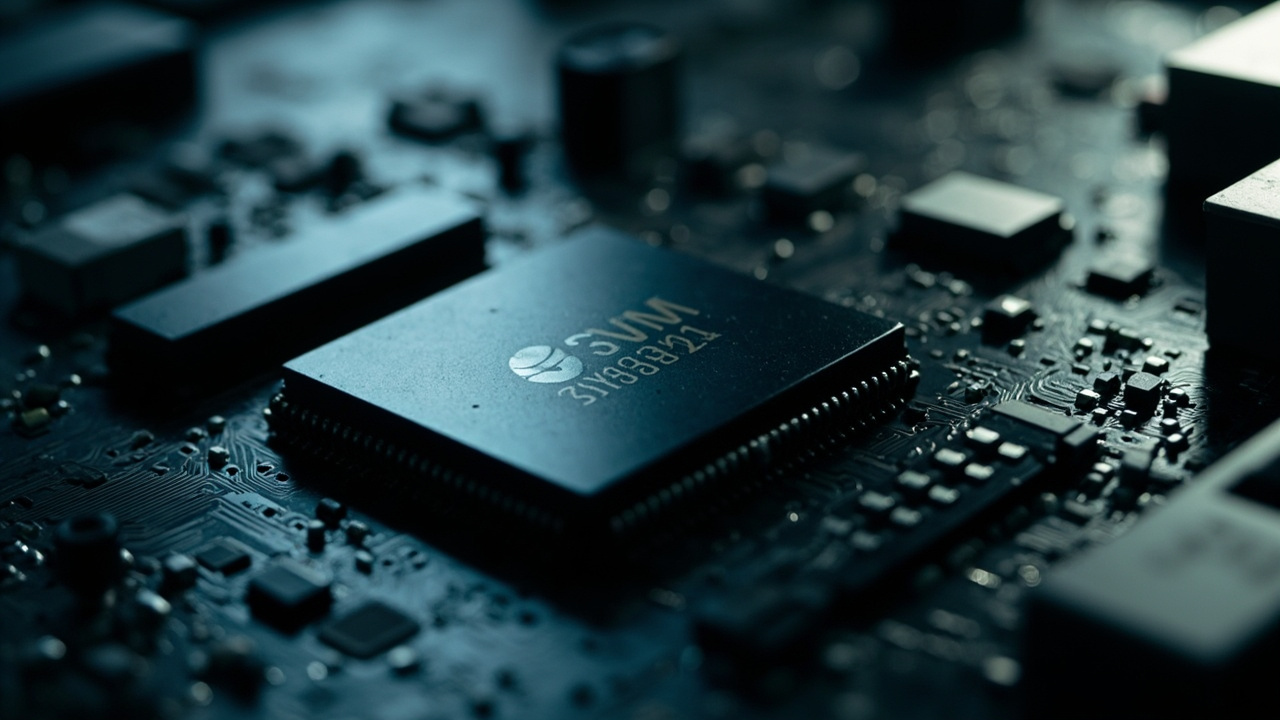
The venue acceptance visit should connect that image to process: compare the received mainboard and configuration against the approved sample, observe the serial and asset record, test ports, and document enclosure and mounting. The macro view is illustrative; the engineering team must validate actual hardware. The central question is not whether the chip appears powerful, but whether the assembled unit produces the required media, network, thermal, and security evidence.
A controlled-room example clarifies the allocation. If the operator owns a managed IPTV catalogue, it should specify the middleware, authentication, entitlement, multicast or unicast delivery, and service monitoring. The integrator should then connect the terminal to the required VLAN, enroll the device, install the approved launcher or image, label the serial number, and test recovery. The venue should provide the display, cable, power, secure mounting location, and access procedure. If an operator-side outage prevents entitlement, the venue should not be asked to reimage each classroom; if a device fails enrollment, the integrator should not be asked to repair an upstream DRM service.
For portable kits, add checkout and return records. The record should identify the terminal, asset tag, assigned room, user group, checkout time, return time, local-wipe result, and incident status. For a permanent installation, the asset register should instead identify the mount, cable path, network port, approved configuration, and service responsibility. These are operational controls, and each should have a named owner before rollout.
Do not infer the required management architecture from the operating-system label. AOSP Android 11 and AOSP Android 14 are baselines in the supplied platform facts. Whether the deployed image supports the proposed enrollment, policy, privilege, logging, lock, wipe, update, and rollback controls must be demonstrated on the final build. The platform table therefore narrows the hardware screen; it does not close the institutional control schedule.
How to choose, step by step
Turn the angle into 8 RFQ lines that suppliers must answer separately. First, define the operating role: managed viewing, operator middleware, or integrator-managed learning terminal. Second, define the software baseline: AOSP Android 11 or AOSP Android 14, plus the precise build identifier, launcher, privileged applications, and update mechanism. Third, define content rights: required DRM services, security level, licence acquisition, offline behavior, and display-protection requirement. Fourth, define connectivity: Ethernet speed, Wi-Fi use, address assignment, VLAN, DNS, multicast, certificate trust, and egress policy. Fifth, define device control: enrollment, policy enforcement, application restrictions, remote lock, wipe, logging, and recovery. Sixth, define physical integration: mounting, exposed-port treatment, power, display, cable, and accessory requirements. Seventh, define acceptance: test content, test cases, sample quantity, environmental and reliability evidence, and defect classification. Eighth, define ownership of failures: network, middleware, DRM, display, device, or operator service.
- State the use case Write 1 paragraph naming the room, users, operating model, content source, and responsible operators.
- Create the mandatory compliance schedule List target-market certificates, import requirements, security controls, and institution policies; confirm evidence scope against the production datasheet.
- Define the platform constraint Specify AOSP Android 11 or AOSP Android 14, RAM, storage, connectivity, ports, middleware base, and device-management model.
- Define the media and rights chain Specify codecs, resolution, frame rate, DRM, licence renewal, cache rules, display path, and failure behavior.
- Define the network boundary Record VLAN, multicast, DNS, firewall, certificate, time source, address, and capacity requirements.
- Define operational control State enrollment, update, rollback, wipe, audit log, spare pool, RMA, and incident-response responsibilities.
- Turn evidence into acceptance gates Require prototype test results, factory records, certification evidence, pilot results, and a signed golden sample.
- Compare like-for-like quotations Normalize the bill of materials, configuration, services, and excluded responsibilities before commercial review.
- Document the request Issue the normalized RFQ with the SKU list and attach the target-market certificates, middleware/DRM checklist, and network-control matrix.
- Screen the response Reject any answer that names a generic box without answering OS build, content rights, management, and test evidence.
- Validate a sample Run the same installation, playback, recovery, and network test on the sample and the proposed production unit.
- Approve a golden sample Record hardware revision, firmware, configuration identifiers, accessories, and accepted test results before the PO.
Ask the factory team to demonstrate how the accepted configuration becomes the delivered configuration. The engineering CTA is a video factory audit focused on SMT, AOI, aging, and configuration traceability, rather than a general tour.
A practical scoring sheet can keep commercial evaluation separate from technical acceptance. Give each response a written score for configuration completeness, middleware evidence, DRM workflow proof, network-control support, factory traceability, pilot reproducibility, and support responsibility. Do not average away a mandatory failure. If the supplier cannot identify the production build or cannot show how the middleware image is installed and recovered, that gap should block approval even if another line scores well.
Paste the resulting RFQ clauses directly into the purchase schedule. Include: “AOSP version and exact firmware build”; “ordered RAM and storage configuration”; “HDMI, USB, TF, Ethernet, AV, audio, and wireless population”; “required Widevine, PlayReady, and display-protection behavior”; “VLAN, DNS, multicast, certificate, and egress requirements”; “application restriction, remote lock, wipe, update, and rollback procedure”; and “acceptance evidence linked to hardware revision and serial number.” Do not use “as standard” for any of these fields.
For a pilot, select a room that exercises the intended production conditions rather than the easiest display. Use the planned Ethernet path, entitlement service, middleware build, mount, and network policy. Record start conditions, content identifiers, DRM event results, network traces, recovery actions, and the final configuration identifier. A pilot is valid only if the same hardware revision and software path can be traced into the production release.
What goes wrong after the PO
The most common commercial divergence is not the processor; it is the “same box” claim with different firmware, storage, wireless module, port population, DRM build, or accessory set. Freeze the bill of materials and require the PO to name the exact configuration identifier. If a quotation lists HDMI, Ethernet, USB, storage, and DRM as generic features but not as ordered deviations, the delivered unit cannot be compared with the pilot sample.
Field trap
A nominal operator build can fail because the middleware expects a different launcher permission set, system-app signature, time source, certificate store, or update path. The media pipeline may also use unstated multicast or CDN behavior. The operational cost is a stalled classroom rollout or repeated manual intervention. Validate the exact middleware/DRM checklist on production-representative hardware before shipment.
Another trap is the unsupported security claim. “Android TV box” does not prove that local storage is encrypted, that applications are sandboxed as required, that USB media is blocked, or that a lost device can be remotely wiped. Those are configuration and operating-system policy decisions. They require a test method, expected result, and operator owner. If the buyer cannot observe the evidence, the control remains a claim.
Field trap
Do not infer compatibility from a codec list. One classroom can combine 4K media, a fixed display, HDMI 2.0b output, a network path, a rights server, and a recovery workflow. Failure in the licence server, DNS, multicast group policy, display EDID, or update signature can look like a device fault. Use fault injection at the network, content, and device layers, and assign each failure to a named owner.
Three quotation variances deserve immediate review: omitted certificates or their scope; unspecified updates, support, or warranty responsibilities; and accessories or installation services excluded from the total bill. Record exclusions explicitly. A lower hardware line can produce a higher deployment cost if it requires extra adapters, local flashing, manual entitlement recovery, replacement units, or repeated site visits.
| Divergence | Detection point | Operational consequence | Corrective action |
|---|---|---|---|
| RAM or storage differs from approved sample | Incoming inspection and configuration record | Performance policy or preinstalled-content plan changes | Reject the variation or rerun affected acceptance tests |
| Ethernet or USB population differs | Port-count and part-number check | Network design or accessory plan fails | Correct before deployment; do not improvise at the venue |
| Firmware build changes | Build identifier inspection | Launcher privilege, update, or middleware behavior may change | Require regression evidence and re-approve the golden sample |
| DRM configuration is absent or inconsistent | Licence and playback test | Protected content cannot start or renew | Trace the device build and service configuration together |
| Mounting or cable accessories are omitted | Delivery reconciliation | Room installation becomes blocked or unsafe | Add accessories to the order and acceptance record |
| On-site flashing is required | First-device commissioning | Local labor, configuration drift, and longer rollout | Move loading and identity binding into the production process |
Configuration drift can also enter through support replacement. Require the service desk to quote the exact hardware revision, RAM/storage option, port population, firmware build, and approved accessories for every replacement. A replacement that is only “equivalent” is not traceable. Route it through the same evidence checks as the original device, or keep it outside the approved pool.
Verification you can ask for on paper
Verification follows the hardware build and then follows the software configuration. The factory should provide evidence for the production revision, not a generic company certificate unrelated to the SKU. Request an evidence index first, then inspect the records tied to the ordered model.
- Incoming materials and SMT evidence Match the bill of materials and component lots to the approved build; retain work-instruction, stencil, placement, and reflow records.
- AOI and board inspection Review AOI criteria, defect disposition, repair records, and sampling plan for the actual board revision.
- Assembly and firmware loading Verify the firmware identifier, device identity, serial mapping, and golden-sample configuration during final assembly.
- Port and display validation Test the ordered USB, Ethernet, AV, TF, HDMI, audio, power, and wireless population against the build sheet.
- Aging and burn-in Define runtime, load pattern, thermal conditions, restart count, and failure logging for the accepted production lot.
- Dark-room and media validation Check display output, synchronization, audio paths, and representative playback without treating visual inspection as a substitute for protocol tests.
- Network, DRM, and middleware validation Record connectivity, entitlement, playback, update, rollback, and failure-recovery results on the final image.
- Release audit Link serial numbers to hardware revision, software build, test results, accepted deviations, and shipment records.
Acceptance record A compliant evidence pack identifies the SKU, hardware revision, AOSP version, build identifier, RAM/storage option, port configuration, DRM configuration, test method, expected result, observed result, defect disposition, and approver. A generic “pass” report without serial or revision traceability is not adequate evidence for a controlled rollout.
The certification evidence should be checked against the target market and product scope, while the compliance documentation should identify which document supports which claim. Confirm final status against the production datasheet and shipment revision. For a pilot, apply the same test sequence used for mass production, then sign the golden sample before release.
Build the evidence request as an index rather than an unstructured document dump. For each record, ask for the model, hardware revision, build identifier, covered serial range, test method, acceptance threshold, observed result, defect disposition, and approval authority. An AOI record should identify the board revision and criteria. An aging record should state the load, duration, restart behavior, and failure log. A dark-room record should connect the display output to the ordered HDMI and audio configuration. A software record should identify the AOSP baseline, firmware build, middleware package, and rollback result.
The release index should also reconcile two paths: the approved golden sample and the mass-production unit. Any change to board revision, memory option, Ethernet population, wireless option, port population, operating image, launcher package, middleware package, or DRM configuration should trigger a documented review. Minor wording changes should not force a full retest; changes that affect media, rights, connectivity, privilege, or recovery need relevance-based regression and buyer approval.
For institutional rollout, add a commissioning sheet completed at the room. It should record serial number, asset tag, display and cable identifiers, network switch and port, address or enrollment state, content entitlement test, update status, lock and wipe configuration, mount condition, and recovery contact. The commissioning record closes the gap between a factory-passed device and an operational classroom endpoint.
For the final technical package, email [email protected] with the SKU list, target-market certificates, middleware/DRM checklist, network-control matrix, and acceptance-test specification. A factory or sample request should reference the same frozen configuration, and the commercial team should identify every quotation exclusion before approval. Request a video factory audit or a focused evidence review covering SMT, AOI, aging, dark-room, firmware loading, and release traceability for the proposed android tv box programme.
Further reading
- Guide android tv box for isps
- Telecom solutions
- Amlogic Android TV boxes
- Google TV devices
- AV1 Android TV box guide
- DataMax DM21P specifications and fit
- DataMax DM21S specifications and fit
FAQ
Can a consumer Android TV box be used in UAE prison education?
Only with strict operational control. A general retail device may lack tenant management, removable-storage restrictions, remote wipe, approved updates, traceable firmware, and the required middleware compatibility. Treat it only as a pilot platform unless the operator can document every control and recover it operationally. The installed configuration must be validated on production-representative hardware.
Which DataMax model is closest to an operator middleware deployment?
DM21P is identified as a 4K IPTV and operator middleware set-top box, with Amlogic S905Y4, AOSP Android 11, and Widevine L1, PlayReady, and optional HDCP 2.2. Final suitability still depends on middleware, network, DRM, and acceptance validation.
Does Widevine L1 make the device suitable for a secure classroom?
No. Widevine L1 is one element of the content-rights chain. The device still needs the correct middleware, entitlement server, licence policy, display path, network controls, and recovery process. The buyer must test the complete workflow rather than infer security from a DRM label. The licence renewal and failure behavior also need an operational owner.
What evidence should be attached to the request for a sample?
Attach the SKU shortlist, target-market certificate requirements, middleware/DRM checklist, network-control matrix, and acceptance-test specification. Include the required RAM, storage, connectivity, ports, and production configuration. This gives the supplier a comparable technical baseline and allows the sample to be linked to the eventual production revision.
Should the RFQ request 8K output?
Do not request 8K from the listed DataMax models without separate production-datasheet confirmation. The supplied DM21T and DM22Q facts cap stated output or decoding at 4K. Base the RFQ on the confirmed display, media, and decoding requirements rather than an unsupported marketing designation. Confirm the final output path against the accepted hardware revision.
How can a buyer validate factory quality before a purchase order?
Request a focused video factory audit and the SMT, AOI, aging, dark-room, firmware-loading, and release-audit records tied to the proposed SKU. Confirm that a pilot unit and the production unit use the same hardware revision, software build, and configuration. The procurement team can coordinate that evidence request.


