

The short answer first
An RFQ lands in the engineering inbox with three attachments: a consumer-style box image, a 4K playback claim and a request for 64GB of storage. The direct answer is that a video streaming box manufacturer is only one party in the product system: it may design the hardware, source components, build firmware, integrate software and perform manufacturing, while the operator, middleware vendor, content owner, distributor or brand remains responsible for other parts of the commercial chain.
A manufacturer can be a factory-type OEM that builds a buyer-controlled design, or a factory-type ODM that contributes product architecture and a platform. It is not automatically the legal factory, source of every component, owner of the firmware, licensed DRM provider or producer of the final service. Procurement must separate those roles before comparing quotations.
The decision-grade test is evidence, not a label on a slide. Ask who owns the schematic and PCB layout, who signs the Android build, who configures Widevine and PlayReady, which party performs SMT/AOI, aging and dark-room checks, and which entity owns regulatory evidence for the destination market. For a broader definition and index of roles, use the canonical video streaming box manufacturer glossary and index. DataMax is positioned here as an OEM/ODM source for Android TV and OTT hardware, but each proposed configuration still requires confirmation against the production datasheet.
That distinction matters at the first RFQ gate. A distributor may offer the lowest visible unit quotation while the design owner controls the board and a separate plant performs final assembly. An OEM may accept a buyer’s schematic while subcontracting firmware integration. A factory-type ODM may control the platform, manufacturing flow and release artefacts, yet leave middleware, content contracts, certification applications and commercial licences outside its scope. The buying team therefore needs an accountability map before it compares delivery terms.
Use the term manufacturer as a role to be allocated rather than a synonym for total solution ownership. For each proposed SKU, identify the contracting entity, production site, design owner, firmware sign-off party, component sourcing channel, inspection owner, update-channel owner and post-deployment support party. If one answer cannot be traced to a named organisation and a controlled record, the scope remains incomplete.
Buyer situations, ranked by what they punish
A video-streaming-box program can look similar on a product page and fail for completely different reasons. Operators punish unstable boot, middleware integration errors and weak fleet diagnostics. Integrators punish missing interfaces, mechanical fit and cable-routing assumptions. Gaming-oriented buyers punish input latency, thermal limits and inconsistent 4K output. Each situation therefore needs a different evidence emphasis from the manufacturer.
| Situation | Primary requirement | Model direction | Evidence to request |
|---|---|---|---|
| Operator IPTV deployment | Stable middleware, boot and lifecycle control | DM21P | Boot-cycle, aging, network and image-rebuild records |
| IPTV/OTT white-label programme | Configurable platform and restrained hardware differentiation | DM21S | Firmware ownership statement, configuration log and AOI records |
| Premium UHD or cloud-gaming trial | 4K media pipeline, stable interface set and controlled thermals | DM21T | Decode/output matrix, thermal run and 4K playback logs |
| Gaming-oriented retail or bundle | 4K60 playback, input responsiveness and LAN headroom | DM22Q | SoC configuration, storage qualification and sustained-load report |
| Fixed-function AV installation | HDMI, audio, networking and mounting integration | Direction only | Port schematic, sample approval and packing validation |
The operator case starts with lifecycle stability because a set-top box may remain connected for long periods and may receive configuration or firmware changes in the field. An integrator may tolerate a general-purpose device if its HDMI, audio, network and mechanical interfaces match the installation. A venue deployment may instead prioritize remote management, recovery after power interruption and consistent packaging across rooms. In each case, the manufacturer should receive a usage profile rather than a generic destination-market label.
A concrete RFQ example is a hotel operator requesting 500 units with operator middleware, Wi-Fi 6, wired Ethernet, S/PDIF and stable boot across repeated power cycles. The quotation should identify the exact model configuration, firmware-image source, boot-test duration, Ethernet rate, supported recovery process and who signs the production image. If the answer says only “same chipset,” the comparison remains incomplete because two boxes using the same SoC can differ in memory, ports, firmware, thermal design and test coverage.
A fixed-function AV installation introduces a separate risk: the product may be electrically capable but mechanically impractical. Require the manufacturer to provide the enclosure drawings, port locations, cable-clearance dimensions and mounting method for the approved revision. A digital-signage buyer may also need a specific update path, but that requirement must be separated from DRM playback and operator middleware because each creates a different release owner.
The modern production scene below shows automatic component placement onto black printed circuit boards. It is the type of SMT operation that a manufacturer should be able to identify with a line, revision, inspection record and responsible production site.
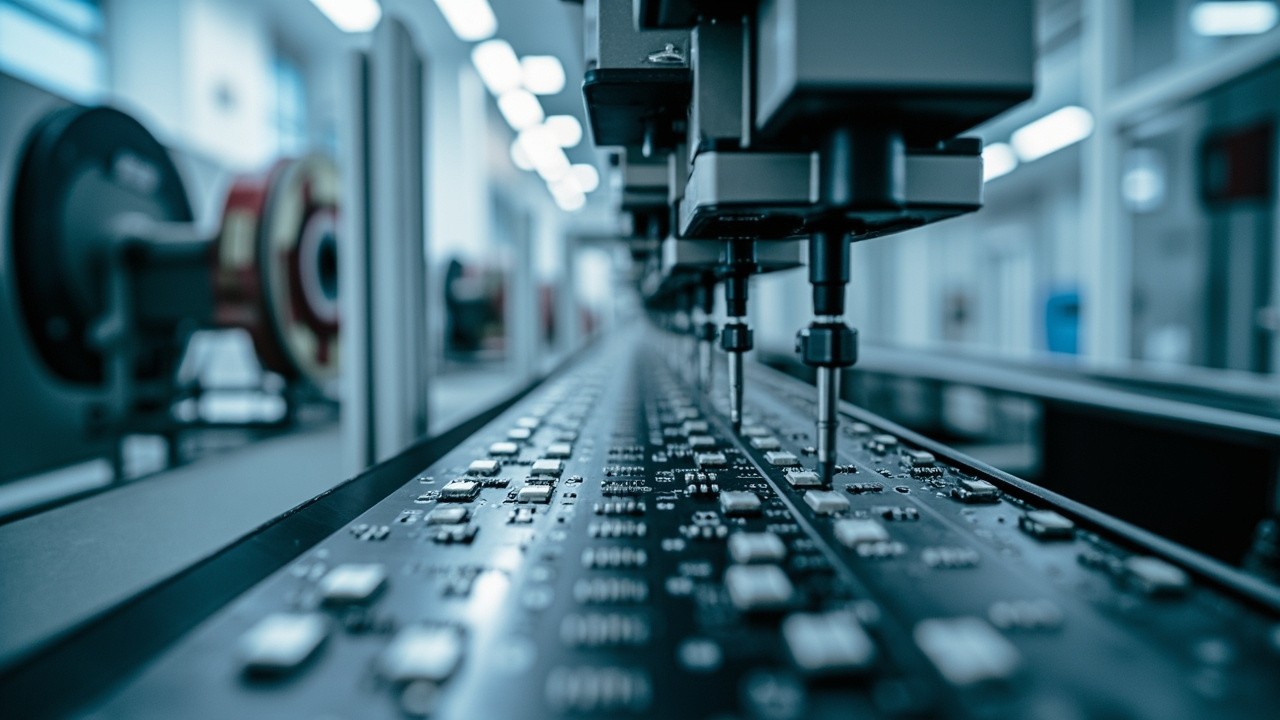
The scene is relevant only as evidence context. The contractual question remains: who performed the operation, who inspected it, which build revision was on the line, and where are the inspection records?
A decision path for the RFQ
Turn “send us a quote” into a sequence that exposes where the manufacturer actually owns the product. A useful RFQ separates commercial scope, technical scope, production scope and service scope before asking for a total landed cost.
- Define the deployment role State whether the device is operator middleware, generic Android TV, white-label OTT, cloud-gaming or digital signage. Identify who operates the portal, middleware, account system and content agreements.
- Name the product authority Require each bidder to identify the legal contracting entity, factory site, design owner, component sourcing channel, firmware builder, test responsibility and approval authority.
- Freeze measurable requirements State OS version, memory configuration, output and decode limits, DRM set, interfaces, network mode, target certificates, update method, branding rules and expected lifecycle.
- Separate quotation layers Request unit build, tooling or NRE, firmware integration, certification, packaging, logistics and after-sales support as separate lines. The lowest assembly price can conceal the highest integration cost.
- Approve evidence before volume Review schematic and layout ownership, sample build record, AOI coverage, aging protocol, dark-room output record, audit trail and factory qualification. An audit invitation should be tied to the named production site.
- Gate production release Use a golden sample, approved component list, firmware hash, serialisation rule, packaging artwork and change-control process as release artefacts. Do not authorize volume solely from a distributor datasheet.
deployment + rights
design + supply + build
sample + process
change control
Pasteable RFQ language should be blunt: “State the legal entity, manufacturing site, schema/BOM owner and firmware sign-off party for every quoted SKU.” Follow it with: “List all target-market certification and DRM obligations, including whether Widevine L1 or PlayReady provisioning is included.” Require the answer to identify exceptions, assumptions and unpriced risks.
Add this release-control line to the RFQ: “For every production revision, identify the approved PCB revision, firmware image hash, component list, test programme, defect disposition rule and packaging release.” The answer should indicate whether the manufacturer retains each record, supplies it to the buyer or allows third-party verification. Where a party will not provide the evidence, record that as an open risk rather than assuming the activity occurs.
Then define what happens after a failed field return. Require a diagnostic decision tree, RMA route, firmware rollback or recovery method, replacement-unit disposition and responsibility for log collection. A box can meet the incoming test plan and still lack a controlled path for an intermittent network, storage, HDMI or remote-control fault. Commercial terms should state who pays for diagnosis, replacement and root-cause work when responsibility is disputed.
Do not ask a supplier merely whether it is a manufacturer. That word can cover several legal and operational relationships. Ask which activities it performs at its own site, which it subcontracts, and which remain with the buyer.
The traps in this category
The most damaging mistake is treating a polished sales page as a production specification. Labels such as “premium,” “gaming” and “4K” do not define the SoC, Android release, output mode, interface population, licensed DRM service or thermal design. Every unresolved adjective becomes a dispute after purchase.
Field trap 1
A box may decode a 4K stream while the output path, television, scaler or application cannot reproduce the claimed mode. Require a model-specific decode/output matrix and record whether HDMI is input, output or absent. The wrong assumption can invalidate the entire use case.
Field trap 2
“DRM supported” can mean a device service is present, not that the exact commercial licence, level, domain, device limit and operator integration are ready. Ask where the licence is issued, which party manages it and what evidence demonstrates the intended playback path.
Quotations also diverge around what counts as “custom.” Cosmetic branding, a preloaded app, a modified boot animation, a different shell, middleware integration and a new PCB are different engineering scopes. The manufacturer may quote one while subcontracting another. Request a scope matrix showing standard catalogue components, buyer-supplied parts, licensed software, firmware changes, certification and test artefacts.
Other recurring traps include an unqualified Ethernet rate, an omitted power supply, a Wi-Fi module whose antenna design remains unstated, and a configuration sold as standard when it is optional. These are not minor catalogue differences: they affect board layout, thermal behaviour, certification and the finished unit cost.
A quotation can also omit the unit of account. “64GB storage” may be the platform family’s capacity rather than the ordered SKU, while “Wi-Fi 6” may conceal the antenna and regulatory configuration. Require each manufacturer response to identify the production BOM line, whether the feature is fitted at shipment, whether it is an approved alternative, and what evidence confirms it. The buyer should reject any “equivalent” component substitution that lacks a written engineering and compliance approval.
Memory choices create a parallel failure path. A catalogue model may list several RAM and ROM combinations, but the quoted production release may contain only one approved pairing. The manufacturer should confirm boot partition, available storage, update headroom, memory type and test coverage for that pairing. Otherwise, a request for “4GB RAM and 64GB storage” can become an engineering request after the purchase order rather than a purchasable SKU.
Verification you can ask for on paper
Verification links the purchase order to an identifiable factory process. Ask for records by site, date, line, build revision and SKU rather than receiving generic certificates that cannot be tied to the order.
- Incoming-material traceability Request lot or batch records linking critical components to the build, approved-vendor list, incoming inspection results and authorized substitutions.
- SMT and AOI evidence Ask for stencils, placement data, AOI results, defect disposition and first-article approval for the production revision. Confirm which checks are automated and which require manual verification.
- ICT, firmware and functional tests Request coverage for power, boot, storage, Ethernet, Wi-Fi, Bluetooth, USB, HDMI, audio and remote-control paths, together with the procedure used to quarantine failures.
- Aging and dark-room records Obtain the defined burn-in duration, load pattern, temperature conditions, sample policy, image comparison method and treatment of units that fail after repeated power cycles.
- Audit trail and change control Review the factory audit, engineering-change notice, component-substitution process, firmware build identifier, serial-number allocation and packaging-release approval.
Ask for a redacted evidence pack covering the proposed model and production revision. Suitable attachments include the inspection plan, SMT/AOI report, aging log, dark-room output report, firmware release record and approved component list. A supplier that cannot map evidence to a specific build has not demonstrated a closed quality loop, regardless of whether it calls itself a manufacturer.
The requested evidence should also identify unresolved deviations. For example, a sample may pass while the production BOM substitutes a network component. A firmware hash may be approved while the OTA image is unsigned or targets the wrong regional partition. Record deviations as actions with owners and closure criteria, not as notes in a meeting.
A practical paper check begins with the approved sample and its serial number. The manufacturer should link that unit to the schematic revision, component list, firmware identifier, test result and packaging file. Next, trace one production date and line to incoming inspection, placement, AOI, functional test and release records. Finally, compare the production records with the approved sample and document every difference. This sequence exposes disconnected processes without demanding confidential information unnecessarily.
Dark-room evidence needs a defined comparison method. The record should identify the model, display mode, colour pattern, equipment, date, operator or system identity and pass criterion. Aging evidence likewise needs its load and duration rather than a generic statement that units were burned in. If those fields are absent, the manufacturer may still be performing an activity, but the buyer cannot use the record to demonstrate a controlled process.
A common contractual gap is the route from a failed test to disposition. Require the plan to state whether a failed unit is reworked, retested, quarantined or scrapped; whether an engineering deviation can permit shipment; and who gives approval. The same rule applies to firmware: a failed image should not be replaced by a nearby build without a new release record and regression result.
DataMax can receive an audit request through its factory quality page or through the manufacturer page. The review should use the exact SKU and destination market, because a successful check on one platform does not validate another board.
Entry tier versus commitment tier
The phrase “entry tier” is often misused. It can describe a lower-cost catalogue configuration, a simpler form factor or a limited-use programme. It is not a technical class defined by Android version alone. Compare tiers by engineering responsibility and control points instead.
| Dimension | Entry commitment | Commitment tier |
|---|---|---|
| Product origin | Established platform with selected configuration | Platform plus explicit engineering ownership and custom scope |
| Buyer control | Configuration-level control | Defined control over approved variants, release and change process |
| Firmware | Standard build or bounded application changes | Named build owner, release artefacts, update method and sign-off record |
| Quality gate | Sample approval and standard production checks | Model-specific traceability, audit, deviation and change-control package |
| Best fit | Pilot, channel validation or standard OTT package | Operator deployment, differentiated programme or managed lifecycle |
The scores describe traceability potential, not measured failure rates. A factory-type ODM can connect more of the design-to-build chain, while a factory-type OEM may know the buyer’s design deeply. Neither label guarantees good execution, and the graph does not replace an audit of the named site.
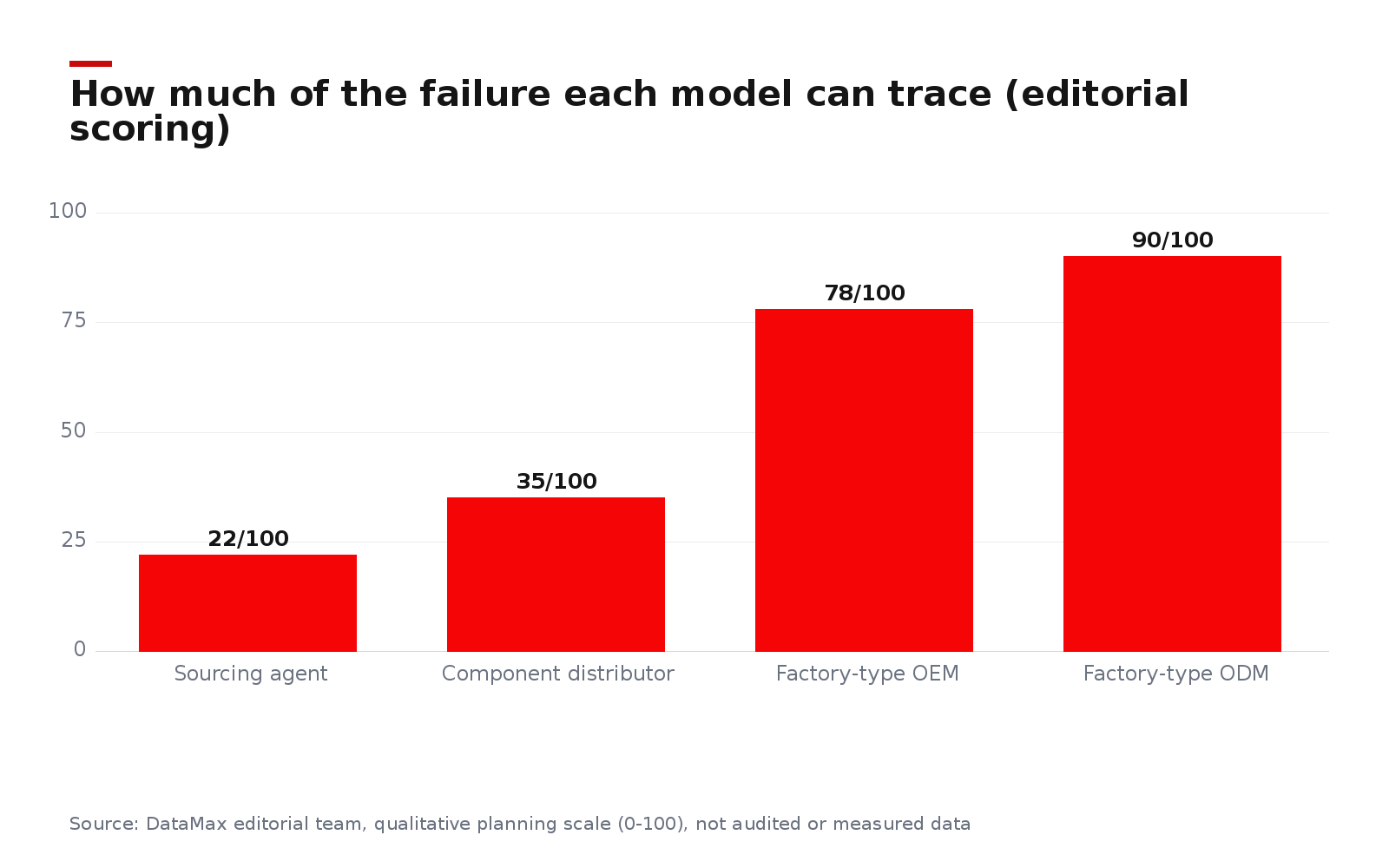
The same figures, in searchable form:
| Model | Editorial score |
|---|---|
| Sourcing agent | 22/100 |
| Component distributor | 35/100 |
| Factory-type OEM | 78/100 |
| Factory-type ODM | 90/100 |
For an entry configuration, a standard build may be adequate if branding, packaging and recovery are stable. For a commitment programme, obtain firmware release governance, approved engineering changes, model-specific test coverage and direct access to the production evidence chain.
The tier comparison also changes dispute management. In an entry programme, the manufacturer may supply a defined catalogue configuration and standard test records, while the buyer approves samples and packaging. In a commitment programme, the agreement should add named engineering approvers, deviation procedures, revision notices, firmware release governance and an audit path. The difference is contractual control, not a badge on the hardware.
Use the tier decision only after confirming the destination. A pilot may not justify a custom PCB but still requires DRM, middleware and update responsibilities to be identified. A national operator rollout may need a controlled configuration and audit trail even if the underlying board is a catalogue platform. The manufacturer scope should therefore follow operational exposure and change frequency rather than the number of units alone.
The mechanism behind the spec
The term “video streaming box manufacturer” covers several mechanisms. An OEM generally manufactures a product designed or controlled by the customer. An ODM designs and manufactures a product offered under the customer’s brand. A contract manufacturer builds to a supplied design but may not own the industrial design or software platform. A component distributor may control neither the box design nor final assembly. These distinctions should be written into the agreement.
Hardware execution starts with the SoC, memory and boot chain. Amlogic S905Y4 with quad Cortex-A35 in DM21P and Amlogic S905Y5 with quad Cortex-A55 in DM21S provide different CPU baselines, but the OS and application behavior remain separate design layers. The manufacturer must control bootloader, kernel, device configuration, driver integration, partition layout, secure update and recovery so that a box can recover rather than remain bricked after an interrupted update.
Media claims require separate definitions. “AV1,” “H.265 [email protected]” or “4K@60” describe parts of a media pipeline; HDMI output mode, display capability and application behaviour determine whether the chain works. Widevine L1 and PlayReady are DRM service references, while HDCP 2.2 concerns protected content output. Each should be verified against the exact firmware, certification status and test setup rather than inferred from a chip headline.
Networking is equally architectural. Ethernet at 100M can be adequate for controlled video delivery, but operators must assess multicast, manifest delivery, DRM traffic and concurrent use against actual application load. Wi-Fi 6 2x2, Bluetooth 5.4, USB and S/PDIF also interact with board layout, antenna selection and firmware drivers. Port counts alone do not prove deployed performance.
The Android mechanism adds another controlled boundary. AOSP identifies the base source baseline, while a shipping product may also contain device drivers, middleware, applications, security patches, update agents and certification state. The manufacturer should identify which layer owns each item and preserve the build identifiers used during production. A buyer asking for “Android 14” has not defined the application framework, Google services status, update behaviour or operator middleware version.
DRM architecture must be traced through both device certification and service issuance. Hardware capability, the device’s DRM implementation, the commercial service account, licence policy and the playback application are separate links. A device may carry Widevine L1 and still be unsuitable for the intended licence workflow. The manufacturer can therefore be responsible for the device implementation while the operator or content platform controls commercial access.
Protected output also requires a complete display chain. The stated HDCP version, negotiated display mode, application behaviour and downstream display capability all matter. For a fixed-function AV or operator deployment, the acceptance test should use the intended television or display, a representative stream and the approved application rather than a generic media file.
Finally, thermal design changes the meaning of sustained performance. Decode capability states what the platform can process; it does not state how long it can process that workload within a defined enclosure and ambient condition. A manufacturer qualification package should state whether the evidence came from the production enclosure, identify the load duration and define the pass condition. Without those fields, “gaming” or “premium” remains a positioning term rather than a verified operating envelope.
Which DataMax models actually sit here
DataMax’s supplied product facts place four platforms in the TV-box and set-top-box discussion. The table below reproduces those facts without adding unreported dimensions, bandwidth, power figures or certification claims.
| Model and fit | SoC and OS | Memory | Media and DRM | Interfaces |
|---|---|---|---|---|
| DM21P 4K IPTV / operator middleware set-top box | Amlogic S905Y4, quad Cortex-A35 AOSP Android 11 | 2GB / 8GB 4GB; 16/32/64GB optional | AV1 [email protected], VP9/H.265 4K@60, H.264 4K@30 Widevine L1 / PlayReady / HDCP 2.2 optional | HDMI 2.0b out x1, USB2.0 x2, TF, S/PDIF, 3.5mm AV, RJ45 100M, Wi-Fi6 2x2 + BT5.4, DC 5V/2A |
| DM21S 4K Android TV box for IPTV/OTT white-label | Amlogic S905Y5, quad Cortex-A55 AOSP Android 14 | 2GB / 16GB 2/4/8GB; 16/32/64GB optional | AV1 / H.265 [email protected] 4K@60 Widevine L1 / PlayReady optional; Dolby Vision/DTS | HDMI 2.0b out, S/PDIF, AV, USB2.0 x2, TF, RJ45 100M (1G optional), Wi-Fi6 2x2 + BT5.4 |
| DM21T Premium UHD / cloud-gaming box | Amlogic S905X5, quad Cortex-A510 (ARMv9) AOSP Android 14 | 4GB / 64GB family options | H.266/VVC [email protected] 4K@120, AV1/VP9/H.265 4K@120, AVS3 4K@120, H.264 4K@60; inline AI-SR Widevine L1 / PlayReady optional | HDMI 2.0b out (no HDMI in), USB2.0 x1 + USB3.0 x1, TF, S/PDIF, AV, RJ45 100M (1G opt), Wi-Fi6 + BT5.4 |
| DM22Q Gaming-oriented Android TV box | Amlogic S905X5M, quad Cortex-A55 up to 2.5GHz AOSP Android 14 | 4GB / 64GB 2/4/8GB; 16/32/64GB optional | AV1/H.265 L5.1 4K@60; inline AI-SR (no NPU TOPS stated) Widevine L1 / PlayReady optional; Dolby Vision/DTS | HDMI 2.0b out, USB2.0 x2, TF, S/PDIF, AV, RJ45 100M (1G opt), Wi-Fi6 2x2 + BT5.4 |
DM21P is the direct operator-middleware direction in the supplied facts. DM21S supports an Android 14 white-label route for IPTV/OTT. DM21T provides the highest stated video-format and frame-rate range in this set, including H.266/VVC [email protected] 4K@120 and several 4K@120 codecs, while its optional 1G Ethernet and single USB3.0 port distinguish it from the simpler interfaces listed on DM21S. DM22Q targets gaming-oriented Android TV use with Amlogic S905X5M and 4K@60 AV1/H.265 support.
These facts do not establish latency, thermal endurance, compatibility, certification scope or production configuration. Confirm against the production datasheet before approving an RFQ, particularly for optional memory, Ethernet, DRM and codec combinations. A custom development review can then separate catalogue selection from actual board, firmware and compliance work.
For a procurement comparison, begin with deployment fit rather than headline capability. DM21P is the supplied direction for operator middleware; DM21S fits an Android 14 white-label programme; DM21T suits the stated premium UHD or cloud-gaming direction; and DM22Q suits gaming-oriented Android TV use. The manufacturer should then quote the exact memory, optional Ethernet, DRM and output configuration in the production datasheet, because the platform family listing does not itself define the released SKU.
For an audit or evidence review, request the model-specific SMT/AOI, aging and dark-room records through the contact page. Before a purchase order, email [email protected] with the SKU list, target-market certificates, middleware and DRM checklist, and proposed firmware-release or update method.
Further reading
- Video Streaming Box Manufacturer Glossary and Index
- Allwinner Android TV boxes
- AOSP Android TV boxes
- H.265 HEVC Android TV box guide
- Widevine L1 certification guide
- DataMax DM21P specifications and fit
- DataMax DM21S specifications and fit
FAQ
Is a video streaming box manufacturer the same as an ODM?
Not necessarily. A manufacturer describes production responsibility, while OEM and ODM describe design and business responsibility. One contract manufacturer may assemble a customer-owned design; one ODM may design the platform and manufacture it. Require the contract to name the legal factory, design owner, software owner and test provider. A manufacturer label alone does not allocate middleware, DRM or update responsibility.
Does “DRM supported” mean the box can receive commercial licences?
No. Device support, service availability, device certification, licence issuance and operator integration are separate conditions. Request the intended DRM service and level, licence workflow, account requirements, device-limit rules and model-specific playback evidence for every manufacturer proposal. The protected-output path should also be tested with the intended display and application.
Should every quotation use the same 4K wording?
No. Decode level, resolution, frame rate, colour format and HDMI output mode must be stated separately. A device can decode a high-resolution stream while its output path remains limited. Require a model-specific decode/output matrix and validate it against the target display and application. The manufacturer should identify the exact firmware used for the test.
What factory records should precede a volume order?
Request an approved sample, production BOM, traceability record, SMT/AOI report, functional test plan, aging log, dark-room output report, firmware release record and change-control process. These should identify the factory site and build revision. Generic factory certificates do not demonstrate that the proposed manufacturer process was applied to the ordered SKU.
How do I verify an OEM versus ODM quotation?
Compare responsibility matrices rather than labels. Ask who owns the PCB, mechanical design, boot image, drivers, middleware port, OTA update, certification, production testing and lifecycle support. Include software release artefacts and unresolved deviations in the response, then confirm the mapped responsibilities during an audit. A manufacturer should identify any activity performed by a subcontractor.
Which DataMax model starts an IPTV RFQ?
The supplied facts position DM21P for 4K IPTV and operator middleware, with DM21S for Android 14 IPTV/OTT white-label programmes. Confirm the exact memory, optional Ethernet and DRM configuration against the production datasheet before ordering samples.


