
What the answer hinges on
| Claim layer | What must be verified |
|---|---|
| Panel output | Maximum HDMI resolution and refresh rate, including any display or source limitation. |
| Video pipeline | Supported codecs, profile, level and pixel format for operator or OTT streams. |
| Content protection | Widevine security level, PlayReady support, HDCP version and licence-service conditions. |
| Lifecycle | Android branch, firmware ownership, update policy, end-of-life notice and spares commitment. |
The direct answer is that an android tv box described as “4K” is not one homogeneous specification. A device may output 4K while decoding 4K at 60 fps, protect commercial streams through Widevine L1 and PlayReady, yet still lack a documented firmware and end-of-life path. Conversely, a platform with strong lifecycle evidence may remain deliberately conservative at 4K@60.
For procurement, the phrase “4K Android TV box” should therefore trigger four separate checks: HDMI output capability, codec and refresh-rate support, DRM implementation, and operational continuity. The SoC name alone answers none of them. A requirement sheet should also identify whether the box is an operator middleware appliance, an IPTV or OTT white-label platform, a cloud-gaming endpoint or a general gaming-oriented variant.
The comparison above also explains why quotations diverge. One supplier may describe display capability; another may describe media playback; a third may describe the contractual support package. For the broader operator selection criteria, use the canonical guide to Android TV box for ISPs. This page concentrates on the four-claim qualification problem rather than repeating a generic platform guide.
A buyer can apply the same split to a single RFQ line. Instead of accepting “supports 4K,” write four acceptance fields: the output mode, the decode mode, the protected-content path and the support commitment. This prevents a display-oriented statement from being mistaken for an end-to-end service specification.
Which DataMax models actually sit here
| Model | Compute and OS | Memory | Video and DRM | Connectivity |
|---|---|---|---|---|
| DM21P | Amlogic S905Y4, quad Cortex-A35; AOSP Android 11 | 2GB / 8GB; 4GB; 16/32/64GB optional | AV1 [email protected]; VP9/H.265 4K@60; H.264 4K@30; Widevine L1 / PlayReady; HDCP 2.2 optional | HDMI 2.0b out x1; USB2.0 x2; TF; S/PDIF; 3.5mm AV; RJ45 100M; Wi-Fi6 2x2 + BT5.4; DC 5V/2A |
| DM21S | Amlogic S905Y5, quad Cortex-A55; AOSP Android 14 | 2GB / 16GB; 2/4/8GB; 16/32/64GB optional | AV1 / H.265 [email protected] 4K@60; Widevine L1 / PlayReady optional; Dolby Vision/DTS | HDMI 2.0b out; S/PDIF; AV; USB2.0 x2; TF; RJ45 100M, 1G optional; Wi-Fi6 2x2 + BT5.4 |
| DM21T | Amlogic S905X5, quad Cortex-A510 (ARMv9); AOSP Android 14 | 4GB / 64GB; family options | H.266/VVC [email protected] 4K@120; AV1/VP9/H.265 4K@120; AVS3 4K@120; H.264 4K@60; inline AI-SR; Widevine L1 / PlayReady optional | HDMI 2.0b out, no HDMI in; USB2.0 x1 + USB3.0 x1; TF; S/PDIF; AV; RJ45 100M, 1G optional; Wi-Fi6 + BT5.4 |
| DM22Q | Amlogic S905X5M, quad Cortex-A55 up to 2.5GHz; AOSP Android 14 | 4GB / 64GB; 2/4/8GB; 16/32/64GB optional | AV1/H.265 L5.1 4K@60; inline AI-SR; Widevine L1 / PlayReady optional; Dolby Vision/DTS | HDMI 2.0b out; USB2.0 x2; TF; S/PDIF; AV; RJ45 100M, 1G opt; Wi-Fi6 2x2 + BT5.4 |
The DM21P is positioned for 4K IPTV and operator middleware set-top-box duties. Its distinguishing facts are AOSP Android 11, 2GB / 8GB baseline memory, H.265 4K@60, optional HDCP 2.2 and a 100M RJ45 interface. Because the operating-system branch is stated, buyers can assess middleware compatibility, but firmware support duration remains a contractual question rather than a hardware inference.
The DM21S moves to AOSP Android 14 and carries AV1 and H.265 at 4K@60, Widevine L1 and optional PlayReady. Its optional 1G Ethernet should be written into an RFQ when switching or multicast traffic makes the 100M configuration unsuitable. Dolby Vision/DTS are included in the supplied facts, but the RFQ should distinguish codec support from device certification, application entitlement and content licensing.
The DM21T is the premium UHD and cloud-gaming platform in this set. Its supplied decode list reaches 4K@120 for H.266/VVC main10, AV1, VP9, H.265 and AVS3, while H.264 is specified at 4K@60. The facts explicitly cap output and decode at 4K; no 8K output claim should appear in a procurement document. Its USB3.0 port and no-HDMI-in configuration also matter when comparing peripheral expansion and source-routing requirements.
The DM22Q is gaming-oriented and reaches AV1/H.265 L5.1 4K@60 with inline AI-SR, Widevine L1 and optional PlayReady, plus Dolby Vision/DTS. Confirm Android, port and memory options against the production datasheet before release to a buyer.
Model names also describe different operating contexts. DM21P is the operator-middleware position; DM21S is the IPTV/OTT white-label position; DM21T addresses premium UHD and cloud-gaming requirements; DM22Q addresses a gaming-oriented use case. These fit statements come from the supplied product facts, so they should direct the shortlist rather than serve as complete acceptance criteria.
The wording of memory options requires care. DM21P lists 2GB / 8GB with 4GB and 16/32/64GB optional; DM21S lists 2GB / 16GB with 2/4/8GB and 16/32/64GB optional; DM22Q lists 4GB / 64GB with 2/4/8GB and 16/32/64GB optional. DM21T is listed as 4GB / 64GB with family options. A family-level option cannot be copied into a purchase order without a confirmed production configuration.
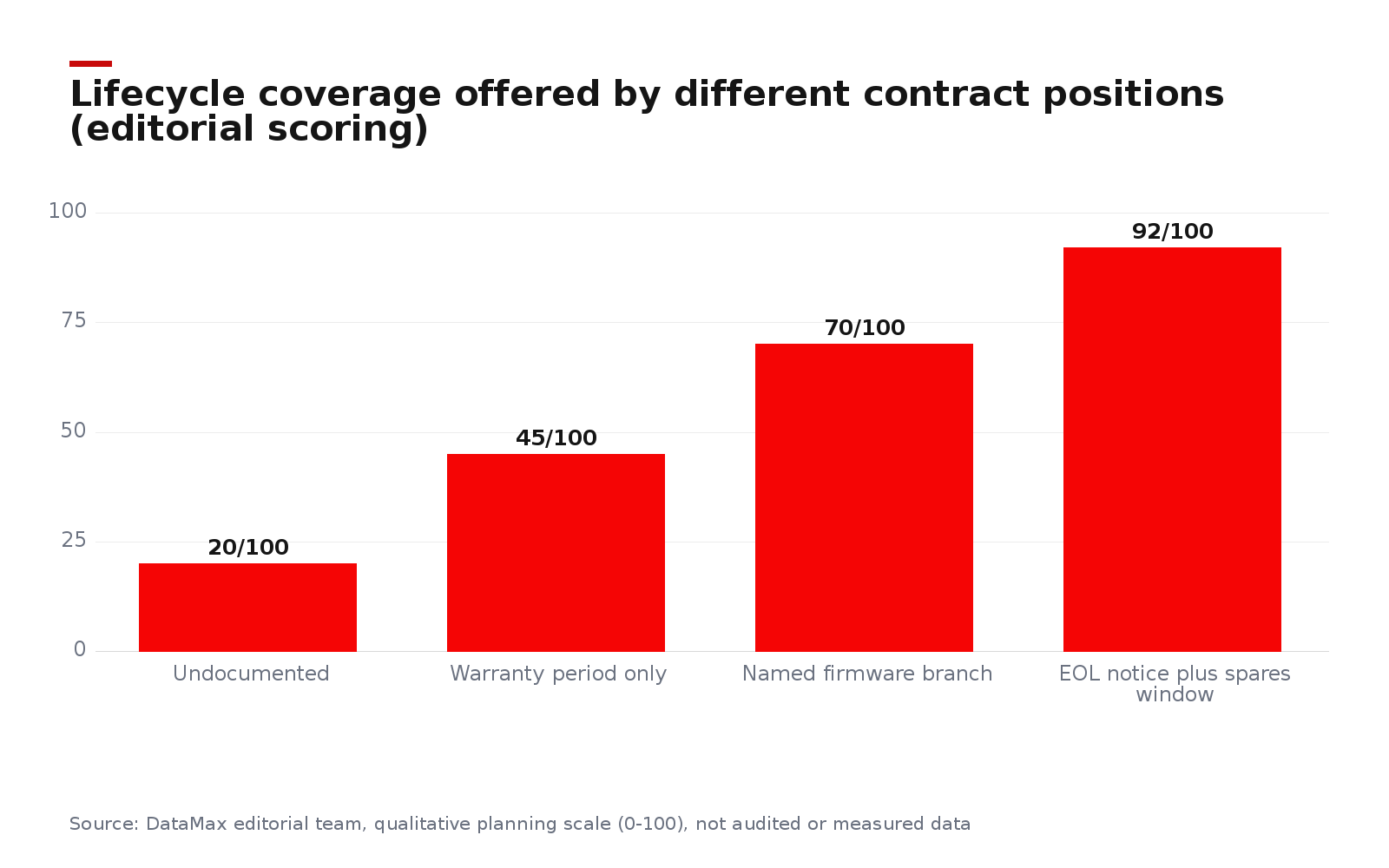
The same figures, in searchable form:
| Contract position | Editorial score |
|---|---|
| Undocumented | 20/100 |
| Warranty period only | 45/100 |
| Named firmware branch | 70/100 |
| EOL notice plus spares window | 92/100 |
The mechanism behind the spec
Output resolution, decode capability and commercial protection operate at different points in the media chain. The decoder accepts an encoded bitstream, converts it into frames and may apply scaling or enhancement. The display pipeline then outputs frames through HDMI at a negotiated resolution and refresh rate. DRM separately controls access to protected content through a licence service; HDCP protects the physical output path. A device can be strong in one layer and limited in another.
For an android tv box, Android certification and the selected Google services build affect application availability, Widevine device-class handling and update operations. AOSP Android 11 or Android 14 identifies the supplied OS branch, but it does not by itself establish the security patch level, Google certification status, Widevine provisioning result or firmware-release cadence. Those items belong in production documents and acceptance tests.
Codec naming also needs precision. H.265 is HEVC; AV1 is a different codec family. Profile and level constrain resolution, frame rate, chroma format and other constraints, so “H.265 4K” is incomplete. DM21P’s AV1 [email protected] and VP9/H.265 4K@60 claims should be quoted exactly, then tested against the operator’s actual profile, bitrate and frame-rate mix. For deeper format selection, the AV1 Android TV box guide helps separate decode support from end-to-end service readiness.
Refresh rate is another control point. A decoder may support 120 fps internally while the television, source content, application and HDMI negotiation establish the displayed rate. DM21T’s stated 4K@120 decode formats therefore need a test matrix that includes the target display, protected playback, UI navigation and fallback behavior. The required HDMI 2.0 bandwidth for the active pixel format must also be checked.
DRM qualification should separate module availability from service operation. Widevine L1, PlayReady and HDCP 2.2 are distinct controls. A provider must also confirm device provisioning, certificate handling, account or domain policy, concurrency rules, forensic expectations and failure logging. The application needs a successful licence request before content will play; merely listing “Widevine L1” in a quotation is insufficient.
The same separation applies to HDR and audio. Dolby Vision and DTS appearing in a model description does not establish which display modes, applications, bitstreams or licences are enabled in a shipment. The buyer must identify the protected-content environment, display model, EDID mode and fallback path. A test can then distinguish decoder rejection, output limitation, licence denial and application-policy rejection.
Storage and memory claims should be handled similarly. RAM and ROM identify nominal platform configurations, while usable application space, reserved partitions and update headroom depend on the released image. These values are not supplied in the product facts, so confirm them against the production datasheet rather than inferring them from the chip family.
Lifecycle governance operates above the SoC. Buyers need the named Android branch, build process, update responsibility, security-patch cadence, release-announcement mechanism, end-of-life notice period and spares availability. The chart above ranks contractual positions editorially: a named firmware branch scores 70/100, while an EOL notice plus spares window scores 92/100. These are planning markers, not measured service outcomes.
For an operator, this architecture determines what can be delegated to the factory and what must remain under the operator’s control. DataMax can evidence board assembly, programming and selected media tests. The operator still owns entitlement, middleware, account policy, network design and service acceptance unless those responsibilities are explicitly assigned.
Entry tier versus commitment tier
| Procurement layer | Entry selection | Commitment selection |
|---|---|---|
| Output goal | Confirm HDMI 2.0b output and a stated 4K mode. | Prove the required resolution, refresh rate, chroma format and protected-content path on the target display. |
| Codec goal | Match the supplied codec list to the stream inventory. | Run operator profiles, peak bitrate, seeking, recovery and multi-stream tests. |
| DRM goal | Verify Widevine L1 and optional PlayReady as stated for the model. | Validate licence provisioning, policy, concurrency, logging and failure procedures. |
| Software | Record the stated AOSP Android branch. | Name the firmware branch, update owner, patch process and release cadence. |
| Connectivity | Use the listed RJ45 and wireless configuration. | Select 1G where required and validate multicast, VPN and traffic separation. |
The entry tier begins with a catalogue match. A buyer may select DM21S for a 4K IPTV/OTT white-label requirement because the supplied facts combine AOSP Android 14, AV1/H.265 4K@60, Widevine L1, optional PlayReady and configurable memory. That is a shortlist, not an approval. Missing evidence should remain explicit rather than being converted into an assumed capability.
The commitment tier is defined by controlled continuity. It adds a named firmware branch, reproducible builds or firmware artifacts, update communications, security-patch responsibility, end-of-life notice and a spares window. The comparison with operator-tier Android TV box solutions can help structure the commercial side, but contract language must still specify each deliverable and recipient.
A practical entry-tier RFQ should still identify the exact model, ordered memory, Ethernet speed, DRM option and operating-system wording. For example, “DM21S, 4K Android TV box, 2GB / 16GB, RJ45 100M, PlayReady [included/not included], AOSP Android 14” removes four common ambiguities. If 1G Ethernet is required, it should replace 100M as the selected line-item configuration rather than appearing as an unsupported default.
The commitment tier adds measurable deliverables. Firmware artifacts should carry a release identifier and update responsibility. Test evidence should identify the stream format, display mode, protected or unprotected status and expected result. Lifecycle clauses should define who communicates end-of-life, through which channel, and what spares or migration support applies during the agreed window.
Model selection should also follow workload rather than headline frame rate. DM21T fits a premium UHD or cloud-gaming requirement when 4K@120 decode paths, USB3.0 or ARMv9 matter. DM22Q fits a gaming-oriented Android TV box requirement when 4K@60 AV1/H.265 and inline AI-SR are central. DM21P fits the operator middleware position where its Android 11 branch and 100M Ethernet are acceptable. A higher decoder figure is not a substitute for thermal stability, firmware policy or software certification.
Cost of ownership can expose different failure profiles. An entry order may appear simpler because it excludes staged firmware artifacts, patch evidence and end-of-life planning. A managed order may require more documentation but reduces the probability of field replacement caused by an undefined configuration or an unsupported Android branch. The relevant commercial review compares evidence and responsibility, not merely the device description.
Where this matters in a deployment
| Situation | Controlling requirement | Model direction | Acceptance evidence |
|---|---|---|---|
| IPTV operator rollout | Middleware compatibility, network behavior and managed updates | DM21P; evaluate DM21S when Android 14 is required | Operator middleware build, IPTV streams, update and recovery report |
| OTT or white-label program | Application ecosystem, codec inventory and DRM operations | DM21S or DM22Q according to workload | App certification, Widevine L1 and PlayReady licence tests |
| Cloud-gaming service | High-rate decode path, peripherals and sustained performance | DM21T | 4K stream matrix, input-device test and sustained-run log |
| Digital-signage venue | Display mode, scheduled playback and remote operations | DM21P, DM21S or DM22Q | Display-mode capture, boot policy, watch-and-recovery test |
| Integrated AV installation | HDMI output, control interfaces, network segmentation and audio routing | Select by output and I/O, not codec headline alone | EDID and HDMI negotiation, control and network integration record |
In an operator deployment, the first field test is not a codec comparison. It is a service workflow: channel change, entitlement failure, restart, configuration loss and network recovery. DM21P’s stated RJ45 100M and AOSP Android 11 make it a candidate for the supplied 4K IPTV and operator middleware role, but network design, middleware binaries and device-management procedures still require integration testing.
A white-label OTT program has a different evidence path. The buyer must validate the exact application set, login flow, user interface, device provisioning, PlayReady entitlement where required and any Dolby Vision or DTS delivery path. DM21S and DM22Q both list Dolby Vision/DTS, while their stated base video ceilings differ: DM21S specifies AV1/H.265 [email protected] 4K@60, whereas DM22Q specifies AV1/H.265 L5.1 4K@60. Do not treat similar marketing descriptors as equivalent certification evidence.
For a cloud-gaming service, DM21T is the relevant direction because the supplied facts include 4K@120 decode for multiple formats, USB3.0 and quad Cortex-A510 (ARMv9). The acceptance test must connect the service’s real output settings, display capabilities and input peripherals. An internal 120 fps decode result does not prove a stable 120 fps service path.
Digital signage changes the operational priority. The box may spend most of its time on a fixed playlist, so boot reliability, remote recovery, display compatibility and update control may outweigh a headline refresh-rate increment. A model with a lower stated ceiling can still be the better operational choice if it is the platform being qualified.
A venue integrator should include display EDID, resolution and refresh-rate negotiation in the commissioning record. The scene can be a hotel room, retail display or corporate lobby, but the same checks apply: wake from standby, recover after power loss, retain the intended application state and avoid an unsupported display mode. DM21P’s 3.5mm AV and S/PDIF outputs, DM21S’s AV and S/PDIF, DM21T’s AV and S/PDIF, and DM22Q’s AV and S/PDIF should be specified according to the installation design rather than treated as interchangeable.
An IPTV operator with multicast distribution should test IGMP behavior, channel-change latency, traffic separation and link utilization at the selected Ethernet configuration. A 1G option should not be selected merely because it appears in the model family; the network architecture must show a reason. Conversely, a 100M deployment can be accepted only when its measured traffic and service objectives fit that configuration.
The traps in this category
Field trap
A quotation that says “8K” does not override the supplied datasheet limits. DM21T and DM22Q must be described as 4K platforms; DM21T lists 4K@120 decode for specified formats and DM22Q lists 4K@60. Request the production datasheet and test evidence before repeating any higher-resolution description.
The first trap collapses several meanings of 4K. “4K-ready” may refer to output, decode, upscaling or display compatibility. These are not interchangeable. A procurement schedule should define the required frame size, refresh rate, chroma format, codec, profile, level and protected-content mode. Without those fields, two quotations can both appear compliant while supporting materially different services.
The second trap treats optional DRM and interface features as standard. HDCP 2.2 is optional on DM21P. PlayReady is optional on DM21S, DM21T and DM22Q. The 1G Ethernet option is not the same as the stated RJ45 100M configuration on those models. A purchase order must identify the ordered configuration; a model-family name is not a complete line item.
Field trap
Do not infer an update promise from an AOSP Android version. “AOSP Android 11,” “AOSP Android 14” and an unqualified “Android 14” are different evidence levels. Put the exact software description, Google services status, firmware branch, patch responsibility and release process in the RFQ.
Network qualification is another source of false equivalence. RJ45 100M and optional 1G belong in separate configuration fields. For IPTV multicast, an operator must validate multicast routing, IGMP behavior, throughput, latency and recovery rather than infer performance from the port label. Wireless specifications also require site-specific validation because Wi-Fi6 2x2 does not determine RF conditions, channel plan or interference margin.
DRM failures often escape basic playback tests. A lab unit may lack the operator’s account, provisioning entitlement or device policy, producing a stream failure unrelated to codec support. The acceptance procedure should document the licence-service state, requested protection level, returned error, device identifier policy and recovery action. The same caution applies to Dolby Vision and DTS: support in the supplied product facts is not a substitute for the application and content-service approval process.
Refresh-rate claims create another mismatch. DM21T’s listed 4K@120 decode for H.266/VVC main10, AV1, VP9, H.265 and AVS3 does not make every application, service or display path a 4K@120 system. A failed test should be classified as input unsupported, decode failed, output negotiation failed, display mode failed or service policy failed. That classification determines whether the remedy belongs in the application, firmware, HDMI configuration or display plan.
The cost of this ambiguity appears after approval. A fleet can be rejected at provisioning, stuck below its expected mode, unable to obtain licences, or unsupported when an application drops an older profile. Recording the exact ordered configuration and acceptance method before purchase reduces that risk without expanding the hardware specification beyond verified facts.
Finally, compare the exact order. Memory options listed for a family do not establish which option will be assembled. Require a configuration code or written line-item schedule that captures memory, Ethernet, DRM and relevant output choices. Then ask DataMax to confirm the production datasheet for the final order.
A decision path for the RFQ
- Classify the service Identify IPTV, OTT white-label, cloud-gaming, signage or gaming-oriented use, then identify the operator, middleware or application that will run.
- Write the media contract Specify output resolution, refresh rate, codec, profile, level, chroma format, HDR or Dolby Vision requirement and DRM service.
- Fix the interface baseline Select HDMI output behavior, Ethernet speed, USB count and type, wireless configuration, audio outputs and storage requirements.
- Match the platform Use DM21P, DM21S, DM21T or DM22Q only where its stated facts satisfy the mandatory fields.
- Define software control Record the exact AOSP branch, Google services status, firmware owner, update mechanism, patch cadence and end-of-life notice.
- Run sample qualification Test media, DRM, middleware, network, thermal behavior, boot and recovery on the intended display and service environment.
- Freeze the evidence pack Attach the approved configuration, datasheet, test report, firmware baseline and lifecycle commitment to the purchase order.
The first RFQ line should prevent four-way ambiguity. Use: “Each device shall support 4K output at [resolution] and [refresh rate] through [specified output path], including [required codecs and profiles], with [named DRM services and HDCP version] where required.” Fill the brackets from the service specification rather than copying a supplier’s headline.
A separate configuration line should read: “Model [exact DataMax model], ordered configuration: [memory], [RJ45 speed], [DRM options], [port and output options], OS: [exact supplied OS wording].” For example, a DM21S requirement must not be mixed with DM22Q memory options or DM21T’s USB layout. Confirm each value against the production datasheet before issuance.
Add acceptance criteria in measurable language. A media test should include the target stream inventory, protected and unprotected playback, channel change, seek, pause, resume and failure recovery. A network test should include the selected Ethernet speed and, where relevant, multicast, DHCP, DNS, VPN and peak-throughput behavior. A lifecycle line should name the firmware branch, communication route, patch cadence, end-of-life notice and spares period.
Add a display and output clause as well. It should identify the target display, expected EDID mode, resolution, refresh rate, chroma format and whether the same source is protected. The result record should contain the negotiated mode and timestamped observation. This clause is particularly useful for DM21T because its stated decode ceiling is higher than the 4K@60 ceilings listed for the other models.
A manufacturing clause should request controlled build identification, AOI results, firmware-programming evidence, selected-unit media tests, aging records and final inspection. A traceability clause should link the approved configuration to the shipment batch. A change-control clause should state that SoC, memory, Ethernet, DRM or firmware changes require written review before implementation.
Commercial review should then compare the hardware line with the support evidence. Ask for the firmware artifact identifier, test report, factory record and lifecycle commitment. DataMax can support a sample or factory review through the sample-order process. For supplier evidence, request an SMT/AOI/aging package and a video audit through the factory quality program. The technical RFQ and manufacturing audit should be reviewed together because a qualified chipset does not establish process control.
The review should end with a disposition, not a general endorsement: approved for the stated profile, conditionally approved with named corrective actions, or rejected with the failing requirement recorded. This format keeps a later shipment review tied to the same criteria used during selection.
The evidence trail from SMT to shipment
- Receive controlled materials Match components, firmware and approved configuration against the released build before placement.
- Inspect after placement Use AOI records to detect assembly defects on populated boards and inspect the resulting build.
- Burn and load software Record the unit identity, bootloader and firmware image used during programming.
- Run functional and media checks Verify interfaces, decoding, output negotiation and the ordered DRM configuration on sampled units.
- Age and stress selected units Use defined burn-in conditions to expose early thermal, power and stability failures before shipment release.
- Review the shipment dossier Tie test results, configuration status and shipment identity to the released production record.
The evidence trail begins with the approved hardware and software configuration. Component substitutions, firmware changes or different memory options must be controlled rather than treated as equivalent. For each build, traceability should connect board identity, line process records, programming result and final configuration. The exact test coverage and sampling rule must be agreed in the quality plan; they are not universal assumptions.
Audit request: For this topic, ask DataMax for the evidence package covering SMT placement records, AOI output, firmware programming, 4K media playback, HDMI output negotiation, the ordered DRM configuration, aging records and final inspection. Request a video factory audit or the relevant records through the manufacturer capability review.
Functional testing must reflect the qualification matrix. A 4K decode check does not alone prove HDMI output at the intended refresh rate, and a protected playback check does not alone prove the operator’s account or policy path. The test record should state input format, expected output mode, display used, result and observed failure code where relevant. If a device uses the optional 1G Ethernet or optional DRM configuration, the evidence should identify that option explicitly.
SMT and AOI records establish board population quality, but they do not prove user-visible media performance. The next link is firmware programming: the unit identity, bootloader and image identifier should connect to the released software baseline. Media and HDMI checks then verify that the assembled configuration can execute the approved use case rather than merely power up.
Dark-room or low-light inspection can reveal display defects that a bright production floor misses, but the acceptance criteria must be defined before shipment release. Likewise, aging addresses early-life stability; it does not prove long-term firmware maintenance. Lifecycle evidence therefore belongs in the commercial and engineering record alongside the factory data.
The shipment dossier should also distinguish model-level facts from build-level facts. SoC, OS branch, nominal decode list and port inventory belong in the controlled specification. The selected memory, Ethernet option, DRM option, firmware image and test disposition belong in the batch record. A final certificate or report should identify which document governs each claim.
For a 4K hardware decision, request four output documents: the exact production datasheet, the frozen configuration, the sample or production test report, and the lifecycle commitment. DataMax’s engineering contact channel can route those requests to the relevant teams. Keeping the hardware evidence, application test and contractual lifecycle commitment in one review packet reduces the risk that an android tv box is selected on one ambiguous “4K” claim rather than on four verified dimensions.
Further reading
- Guide android tv box for isps
- Telecom and pay-TV operator solutions
- Allwinner Android TV boxes
- AOSP Android TV boxes
- H.265 HEVC Android TV box guide
- DataMax DM21P specifications and fit
- DataMax DM21S specifications and fit
FAQ
Is a 4K Android TV box automatically suitable for IPTV?
No. Confirm HDMI output, codec and profile support, DRM requirements, Ethernet configuration, middleware compatibility and update governance. For example, DM21P’s stated 4K@60 decode and 100M RJ45 make it a candidate, but the operator’s streams, middleware and network design still require validation.
Does Widevine L1 guarantee all commercial streaming services?
No. Widevine L1 addresses a specific device-level security level; it does not guarantee that every application, account, content license or service policy will authorize playback. Test the complete licence flow with the intended service and confirm PlayReady, HDCP and application requirements separately.
Should an RFQ select the model with the highest stated frame rate?
Only if frame rate is a controlling workload requirement. A 4K@120 decode claim on DM21T may suit premium UHD or cloud-gaming work, but output negotiation, display support, firmware stability and peripheral testing remain necessary. Other deployments may prioritize DRM, connectivity or lifecycle evidence instead.
What exact 4K specification should be added to a purchase order?
State output resolution, refresh rate, codec, profile, level, chroma format, protected-content requirement and display-validation method. Also freeze the model, memory, Ethernet speed, DRM options, ports, OS wording and firmware baseline. Avoid leaving “4K” as an unqualified marketing descriptor.
Can an AOSP Android version prove firmware support?
No. AOSP Android 11 or Android 14 identifies the supplied platform branch, not its patch level, Google certification, update cadence or end-of-life handling. Require the firmware branch, build identifier, update owner, security-patch process and written lifecycle commitment.
What factory evidence should accompany a 4K qualification?
Request controlled build records, SMT and AOI results, firmware-programming evidence, the ordered configuration, media and HDMI tests, DRM checks where applicable, aging records and final inspection. For an audit request, use DataMax’s factory-quality channel and specify the 4K test matrix rather than accepting a generic production report.




