Before the terminology: the decision
If the unit must run operator middleware, accept IPTV traffic, or meet a fixed fleet-management brief, start with the ISP Android TV box guide and shortlist models against those controls. If the purchase is for branded OTT playback, hospitality, or general 4K streaming, compare memory, Android generation, codec coverage, DRM, and connectivity instead. Most procurement teams sit between those positions: they need a commercial android tv box, but the catalogue also contains operator, white-label, premium, and gaming variants.
The short answer is to read the available model list as a matrix of deployment obligations, not as a ranking of faster boxes. A model qualifies only when its SoC, AOSP release, memory configuration, output path, codec profile, DRM position, and interfaces match the service definition and the written purchase order. A lower-cost model may be the right choice for a controlled IPTV overlay; a premium platform earns its place only when the application uses the extra decode, memory, or I/O capability.
The first split is software responsibility. If DataMax supplies only hardware and the operator installs and maintains the middleware, confirm the target Android API, boot-control method, update mechanism, and operator integration package. If the supplier owns a white-label launcher, app store, playback stack, and remote UI, the acceptance test must include that software rather than the Android version alone.
For every candidate, write down four non-negotiables before discussing variants: licensed content path, network attachment, installed software method, and physical installation. Then match the model. Product names, processor generation, or memory size alone cannot close the gap. Use the DataMax catalogue below as a shortlist, and confirm any unresolved configuration against the production datasheet.
Where quotations quietly diverge
Quotations usually diverge because the SKU line omits a configuration boundary. “Android 14” does not identify whether the box is Google-certified, whether Widevine is enabled, or whether HDMI 2.0b means output only. “4K” does not state the frame rate, codec profile, chroma format, or HDR condition. A listed Wi-Fi 6 capability also does not establish the antenna path, regulatory domain, or final conducted-power configuration.
Field trap
A quotation that lists only model name, RAM and ROM can conceal a different SoC, Android release, Ethernet option, HDMI configuration, or DRM status. Treat every such line as provisional until it is tied to the production datasheet and the PO.
Memory is a frequent source of later change. The base configuration shown in the catalogue is not the only deployable memory tier. A buyer may need more RAM for a heavier launcher, more storage for applications and cached assets, or a lower-memory variant for a tightly controlled deployment. That choice affects the SoC/OS family, certification evidence, test coverage and production quantity, so it cannot be left as “same model, higher memory” without a line item.
Connectivity creates another divergence. RJ45 100M appears as the base configuration on the quoted platforms, while 1G is optional on several models. That distinction changes switch, backhaul, installation and operational implications. Wireless access also needs explicit review because Wi-Fi 6 2x2, Wi-Fi 6, and BT5.4 are not equivalent acceptance criteria across every catalogue row.
Field trap
Do not merge “HDMI 2.0b output” into a generic “HDMI 2.0b” claim. DM21T is specified with no HDMI input, so a requirement for loop-through or capture must be checked before the model is shortlisted.
The commercial consequence is not limited to a mismatched unit. Incorrectly accepted hardware can trigger replacement, repeated certification review, packaging rework, field-service diagnostics, delayed activation, or a failed content-secure deployment. Put the model, base and optional configurations, software baseline, test evidence, accessories and packaging on separate PO lines, then require any approved substitution to be returned for written review.
A practical quotation review should expose the differences that remain hidden behind a model name. Ask the supplier to attach a configuration annex showing the exact hardware revision, Android image, memory tier, storage tier, Ethernet speed, DRM option, wireless module and accessory list. A model-number match is insufficient when one of those fields has changed between sample and production builds. The quotation should also identify which fields are fixed, which are selected by the buyer, and which remain unverified.
Consider three comparison cases. A buyer requesting a DM21P for operator middleware may need 4GB RAM instead of the listed 2GB base and a 16GB or larger storage tier; both changes need separate PO lines and renewed application testing. A white-label buyer may accept Wi-Fi only during installation but require RJ45 100M in every shipped unit, so the Ethernet path must be tested as a deployment requirement rather than treated as a convenience port. A premium buyer may ask for 4K@120 and Dolby Vision or DTS support, then discover that the selected model does not list both; the specification conflict must be resolved before an approval sample is requested.
The risk register should assign an owner to each unresolved item. Product engineering can own codec and interface compatibility; the software team can own image, middleware and update behavior; procurement can own commercial configuration locking; quality can own inspection evidence; and the programme owner can approve any substitution. If the same optional phrase remains in three versions of the quote, the programme has not reached a controlled baseline.
Questions to put in the supplier review
A supplier review should follow the physical and software route that turns a catalogue entry into a delivered unit. Ask where SMT inspection, AOI, software flashing, burn-in or aging, network testing, dark-room display verification, and final audit occur. More importantly, ask for evidence tied to the production configuration rather than a generic factory description.
- Freeze the build Require the SoC, Android baseline, RAM/ROM tier, port list, codec set, DRM configuration, wireless option and intended accessories on the same build sheet.
- Trace the line Ask which station catches polarity, soldering, component-placement and assembly defects, and who releases the line after an AOI or inspection exception.
- Flash the image Identify the image identifier, flashing tool, boot-control process and operator-specific software installation method. Require traceability from serial number to firmware.
- Age the unit Establish the duration and conditions used to expose thermal, boot, network and display instability before shipment.
- Test in a dark room Require evidence that display output, cables, intended resolution and the selected playback path meet the agreed configuration.
- Audit the shipment Confirm model label, ports, cables, remote, packaging and carton markings against the purchase order before release.
DataMax can make the evidence review concrete. The first RFQ message should name the target android tv box model, required RAM/ROM tier, Android release, deployment role, codec or DRM requirement, network choice, and quantity planning basis; ask for an RFQ response with the production datasheet and proposed configuration.
Ask how the factory demonstrates repeatability across a volume run. A sample proves one unit; a quality system demonstrates whether later units match it. Request the applicable inspection record, firmware-flashing log, aging procedure, dark-room test method, and final audit checklist. Also request access to relevant compliance records through DataMax’s certification overview and compliance materials, but do not substitute a general certification list for model-level approval.
The review should separate three layers of evidence: component capability, as stated in the datasheet; production configuration, evidenced by the build sheet and line records; and application acceptance, demonstrated on the finished unit. A Widevine L1 entry establishes the stated platform capability, not automatic compliance for every application or content contract. Likewise, a codec in the decoder list does not establish that the complete service path—source, packaging, licence, playback application and display output—has passed.
Ask for the factory to explain an exception, not only describe the happy path. Who quarantines a failed unit? How is firmware reseated? What test is repeated? What serial range is affected? Can the correction be linked to later cartons? Those answers reveal whether the evidence trail is operational or merely documentary.
The supplier should also define what the evidence covers. A model-level aging record may establish that a representative unit survived a defined procedure, but it does not establish that every carton received the same treatment unless the record has serial or batch linkage. The buyer should request representative records, identify the sampling method, and confirm the release authority. Where the application depends on operator middleware, request a repeatable installation procedure and a method for validating the installed version after reboot. Where DRM is required, request evidence for the stated platform configuration, not merely a supplier statement that the box is “DRM ready.”
A useful pre-production request contains five items: the approved build sheet, the golden-unit configuration, the line inspection plan, the firmware and application installation method, and the acceptance test. A factory video audit should show the same sequence used for the quoted configuration. If the factory demonstrates a different RAM tier, image revision, or network option, the buyer should treat the demonstration as informative but not as evidence for the ordered unit.
The comparison buyers actually make
Buyers rarely compare an entire catalogue line by line. They compare the least disruptive platform against the platform justified by the service. That comparison should show the bill of differences, including the deployment constraints that a processor table can obscure.
| Decision dimension | Entry-side choice | Commitment-side choice | RFQ consequence |
|---|---|---|---|
| Primary role | Operator middleware or tightly scoped IPTV set-top-box duty | White-label OTT, premium UHD, cloud-gaming or gaming-oriented use | Define the application and service before selecting the model |
| Software baseline | AOSP Android 11 is available on DM21P | AOSP Android 14 is available on DM21S, DM21T and DM22Q | Check middleware, launcher and update compatibility |
| Memory | DM21P base is 2GB / 8GB; higher storage and other RAM tiers require quotation | DM21T and DM22Q base is 4GB / 64GB; family options exist | Fix the exact RAM/ROM line in the PO |
| Media ceiling | VP9/H.265 4K@60 and H.264 4K@30 on DM21P | DM21T supports 4K@120 across listed modern formats, including H.266/VVC main10 | Match decoder claims to source and display conditions |
| DRM position | DM21P lists Widevine L1 / PlayReady, with HDCP 2.2 optional | DM21T lists Widevine L1 / PlayReady optional; DM21S and DM22Q also list Dolby Vision/DTS | Name required and optional DRM explicitly |
| Wired network | RJ45 100M is the listed baseline across the quoted models | 1G Ethernet is optional on DM21S, DM21T and DM22Q | Specify the Ethernet variant and test method |
The table also exposes where “more” is not automatically “better.” A 4GB base configuration may be required for a launcher, cache or operating pattern, but it does not remove the need for lifecycle testing. Android 14 provides a newer AOSP baseline on three models, but the application, bootloader policy and update design still determine deployment cost. A 4K@120 decoder path can reduce frame-rate constraints where the service uses it, yet the HDMI 2.0b output specification remains a constraint that the buyer must reconcile with display and source support.
Use an editorial ranking only to focus the review, not to claim measured performance.
The correct comparison is therefore a fit analysis. For a fixed operator estate, the model that integrates with existing middleware and meets the access network may deliver lower deployment risk than a higher-tier platform with unused capability. For a branded consumer proposition, playback features, interface choice, memory and optional output protection may carry more weight than operator middleware assumptions. The RFQ should expose those trade-offs rather than ask for the “best” model.
Add an application workload line before making the final choice. A controlled IPTV overlay may impose less memory pressure than a branded launcher with multiple resident applications, cached artwork, account state and a long update cycle. A cloud-gaming proposition may impose network and latency obligations that no local codec entry can establish. A gaming-oriented retail product may depend on controller behavior, title compatibility and sustained interface behavior. The model table can narrow the candidates; it cannot replace workload acceptance.
Price is deliberately excluded, so the comparison must use technical and operational consequences instead. A lower-complexity platform may reduce integration work if it already matches the service. A higher-capability platform may reduce redesign risk if it meets a stated decode or memory target without an adapter. Those statements still require the production datasheet and application test; they are not measured performance claims.
Definitions a buyer cannot outsource
The catalogue uses several technical terms that procurement and engineering teams must interpret together. An android tv box is the physical platform, but the delivered service also depends on the AOSP image, boot control, operator or launcher software, application rights, network configuration and display environment.
“4K” is a pixel-format description, not a complete playback specification. The relevant decoder rows include codec, profile, level and frame rate: for example, VP9/H.265 4K@60, H.264 4K@30, or H.266/VVC [email protected] 4K@120. These entries describe decode capability. They do not, by themselves, establish application support, content packaging, output colour behaviour, display compatibility, or end-to-end certification.
DRM has several layers. Widevine L1 and PlayReady identify content-protection mechanisms supported or listed by the platform. HDCP 2.2 concerns protected AV output and is optional on DM21P. Dolby Vision and DTS are listed on DM21S and DM22Q in the relevant DRM rows. A buyer should state whether a listed item is mandatory or optional, then obtain the production configuration and applicable interoperability evidence. “Optional” is not equivalent to “included.”
- DRM system: Widevine L1 or PlayReady
- Output protection: HDCP configuration where applicable
- Codec profile and frame-rate target
- AOSP Android 11 on DM21P
- AOSP Android 14 on DM21S, DM21T and DM22Q
- Operator, launcher and update responsibilities
- RJ45 100M baseline; 1G options where listed
- Wi-Fi 6 and BT5.4 radio variants
- HDMI output, USB, AV, S/PDIF and TF availability
The architecture boundary also matters. AOSP is the upstream Android source foundation; it is not the same as a Google-certified Android TV distribution. When a programme depends on Google services, device certification, a particular application catalogue, or vendor update mechanisms, those requirements need explicit review. The appropriate companion reading is the AOSP versus Google Android TV guide.
Output interfaces must be read literally. HDMI 2.0b out identifies output; it does not add input, capture or loop-through. DM21T explicitly has no HDMI input. USB counts also differ: DM21P and DM21S list two USB2.0 ports, while DM21T lists one USB2.0 and one USB3.0. These differences affect peripheral selection, service access and physical installation.
Finally, distinguish decode, display and storage specifications. Inline AI-SR appears on DM21T and DM22Q, but the DM22Q facts state no NPU TOPS figure. Do not translate the feature into a performance claim. Likewise, RAM/ROM is capacity, not application performance. Use the service workload, update model and acceptance tests to establish suitability.
Protocol and format terminology should also remain precise. AV1 MP-10 refers to the profile and level used by the listed decoder entry; H.265 and HEVC identify the same codec family, while H.266 refers to VVC. BT5.4 identifies the listed Bluetooth version, not the range or coexistence behavior of the final radio implementation. Wi-Fi6 describes the wireless generation listed for the platform, not a guaranteed application throughput figure. Each capability therefore needs an associated acceptance condition.
The buyer should define four linked acceptance statements: “the application requests this exact profile,” “the production image enables the required path,” “the output device accepts the resulting signal,” and “the complete content path passes.” Without those links, a datasheet entry remains a component-level claim. This distinction is particularly important where the same platform is used for operator middleware, branded OTT, premium media, or gaming; the same decode row can have different operational consequences in each service.
Real DataMax platforms, field by field
The four quoted DataMax platforms cover distinct deployment roles, but each field must be copied into the RFQ and PO rather than summarized as a “4K box.” The table below reproduces the supplied production facts.
| Field | DM21P | DM21S | DM21T | DM22Q |
|---|---|---|---|---|
| Intended fit | 4K IPTV / operator middleware set-top box | 4K Android TV box for IPTV/OTT white-label | Premium UHD / cloud-gaming box | Gaming-oriented Android TV box |
| PDP | DM21P | DM21S | DM21T | DM22Q |
| SoC | Amlogic S905Y4, quad Cortex-A35 | Amlogic S905Y5, quad Cortex-A55 | Amlogic S905X5, quad Cortex-A510 (ARMv9) | Amlogic S905X5M, quad Cortex-A55 up to 2.5GHz |
| OS | AOSP Android 11 | AOSP Android 14 | AOSP Android 14 | AOSP Android 14 |
| RAM / ROM | 2GB / 8GB (4GB; 16/32/64GB optional) | 2GB / 16GB (2/4/8GB; 16/32/64GB optional) | 4GB / 64GB (family options) | 4GB / 64GB (2/4/8GB; 16/32/64GB optional) |
| Decode | AV1 [email protected], VP9/H.265 4K@60, H.264 4K@30 | AV1 / H.265 [email protected] 4K@60 | H.266/VVC [email protected] 4K@120, AV1/VP9/H.265 4K@120, AVS3 4K@120, H.264 4K@60; inline AI-SR | AV1/H.265 L5.1 4K@60; inline AI-SR (no NPU TOPS stated) |
| DRM | Widevine L1 / PlayReady / HDCP 2.2 optional | Widevine L1 / PlayReady optional; Dolby Vision/DTS | Widevine L1 / PlayReady optional | Widevine L1 / PlayReady optional; Dolby Vision/DTS |
| Ports | HDMI 2.0b out x1, USB2.0 x2, TF, S/PDIF, 3.5mm AV, RJ45 100M, Wi-Fi6 2x2 + BT5.4, DC 5V/2A | HDMI 2.0b out, S/PDIF, AV, USB2.0 x2, TF, RJ45 100M (1G optional), Wi-Fi6 2x2 + BT5.4 | HDMI 2.0b out (no HDMI in), USB2.0 x1 + USB3.0 x1, TF, S/PDIF, AV, RJ45 100M (1G opt), Wi-Fi6 + BT5.4 | HDMI 2.0b out, USB2.0 x2, TF, S/PDIF, AV, RJ45 100M (1G opt), Wi-Fi6 2x2 + BT5.4 |
The base RAM comparison is the clearest reason not to treat a model family as one fixed configuration.
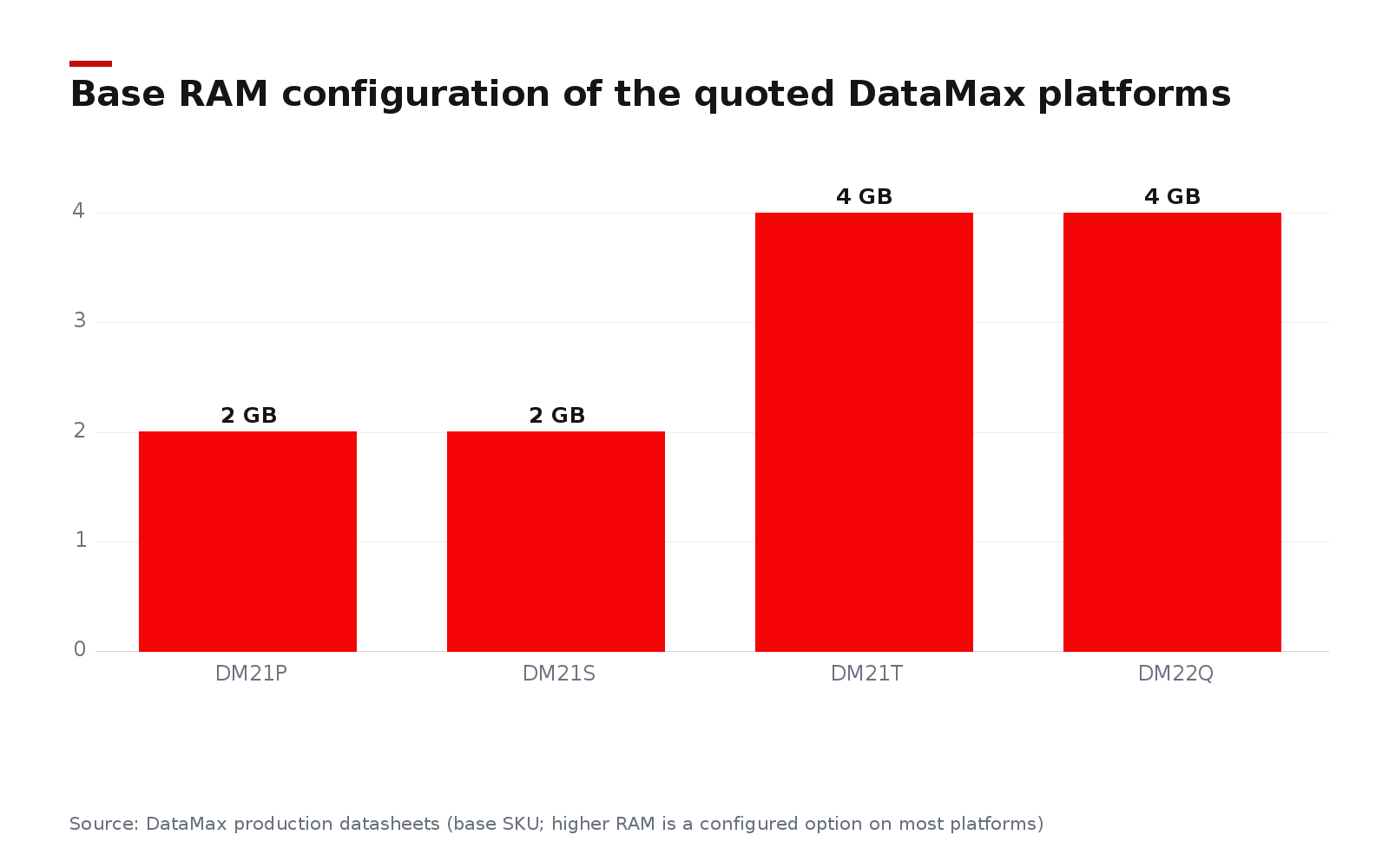
The same figures, in searchable form:
| Model | Base RAM |
|---|---|
| DM21P | 2 GB |
| DM21S | 2 GB |
| DM21T | 4 GB |
| DM22Q | 4 GB |
Source: DataMax production datasheets. Base SKU; higher RAM is a configured option on most platforms. Base configuration only; optional RAM tiers exist and must be fixed line-by-line in the PO.
Three interpretation rules follow. First, DM21T’s decoder row is a 4K@120 capability statement, including H.266/VVC [email protected] and AVS3; it is not a claim of 8K output. Second, DM22Q’s stated maximum is 4K@60; its live product name does not alter that ceiling. Third, a listed option remains conditional until it appears in the quotation and PO.
Use the linked PDP for each model as the starting point for a programme review. Any dimension, certification, packaging, accessory, thermal, power or regulatory detail not stated in the supplied facts should be confirmed against the production datasheet.
A field-level comparison can become a direct RFQ table without changing its meaning. For example, the RFQ should preserve “Amlogic S905Y4, quad Cortex-A35” for DM21P instead of paraphrasing it as a quad-core processor. It should preserve the AOSP Android 11 or Android 14 baseline rather than saying only “Android.” It should list the exact USB counts and the DM21T “no HDMI in” condition. It should distinguish RJ45 100M from the listed 1G option. Those literal fields reduce ambiguity during substitution review.
The memory fields require particular care because several families include alternatives. DM21P starts at 2GB / 8GB and lists 4GB plus 16/32/64GB storage options. DM21S starts at 2GB / 16GB and lists 2/4/8GB RAM with 16/32/64GB storage options. DM22Q starts at 4GB / 64GB and also lists 2/4/8GB RAM plus 16/32/64GB storage options. DM21T is listed at 4GB / 64GB with family options. The PO should name the selected pair, not merely the family.
The model fit also narrows quickly. DM21P is the direct operator middleware set-top-box direction. DM21S is the IPTV/OTT white-label direction. DM21T applies when the premium UHD or cloud-gaming use case needs its stated modern decode envelope. DM22Q applies to the gaming-oriented role. The generic android tv box label does not remove the need to choose among these four stated roles, and none of the fields above should be supplemented beyond the supplied facts without production-datasheet confirmation.
Buyer situations, ranked by what they punish
Different deployments fail in different ways. An operator programme punishes a broken management or middleware lifecycle; an integrator punishes missing interfaces; a venue programme punishes deployment friction; a gaming proposition punishes frame-rate and input-path mismatches. Rank the model list against those consequences rather than against a generic score.
| Situation | Primary requirement | Model direction | Acceptance focus |
|---|---|---|---|
| • IPTV operator fleet | • Middleware integration and fleet management | • DM21P for the operator middleware set-top-box role | • Boot, update, network, output and identity workflows |
| • IPTV/OTT white-label programme | • Branded launcher and current AOSP baseline | • DM21S as the direct white-label candidate | • UI, storage, DRM option, Wi-Fi and Ethernet configuration |
| • Premium UHD service | • High-frame-rate modern codec path | • DM21T where 4K@120 capability is required | • Codec, source, display, output and application chain |
| • Cloud-gaming deployment | • Latency-sensitive service with premium media demands | • DM21T; validate network and service separately | • End-to-end session, decode and display behaviour |
| • Gaming-oriented retail product | • 4GB base, AV1/H.265 and optional Dolby Vision/DTS | • DM22Q | • Controller, OS, title, frame-rate and content-protection fit |
| • AV integrator with fixed cabling | • Required HDMI, USB, AV, S/PDIF, TF and Ethernet | • Select by literal port list | • Cable-by-cable installation and signal-path test |
Rows marked with a bullet represent selectable directions, not an approved substitute. For an operator migration, the strongest starting point is usually DM21P because its stated fit is an operator middleware set-top box. For a white-label product, DM21S is the purpose-fit candidate because its listed role includes IPTV/OTT white-label. DM21T becomes relevant when the service actually consumes its 4K@120 decoder envelope or premium media profile. DM22Q fits the gaming-oriented role, with its listed Dolby Vision/DTS option and 4GB / 64GB base configuration.
An integrator may select a platform that looks nominally similar but has a different port mix. DM21T has only one USB2.0 port and adds one USB3.0 port; DM21P and DM21S each list two USB2.0 ports. A venue installation may need wired Ethernet rather than wireless, making the RJ45 100M baseline versus 1G option material to network design. A product owner may need storage for applications and assets, making the RAM/ROM line more consequential than the processor name.
The ranking also changes with deployment ownership. An operator may prioritize a known middleware baseline, boot behavior, fleet identity, and network recovery. A branded product owner may prioritize the launcher, application catalogue, account flow, storage, and remote experience. An AV integrator may prioritize port count, connector placement, HDMI output, Ethernet, and the physical cable schedule. A distributor may prioritize a stable model-to-configuration mapping, packaging identification, and a repeatable audit trail. The same platform can be inexpensive to deploy in one situation and costly in another because the acceptance burden differs.
Two failure modes deserve explicit testing. First, a wireless-first showroom may pass while an operator deployment fails because the intended RJ45 path or network recovery behavior was not included in the sample plan. Second, a decoder-led selection may pass a short clip but fail a real service because the source, license, application, output setting and display were not tested together. The model direction therefore guides the candidate set; the workload determines the acceptance evidence.
A realistic fleet scene begins with identical units, controlled packaging and repeatable final audit.
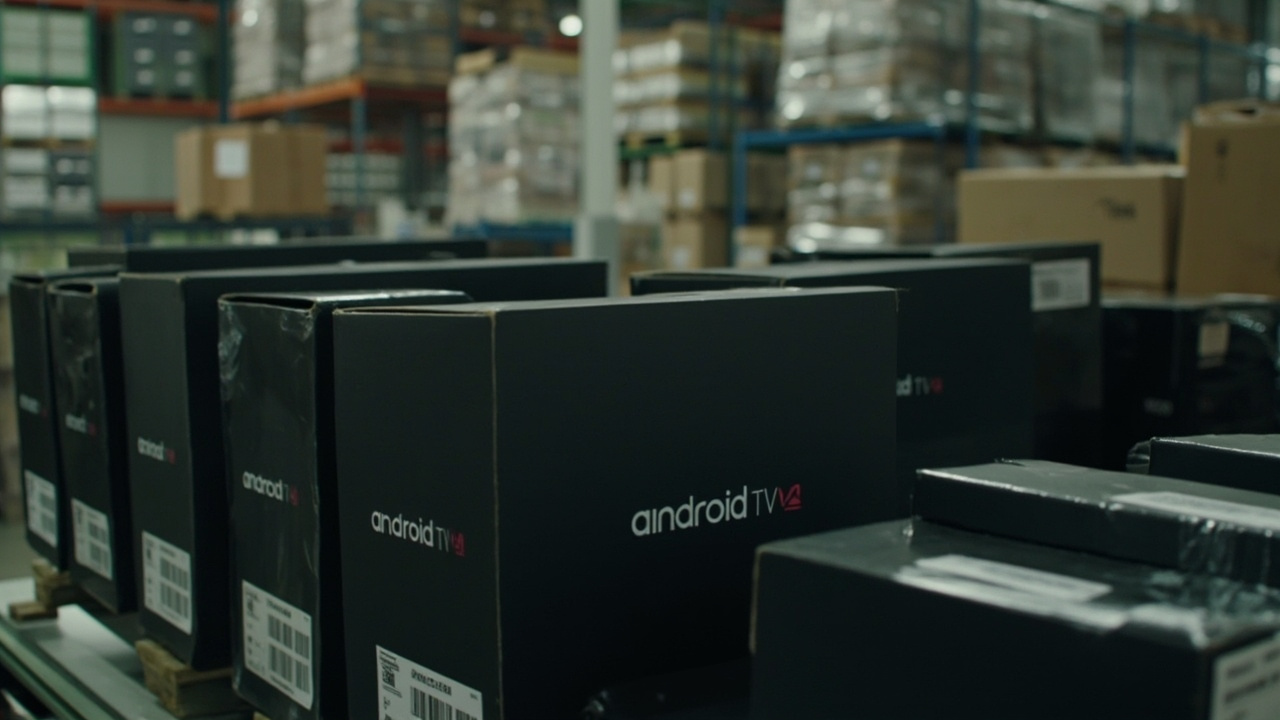
The photograph shows the operational reality that the catalogue cannot express: units must remain traceable from line output to carton, and the model label, software image and accessories must agree. Before a volume commitment, invite DataMax to document the route from SMT and AOI through aging, dark-room testing and shipment audit. The factory quality evidence should be specific to the selected configuration, not merely a general process tour.
A decision path for the RFQ
Turn the model list into a sequence that eliminates incompatible options before commercial discussion. The output should be a specification schedule that can be pasted into an RFQ and later converted, without reinterpretation, into PO lines.
- State the service role Write “IPTV operator middleware set-top box,” “IPTV/OTT white-label,” “premium UHD/cloud-gaming,” or “gaming-oriented Android TV box.” Attach the application, middleware and update-owner responsibilities.
- Fix the content path Specify source format, codec profile, frame rate, HDR condition where relevant, DRM system and protected-output requirement. Mark every optional feature as optional until confirmed.
- Select the model Compare the four DataMax candidates against the service, then remove any row with a decode, OS, port or interface conflict.
- Freeze RAM/ROM and network Name the exact memory tier, Ethernet option and wireless configuration. Use the base figures only as the starting point.
- Define production evidence Require the datasheet, build sheet, firmware identity, SMT/AOI records, aging method, dark-room test, final audit and applicable model-level compliance documents.
- Set acceptance and substitution rules Define sample approval, golden-unit criteria, defect classification, serial traceability, packaging, accessories and written approval for any change.
The first RFQ message should contain this exact topic-specific statement: “Please quote the target android tv box model, exact RAM/ROM tier, AOSP Android release, codec and frame-rate target, DRM requirement, Ethernet option, wireless configuration, port list, packaging and accessories. Provide the production datasheet, proposed configuration and supporting build/test evidence.” Send it through the sample request or the inquiry form.
Do not put unresolved options into the PO. Replace “optional Ethernet” with the selected configuration once agreed. Replace “4K” with the required decode profile and frame rate. Replace “TV box” with the model, OS, memory tier, image and required accessories. Confirm every omitted specification against the production datasheet.
A workable specification schedule contains one row per controlled variable. A sample line should read: model; SoC; AOSP release; RAM/ROM; Ethernet; wireless and Bluetooth; HDMI direction and version; USB count and generation; decoder profile and frame rate; DRM requirement; output-protection requirement; software installation responsibility; update responsibility; packaging; accessories; and evidence package. The programme can then compare each row against the production datasheet without relying on a model label.
The RFQ should also define the sample’s role. Is it a configuration sample, a software golden unit, a mechanical proof, or an application acceptance unit? State which functions it must prove and which remain to be proven in the volume audit. That prevents a visually correct sample from being treated as complete evidence for firmware traceability, aging, packaging or fleet logistics.
For factory due diligence, request a video factory audit or the SMT/AOI/aging evidence specific to this model and configuration. DataMax can support the engineering review through its manufacturing overview, while custom hardware or software requirements can be assessed through custom development. The commercial objective is a controlled PO: one model, one configuration, one evidence trail, and one approved golden unit.
Before issuing the PO, perform a final cross-check against the linked PDP and production datasheet. Confirm that the model name, RAM/ROM, Android baseline, decoder ceiling, DRM status, Ethernet option and physical ports have not been shortened into ambiguous summaries. Confirm that DM21T is described only within its stated 4K@120 envelope and DM22Q only within its stated 4K@60 ceiling. Any field not covered by the supplied facts should be confirmed rather than inferred. That final pass gives the purchasing team a precise RFQ, a testable sample, and a traceable production order.
Further reading
- Guide android tv box for isps
- Rockchip Android TV box guide
- Dolby Vision Android TV box guide
- RFQ checklist for device procurement
- Android TV boxes
- DataMax DM21P specifications and fit
- DataMax DM21S specifications and fit
FAQ
What is the fastest way to choose an Android TV box from a supplier model list?
Start with the service role, then lock four mandatory fields: Android baseline, RAM/ROM tier, codec and frame-rate target, and DRM configuration. Use those fields to eliminate models before comparing ports and network options. Confirm the surviving configuration against the production datasheet and request production evidence tied to that exact build.
Should a buyer select the model with the highest base RAM?
Only when the workload justifies it. Higher RAM does not establish boot reliability, application performance or update behaviour. DM21T and DM22Q list 4GB / 64GB base configurations, while DM21P and DM21S list 2GB bases, but the final decision must include codec, DRM, software and interface requirements.
Does a listed 4K decoder guarantee 4K playback?
No. It states the platform’s listed decode capability. End-to-end playback also depends on the source, application, DRM, output configuration, display, cables and acceptance test. The quoted rows specify codec, profile and frame-rate details; use those exact conditions rather than relying on a generic “4K” label.
Which DataMax model fits an operator middleware set-top box?
DM21P is specified for a 4K IPTV and operator middleware set-top-box fit. Its supplied facts list AOSP Android 11, 2GB / 8GB base memory, RJ45 100M, Wi-Fi6 2x2 and BT5.4. Confirm the selected memory and other options against the production datasheet before ordering.
How should optional DRM and Ethernet be written in an RFQ?
List the mandatory service requirement first, then identify the catalogue option as a proposed configuration subject to confirmation. For example, specify whether PlayReady, HDCP 2.2, Dolby Vision, DTS or 1G Ethernet is required. The final PO should name the selected configuration rather than retain “optional” wording.
What factory evidence should accompany a volume quotation?
Request the build sheet, firmware identity, SMT and AOI records, aging procedure, dark-room display test, final audit and applicable model-level compliance documents. DataMax can provide configuration-specific evidence or arrange a video factory audit so the quotation can be linked to the units intended for shipment.