

What the answer hinges on
An android tv box manufacturer should be selected through a sample acceptance gate that tests whether the production configuration, software image, interfaces, and content-protection behavior match the signed RFQ. A working retail unit is not enough: sample suitability, factory reproducibility, and shipment traceability are separate decisions.
| Decision layer | Acceptance question | Required evidence |
|---|---|---|
| Configuration | Does the sample match the specified platform, memory, OS, ports, and optional functions? | Signed configuration sheet and photographed identifiers |
| Function | Do video, networking, peripherals, DRM, update, and recovery behave as required? | Test log with pass, fail, and observed result |
| Reliability | Does the unit survive the defined burn-in and thermal workflow? | Temperature, duration, power-cycle, and defect record |
| Traceability | Can the factory connect the unit to a production lot? | Serial number, build record, and sample-to-lot link |
Treat the sample as an evidence generator. Before functional testing, confirm the exact production bill of materials, AOSP image revision, middleware or operator integration, DRM licensing arrangement, and port configuration. Capture repeatable procedures rather than subjective impressions. For broader selection criteria, use the canonical Android TV box manufacturer selection guide.
A successful gate produces a repeatable decision. The buyer must know which component, software revision, factory, and test condition produced the pass. Memory substitution, an Ethernet-option change, a revised AOSP image, an unapproved DRM path, or altered operator middleware invalidates the sample unless a controlled deviation and retest approve it.
Sample approval and production release remain separate. Sample acceptance confirms that a defined configuration meets defined requirements. Production release confirms that a controlled process can reproduce that configuration at volume. An android tv box manufacturer with a mature evidence trail should state both boundaries: what passed and how later equivalence will be demonstrated.
The immediate procurement deliverable is a numbered acceptance protocol attached to the RFQ. Every sample receives a configuration identifier. Every test row contains the input, expected result, observed result, severity, disposition, and approval owner. Failed tests remain visible. Otherwise, the report records selected successes and cannot support a reliable factory comparison.
Ownership should be assigned before execution. Engineering owns codec, interface, recovery, and middleware findings; quality owns inspection and aging records; the factory owns lot traceability; procurement owns commercial configuration match. Acceptance evidence also differs from certification evidence. A sample may pass a defined protocol while the order still requires separate regulatory, safety, radio, or market documentation. Conversely, a broad factory certificate cannot prove a specific memory, OS, DRM, or regional image was tested.
Which DataMax models actually sit here
The DataMax comparison set spans IPTV, OTT, premium UHD, and gaming-oriented boxes. Start with workload, then map the sample to the intended production configuration. Specifications below are transcribed from the provided product facts; options require confirmation against the production datasheet and quotation.
| Model | Position | Platform and OS | Memory | Video | DRM | Connectivity and I/O |
|---|---|---|---|---|---|---|
| DM21P | 4K IPTV / operator middleware set-top box | Amlogic S905Y4, quad Cortex-A35; AOSP Android 11 | 2GB / 8GB; 4GB; 16/32/64GB optional | AV1 [email protected], VP9/H.265 4K@60, H.264 4K@30 | Widevine L1 / PlayReady / HDCP 2.2 optional | HDMI 2.0b out x1, USB2.0 x2, TF, S/PDIF, 3.5mm AV, RJ45 100M, Wi-Fi6 2x2 + BT5.4, DC 5V/2A |
| DM21S | 4K Android TV box for IPTV/OTT white-label | Amlogic S905Y5, quad Cortex-A55; AOSP Android 14 | 2GB / 16GB; 2/4/8GB; 16/32/64GB optional | AV1 / H.265 [email protected] 4K@60 | Widevine L1 / PlayReady optional; Dolby Vision/DTS | HDMI 2.0b out, S/PDIF, AV, USB2.0 x2, TF, RJ45 100M; 1G optional; Wi-Fi6 2x2 + BT5.4 |
| DM21T | Premium UHD / cloud-gaming box | Amlogic S905X5, quad Cortex-A510 (ARMv9); AOSP Android 14 | 4GB / 64GB family options | H.266/VVC [email protected] 4K@120; AV1/VP9/H.265 4K@120; AVS3 4K@120; H.264 4K@60; inline AI-SR | Widevine L1 / PlayReady optional | HDMI 2.0b out, no HDMI input, USB2.0 x1, USB3.0 x1, TF, S/PDIF, AV, RJ45 100M; 1G optional; Wi-Fi6 + BT5.4 |
| DM22Q | Gaming-oriented Android TV box | Amlogic S905X5M, quad Cortex-A55 up to 2.5GHz; AOSP Android 14 | 4GB / 64GB; 2/4/8GB; 16/32/64GB optional | AV1/H.265 L5.1 4K@60; inline AI-SR | Widevine L1 / PlayReady optional; Dolby Vision/DTS | HDMI 2.0b out, USB2.0 x2, TF, S/PDIF, AV, RJ45 100M; 1G opt; Wi-Fi6 2x2 + BT5.4 |
For an IPTV middleware program, DM21P is the relevant starting point because that is its stated fit; its AOSP Android 11 baseline creates a deliberate software-generation decision. DM21S moves an IPTV or OTT white-label program to AOSP Android 14 and a 2GB / 16GB baseline. The AOSP versus Google Android TV guide separates platform policy from the sample gate.
DM21T and DM22Q are not interchangeable gaming samples. DM21T provides 4K@120 decode paths across H.266/VVC, AV1, VP9, H.265, and AVS3, while its output is stated as 4K through HDMI 2.0b. DM22Q uses Amlogic S905X5M, has 4K@60 AV1/H.265, and uses a 4GB / 64GB family configuration. Do not claim 8K output for either model; confirm against the production datasheet.
RAM and storage entries are configurations, not inferred capacities. A DM21P request for 2GB / 8GB differs from a 4GB or optional 16/32/64GB version. On DM21S, DM21T, and DM22Q, optional Ethernet at 1G must appear in the purchase configuration because the listed baseline is RJ45 100M. This distinction can affect file transfer, diagnostic access, and middleware traffic.
Auditability depends on the attached software. Record the AOSP Android version, build identifier, launcher or middleware version, device tree, regional settings, network profile, and update package. A retail image can demonstrate decoding but cannot validate an operator image. An IPTV middleware build that passes playback does not automatically prove HDMI output, USB peripherals, factory reset, or recovery behavior.
For each sample, name the exact option state. DM21P requires the selected RAM and storage combination, HDCP 2.2 status, 3.5mm AV, and DC 5V/2A arrangement. DM21S, DM21T, and DM22Q require the 100M or optional 1G Ethernet decision. DM21T also requires the USB2.0 and USB3.0 arrangement and no HDMI input. These fields change physical inspection and functional tests.
The following comparison shows why a source label is not a substitute for factory evidence. It compares organizational routes by their potential to expose manufacturing issues during sample qualification. It does not rank DataMax products or replace an audit.
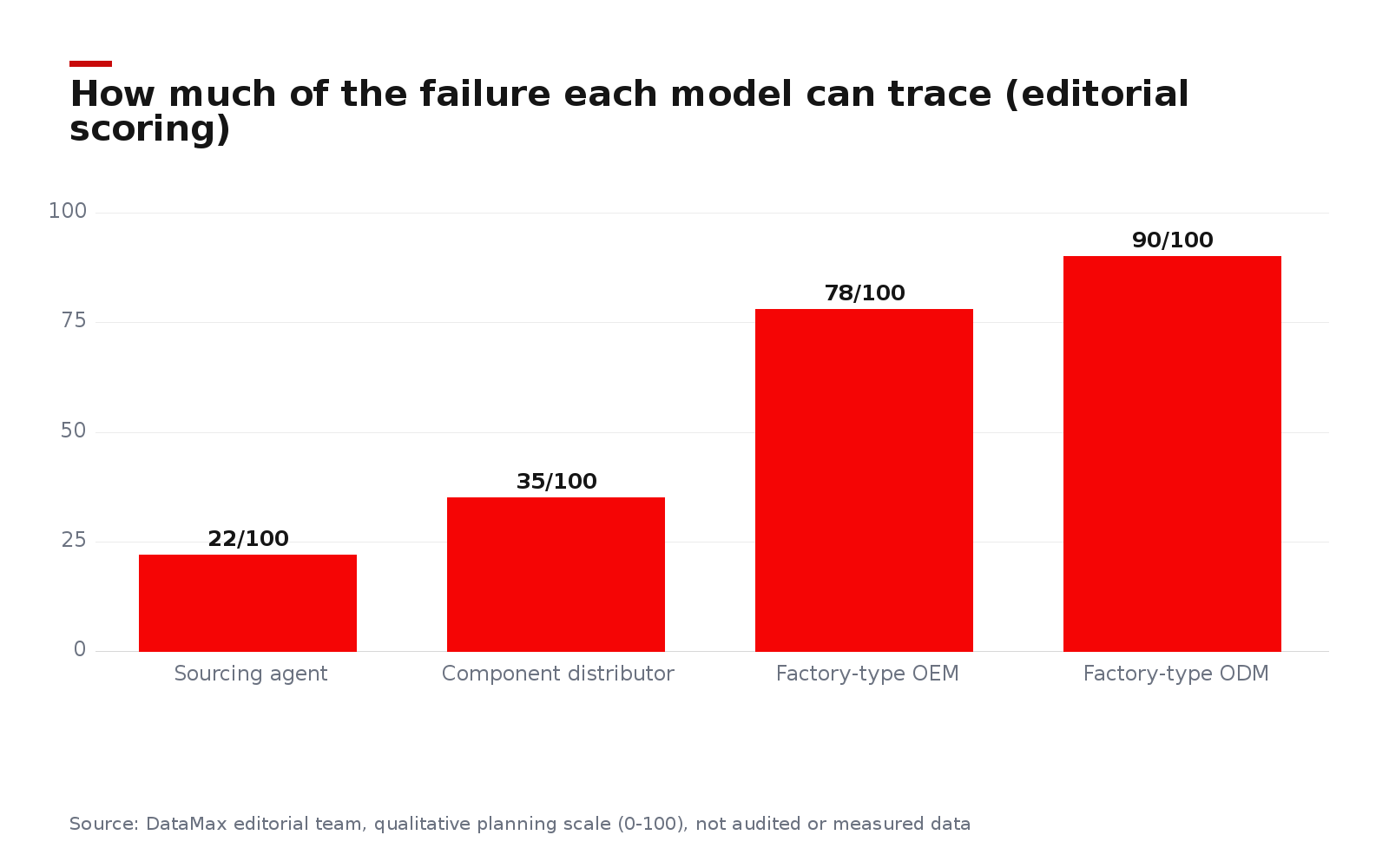
The same figures, in searchable form:
| Sourcing route | Editorial score |
|---|---|
| Sourcing agent | 22 |
| Component distributor | 35 |
| Factory-type OEM | 78 |
| Factory-type ODM | 90 |
Source: DataMax editorial team, qualitative planning scale (0-100), not audited or measured data.
The mechanism behind the spec
A sample gate compares 4 artifacts: the commercial specification, engineering build, acceptance procedure, and proposed mass-production configuration. The sample proves behavior at one point; it does not prove every later lot. The mechanism is “golden sample plus repeatable procedure plus traceability,” not “one passed unit equals factory approval.”
The first artifact converts marketing language into testable requirements. For example, 4K must identify resolution, refresh rate, chroma format, codec profile, and level. AV1 [email protected] at 4K@60 on DM21S differs from DM21T’s broader 4K@120 decode list. Load controlled media rather than relying on a retail application, and record the displayed format as well as successful playback.
The second artifact fixes the software baseline. AOSP Android 11 on DM21P and AOSP Android 14 on DM21S, DM21T, and DM22Q are different environments. Record the image revision, launcher or middleware build, update mechanism, permissions, bootloader behavior, factory reset, recovery path, and regional network settings. A sample can pass IPTV playback while failing captive-portal requirements, OTA policy, or operator provisioning.
The third artifact tests interfaces. HDMI output, S/PDIF, analog AV, USB, TF, RJ45, Wi-Fi6, and Bluetooth 5.4 should each be exercised according to the selected configuration. Listed RJ45 baseline is 100M; 1G is optional on DM21S, DM21T, and DM22Q and must be ordered and verified. USB 3.0 on DM21T must be distinguished from USB 2.0 ports on the other models.
The fourth artifact is content protection. Widevine L1, PlayReady, HDCP 2.2, Dolby Vision, and DTS are not interchangeable claims. Optional means optional. Record licensed-device status, output-protection behavior, requested key system, supported stream path, and contractual license provisioning. The AV1 Android TV box guide helps define a separate media test set.
The operating architecture connects 6 records: configuration baseline, media corpus, pass criteria, sample result, deviation log, and equivalence rule. The baseline identifies what was offered. The corpus defines inputs. Pass criteria determine success. The result records observations. The deviation log explains accepted differences. The equivalence rule determines whether a later unit or lot remains inside the approved envelope.
Video test records should identify codec, profile, level, resolution, refresh rate, color representation, bit depth, and container. Network records should identify Ethernet speed, Wi-Fi band and channel plan, DHCP or static addressing, DNS behavior, captive portal, multicast path where relevant, and measurement method. A connected icon is not evidence of usable service.
DRM verification should follow a chain. Identify the requested system and whether it is optional. Record device licensing, key-system behavior, protected output path, display capability, audio path, and exact test content. Document who controls license provisioning for production units. A sample licensed under a developer account cannot automatically demonstrate fleet provisioning.
Thermal and recovery testing establishes whether the sample sustains its workload. Specify power source, ambient condition, media session, duration, restart count, and recovery procedure before execution. Define measurable failures such as decoder errors, unexpected reboot, network loss, image corruption, audio interruption, or failure to recover. Include normal reboot and interruption during update or provisioning.
Controlled change closes the mechanism. Any processor, RAM, storage, Ethernet, OS image, middleware, DRM, HDMI, or USB change needs an impact assessment. The assessment can require document review, a new sample, focused retest, or production-lot verification. This prevents an approved sample from becoming an obsolete proxy after a component or software branch changes.
For an android tv box manufacturer, the most useful artifact is a version-controlled test package rather than a generic checklist. Its index should identify procedure revision, media revision, firmware revision, hardware configuration, expected result, and approval status. A test row without those references cannot be replayed on a later lot.
Entry tier versus commitment tier
The entry route reduces initial coordination effort; the commitment route increases traceability before production tooling or a large build is approved. Neither tier should be selected by supplier label alone. A sourcing agent may arrange the sample, but the manufacturing party must still supply configuration and quality evidence.
An entry-tier sample request should include one representative unit, its configuration sheet, package list, and test result. It supports checking a platform direction before firmware integration. Its weakness is limited observation: one sample cannot reveal lot variation, repeat thermal behavior, or serial-number discipline.
A commitment-tier gate adds a controlled media library, interface matrix, boot and recovery sequence, network test, DRM verification, burn-in record, and sample-to-lot traceability. It also requires the supplier to define which changes trigger re-approval. The commercial cost is a slower approval cycle; the operational benefit is fewer configuration escapes after tooling or volume production.
Here, an android tv box manufacturer should not be ranked by how quickly it returns a generic box. Rank the evidence chain instead. The editorial chart is a planning aid, not a factory scorecard. For DataMax programs, request a sample against the specific PDP and exact memory, OS, port, codec, and DRM configuration.
The entry tier can remain objective. Use a short configuration identity check, cold boot, cold reset, controlled video clip, Ethernet or Wi-Fi transfer, and required physical ports. Identify missing features and unverified options. Its approval should state “platform direction accepted,” not “production approved.” That wording prevents a demonstration unit from becoming a reference design for a volume order.
The commitment tier becomes appropriate when software integration is ready, tooling approaches release, or field failure carries meaningful operational cost. For an operator set-top box, add provisioning, account entitlement, multicast or unicast service, remote update, recovery, and fleet identity. For premium UHD or cloud gaming, add sustained 4K@120 decode cases, high-bandwidth network behavior, thermal observation, and the declared USB generation.
The practical difference is not the number of test ticks. Entry acceptance seeks directional confidence; commitment acceptance seeks reproducibility. The former asks whether the platform can meet the use case. The latter asks whether the factory can repeatedly build, flash, inspect, age, and release equivalent units while preserving access to the evidence.
| Dimension | Entry tier | Commitment tier |
|---|---|---|
| Configuration | Model and principal options recorded | Signed BOM, image revision, approved substitutions, and equivalence rules |
| Functional test | Core playback, boot, network, and required ports | Controlled codec, DRM, middleware, recovery, update, peripheral, and network matrix |
| Reliability | Short repeated boot and operation check | Defined burn-in, thermal session, repeated power cycles, and defect disposition |
| Traceability | Sample identity and configuration sheet | Serial-to-build link, inspection records, golden sample, release record, and change control |
| Decision | Proceed to integration or deeper test | Approve a controlled production baseline |
Tie escalation to the consequence of an unnoticed mismatch. Low-complexity evaluation units can use the entry tier. Operator middleware, licensed content, shared-service environments, and difficult-to-replace deployments normally need the commitment tier because field failures cannot be corrected by replacing a loose retail carton. This is a methodology judgment, not a DataMax product specification.
The quotation structure should reflect the tier. Scope entry work as evaluation engineering time, sample preparation, and a basic report. Separately identify golden-sample creation, firmware and middleware freeze, controlled test-asset preparation, traceability setup, and production-equivalence review for commitment work. If one commercial line covers both without deliverables, the buyer cannot locate responsibility or identify omitted work.
Where this matters in a deployment
Deployment context changes which failures matter. An operator prioritizes middleware, provisioning, and service recovery; an integrator stresses physical I/O and network stability; a gaming-oriented venue requires sustained decode performance and thermal behavior.
| Situation | Primary requirement | Acceptance emphasis | Model direction |
|---|---|---|---|
| IPTV operator middleware | Managed deployment and predictable device behavior | Provisioning, boot, recovery, middleware build, 4K IPTV media path | DM21P for 4K IPTV / operator middleware fit |
| IPTV or OTT white label | Android 14 baseline with brand customization | Image identity, launcher, update path, HDMI, network, licensing | DM21S |
| Premium UHD or cloud gaming | Higher decode breadth and frame-rate validation | 4K@120 codec set, thermal run, USB, output limitation, AI-SR behavior | DM21T |
| Gaming-oriented Android TV | 4K@60 gaming path and stable system configuration | AV1/H.265 media, sustained load, Android 14 image, ports, recovery | DM22Q |
| Hotel, retail, or signage integration | Physical integration and field recovery | HDMI, AV, USB, Ethernet, Wi-Fi, reboot, factory reset, remote-control behavior | Select by required I/O and operator software; confirm against the production datasheet |
An IPTV acceptance lab should include controlled multicast and unicast sessions where applicable, plus required account or token behavior. Freeze the sample’s network configuration rather than relying on a developer account or unrestricted internet path. An integrator deploying hundreds of room devices should add repeated power-cycle and recovery checks because installation faults often surface at restart.
In a hotel deployment, the sequence may begin with firmware identification, then HDMI handshake, remote-control operation, Ethernet insertion, network authentication, channel retrieval, audio output, power-cycle recovery, and factory reset. If equipment is stored before room activation, add a discharge and first-boot sequence matching the logistics path. Select by required interfaces and operator software.
For retail digital-signage or commercial-display use, test remote update, unauthorized menu access, accidental reset, network-loss handling, display compatibility, scheduled reboot, and recovery after interrupted update. HDMI 2.0b output must be checked against the display’s accepted behavior. If AV or S/PDIF is installed, test that path with the actual amplifier or display arrangement.
A gaming-oriented venue requires sustained workload rather than a short clip. Record codec, 4K@60 or 4K@120 target, display mode, controller behavior if applicable, network conditions, and observation period. Document thermal behavior under repeated decode and sustained use. For DM21T, test its listed 4K@120 codec set; for DM22Q, start with the stated AV1/H.265 4K@60 path.
Operator procurement should add field identity: serial or device ID format, provisioning import, remote-support access, update grouping, and replacement procedure. Demonstrate the intended middleware workflow. If provisioning occurs as a separate factory operation, state whether it is inside the sample scope or a separate production-control point.
Define the failed-unit return path. An operator may need the faulting unit to preserve its identifier, image version, and middleware log until root-cause assignment. A venue integrator needs a replacement procedure that verifies the replacement image and configuration. Without these instructions, the laboratory sample passes while the field process remains untraceable.
For distributor-led retailer programs, the sample gate establishes a platform baseline while branding remains controlled. Check each retailer build for launcher identity, update URL, regional settings, network defaults, and packaging. This avoids requalifying every brand variation while preventing configuration mismatch from reaching distribution.
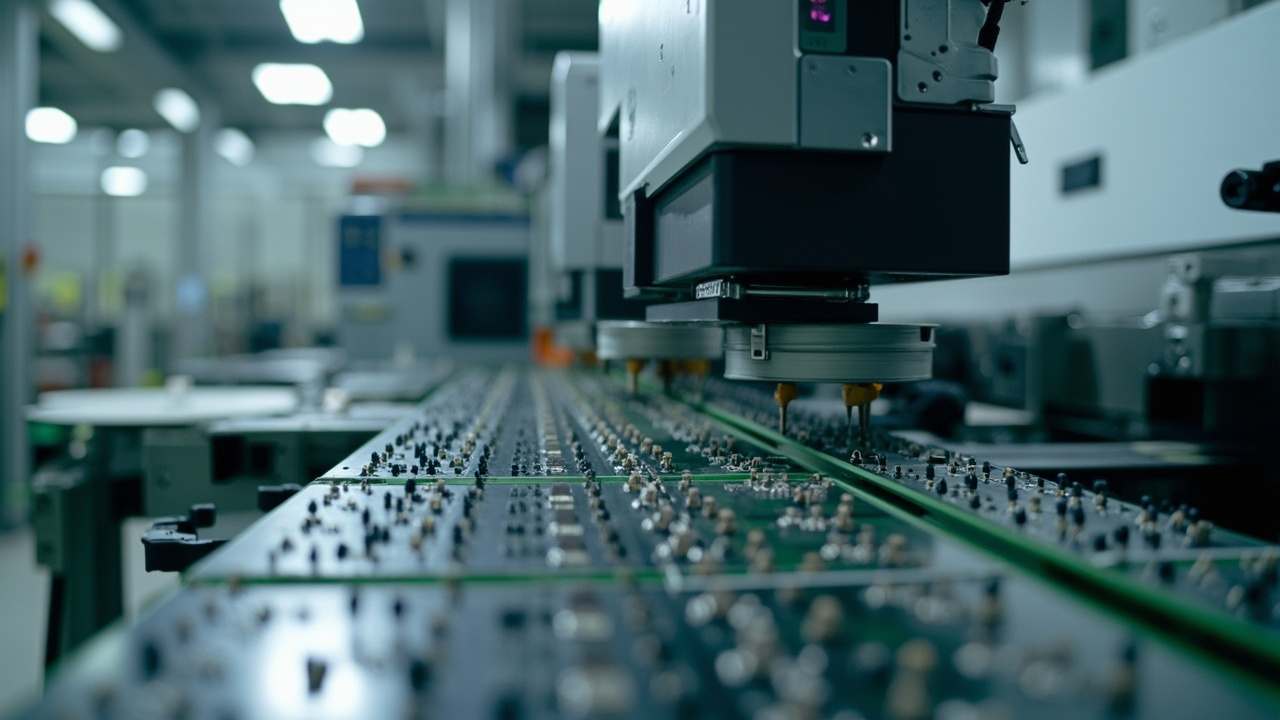
The sample gate eventually intersects with SMT and inspection rather than remaining a laboratory exercise. The intended production context is automatic component placement on a modern SMT line.
The traps in this category
Field trap
A quotation stating “DRM supported” does not define a usable content-protection configuration. Widevine L1, PlayReady, HDCP 2.2, Dolby Vision, and DTS involve different device, output, and license conditions. Approving the phrase without the key system, output path, license owner, device status, and test stream can produce a sample that plays commercial content while failing the intended service.
Field trap
Do not let sample-approval language drift into undocumented production substitution. A processor family, RAM and storage option, Ethernet speed, OS baseline, HDMI arrangement, or USB generation can change the acceptance envelope. If substitution is possible, require written advance approval and a fresh sample test for the affected change.
The first trap is ambiguity around “same model.” Memory configurations, 100M versus optional 1G Ethernet, DRM options, and Android 11 versus Android 14 are materially different sample states. Attach an approved configuration identifier to every sample and report. The second is output exaggeration: marketing language cannot override a datasheet’s stated 4K ceiling.
Another failure mode is accepting a clean UI screenshot as evidence of a production image. It does not reveal update failures, recovery loops, codec errors, thermal throttling, port instability, or a wrong serial number. The gate must record outcomes, including failed tests and accepted deviations.
An untested power and thermal profile is another risk. A short demonstration does not expose heat-related instability or repeated startup under the intended supply. Insufficient ownership is also common: the agent buying the sample may not be the factory assembling it. Name the manufacturer, engineering owner, quality owner, and approval authority.
Avoid changing the gate after failure. Test criteria, media, duration, and severity rules should be approved before execution. Post-failure changes create disagreement about acceptable deviations. A controlled deviation must identify the original failure, changed condition, affected test rows, and approval authority.
“Sample” can also mean several deliverables. A preloaded evaluation box, customized engineering build, and unit from the production BOM have different evidentiary weight. State which is supplied and which stated features are present. Development features may obscure production behavior or require removal before shipment.
Do not confuse certification evidence with model acceptance. A factory may provide broad certification documents while the selected memory, OS image, DRM option, and regional configuration remain outside the tested evidence. Conversely, a demonstrated sample does not prove every certification file applies to the final order. Review applicability through certifications and compliance processes.
Silent aging is a final trap. A unit that starts correctly may fail after repeated restart, prolonged decode, or repeated network association. Ask for the planned aging condition and record. Do not invent an arbitrary duration; select it from duty cycle, supplier capability, and deployment risk. An unavailable record belongs in the qualification decision.
Quotations can also diverge because of test assets. One supplier may use a retail application, another a controlled stream, and a third an operator middleware build. These can produce different conclusions from the same hardware. Identify media, account, network path, display, audio path, and application version so comparisons use comparable conditions.
A failed sample also needs controlled retest rules. Replacement hardware may contain a different image, component lot, or configuration. Record the original unit identifier and failed rows, verify replacement identity, and rerun affected tests with the same controlled inputs where possible. An informal “try another box” decision prevents root-cause analysis and leaves the production baseline uncertain.
A decision path for the RFQ
Convert the request into a sequence that resolves commercial ambiguity before engineering spends time on the sample.
- Lock the use case State IPTV middleware, IPTV/OTT white label, premium UHD/cloud gaming, or gaming-oriented deployment, including required output resolution, refresh rate, codec, DRM, connectivity, and update model.
- Freeze the configuration Write the exact DataMax model, memory configuration, AOSP Android baseline, port set, Ethernet option, DRM options, accessories, packaging, and approved substitutions.
- Define the test corpus Supply controlled media for every required codec and format, operator middleware or middleware image, network profiles, DRM test account, peripheral list, recovery steps, and update packages.
- Set pass criteria Specify required duration, repetition count, thermal conditions, permitted error rate, boot-time method, interface checks, documentation, and handling of unavailable optional features.
- Require sample evidence Collect serial number, configuration identifier, software revision, photographs, boot and playback results, network results, recovery results, and signed test report.
- Approve production equivalence Define which BOM, image, tooling, supplier, or process changes trigger a new sample, written deviation, or production revalidation.
A useful RFQ line states: “Sample must match the signed configuration and production BOM; report device serial number, AOSP image revision, memory configuration, DRM state, and test date.” Another states: “No processor, memory, storage, Ethernet, OS, DRM, HDMI, or USB substitution without prior written approval.”
When requesting DataMax samples, the first message should contain the target model, deployment profile, exact memory and storage option, required OS baseline, codec and output target, DRM requirements, port list, network requirement, middleware or customization scope, and intended sample date. Use the sample request or engineering inquiry route so the test definition remains connected to the configuration. The operator-tier Android TV box solution separates operator deployment requirements from retail-box features.
Turn the use case into a requirements matrix. Each row identifies the function, input condition, expected observation, measurement method, repetition count, severity, and evidence attachment. An HDMI row specifies resolution, refresh rate, color format, display or capture method, and handshake-failure treatment. A network row specifies interface, speed, server, transfer size, observation period, and whether retries are permitted.
The configuration line should separate standard fields from ordered options. For DM21P, state the selected RAM and storage configuration, HDCP 2.2 requirement, 3.5mm AV, and DC 5V/2A arrangement. For DM21S, DM21T, or DM22Q, identify 100M or 1G Ethernet explicitly. For DM21T, identify USB3.0 versus USB2.0 and keep HDMI output within the stated 4K boundary.
The software line should name more than the OS release. Request the build identifier, launcher or middleware revision, regional configuration, update mechanism, device identity scheme, and factory-reset behavior. If DRM is required, add the requested system, protected output path, test account or licensing method, and production provisioning responsibility. Label development-grade samples and state which production-equivalence tests remain outstanding.
The decision record should contain 3 outcomes. “Accepted” means the configuration and procedure are approved for the stated purpose. “Accepted with deviation” means identified differences are documented and bounded by an approver. “Rejected” means the sample missed pre-agreed criteria. Avoid “for review” after testing because it leaves the production baseline ambiguous.
Define the response package: configuration sheet, test procedure, controlled-media index, signed result sheet, deviation log, proposed golden-sample identifier, production-equivalence rule, and available manufacturing-quality records. This package can be compared across quotations even when factories use different terminology.
Procurement should set dates and ownership for resolving deviations. Assign engineering to reproduce a failure, quality to determine whether it is process-related, and commercial owners to estimate schedule or volume effects. Record the retest on the same controlled media and firmware revision where possible. A replacement sample is not automatically a retest because it may contain a different image or component lot.
The evidence trail from SMT to shipment
The production gate should connect SMT with what can be proven at shipment. Sample approval establishes a target configuration; it does not replace process control. The evidence trail begins with production materials, moves through assembly and inspection, enters aging and functional testing, and ends with a serialized shipment record.
- Incoming and build control Match approved components and production materials to the signed configuration. Link the device serial number or identifier to its build record and software image.
- SMT and AOI evidence Retain the machine or line record, inspection result, defect disposition, and component-lot linkage for the production board set.
- Assembly evidence Record firmware flashing, display and network checks, port checks, identifier programming, and any repair or component-substitution event.
- Aging and dark-room verification Execute approved power-on, thermal, repeated restart, display, audio, network, and image-quality checks under the documented procedure.
- Final audit and release Link the passing device to the golden sample, configuration revision, test log, packaging record, and shipment lot; retain the release decision.
Acceptance evidence should be a linked record, not disconnected reports: serial identifier → hardware build → AOSP image and middleware revision → SMT/AOI result → burn-in and functional test → packaging and shipment lot. Repairs, rework, substitutions, and image reflashes must remain visible. DataMax can provide relevant manufacturing and quality documentation through its factory quality, certifications, and compliance processes; confirm the applicable document set and production status for the ordered configuration.
Approve the configuration and procedure, not an unidentified physical resemblance. At shipment, sampling can verify consistency with the approved baseline, while production records provide traceability. The final request to an android tv box manufacturer should ask for the sample report, proposed production-equivalence rule, and evidence chain that survives beyond the first unit.
At incoming control, reconcile components and approved alternatives with the production BOM. The factory should identify the relevant component lot without requiring the buyer to reconstruct traceability from a carton label. At SMT and AOI, inspection results need an accepted, reworked, or quarantined disposition. Rework remains linked to the device record because a repaired board may differ from an untouched board.
At assembly, software flashing is a controlled process rather than a box-checking task. The operator verifies the exact AOSP image and applicable middleware or launcher revision. Device identifiers, Ethernet option, ports, and optional hardware are checked against the configuration identifier. Any changed component or image becomes an event and is evaluated against the equivalence rule.
Dark-room and aging provide functional evidence under controlled conditions. The approved sequence states what the unit displays, what media it plays, what network path it uses, how often it restarts, and what constitutes failure. Media content, ambient condition, duration, and power source are recorded with the result. The same structure feeds the shipment audit rather than creating a separate inspection system.
At final release, the unit identifier resolves backward to the build, forward to the test record, and outward to packaging and shipment lot. A buyer can select a delivered unit, obtain its configuration and test outcome, and identify any repair or deviation. This is the operational objective: the approved sample becomes the reference point for a controlled production system.
An android tv box manufacturer can close the loop when the sample procedure and factory control plan use the same configuration identifier, defect codes, and release states. A laboratory finding maps to the inspection step that should prevent it, while a field failure maps back to a specific build and test result.
The final review reconciles 4 items: signed RFQ, golden-sample configuration, approved procedure revision, and first production-lot evidence. Classify any mismatch as clarification, deviation, or rejection. This gives procurement a defensible release basis while engineering and quality retain the changes that reopen acceptance.
Further reading
- Guide android tv box manufacturer
- Compliance support by market
- Allwinner Android TV boxes
- AOSP Android TV boxes
- H.265 HEVC Android TV box guide
- DataMax DM21P specifications and fit
- DataMax DM21S specifications and fit
FAQ
Does a working sample prove mass-production quality?
No. It proves that one sample passed the approved tests under defined conditions. Mass-production quality requires controlled inputs, repeatable assembly and inspection, traceable test records, defined change controls, and shipment release procedures. A sample also becomes invalid as the reference if the production BOM or software image changes without approval.
Which DataMax model fits an IPTV operator program?
The DM21P is explicitly positioned for 4K IPTV and operator middleware set-top boxes, using the Amlogic S905Y4 and AOSP Android 11. The DM21S supports 4K IPTV/OTT white-label use on the Amlogic S905Y5 and AOSP Android 14. Selection should then be checked against memory, DRM, middleware, ports, and the production datasheet.
Should DRM support be verified in the first sample?
Yes, if DRM is part of the acceptance requirement. Record the requested system—Widevine L1, PlayReady, HDCP 2.2, Dolby Vision, or DTS—and the output path and license arrangement. Optional DRM features must be ordered and tested rather than inferred from the model name. A commercial content demonstration alone is not sufficient evidence.
What evidence should accompany a factory sample?
Request the serial number, exact configuration, AOSP image or software revision, controlled-media results, interface results, network results, recovery results, thermal or burn-in record, and deviations. The sample should link to a golden-sample identifier and production-equivalence procedure. Obtain confirmed production documents from the selected factory before approval.
Can acceptance criteria change after a failure?
Only through a controlled deviation process. Record what changed, why, which results are invalidated, and who approved the change. Changing media, duration, temperature, or pass threshold without evidence can conceal a weak configuration and create disputes over mass-production release.
How should a DataMax sample request be prepared?
Send the target model, deployment type, exact memory and storage configuration, Android baseline, codec and output requirements, DRM needs, port and network requirements, middleware scope, controlled-test availability, and intended sample timing. Identify options as requested rather than assumed. The DataMax contact route can direct the technical request to the appropriate engineering and quality process.




