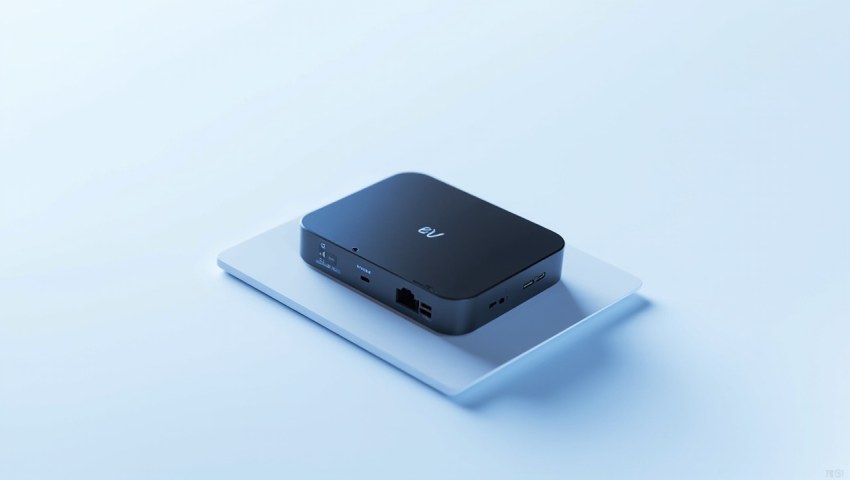
The RFQ for ten thousand 4K operator boxes sits in your inbox with three quotations attached, and the per-unit prices spread wider than any line item explains. One supplier leads with the chip, one with the certification, and the third simply writes "Android TV box, 4K, with Wi-Fi" as if that described one device. All three are quoting in good faith. None of them is quoting the same thing.
Here is the short answer before the mechanics: an android tv box price moves on four specification fields — the silicon platform, the content-protection licence class, the memory and storage tier, and the radio/regional configuration. Chassis colour, packaging gloss and most marketing adjectives barely register. A buyer who writes those four fields tightly receives three comparable numbers; a buyer who does not receives three different devices with three different prices, and discovers which one arrived at customs.
This article takes a factory quotation apart field by field, using five DataMax platforms that are in serial production today. It avoids unit figures on purpose — a printed price for an unverified configuration is the fastest way to make two quotes incomparable — and ends with the exact list to send to a supplier.
What an android tv box price actually contains
A quoted unit price is a stack, and only part of the stack is visible on a product page. The bill of materials is the middle of it, not the whole of it.
| Layer | What it covers | Who controls it |
|---|---|---|
| Silicon | SoC, RAM, flash, Wi-Fi/Bluetooth module, cellular modem if fitted | Your capability spec + memory market |
| Licences | DRM integration per SKU, and where required a Google-certified build path | Your content requirements |
| Conformity | Destination-market testing and the technical file behind each market | Your shipping list |
| Customisation | Boot logo, launcher, preloaded apps, packaging artwork, regional firmware | Your brand scope |
| Manufacturing | SMT, in-circuit checks, burn-in, final QC, packing | The factory's process |
| Lifecycle | Firmware branch maintenance, EOL notice window, spare-board policy | The contract terms |
A buyer only sees one number, but the number tilts differently depending on which layer the supplier optimised. A quotation that looks expensive may carry a per-SKU DRM option and a fixed-BOM window that the cheap quote silently excludes. A quotation that looks cheap may quote a memory tier one step below what the launcher, EPG and DRM pipeline actually need — a saving that converts into field returns, which the quotation never prices in.
The discipline is therefore not to negotiate the number first. It is to force all three quotations through the same four fields, then compare.
The four fields that move the number
Not every spec row carries equal weight. The scale below is a qualitative planning scale, not audited financial data; it ranks how often each field is the reason two apparently identical quotations fail to reconcile.
Field 1 — The silicon platform and its decode profile
"4K box" is not a platform. A quad-core A53 built for 1080p signage loops, a quad-A55 with an AV1 pipeline, and an ARMv9 part with a neural accelerator all appear on the same quotation template, and the price gap between them is the difference between a media player and a premium UHD terminal.
The decode profile is the part to write in full. "Supports 4K" tells a supplier nothing about codec, level or frame rate; it will be answered with the cheapest silicon that can output a 4K desktop. The procurement-grade version names codec, profile, level and frame rate — for example AV1 [email protected] at 4K@60, H.265 4K@60 — because that sentence is what the chip selection table actually keys on.
Three distinctions inside that sentence routinely fail to survive a quotation round. The first is decode versus output: a chip may accept an 8K source over the network while the HDMI pipeline leaves the screen at 4K, which is a perfectly sensible design but not "an 8K box." The second is level within a codec: AV1 Main 8-bit at 1080p and AV1 Main10 at 4K@60 are different silicon price bands under the same three-letter word. The third is HDR path — HDR10 is table stakes, HDR10+ and Dolby Vision are separate licensing and implementation questions, and an android tv box price that silently assumes none of them is a different product from one that assumes two. Writing the profile in full removes all three ambiguities before the first number is offered, which is considerably cheaper than removing them at pilot.
Field 2 — Licence and DRM class
This is the field that most often turns two comparable-looking quotations into two different products. One quote includes a content-protection licence integrated against a per-SKU option; the other lists the same DRM as an optional row and prices the base device without it. The spread looks like a margin argument. It is a scope argument.
Widevine's own architecture document is explicit about what the levels mean: at Security Level 1, all content processing, cryptography and control run inside the trusted execution environment; at Level 3 there is no TEE and protection lives in the host operating system. That is a hardware-design difference, not a settings toggle, which is why L1-capable and L3-only builds cannot be the same price. AOSP itself ships a DRM framework at no additional framework licence fee, but the integration, key provisioning and certification work against a specific SKU remains a project deliverable.
A second axis runs underneath it: plain AOSP, AOSP with GMS, and Google TV are three different commercial builds. Google reports that Google TV and other Android TV OS devices now exceed 300 million active devices, which is why retail buyers increasingly ask for the Google TV track — and why the build path must be named on the quote instead of implied by a logo.
Field 3 — RAM and flash tier
2/8, 2/16, 4/32, 4/64 — the tiers look like an upsell menu. Treat them as a workload question. A launcher, an EPG, a resident middleware agent and a DRM pipeline running together need headroom that a bare demo image does not, and an underspecified unit fails during deployment, not during acceptance.
Flash matters more than buyers expect on operator deals because of app growth across a multi-year contract. The cheapest coherent practice is to specify the tier your software measurably needs on the target image — not the demo image — and hold it for the contract window rather than accepting silent substitution.
A practical test exists and costs nothing to run. Load the exact production image — launcher, EPG, middleware agent, DRM stack, the analytics SDK and the remote-update client — onto the candidate tier, boot it cold, switch channels or inputs at the speed of a hotel guest or an impatient subscriber, then leave it on a soak loop for the weekend. Stutter, relaunches and killed background services show up in that test; they never show up on a quotation line. This is also where an apparently identical android tv box price hides its largest quality gap, because two factories can truthfully quote "2GB + 16GB" while selecting memory from different speed bins and different eMMC lifetimes. Name the memory brand and grade, or name the supplier's approved list, and the quotes finally describe the same component.
Field 4 — Radio and the regional module
"With Wi-Fi" hides two generations of radio; "with 4G" hides at least three regional module configurations and a certification file in every destination market. A cellular SKU such as the Allwinner H618-based DM33H carries a Quectel EG915N LTE module (5G optional), has no RJ45 connector at all, and is aimed at RV, hospitality and no-LAN signage deployments — a different board, a different conformity path, and a different price from a wired operator box. Gigabit Ethernet versus 100M, and 2×2 Wi-Fi 6 versus a single antenna, are likewise board-level decisions rather than accessories. The radio is also where an android tv box price can quietly move after the order: a substituted module to ease a component shortage changes both the RF performance a telecoms buyer tests and the regional approval the shipment clears customs on, which is why module names belong on the quotation, not in an appendix email.
Five DataMax platforms, five different positions on price
The way the four fields combine is easier to read across real SKUs than in the abstract. Every row below is a production DataMax platform; optional rows are options on the published data sheet, not items assumed into a base price.
| Field | DM21P | DM21S | DM21T | DM33H | DM16N |
|---|---|---|---|---|---|
| SoC | Amlogic S905Y4, 4×A35 | Amlogic S905Y5, 4×A55 | Amlogic S905X5, 4×A510 (ARMv9) | Allwinner H618, 4×A53 | Rockchip RK3588, 8-core (8nm) |
| OS | AOSP 11 | AOSP 14 | AOSP 14 | AOSP 14 | AOSP 14 / Debian 10.6 |
| Base RAM/ROM | 2GB / 8GB | 2GB / 16GB | 4GB / 64GB | 2GB / 16GB | 8GB / 64GB LPDDR4X |
| Decode headline | AV1 & H.265 4K@60 | AV1 / H.265 4K@60 | VVC & AV1 up to 4K@120; AI-SR; 4 TOPS NPU | H.265 8K@24 source decode; 4K@60 Main10 | AV1 4K@60; 8K encode; HDMI in+out; 6 TOPS |
| DRM row | Widevine L1 / PlayReady per-SKU option | Widevine L1 per-SKU option | Widevine L1 per-SKU option | no Widevine row on data sheet | enterprise build, no consumer Widevine row |
| Radio / network | 100M LAN, Wi-Fi 6 2×2 | 100M (1G optional), Wi-Fi 6 2×2 | 100M (1G optional), Wi-Fi 6 | 4G LTE (5G opt.), no LAN, Wi-Fi 6 2T2R | GbE with PoE, Wi-Fi 6 |
| Typical deployment | 4K IPTV operator box | OTT / white-label | premium UHD, cloud gaming | cellular / RV / hospitality | edge compute, AV-over-IP meeting engine |
Reading the table as a buyer: the DM21P answers a 4K IPTV tender that needs an AV1-capable operator box with per-SKU Widevine L1 on a controlled bill. The DM21S moves the same job onto AOSP 14 silicon with a newer CPU generation. The DM21T is the premium answer where VVC decode, on-device AI upscaling or a cloud-gaming workload justifies the jump — and its published ceiling is 4K output, regardless of how reseller listings describe it. The DM33H buys freedom from fixed infrastructure instead of DRM headroom. The DM16N is not priced as a media box at all; HDMI input, PoE and an 8K encode path put it in an edge-engine category.
Field trap
Never reconcile two quotes on the marketing name. The DM21T and DM22Q listings attract "8K" language in the channel, but the production data sheet caps output at 4K — the DM21T decodes advanced codecs at high frame rates, it does not output an 8K picture. A price justified by an "8K box" label is paying for a sentence that is not in the specification.
Why AV1 quietly rewrote the entry price for a 4K box
A codec is usually an engineering footnote in a commercial article. AV1 stopped being one in 2025, because the content side moved first and the silicon floor moved with it.
Netflix reported in December 2025 that AV1 already powers roughly 30% of all viewing on its platform — the second most-used codec in its stack — with about one-third less bandwidth than AVC and HEVC, VMAF quality 4.3 points above AVC, and 45% fewer buffering interruptions in its measurements. Perhaps more important for a procurement team specifying hardware for a multi-year fleet: 88% of the large-screen devices — TVs, set-top boxes and streaming sticks — submitted for Netflix certification between 2021 and 2025 supported AV1, and nearly every submission since 2023 has.

The same numbers, in searchable form:
| Metric (snapshot 2025-11-13) | Reported value |
|---|---|
| AV1 share of all Netflix viewing | 30% |
| All other codecs combined (AVC, HEVC and others) | 70% |
| Quality vs AVC / vs HEVC | VMAF +4.3 points / +0.9 points |
| Bandwidth vs AVC and HEVC | about one-third less |
| Rebuffering interruptions | 45% fewer |
| Certified large-screen devices 2021–2025 with AV1 | 88% (nearly all submissions since 2023) |
| HDR10+ AV1 coverage of HDR catalog view-hours | 85% |
Source: Netflix Technology Blog, “AV1 — Now Powering 30% of Netflix Streaming,” Dec 2025; codec definition per the AOMedia AV1 specification. Retrieved 2026-10-25.
The procurement consequence is direct: an entry-level 4K operator box in 2026 is expected to carry AV1 [email protected], and the cheapest current Amlogic platforms already do — the S905Y4 in the DM21P is an AV1 part. Specifying AV1 no longer buys a premium chip; omitting it now ages the fleet faster. The premium price conversation has shifted upward to VVC/H.266, 4K@120 and on-device AI, where the S905X5-based DM21T actually lives.
How a licence class splits one quotation in two
Buyers who treat DRM as a checkbox tend to ask "does it support Widevine?" and receive a confident "yes" from every supplier. The question is too cheap to answer carefully. The useful version is a sentence: "On this exact SKU and firmware build, which security level is provisioned, is it a per-SKU licensed option in the quotation, and what evidence is attached?"
The distinction in the Widevine architecture document is worth stating plainly to the procurement file: Level 1 performs decryption and frame processing inside the TEE, while Level 3 has no TEE and keeps protection in the host OS. For an operator selling premium sport and film packages, that difference decides which content the studio allows on the device at all. On DataMax data sheets the Widevine L1 / PlayReady rows appear as per-SKU options precisely because key provisioning is tied to the certified build, not the board name.
The Google-track question sits one layer above it:
- Which commercial build is the price quoting?
- AOSP only — full middleware control, no Google apps; the default for many operator tenders.
- AOSP with GMS — a Google-certified non-Google-TV build for retail that needs the app ecosystem; a distinct SKU path, such as the Realtek RTD1325-based DM21RTD track.
- Google TV — the licensed launcher and Chromecast experience; tied to a certified device configuration, not a sideload.
- What is the evidence? The identifier, the named licensee, the exact model and device class, and validity confirmed against the licensor's own listing. A logo on a render is none of these.
- What happens across the contract window? Fixed BOM, named firmware branch, EOL notice and a spare-board policy — the terms operator accounts actually run on.
A supplier writing "Google TV compatible" instead of naming the certified configuration is not necessarily being evasive; the sales engineer may simply be describing the ability to sideload an app. But those are different devices with different licence postures, and the quotation should say which one it prices.
The cellular SKU deserves its own note here. The DM33H data sheet carries no Widevine row, because its job is resilient playback over LTE in RVs, hotels and retrofitted signage, not premium studio playback. A buyer who forces a premium-SVOD use case onto the cheapest cellular board has mismatched two fields at once; a buyer who genuinely needs streaming over a SIM should say so and take the configuration that answers it.
Where the number is actually built
Specifications are cheap until they survive a production line. The reason a fixed BOM and a golden sample belong in a price discussion is that the lowest quoted unit cost is meaningless if the memory brand, radio module or flash supplier can rotate after the pilot.

On DataMax's single Bao'an campus the main boards run through in-house SMT — JUKI RS-1 placement, 3D solder-paste inspection before the oven, and automated optical inspection after it — then four named quality gates (IQC, IPQC, FQC, OQC) and a standard four-hour burn-in, longer for 24/7-rated models. The golden sample is the contractual reference for the run, and a pilot-lot gate closes before mass production opens. None of these rituals appears on a one-page price comparison; all of them decide whether the ten-thousandth unit matches the sample that won the order. That is also why a fixed-BOM clause across the contract window is a commercial term with a manufacturing purpose: it keeps the certified board the same board after the price has been agreed.
How to make three suppliers quote the same device
The whole article compresses into one procedure. Send all three suppliers the same eight lines and ask each to confirm them against a named published data sheet.
- Specify capabilities tightly, then accept the supplier's chip. Name the decode profile in full — codec, profile, level, frame rate, HDR formats — rather than a brand of silicon, which would lock out equivalent newer parts.
- Name the licence class per SKU. AOSP, GMS or Google TV; Widevine security level; whether the integration is inside the quoted price or an optional row; evidence attached.
- Fix the memory and storage tier. RAM, flash, and the measured workload that justifies them, tested on the production image rather than a demo build.
- Fix the radio and the markets. Wi-Fi generation and antenna count, 100M versus gigabit LAN, and for cellular the named module, bands and destination approvals.
- State the acceptance methods. Golden sample as contractual reference, pilot-lot gate before mass production, burn-in duration, and the checks performed at each quality gate.
- Require a fixed-BOM window. The approved memory, flash and radio brands hold for the contract term, with named substitution approval.
- Settle the lifecycle terms. Who owns the next firmware image, the update path, the EOL notice window, and spare-board availability.
- Force quote-to-sheet consistency. One closing sentence: every figure in the quotation matches a named, dated product data sheet, and any conflict is resolved in writing before deposit.
Beyond the unit price: the comparison buyers forget
A fleet is owned for years, so the honest comparison is total cost over the deployment window — field failures from a thin memory tier, re-provisioning when a content owner raises its DRM floor, re-certification when a module rotates, and early replacement when AV1 becomes the baseline. The matrix below maps buyer profiles to the platform direction that removes the most downstream cost.
| Buyer profile | Platform direction | Licence question to settle first | The cost that gets worse if you skip it |
|---|---|---|---|
| Pay-TV / IPTV operator | DM21P or DM21S, fixed BOM | Widevine L1 per-SKU + middleware integration | Studio refusal or fleet-wide reprovisioning |
| White-label OTT retail | DM21S, or the GMS track DM21RTD | GMS/Google TV build path and evidence | Retail returns over missing expected apps |
| Premium UHD / cloud gaming | DM21T | DRM level + AI-SR expectations | Boxes aged out before the contract ends |
| Cellular / RV / hospitality | DM33H (LTE, 5G option) | No LAN by design; playback class vs premium SVOD | Regional cellular re-certification |
| Enterprise edge / AV-over-IP | DM16N (PoE, HDMI in/out) | Enterprise image, Debian option | Bolting an encoder onto a media box later |
The cheapest sticker price in any of those rows is the one missing the field that row depends on. Buying down total cost means identifying that field before the quotation arrives.
Two total-cost line items almost never appear on the price comparison and should be written into it anyway. The first is the cost of a fleet-wide firmware event: when a content owner raises its DRM floor or a streaming service changes its certification requirements, the question is not whether an update exists but whether the supplier still maintains a named firmware branch for that exact SKU, whether the OTA channel is the operator's or the factory's, and whether the update is qualified against the pinned BOM. A device whose platform was silently substituted mid-contract may need its own separate branch — which is how a small unit saving becomes an ongoing engineering retainer. The second is end-of-life exposure: the useful moment to learn the EOL notice window and the last-time-buy policy for spare boards is before the first ten thousand units ship, not when the platform is discontinued in year three. Suppliers who answer those questions in writing tend to be the same suppliers whose quotations reconcile cleanly; the questions also double as a filter, because an android tv box price detached from lifecycle terms is only the first instalment, not the total.
Sending the enquiry
When you are ready to turn this into comparable numbers, use the sample and enquiry process and attach the eight lines above: deployment type, target markets, decode profile, licence class, RAM/ROM tier, radio configuration, expected lifecycle terms and the customisation scope. That package converts an "android tv box price" question into quotations a procurement team can actually put side by side. If your organisation audits vendors first, the factory and quality page documents the SMT line, inspection stages and burn-in practice described here, and a video factory walk-through can be arranged under NDA.
Further reading
- Android TV Boxes — the full range these cost drivers sit inside
- Amlogic TV Box Platforms — the silicon families behind the tier choices
- AV1 on Android TV boxes — buyer guide — turning the codec data into a spec line
- AOSP vs Google TV for operators — the build-track decision
- DRM compliance solutions — how content protection reaches a certified SKU
- TV box RFQ checklist — the eight lines in printable form
- Android TV Box Price: How a Quotation Is Actually Built — companion piece on the quotation mechanics
FAQ
Is the cheapest quotation always the one with the smallest memory tier?
Rarely, because memory interacts with the application rather than sitting beside it. A launcher, EPG, middleware agent and DRM pipeline running together need headroom that a demo image does not consume, and an underspecified unit fails at deployment rather than acceptance. Specify the tier your production image measures, hold it for the contract window, and negotiate from there.
Which single field most often makes two android tv box quotations incomparable?
Licence class, by a distance. One quote includes a per-SKU Widevine L1 integration and another lists DRM as an optional row on a base device without it, so the price gap looks like margin when it is actually two products with different content rights. The radio variant runs second, because "with 4G" can mean several regional module and approval configurations.
Should I specify the chip or the capability?
Specify the capability tightly and let the supplier name the chip. A named part excludes every equivalent silicon from other suppliers, and the equivalent may be newer, cheaper or already deep in that factory's production history. The one thing you must not do is specify loosely — "must support 4K" is answered with the cheapest 4K-output silicon in the range. Name codec, profile, level and frame rate.
Do we need a premium chip just to get AV1?
No. AV1 decode at 4K@60 already sits in current mid-range Amlogic platforms — the S905Y4 used in the DM21P covers AV1 [email protected]. Premium silicon is justified by what sits above AV1: VVC/H.266, 4K@120, neural-accelerator workloads and 8K encode, which is where platforms such as the S905X5 and RK3588 earn their price position.
What should the quotation itself include so the price is defensible later?
A named SKU and dated data sheet, the licence class stated per SKU, the RAM/ROM and radio configuration, the conformity files per destination market, a fixed-BOM clause, the golden-sample and pilot-gate arrangement, and a sentence confirming quote-to-sheet consistency. If a figure conflicts with the published page — for example an "8K" claim on a 4K-output platform — require the correction in writing before deposit.