

What the answer hinges on
A widespread belief in this category is that an “AV1 Android TV box” is defined by the badge on the box. That is incomplete. The correct frame is a controlled hardware, software, rights and manufacturing stack: AV1 decode must match the source resolution and frame rate, Android TV behavior must pass operator acceptance, DRM and output protection must be available where required, and the supplier must provide traceable production evidence. Codec support alone does not prove a deployable platform.
This android tv box checklist therefore covers 5 linked decisions: AV1 profile and level, SoC and memory configuration, AOSP Android version and middleware integration, licensed content protection, and production control. For an operator or integrator, the first screen should establish whether the proposed unit can decode the actual stream matrix, boot the required image, negotiate the required output mode, survive thermal and network testing, and reproduce the approved configuration at scale.
The evidence should be treated as a qualification record. A production sample can show AV1 playback, but that alone cannot demonstrate repeatable firmware builds, stable Ethernet behavior, correct HDMI modes, secure-media output, or regression control. An RFQ should identify the exact model and SoC, request a bill of materials configuration, require a golden sample, and define the acceptance tests. For broader platform selection, use the canonical RK3568 Android box engineers checklist as the parent checklist and apply this page as the AV1-specific sub-check.
The practical acceptance boundary is the complete playback path. Source packaging, decoder profile and level, Android media pipeline, DRM license exchange, HDMI negotiation, display capability, audio synchronization and sustained thermal behavior all contribute to the result. A supplier claiming AV1 support should identify where each test sits and provide a result rather than a generic capability statement.
For a program buying hundreds or thousands of units, the checklist should also identify who may approve exceptions. The supplier may provide an engineering disposition, but the buyer needs a named acceptance authority. If a memory option, firmware branch or Ethernet configuration differs from the approved sample, the quote is no longer directly comparable with the baseline. This is why the android tv box checklist is both a technical test matrix and a change-control document.
Questions to put in the supplier review
The factory controls AV1 readiness through more than a decoder test. It controls component selection, firmware integration, display output, network behavior, aging, inspection and configuration traceability. Ask for evidence tied to the ordered model, not a generic “AV1 demo.”
- Lock the build identity Record model, SoC, RAM/ROM, Android release, firmware build, regulatory configuration and applicable operator middleware.
- Verify the media path Test AV1 Main Profile 10 at the contracted resolution and frame rate with representative bitrates, audio tracks, subtitles and service inserts.
- Inspect production workmanship Require SMT records, AOI coverage, ICT or functional-test results, traceability to component lots, and an audit trail for concessions.
- Stress the completed unit Run thermal aging, repeated reboot, power-cycle, Ethernet stability, Wi-Fi coverage, USB-device and HDMI-mode tests.
- Compare against a golden sample Reject changes to firmware, SoC, memory configuration, RF module, power supply or peripherals without written approval.
Evidence packet: request golden-sample approval, media test report, production test plan, AOI records, aging report, firmware hash, bill-of-materials revision and corrective-action log. A video link is supporting evidence, not the control record.
A useful RFQ line is: “Provide one serial-number-labelled production unit, its firmware hash, media test result, BOM revision and all unpublished factory test records for review.” This creates an auditable chain from prototype to shipment. DataMax can support that workflow through its factory-quality process, with final scope confirmed against the production datasheet.
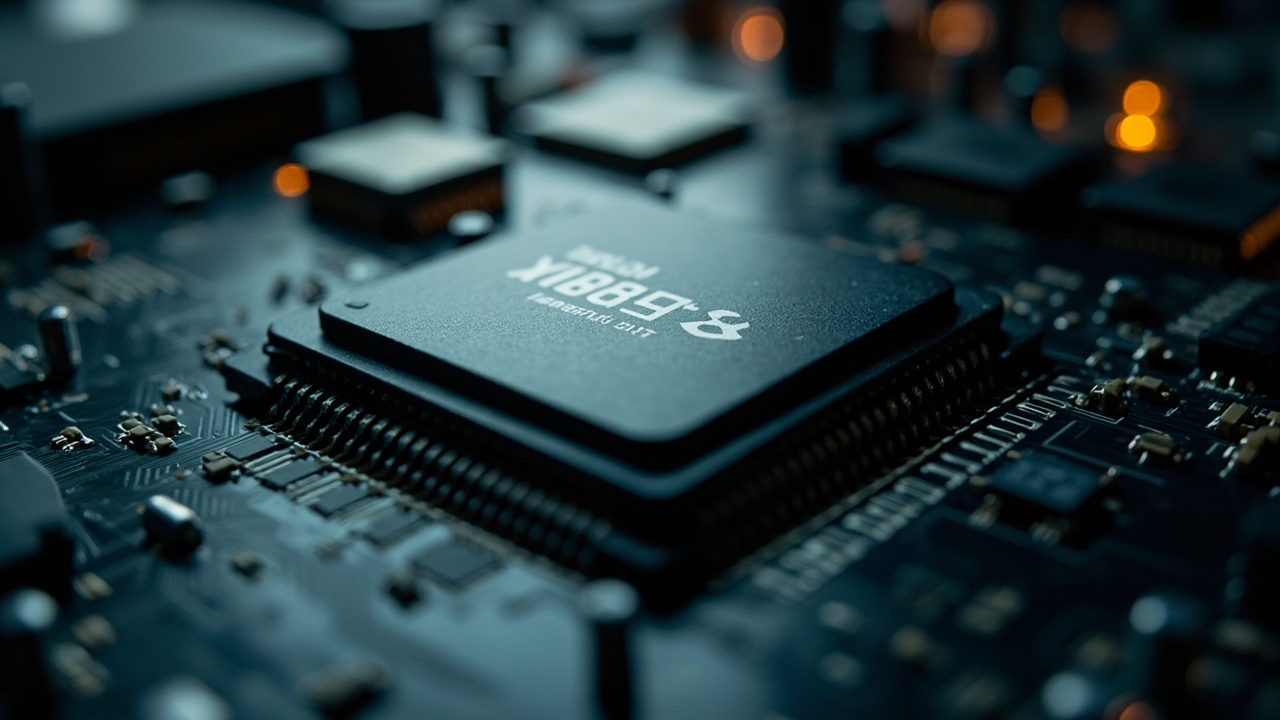
The photograph below shows the kind of board-level inspection context the supplier must control: an extreme macro of a black system-on-chip package on a television mainboard, surrounded by memory chips and PCB traces under dramatic side lighting. Any readable brand text is excluded because the image is illustrative.
Do not accept “supports AV1” as a test criterion. Specify container and elementary-stream conditions, profile, level, bit depth, resolution, frame rate and audio synchronization. Also ask how firmware changes are validated. A change to the media stack can alter decoder timing, HDMI behavior, thermal load and playback recovery without changing the external model number.
Turn the review into a document-index request. The supplier should identify the production-test specification, test-station software version, operator login, pass/fail threshold, exception code and report-retention period. If AOI coverage is limited, require a written risk assessment showing which defects the inspection can detect and which require ICT, functional or manual checks. A bare “AOI used” statement is not evidence of coverage.
For media validation, include failure recovery rather than only successful playback. Seek evidence for seeking, channel changes, subtitles, pause and resume, network interruption, application restart and repeated power cycling. Run at least the contracted frame rate and bitrate ceiling. Add an overnight session because a short clip does not reveal thermal throttling, memory pressure or a firmware timer that interrupts a long live stream.
Aging evidence should identify the chamber condition, duration, workload and sample size. If the unit runs a synthetic video loop, that loop must resemble the deployment profile rather than a low-bitrate clip that leaves the decoder nearly idle. The output of the review is an evidence map: supplier record, buyer retest, acceptance owner and disposition for each failure mode.
A second-pass audit should compare the approved sample with the production process. Inspect the board revision, memory markings where accessible, RF module, power-supply rating and external interfaces. Confirm that the test fixture exercises the specified HDMI mode, Ethernet speed and USB topology. This closes the gap between a laboratory demonstration and a repeatable production unit.
The comparison buyers actually make
Buyers normally compare an entry configuration with a committed platform, but the useful differences are not “good” versus “bad” boxes. They are declared capabilities, test obligations and change control. Compare the proposed platform against an approved golden sample, then compare commercial commitments separately from technical performance.
| Decision layer | Entry-stage request | Commitment-stage request |
|---|---|---|
| Decoder evidence | Demonstration stream and vendor statement | Profile, level, resolution, frame-rate and bitrate test matrix |
| Firmware | General AOSP image | Versioned build, hash, update path and regression report |
| Manufacturing | Functional sample | AOI, aging, traceable test results and approved golden sample |
| DRM and protection | Availability statement | Certified service test and output-protection configuration |
| Change control | Best-effort consistency | Written approval for SoC, memory, firmware and peripheral substitutions |
The wider AV1 Android TV box guide helps define codec decisions. The wider TV-box vendor selection checklist helps structure supplier qualification. Neither replaces an order-specific acceptance matrix.
The meaningful distinction is the evidence burden. A specification-only RFQ leaves the supplier to interpret decode claims. A golden sample binds the expected behavior. Pilot sign-off validates manufacturing repeatability. These stages need not be separate purchases, but each requires distinct records and named approval authority.
Add a row for the media test matrix. An entry-stage comparison may list only “AV1 4K,” while a commitment-stage comparison should state the profile, level, resolution, frame rate and representative bitrate. Add another row for thermal behavior: the committed platform should provide sustained-play evidence, not a laboratory clip. For networking, compare Ethernet baseline and optional configurations separately. A quoted “RJ45 100M” and an optional 1G variant are not equivalent acceptance criteria.
Use the same discipline for security and rights. Record which DRM implementations are fitted, whether licensing responsibility belongs to the supplier or operator, and how secure-media output is demonstrated. For an IPTV program, include middleware image ownership, signing keys, update channels, diagnostic access and the process for revoking or rotating application assets. For an OTT deployment, identify launcher behavior, account login, telemetry and any Google-certified platform requirement.
A factory comparison should separate baseline from options. The approved quote should list baseline RAM/ROM, the selected optional capacity, Ethernet configuration, Wi-Fi module, remote-control hardware and packaging. It should also identify whether the quoted test sample and production units share the same bill of materials. This prevents a low comparison figure from being compared against a high specification merely because optional features were mixed into one column.
Do not compare only unit quotations. Build a scope sheet listing the platform, required firmware integration, approved AV1 media tests, production test records, pilot-batch review and post-delivery corrective action. This table separates product selection from program governance. Technical acceptance, commercial scope and future change control then have different approval routes and do not obscure one another.
Where the terminology comes from
AV1 is an open, royalty-free codec specification developed by AOMedia. That describes the codec standard, not an Android TV device category, a DRM license, a resolution promise or a production-process guarantee. The relevant source is the Alliance for Open Media, AV1 Bitstream & Decoding Process Specification.
Specification scope: AV1 is the open, royalty-free codec specification developed by AOMedia; AV2 announced for year-end 2025 launch.
Source: Alliance for Open Media, AV1 Bitstream & Decoding Process Specification
An RFQ should separate at least 5 layers. First, the codec layer defines bitstream syntax and decoding behavior. Second, the SoC provides the AV1 hardware block, firmware driver and output path. Third, Android exposes the decoder through platform components and media APIs. Fourth, the application or operator middleware requests playback through the supported pipeline. Fifth, DRM, HDCP and the television or display determine whether protected content can be rendered at the intended resolution and frame rate.
This separation explains why a chipset statement is not enough. “AV1 4K@60” may refer to decoder capability, but the delivered system must also produce a valid HDMI mode, maintain audio-video synchronization, meet thermal limits and negotiate the protected output path. Profile and level matter too. A device advertised around AV1 Main Profile 10 must be evaluated against the profile and level required by the deployed content.
The term Main Profile 10 identifies 10-bit capability within the codec profile structure; it does not establish the output resolution, refresh rate or protected-output behavior. Level constrains decoder operating limits. A buyer should still state the actual service parameters so the supplier can demonstrate compliance rather than point to a generic codec badge.
For a streaming service, the delivery path may add adaptive-bitrate switching, packaging variants, encrypted segments and timed metadata. These are not interchangeable with a local AV1 file. Test both live and stored content where both will ship. Also test the transition between codec representations, because a decoder can pass isolated clips while exposing recovery defects during manifest changes.
AOSP Android 11, AOSP Android 14 and AOSP-based Android TV builds also require precise interpretation. AOSP identifies the upstream platform baseline, while device-specific drivers, firmware, middleware, certification and operator configuration affect the final product. Compare AOSP versus Google Android TV before writing an OS requirement.
DRM and output protection form another separate contract. Widevine L1, PlayReady and HDCP support are different statements. The RFQ should name the required implementation, the service used for validation and the display path. If the deployment needs a protected 4K output mode, require evidence from the licensed service rather than an unlicensed playback demonstration. Do not treat AV1 capability as evidence that secure playback has been validated.
The architecture also explains where a defect belongs. If AV1 decode fails with a bitstream rejected before display, investigate the codec or decoder path. If decode completes but the picture is absent, examine Android media integration, display routing and HDMI negotiation. If playback stops after sustained load, investigate thermal or memory behavior. This triage prevents a supplier from replacing a complete unit when a firmware, display or test-definition issue is the actual cause.
Real DataMax platforms, field by field
The following DataMax models show different AV1 positioning, but each must be confirmed against its production datasheet before an order is committed. The table reproduces only the supplied product facts and links each model to its PDP.
| Model | SoC and CPU | OS | RAM / ROM | Decode and DRM | Ports |
|---|---|---|---|---|---|
| DM21P | Amlogic S905Y4, quad Cortex-A35 | AOSP Android 11 | 2GB / 8GB; 4GB and 16/32/64GB optional | AV1 [email protected]; VP9/H.265 4K@60; H.264 4K@30. Widevine L1 / PlayReady; HDCP 2.2 optional | HDMI 2.0b out x1; USB2.0 x2; TF; S/PDIF; 3.5mm AV; RJ45 100M; Wi-Fi6 2x2 + BT5.4; DC 5V/2A |
| DM21S | Amlogic S905Y5, quad Cortex-A55 | AOSP Android 14 | 2GB / 16GB; 2/4/8GB and 16/32/64GB optional | AV1 / H.265 [email protected] 4K@60. Widevine L1 / PlayReady optional; Dolby Vision/DTS | HDMI 2.0b out; S/PDIF; AV; USB2.0 x2; TF; RJ45 100M with 1G optional; Wi-Fi6 2x2 + BT5.4 |
| DM21T | Amlogic S905X5, quad Cortex-A510 (ARMv9) | AOSP Android 14 | 4GB / 64GB family options | H.266/VVC [email protected] 4K@120; AV1/VP9/H.265 4K@120; AVS3 4K@120; H.264 4K@60; inline AI-SR. Widevine L1 / PlayReady optional | HDMI 2.0b out with no HDMI in; USB2.0 x1 + USB3.0 x1; TF; S/PDIF; AV; RJ45 100M with 1G optional; Wi-Fi6 + BT5.4 |
| DM22Q | Amlogic S905X5M, quad Cortex-A55 up to 2.5GHz | AOSP Android 14 | 4GB / 64GB; 2/4/8GB and 16/32/64GB optional | AV1/H.265 L5.1 4K@60; inline AI-SR with no NPU TOPS stated. Widevine L1 / PlayReady optional; Dolby Vision/DTS | HDMI 2.0b out; USB2.0 x2; TF; S/PDIF; AV; RJ45 100M with 1G optional; Wi-Fi6 2x2 + BT5.4 |
The model comparison starts with the contract requirement, not the processor tier. DM21P is positioned for 4K IPTV and operator middleware, with AV1 [email protected] and an AOSP Android 11 baseline. DM21S is positioned for a 4K Android TV box for IPTV/OTT white-label work, with AV1/H.265 [email protected] 4K@60 and AOSP Android 14. Confirm both platforms against the production datasheet before fixing the order configuration.
DM21T is positioned for premium UHD and cloud-gaming use. Its supplied decode line includes AV1/VP9/H.265 4K@120, while its ports include USB3.0 and no HDMI input. These distinctions affect the test matrix: the buyer should verify the required high-frame-rate output, the available external connections and the absence of HDMI input. The supplied facts also state inline AI-SR, but no additional performance claim should be inferred from that label.
DM22Q is positioned for gaming-oriented use and carries the supplied AV1/H.265 L5.1 4K@60 decode statement. Its facts mention inline AI-SR with no NPU TOPS stated, so a procurement file must not insert an unstated TOPS figure or infer a workload result. Its RJ45 100M baseline and optional 1G configuration should be written as alternatives in the RFQ until the order is frozen.
This second android tv box checklist comparison should preserve model names exactly and separate fit descriptions from contractual specifications. “4K IPTV,” “IPTV/OTT white-label,” “Premium UHD/cloud-gaming” and “Gaming-oriented” describe intended use. The SoC, OS, memory, decode, DRM and ports are the fields to lock against the approved production datasheet. Optional entries must remain visibly optional until selected.

The same figures, in searchable form:
| Stage | Editorial score |
|---|---|
| Requirements only | 25 |
| Requirements plus target price | 46 |
| Approved golden sample | 74 |
| Pilot batch sign-off | 91 |
Do not infer an 8K output capability from any model name or legacy marketing expression. The supplied datasheet caps DM21T output and decode at 4K and caps DM22Q at 4K@60. Other configuration details must be confirmed against the production datasheet.
The stage scores above are planning aids, not measured productivity gains. A score of 74 for an approved golden sample does not guarantee lower defects, and a score of 91 for pilot sign-off does not establish a universal acceptance threshold. Use the sequence to allocate review effort: specify the service, freeze the build, bind the sample and then authorize the pilot. Each stage should contain records that the next stage can audit.
Buyer situations, ranked by what they punish
Different deployments fail differently. A live IPTV operator punishes unstable boot, middleware integration defects and long-term firmware divergence. An AV integrator punishes unsupported HDMI modes, poor control and unstable USB behavior. A cloud-gaming venue punishes input latency, frame pacing and recovery, while an OTT brand punishes certification gaps, weak update controls and inconsistent branding. A digital-signage operator generally punishes unattended restart reliability and simplified fleet management.
| Situation | Primary requirement | Secondary requirement | Model direction |
|---|---|---|---|
| IPTV operator | 4K IPTV fit; operator middleware | Stable Ethernet and recovery | DM21P or DM21S, subject to specification |
| OTT white-label program | Android TV integration and brand control | DRM, storage and update control | DM21S |
| Premium UHD or cloud gaming | High-frame-rate 4K media path | USB3.0 and performance margin | DM21T |
| Gaming-oriented TV box | AV1/H.265 4K@60 path | Gaming features and configuration review | DM22Q |
| AV integrator | HDMI and peripheral compatibility | Stable control and recovery | Select by ports and accepted sample |
Rank the situation by its cost of failure, not by advertised resolution. For an operator, one unstable multicast session can affect many subscribers; for a venue, one failed recovery after power restoration can interrupt a session; for a signage deployment, a boot loop can remain unnoticed until a site visit. These consequences determine how much evidence the buyer should require before scaling.
The relevant architecture is therefore layered. The operator’s service reaches the box through the network, the application requests media playback, Android invokes the decoder pipeline, the SoC performs decode, and HDMI carries the result to the display. Each interface needs a test. The operator-tier Android TV box solution helps frame that architecture; model selection still requires an order-specific RFQ.
For an integrator, validation should include repeated source changes, EDID handling, audio routing, USB storage, remote-control behavior and power recovery. For a gaming-oriented deployment, establish which latency and frame-pacing metrics the supplier is contractually required to meet; do not infer them from a processor generation.
An IPTV operator should test multicast playback through the actual network path, including a controlled packet-loss profile and service recovery after loss. The application, middleware and device image must remain aligned. Require a signed application identifier, an update rollback procedure and diagnostic evidence that distinguishes a network interruption from a decoder failure. A successful local AV1 file does not clear the live-service path.
An OTT team should test account binding, launch behavior, secure playback and update continuity across the selected storage capacity. White-label programs need configuration control for launcher assets, remote-control mapping and regional packaging. A generic device image may work in a demonstration while missing the branded boot sequence, network assumptions or operator-specific app behavior required at scale.
An AV or venue integrator should treat display compatibility as a matrix. Record the display model, advertised and forced EDID modes, audio format, sample rate, color mode, refresh rate and distance-related control behavior. Repeat the test after power restoration and source reconnection. For a premium UHD path, verify the complete route from protected source to display rather than assuming the box negotiates the intended mode in every installation.
A signage operator should test unattended endurance: scheduled reboot, application crash recovery, network loss, clock reset and remote recovery. The box may boot correctly during installation yet remain exposed in the field. Define the fleet-management interface, log-retention expectation and escalation route. Model selection then depends on the management and recovery architecture, not merely AV1 capability.
For each situation, record a failure consequence and a rollback action. A program that cannot identify whether a failure belongs to content, network, middleware, firmware or hardware will lose time during pilot approval. A situation-specific test list prevents the broad android tv box checklist from becoming a generic questionnaire that misses the actual operational pain.
A decision path for the RFQ
Begin with the service profile, not a model. Record source codec, AV1 profile, level, resolution, frame rate, bitrate, HDR requirements, audio format, subtitle requirements and DRM. Then select the candidate platform and freeze its hardware configuration. Next, create a test matrix and approve a golden sample. Only after manufacturing evidence is accepted should the order move to pilot-batch sign-off and scale release.
Pasteable RFQ lines should be unambiguous. Use: “AV1 decode shall support the contracted Main Profile 10 level, 4K resolution, frame rate and bitrate range, including HDR, audio and subtitle combinations listed in Attachment A.” Use: “The unit shall use the quoted SoC, RAM/ROM capacity, Android baseline and firmware branch; substitutions require written approval.” Use: “Supplier shall provide serial-number-linked SMT, AOI, functional-test, aging and audit records for the production lot.” Use: “Protected-content playback shall be demonstrated in the specified DRM service and output-protection configuration.”
Keep commercial comparison separate from technical acceptance. A lower quotation may exclude DRM licensing, operator middleware, certification, pilot testing, spare units or local compliance. Conversely, a higher quotation may not justify a weaker evidence process. The RFQ should identify which scope each quotation includes.
Turn the decision path into attachments. Attachment A should define the service and media matrix; Attachment B should define the exact hardware, RAM/ROM, OS, firmware and middleware; Attachment C should define factory tests and evidence; Attachment D should define pilot acceptance, nonconformity handling and release authority. Each attachment should have a revision field, so an updated firmware cannot silently inherit the previous approval.
The golden-sample stage needs a physical identity. Record its serial number, hardware revision, BOM revision, firmware build, firmware hash, storage configuration, accessory set and test date. Store the expected outputs and failure signatures. The supplier should receive the same test media and procedures planned for production. A buyer sign-off on that sample becomes the reference for the pilot, not a general statement that the model is acceptable.
Pilot sign-off should sample the actual production process and configuration. Review the test records, open concessions, component-lot traceability and corrective actions. Repeat the highest-risk buyer tests on units drawn from that lot. Define the release gate in advance: no unresolved critical playback defect, no unapproved configuration change and complete evidence for the tested sample population.
The RFQ should also state responsibility boundaries. Name the party supplying test streams, the party operating the licensed DRM service, the party conducting buyer acceptance and the party authorizing concessions. Ask who maintains the decoder configuration when an OS security update arrives. This prevents an AV1 regression from being treated as an operator-app issue.
For scale release, retain the approved sample, the evidence packet and the signed configuration record with the purchase documentation. Re-open qualification if the SoC, memory baseline, firmware branch, RF module, power supply, external connector set or media stack changes materially. The android tv box checklist should define which changes require notice, which require re-test and which invalidate the previous sample approval.
The traps in this category
The first trap is confusing decoder capability with delivered output. “AV1 4K” can be true at the codec block while the full Android, thermal, HDMI and display chain fails under sustained playback. Require the complete media-path test.
Field trap
A quotation that says only “AV1 4K@60” does not identify profile, level, bit depth, output mode, HDR path or thermal test conditions. The cost of getting this wrong is a rejected pilot batch after tooling, certification or integration work has already begun.
Field trap
Do not accept an 8K claim inherited from marketing where the supplied DataMax production facts cap the platform at 4K. For DM21T, output and decode are capped at 4K; for DM22Q, the stated maximum is 4K@60. Confirm the current production datasheet before quoting.
The second trap is quotation ambiguity around “Android TV.” Some quotations refer to AOSP-derived device builds, some to Google-certified Android TV, and others to a product merely described as an Android box. Specify the baseline, launcher, device certification, middleware, app signing, update mechanism and operator integration deliverables. If protected content is required, specify Widevine L1, PlayReady or both only where the deployment needs them; “DRM supported” is not a service-level statement.
The third trap is configuration drift. A model code can remain unchanged while RAM, ROM, Wi-Fi module, Ethernet speed, power supply, remote control or firmware changes. Require a BOM revision, firmware hash and approved golden sample. The quotation comparison should identify optional versus baseline configuration, because “1G optional” is not the same acceptance criterion as a supplied 1G port.
The fourth trap is relying on laboratory success without production repeatability. A demonstration unit may have been hand-selected. SMT, AOI, aging and final-test records should connect the delivered unit to a production lot and configuration revision. The final scale decision should be based on evidence from the same build process proposed for the order.
A fifth trap is allowing test conditions to remain informal. “AV1 at 4K” without a defined frame rate, bitrate, duration and display mode can produce different results on different suppliers. Attach the exact media matrix, require an unsuccessful-case log, and define whether the manufacturer or buyer owns test-stream preparation. Informal testing often converts a specification dispute into an opinion dispute.
A sixth trap is assuming a hardware substitution is equivalent. Two devices can carry the same model name but differ in SoC stepping, firmware branch, thermal solution or memory population. Add written approval gates for those fields. Record any approved alternative in the same BOM and evidence chain. Never let an equivalent configuration appear only in an informal supplier email after pilot approval.
The final trap is treating the checklist as a one-time purchase gate. OS updates, security patches, app releases and component lead-time changes can alter behavior after shipment. Define update governance, notification duties and regression sampling. The android tv box checklist should therefore include both initial acceptance and the evidence needed to control later changes.
Further reading
- Rk3568 Android Box: Engineer's Checklist
- Android TV boxes
- Rockchip Android TV boxes
- Edge computing boxes
- 4K 60fps Android TV box guide
- DataMax DM21P specifications and fit
- DataMax DM21S specifications and fit
FAQ
Does AV1 support make an Android TV box suitable for IPTV?
No. AV1 decoding is one requirement. An IPTV deployment also needs reliable Ethernet, operator middleware, boot stability, network recovery, application signing, update control and compatible protected-content output. Specify the service profile and test the complete device rather than treating a codec demonstration as platform qualification.
What AV1 details belong in an RFQ?
State the required profile, level, bit depth, resolution, frame rate and bitrate range. Add HDR, audio, subtitle, DRM and output-protection requirements. Also require evidence from representative streams, including sustained playback, recovery behavior, synchronization and the specified display connection. A general “AV1 4K” line leaves too much interpretation to the supplier.
Is AOSP Android 14 automatically equivalent to Google Android TV?
No. AOSP is an upstream platform baseline, while Google Android TV certification, device integrations, applications and launchers add separate requirements. Ask the supplier to identify the exact OS baseline, certification status, middleware, update path and device configuration, then test those elements in the approved golden sample.
Why require an approved golden sample?
A golden sample binds physical configuration, firmware, accessories, output behavior and test expectations. Without that reference, substitutions and firmware drift may appear only after mass production. Record the sample serial number, firmware hash and BOM revision, then use it as the comparison authority for pilot and production acceptance.
Which DataMax model should be selected for AV1?
Selection depends on the required platform, resolution, frame rate, memory, DRM, ports and operating-system baseline. DM21P, DM21S, DM21T and DM22Q have different supplied configurations. Use the model table to narrow the direction, then confirm the current production datasheet and order-specific acceptance criteria before making a commitment.
When should the RFQ request production-test evidence?
Request it before pilot-batch approval, not after scale release. The evidence should link the ordered configuration to SMT, AOI, functional-test, aging and audit records, then identify any concessions and corrective actions. Require the same test process and revision controls proposed for the production order.




