
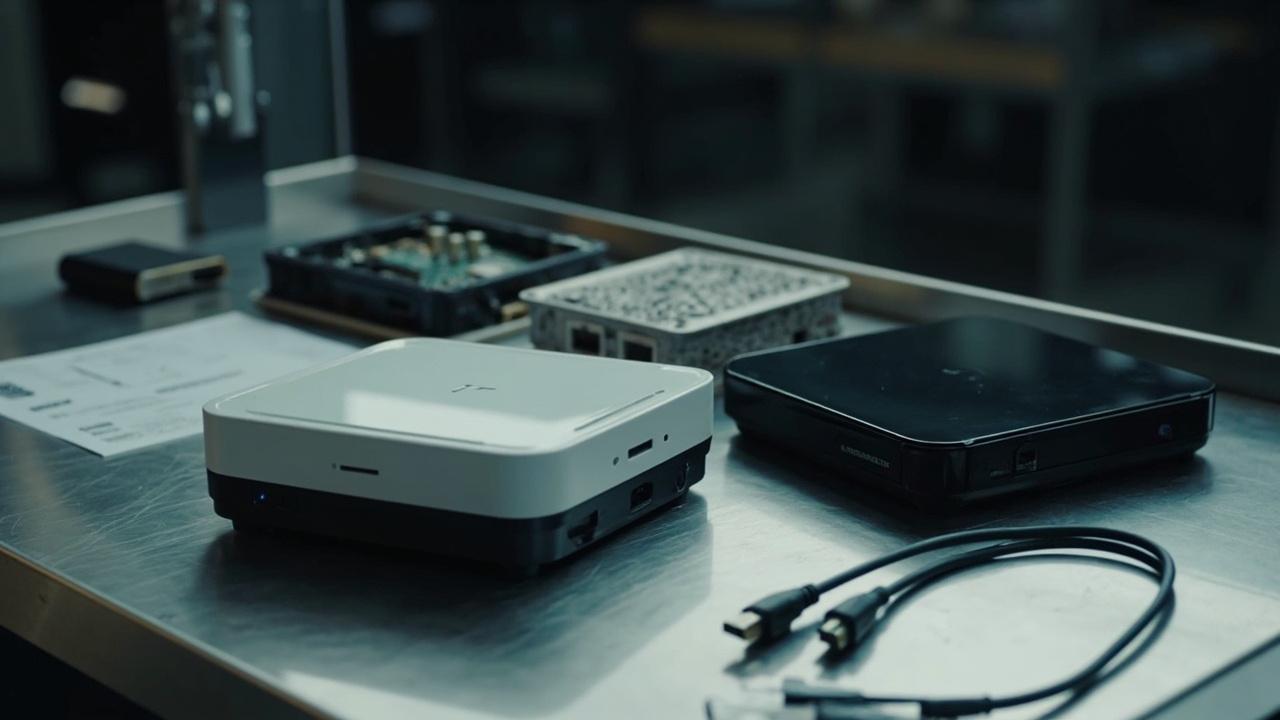
Most "custom Android TV box" projects are not silicon design — they are careful configuration of an existing platform across firmware, hardware, accessory and packaging layers. The difference between a project that ships on schedule and one that stalls at DVT is whether the specification is honest about which layers can actually change. This guide walks procurement engineers through the customization menu, the fixed boundaries and the engineering review that protects the timeline.
The Customization Menu: What an OEM/ODM Factory Can Change
A "custom Android TV box" project almost never starts from a blank silicon die. Most operator, hospitality, ISP and reseller projects begin from a defined menu of firmware, hardware, accessory and packaging options layered onto an existing, qualified platform. Understanding that menu — and the boundaries around it — is the single most important step before any RFQ is issued.
Customization is organized into four functional layers, each one confirmed against the chosen SoC and the specific SKU before tooling or production starts. The signed specification sheet, not the marketing brochure, is the document that counts as the source of truth. Buyers should treat anything not written into that sheet as a verbal commitment, and verbal commitments tend to evaporate at pilot build.
The four layers in scope for almost every operator-grade engagement are:
- Software — launcher, preloaded applications, default settings, OTA policy and provisioning parameters.
- Hardware — port count and type, enclosure colour and finish, silk-screen branding, LED behaviour.
- Accessory — remote control layout, power plug standard, HDMI cable grade, optional spare adapters.
- Packaging — colour box, sleeve, quick-start guide in the buyer's language, compliance labels, master carton marks.
For most operator and ISP buyers, the software layer carries the heaviest procurement weight because it directly affects subscriber experience and the ongoing operational cost of the fleet. A starting platform such as the DataMax DM22Q with Amlogic S905X5M gives procurement a known SoC baseline plus a customization menu the factory has already tooled around.
Firmware and Launcher Customization
Many "custom box" projects are, at heart, a software project. The launcher defines what every end user sees from first boot, and it can be built to the operator's exact layout: live tiles, an electronic programme guide, a branded content rail, a single-application kiosk for hospitality, or a fully locked operator experience. Preloaded applications, default inputs, language set, DNS and NTP settings and update policy are all part of the firmware configuration rather than separate workstreams, which means they can be revised together in a single image build.
Where a self-managed app store is required — for example, an operator that wants to ship its own catalogue without depending on consumer platform services — signed package distribution can be built directly into the firmware image. The image itself becomes the catalogue carrier, and updates flow through the operator's own OTA endpoint rather than a third-party store.
The standard firmware customization scope includes:
- Operator-branded launcher, EPG layout or full kiosk lockdown.
- Preload, remove or replace stock applications, subject to certification rules on GMS builds.
- Custom provisioning endpoints and management parameters, including TR-069 or MQTT defaults.
- Signed OTA from the buyer's chosen endpoint with staged rollout by cohort.
For projects that need the certified consumer application track, a device such as the DataMax DM21P 4K IPTV box with Widevine L1 optional or the DataMax DM21T with Amlogic S905X5 and H.266 VVC decoding gives buyers a baseline that already includes the operator-friendly hooks for app control and remote management. Buyers planning an AOSP-only image for kiosk or operator use should also read the broader guide on AOSP Android TV boxes built for operators before scoping the launcher, because the firmware architecture decisions made at this stage cascade through every later workstream.
Hardware Modifications: Ports, Finish and Enclosure
On platforms where the signals are already routed and the existing tooling supports it, port configuration, housing colour, surface finish, silk-screen branding and LED behaviour can be adjusted without triggering a full ODM development programme. Each modification is specified in the project sheet, validated on pre-production samples and frozen before mass production. Changes that fit inside existing tooling are typically fast and carry low NRE.
Examples of hardware changes that are usually toolable on existing tooling:
- USB port count and type, including USB 2.0 vs USB 3.0 vs Type-C placement.
- Card slot presence, including microSD or SIM for cellular SKUs.
- AV output and SPDIF for legacy TV integrations in hospitality deployments.
- Ethernet speed grade and indicator placement on the front face.
- Enclosure colour and finish, including silk-screen and laser-etched marks.
- Front-panel button layout and LED colour and behaviour.
Buyers evaluating cellular or LTE-capable SKUs should expect adding a cellular radio to change both the antenna and the certification scope. These are not silent changes, and they should be flagged explicitly at the spec review stage rather than discovered during EMC testing.
If a customization requires a new mould, a custom PCBA layout or a different thermal architecture, it is ODM work, not configuration. Honest suppliers quote it that way — under-quoting such work is the single most common reason DVT samples fail the qualification gate.
Boundaries: What Cannot Be Customized on Request
Stating boundaries early saves weeks of misaligned expectation. The items below are fixed by physics, by silicon capability, by licensing or by certification rules. No factory can promise them away, and any supplier that claims otherwise is selling a deliverable that will not arrive. Buyers who understand these limits up front submit tighter specs and receive more accurate quotations.
| Item | Why it is fixed | Available alternative |
|---|---|---|
| A new SoC feature or die revision | Silicon capabilities are fixed by the chip vendor | Select a different SoC tier at scoping |
| DRM security level above hardware support | TrustZone and key provisioning are platform-defined | Choose an L1-capable platform and qualify it |
| Certified consumer apps on pure AOSP | Requires vendor certification and the GMS track | Use the certified Android TV OS track instead |
| Arbitrary codec guarantees | Decode support is defined in the SoC datasheet | Match codec requirements to the chosen platform |
| Radio performance beyond the module | Wi-Fi and cellular limits are module and antenna defined | Upgrade module tier or add external antennas |
For projects where Widevine L1 is non-negotiable — typical for premium OTT, IPTV and many telco IPTV deployments — the right starting point is a platform whose SoC and key-provisioning path is documented to support L1. Suppliers offering "guaranteed L1 on any custom box" are selling something that cannot be delivered; L1 follows hardware and qualification, not configuration. Buyers working through broader enterprise certification decisions, including EDLA, should also review the EDLA certification guide for enterprise Android devices to understand which certification is appropriate for the deployment model.
The 48-Hour Spec Review
A written specification is the cleanest possible RFQ input. It should include the platform or performance tier, RAM and flash targets, display and codec requirements, the full port list, firmware scope, remote and packaging requirements, destination market and estimated annual volume. A completed specification is typically reviewed by engineering within roughly two business days, with a written response covering feasibility, customization classification, recommended SKU and next steps.
The review is deliberately written to surface conflicts before tooling is committed. Common conflicts the review is designed to catch include:
- Demanding a certified consumer app stack on a pure AOSP image.
- Requesting DRM L1 on a silicon tier that does not support it.
- Asking for codec coverage, for example H.266 / VVC, on a platform whose decoder does not include it.
- Adding ports or radios that the chosen SoC cannot route, or that change the EMC profile.
For buyers comparing operator-focused reference designs, the sibling guides on carrier-grade Android TV boxes for telco IPTV and on IPTV operator set-top boxes built for scale and middleware provide useful baseline reference specs that can be copied into a procurement template and then amended with the operator's own port list and software scope.
From Approved Spec to Shipment
After the spec review, the project moves through a written quotation, pre-production samples against the frozen spec, written sign-off, production with in-line QC and aging, final inspection and shipment. Software changes after sign-off follow a simple change record, so both sides always know exactly which firmware revision the production line is flashing on any given day. This discipline is what makes field returns traceable.
For resellers and smaller hospitality buyers, the same flow applies — the customization menu simply has fewer layers active. The branded TV boxes for resellers guide outlines a lighter-weight engagement model where the unit ships with a prebuilt launcher image and minimal hardware changes, which is appropriate for sub-thousand-unit annual volumes.
ISP and operator buyers with higher volume and remote-management requirements will also want to review the ISP-grade Android TV box guide alongside this one, because remote management, TR-069 / MQTT parameter sets and OTA staging policy interact directly with the firmware customization scope discussed earlier. Combining the two guides gives procurement a complete picture of both the customization menu and the operational lifecycle that follows the first shipment.
Decision Framework at a Glance
The visuals below convert the criteria discussed above into a simple scoring view you can reuse with your own requirements. Weightings are illustrative defaults for this buying scenario, not measured performance data.
| Firmware configuration | 28 percent | 28% | |
|---|---|---|---|
| Applications and OTA | 24 percent | 24% | |
| Hardware ports and finish | 18 percent | 18% | |
| Accessories and remote | 16 percent | 16% | |
| Packaging and printing | 14 percent | 14% |
Approximate effort distribution across the customization layers of a typical operator Android TV box project. Illustrative values for planning; not measured benchmark data.
Platform and SoC fit
24 · 100% of max
DRM and certification path
22 · 91.7% of max
Codec and audio coverage
18 · 75% of max
Remote management hooks
14 · 58.3% of max
Customization menu depth
12 · 50% of max
Logistics and lead time
10 · 41.7% of max
Suggested weighting for scoring a custom Android TV box supplier against project requirements. Illustrative values for planning; not measured benchmark data.
Frequently Asked Questions
Can the launcher on a custom Android TV box be fully replaced?
Yes. A fully custom launcher, EPG layout or single-app kiosk is standard firmware customization, including default settings, preloaded apps and a locked system UI where required. The scope is defined in the project spec sheet and frozen at written sign-off, so any change after that point goes through a formal change record.
Can stock applications be removed or hidden on a custom build?
Yes. Stock applications can be removed or hidden and the firmware image can be built with only the applications the deployment actually needs. On GMS-certified builds, some components are protected by certification rules; on AOSP images the application set is fully under project control.
Can ports such as USB or SPDIF be added or removed on a custom box?
On platforms where the signals are already routed and the existing tooling allows it, yes, and this is confirmed on the chosen SKU during the spec review. Changes that require a new PCBA layout or a new enclosure mould are handled as ODM work and quoted separately rather than bundled into the customization line.
Can Widevine L1 be guaranteed on any custom Android TV box?
No honest supplier can guarantee L1 independent of hardware. The security level follows the SoC capability and the key-provisioning path, not configuration. The correct approach is to select an L1-capable platform and run the qualification workstream if L1 is a requirement for the deployment.
How fast is the engineering spec review?
A completed specification is typically reviewed by engineering within roughly two business days, with a written response covering feasibility, customization classification, a recommended SKU and immediate next steps. Incomplete specs receive a clarification request before the review clock starts.
What information is needed to produce a complete quotation?
A complete quote needs platform or performance tier, RAM and flash targets, video and DRM requirements, the full port list, firmware scope, remote and packaging requirements, destination market, certification needs and estimated annual volume. The RFQ checklist is the full template that maps these inputs one to one.
Next Steps
Ready to turn this guide into a procurement plan? Review the full technical overview for this topic, browse the DataMax Buying Guides library, or contact DataMax engineering with your target configuration, volume and destination market for a scoped RFQ response and sample plan.


