
The short answer first
Before approving an in room entertainment hotel deployment in campus housing, confirm five things: the payment boundary, identity and entitlement, device lifecycle, network policy, and evidence trail. The device does not create a no-folio environment by itself. The operator’s billing architecture must prevent entertainment charges from reaching the resident’s room account unless explicitly approved, while the set-top box enforces application, playback, policy, and recovery behaviour.
A procurement example makes the boundary concrete. If a resident receives an operator subscription funded by the campus, the room credential should authorize only contracted channels. A separate application store must not expose the property’s folio payment service, and an optional upgrade must be unavailable or routed to an approved non-folio channel. The RFQ should state that any payment integration capable of creating a room-account posting is prohibited unless named in the agreement.
Identity must also follow the housing model. A shared room PIN is simpler but must expire or change at checkout. A resident-bound account supports personalisation but creates deletion, privacy, and recovery obligations. The acceptance test must link the physical device, room, credential, and entitlement from activation through reassignment.
Network design determines whether IPTV, multicast, captive portal, updates, and telemetry work reliably. The supplier’s statement that a box supports IPTV is incomplete without VLAN, IGMP, DNS, proxy, multicast-source, and Internet-access rules.
Finally, the programme needs factory and deployment evidence. For an in room entertainment hotel order, procurement can send an RFQ whose first message specifies the selected model, no-folio transaction rule, credential lifetime, checkout sequence, network profile, and required SMT, AOI, ageing, provisioning, and deployed-unit evidence. The canonical discussion of in-room entertainment hotel content-portal architecture provides the broader service context.
Two routes, one bill of differences
The commercial choice is between a catalogue platform with configuration and a committed programme that includes deeper software, hardware, or joint ODM work. Both can satisfy a no-folio rule if the commercial boundary is implemented outside the device and tested end to end.
| Decision area | Standard operator route | Committed custom route |
|---|---|---|
| Billing boundary | Operator billing is pre-integrated; device UI exposes no path to hotel folio | Billing boundary, payment exclusions, and exception handling are specified for the programme |
| Resident identity | Property or room credential issued by existing platform | Identity flow can be extended for personal accounts, room transfer, or PMS linkage |
| Launcher and branding | Standard operator launcher and approved remote update path | Boot logo, launcher, feature branch, or joint hardware/software work |
| Hardware configuration | Catalogue model with defined RAM/ROM and ports | Configuration selected against fixed programme requirements |
| Operational recovery | Reset and reassignment handled through operator tooling | Room return, wipe, purge, and audit sequence tailored to the property workflow |
| Supplier obligation | Delivery and configuration evidence against the catalogue | Requirement traceability, validation evidence, and agreed change control |
The standard route is appropriate where the operator already controls authentication, content, payment, and device management. Consider a residence hall receiving 2,000 centrally funded rooms: if all units use the same launcher, room-bound certificate, and operator entitlement, a catalogue configuration can reduce engineering and field variation. The supplier obligation remains precise: produce the agreed hardware revision, install the agreed image, record the configuration, and demonstrate the defined test results.
The committed route becomes relevant when several properties use different PMS or billing relationships, when personal accounts must transfer between rooms, or when the image must exclude specific storefronts and payment applications. It also applies when hardware changes require coordinated PCB, enclosure, firmware, and certification work. In that case, the programme needs named engineering milestones, a frozen configuration, compatibility responsibilities, and a defect-disposition process.
| Programme condition | More defensible route | Reason |
|---|---|---|
| One operator, one identity provider, one image | Standard operator route | Existing control planes reduce bespoke integration |
| Multiple PMS or billing boundaries | Committed custom route | Per-site exceptions need explicit ownership and regression coverage |
| Personal resident accounts | Committed custom route | Identity deletion, privacy, and departure workflows become acceptance conditions |
| Uniform centrally funded housing estate | Standard operator route | Room credentials and operator billing can be standardized |
| New enclosure or connector requirements | Joint hardware/software ODM | Mechanical, electrical, firmware, and validation changes must move together |
“Custom” without an accountable owner, acceptance procedure, and update responsibility is not a purchase specification. For in room entertainment hotel programmes, freeze the route by model, memory, operating-system image, launcher, payment exclusions, identity method, and evidence package. Otherwise, quotations may look equivalent while carrying different engineering and warranty obligations.
How the requirement actually works
“No folio” means the resident’s room account cannot serve as the default settlement channel for entertainment services. It is a commercial and technical prohibition, not a feature label. Three payment paths need separate rules: the operator subscription, third-party applications, and optional purchases.
For the operator subscription, the commercial flow can be direct, prepaid, campus-sponsored, or billed through a separate resident account. For third-party applications, the device should expose only an approved catalogue, with each application governed by its own commercial terms. Optional purchases should use an approved external payment workflow or remain unavailable. If a content provider requires a hotel-folio transaction, that requirement conflicts with the programme and must be escalated before quotation rather than concealed in an application integration clause.
Identity and entitlement determine who can watch what. A room-bound credential is operationally straightforward, but it must be invalidated at checkout. A resident-bound account supports profiles and personalisation but introduces recovery, privacy, and departure handling. A hybrid architecture can pair a device certificate with a resident token. Regardless of design, the operator needs an auditable mapping among physical serial, housing inventory, room, credential, and active entitlement.
The control plane commonly contains an MDM or Android enterprise-management profile, an operator application using protected APIs, and remote provisioning for firmware, configuration, certificates, and application versions. Android Management APIs can support ownership, policy, and application management. Android CDD and CTS remain relevant platform validation considerations, but they do not prove that a campus-housing workflow behaves correctly. Acceptance must exercise login, playback, logout, payment exclusion, reset, and reassignment.
Network policy is equally precise. IPTV multicast may require controlled IGMP handling and VLAN separation. A captive portal can restrict general Internet access while permitting operator content, telemetry, licensing, and update destinations. Local devices may use Ethernet while Wi-Fi remains subject to property policy. RJ45 100M support on the listed platforms is a transport fact, not evidence of multicast performance, sustained throughput, or headroom.
- Operator subscription and campus funding
- Approved third-party applications
- Disabled or separately routed optional purchases
- Prohibited property-billing integrations
- Restricted launcher and application catalogue
- Operator payment-service policy
- Credential-scoped entitlement API
- Device-management ownership policy
- Activation record
- Checkout revocation result
- Personal-data purge result
- Reassignment inventory record
For an in room entertainment hotel pilot, the acceptance rule should be simple: attempting an unauthorized purchase must produce no folio posting, no retained payment state, and a traceable error or blocking action. That result is more useful than a general assurance that the service is “folio separated.”
The distinction between enforcement layers should be documented in operational language. The operator entitlement API decides which content session may begin; the launcher decides which purchase surfaces are visible; the payment application determines which transaction system receives a request; and the property system determines whether a posting can be created. A deployment can block the first path, expose the second, or leave the third outside the operator’s control. Procurement must identify the owner of every layer and prohibit an unowned gap.
A room can be funded centrally while still presenting third-party purchase surfaces. The acceptance design should therefore classify each service as centrally funded, resident-funded outside the room account, or prohibited. For example, operator channels may be centrally funded, a separate personal payment method may support optional apps, and a property-folio integration may be blocked entirely. Each class needs a different UI label, transaction route, audit record, and support script. Without that mapping, staff cannot explain why one purchase succeeds and another does not.
Lifecycle handling should be treated as a service operation rather than a reset-button feature. At activation, the system records the unit, room, entitlement, and credential. During occupancy, it applies the requested content and payment policy. At checkout, it revokes the credential and removes resident state. Before reassignment, it reconciles the inventory record. If a device is offline at checkout, the policy must define whether access is blocked locally, expires by clock, or is revoked on reconnection. A resilient design fails closed for restricted transactions while allowing authorized operator functions to recover.
The platform shortlist with datasheet values
The shortlist below uses only the supplied production facts. RAM/ROM options are reproduced as stated, but each proposed programme still requires confirmation against the production datasheet and final BOM.
| Model | Platform and fit | Memory | Decode | DRM | Ports and connectivity |
|---|---|---|---|---|---|
| DM21P | Amlogic S905Y4, quad Cortex-A35; AOSP Android 11; 4K IPTV / operator middleware set-top box | 2GB / 8GB (4GB; 16/32/64GB optional) | AV1 [email protected], VP9/H.265 4K@60, H.264 4K@30 | Widevine L1 / PlayReady / HDCP 2.2 optional | HDMI 2.0b out x1; USB2.0 x2; TF; S/PDIF; 3.5mm AV; RJ45 100M; Wi-Fi6 2x2 + BT5.4; DC 5V/2A |
| DM21S | Amlogic S905Y5, quad Cortex-A55; AOSP Android 14; 4K Android TV box for IPTV/OTT white-label | 2GB / 16GB (2/4/8GB; 16/32/64GB optional) | AV1 / H.265 [email protected] 4K@60 | Widevine L1 / PlayReady optional; Dolby Vision/DTS | HDMI 2.0b out; S/PDIF; AV; USB2.0 x2; TF; RJ45 100M (1G optional); Wi-Fi6 2x2 + BT5.4 |
| DM21T | Amlogic S905X5, quad Cortex-A510 (ARMv9); AOSP Android 14; Premium UHD / cloud-gaming box | 4GB / 64GB (family options) | H.266/VVC [email protected] 4K@120, AV1/VP9/H.265 4K@120, AVS3 4K@120, H.264 4K@60; inline AI-SR | Widevine L1 / PlayReady optional | HDMI 2.0b out (no HDMI in); USB2.0 x1 + USB3.0 x1; TF; S/PDIF; AV; RJ45 100M (1G opt); Wi-Fi6 + BT5.4 |
| DM22Q | Amlogic S905X5M, quad Cortex-A55 up to 2.5GHz; AOSP Android 14; gaming-oriented Android TV box | 4GB / 64GB (2/4/8GB; 16/32/64GB optional) | AV1/H.265 L5.1 4K@60; inline AI-SR | Widevine L1 / PlayReady optional; Dolby Vision/DTS | HDMI 2.0b out; USB2.0 x2; TF; S/PDIF; AV; RJ45 100M (1G opt); Wi-Fi6 2x2 + BT5.4 |
DM21P is the most directly stated operator-middleware option. DM21S carries the higher listed Android version and is positioned for white-label IPTV/OTT use. DM21T and DM22Q provide higher stated memory or newer codec capability, but neither should be selected merely by the word “gaming.” The programme must identify a real workload, supported display mode, input-latency target, controller support, or network requirement.
The customisation-depth decision should follow the complexity of the estate and operator workflows. The following score is an editorial ranking tool, not product performance data:
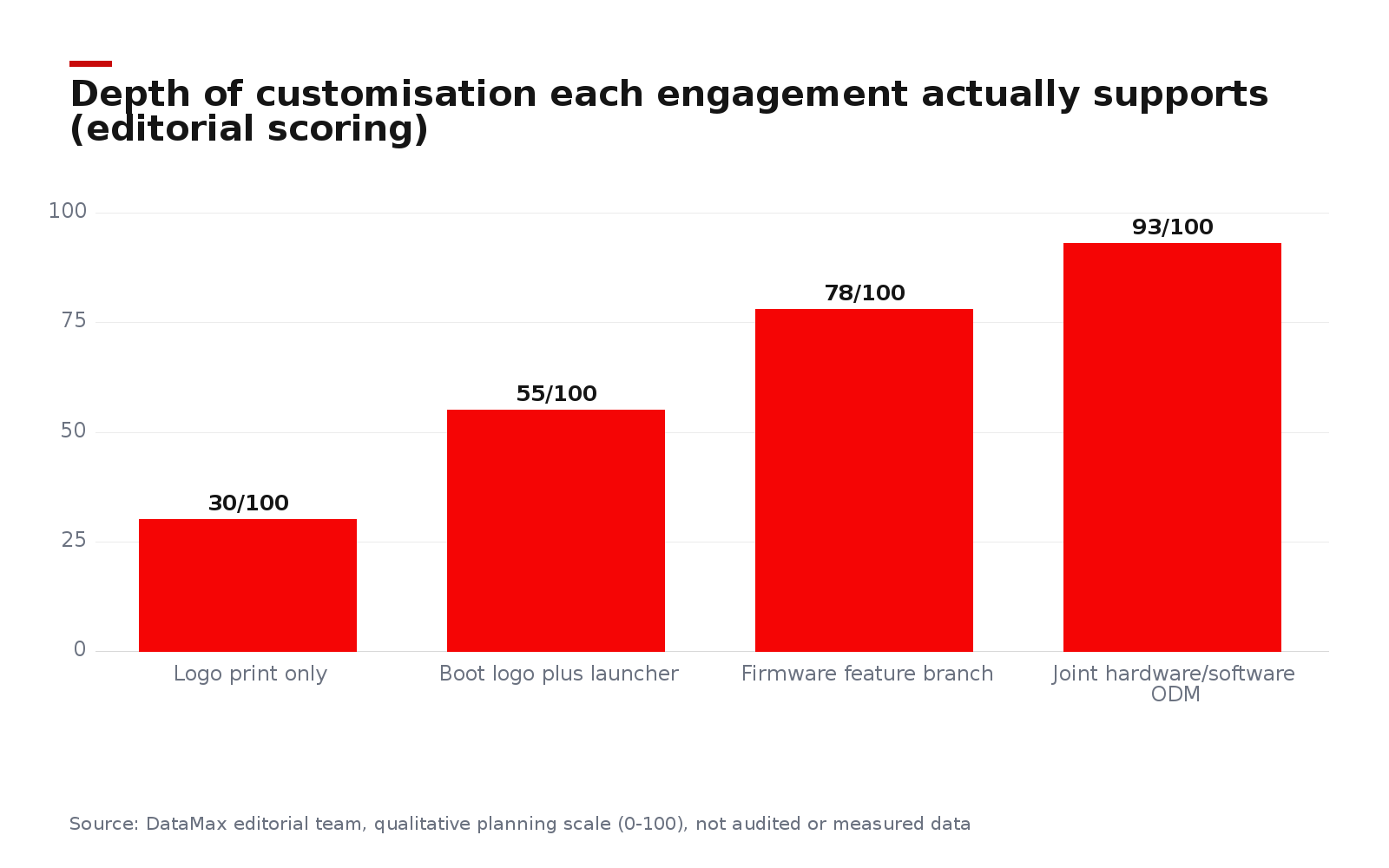
The same figures, in searchable form:
| Option | Editorial score /100 |
|---|---|
| Logo print only | 30 |
| Boot logo plus launcher | 55 |
| Firmware feature branch | 78 |
| Joint hardware/software ODM | 93 |
These values are planning aids, not performance measurements. Validate all selected configurations against the production datasheet.
The model fit should be recorded as a traceable decision rather than a marketing preference. DM21P begins with the stated operator-middleware fit and AOSP Android 11, while DM21S begins with the stated IPTV/OTT white-label fit and AOSP Android 14. DM21T becomes relevant where the stated decode profile includes 4K@120 formats and inline AI-SR are program requirements. DM22Q becomes relevant where the stated gaming-oriented fit, 4GB / 64GB configuration, and supported 4K@60 decode profile match the workload.
Optional is a commercial status, not an included feature. Widevine L1, PlayReady, HDCP 2.2, Dolby Vision, DTS, and 1G Ethernet are marked optional in the supplied facts for relevant models. The RFQ must identify whether each option is required, and the accepted production BOM must show the ordered status. A quotation that lists “DRM ready” without an option code cannot be compared with one that orders a specific licence configuration.
The table also separates platform capability from deployment acceptance. AV1, VP9, H.265, H.264, AVS3, or VVC decode support does not establish the source rate, output mode, television compatibility, DRM entitlement, or sustained playback condition of a campus room. Conversely, a decoder does not determine whether a third-party storefront can create a folio posting. Platform selection and service-policy validation remain separate workstreams, even when one procurement order covers both.
Deployment scenarios and the spec each needs
The same no-folio rule produces different hardware and integration requirements across campus estates. A residence hall with centrally managed rooms may prefer an operator middleware box. A graduate residence with tenant-managed subscriptions may need a more open Android TV launcher. A clinical, hospitality, or serviced-building extension may require institutional identity and room-asset controls.
| Situation | Primary requirement | Platform direction | Control to verify |
|---|---|---|---|
| University residence hall | Central subscription with no resident charge at checkout | DM21P for operator middleware, or DM21S for a white-label launcher | Room credential expiry and operator-only settlement path |
| Graduate housing with tenant accounts | Personal entitlement, device-to-room mapping, clean departure | DM21S with managed identity and configurable recovery | Account deletion, device wipe, and reassignment evidence |
| Conference or hospitality suite | Occasional-use room with shared access | DM21P, subject to authentication and session limits | Session timeout, PIN distribution, and billing exclusion |
| Premium gaming-oriented residence | Higher memory and supported 4K workloads | DM21T or DM22Q | Display mode, controller path, network QoS, and decoding test |
| Multi-campus operator rollout | Consistent image, remote policy, and site-specific configuration | Selected L1 model plus centralised device management | Software release control and site-level configuration inventory |
A room-based student residence has a narrow operational requirement: the device must return to a clean catalogue state, and the resident must not remain entitled after departure. A tenant-facing property has a broader account requirement, but it also needs a defensible privacy process. A hospitality suite may use a shared PIN, yet the PIN must expire and must never create a folio charge by default.
Gaming-oriented housing creates a separate performance conversation. The listed DM21T and DM22Q decode capabilities are platform facts, not a guarantee of latency or visual quality. A buyer must specify monitor size, refresh rate, HDR expectation, controller type, network path, and whether cloud gaming is part of the actual service. If those requirements are absent, selecting a premium platform adds cost without a defensible acceptance criterion.
A modern room installation must also account for television compatibility, concealed-box placement, power, thermal management, IR or network control, and service access. Confirm physical fit against the production datasheet; do not infer mounting, enclosure, or thermal performance from the model name.
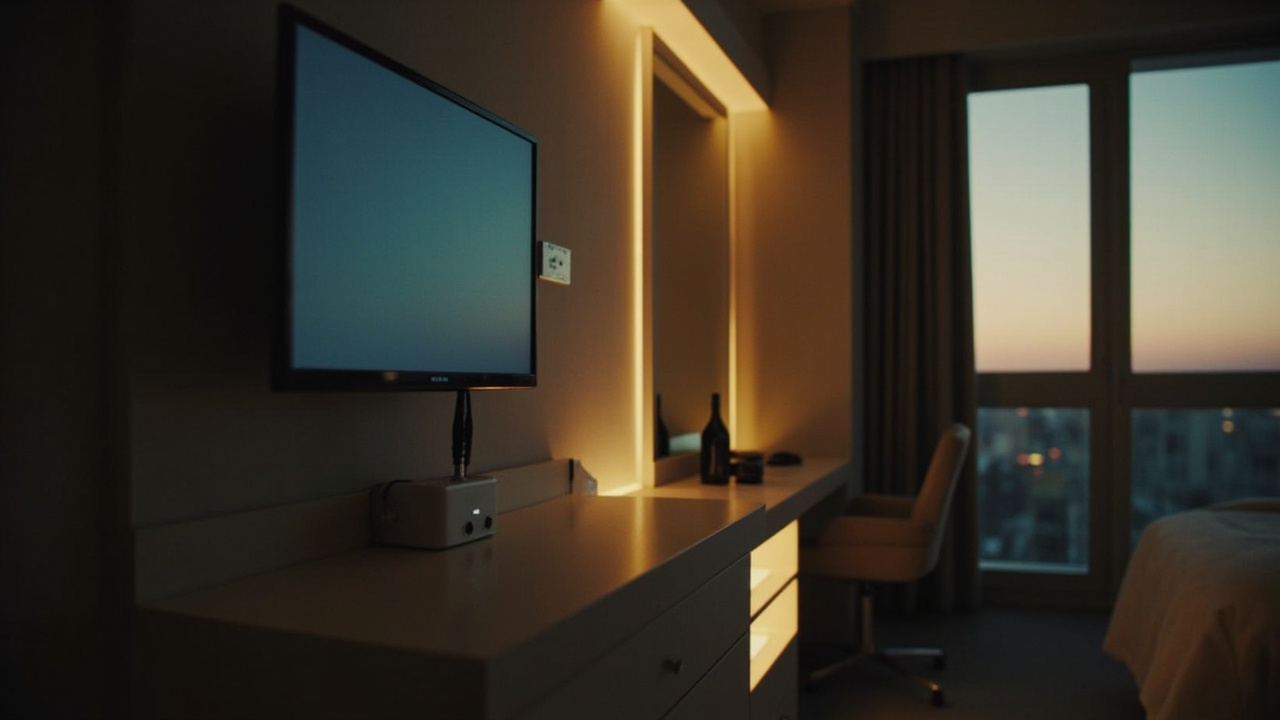
The realistic test is a room walk-through: resident launches the service, plays authorised content, encounters no unauthorised payment prompt, returns the remote, and triggers checkout. The device must then revoke or expire access and support controlled recovery.
An operator-owned estate should test one room from every building type, not only the newest property. A contractor-managed residence should add installer instructions and remote-recovery escalation. A tenant-supported model should add account-transfer, deletion-request, and payment-state tests. In each case, the pass condition includes both service availability and the absence of a folio posting.
Network paths create a second scenario divider. A wired residence may provide dedicated access to operator content and use Ethernet for the box, while a retrofit property may depend on Wi-Fi6 and a captive portal. These are not equivalent acceptance environments. The first should record DHCP, VLAN, multicast, DNS, and update routing; the second should add portal interception, captive-portal release, credential renewal, and roaming behavior.
Support ownership also changes by scenario. A centrally funded hall may permit a single operator support path, while a mixed-estate rollout may need property-level escalation for a failed checkout. The operator should know whether the resident calls the housing office, the service desk, or the operator, and whether each party can view the device serial, active entitlement, and last provisioning result. Ambiguous ownership turns a technical revocation delay into a resident dispute.
Turning the question into a spec line
Turn the programme into testable statements before requesting quotations. A broad request for an “Android TV box for a hotel” cannot be evaluated consistently. A precise specification can be pasted into an RFQ and answered without interpretive gaps.
- Define the billing boundary State: “The device shall not create or authorise hotel-folio charges for operator content, third-party applications, optional purchases, upgrades, or support calls unless specifically approved in writing.”
- Define identity and entitlement State the credential type, credential lifetime, room-binding rule, checkout revocation trigger, and owner of the identity platform.
- Define the launcher State which applications appear at boot, which are removable, who may change them, and whether a standard marketplace is permitted.
- Define hardware State the selected model, required RAM/ROM, wired or wireless primary transport, output interface, supported codecs, DRM, and any required ports. Confirm each against the production datasheet.
- Define network policy State multicast, IGMP, VLAN, captive-portal, DNS, update, telemetry, and Internet-access behaviour, including permitted destinations.
- Define recovery State the checkout sequence for credential expiry, account removal, factory reset, local data purge, device reassignment, and inventory reconciliation.
- Define acceptance evidence State the unit serial mapping, firmware and configuration versions, test result, packaging evidence, and delivery method for the pilot batch.
Every sentence should contain an observable condition. Replace “secure” with the authentication method and protected interface. Replace “seamless” with the permitted number of steps or a measured startup condition. Replace “no folio” with prohibited transactions and named system boundaries. Replace “custom logo” with the boot asset, launcher application, update ownership, and approval workflow.
The platform line should avoid bundling unrelated requirements. A Wi-Fi6 association is not equivalent to multicast entitlement. Widevine L1 support does not itself resolve which content catalogue is licensed. Dolby Vision/DTS support does not guarantee a selected application’s commercial deployment. AV1 decoding does not remove the need for correct output, display, and playback-path testing.
The RFQ should also separate one-time engineering from recurring programme costs. Identify firmware maintenance, launcher maintenance, security patch handling, device-management licences, content integration, certification, and support responsibilities. For the first supplier message, request samples and specify the pilot room count, chosen model, no-folio transaction rule, identity method, network profile, checkout test, and required evidence package.
A useful model line names one exact configuration: model, SoC, operating system, RAM/ROM, output interface, wired-network option, DRM, decode requirement, and expected ports. Do not allow “equivalent” or “latest” to substitute for those values. Each deviation then becomes a visible engineering difference.
The no-folio clause should enumerate the attempted actions, not only the intended architecture. The test matrix can include opening the application catalogue, launching an approved app, initiating an optional purchase, cancelling the transaction, returning after logout, and attempting an operator-content purchase. For each action, the expected record identifies whether the request was allowed, blocked, redirected, or charged through an approved external route. The pass condition includes both the user-visible result and the absence of an unauthorized property posting.
Version control should be equally explicit. Name the approved launcher package, firmware baseline, configuration file, certificate profile, and application catalogue. Record the revision at pilot sign-off and again at shipment. A change request should identify whether it affects payment exclusion, device identity, network access, or another controlled function. Without this structure, a remote update that restores a prohibited storefront can bypass an otherwise sound procurement specification.
Where quotations quietly diverge
Most divergence occurs where commercial language hides an ownership gap. A quotation may say “operator platform ready,” but it may not state whether the supplier controls the launcher, whether payment applications are blocked, or whether remote policy can revoke a room credential. A quote may list a chipset or codec without defining the complete output and playback path. Another may bundle DRM names without identifying licence configuration responsibility.
Field trap
A promise of “no folio” at the operator level can still fail if a preinstalled application, ad SDK, or checkout application retains a property-billing integration. Contract language must identify prohibited transaction paths, authorised payment flows, and the evidence required to demonstrate that no unexpected folio posting occurs.
The second common trap is room lifecycle. Device inventory can be correct while entitlement mapping is wrong. A resident may retain access after checkout, or the next resident may inherit a signed-in account, downloaded content, browser history, favourites, or payment details. The acceptance test must cover account removal and device reassignment, not only initial login.
Network quotations can also diverge. “IPTV supported” does not specify whether multicast is handled by the property network, the operator headend, an external gateway, or a software tunnel. It does not specify VLAN mapping, IGMP version, multicast source filtering, DNS, proxy behaviour, or captive-portal interception. These details can determine whether the box works during peak occupancy when many rooms request channels simultaneously.
Hardware language can hide substitutions. A listed RJ45 100M port may be quoted differently from an optional 1G configuration. RAM/ROM may exist in a family rather than the production BOM. Optional DRM must be confirmed as an ordered configuration, not merely a platform capability. Compare every quotation against the same frozen specification revision and serialise approved changes.
Field trap
Marketing labels can exceed the supplied technical envelope. A quotation that repeats an 8K claim for a model whose datasheet caps output or decode at 4K should be rejected until the production specification is corrected. Use the published decode and output values, then validate the selected mode on the actual television.
Another divergence appears in pilot scope. A laboratory playback test does not prove property-network operation, and a single-room test does not prove provisioning consistency across a batch. Specify sample size, room types, content service, transaction attempts, credential durations, recovery events, and required records. Define what happens when one unit fails: quarantine, rework, replacement, image re-provisioning, or shipment hold.
Finally, compare acceptance scope. A factory burn-in does not prove hotel checkout behaviour, and a sample playback does not prove fleet provisioning. The quote must distinguish component inspection, software testing, network integration, property pilot, and production rollout. Each stage needs an owner, sample size, defect threshold, evidence format, and disposition rule.
A specific failure can propagate across an entire estate. If one checkout procedure leaves a personal credential active, the next resident may inherit viewing history or purchase access. If one image update installs a marketplace not included in the approved catalogue, a no-folio rule can be weakened on every unit receiving that update. The corrective action should therefore be version-specific: identify affected serials, stop or reverse the update, apply a corrected image, rerun the affected test, and retain the result against the fleet release record.
Price is not the right comparison variable here because commercial terms are programme-specific, but the cost of ambiguity is measurable in engineering time. A late clarification of the payment path can require changes to the launcher, identity flow, PMS interface, documentation, and pilot script. A late clarification of the memory configuration can trigger an order change and a new traceability record. Freezing those fields before quotation reduces avoidable review cycles and makes competing proposals technically comparable.
Questions to put in the supplier review
A supplier review should trace both product manufacture and programme configuration. DataMax can be asked for evidence specific to the proposed deployment rather than accepting a generic “quality controlled” statement. The review should connect the order line to the device serial, hardware revision, firmware version, configuration record, test result, and shipment record.
- Inspect SMT evidence Review line records, component substitutions, first-article inspection, soldering criteria, and traceability between boards and serial identifiers.
- Review AOI evidence Confirm inspection coverage, defect classification, disposition, and the relationship between detected defects and repair or scrap records.
- Review aging evidence Establish the applied test duration, environmental conditions, load profile, observed failures, and whether failed units were analysed and excluded or reworked.
- Review firmware provisioning Match the signed image, application set, launcher configuration, certificates, model identifier, and region or site profile to the production order.
- Review dark-room or display testing Request the applicable procedure, display source, test pattern, port configuration, and pass criterion; do not infer display validation from codec support.
- Audit the trail Sample deployed units back to manufacturing, ageing, software provisioning, final test, packaging, and dispatch records.
Ask for a redacted evidence index rather than a blank statement of quality. The useful index includes record type, identifier, revision, test date, result, disposition, and responsible reviewer. For this programme, add the no-folio transaction test, login and logout sequence, checkout revocation, account purge, reassignment reset, and pilot-room network result.
The review should also separate DataMax-controlled activities from customer or operator-controlled activities. DataMax may control assembly, firmware preparation, provisioning, and factory testing. The operator may own content licensing, authentication, entitlement, payment policy, network configuration, and property integration. The supplier should not sign an acceptance criterion it cannot test, while the buyer should not leave a critical control owner unnamed.
For in room entertainment hotel programmes, request a video factory audit or a targeted evidence pack through the factory-quality programme. The first request should name the selected model, proposed RAM/ROM, ordered DRM configuration, interface requirements, pilot quantity, and the precise evidence fields required for SMT, AOI, ageing, provisioning, and deployed-unit traceability.
The sign-off package should close five loops: requirement to specification, specification to order, order to serial, serial to test, and test to campus acceptance. When those links are documented, a no-folio deployment can be audited technically, commercially, and operationally rather than accepted through a generic device description.
A supplier interview should challenge the evidence with a sample unit. Select one serial from the proposed batch and ask for its board inspection record, ageing record, firmware image, launcher configuration, final playback test, packaging record, and dispatch entry. A missing link identifies a process gap before rollout. The same sample should then be checked against the room-asset record after installation, confirming that the deployed unit corresponds to the intended hardware and software baseline.
The review should also establish change control. Ask who may approve a firmware image, launcher update, component substitution, memory configuration, DRM option, or network-profile change; how the change is regression-tested; and how affected units are identified. For in room entertainment hotel deployments, payment exclusion and checkout behavior belong in that regression list. A general smoke test is insufficient if it does not attempt the transaction path and inspect the resulting property records.
Further reading
- in room entertainment hotel: The IRD and Portal Integration
- Edge computing boxes
- 4K 60fps Android TV box guide
- Rockchip Android TV box guide
- Dolby Vision Android TV box guide
- DataMax DM21P specifications and fit
- DataMax DM21S specifications and fit
FAQ
What does “no folio” mean for a campus-housing TV service?
It means the resident’s room account cannot be used as the default payment channel for entertainment. The operator subscription, third-party applications, and optional purchases need separate rules. The programme should prohibit unapproved folio transactions, define any permitted exceptions, and test login, purchase, checkout, and device-reassignment flows against the property billing boundary.
Does the device platform enforce no-folio billing by itself?
No. The platform can remove or restrict applications and expose controlled payment flows, but commercial enforcement also depends on operator applications, payment-service configuration, content contracts, and property-system controls. Procurement should identify which party owns each restriction and require an end-to-end test showing that unapproved transactions cannot create folio postings.
Which DataMax model is the natural starting point for operator middleware?
DM21P is identified as a 4K IPTV or operator middleware set-top box. Its supplied specification includes an Amlogic S905Y4, AOSP Android 11, and Widevine L1 / PlayReady with HDCP 2.2 optional. Selection still depends on network, identity, DRM, memory, and output requirements confirmed against the production datasheet.
Should a campus-housing project choose a premium 4K or gaming-oriented model?
Only if the programme defines a measurable workload. Display resolution, refresh rate, HDR, controller support, cloud-gaming use, network quality, and local storage affect the decision. DM21T or DM22Q may fit such requirements, but their supplied specifications do not by themselves establish latency, thermal performance, or end-to-end gaming quality in the target room.
What must be tested before a device is reassigned to another room?
Test entitlement revocation, account logout, personal-data purge, browser and favourites reset, payment-state removal, factory-reset behaviour where required, and inventory reconciliation. The sequence should preserve operational telemetry needed for audit while removing resident access. Evidence must link the device serial to the checkout event and the reassigned-room record.
How should a supplier demonstrate customisation and quality control?
Request a traceable package covering the approved hardware revision, signed firmware, launcher configuration, SMT records, AOI results, ageing evidence, display or dark-room test results, and unit-level provisioning. For a campus pilot, add no-folio transaction results and checkout tests. A manufacturer capability review should identify the owner and disposition rule for every test stage.


