
The procurement answer in one screen
Before approving an Android TV set-top box for Nigerian distribution, confirm the radio module, exact importer or responsible company, final hardware configuration, applicable conformity-assessment route, and evidence trail. Verify each item against the production SKU rather than a catalogue entry.
The critical distinction is that a supplier’s ability to manufacture an Android TV device does not establish that the shipped product has a valid types approval. The importer normally assumes regulatory accountability for the consignment, while the manufacturer must supply traceable evidence and configuration control. A Wi-Fi/Bluetooth-enabled device, a non-radio LAN-only variant, and a fixed set-top-box design can produce different regulatory paths, especially after SoC, PCB, antenna, enclosure, or firmware changes.
For procurement, request four documents before sign-off: the exact model-to-certificate mapping, a current conformity-assessment result covering the final configuration, evidence for the radio module and antenna arrangement, and a change-control process linking production to that evidence. For DRM and cybersecurity claims, also request the configuration-specific commitments from the supplier. The certification support page is the appropriate place to confirm certificates and DRM/security provisions per ordered SKU, not per catalogue page.
This page focuses on ownership and inherited risk around types. For the broader matrix covering supported equipment categories and approval routes, use the canonical telecommunications type-approval support matrix.
Field trap
A certificate number alone is not a release decision. Check the legal applicant, exact model, radio configuration, antenna specification, validity status, regulatory markings, and responsible importer against the purchase order and packing list.
Before sign-off, ask one additional operational question: can the supplier reproduce the assessed product from the production bill of materials and line records? A valid types record is useful only when the factory can show that the radio module, antenna, enclosure, model label and firmware used in the shipment remain within its stated scope. If that production link is missing, the buyer inherits documentary uncertainty even when the laboratory file appears complete.
Options placed side by side
Three evidence routes can support a release decision, but they do not carry equal risk. The comparison below treats a supplier statement as the starting point, a generic report as supporting material, and certificate evidence as the control point.
| Evidence route | What it proves | What remains open | Release treatment |
|---|---|---|---|
| Supplier claim | Manufacturer states that work has been performed | Model scope, final configuration, issuer, public lookup and change history | Insufficient alone |
| Generic test report | Laboratory tested a stated condition or requirement | Production identity and relationship to the shipped SKU | Supporting only |
| Standard-specific report | Requirement-specific testing is documented | Whether the final product remains within that tested scope | Useful with identity controls |
| Certificate with public registry lookup | Authorised record can be matched to applicant and model | Importer duties, labels, installation and ongoing change control | Primary release evidence |
For teams moving from development to importation, the practical options are also a choice of operating model. DataMax can quote a standard catalogue configuration, quote a configured SKU with customer-specific software and connectivity, or support a customer-specified hardware and certification route. The production datasheet and a written scope statement must resolve the applicable types in each case.
| Option | Configuration control | Compliance ownership | Buyer action |
|---|---|---|---|
| Catalogue SKU | • Fixed hardware and standard software | • Supplier evidence for the defined SKU | • Match every SKU field to the order |
| Configured OEM SKU | • Branding, software and selected interfaces may vary | • Supplier covers agreed configuration; importer retains local duties | • Freeze the approved BOM and artwork |
| Custom development | • Customer-specified hardware and firmware | • Defined by contract and applicable law | • Approve a requirement-to-evidence matrix |
The editorial ranking below helps buyers prioritise handover documents. It is an editorial qualitative scale, not measured or audited data.
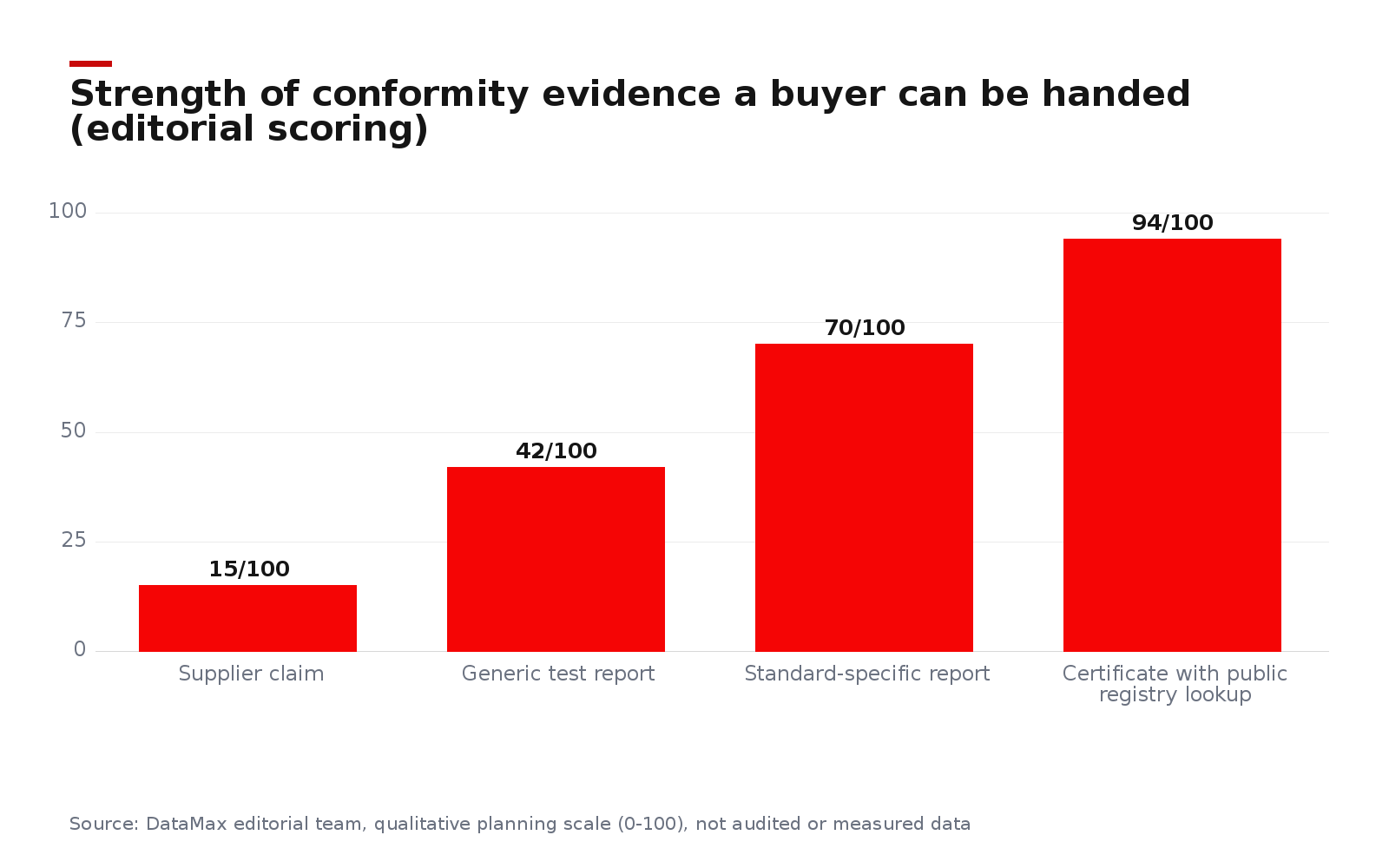
The same figures, in searchable form:
| Evidence option | Editorial score | Source context |
|---|---|---|
| Supplier claim | 15/100 | DataMax editorial team, qualitative planning scale (0-100), not audited or measured data |
| Generic test report | 42/100 | DataMax editorial team, qualitative planning scale (0-100), not audited or measured data |
| Standard-specific report | 70/100 | DataMax editorial team, qualitative planning scale (0-100), not audited or measured data |
| Certificate with public registry lookup | 94/100 | DataMax editorial team, qualitative planning scale (0-100), not audited or measured data |
A low-entry quotation may include only a standard catalogue configuration and supplier-provided technical documents. That option reduces customisation but also limits branding, firmware and radio variation. A commitment-tier quotation can cover a frozen OEM configuration, production BOM revision, artwork, firmware branch, laboratory evidence and change notification. It requires more approval gates before the purchase order, but it gives the importer a clearer defence that the shipped product corresponds to the assessed types record.
The middle ground is a configured OEM SKU with tightly controlled options. This may suit an operator that needs custom middleware but does not need a new radio implementation. The contract should enumerate every optional component: Ethernet speed, memory, DRM provision, wireless antenna, power supply, packaging and regulatory artwork. A quotation that merely says “approval included” leaves the release team without acceptance criteria.
Definitions a buyer cannot outsource
Nigerian type approval concerns equipment placed on regulated telecommunications markets. A buyer must distinguish product identity, market access and legal responsibility. The product identity is the final device, including model designation, radio module, antenna, firmware/operating mode and any connected accessories. Market access is the permission pathway applicable to that product in Nigeria. Legal responsibility remains with the parties named in the approval and the importing arrangements.
The terminology must also be read precisely. A types approval covers an identified type of equipment rather than creating a blanket exemption for every related product. A model series, a product family, a chipset and a regulatory category are not interchangeable identifiers. Buyers should ask the supplier which approved record covers the production unit, not merely which reference platform was used during development.
Radio and non-radio paths require separate analysis. Wi-Fi 6, Bluetooth 5.4 and other short-range functions can bring the transmitter into the scope of radio requirements. Ethernet may change the product’s radio profile without changing its visible model number. The final antenna specification remains material because matching or selective-scanning antenna variants can alter the technical assessment.
Conformity assessment can connect the final product to technical requirements through documented testing. The buyer needs the report’s identifier, dated scope, tested model, laboratory identification, applicable requirement or standard, and a clear relationship to serialised production. A report does not become a certificate through a sales statement, and a certificate does not cover a modified product unless that modification remains within its stated scope.
Local responsibility also involves the label, packaging, user information, importer records and installation context. Those duties are not cancelled by an OEM factory audit. For an operator or distributor, the safe governance model is to retain a release file containing the approval record, public-registry evidence, model-to-production mapping, radio configuration, labels, and change notifications.
The procurement consequence is straightforward: the supplier owns truthful technical disclosure and controlled manufacturing; the importer or other responsible local party owns market-entry compliance; the integrator owns whether the deployed configuration remains within the approved conditions. If those boundaries are vague, the types record can exist while the shipment still lacks defensible traceability.
“Type approval” also does not transfer automatically with the physical hardware. If the importer changes, the responsible applicant changes, or the approved party is no longer available for technical questions, the buyer should determine whether the existing record remains usable for the new commercial arrangement. The request to the conformity-assessment party should name the intended importer, manufacturer, production site and final SKU rather than ask only whether the device family has ever been assessed.
A useful evidence index uses one row per controlled field. For example, the radio row should contain the module, antenna designation, frequency configuration and output limits; the identity row should contain the commercial model, hardware revision and operating mode; the manufacturing row should contain the production line, firmware branch and inspection route. A PDF index can locate the evidence, but it cannot replace the underlying record.
Real DataMax platforms, field by field
The following fields reproduce the supplied product facts. They identify hardware and software directions; they do not assert that any listed model already holds a specific national approval. Confirm the applicable types and production evidence against the production datasheet for each ordered SKU.
| Model | SoC and OS | RAM / storage | Decode and DRM | Interfaces |
|---|---|---|---|---|
| DM21P | Amlogic S905Y4, quad Cortex-A35; AOSP Android 11 | 2GB / 8GB (4GB; 16/32/64GB optional) | AV1 [email protected], VP9/H.265 4K@60, H.264 4K@30; Widevine L1 / PlayReady / HDCP 2.2 optional | HDMI 2.0b out x1, USB2.0 x2, TF, S/PDIF, 3.5mm AV, RJ45 100M, Wi-Fi6 2x2 + BT5.4, DC 5V/2A |
| DM21S | Amlogic S905Y5, quad Cortex-A55; AOSP Android 14 | 2GB / 16GB (2/4/8GB; 16/32/64GB optional) | AV1 / H.265 [email protected] 4K@60; Widevine L1 / PlayReady optional; Dolby Vision/DTS | HDMI 2.0b out, S/PDIF, AV, USB2.0 x2, TF, RJ45 100M (1G optional), Wi-Fi6 2x2 + BT5.4 |
| DM21T | Amlogic S905X5, quad Cortex-A510 (ARMv9); AOSP Android 14 | 4GB / 64GB (family options) | H.266/VVC [email protected] 4K@120, AV1/VP9/H.265 4K@120, AVS3 4K@120, H.264 4K@60; inline AI-SR; Widevine L1 / PlayReady optional | HDMI 2.0b out (no HDMI in), USB2.0 x1 + USB3.0 x1, TF, S/PDIF, AV, RJ45 100M (1G opt), Wi-Fi6 + BT5.4 |
| DM22Q | Amlogic S905X5M, quad Cortex-A55 up to 2.5GHz; AOSP Android 14 | 4GB / 64GB (2/4/8GB; 16/32/64GB optional) | AV1/H.265 L5.1 4K@60; inline AI-SR (no NPU TOPS stated); Widevine L1 / PlayReady optional; Dolby Vision/DTS | HDMI 2.0b out, USB2.0 x2, TF, S/PDIF, AV, RJ45 100M (1G opt), Wi-Fi6 2x2 + BT5.4 |
DM21P fits a 4K IPTV or operator middleware set-top-box direction. DM21S fits a 4K Android TV box for IPTV/OTT white-label deployments. DM21T fits a premium UHD or cloud-gaming box. DM22Q fits a gaming-oriented Android TV box. These are fit descriptions, not regulatory classifications.
Configuration control is especially relevant because optional Ethernet, memory and DRM provisions alter the orderable SKU. A buyer must connect the exact ordering code, firmware branch, approval record and production line. If a catalogue page shows a family option, it cannot establish which types evidence belongs to the incoming unit.
For custom operator middleware, middleware identity may differ from the base hardware SKU while the radio and physical product remain unchanged. The RFQ should therefore separate three questions: which hardware record is used, which customer configuration is built, and which evidence package covers that combined product. DataMax’s manufacturing overview and custom development capability can define the proposed control process.
The four platforms illustrate why one compliance statement cannot cover every order. DM21P and DM21S occupy different OS generations and operator or white-label fit, while DM21T and DM22Q use different SoCs and performance orientations. Their listed interfaces also differ, including Ethernet options, USB counts and wireless arrangements. These are commercial configuration boundaries that a types review must consider only through the production datasheet and the applicable assessment scope.
For an RFQ comparison, avoid presenting a platform family as a regulatory category. Instead, create one product line per ordered configuration and add the selected RAM/storage, Ethernet option, DRM choice, firmware release, antenna expectation, destination packaging and importer identity. DataMax should state which fields are confirmed, which remain customer-controlled and which require confirmation against the production datasheet before quotation or shipment.
The platform table is also not a catalogue of approvals. Widevine L1, PlayReady, Dolby Vision/DTS and HDCP 2.2 describe content-protection or DRM provisions for applicable options. They do not prove that the device has an NCC approval. A compliant purchasing file keeps those subjects separate: product capability, protected-content terms, radio configuration and market-access evidence.
The operator, the integrator and the venue
Deployment roles determine who needs which evidence. The operator may import finished devices for subscriber distribution; the integrator may install and commission operator-supplied equipment; the venue may combine a set-top box with displays, sound, network and building systems. Their operational duties differ, but all three need a traceable product identity and a controlled installation.
| Situation | Primary requirement | Evidence to obtain | Model direction |
|---|---|---|---|
| Operator subscriber rollout | • Repeatable imported SKU and local market access | • Model-to-approval mapping; public registry result; label and importer records | • DM21P for operator middleware; DM21S for white-label Android TV |
| Systems integrator commissioning | • Product identity retained through handover | • Serial or batch mapping; installation record; approved power, display and network configuration | • DM21P where operator middleware drives the terminal |
| Hotel or hospitality venue | • Remote management and consistent room firmware | • Firmware version control; network assumptions; recovery procedure; model evidence | • DM21S where Android TV white-label deployment is preferred |
| Gaming-focused service | • Sustained device configuration and display capability | • Exact SKU record; decode/output requirements; thermal and quality evidence | • DM21T for premium UHD or cloud gaming; DM22Q for gaming-oriented Android TV |
The integrator’s task is not to recreate the regulatory approval, but to avoid removing assumptions embedded in it. Substituting an antenna, power supply, display mode or firmware image can matter. The installation package should identify the approved configuration and record any departure for assessment rather than silently normalising it in the field.
For a venue, the buyer also needs a replacement process. A fleet cannot be supported reliably if staff can install an unverified spare. Asset records should connect serial identity, approved model, software version, room or zone, and service history. The venue then inherits an operational duty to maintain that mapping.
An operator rollout creates a different inheritance path. The importer may approve a master purchase order, while operations, warehouse staff and field technicians later receive devices by batch rather than by conformity file. The release instruction should therefore travel with the stock: the exact model and ordering code, the evidence reference, the applicable types configuration, and the prohibition on substituting radios, antennas or unapproved firmware.
For a systems integrator, the handover package should also identify what the installer may configure. Network connection, display resolution, audio routing and accessory selection may be operational choices, but a change to radio behaviour or the regulated product configuration may require review. A commissioning checklist can record the approved power adapter, connected cables, installed software image and serial number, then flag any field substitution for technical assessment.
For a hospitality venue, fleet management and refurbishment matter as much as the initial installation. The replacement process should draw only from an approved spare pool. Used units must retain their model label and serial identity; changing memory, storage or the Ethernet option may convert a familiar asset into a different configuration. The venue should escalate any hardware substitution rather than assume it remains within the same types scope.
A real production line links these roles visually: component assembly, programmed identity, test, configuration record, packing and dispatch.

That scene matters because a SoC package is only one element of the evidence chain. The shipped identity also depends on the board, radio components, antenna arrangement, firmware and external product decisions. The types record must be reconciled against the actual unit rather than inferred from the chip marking.
How to choose, step by step
Turn the regulatory question into a sequence of release gates. Do not begin with the catalogue image. Begin with the market scenario and freeze the product identity before asking for a supplier response.
- Define the shipment model Record whether the importer, operator, distributor or integrator is responsible for market entry, and identify the consignee and local accountable party.
- Freeze the technical configuration State the exact DataMax model, storage, Ethernet option, DRM option, wireless configuration, antenna expectation, OS release, customer firmware and intended accessories.
- Ask for the route Require the supplier to state the applicable conformity-assessment path and identify any assumptions that require local confirmation before shipment.
- Match the evidence Request the approval or conformity-assessment record for the exact SKU, public registry details, model mapping, radio documentation and test reports where available.
- Approve labels and documents Check importer particulars, instructions, packaging, regulatory markings and the consistency between paperwork, product and shipment.
- Define change control Name the triggers that require reassessment, including SoC, PCB, radio module, antenna, enclosure, firmware, power supply and production-site changes.
- Release by evidence Gate the first production order against the approved configuration, then reconcile serials, test records and dispatch documents.
The procurement message should not ask only, “Is this box approved?” It should ask for the exact types record, its holder, its model scope, the applicable Nigerian route, public lookup details, final-configuration restrictions, required markings, and the evidence that DataMax’s production line can reproduce the approved configuration.
The model choice is a separate decision from regulatory coverage. DM21P provides the specified operator middleware fit; DM21S provides the white-label Android TV fit; DM21T addresses the premium UHD or cloud-gaming fit; DM22Q addresses the gaming-oriented Android TV fit. Each platform still requires evidence for its ordered configuration.
The manufacturer and importer split should appear in the purchase order. DataMax can commit to an agreed BOM, firmware, artwork, test procedure and change notification. The local party can commit to importer details, local declarations where applicable, customs coordination, labels and market-entry records. Overlap creates accountability gaps; silence creates inherited risk.
For an RFQ, the first message should contain: target market, importer identity, deployment channel, exact DataMax model, requested RAM/storage, wired and wireless configuration, DRM requirements, OS/firmware policy, expected order quantity, destination packaging and whether a conformity-assessment evidence pack is required. The inquiry team should receive that line before quotation, and sample requests should identify the same configuration for evaluation.
Turn the sequence into pasteable RFQ lines. “Compliance: DataMax to identify the applicable Nigerian conformity-assessment route for the ordered SKU and provide the corresponding types evidence or document the unresolved route and owner.” “Configuration: exact DataMax model, ordering code, memory, Ethernet, DRM, wireless, antenna and firmware are frozen before evidence matching.” “Traceability: each production batch links to BOM revision, firmware image, inspection, test and packing records.” “Change notice: supplier reports proposed changes to SoC, PCB, radio module, antenna, enclosure, firmware, power supply or production site.”
A sample should be the first controlled object. The evaluation unit, quotation configuration and production order should identify the same hardware and software unless the change is explicitly recorded. If the sample differs from production, the buyer needs to know which difference is only cosmetic and which could affect the radio, model designation or assessed behaviour. A comparison sheet with photographs, labels, firmware identifiers and configuration fields prevents the evaluation from becoming a different types scope.
What goes wrong after the PO
The common failure is not a missing PDF. It is a mismatch between the PDF and the product. This can arise from an approved development configuration becoming a production configuration with different options, or from a distributor combining an approval record with a non-equivalent SKU.
Field trap
A family name is not a product identity. If the purchase order says “2GB”, “1G Ethernet optional” or “DRM optional” without resolving the selected configuration, the compliance file cannot determine what was actually produced. Freeze the option code before release.
A second failure occurs when the importer assumes the factory owns every regulatory obligation. The manufacturer can control design, BOM, firmware, test and production evidence. It cannot assume the importer’s local declarations, label instructions or recordkeeping. The contract should assign each deliverable and acceptance criterion.
Field trap
Radio assumptions are frequently inherited silently. A Wi-Fi/Bluetooth specification in a catalogue does not describe the final antenna implementation. Require the production antenna, radio module and configuration to be checked against the evidence before the **types** decision is approved.
Commercial quotations can also diverge around “compliance included”. One quotation may cover evidence supplied by the factory; another may cover application and liaison work; a third may cover only a certificate image. Ask what is excluded, who owns application fees where applicable, how model amendments are handled, and whether evidence is transferable to the named importer. Do not accept an ambiguous phrase such as “certified” as a contractual deliverable.
Another risk is confusing content-security capabilities with market approval. Widevine L1, PlayReady, Dolby Vision/DTS and HDCP 2.2 relate to DRM or protected-content provisions, not to a telecommunications approval. The selected DataMax platform may offer some of these options, but they do not replace the applicable types evidence.
The operational cost of a mismatch can include held inventory, rework, relabelling, shipment delay, replacement samples and inability to support the device in the field. The prevention cost is a controlled model-to-evidence matrix, factory release gates and a change-notification process. Procurement should price those controls as part of product conformity rather than treat them as paperwork after award.
Evidence can also expire or become detached from commercial reality. A record may remain visible in a public registry while the named holder, authorised representative or production arrangement has changed. The release team should capture the lookup result at approval and define when it must be refreshed. This does not convert a registry entry into a substitute for the importer’s responsibilities; it simply establishes whether the claimed types basis remains identifiable at the point of release.
A third quotation divergence concerns sampling. One supplier may provide a laboratory report for a prototype; another may provide records for the production configuration; a third may provide only a declaration that the platform is “the same”. The acceptance criterion should specify the sample identity, tested configuration, production linkage and disposition of deviations. Otherwise, the buyer cannot tell whether the submitted types evidence covers the units that will actually enter the channel.
Verification you can ask for on paper
Verification must connect the paper record to the physical product. A factory can present a conformity file and still fail to reproduce the relevant configuration. The handover should show how the evidence travels through assembly, programming, test, packing and dispatch.
- Incoming and SMT evidence Link the approved bill of materials to component receipts, line settings and the build record. Record the SoC, memory, Ethernet, radio and antenna selections without changing the approved evidence boundary.
- Inspection evidence Retain AOI or equivalent inspection output, defect disposition and line acceptance for the production configuration.
- Programming evidence Capture the firmware image identifier, serial assignment and configuration checksum so the programmed unit can be related to the ordered SKU.
- Functional and RF evidence Record the test steps applicable to the released unit, including display, interfaces, network functions and radio checks performed by the approved production process.
- Reliability evidence Provide the production burn-in, ageing or environmental procedure as applicable to the product, with failed units removed from the release path.
- Final inspection Confirm model label, port configuration, accessories, packaging, regulatory marking and serial traceability before packing.
- Dispatch and reconciliation Reconcile the packed serial or batch identity to the test record, packing list, model mapping and conformity evidence.
A dark-room or RF visual check may form part of a radio test process, but the buyer should request the actual procedure and result rather than infer one from the factory’s generic description. SMT inspection establishes board population; AOI detects specified assembly anomalies; ageing exposes units to defined stress; audit records confirm that the released process matches the controlled process. None replaces the identity check.
Minimum handover package: model-to-approval mapping, public-registry lookup where available, radio and antenna scope, production BOM revision, firmware identity, inspection and test results, serial or batch traceability, label artwork, packing record, and change-control contact. The package must identify which document proves each field and which SKU it covers.
DataMax’s factory quality evidence and compliance support should be requested against the frozen production configuration. For certification documents and DRM or security provisions, confirm the deliverables per ordered SKU rather than treating a catalogue page as the control document. The importer can then make a documented release decision on the applicable types and retain the evidence needed for future audits, incidents or product changes.
The evidence index should carry document identifiers, revision dates, owners and applicable SKU fields rather than placing unlabelled files in a shared folder. For the radio, record the module and antenna against the assessed configuration. For software, record the production image identifier and change status. For physical identity, record the model label, PCB revision, enclosure and relevant ports. For shipment, record the serial or batch and packing-list link. This structure lets an auditor answer “which evidence proves this field?” without reconstructing the history from email.
A controlled audit trail also needs exception handling. A line technician, distributor or integrator may identify a mismatch between the work order, the physical label and the conformity record. The exception should enter a quarantine path, identify the affected types assumption, and receive a documented disposition before release. The evidence package should show both passed and rejected deviations; hiding an exception weakens the credibility of the passing results.
Further reading
- Telecommunications Type Approval: A Cross-Market Matrix
- AOSP vs Google TV guide
- HDR10+ Android TV box guide
- DTS:X Android TV box guide
- DRM compliance solutions
- DataMax DM21P specifications and fit
- DataMax DM21S specifications and fit
FAQ
Does an OEM approval automatically cover my imported set-top boxes?
No automatic coverage should be assumed. The importer must verify that the approval record, applicant or responsible party, model, radio configuration and permitted variations match the shipped product. A family name, chipset or earlier prototype does not establish coverage for the final SKU. Ask for a model-to-evidence mapping and confirm the applicable types before approving the PO.
Which party owns NCC type-approval obligations?
Responsibility depends on the transaction and the approval record. The manufacturer controls its design, BOM, firmware and production evidence, while the importer normally carries local market-entry and recordkeeping duties. The purchase order should assign application work, evidence transfer, labels, declarations, shipment release and change notification explicitly, rather than using an ambiguous “approval included” clause.
Does a Wireless DAM asset improve the technical file?
A Wireless DAM asset can support a specific assessment, but it does not replace the need to match the final radio module, antenna and product configuration to the conformity evidence. Buyers should verify the document’s model and test scope. If the production antenna or firmware differs from the assessed configuration, confirm with the responsible conformity-assessment party whether re-evaluation is required.
Can software branding changes invalidate a set-top-box approval?
It depends on the scope of the approval and evidence. Branding alone may not change the technical assessment, while firmware, radio behaviour, model designation, labels or accessories can affect identity or compliance. Freeze the commercial artwork and firmware version, document the differences, and obtain a written scope decision before shipment. That decision should identify the affected types and responsible assessor.
What should a first RFQ message contain?
State the target market, importer identity, deployment channel, exact DataMax model, RAM/storage, wired and wireless options, DRM needs, OS or firmware policy, packaging, expected quantity and request for a conformity-assessment evidence pack. The sample order team should receive the same configuration description so the evaluated sample and eventual production SKU remain aligned.
How much compliance evidence should accompany the quote?
Request the applicable model-specific evidence and a written scope statement, not a generic portfolio. Include the exact SKU mapping, configuration restrictions, public lookup details where available, labelling requirements, document ownership and change-control process. Confirm certificates and DRM/security provisions per ordered SKU through DataMax, because catalogue-level statements cannot establish what will be shipped.




