
Before the terminology: the decision
Before sign-off, confirm 4 controls: the production SoC and memory, the Android feature set, the DRM and middleware path, and the manufacturing evidence behind the quotation. The direct answer to android tv box checklist is therefore a traceability exercise, not a processor name or generic feature list. Each requirement must move from market requirement to frozen configuration, approved golden sample, pilot-batch result and release evidence.
This focused sub-topic applies the same discipline to the DataMax L1 line while preserving the broader RK3568 Android Box Engineers Checklist as the canonical page. The procurement consequence is immediate: a supplier can quote an attractive Android 14 configuration while omitting the network, interface, certification or test evidence needed for deployment.
Verify every commercial line before signing. First, identify the production SoC, CPU architecture, RAM/ROM and operating-system baseline against the production datasheet. Second, match every decoder mode and output port to the actual content profile. Third, confirm DRM level, optional protection features and middleware integration with the target operator. Fourth, record the approval path: requirements only, requirements plus commercial target, approved golden sample or pilot-batch sign-off. A purchase order should reference that evidence package rather than an ambiguous model label.
An RK3576 quotation must not inherit the DataMax L1 specifications by implication. For that programme, confirm the processor, operating system, media pipeline, port population, certifications and lifecycle plan against its own production datasheet. Use the models below as a comparison structure, not as substitutes for the proposed RK3576 specification. In an android tv box checklist, the proposed RK3576 configuration should remain a separate row until its released evidence is attached.
The comparison buyers actually make
Buyers usually compare the operational entry configuration with a more committed platform, then add the cost of unresolved requirements. For DataMax L1, DM21P is the operator-oriented 4K IPTV option, while DM21S supports an Android 14 white-label role. The higher decode direction shifts to DM21T and DM22Q. A “higher tier” label does not replace checking the SoC and exact interfaces.
| Decision item | Entry/operator direction | Commitment/gaming direction | Evidence required |
|---|---|---|---|
| Platform basis | DM21P: Amlogic S905Y4, quad Cortex-A35 | DM21S: Amlogic S905Y5, quad Cortex-A55; gaming SKUs use their listed S905X5-family SoCs | Approved hardware revision and production BOM |
| Software baseline | DM21P: AOSP Android 11 | DM21S, DM21T and DM22Q: AOSP Android 14 | Build number, image hash and update policy |
| Media direction | DM21P includes AV1 [email protected] and 4K@60 modes | DM21T lists 4K@120 modes; DM22Q lists 4K@60 | Bitstream and frame-rate test matrix |
| Network | RJ45 100M; Wi-Fi6 2x2 + BT5.4 | RJ45 100M, with 1G optional on DM21S, DM21T and DM22Q | NIC population and sustained-throughput test |
| Approval boundary | Specification and sample approval | Golden sample followed by pilot-batch sign-off | Signed acceptance record |
| Memory configuration | DM21P starts at 2GB / 8GB, with other variants stated as optional | DM21S uses a 2GB / 16GB baseline; DM21T and DM22Q list 4GB / 64GB | Exact RAM/ROM written into PO and golden-sample record |
| USB direction | DM21P and DM21S list USB2.0 x2 | DM21T lists USB2.0 x1 + USB3.0 x1; DM22Q lists USB2.0 x2 | Port population and USB transfer test |
| Certification scope | Operator image, target-market certificates and service integration are separately controlled | Same evidence applies, with additional app, codec and display acceptance where relevant | Certificate list tied to exact model and hardware revision |
The chart ranks how far each approval gate progresses toward production. Its values are editorial planning scores, not measured rework performance.

The same figures, in searchable form:
| Approval stage | Editorial score |
|---|---|
| Requirements only | 25/100 |
| Requirements plus target price | 46/100 |
| Approved golden sample | 74/100 |
| Pilot batch sign-off | 91/100 |
The practical comparison is the delta between evidence stages, not the absolute score. Requirements alone leave the hardware revision, image, port population and accepted defects unresolved. An approved golden sample connects those decisions to one physical and software reference. Pilot-batch sign-off then tests whether the production process can reproduce that reference.
Two quotations can therefore be operationally different even when both say “4K Android TV box.” One may identify an exact RAM/ROM population, Ethernet option, firmware hash, middleware version and test-vector set. The other may leave those variables implicit. The second quotation may look equivalent on a spreadsheet but carries more clarification work, sample substitutions and release risk. This is why the android tv box checklist must compare evidence completeness alongside processor and memory.
Where the terminology comes from
An Android TV box is an Android-based set-top or television-edge device whose software, DRM, media pipeline and connectivity operate as one controlled product. AOSP Android 11 or AOSP Android 14 identifies the upstream software baseline; it does not itself prove Google Android TV certification, operator middleware integration or a particular Widevine implementation. Confirm those commercial and certification states separately.
The processor architecture governs the implementation ceiling, while the configured SoC governs available hardware blocks. An instruction set is not a chipset. Cortex-A35, Cortex-A55 and Cortex-A510 describe CPU cores; Amlogic S905Y4, S905Y5, S905X5 and S905X5M identify the production devices listed by DataMax. RFQs must name both where the distinction affects thermal design, software baseline or lifecycle planning.
Media terminology separates capability claims from tested behavior. AV1, VP9, H.265/HEVC and H.264 are codec families. Main10, profile and level constrain bitstream interpretation. A specification such as 4K@60 identifies frame rate, but still requires resolution, pixel format, HDR/SDR path, audio synchronization and sustained thermal behavior to be tested together.
DRM is a licence and key-delivery system. Widevine L1 and PlayReady identify the supported commercial DRM families in the supplied DataMax facts; HDCP 2.2 concerns output protection where listed. Dolby Vision and DTS are optional on relevant models. “Optional” is operationally significant: an RFQ requiring either feature must state whether the production BOM includes it, and the supplier must attach the corresponding licence, middleware and content-playback evidence.
Connectivity must be handled as a bill of differences. Wi-Fi6 2x2 describes the listed radio configuration, while BT5.4 identifies the listed Bluetooth version. Ethernet population, USB generation, HDMI input availability and audio outputs can change the SKU without changing the box family name. That is why this focused android tv box checklist treats each line item as a configuration fact requiring a sample or production-record match.
- SoC and CPU
- RAM/ROM population
- Ethernet, USB, HDMI and audio population
- AOSP baseline and build identifier
- Operator or white-label image
- Application, update and recovery policy
- Widevine L1 and PlayReady
- Optional Dolby Vision, DTS and HDCP 2.2
- Entitlement and key-delivery path
- Approved golden sample
- Pilot-batch report
- Serial-level traceability
An RK3576 RFQ should follow the same tree even though its underlying part numbers differ. Separate the physical build from the software image, then separate the service-protection configuration from the evidence package. This avoids a category error: treating a compliant decoder or a Widevine label as proof that the complete commercial service works.
The Android certification question also needs separate wording. Ask whether the device is AOSP-based, Google Android TV-certified, operator-certified or all three. These are different approval systems with different evidence. The AOSP vs Google Android TV guide explains the software distinction, while the RFQ should state the exact status required for the destination market.
For an RK3576 proposal, the same distinction applies to the SoC name. Do not transpose an Amlogic model, ARM core count or Android baseline from this comparison into an RK3576 product. The proposed processor, memory and media claims belong in their own specification line. This android tv box checklist should close only after that line has a datasheet reference, a sample and a signed acceptance basis.
Five production SKUs compared
The DataMax L1 line contains four supplied production SKUs, not five. The fifth comparison position would require another production datasheet and cannot be invented. This section compares all four available platforms and records the missing row as “confirm against the production datasheet” rather than introducing an unlisted model.
| Model | SoC and CPU | OS | RAM/ROM | Decode | DRM | Ports and connectivity |
|---|---|---|---|---|---|---|
| DM21P | Amlogic S905Y4; quad Cortex-A35 | AOSP Android 11 | 2GB / 8GB; 4GB; 16/32/64GB optional | AV1 [email protected], VP9/H.265 4K@60, H.264 4K@30 | Widevine L1 / PlayReady / HDCP 2.2 optional | HDMI 2.0b out x1; USB2.0 x2; TF; S/PDIF; 3.5mm AV; RJ45 100M; Wi-Fi6 2x2 + BT5.4; DC 5V/2A |
| DM21S | Amlogic S905Y5; quad Cortex-A55 | AOSP Android 14 | 2GB / 16GB; 2/4/8GB; 16/32/64GB optional | AV1 / H.265 [email protected] 4K@60 | Widevine L1 / PlayReady optional; Dolby Vision/DTS | HDMI 2.0b out; S/PDIF; AV; USB2.0 x2; TF; RJ45 100M (1G optional); Wi-Fi6 2x2 + BT5.4 |
| DM21T | Amlogic S905X5; quad Cortex-A510 (ARMv9) | AOSP Android 14 | 4GB / 64GB; family options | H.266/VVC [email protected] 4K@120; AV1/VP9/H.265 4K@120; AVS3 4K@120; H.264 4K@60; inline AI-SR | Widevine L1 / PlayReady optional | HDMI 2.0b out, no HDMI in; USB2.0 x1 + USB3.0 x1; TF; S/PDIF; AV; RJ45 100M (1G opt); Wi-Fi6 + BT5.4 |
| DM22Q | Amlogic S905X5M; quad Cortex-A55 up to 2.5GHz | AOSP Android 14 | 4GB / 64GB; 2/4/8GB; 16/32/64GB optional | AV1/H.265 L5.1 4K@60; inline AI-SR; no NPU TOPS stated | Widevine L1 / PlayReady optional; Dolby Vision/DTS | HDMI 2.0b out; USB2.0 x2; TF; S/PDIF; AV; RJ45 100M (1G opt); Wi-Fi6 2x2 + BT5.4 |
| Fifth production SKU | No additional DataMax production facts were provided. Confirm model, SoC, OS, RAM/ROM, DRM, ports and dimensions against the production datasheet. | |||||
Two quotation-control points follow. DM21T and DM22Q are described by their supplied decode data at 4K, with 4K@120 only on DM21T; do not promote either model to an 8K output claim. Also, “1G opt” and “1G optional” must be converted into a selected Ethernet configuration in the purchase order.
A third control point concerns the word “family.” DM21T’s RAM/ROM is recorded as 4GB / 64GB with family options. That does not authorize a buyer to assume any unstated capacity. Select the exact configuration, have the supplier confirm it against the production datasheet, and repeat it in the purchase order. The same rule applies to Dolby Vision, DTS and HDCP 2.2 wherever the supplied facts mark them optional.
The fifth row is intentionally not a fabricated fifth model. A useful engineering review can still compare five positions: DM21P, DM21S, DM21T, DM22Q and the unresolved fifth proposal. Until the fifth platform has a released datasheet, its operating system, SoC, memory, decode modes, DRM and connectors remain procurement gaps rather than assumptions.
For the RK3576 quotation, add a separate line identifying the proposed processor, operating-system baseline, memory, decode modes, DRM, ports, power and certification scope. Do not place it inside the DM21P, DM21S, DM21T or DM22Q rows merely to make the matrix visually complete. A field-level android tv box checklist records differences; it does not normalize unlike products into one unsupported family.
Buyer situations, ranked by what they punish
Operator procurement first punishes middleware mismatch. A set-top box must load the target middleware, satisfy its boot, provisioning, update and DRM flows, and remain operable under the operator’s account and entitlement system. The supplied fit places DM21P in the 4K IPTV/operator middleware set-top-box role and DM21S in the IPTV/OTT white-label role; neither statement alone proves compatibility with a named middleware release.
Integrators are usually punished by physical-interface omissions. The checklist must distinguish HDMI 2.0b output from HDMI input, USB2.0 from USB3.0, RJ45 100M from optional 1G, and the listed AV, S/PDIF and TF connections. An operator is more likely to be punished by entitlement, provisioning or update defects. A venue deployment is likely to expose thermal stability, wired-network resilience and management requirements.
For a digital-signage programme, a 24-hour operating claim should not be placed in the RFQ unless it is backed by a defined aging condition, workload and observation period. For a multi-room project, the procurement document should freeze the image, wall configuration, remote-control behaviour and recovery method; otherwise technicians may spend more time reproducing configurations than installing devices.
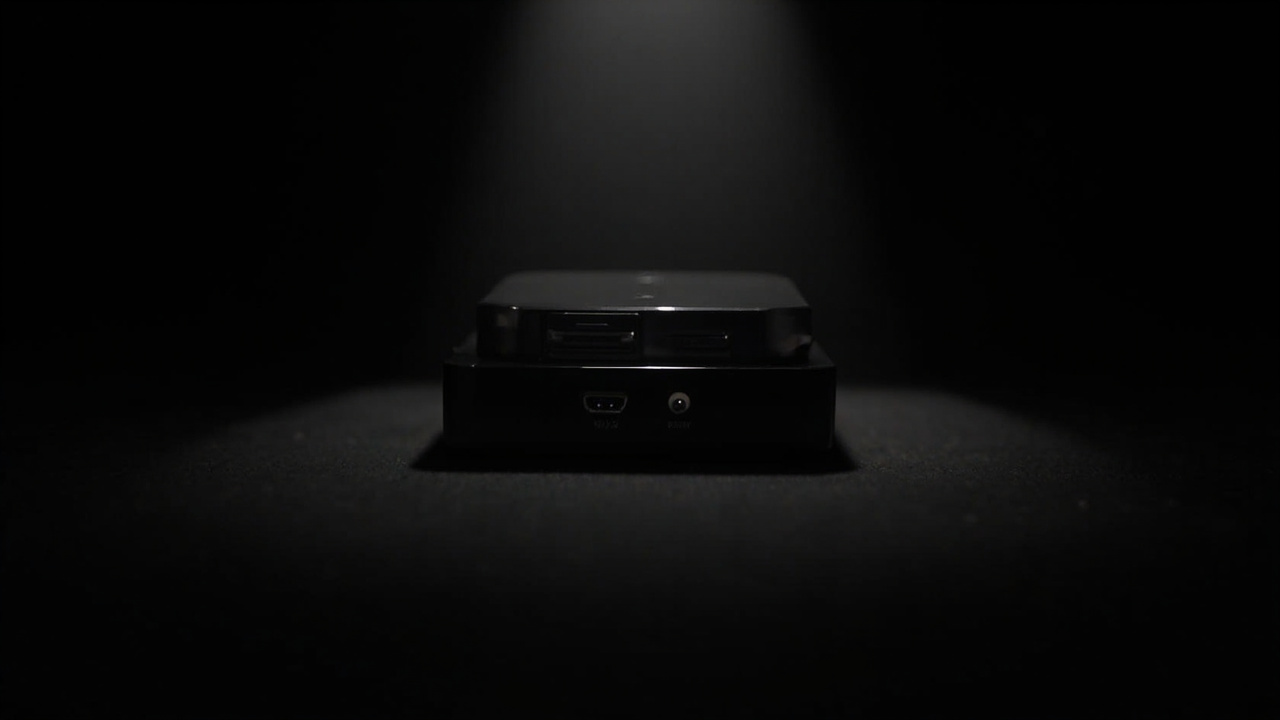
The visual scene is a mainboard-level inspection: a black system-on-chip package, surrounding memory chips and PCB traces under side lighting. It illustrates where the silicon choice becomes a board-level engineering decision, not a catalogue label.

An operator RFQ should lead with entitlement, provisioning and recovery rather than peak codec capability. An integrator’s RFQ should lead with physical ports, display and audio paths. A gaming-oriented venue should define the complete 4K path, including source format, selected refresh rate, USB population and display limitations. An RK3576 programme must preserve those distinctions instead of assuming the DataMax models’ interface populations. This android tv box checklist therefore remains scenario-specific even within one product category.
A decision path for the RFQ
Turn the purchase into a sequence of gates. Each gate has a named output, preventing an attractive SoC or Android version from carrying an unverified requirement through to the final order.
- Define the deployment envelope Record market, operator or brand, content services, resolution and refresh-rate ceiling, HDR/SDR policy, network design, display outputs, audio outputs and update responsibility.
- Select the hardware direction Map the envelope to DM21P, DM21S, DM21T or DM22Q using the verified field. Treat 1G Ethernet, Dolby Vision, DTS, HDCP 2.2, USB3.0 and memory variants as explicit selections.
- Freeze software and protection Specify AOSP Android 11 or AOSP Android 14, build policy, Widevine L1, PlayReady and any optional feature required by the service. Attach middleware and content-account evidence.
- Create the test matrix Define test vectors for boot, Ethernet, Wi-Fi6, Bluetooth, HDMI output, USB population, TF, audio, codecs, refresh rates, DRM, OTA, reset and recovery.
- Approve the golden sample Record hardware revision, firmware hash, serial number, accessories and accepted defects. A photo is identification evidence, not a substitute for the signed configuration record.
- Sign off the pilot batch Apply the same test matrix to units drawn from the pilot, compare findings against the golden sample, and close deviations before volume release.
Pasteable RFQ lines should read like these:
- “Ship <named DataMax model and hardware revision> with <SoC>, <RAM/ROM> and <AOSP version> exactly as listed in the production datasheet.”
- “Populate <RJ45 100M or 1G optional configuration>, <USB2.0/USB3.0 count>, <HDMI output>, <S/PDIF/AV/TF> and the specified power input.”
- “Demonstrate <codec, resolution, refresh rate and HDR/SDR> playback using the agreed test vectors.”
- “Provide Widevine L1/PlayReady and optional Dolby Vision/DTS evidence, together with the target middleware compatibility record.”
- “Tie acceptance to the approved golden sample, firmware hash, pilot test report and corrective-action register.”
Add one line for change control: “No SoC, memory, Ethernet, codec, DRM, connector or operating-system substitution without written approval against the released BOM and golden-sample configuration.” Another line should govern the certificate set: “Attach certificates and declarations tied to the exact model, hardware revision and destination market; identify any item still pending against its issuing authority and owner.” These lines prevent commercially attractive substitutions from silently changing the acceptance basis.
A third line should define failure disposition: “A failed noncritical test may proceed only under a documented deviation signed by the buyer; a failed boot, DRM, output, thermal, safety or update test blocks release.” The distinction matters when a pilot contains units that are operational but not identical to the reference device.
For an RK3576 RFQ, insert explicit brackets for every unverified item instead of filling them from the comparison table. The line should say “<proposed SoC and core configuration>,” “<AOSP or other Android baseline>” and “<production RAM/ROM>,” followed by a requirement for datasheet confirmation. This android tv box checklist approach leaves no blank field to be interpreted as a DataMax specification.
For software and certification comparison beyond this focused page, use the AOSP vs Google Android TV guide. For the generic sourcing process, the TV box vendor selection checklist provides broader context.
The traps in this category
The first trap is treating a family name as a production configuration. DM21S and DM22Q both list optional 1G Ethernet, but the accepted sample and purchase order must identify that option explicitly. RAM/ROM variants likewise change the quotation without changing the model designation. A generic “4K Android TV box” line leaves too many interfaces undefined for an integrator to approve.
Field trap
Do not combine “Android 14,” “4K,” a DRM name and a model label into one assumed feature set. Each can be optional, dependent on the selected hardware revision or limited by the configured software image. Require the production datasheet and a configuration identifier; otherwise confirm against the production datasheet.
The second trap is confusing codec capability with end-to-end service readiness. A listed decoder mode does not establish streaming stability, audio synchronization, HDR output behaviour, thermal endurance or operator-app compatibility. Likewise, Widevine L1 does not prove that every target service account will issue a playable licence. Test the service, entitlement path and display chain.
Field trap
Do not infer 8K output from a marketing label. The supplied DataMax facts cap DM21T decode/output at 4K, with selected modes at 4K@120, and DM22Q at 4K@60. A quotation promising 8K requires a separately verified production datasheet; otherwise confirm against the production datasheet.
A third trap is accepting test evidence without traceability. A factory report showing “pass” is weak if it lacks serial numbers, firmware hashes, test-vector versions and defect disposition. The cost is not only scrap: late discovery can invalidate certification, operator approval, packaging work or a pilot deployment. Similar ambiguity can arise when “family options” are used for RAM/ROM. Specify the chosen capacity and make it part of the sample and pilot records.
The fourth trap is using resolution without the display path. A 4K@120 decode claim is not useful if the attached display, cable, HDMI output, operating-system surface and application path cannot sustain the intended mode. Write the complete path into acceptance criteria: source format, decoder mode, HDMI output configuration, display capability, cable requirement, application behaviour and sustained test duration.
The fifth trap is treating Wi-Fi6 and Bluetooth version labels as a substitute for a network acceptance test. Verify the intended frequency plan, authentication method, DHCP or static-address behaviour, service discovery, wired fallback, recovery after signal loss and the number of concurrent devices. These are measurable acceptance conditions; they should not remain broad claims in a quotation.
The sixth trap is accepting certificates without checking scope. A report may name the company or product family without covering the exact hardware revision, optional radio configuration, power supply or destination market. The release packet should map each document to the model and configuration it covers. Any certificate listed but not supplied should have an owner, expected issue point and shipment-blocking condition.
For operators, middleware evidence should be equally explicit. Record the middleware version, tested image hash, provisioning method, entitlement service, update method and recovery result. For OTT teams, record the target applications and content accounts. For integrators, record the complete display and audio chain. This android tv box checklist then becomes a set of auditable acceptance obligations instead of a catalogue comparison.
How the factory controls the variable
Factory control converts a flexible configuration into a repeatable evidence trail. DataMax should be able to explain what was populated, how defects were detected, which units were tested and how deviations were closed. The procurement team can request a video factory audit and specific SMT/AOI, aging and audit evidence through DataMax factory quality, with process context on the manufacturer page.
- Incoming control Match approved electronic components and production materials to the released BOM and hardware revision; quarantine substitutions until engineering approval.
- SMT and AOI Record board revision, line setup, stencil and placement checks, AOI result and disposition of detected solder defects.
- Assembly and configuration Verify the fitted network, USB, HDMI, audio and memory configuration against the production order rather than a generic model list.
- Software flashing Load the approved AOSP image, record firmware hash and apply the specified operator or white-label configuration under change control.
- Dark-room and functional test Execute display, network, media, audio, DRM and interface tests according to the frozen matrix. Attach equipment and test-vector traceability.
- Aging and audit Use the defined aging procedure, then audit units, packaging and records. Close exceptions against the approved golden sample before release.
The minimum release packet should connect the purchase order, production SKU, hardware revision, BOM, firmware hash, golden sample, AOI and aging records, test report and deviation disposition. A report without serial-level traceability is not sufficient acceptance evidence for this RK3568 Android Box Engineers Checklist.
The control point is not merely “the unit passed.” It is the chain from an approved component to a finished product: incoming inspection, board revision, SMT setup, AOI detection, assembly population, firmware hash, dark-room result, aging result, packaging and final audit. When an optional Ethernet variant changes, the inspection route and test record must identify that change. When the operator image changes, the flashing and content-account records must identify the new hash.
For example, an integrator ordering DM21P should be able to trace the approved 2GB / 8GB population and RJ45 100M configuration to the same model revision shown on the golden-sample sheet. A DM21S order that selects 1G Ethernet should have that selection visible in the order, assembly check and network test. A DM21T programme should distinguish its supplied USB3.0 port from USB2.0 and retain evidence for the selected 4K@120 decode modes without extending that evidence to an 8K output claim.
For operator-specific design and approval boundaries, review the operator-tier Android TV box solution. For custom hardware or software work, the custom development page defines the appropriate engineering route. Before requesting samples, use sample ordering; the request should identify the model, memory, Ethernet option, DRM set, target market and required middleware. Procurement may then email [email protected] with the SKU list, target-market certificates, middleware/DRM checklist, firmware acceptance matrix and pilot-batch sign-off template.
For an RK3576 programme, the same evidence chain applies without importing any DataMax model facts. The factory evidence must identify the proposed processor, board revision, memory population, operating-system image, selected Ethernet and USB configurations, and the exact golden-sample hash. That final android tv box checklist control makes the sign-off reproducible even when the proposed platform is outside the DataMax L1 family.
Further reading
- Rk3568 Android Box: Engineer's Checklist
- Telecom solutions
- Amlogic Android TV boxes
- Google TV devices
- AV1 Android TV box guide
- DataMax DM21P specifications and fit
- DataMax DM21S specifications and fit
FAQ
Does an RK3576-based quote match these DataMax L1 models?
No automatic match should be assumed. The supplied DataMax L1 models use Amlogic S905Y4, S905Y5, S905X5 and S905X5M. For an RK3576 programme, require the proposed SoC, CPU, Android baseline, memory, media, DRM, ports and certifications to be confirmed against the production datasheet.
Which DataMax model is closest to a 4K IPTV deployment?
DM21P is identified for a 4K IPTV/operator middleware set-top-box fit and lists Amlogic S905Y4, AOSP Android 11, 2GB / 8GB, Widevine L1, PlayReady and RJ45 100M. Compatibility with a specific middleware, service entitlement and operator image still requires evidence.
Should I choose DM21T for any 4K@120 project?
DM21T is the supplied model that lists AV1, VP9, H.265, AVS3 and H.266/VVC modes at 4K@120, with inline AI-SR. It must not be described as an 8K-output device from the supplied facts. Validate the complete content path, display, thermal load and acceptance vectors.
What does “optional 1G” mean in an RFQ?
It means the Ethernet configuration can be optional, not that every produced unit has 1G. Write the selected configuration into the RFQ, purchase order, golden-sample record and pilot test report. This prevents an interface difference from being discovered after packaging or deployment.
Which evidence should accompany the first sample request?
Attach the intended model and hardware revision, selected RAM/ROM and Ethernet option, target-market certification list, middleware and DRM checklist, codec test matrix, required accessories and firmware acceptance criteria. The sample should become the reference configuration for the RK3568 Android Box Engineers Checklist.
Can a factory audit close an unfinished RFQ?
No. A video factory audit can verify process control and evidence practices, but it cannot establish missing product specifications. Complete the RFQ first, then request an audit focused on SMT/AOI, dark-room, aging, traceability and corrective-action controls for the proposed configuration.


