

The short answer first: when the latest RoHS report is due
A rohs report is not a single universal document with one global expiry date. It is evidence that a product or material combination has been assessed against the applicable restricted-substance requirements, with the report tied to the model, bill of materials, production site, laboratory, standards basis, sample date and approved test method. For an Android TV box, the practical answer is to request the report linked to the exact production SKU and its current BOM, then confirm whether the laboratory or customer has issued a newer revision after a directive change, customer-rule change or material substitution.
The latest revision cannot be selected from the catalogue name alone. A buyer should obtain 4 documents in one evidence package: the model-specific declaration, the supporting laboratory report, the material or homogeneity documentation, and the factory statement covering components sourced through approved suppliers. If a supplier sends only a generic PDF or a certificate for another model, the evidence is not adequate for release. DataMax should confirm the document status for each ordered SKU through its certifications or compliance process; certificates and DRM/security provisions are confirmed per ordered SKU, not per catalogue page.
Timing depends on the controlling requirement: EU RoHS, China RoHS, customer-specific substance limits and contractual revision notices can trigger review on different schedules. A compliant shipping date is therefore an event-based decision, not a “latest report” calendar date. Ask the manufacturer to identify the report revision, issue date, applicable legal basis, tested configuration and whether any later BOM or supplier change requires retesting.
Direct answer: request the current report for the exact ordered model, BOM, production site and destination market. If the supplier cannot link the report to those 4 items, treat the evidence set as incomplete.
The revision date alone does not determine readiness. A recently issued PDF may still omit the ordered power supply, cable set or memory variant, while an older controlled revision may remain valid if its scope expressly covers the unchanged production configuration. Procurement should therefore evaluate 3 dates separately: laboratory issue date, supplier approval date and internal release date.
For a volume Android TV program, the minimum decision record should contain the model identifier, hardware revision, Android build, ordered memory option, accessory configuration, destination market, evidence document number, evidence revision and approver. DataMax can use that record to confirm whether the current rohs report remains linked to the production definition. This avoids treating a catalogue claim as a shipment-release decision.
The selection sequence that removes rework
Start with product identity because a report for a similar housing or previous SoC cannot automatically cover the shipping configuration. For TV boxes and set-top boxes, the controlled identity should include the model name, Android version, SoC, RAM/ROM combination, PCB revision, power supply, remote-control hardware and market destination. Record each difference in the RFQ rather than accepting “the same report as the last batch.”
- Freeze the SKU and destination Add the exact DataMax model, Android release, memory configuration, power adapter, target country and deployment scenario to the RFQ. The destination determines whether EU RoHS, China RoHS or a separate customer specification controls the review.
- Ask for the document hierarchy Request the latest signed RoHS declaration, its laboratory report, material declarations and homogeneity records. Record the revision number, issue date, model coverage, laboratory identity and test basis for each file.
- Trace material changes Require notification before changes to PCB, power supply, enclosure plastics, cable set, adapter, remote-control PCB, supplier site or material composition. Define who decides whether a changed part can be covered administratively or needs laboratory work.
- Define release evidence Set the required package for pilot approval, production release and annual requalification. Include linkage between the report and the current BOM rather than treating document receipt as standalone approval.
- Schedule revalidation triggers Tie review dates to regulatory or customer changes, supplier changes, production-site transfers and internal audit findings. Assign a named owner for evidence retrieval and version control.
A pasteable RFQ line is: “Provide the current model- and BOM-specific RoHS report revision for [exact model and market], including laboratory report, restricted-substance test basis, material or homogeneity evidence, covered production site, sample identity, issue date, next revalidation trigger and notification process for subsequent substitutions.”
The sequence also prevents an avoidable time dispute. Instead of asking “when is the latest rohs report due?”, the buyer asks which document controls, what changed and what evidence authorizes continued use.
Make the first RFQ response binary: “covered and traceable” or “gap requiring action.” For each requested file, require the document number, revision, issue date and exact covered model. A supplier answer such as “RoHS is available” is not a response because it leaves the model, BOM and sample unidentified. Attach the current product definition to the request so the supplier can compare its approved evidence baseline against the ordered configuration.
Add a second line for shipping authorization: “State which party approves continued use of the report after a listed material or supplier change and the approval lead time.” Without this rule, even a complete laboratory report can become administratively stale when a connector, enclosure colourant or power adapter changes. The buyer needs both an evidence owner and a business owner: one verifies technical applicability, while the other controls whether production may continue.
For custom Android TV products, replace “model name” with an unambiguous configuration code. Include enclosure material and colour, adapter specification, cable markings, printed artwork, packaging, remote-control PCB and any operator middleware. The procurement record should state which changes are administrative updates and which create a new sample or test request. That distinction allows a stable rohs report to be retained where its scope remains valid, without forcing unnecessary laboratory work.
A useful gate is to require evidence before the pilot build, not after the first commercial order. The pilot provides the frozen SKU against which the factory can reconcile BOM revision, labels and accessories. If the pilot and production BOMs differ, the discrepancy must be closed before shipment. This single control removes much of the rework associated with generic laboratory evidence that does not match the actual device.
Failure modes that reach the field
The most common failure is category error: treating a broad declaration as though it were a model-specific test package. A declaration may summarize supplier commitments without exposing sample construction, test method or component coverage. It can still have contractual value, but it does not answer every technical question. Distinguish a declaration from a laboratory report, a certificate of conformity and a supplier certificate.
Field trap
A report for a predecessor model does not automatically cover a changed SoC, PCB, power adapter or enclosure. The cost of accepting it is not merely an audit finding: nonconforming material can remain in the finished unit, and the commercial team may later need containment, sorting, rework or supplier replacement.
The second failure is revision confusion. PDFs can retain an old filename after replacement, while email subjects may combine “new report” with an obsolete revision number. The evidence-control rule should require the revision identifier, issue date and supersession statement to be read inside the file. Filename dates and supplier verbal confirmation are not adequate version controls.
A third failure is BOM drift. RoHS substance evidence can depend on connectors, solder, coatings, labels, batteries, power cords, plastic colorants and adhesives. A supplier’s “no change” declaration cannot cover a second-source component unless the manufacturer has assessed that part and linked the evidence to the new configuration. Uncontrolled substitutions also undermine traceable corrective action.
A fourth failure is scope mismatch across jurisdictions. A document described as “RoHS compliant” may not identify whether it addresses EU restrictions, China requirements or a customer’s own substance list. Conversely, a report prepared for one legal framework may be reusable as technical input for another, but the manufacturer still needs a formal applicability decision.
Field trap
A generic report from an unrelated product can look complete while offering zero model traceability. Reject it at RFQ stage; do not wait until the first shipment when the evidence is needed for customs, customer audit or product release.
A fifth failure is treating sample photographs as configuration control. A laboratory report may show the correct enclosure, but the photograph cannot prove which PCB, power supply, internal cable or approved vendor lot was installed in production. Request the model label, hardware revision and configuration map alongside photographs. A visible logo is not evidence of material coverage because compliant and noncompliant parts can coexist inside an unopened enclosure.
A sixth failure is losing the rejected revision. The quality file may preserve only the approved rohs report, making it impossible to explain what changed after a supplier substitution. Maintain a superseded-document register containing the withdrawn revision, approval date, reason for replacement, affected production lots and containment decision. Access to the prior file also supports root-cause analysis if a customer later challenges the evidence trail.
A seventh failure is confusing factory quality procedures with chemical conformity. SMT and AOI records demonstrate process control and assembly workmanship, but neither measures restricted substances. Likewise, a functioning Android image, successful network connection or normal burn-in does not establish material conformity. The release record must keep process evidence and chemical evidence as separate, linked controls.
The quotation should therefore separate 4 costs and timelines: initial evidence assembly, laboratory testing if required, documentation review and revalidation after a BOM or site change. A supplier claiming that the rohs report is “always valid” has not supplied a usable change-control process.
The evidence trail from SMT to shipment
The factory’s quality system must connect electrical manufacture to material conformity. SMT and AOI inspect component placement and soldering, but they do not establish RoHS status by themselves. Their role is to ensure the correct approved parts and assemblies are used. The compliance layer must connect that build record to the controlled BOM, supplier declarations and laboratory evidence.
A workable evidence trail starts at incoming-material control. Purchase orders should carry approved-part identifiers and substance requirements. Receiving records should preserve lot or batch identity where the traceability system permits. SMT travelers should identify the PCB and assembly revision. AOI records provide inspection evidence for placement and solder quality, while line operators prevent unauthorized substitutions. These records do not replace chemical testing, but they establish what was physically built.
Next, selected parts should link to current supporting evidence. For higher-risk or customer-specified materials, the factory can request supplier declarations, material disclosures or laboratory reports. Engineering and quality teams review applicability, validity and revision status. Any unresolved gap moves into an approved exception or testing plan rather than disappearing into general paperwork.
The product then moves through assembly, aging and functional test. Aging exposes thermal and electrical instability; functional testing verifies that the finished unit operates, but neither process creates material compliance. A separate final-release check should reconcile the production order, model label, BOM revision, approved-supplier list and conformity-document revision. The record should show who approved release and when.
A practical shipment index can link 8 identifiers: production order, customer SKU, DataMax model, hardware revision, BOM revision, conformity-report revision, approved supplier list and destination market. Each finished unit or batch should point to the applicable entry. A mismatch at any point should create a hold rather than an informal exception. This is especially important when an operator uses the same commercial model across several markets.
The inspection sequence should preserve sign-off boundaries. Incoming inspection verifies delivery against the approved-part record. SMT setup verifies the correct feeder and assembly revision. AOI detects placement and soldering defects. Line control prevents unreviewed substitutions. Assembly and functional test establish product function. Final compliance review establishes documentary coverage. Combining all functions into one “QC passed” signature removes visibility without improving assurance.
For the rohs report, the sample chain should also be preserved. Link the tested sample to the product revision it represented, the production configuration and the supporting material records. If a later build uses a different accessory set, the quality owner must determine whether laboratory sampling remains representative. The decision and its rationale belong in the release file.
The shipment file should contain the approved report package, release approval and configuration record. When a customer asks for a video factory audit, request evidence specific to incoming inspection, SMT/AOI, aging and material-change control through DataMax’s factory-quality or manufacturer process.
The comparison buyers actually make
Buyers rarely compare “RoHS versus no RoHS.” They compare evidence completeness, revision control and the ability to defend a shipment. A supplier claim may clear an initial RFQ, but it leaves the buyer dependent on the supplier. A generic test report adds analytical evidence but may not be tied to the product. A standard-specific report connects test methods and legal scope more clearly. A certificate with a public registry lookup offers another verification route, provided the registry entry matches the certificate holder, model and report identifier.
| Option | What it establishes | Primary limitation | Procurement use |
|---|---|---|---|
| Supplier claim | Supplier representation about restricted substances | Verification and model traceability may be weak | Initial screening only |
| Generic test report | Laboratory results for a defined sample | Product and BOM linkage must be checked | Technical review with configuration mapping |
| Standard-specific report | Evidence linked to a defined regulatory or contractual basis | Scope and validity still require confirmation | Model approval and release control |
| Certificate with public registry lookup | Certificate details that can be independently cross-checked | Registry identity and model fields must match | Higher-assurance supplier verification |
| Decision dimension | Entry approach | Commitment approach | Buyer action |
|---|---|---|---|
| Model linkage | Family-level statement | Exact ordered SKU and hardware revision | Reject family-only evidence for unreviewed options |
| BOM linkage | General parts coverage | Approved-part list and change process | Map each ordered option to controlled evidence |
| Sample identity | Descriptive product family | Serialization, revision and configuration record | Confirm that the sample represents production |
| Change notification | Best-effort notice | Contractual advance notice and approval route | Assign a notice recipient and lead time |
| Revision status | One current PDF | Approval log plus superseded-document register | Preserve rejection and replacement history |
| Audit support | Document-only response | Line records and audit access | Test the process behind the file |
| Customization | Assumes catalogue coverage | Delta assessment for each changed item | Create a configuration-specific evidence decision |
| Release timing | Waits for the first shipment | Evidence gate before pilot approval | Prevent stock from entering an unapproved configuration |
The strongest buying position combines all 4 layers without treating them as interchangeable: a signed declaration for contractual coverage, a laboratory report for technical evidence, BOM linkage for configuration control and an accessible verification path where available. It also defines revalidation triggers in advance.
Timing follows that hierarchy. A claim may be available immediately but require follow-up. A generic report may be immediate but unsuitable for release. A standard-specific report requires scope review, while a registry-verifiable certificate requires identity matching. Record each gate separately rather than compressing them into one “document received” milestone.
For a customized product, the difference is clearer. A standard catalogue model may already have a controlled evidence baseline. A custom enclosure, adapter, cable set or remote may create a new configuration that must be mapped back to approved parts. The procurement plan should reserve time for that mapping; it should not assume standard-product evidence automatically covers every custom variation.
Ask suppliers to compare quotations on this evidence basis: what configuration is covered, which files are included, who performs applicability review, what triggers retesting and what record remains after shipment. Two apparently complete responses can carry different technical burdens. One may provide the current rohs report and approved-part traceability; the other may provide only a supplier letter requiring the buyer to reconstruct its applicability.
Where the terminology comes from
“RoHS” is commonly used as shorthand for restrictions on hazardous substances in electrical and electronic equipment. The exact legal scope depends on the governing jurisdiction and product category. A declaration of conformity can summarize the manufacturer’s determination, while a test report records results from a defined sample using defined methods. A “certificate” may be issued by a laboratory, certification body, supplier or another party, so its authority must be identified rather than inferred from the document title.
The product identity behind the evidence is equally important. A finished Android TV box combines a main PCB, SoC package, memory, tuner or connectivity hardware, power supply, enclosure, remote-control electronics, cables and packaging. Evidence may be assembled at component level, but the finished-product report must demonstrate how those components were considered. A report cannot be matched merely because its enclosure photograph resembles the device on the purchasing record.
Material homogeneity is another term with a specific role. It describes a material’s constituent composition within defined limits, allowing a supplier to demonstrate control over substances that may be present. Homogeneity documentation and laboratory testing are not synonyms, but both can support the conformity analysis when the product construction and control plan are properly defined.
“Latest revision” means the most recent controlled version applicable to the defined product and requirement, not necessarily the most recently uploaded file. Version control requires an identifier, issue date, supersession relationship, approver and covered configuration. If a supplier distributes Rev 2 while replacing Rev 1 in the same folder, the buyer still needs a formal record that Rev 1 is withdrawn.
The laboratory role also requires precise treatment. A laboratory reports the result for the sample and method it received; the manufacturer applies that result to the production configuration through a documented evaluation. That evaluation may require additional declarations, component certificates or a new representative sample. Assigning all reasoning to the laboratory removes the manufacturer from the compliance chain and leaves the buyer without a controlled applicability decision.
The architecture behind a durable compliance program is a closed-loop record:
- Requirement layer applicable law, customer limits, designated substances and test basis
- Material layer approved-part list, supplier evidence and homogeneity documentation
- Product layer BOM revision, sample identity, construction and laboratory result
- Control layer incoming inspection, SMT/AOI, production traceability and change notification
- Release layer approved revision, responsible approver, shipment linkage and revalidation trigger
This architecture explains why the question “when is the latest rohs report due?” cannot be answered from a date alone. The date exists only inside a defined configuration, legal basis, laboratory and change-control system.
Distinguish “revision” from “requalification.” A revision corrects or updates a document without necessarily changing the tested product. Requalification evaluates whether a material, supplier, site or hardware change affects the conformity conclusion. A buyer should not wait for the laboratory to issue a new document when an internal change assessment already shows that evidence must be reopened.
The same distinction applies to contractual notices. A customer may define a reporting cadence, while EU or China requirements may define a separate legal change mechanism. The procurement calendar should show both and identify which event controls each SKU. If the dates differ, the earlier action can govern the internal approval deadline without changing the legal basis of the underlying document.
For Android TV boxes, operating-system version and codec configuration do not by themselves establish RoHS scope, but they can identify the ordered product build used in the report mapping. Likewise, DRM and HDCP relate to content-protection requirements rather than restricted-substance conformity. Keep those evidence streams separate so that a capable rohs report is not diluted by unrelated certification claims.
Five production SKUs compared
The heading names 5 production SKUs, but the supplied product facts identify 4 DataMax platforms: DM21P, DM21S, DM21T and DM22Q. No fifth model, chipset or configuration has been provided, so none is invented here. The correct procurement step is to request a fifth SKU and its controlled evidence from DataMax rather than infer one from a related platform.
The comparison below preserves only the supplied facts. Compliance evidence still requires confirmation against each ordered configuration and production datasheet. The table does not imply that decoding, DRM or connectivity capabilities determine RoHS scope.
| Model | SoC and operating system | RAM/ROM | DRM statement | Ports and connectivity |
|---|---|---|---|---|
| DM21P | Amlogic S905Y4, quad Cortex-A35; AOSP Android 11 | 2GB / 8GB; 4GB; 16/32/64GB optional | Widevine L1 / PlayReady / HDCP 2.2 optional | HDMI 2.0b out x1, USB2.0 x2, TF, S/PDIF, 3.5mm AV, RJ45 100M, Wi-Fi6 2x2 + BT5.4, DC 5V/2A |
| DM21S | Amlogic S905Y5, quad Cortex-A55; AOSP Android 14 | 2GB / 16GB; 2/4/8GB; 16/32/64GB optional | Widevine L1 / PlayReady optional; Dolby Vision/DTS | HDMI 2.0b out, S/PDIF, AV, USB2.0 x2, TF, RJ45 100M; 1G optional; Wi-Fi6 2x2 + BT5.4 |
| DM21T | Amlogic S905X5, quad Cortex-A510 (ARMv9); AOSP Android 14 | 4GB / 64GB; family options | Widevine L1 / PlayReady optional | HDMI 2.0b out; no HDMI in; USB2.0 x1 + USB3.0 x1, TF, S/PDIF, AV, RJ45 100M; 1G optional; Wi-Fi6 + BT5.4 |
| DM22Q | Amlogic S905X5M, quad Cortex-A55 up to 2.5GHz; AOSP Android 14 | 4GB / 64GB; 2/4/8GB; 16/32/64GB optional | Widevine L1 / PlayReady optional; Dolby Vision/DTS | HDMI 2.0b out, USB2.0 x2, TF, S/PDIF, AV, RJ45 100M; 1G optional; Wi-Fi6 2x2 + BT5.4 |
For the rohs report, the implication is procedural: each distinct memory configuration, optional Ethernet variant, power arrangement or other ordered option needs to be checked against the controlled build definition. A model-level report can cover the platform only when the evidence owner confirms that the ordered BOM and material set fall within its scope.
The procurement example matters. For the DM21P, the supplied configuration includes 2GB / 8GB, an optional 4GB memory entry and optional 16/32/64GB storage entries. The request should identify the exact ordered combination rather than cite “DM21P.” The same rule applies to the Ethernet option on DM21S, DM21T and DM22Q: if the ordered device differs from the baseline port configuration, the evidence owner must confirm its coverage.
The decode capability of each model may affect the customer’s product selection, but it is not a proxy for material compliance. DM21T’s listed 4K@120 decoding and DM22Q’s listed 4K@60 capability should not be described as 8K output. Their processor, memory and Android build fields still help the buyer freeze the commercial SKU that must be matched to the report.
Confirm the production datasheet before release. The product facts supplied here do not state RoHS document identifiers, revision dates, test laboratories, covered production sites or material scope. Those are precisely the fields the buyer must request. DataMax should confirm the applicable rohs report for the ordered SKU through its compliance process, while the customer retains approval over the destination-market requirement and release gate.
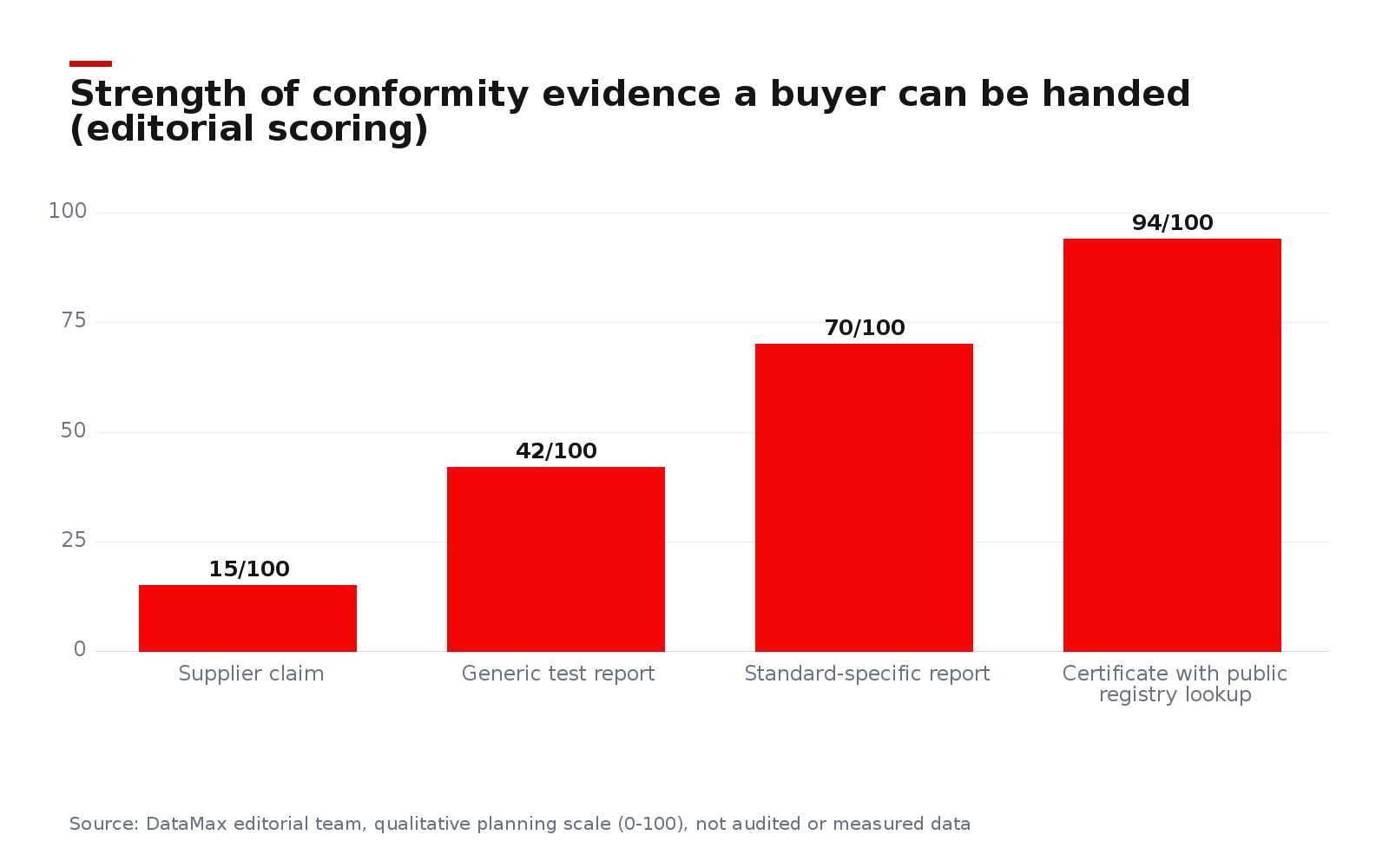
The same figures, in searchable form:
| Evidence option | Editorial score |
|---|---|
| Supplier claim | 15 |
| Generic test report | 42 |
| Standard-specific report | 70 |
| Certificate with public registry lookup | 94 |
The operator, the integrator and the venue
The evidence package should be shaped by the deployment owner, not by a generic sales request. An operator managing subscriber access usually needs a stable production configuration, a controlled model identity and a repeatable approval path for hardware revisions. An AV or IT integrator serving commercial venues may have more varied power, cable, mounting and peripheral configurations. A brand owner may change suppliers, logos or packaging without changing the electronics, but each change can still affect the controlled configuration.
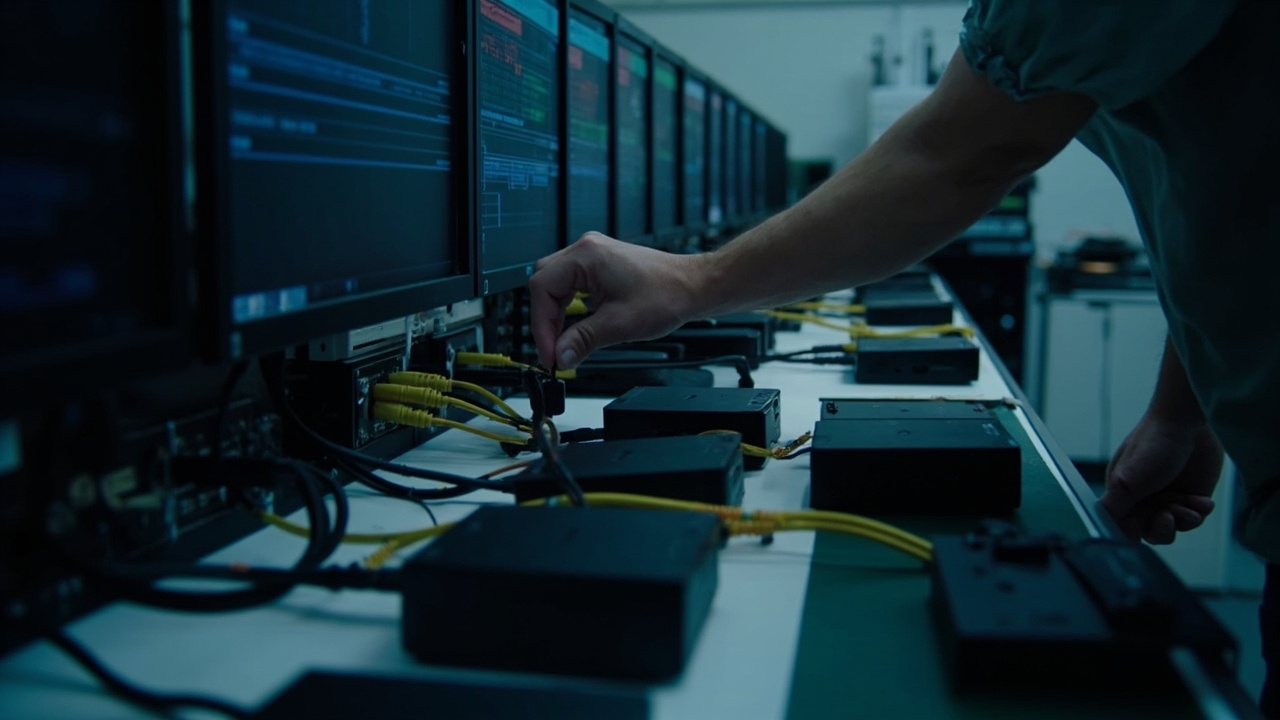
The following photo shows the type of engineering environment in which hardware and evidence controls should meet: a telecom laboratory bench with connected set-top boxes and active measurement equipment.
| Situation | Primary requirement | Model direction | Evidence focus |
|---|---|---|---|
| • Pay-TV or IPTV operator | Stable 4K set-top deployment with operator middleware | Direction: DM21P | Exact operator SKU, BOM revision and change notification |
| • OTT or white-label product | Current Android release and branded OTT configuration | Direction: DM21S | Brand-related BOM changes and report linkage |
| • Premium UHD or cloud-gaming program | 4K media capability and higher-memory configuration | Direction: DM21T | Configuration-specific evidence and production-site control |
| • Gaming-oriented Android TV program | 4K Android TV platform with 4GB / 64GB baseline | Direction: DM22Q | Approved-part list, optional Ethernet and accessory traceability |
| • Venue integrator | Port and connection match with controlled accessory set | Direction: select from the 4 supplied platforms after interface review | Power, cables, peripherals and installation BOM |
| • Brand owner | Supplier substitution control across product variants | Direction: model-specific evidence per production order | Revision, approval date, requalification trigger |
In the field, the useful answer to “latest” is a controlled status: the approved revision currently valid for the shipped configuration. Operators need an auditable model-to-document mapping. Integrators need accessory-level visibility because a compliant box can still be combined with an unverified power cord or peripheral. Venues need traceable maintenance stock, so the model label, hardware revision and evidence revision should remain linked through spare-unit deployment.
An operator should specify the middleware image and operator hardware revision in the release record, then require notification when either changes. This is a procurement control even though the RoHS evidence itself addresses materials: an operator image can identify the production unit, while the compliance file confirms its physical configuration. A mismatch between the two records should trigger review.
An integrator should create a deployment accessory list covering power adapters, cable sets, remotes and external tuners. Ask whether each accessory belongs to the ordered set-top configuration or is supplied separately, and identify which document covers it. This prevents a site rollout from combining a verified set-top box with an accessory outside the approved configuration.
A venue owner should preserve the hardware revision and evidence status with the maintenance inventory. When a replacement unit is installed, staff should record its serial identifier, model, hardware revision and shipment evidence status. If the model is DM21S or DM22Q, for example, the record should preserve the selected RAM/ROM and Ethernet option. This makes field replacement auditable instead of relying on an external label alone.
A brand owner should maintain a market-to-configuration matrix. The same platform can be ordered for multiple destinations, but the controlled evidence scope and destination requirement must remain distinct. Ask DataMax to state whether each market and option uses the same report revision or a separately approved document. The answer supports deployment planning without assuming that catalogue features define regulatory coverage.
Before approving a volume program, request the model-specific package and ask DataMax to confirm certificates and DRM/security provisions per ordered SKU. A video factory audit or a focused request for SMT/AOI and aging evidence can then test whether the documented control process exists on the line. This closes the gap between a file called the latest rohs report and the configuration physically leaving the factory.
Use the inquiry process to send the frozen configuration and evidence fields in one request. For sample validation, sample ordering can establish the physical configuration that the compliance evidence should cover. The engineering team should not approve a commercial configuration from a catalogue page when the ordered memory, Ethernet, power or accessory option remains unresolved.
Further reading
- Rockchip Android TV boxes
- Edge computing boxes
- 4K 60fps Android TV box guide
- Rockchip Android TV box guide
- Dolby Vision Android TV box guide
- DataMax DM21P specifications and fit
- DataMax DM21S specifications and fit
FAQ
How often is a RoHS report updated?
There is no universal update interval for every product. A revision may follow an applicable requirement change, customer-rule update, material substitution, supplier or production-site change, laboratory finding or internal review. The controlled trigger is better than a calendar assumption: the buyer should receive notice when the approved report revision changes or the covered configuration becomes invalid.
Does a RoHS report cover every Android TV box configuration?
Only when its scope and covered configuration match the ordered product. RAM/ROM options, power supplies, cables, peripherals, PCB revisions and branding may affect the material build. A platform-level declaration may provide supporting input, but the manufacturer must confirm applicability to the exact production SKU and current BOM.
Is a declaration of conformity the same as a laboratory report?
No. A declaration records a conformity determination and contractual position, while a laboratory report presents analytical results for a defined sample, method and date. A strong package may include both, plus material or homogeneity documentation and BOM traceability. Review each document separately rather than treating one title as proof of every control.
What should a buyer request for a custom TV box?
Specify the custom enclosure, power adapter, cables, remote-control electronics, PCB revision, Android build, memory configuration, destination market and production quantity in the RFQ. Require the manufacturer to identify which approved evidence covers each changed item and which new testing or formal review is required before shipment approval.
Can the supplier provide a generic RoHS certificate instead?
A generic certificate can support initial screening, but it cannot substitute for model-specific traceability when product construction differs. Verify the tested sample, legal basis, report revision, covered manufacturer and production site. Approval should remain on hold until the supplier maps the document to the exact ordered configuration.
When should a video factory audit be requested?
Request an audit when release depends on evidence that production follows the controlled BOM, particularly after supplier changes, new production sites or repeated document mismatches. The audit should inspect incoming-material controls, approved-part records, SMT and AOI evidence, product traceability, line-change authorization, aging records and final-release review.




