What the answer hinges on
A widespread belief in this category is that an android tv box is simply a lower-cost television receiver whose channel count can be increased by adding hardware. That is the wrong frame for a sports venue. Venue playback is a multi-zone AV system: each zone may need different content, entitlement rules, synchronization behavior, diagnostics, and recovery procedures, while the central network and operator platform must remain stable during a live event.
The decision-grade answer is to specify an android tv box by operating profile, not by processor alone. First define the number of physical output zones, concurrent decode sessions per unit, and whether those sessions share one downstream pipeline or originate from separate tuner or IP sources. Then define the required codec, DRM, output resolution, refresh rate, wired-network behavior, recovery policy, and remote-management path. A box used as a receiver for 1 zone and a box used as a local gateway for 8 zones must not be quoted as equivalent.
The second correction concerns synchronization. A low-latency presentation workflow can synchronize separate displays through a central video processor, IP multicast distribution, or another controlled clocking architecture. An ordinary TV box does not, by itself, guarantee frame-accurate synchronization across separate screens. Require the playback architecture to specify timing source, buffering policy, output pipeline, and monitoring method.
The third is concurrent-stream meaning. Multiple preloaded applications, background services, and simultaneous video decoders create different loads. Require a tested configuration for every active mode, including codec, resolution, frame rate, audio format, and DRM path. For broader ISP selection criteria, use the canonical guide to android tv box for ISPs, then return to this page for the venue-specific zoning and concurrency test.
A venue android tv box is therefore an operational endpoint, not merely a display accessory. Its procurement value lies in making the zone map, workload matrix, recovery ownership, and acceptance evidence explicit before a unit is ordered. The supplier review should demonstrate that the proposed configuration can remain stable across the expected operating interval, with the same firmware, regional settings, application bundle, and network conditions used during the event.
Questions to put in the supplier review
A supplier should be able to explain how it controls the variables that determine whether an android tv box survives a repeat-volume programme. Ask for evidence tied to the production configuration, not generic statements about quality management. The review should connect four activities into one traceable chain: SMT inspection, AOI, powered aging, and final audit.
- Define the frozen build Issue the exact SoC, Android branch, RAM/ROM combination, firmware identifier, application bundle, regional parameter set, and port configuration. Tie every inspection record to that build or revision.
- Inspect assembly Request SMT stencils, first-article records, AOI coverage, defect classifications, repair logs, and re-inspection evidence. Verify that inspections cover the PCB assembly rather than only final appearance.
- Power and age the units Ask for the duration, operating load, thermal conditions, network connection, video output, restart cycles, and sampling rule used during powered aging. A visual burn-in check alone is not equivalent to functional aging.
- Audit the finished unit Require checks for boot, firmware version, RAM/ROM visibility, storage, Ethernet, Wi-Fi, Bluetooth, HDMI output, audio interfaces, USB, tuner or upstream feed path, remote management, DRM state, and recovery behavior.
- Retain the evidence trail Request traceability from work order to serial number, with nonconformance, rework, retest, and release records. For audit purposes, sample units should remain identifiable against the production lot.
Evidence packet: ask the factory for an anonymized production record containing the frozen build identifier, AOI report, aging configuration, final functional-test result, defect disposition, and release sign-off. The packet should identify which steps were performed in-house and which were subcontracted.
For concurrency, the strongest evidence is a repeatable test matrix. One row should cover the intended live mode; another should cover the highest simultaneous decoder count; another should exercise menu navigation or secondary playback while the primary event continues. Record frame drops, audio-video synchronization behavior, thermal throttling, reboot rate, and application recovery time. “Supports 4K” is not a concurrency result.
A practical matrix has columns for unit count, stream count, source protocol, codec, resolution, frame rate, DRM state, audio type, network rate, duration, recovery action, and pass criterion. For a venue with 12 displays, the matrix must identify whether each display has a dedicated receiver, whether streams are mirrored, or whether several displays are driven by one downstream video processor. A test with 4 streams on 1 unit does not establish behavior for 4 units receiving 12 feeds.
The supplier should also explain sampling. State whether every unit receives the same functional checks, whether aging applies to every unit or a defined lot sample, and how failed units are segregated. The answer should identify the serial-number range, defect code, repair action, retest result, and release authority. If a subcontractor performs SMT, AOI, or aging, the factory must still provide the records and identify the subcontracted scope.
The android tv box acceptance test should be a controlled sequence, not a showroom demonstration. Use the intended network path, the intended media service, the actual display configuration, and the operational recovery procedure. Keep the evidence package linked to the event profile so that a later firmware, application, or hardware revision does not inherit an old result without qualification.
For a venue programme, request a video factory audit or a request for SMT/AOI/aging evidence specific to this topic from DataMax factory quality. Add the required uptime interval, event profile, and channel mix to the test brief. Those three inputs determine whether the result can be transferred from the bench to the event.
The comparison buyers actually make
Most venue comparisons divide proposals into an entry tier and a commitment tier, but the meaningful distinction is scope of validation. An entry configuration may satisfy ordinary single-zone reception with standard firmware management. A commitment configuration adds documented concurrency, thermal, synchronization, and production controls. Neither tier is automatically superior; the proposal must state what it proves.
| Evaluation line | Entry configuration | Commitment configuration | Buyer evidence |
|---|---|---|---|
| Zone topology | One managed display or a simple local distribution role | Multi-zone playback with explicit source, output, and control mapping | Logical topology and port assignment |
| Concurrency | Nominal processor capability | Defined stream count tested in the target codec and resolution | Frozen test matrix and results |
| Synchronization | Best-effort playback across independent outputs | Defined timing source and recovery behavior within the designed architecture | End-to-end timing test |
| Operations | Manual reboot and local diagnosis | Remote monitoring, staged configuration, and controlled recovery | Runbook plus management workflow |
| Production assurance | Functional sampling | Lot traceability, AOI, powered aging, and final audit | Serialized evidence packet |
| Programme change | Limited engineering adaptation | Documented firmware, middleware, and hardware change control | Change log and ownership matrix |
| Protected content | Optional feature label | Application, licence, display, and output path verified together | Service-level acceptance record |
| Network dependency | Wireless convenience assumed | Wired path, multicast behavior, and fallback documented | Network acceptance test |
| Field replacement | Swap-and-return process | Remote diagnosis, rollback, and replacement ownership defined | Service-level runbook |
The figure is a planning aid, not a supplier audit. A full-process OEM/ODM may score higher because it can coordinate engineering, sourcing, SMT, firmware, and production evidence, while a sourcing agent can still be the right commercial model for a buyer with strong internal controls. The key contractual question is who owns each failure. If the agent does not control firmware qualification or manufacturing records, the evidence must still be provided by the producing factory.

The same figures, in searchable form:
| Supplier type | Editorial score | Source context |
|---|---|---|
| General trader | 28/100 | DataMax editorial team, qualitative planning scale |
| Sourcing agent | 44/100 | DataMax editorial team, qualitative planning scale |
| Single-line factory | 72/100 | DataMax editorial team, qualitative planning scale |
| Full-process OEM/ODM | 89/100 | DataMax editorial team, qualitative planning scale |
A comparable quotation should also separate hardware cost from programme cost: unit configuration, firmware integration, certification, production test, packaging, spare units, field recovery, and engineering ownership. Without those lines, a lower hardware quotation can conceal a higher cost of ownership.
Where the terminology comes from
“Zone” describes a defined presentation area, but it does not specify the technical implementation. A zone can be one display, a group of displays driven through a video processor, a hospitality screen, a concourse cluster, or a service area. Before selecting an android tv box, map each zone to its source, decoder location, output path, audio path, and operator.
“Concurrent streams” describes simultaneous active workloads. It is not synonymous with installed application count, tuner count, or supported codec list. For example, four applications installed on one box may run only one protected 4K stream. Conversely, a multi-output appliance may decode several feeds but share one rendering or network resource. The procurement requirement should state the number of simultaneously protected or unprotected streams, their resolutions and frame rates, and whether secondary streams are full-motion video, audio-only, still images, or web views.
IPTV delivery commonly uses unicast or multicast. In multicast, a receiver joins an IP multicast group and receives traffic addressed to that group. In unicast, each session is delivered individually. The upstream access architecture, multicast proxying, IGMP behavior, and Wi-Fi or Ethernet preference can therefore affect venue performance. If wired Ethernet is required, specify it; do not treat Wi-Fi6 as an equivalent failover design without a network acceptance test.
DRM changes the validation burden. Widevine L1 and PlayReady are distinct licence systems, and HDCP 2.2 applies to the protected AV output path. A box can expose the required APIs yet fail a particular token, licence, display, or service-level check. Require the intended application, content service, account model, output device, and security architecture in the acceptance test.
Output language also needs precision. HDMI 2.0b is an interface version; resolution and refresh rate are separate capabilities. Codec support at 4K@60 does not imply every application, scale mode, display, or DRM path delivers that mode. Likewise, AI-SR is an image-processing feature, not evidence of 4K@120 output. The commercial requirement should separate source format, decode capability, rendering mode, protected-output path, and display capability.
Finally, Android is an operating-system layer, not the whole playback architecture. AOSP Android 11 and AOSP Android 14 identify the base software families in the product records, but middleware, drivers, firmware, apps, certificates, update policy, and device certification remain separate programme items. For a venue operator, the decisive questions concern recoverability, observability, and change control under live conditions.
The term “zone” also carries an operational meaning. A zone may be independently managed, mirrored from one source, or grouped for synchronized playback. The RFQ should say which. If the venue operator wants 6 hospitality screens to show the same feed, the design may use mirrored receivers or one decoded stream distributed by a video processor; if each screen shows different programming, each endpoint needs a distinct source or decoding resource. Confusing these cases changes network traffic, output count, control software, and recovery behavior.
For an android tv box used in a live-event workflow, define the boundary between the device and the AV system. State whether the box renders video, receives a rendered feed, or only controls another processor. State whether audio is embedded, extracted over S/PDIF, or sent over the network. State whether the box owns a clock or follows a house clock. These definitions prevent a software feature from being mistaken for an end-to-end capability.
Real DataMax platforms, field by field
The available DataMax L1 platforms cover different technical positions, but none should be represented as a venue concurrency solution without validation against the intended zone topology. The table below reproduces the supplied production facts only. Unstated capabilities remain “confirm against the production datasheet.”
| Model | SoC and OS | RAM/ROM | Decode and DRM | Connectivity and output |
|---|---|---|---|---|
| DM21P | Amlogic S905Y4, quad Cortex-A35; AOSP Android 11 | 2GB / 8GB; 4GB; 16/32/64GB optional | AV1 [email protected]; VP9/H.265 4K@60; H.264 4K@30; Widevine L1 / PlayReady / HDCP 2.2 optional | HDMI 2.0b out x1; USB2.0 x2; TF; S/PDIF; 3.5mm AV; RJ45 100M; Wi-Fi6 2x2 + BT5.4; DC 5V/2A |
| DM21S | Amlogic S905Y5, quad Cortex-A55; AOSP Android 14 | 2GB / 16GB; 2/4/8GB; 16/32/64GB optional | AV1 / H.265 [email protected] 4K@60; Widevine L1 / PlayReady optional; Dolby Vision/DTS | HDMI 2.0b out; S/PDIF; AV; USB2.0 x2; TF; RJ45 100M, 1G optional; Wi-Fi6 2x2 + BT5.4 |
| DM21T | Amlogic S905X5, quad Cortex-A510 (ARMv9); AOSP Android 14 | 4GB / 64GB family options | H.266/VVC [email protected] 4K@120; AV1/VP9/H.265 4K@120; AVS3 4K@120; H.264 4K@60; inline AI-SR; Widevine L1 / PlayReady optional | HDMI 2.0b out, no HDMI input; USB2.0 x1 + USB3.0 x1; TF; S/PDIF; AV; RJ45 100M, 1G optional; Wi-Fi6 + BT5.4 |
| DM22Q | Amlogic S905X5M, quad Cortex-A55 up to 2.5GHz; AOSP Android 14 | 4GB / 64GB; 2/4/8GB; 16/32/64GB optional | AV1/H.265 L5.1 4K@60; inline AI-SR; no NPU TOPS stated; Widevine L1 / PlayReady optional; Dolby Vision/DTS | HDMI 2.0b out; USB2.0 x2; TF; S/PDIF; AV; RJ45 100M, 1G optional; Wi-Fi6 2x2 + BT5.4 |
DM21P fits the stated 4K IPTV and operator-middleware set-top-box direction. Its optional HDCP 2.2 path matters when protected output is part of the acceptance scenario. DM21S targets the 4K white-label IPTV/OTT position and offers a newer Android base than DM21P. For both devices, network concurrency, simultaneous decoders, thermal limits, and certified Android TV capability are not stated in the supplied facts; confirm against the production datasheet.
DM21T provides the highest documented decode frame rates in this set and supports USB3.0, but its single HDMI output and stated absence of HDMI input constrain topology assumptions. The datasheet caps output and decode at 4K despite broader marketing language, so no 8K output claim should enter an RFQ or acceptance plan.
DM22Q is positioned for gaming-oriented use and includes 4GB/64GB as the stated base configuration. Its 4K@60 ceiling likewise rules out inferring 8K performance. Neither DM21T nor DM22Q establishes how many protected streams can run concurrently; confirm against the production datasheet and require a venue-specific stress test.
The port list must be read as a topology constraint, not merely a connectivity list. A model with one HDMI output can serve one direct display endpoint or feed another processor. It cannot independently drive 4 screens without an external distribution design. The 100M RJ45 entries support a defined wired path, while the optional 1G configurations on DM21S, DM21T, and DM22Q require the buyer to identify the fitted production variant rather than assume that every unit includes 1G.
When an RFQ compares the platforms, use the fields that can change the engineering decision: operating-system family, decode format and frame rate, DRM configuration, output count, wired-network option, and storage option. Do not infer GMS, EDLA, certified Android TV status, thermal ratings, or concurrent decoder limits from those fields. Each remains a separate evidence request. DataMax can provide the production datasheet and configuration evidence, but a venue claim requires the actual test record.
Buyer situations, ranked by what they punish
Venue buyers encounter different failure patterns. The ranking below is qualitative: it identifies which requirement receives the first line of scrutiny, not measured reliability data. Operators tend to punish loss of platform control; integrators punish topology ambiguity; broadcast and rights owners punish protected-playback failure; and secondary venues punish recovery time.
| Situation | Primary requirement | What the quotation must prove | Model direction |
|---|---|---|---|
| Pay-TV or IPTV operator | Managed device lifecycle and middleware integration | Provisioning, firmware control, remote recovery, and serial traceability | Start with DM21P or DM21S; confirm operator middleware and concurrency |
| AV integrator | Defined display, audio, and source topology | Port mapping, EDID handling, output mode, network path, and synchronization boundary | DM21S for standard 4K distribution; DM21T when 120 Hz decode evidence matters |
| Sports rights owner | Protected content under the event workload | DRM token flow, licence behaviour, output path, and simultaneous playback | DM21P or DM21S, subject to DRM and service acceptance |
| Premium hospitality venue | Output quality and low visible disruption | Native versus processed picture mode, audio format, recovery, and peripheral integration | DM21T for documented high-frame-rate decode; confirm display compatibility |
| Gaming-oriented venue | Latency, control latency, and sustained workload | Game stream format, input path, network conditions, and thermal behavior | DM22Q; validate input and latency because they are not stated facts |
| Secondary or distributed site | Remote recovery and consistent provisioning | Management connectivity, rollback procedure, and unattended restart behavior | Use an operator-oriented platform only after remote-management proof |
An operator’s first risk is often management. If firmware, middleware, or configuration ownership is unclear, a venue may receive units that pass a demonstration but cannot be diagnosed after deployment. The RFQ should name the management plane, enrollment process, remote-log procedure, application update policy, and rollback authority.
An integrator’s first risk is topology. A single HDMI output may suit a receiver role but not a multi-zone design assumed by the integrator. Multi-screen synchronization should be assigned to a defined video-processing layer rather than implied from several independent boxes.
A rights owner’s first risk is rights protection. Dolby Vision, DTS, Widevine L1, PlayReady, and HDCP 2.2 must be tied to the actual application, display, receiver, and licence service. Optional labels require confirmation in the production configuration.
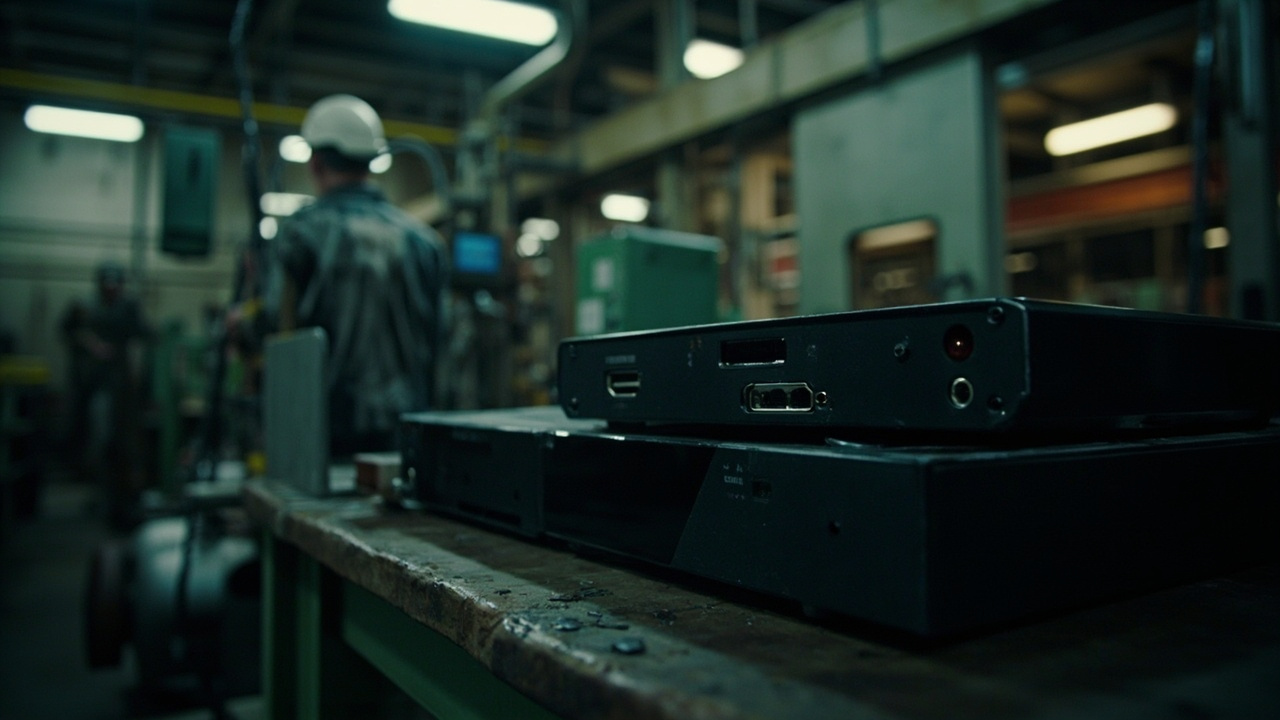
Bring the real deployment environment into the test bench rather than relying on a product-page inference.

The scene represents the required acceptance environment: multiple units connected through HDMI and network paths, monitored with controlled media, and tested for reboot, application recovery, and sustained playback. For a 12-zone example, validate the network switch, cabling plan, multicast or unicast delivery, and display grouping as one system; the box specification alone cannot prove venue behavior.
A venue integrator should test the android tv box with the same number of units and displays proposed for deployment. If the architecture uses 1 unit as a source and 12 displays downstream, test that source’s network load, HDMI compatibility, EDID behavior, and restart recovery. If it uses 12 receivers, test the switch uplinks, multicast traffic, simultaneous licence flows, and the time required to restore service after one unit fails. The two designs have different bills of materials and different failure domains.
The procurement consequence is clear. A model direction is useful only when it is attached to a topology and a test. DM21P or DM21S can be considered for operator-managed IPTV workflows; DM21T can be considered when the documented high-frame-rate decode profile matches the display requirement; DM22Q can be considered for gaming-oriented workloads. The final venue model remains subject to the production datasheet and an acceptance record.
A decision path for the RFQ
Start with the venue architecture, not the model list. Write a one-page topology that names each zone, screen count, source, audio route, network switch, control method, and recovery owner. This prevents a processor from being selected for a role the hardware will not perform.
The workload matrix should quantify streams, not adjectives. For each operating mode, enter source type, codec, resolution, frame rate, DRM, audio, and whether the stream is live, delayed, or preloaded. Add the number of units in the venue, not only the number of streams per unit. A 4-zone design may use four receivers, one gateway plus downstream displays, or another topology; each architecture has different failure behavior.
Next, issue the RFQ with lines the bidder must answer. Suitable lines include:
- “State the exact model, SoC, Android version, RAM/ROM configuration, firmware identifier, and any optional hardware fitted.”
- “Define maximum simultaneous active streams by codec, resolution, frame rate, DRM state, and audio mode.”
- “Identify the HDMI output count, Ethernet speed, wireless standard, audio outputs, USB configuration, and input capability.”
- “Describe the end-to-end synchronization boundary, including the timing source and whether external video processing is required.”
- “Provide the remote provisioning, monitoring, restart, rollback, and log-retrieval procedure.”
- “State the production test flow, including SMT, AOI, powered aging, final functional test, sampling, and lot traceability.”
- “List Android, GMS, EDLA, Widevine, PlayReady, HDCP, Dolby, DTS, and regional certification status for the exact build.”
- “Quote acceptance criteria, failure ownership, spare-unit policy, and the process for hardware or firmware revision.”
Turn the matrix into acceptance clauses. For example: “During the 4-hour event-profile run, the proposed configuration shall sustain the stated protected 4K streams with the specified secondary application active; any frame drop, application lock-up, or unrecovered reboot shall be recorded against serial number.” A clause of that form creates an objective result without pretending that a generic processor claim is a venue guarantee.
The sequence should also include a network acceptance step. Test the actual switch, cabling, multicast or unicast origin, DNS, authentication, and device-management path. Then test the display path with the intended EDID, audio route, and output mode. Finally, run the operational response test: remove a unit, restart an application, apply the stated recovery procedure, and record the restoration result.
Use the model facts to identify plausible starting points, not to complete unanswered fields. DM21P is the operator-middleware candidate; DM21S fits the white-label 4K direction; DM21T offers the documented high-frame-rate decode set; and DM22Q addresses the gaming-oriented direction. Any concurrent-stream limit, certified Android TV status, thermal envelope, or venue synchronization role must remain an open line until the production datasheet and test results support it.
Complete a pilot with the hardest credible workload. Run the live event feed through the intended network path, maintain secondary zones, exercise audio, record reboot and recovery behavior, and inspect thermals over the expected operating interval. Commercial release should depend on that pilot rather than a standard demonstration clip.
DataMax can support an engineering review through its manufacturer capability or an RFQ discussion. The useful request is a configuration mapping and acceptance-test review, not a generic product recommendation. Sample evaluation is available through sample ordering for the selected test protocol.
The traps in this category
The first trap is treating “zone” as an output specification. A quotation that says “supports 8 zones” without defining whether each zone is an independent display, a processor-fed display group, an application tile, or an IP multicast endpoint has not priced the system. A mismatch can add external video processors, network infrastructure, licences, or control software after award.
Field trap
“Concurrency: 4 streams” is incomplete unless the row states 4K or 1080p, frame rate, codec, DRM state, audio mode, network conditions, and whether another application remains active. The cost of getting this wrong is an architecture redesign after installation, because the firmware and display pipeline may not support the assumed workload.
The second trap is treating synchronization as a property of the television box. Independent displays can show the same event but drift relative to one another because their playback clocks or paths differ. Define whether synchronization is required across zones, within a display wall, or only at the source. If it is required, specify the external synchronization mechanism and acceptance measurement. Otherwise, remove the word “synchronized” from the quotation.
Field trap
Optional DRM and display features can create a false assumption of readiness. A proposal may list Widevine L1, PlayReady, HDCP 2.2, Dolby Vision, or DTS without confirming the exact build, application, display, receiver, licence flow, or production option. The commercial cost is failed acceptance or an unavailable protected stream during the event.
Watch the difference between hardware evidence and programme evidence. An AOI report supports assembly inspection; it does not prove sustained decoding. A powered-aging log supports thermal and functional exposure; it does not prove remote recovery. A codec list supports candidate capability; it does not prove concurrent throughput. Require one document per claim and name the test method behind it.
Another trap is confusing a device specification with an Android certification scope. AOSP Android 11 or AOSP Android 14 identifies the supplied operating-system family. It does not by itself prove that a particular unit has the intended GMS, EDLA, Widevine, PlayReady, HDCP, Dolby, DTS, or regional certification status. Put the exact build and application on the acceptance record.
Finally, quotations often omit the failure owner. Ask who replaces a failed unit, who diagnoses an application lock-up, who approves firmware changes, and who validates a revised model. Confirm against the production datasheet for every hardware detail, and require a video factory audit or SMT/AOI/aging evidence through DataMax factory-quality review. A venue box that works only under laboratory conditions is not a finished venue product.
Further reading
- Guide android tv box for isps
- AOSP Android TV boxes
- H.265 HEVC Android TV box guide
- Widevine L1 certification guide
- Dolby Atmos Android TV box guide
- DataMax DM21P specifications and fit
- DataMax DM21S specifications and fit
FAQ
How many zones should one android tv box support?
Do not derive zone capacity from processor specifications alone. Define whether a zone means one display, a display group, a multicast endpoint, or an application tile, then map sources and outputs. Require a topology showing where each stream is decoded and how it reaches the display. A box with one HDMI output cannot independently drive several displays; an external video processor may be required.
Can one box decode multiple live sports streams concurrently?
Possibly, but only a target-specific test can establish the limit. The RFQ must name simultaneous stream count, codec, resolution, frame rate, DRM status, audio mode, network conditions, and secondary application activity. Validate sustained playback, thermal behavior, frame drops, and recovery. The supplied DataMax model facts do not state venue-grade concurrency limits.
Which DataMax model is best for sports venues?
There is no single selection from the supplied facts alone. DM21P fits operator middleware, DM21S fits white-label IPTV/OTT, DM21T provides the highest documented decode frame rates, and DM22Q targets gaming-oriented deployments. The correct choice follows the zone map, workload matrix, DRM path, and management requirement. Confirm availability and all production details against the production datasheet.
Does Wi-Fi6 remove the need for Ethernet in a venue?
Not automatically. Multicast traffic, protected streams, recovery transfers, and large software updates can behave differently over a managed wired network than over Wi-Fi. If the design permits Wi-Fi, specify RF survey, channel plan, roaming or AP capacity, and a wired fallback test. If Ethernet is mandatory, require RJ45 100M or the optional 1G configuration to be fitted and verified.
What evidence should a venue buyer request from the factory?
Request traceability from the frozen build to serial number, plus SMT inspection, AOI, powered-aging configuration, final functional-test results, nonconformance disposition, and release records. For zone and concurrency claims, also request the workload matrix, test method, duration, and failure criteria. These records should distinguish factory-controlled processes from subcontracted activities.
How should an android tv box be tested before deployment?
Use the intended network, media service, display, audio, and management paths. Run the hardest credible workload, record frame drops, audio-video synchronization behavior, thermal throttling, reboot or lock-up events, and recovery time. Test the failure path as well as normal playback. A demonstration clip cannot establish venue acceptance, and a product-page codec list cannot establish concurrency.
Can a single unit drive every screen in a stadium?
Only if the architecture assigns that role to the unit and provides the required distribution and synchronization. A one-HDMI-output device normally serves one direct endpoint or feeds another processor; multiple independent displays require a defined downstream topology. The RFQ should identify the decoder location, distribution layer, timing source, network path, and recovery owner for every display group.