

What the answer hinges on
The widespread belief is that a Verimatrix reference attached to an android tv box is itself proof of RoHS compliance. That is incorrect. A Verimatrix reference identifies a specific evaluation report or test item; it does not automatically certify every production SKU, every component change, or every unit leaving the factory. For procurement, the decisive issue is the document chain: supplier identity, exact model and hardware revision, applicable RoHS substance limits, laboratory accreditation or recognition, issue and revision dates, sample configuration, covered components, and linkage to the units being purchased.
This distinction matters because an android tv box can contain several boards, power supplies, cables, packaging, coatings, solders, and plastic parts. A report covering one assembly revision does not automatically cover a later mainboard, power adapter, enclosure material, or supplier substitution. The correct frame is “model-and-revision evidence.” The buyer needs documentary traceability from the ordered configuration back to the test evidence, with changes re-evaluated through a controlled process.
The title’s mention of Switzerland should also be treated precisely. Without the supplied report and source record, the laboratory’s country, accreditation scope, and report authenticity cannot be inferred from the brand name or a copied document. Confirm the issuing laboratory, its current status, and the exact report against the production datasheet and original source. DataMax should provide the ordered SKU’s compliance dossier, not a generic page image. For the wider operating context, see the canonical android tv box guide for ISPs; this article concentrates on Verimatrix, RoHS, laboratory evidence, and revisions.
The short answer is therefore conditional on evidence, not on the appearance of a laboratory logo. For an android tv box, acceptance should require four links: the report identifies the tested configuration; the laboratory can be authenticated; production records correspond to that configuration; and any later change has an approved revalidation. If any link is absent, the buyer has a supplier claim rather than complete conformity evidence. This distinction also determines which documents to request first, which factory controls to inspect, and whether a quotation should be compared by the model family or by the exact ordered SKU.
Questions to put in the supplier review
A RoHS review should test the manufacturing control system, not merely request a PDF. Use the following evidence sequence:
- Identify the exact build Request the legal manufacturer, factory address, model designation, mainboard part number, hardware revision, and ordered component configuration. A commercial name alone is insufficient.
- Trace the laboratory record Obtain the original Verimatrix-labelled report, test-item references, laboratory identity, report number, issue date, revision history, accreditation or recognition details, and the issuing laboratory’s current public registry entry.
- Map material declarations Ask for the RoHS declaration covering homogeneous materials, declarations of compliance, material composition evidence, and the list of restricted-substance test methods.
- Verify manufacturing controls Request SMT stencil and solder records, AOI inspection criteria, component traceability, approved-vendor-list controls, incoming-material inspection, and deviation handling.
- Close the revision gap Require written notice and revalidation rules for mainboard, firmware, power supply, enclosure, cable, or material changes before shipment approval.
- Confirm release evidence Bind the certificate, report, factory location, SKU, and shipment records through a unique document or batch reference.
A useful supplier questionnaire should request evidence “issued to” or “covering” the production configuration, not merely documents “similar to” the submitted sample. Ask whether the report identifies RoHS testing against applicable substance restrictions, what sample quantity was used, which material categories were covered, and what exclusions exist. Also request the declaration’s controlled revision number and a change log.
For a procurement example, suppose an operator orders 10,000 units with the DM21P, AOSP Android 11, 2GB / 8GB, optional Widevine L1 / PlayReady, HDCP 2.2 optional, a 100M RJ45, and a specified external power supply. The compliance request should identify every one of those selections where they affect the delivered object, but it must not treat optional DRM as an automatic configuration. The quotation should state whether HDCP 2.2 and either DRM option are populated, and the evidence file should identify the relevant commercial SKU rather than merely the DM21P family name.
Review record
Store the model, hardware revision, report number, laboratory, issue date, revision date, sample configuration, approved-vendor-list version, component-substitution rule, and approver in one conformity matrix. A change in any linked field should reopen the evidence review.
Production controls require separate attention. SMT records show what was placed; AOI detects assembly defects but does not establish material compliance; burn-in or aging can expose thermal and stability failures; audits confirm process execution. None replaces a valid RoHS declaration and laboratory report. The evidence must connect supplier declarations, incoming inspection, board assembly, and final release.
For board revisions, request a side-by-side comparison that identifies the tested sample and current production item. Include the mainboard revision, power-supply model, housing material, cable set, solder, conformal coating, adhesives, inks, and packaging. If the supplier changes an enclosure supplier but says the enclosure remains “the same color,” that response does not close the conformity question. The buyer needs a documented assessment stating whether the change affects material identity, restricted-substance declarations, test applicability, or production traceability.
For SMT evidence, a video audit should show reels or lot labels being reconciled to the approved-vendor list, AOI criteria applied to the relevant board revision, and non-conforming parts physically segregated. For aging evidence, request defined test conditions, duration, sample quantity, observed failures, and the disposition of failed units. These records establish process execution; they do not infer laboratory results that were never issued.
Before accepting files, request a video factory audit through DataMax factory quality, with particular attention to SMT, AOI, aging, material segregation, and document revision control. The auditable question is whether the factory can prevent an unapproved material or board substitution from reaching production.
The comparison buyers actually make
The practical comparison is not “RoHS report present” versus “RoHS report absent.” It is the difference between a commercial claim, a generic test report, a standard-specific report, and a certificate whose issuer can be checked in a public registry. The evidence ladder below ranks documentary strength for planning purposes.
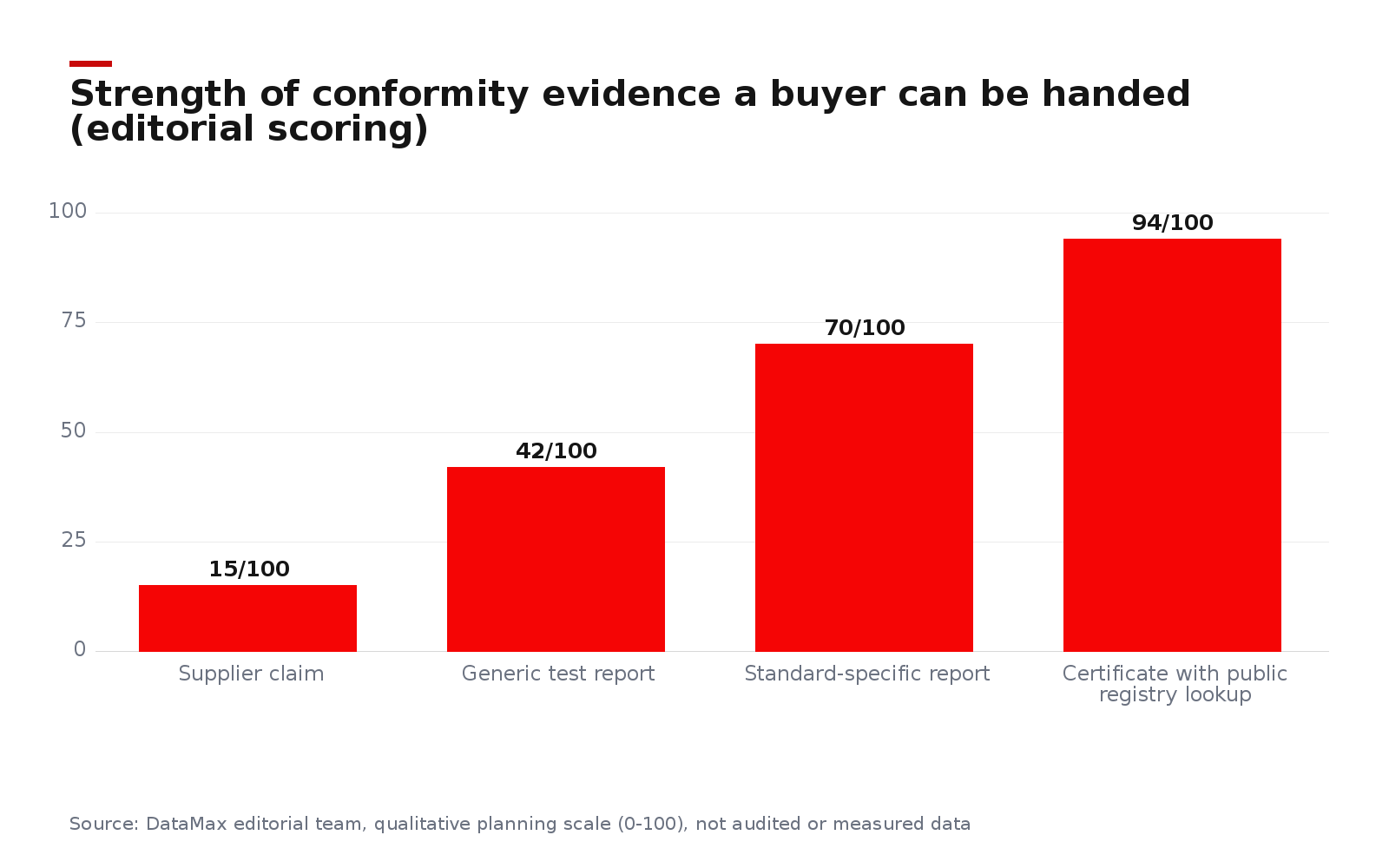
The same figures, in searchable form:
| Evidence option | Editorial score |
|---|---|
| Supplier claim | 15/100 |
| Generic test report | 42/100 |
| Standard-specific report | 70/100 |
| Certificate with public registry lookup | 94/100 |
A supplier claim can state compliance but gives the buyer little independent verification. A generic report may describe testing without clearly identifying the regulatory scope, sample, or production linkage. A standard-specific report improves traceability when it names the applicable requirement and test method. A certificate with a public registry lookup offers a further verification route, provided the certificate number, holder, scope, and validity are checked.
For each quotation, compare seven lines: SKU identity, hardware revision, report title, laboratory identity, laboratory status, declaration revision, and change-control commitment. Then compare commercial commitments: sample availability, audit access, document timing, corrective-action process, and responsibility for a failed shipment. Do not let a higher document score conceal an uncovered material or a factory that cannot freeze changes.
| Evaluation point | Entry position | Commitment position | Buyer check |
|---|---|---|---|
| Model identity | Commercial family name | Ordered SKU and factory part number | Reject family-only matching |
| Revision | “Latest” report | Controlled revision map | Compare board, BOM, and accessories |
| Laboratory record | PDF cover image | Original report and registry lookup | Verify issuer and scope |
| Factory control | Policy statement | Lot traceability, SMT and AOI records | Request production-period evidence |
| Change management | Notice after shipment | Pre-shipment approval and revalidation | Define responsible party and deadline |
| Release control | Goods linked loosely to certificate | Shipment or batch linked to accepted revision | Specify shipment-release record |
| Remedy | Generic replacement request | Containment, correction, and responsibility | Write into purchase terms |
The entry and commitment positions are not different technical standards. They are different levels of contractual specificity. An entry-level quotation may be suitable for initial engineering evaluation if the buyer reserves a pre-production evidence audit. A commitment-level quotation is needed for fleet release, tender submission, or a programme where component substitutions are likely.
A practical scoring sheet should keep one column for documentary evidence and another for manufacturing execution. A laboratory report can score highly in the first column while the factory remains weak in the second. Conversely, a disciplined incoming-material and change-control system can strengthen the release chain but cannot replace the report. The procurement decision should therefore reject any single substitute for the combined model-revision-process review.
A laboratory logo or Verimatrix-branded cover can be copied across documents. Match the report number, revision, covered sample, and laboratory registry record. Treat an unverifiable image as a claim, not evidence.
Where the terminology comes from
RoHS is the restriction of hazardous substances in electrical and electronic equipment. Its technical value comes from substance limits applied to homogeneous materials, supported by material declarations and laboratory analysis. Buyers often collapse three distinct objects into one document: the declaration of compliance, the test report, and the production configuration record. Each answers a different question.
A declaration states that the manufacturer believes the product complies with the identified requirements. A laboratory report records methods, samples, results, and sometimes limits, but it is evidence about the tested configuration rather than a universal authorization. The production record establishes which mainboard, power supply, enclosure, cable, and materials were actually used when the shipped configuration was released.
The Verimatrix reference must therefore be read in its original document context. Determine what the document is called, which entity issued it, whether it is a report, certificate, summary, or declaration, and whether the report number resolves to the claimed laboratory record. “Switzerland” should not be used as a substitute for accreditation or recognition evidence. Check the issuing body’s current status in the relevant public registry and confirm that its recognition scope covers the test performed. The laboratory’s location, report ownership, and legal manufacturer may differ.
A compliant evidence architecture follows this chain:
The hardware revision is central. A “Rev 1.0” label may be insufficient if the board has been reworked without a controlled revision number. Request a bill-of-materials comparison between the tested sample and the production release, including solder, conformal coating, adhesives, inks, plastics, metals, and external power supply. Firmware revision ordinarily does not change material composition, but an OS or platform revision may change the commercial SKU and bundled accessories; confirm whether the compliance file follows those changes.
Avoid terminology that overstates the mechanism. A “RoHS test report” does not mean that every substance in every component was identified. A “certificate” does not transfer from a vendor to every downstream product. A “revision” does not mean an unchanged document if its technical scope changed. The buyer should verify what changed, who approved it, and which production units it covers.
Terminology also needs control at the document level. “Verimatrix” can identify a programme, service, test item, or referenced document depending on the record. The buyer should not call it a Verimatrix certificate unless the object itself is a certificate and the holder, scope, and registry route are shown. Likewise, a laboratory’s name, location, and recognition status are separate attributes. A Swiss address supports a location claim; it does not prove the test method is within the laboratory’s current recognized scope.
An example makes the distinction concrete. A test report may identify a polymer enclosure sample and a separate lead sample from a printed circuit board. The production record must show that the released enclosure and board correspond to those samples or to material declarations supporting the same outcome. If the enclosure supplier changes, the new supplier’s material declaration becomes necessary even when the enclosure shape remains unchanged. That is why material identity and part traceability matter more than visual similarity.
For firmware and operating-system changes, separate configuration control from material conformity. AOSP Android 11 and AOSP Android 14 platforms can have different software release processes without creating a material change. However, a new firmware image, bundled remote, revised power adapter, updated retail package, or different enclosure can affect the commercial SKU or delivered object. The compliance record and purchase specification should state which changes are material, which are software-only, and which require documentary reassessment.
Real DataMax platforms, field by field
The product facts below define the available DataMax platforms; they do not establish a Verimatrix-labelled RoHS report for each model. Request the compliance dossier against the production datasheet for the ordered SKU, including any bundle-specific power supply, cable, remote control, packaging, and enclosure. Never infer report coverage from the model family.
| Field | DM21P | DM21S | DM21T | DM22Q |
|---|---|---|---|---|
| Intended fit | 4K IPTV / operator middleware set-top box | 4K Android TV box for IPTV/OTT white-label | Premium UHD / cloud-gaming box | Gaming-oriented Android TV box |
| SoC and CPU | Amlogic S905Y4, quad Cortex-A35 | Amlogic S905Y5, quad Cortex-A55 | Amlogic S905X5, quad Cortex-A510 (ARMv9) | Amlogic S905X5M, quad Cortex-A55 up to 2.5GHz |
| OS | AOSP Android 11 | AOSP Android 14 | AOSP Android 14 | AOSP Android 14 |
| RAM/ROM | 2GB / 8GB (4GB; 16/32/64GB optional) | 2GB / 16GB (2/4/8GB; 16/32/64GB optional) | 4GB / 64GB (family options) | 4GB / 64GB (2/4/8GB; 16/32/64GB optional) |
| Decode | AV1 [email protected], VP9/H.265 4K@60, H.264 4K@30 | AV1 / H.265 [email protected] 4K@60 | H.266/VVC [email protected] 4K@120, AV1/VP9/H.265 4K@120, AVS3 4K@120, H.264 4K@60; inline AI-SR | AV1/H.265 L5.1 4K@60; inline AI-SR (no NPU TOPS stated) |
| DRM | Widevine L1 / PlayReady / HDCP 2.2 optional | Widevine L1 / PlayReady optional; Dolby Vision/DTS | Widevine L1 / PlayReady optional | Widevine L1 / PlayReady optional; Dolby Vision/DTS |
| Ports and connectivity | HDMI 2.0b out x1, USB2.0 x2, TF, S/PDIF, 3.5mm AV, RJ45 100M, Wi-Fi6 2x2 + BT5.4, DC 5V/2A | HDMI 2.0b out, S/PDIF, AV, USB2.0 x2, TF, RJ45 100M (1G optional), Wi-Fi6 2x2 + BT5.4 | HDMI 2.0b out (no HDMI in), USB2.0 x1 + USB3.0 x1, TF, S/PDIF, AV, RJ45 100M (1G opt), Wi-Fi6 + BT5.4 | HDMI 2.0b out, USB2.0 x2, TF, S/PDIF, AV, RJ45 100M (1G opt), Wi-Fi6 2x2 + BT5.4 |
The DM21P is positioned for 4K IPTV and operator middleware set-top-box deployments. Its quoted configuration is AOSP Android 11 with 2GB / 8GB, expandable storage options, Widevine L1 / PlayReady, optional HDCP 2.2, and a 100M RJ45. These are platform facts, not substitutes for a SKU-specific compliance record.
The DM21S targets 4K IPTV/OTT white-label programs and moves to AOSP Android 14 with 2GB / 16GB. Its listed decoding is AV1 / H.265 [email protected] 4K@60, with Widevine L1 / PlayReady and Dolby Vision/DTS marked optional. The optional status must be reconciled with the actual quotation before evidence is assessed.
The DM21T covers premium UHD and cloud-gaming use with Amlogic S905X5, 4GB / 64GB, and the broadest listed decode set, including H.266/VVC [email protected] 4K@120 and AVS3 4K@120. Its datasheet caps output and decoding at 4K; do not claim 8K output.
The DM22Q targets gaming-oriented deployments with Amlogic S905X5M, 4GB / 64GB, and AV1/H.265 L5.1 4K@60. Its datasheet maximum is 4K@60 despite any live-name 8K wording. Inline AI-SR is stated, but no NPU TOPS figure is provided.
For compliance mapping, the same RFQ should freeze more than the model name. DM21P and DM21S differ in SoC, OS, listed memory configuration, and some connectivity or feature options. DM21T and DM22Q use different listed SoCs and differ in decode limits and interface details. Any of those configurations can create a different production item that must be matched to its evidence. RAM and ROM selection, network option, DRM population, cable set, power supply, enclosure, packaging, and remote can also affect the delivered configuration.
The table does not provide dimensions, cellular options, ingress ratings, or compliance-file identifiers because none are included in the supplied product facts. Those fields must be confirmed against the production datasheet. A buyer should not infer that the two white-label-oriented models share the same compliance record, or that a laboratory report for one chipset automatically extends to another chipset within the same family.
For initial sample planning, ask DataMax samples to identify the production revision and bundle associated with each sample. Then request the matching dossier before the sample becomes a golden unit. If engineering modifies the enclosure, board, power adapter, or accessories, the sample approval should not be treated as covering the modified output. A separate engineering-change record should state which documentary fields require reopening.
Buyer situations, ranked by what they punish
Different procurement situations punish different documentation failures. The ranking below reflects editorial prioritization for RFQ planning, not measured deployment performance.
| Situation | Requirement that is punished if missing | Platform direction |
|---|---|---|
| • IPTV operator deployment | • Stable operator middleware, exact SKU/revision traceability, controlled component changes | • DM21P for operator middleware; DM21S for white-label OTT |
| • AV integrator project | • HDMI and output-path confirmation, accessory scope, revision-matched enclosure and cable evidence | • DM21S for common 4K integration; DM21T when the required decode path reaches 4K@120 |
| • Gaming or cloud-gaming venue | • Display-path capability, storage configuration, thermal/aging evidence, accurate resolution claims | • DM21T or DM22Q, selected by decode and interface requirements |
| • White-label distributor | • Traceable labels, packing-list identity, carton and accessory documentation, revision freeze | • DM21S with a frozen production configuration |
| • Regulatory or tender submission | • Original laboratory record, issuer verification, certificate holder and scope | • Any platform only after the exact ordered configuration is documented |
An IPTV operator is likely to punish silent board or component changes because field failures affect a managed fleet. Its supplier review should emphasize revision freeze, approved-vendor controls, traceability from incoming inspection to shipment, and firmware configuration management. The product platform alone cannot resolve those operational controls.
An AV integrator is likely to punish accessory and output-path ambiguity. A compliance report may cover the set-top box while excluding the external power supply, HDMI cable, remote control, stand, or packaging. The RFQ must define the delivered kit and request coverage boundaries. For AVS3, H.266/VVC, high-frame-rate decode, or specific display integration, verify the exact DM21T configuration against the production datasheet.
A gaming venue is likely to punish thermal instability, storage mismatch, and overstated resolution. Aging evidence should include sustained operation and representative loading, while RFQ wording must not infer an NPU metric that is not stated. The DM22Q’s 4K@60 datasheet ceiling should remain explicit.
A photograph of an SMT line can orient the audit, but it cannot prove material compliance. The real scene is a bright electronics factory where pick-and-place machines populate black printed circuit boards before inspection, traceability, aging, and release.

For a tender, the buyer should request original evidence and registry verification from DataMax. Documentary discipline often matters more than choosing a more elaborate platform designation.
The operator case also exposes a software-versus-material boundary. Firmware release management belongs in the device lifecycle plan, while the RoHS file remains attached to the physical production configuration. A firmware image does not silently replace a board or adapter. Conversely, a board revision that is intended only to improve firmware compatibility still needs a controlled identity because the physical evidence map may have changed.
For a distributor, packaging can become the visible configuration controlled by the channel. The carton, labels, manual, remote, power adapter, and HDMI cable may travel independently from the unit. The compliance request should identify which items are in the shipment and which are buyer-supplied. Without that distinction, a laboratory report covering the set-top box cannot be used to claim that every item in the delivered carton was assessed.
A decision path for the RFQ
Turn the compliance question into a sequence that prevents a catalogue assumption from becoming a contractual mistake.
Pasteable RFQ lines should be specific:
“Conformity evidence shall identify the ordered model, RAM/ROM configuration, hardware revision, power supply, bundled accessories, and factory. The supplier shall provide the original RoHS declaration and applicable laboratory report, including report number, revision history, tested sample scope, laboratory identity, and current recognition status.”
“The supplier shall maintain controlled SMT, AOI, incoming-inspection, approved-vendor, and aging records. Any change to mainboard, component, solder, coating, adhesive, enclosure, cable, or power-supply revision shall require advance notification and documentary revalidation before shipment.”
“Production release shall be traceable to the accepted configuration and compliance revision. The buyer reserves the right to request a video factory audit and to withhold acceptance where the evidence chain does not match the released goods.”
These lines should be completed with the destination market and the applicable contractual evidence list. “Current report” is too vague; “report number, revision date, covered model, sample description, laboratory, and covered materials” is actionable. If the buyer wants access to laboratory records, the request should identify the records and verification route rather than rely on the supplier’s summary.
A platform decision should follow the compliance definition, not precede it. First establish whether the evidence applies to the intended model and bundle. Then confirm whether optional DRM and connectivity selections match the production record. After that, compare the technical fields needed by the deployment. For an operator middleware programme, DM21P is the stated fit. For an IPTV/OTT white-label programme, DM21S is the stated fit. DM21T fits premium UHD or cloud-gaming requirements where the listed 4K@120 decode paths are relevant. DM22Q fits gaming-oriented work with its listed 4K@60 ceiling.
The RFQ should include a sample-to-production gate. The sample must carry a serial or lot identifier; engineering signs the hardware, software, accessory, and packaging configuration; compliance reviews the documentary mapping; and the production release record must identify the accepted baseline. Any approved engineering change should update the golden-unit record and compliance matrix. This avoids a common sequence in which the sample is approved, the enclosure changes, and production continues without determining whether the old report remains applicable.
For a second-source or transfer of production, add a continuity clause. The receiving factory needs the same revision map, approved-vendor rules, incoming-inspection controls, and release records. Moving an android tv box programme between factories does not make the supplier claim adequate. The buyer should require an equivalence assessment for the board, power supply, enclosure, cable, and packaging, followed by the evidence update required by that assessment.
Select the platform only after the evidence is defined. Review DataMax manufacturing and custom development only after confirming the base SKU and revision rules. A customization request should identify which changes are software-only and which affect the physical compliance file.
The traps in this category
The first trap is treating a Verimatrix-labelled PDF as self-authenticating. A report can be genuine while covering the wrong model, an earlier revision, or only a sample. The second is assuming that “Swiss lab” proves current competence for every method. Verify issuer identity and registry scope.
Field trap 1
Reject any evidence request that omits the hardware revision. A report without revision traceability cannot be mapped reliably to a production android tv box, and a mismatch can trigger detention, rework, or unsupported regulatory declarations.
A third failure mode is scope collapse. The enclosure, PCB, solder, coating, power adapter, HDMI cable, and packaging may come from different suppliers. If only one assembly was tested, the declaration’s scope must state that plainly. Ask for a bill-of-materials mapping rather than accepting “all components compliant” without a source.
Field trap 2
A factory audit does not create laboratory evidence. SMT, AOI, burn-in, and document controls reduce process risk; the RoHS declaration and applicable report support material conformity. Keep the two evidence chains linked but distinct.
Quotations also diverge on audit rights, sample selection, change notice, document ownership, laboratory verification, defect containment, and responsibility for retesting. These are contractual gaps rather than technical details. Specify them before comparing commercial terms.
A further trap is confusing a laboratory summary with an authenticated original. The buyer should receive the complete report, identify the issuing body, and use the applicable registry route. A broker’s cover sheet cannot substitute for that chain. If the record is unavailable, define whether the quotation remains conditional, whether a pre-production sample must be tested, and who bears the cost and schedule risk.
Finally, avoid copying stale model claims. The DM21T must not be described as delivering 8K output; its production datasheet states 4K@120 decode and output limits. The DM22Q must not be described as 8K; its datasheet maximum is 4K@60. Also avoid adding an NPU TOPS figure to either platform because none is stated in the supplied facts.
DataMax certificates, laboratory documents, and DRM/security provisions must be confirmed for each ordered SKU rather than inferred from a catalogue page. Request the production dossier through certifications or compliance, and request an engineering and procurement inquiry with the exact configuration frozen in the RFQ. For factory evidence, request an SMT/AOI/aging-specific video audit through DataMax manufacturing. The final acceptance record should contain one evidence identifier for each released physical revision.
Further reading
- Guide android tv box for isps
- 4K 60fps Android TV box guide
- Rockchip Android TV box guide
- Dolby Vision Android TV box guide
- RFQ checklist for device procurement
- DataMax DM21P specifications and fit
- DataMax DM21S specifications and fit
FAQ
Does a Verimatrix reference prove RoHS compliance?
No. It identifies a document or evaluation context, but the buyer must verify what the document covers. Confirm the model, hardware revision, sample, material scope, laboratory, report number, issue date, revision history, and production linkage. A genuine report can still be irrelevant to a changed production configuration.
Can I rely on a Swiss-labelled test report?
Do not rely on the country label alone. Verify the laboratory identity, current registry status, recognition scope, report number, and whether it matches the evidence presented. The laboratory’s legal name, location, and certification status should be checked against current authoritative records.
Is the latest RoHS report automatically valid for production?
Only if its tested sample and revision chain match the goods being produced. Request a comparison between the sample, current bill of materials, mainboard revision, power supply, enclosure, cables, and other covered materials. Any controlled substitution should have an approval and revalidation record.
What production evidence complements a laboratory report?
SMT records, AOI criteria, incoming-material inspection, approved-vendor controls, aging evidence, and audit findings support manufacturing control. They do not replace the declaration or laboratory report. The useful evidence chain connects material records to board assembly, SKU revision, document approval, and shipment release.
Does DataMax publish the same compliance file for every model?
No. Certificates and compliance documents must be confirmed for the ordered SKU, hardware revision, options, and bundle. The model family or catalogue description is not sufficient. Request the production dossier through DataMax’s certification or compliance channels before treating it as contractual evidence.
What should a buyer include in the RFQ?
Identify the model, memory configuration, OS, DRM option, accessories, factory, and destination market. Require the original declaration and laboratory report, revision mapping, component-change controls, factory-audit access, shipment traceability, and corrective-action responsibility. This prevents a generic report from becoming the acceptance criterion for an unrelated configuration.




