

The procurement answer in one screen
If the deployment is operator-controlled IPTV with middleware, start with the DM21P and verify its codec, DRM, interface, and update requirements. If the deployment is branded Android TV for IPTV or OTT, evaluate the DM21S against the exact Android 14 build, RAM, storage, DRM, and network options. If the source is premium UHD or cloud gaming, test the DM21T for the required frame rate, output path, thermal load, and sustained performance. If gaming orientation matters more than the highest stated decode frame rate, assess the DM22Q.
Most readers sit on the operator or integrator side of the fork: a device is being selected against a service workflow, middleware stack, certification regime, and installed-base lifecycle rather than a standalone specification sheet. The direct answer is to compare media player options as complete delivery systems: silicon capability, Android release, memory, codec obligations, DRM configuration, interfaces, production evidence, and software support must remain coherent.
Do not use “4K” as the comparison key. A 4K label does not establish AV1 profile, HDR format, output frame rate, protected-content path, thermal behaviour, or update responsibility. The strongest shortlist therefore links each model to a documented workload and converts the workload into testable purchase-order lines. For terminology and boundaries, use the canonical guide to what a 4K media player box is and what it is not; this article concentrates on comparative performance and lifecycle decisions.
A practical procurement sequence is: name the workload, identify the controlling software owner, select the nearest model direction, freeze RAM and storage, verify DRM and output, test the complete chain, and then release evidence-backed purchase-order lines. This order prevents a specification-led selection from overlooking the application, entitlement, middleware, or update path. It also prevents a lifecycle discussion from becoming an unbounded service commitment without an assigned owner.
A qualification sample should represent the intended production configuration, not merely a demonstration unit. Ask the supplier to identify the exact hardware revision, SoC, memory tier, storage tier, operating-system image, middleware build, DRM state, and firmware identifier on the sample. If those fields are absent, the result applies only to an undefined configuration and cannot safely become the release baseline. This distinction is central to comparing a media player as an industrial delivery item rather than a generic Android appliance.
Failure modes that reach the field
The first failure mode is specification mismatch. “4K@60” can refer to decode capability without resolving the complete output chain: source format, decoder profile, operating system pipeline, display mode, HDMI negotiation, scaler, panel, and content protection. A procurement team that treats the resolution label as an acceptance test can receive equipment that passes a file-playback test but fails live operator workflows.
A practical example is an operator delivering a 4K service with AV1 Main 10, Dolby Vision, HDCP-protected content, and a 4K@60 display. A box that accepts ordinary AV1 files but fails protected playback, negotiates the wrong display mode, or cannot reproduce the operator image has not passed the actual requirement. The acceptance script should therefore include the production entitlement service, production DRM configuration, target television, operating mode, audio route, and real session duration.
The second failure mode is lifecycle ambiguity. Device failure, DRM failure, middleware failure, server-side entitlement failure, and application-update failure require different owners. If the contract does not identify who maintains the middleware, signs the production image, provisions certificates, distributes applications, and investigates returned units, a hardware replacement may be issued without removing the underlying defect.
Field trap
A quotation that lists AOSP Android 11 or Android 14 but omits the production image, patch baseline, update channel, and owner has not specified a lifecycle. The commercial consequence is a fleet that cannot be reproduced consistently when the original engineering team, application version, or certificate profile changes.
Thermal stability is a third divider. A decoder capable of 4K@120 is not automatically a platform that sustains the corresponding workload within its enclosure. Thermal design, ventilation, ambient temperature, power adapter, display mode, network load, and local storage activity all affect long-run behaviour. Conversely, a 4K@60 platform may be operationally preferable when the service target is 4K HDR delivery rather than high-frame-rate gaming.
Field trap
Do not infer an 8K output path from marketing naming. For the DM21T and DM22Q, compare against the production datasheet: the stated maximum is 4K, and any configured decode or output mode must be accepted against that documented boundary. Confusing a platform label with a verified signal mode can produce incompatible screens, cables, scalers, and acceptance scripts.
A fourth failure mode is incomplete RAM and storage configuration. Base RAM affects application concurrency and resident services; storage affects image provenance, update staging, logging, caching, and local media requirements. A quotation that shows only the family memory range leaves the purchaser without a deployable bill of materials. Specify base configuration and every approved option line by line.
A fifth failure mode is false equivalence between Ethernet options. The DM21S, DM21T, and DM22Q list RJ45 100M with a 1G option, while the DM21P lists RJ45 100M. “Ethernet included” does not establish the speed. Write the speed, interface count, network qualification method, and intended traffic profile into the quotation.
A sixth failure mode is the unproven interaction between application release and device image. A kernel, driver, boot partition, middleware, or certificate update can alter the path that previously passed. Each production-intent media player sample should therefore receive the intended image, and each update should be tested for installation, service continuity, recovery, and rollback rather than treated as an administrative action.
Finally, quotations diverge because suppliers treat certification, middleware, branding, packaging, logistics, and support as differently scoped services. A hardware bill of materials is not a complete source contract. Require a configuration sheet, software artefact list, compliance schedule, test protocol, and ownership matrix before comparing commercial options.
The evidence trail from SMT to shipment
Factory evidence should connect the ordered SKU to the finished device rather than exist as a generic quality-policy presentation. The sequence begins with component control, moves through board assembly and inspection, and ends with a production unit whose hardware revision, image, configuration, and test evidence are traceable.
- Component and revision control Record the approved BOM, SoC and memory configurations, PCB revision, firmware baseline, and authorized alternates. Any substitution that changes performance, power, regulatory status, or compatibility requires engineering approval before use.
- SMT and AOI evidence Capture line records, stencil and placement records, AOI results, and defect disposition for the production lot. The objective is traceability from the ordered configuration to the assembled board.
- Download and programming control Map boot, recovery, and production programming steps to the exact board revision. Retain failed-unit and rework records so that software loading remains separate from hardware repair status.
- Functional and dark-room verification Verify interfaces, boot, network, decoding, output, audio, remote control, storage, and protected-content paths using approved test media. Dark-room testing identifies unintended light, image, and display defects that electrical testing alone may miss.
- Aging and burn-in Apply the agreed workload for the agreed duration and ambient condition, record thermal and functional observations, and define the reject rule before shipment.
- Audit and release Reconcile the serial number, hardware configuration, software image, test results, packaging, and approved sample. Any deviation should appear in the release record rather than remain an undocumented exception.
A lot is not properly traceable when the factory provides only an aggregate pass rate. The review package should show how a sampled serial number maps to its board revision, component lot, programming record, test result, rework disposition, software identifier, and packed configuration. That chain matters when an operator investigates intermittent boot, network, decoding, display, or protected-playback failures.
Evidence package to request: the lot-specific SMT report, AOI report, programming record, functional test report, dark-room result, aging record, firmware and application identifiers, configuration sheet, and signed sample. Ask the factory to explain how the lot can be reconstructed if a defect is found after deployment.
The manufacturing stage also needs a change-control gate. An OS patch, middleware release, memory supplier change, PCB substitution, or packaging revision can alter lifecycle behaviour even when the commercial SKU name remains unchanged. A practical release gate records what changed, which test cases were rerun, which certifications remain applicable, and whether previously qualified firmware can still be restored.
The photograph below shows the kind of controlled manufacturing environment that should support a traceable board-level process.

For factory review, request an evidence pack specific to SMT, AOI, and aging. A video factory audit can establish whether the documented process matches the actual line, while the written evidence should still govern acceptance. The buyer should also reconcile the factory's test vocabulary with the procurement acceptance vocabulary; a factory “pass” is not automatically evidence that the operator's complete middleware and entitlement workflow passed.
A practical sampling rule strengthens this evidence chain. Select serial numbers across the lot rather than reviewing only one golden unit, link each selected serial number to its test record, and retain a signed configuration sheet showing whether the shipped media player carries the base memory tier or an ordered option. If a rework is performed, the record should show what was replaced, which tests were repeated, and who authorized release.
Options placed side by side
The models occupy different commercial positions, so “entry” and “commitment” are better understood as deployment tiers than quality grades. The comparison below uses only the supplied production facts.
| Model | Primary fit | Processor | OS | Base memory | DRM position |
|---|---|---|---|---|---|
| DM21P | 4K IPTV / operator middleware set-top box | Amlogic S905Y4, quad Cortex-A35 | AOSP Android 11 | 2GB / 8GB | Widevine L1 / PlayReady / HDCP 2.2 optional |
| DM21S | 4K Android TV box for IPTV/OTT white-label | Amlogic S905Y5, quad Cortex-A55 | AOSP Android 14 | 2GB / 16GB | Widevine L1 / PlayReady optional; Dolby Vision/DTS |
| DM21T | Premium UHD / cloud-gaming box | Amlogic S905X5, quad Cortex-A510 (ARMv9) | AOSP Android 14 | 4GB / 64GB | Widevine L1 / PlayReady optional |
| DM22Q | Gaming-oriented Android TV box | Amlogic S905X5M, quad Cortex-A55 up to 2.5GHz | AOSP Android 14 | 4GB / 64GB | Widevine L1 / PlayReady optional; Dolby Vision/DTS |
The first tier is the DM21P, aimed at an operator middleware environment where the supplied fit is 4K IPTV. Its AOSP Android 11 baseline is older than the Android 14 alternatives, making image maintenance and middleware compatibility a deliberate selection point rather than a simple disadvantage. Its listed decode set is specific: AV1 [email protected], VP9/H.265 4K@60, and H.264 4K@30.
The DM21S shifts to a 4K Android TV box for IPTV/OTT white-label work. Its Android 14 base, optional 1G Ethernet, and listed Dolby Vision/DTS position make it a candidate where the programme requires a more recent Android branch or branded TV experience. However, its RAM range should not be treated as free substitution: base production memory is 2GB, with 2/4/8GB options and 16/32/64GB storage options stated.
The DM21T is the high-frame-rate decode option in this set. It supports H.266/VVC [email protected] 4K@120, AV1/VP9/H.265 4K@120, AVS3 4K@120, and H.264 4K@60, plus inline AI-SR. Its ports include USB2.0 and USB3.0, while HDMI input is absent. Those boundaries matter for source architecture and peripheral selection.
The DM22Q uses Amlogic S905X5M and quad Cortex-A55 up to 2.5GHz. Its listed decode maximum is 4K@60, and its inline AI-SR does not establish a separate NPU TOPS figure. It fits where gaming orientation, Android 14, 4GB base RAM, and the stated output set matter, but it should not be substituted for a 4K@120 acceptance target without validation.
The commitment tier is not defined by memory alone. It is defined by workload fit: high-frame-rate source capability for DM21T, Android 14 and white-label positioning for DM21S, or gaming orientation and 4K@60 delivery for DM22Q. A buyer should document the workload delta that justifies the additional configuration, rather than assuming the higher base RAM proves superior playback.
| Decision | Lower-position route | Higher-commitment route | Evidence required |
|---|---|---|---|
| Operating-system branch | DM21P with AOSP Android 11 | DM21S, DM21T, or DM22Q with AOSP Android 14 | Production image, middleware compatibility, update and rollback test |
| Decode boundary | DM21P with stated 4K@60 and 4K@30 paths | DM21T with stated 4K@120 paths | Source corpus, output mode, display and sustained-playback result |
| Wired-network position | DM21P with RJ45 100M | DM21S, DM21T, or DM22Q with 1G option where stated | Exact fitted Ethernet speed and operating traffic profile |
| DRM and feature position | Widevine L1 / PlayReady on the supplied platforms | DM21P HDCP 2.2 optional; DM21S and DM22Q Dolby Vision/DTS | Production entitlement test and exact licensed configuration |
For commercial comparability, normalize each quotation to the same evidence boundary. One proposal should not gain an advantage because its “full” scope silently includes certification, packaging, provisioning, or updates while another lists bare hardware. Require each quote to separate hardware, software image, middleware integration, DRM licensing responsibility, logistics, and support ownership.
Where the terminology comes from
“Media player” can describe a device role, a software application, a decoding path, or an end-to-end playback service. In an operator context, the device is the client endpoint: it receives access-controlled content, authenticates, decodes, renders video and audio, handles user input, and reports operational events. A set-top box may therefore be a media player without being a general-purpose Android TV product, while an Android TV box may also be a media player but carry additional boot, application, and update obligations.
The architecture should be described in layers. At the hardware layer are the SoC, memory, storage, interfaces, power input, radio, and display output. At the platform layer are the boot chain, drivers, firmware, and AOSP Android release. Above that sits the middleware or application, including conditional access, DRM integration, provisioning, UI, telemetry, and device management. The service layer supplies entitlement, manifests, licence requests, catalogues, updates, and operational support.
DRM names describe integration positions, not a complete playback guarantee. Widevine L1 and PlayReady identify the supplied DRM positions for the compared DataMax platforms; optional status means the exact build must be confirmed against the production datasheet and order. HDCP 2.2 is optional on the DM21P. Dolby Vision/DTS is listed for the DM21S and DM22Q. Buyers should require the precise combination, certificate profile, test vectors, device identity, and responsible service operator.
Codec claims also have several levels. A codec name identifies a compression format; a profile and level constrain tools and bitstreams; a maximum resolution and frame rate describe a boundary. “4K@60” does not itself state AV1 Main 10, VVC Main 10, colour treatment, HDR metadata, or output standard. For the DM21P, the facts distinguish AV1 [email protected], VP9/H.265 4K@60, and H.264 4K@30. For the DM21T, they distinguish H.266/VVC [email protected] 4K@120 and several other 4K@120 paths from H.264 4K@60.
The terms IPTV, OTT, and Android TV also describe different control boundaries. IPTV commonly places operator middleware between the endpoint and service; OTT can use a branded application and catalogue; Android TV adds a platform boot, application discovery, input, and update model. A media player may participate in all three, but the procurement owner still differs: the operator may control middleware and entitlements, the service provider may control applications and content, and the device programme may control firmware and certification.
HDMI and display integration require another layer of precision. The compared devices list HDMI 2.0b output. The DM21T explicitly has no HDMI input, which constrains pass-through or source-routing architecture. RF compatibility, HDCP negotiation, display mode acceptance, and protected-path playback should be tested together with the intended television, projector, scaler, or capture device.
The lifecycle mechanism follows the same discipline. Software update capability is not established by the word Android alone. A deployable programme names the image, update method, release owner, signing or key custody arrangement, rollback rule, and end-of-support boundary. Lifecycle requirements and protocol names should be stated as line items, not implied by the box category.
A useful architecture record separates the physical media player, the software control plane, and the content service. The device can boot and decode while middleware fails to provision, or the entitlement service can reject a request while the hardware remains healthy. That separation determines the failed-unit route, escalation ticket, and replacement decision. Without it, every incident becomes an undifferentiated hardware claim.
The same terminology discipline applies to “Android TV.” AOSP Android 14 identifies the base operating system position in the supplied facts, while the deployment may add a branded launcher, approved application, account flow, remote-control implementation, and update policy. These elements must be named separately so that a media player quotation does not imply that a generic Android build already satisfies an operator service.
Five production SKUs compared
The supplied set contains four named DataMax platforms, not five. The fifth row is therefore not invented; this comparison preserves the plan’s wording while documenting the four verified SKUs and identifying the missing fifth reference explicitly.
| Field | DM21P | DM21S | DM21T | DM22Q |
|---|---|---|---|---|
| Product fit | 4K IPTV / operator middleware set-top box | 4K Android TV box for IPTV/OTT white-label | Premium UHD / cloud-gaming box | Gaming-oriented Android TV box |
| SoC | Amlogic S905Y4, quad Cortex-A35 | Amlogic S905Y5, quad Cortex-A55 | Amlogic S905X5, quad Cortex-A510 (ARMv9) | Amlogic S905X5M, quad Cortex-A55 up to 2.5GHz |
| OS | AOSP Android 11 | AOSP Android 14 | AOSP Android 14 | AOSP Android 14 |
| RAM / storage | 2GB / 8GB; 4GB and 16/32/64GB optional | 2GB / 16GB; 2/4/8GB and 16/32/64GB optional | 4GB / 64GB; family options | 4GB / 64GB; 2/4/8GB and 16/32/64GB optional |
| Decode | AV1 [email protected]; VP9/H.265 4K@60; H.264 4K@30 | AV1 / H.265 [email protected] 4K@60 | H.266/VVC [email protected] 4K@120; AV1/VP9/H.265 4K@120; AVS3 4K@120; H.264 4K@60; inline AI-SR | AV1/H.265 L5.1 4K@60; inline AI-SR |
| DRM | Widevine L1 / PlayReady / HDCP 2.2 optional | Widevine L1 / PlayReady optional; Dolby Vision/DTS | Widevine L1 / PlayReady optional | Widevine L1 / PlayReady optional; Dolby Vision/DTS |
| Video and audio output | HDMI 2.0b out x1; S/PDIF; 3.5mm AV | HDMI 2.0b out; S/PDIF; AV | HDMI 2.0b out; no HDMI in; S/PDIF; AV | HDMI 2.0b out; S/PDIF; AV |
| USB and storage | USB2.0 x2; TF | USB2.0 x2; TF | USB2.0 x1 + USB3.0 x1; TF | USB2.0 x2; TF |
| Wired network | RJ45 100M | RJ45 100M; 1G optional | RJ45 100M; 1G opt | RJ45 100M; 1G opt |
| Wireless | Wi-Fi6 2x2 + BT5.4 | Wi-Fi6 2x2 + BT5.4 | Wi-Fi6 + BT5.4 | Wi-Fi6 2x2 + BT5.4 |
| Power | DC 5V/2A | Not stated | Not stated | Not stated |
The base RAM chart separates the two memory positions without implying that all higher options are interchangeable.
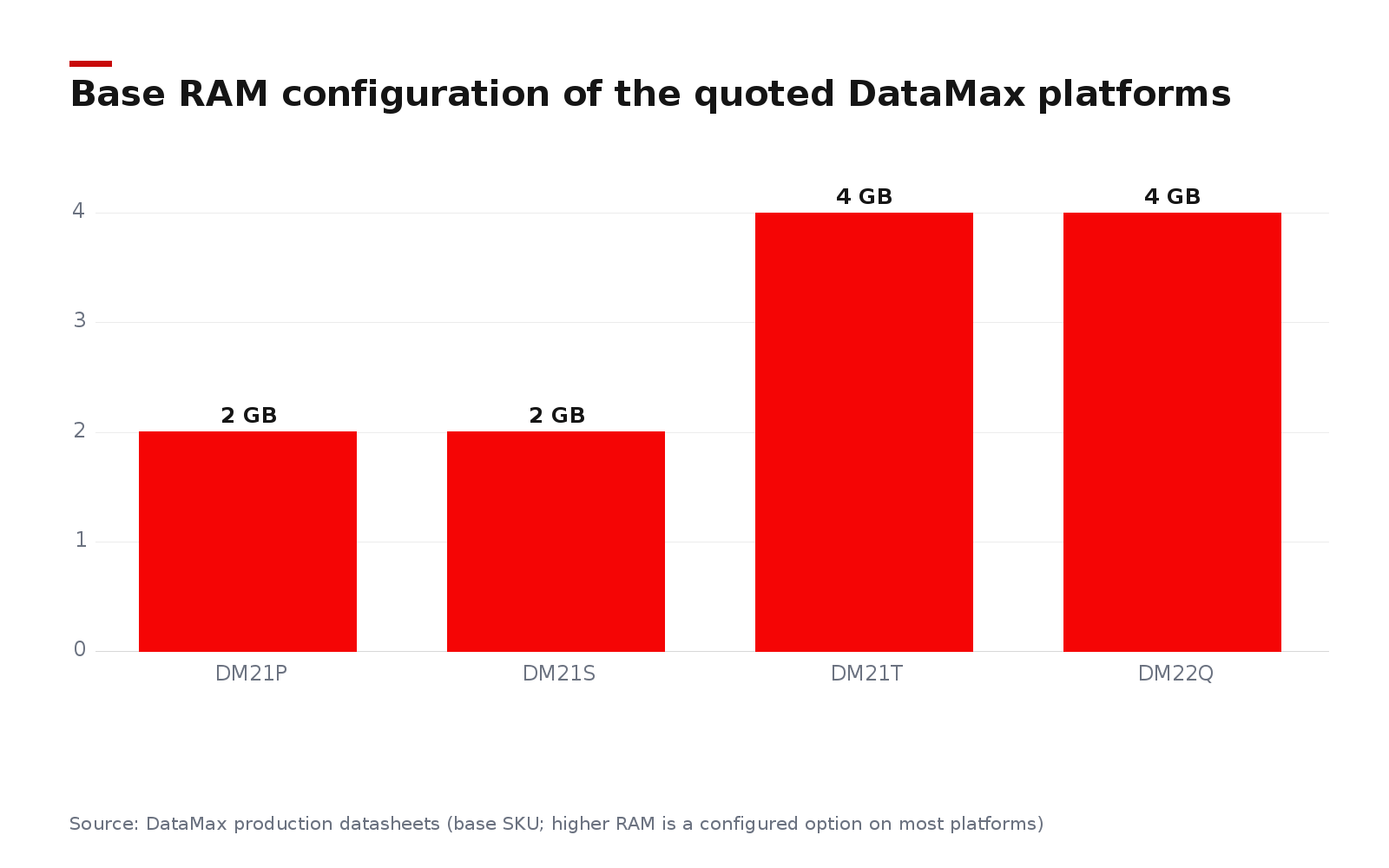
The same figures, in searchable form:
| Model | Base RAM |
|---|---|
| DM21P | 2 GB |
| DM21S | 2 GB |
| DM21T | 4 GB |
| DM22Q | 4 GB |
All four models remain under the product-documentation discipline. Missing power details are not filled by analogy. Likewise, no unprovided dimensions, certifications, warranty period, ingress rating, or thermal figure is implied. Confirm every production characteristic against the production datasheet and the approved purchase order.
The comparison also exposes quotation questions that should be answered before sampling. For DM21P, confirm whether the operator needs the optional 4GB RAM and 16/32/64GB storage. For DM21S, decide whether 1G Ethernet and which storage tier are contractual. For DM21T, identify the exact 4K@120 source profile and verify the absence of HDMI input against the room design. For DM22Q, decide whether the gaming workload needs any optional RAM or storage tier beyond its 4GB / 64GB base.
Each media player comparison should use model-linked purchase-order text rather than a family name. The order should say which SoC configuration, OS image, memory tier, storage tier, port map, codec target, DRM position, and evidence package apply to that exact SKU. A change to any of those lines can change the test result and should trigger a configuration review.
The table also prevents accidental mixing of similarly named platforms. The DM21T uses Amlogic S905X5 with quad Cortex-A510 (ARMv9), whereas the DM22Q uses Amlogic S905X5M with quad Cortex-A55 up to 2.5GHz. Their common 4GB / 64GB base does not make their decode envelopes interchangeable. The DM21P and DM21S likewise share a 2GB base but sit on different Android releases and different stated product fits.
Any quotation using a family name without the exact SoC, OS, memory, storage, and port configuration should return for clarification. A production-intent media player sample must identify the same configuration fields, and the approved sample should become the attachment referenced by the purchase order. This closes the gap between a product-family comparison and a deliverable SKU.
The operator, the integrator and the venue
The best model depends on who controls installation, software, and support. An operator usually starts with the device as an access-controlled endpoint, while an integrator may need direct interface control and predictable deployment. A venue adds display, audio, mounting, network, and operating-hour constraints.
| Situation | Primary requirement | Model direction | Validation point |
|---|---|---|---|
| Operator IPTV with established middleware | Stable set-top endpoint and codec coverage | Evaluate DM21P first | Validate AOSP Android 11, middleware image, provisioning, and 2GB / 8GB baseline |
| IPTV/OTT white-label Android TV programme | Branded Android 14 platform and flexible configuration | Evaluate DM21S first | Lock RAM, storage, 1G Ethernet option, DRM, Dolby Vision/DTS, and boot artwork |
| Premium UHD or cloud-gaming source | High-frame-rate decode including 4K@120 paths | Evaluate DM21T first | Confirm source format, output path, absence of HDMI input, sustained load, and storage requirement |
| Gaming-oriented Android TV deployment | Gaming positioning with 4K@60 decode | Evaluate DM22Q first | Test application behaviour, thermals, output set, and 4GB / 64GB configuration |
| AV integrator connecting display and audio | Required HDMI, optical, analogue, and peripheral interfaces | Select by exact port map | Verify HDMI 2.0b output, S/PDIF, AV, USB, and TF against the room system |
| Digital-signage or hospitality venue | Predictable boot, remote operation, and update control | Choose after software proof | Test application launch, kiosk behaviour, signage mode, and managed deployment |
For an operator, the DM21P direction is anchored by its stated fit as an operator middleware set-top box. The decisive test is not whether it can launch a generic application; it is whether the middleware image, codec path, provisioning, entitlement, and monitoring workflow operate together. A 2GB base can be evaluated against the actual resident-service profile rather than a generic “4K needs more memory” rule.
The operator's test matrix should include channel change, entitlement failure, service restart, network reconnection, protected playback, remote input, and an application update with rollback. It should also record the time required for the service owner to identify whether a fault belongs to the endpoint, middleware, entitlement platform, content feed, or network. That recorded diagnostic path is part of lifecycle quality.
For an integrator, the DM21S is relevant where the programme is explicitly an IPTV/OTT white-label Android TV box. The integrator should verify the selected Ethernet configuration, display and audio connections, remote-control implementation, and app startup behaviour. Optional features are not included until the quotation names them.
For a premium source or cloud-gaming environment, the DM21T offers the most demanding supplied decode envelope: 4K@120 for H.266/VVC [email protected] and listed AV1, VP9, H.265, and AVS3 paths. Its no-HDMI-in boundary removes an entire class of source-routing assumptions. The purchase test should use the actual source, display, refresh mode, network path, and session duration.
The DM22Q direction fits gaming-oriented Android TV use where 4K@60 is the stated target. Its supplied inline AI-SR is a platform feature to validate, not a measurable performance claim. No NPU TOPS value is stated, and none should be inserted into the acceptance plan.
In a venue deployment, environmental and operational responsibilities dominate. Confirm enclosure ventilation, display compatibility, network design, power provisioning, kiosk controls, local logging, and recovery procedures. For any programme, the media player remains one component of a controlled service, and the selected model should be linked to a service owner.
A useful split is to assign the operator, integrator, and venue one acceptance responsibility each. The operator verifies entitlement and middleware; the integrator verifies display, audio, network, and input paths; the venue verifies power, physical installation, ventilation, operating hours, and local recovery. This prevents a technically capable media player from failing because an ownership boundary was left undefined.
Use the same split for incident ownership. A failed source service should reach the content owner, a failed entitlement response the operator or service operator, and a failed physical output the integrator. A device-level diagnosis should include the serial number, hardware revision, image identifier, test media, display model, and network attachment. Without those fields, the venue may replace hardware that was never the failing layer.
How to choose, step by step
Turn the business requirement into an executable sequence. The result should be a shortlist of configurations, a proof plan, and purchase-order lines that prevent an ambiguous quotation from becoming an ambiguous deployment.
- Name the workload Write one line for operator IPTV, white-label IPTV/OTT, premium UHD, cloud gaming, gaming-oriented Android TV, or signage. Add source formats, maximum frame rate, HDR requirements, content protection, peripherals, and session duration.
- Map workload to a model direction Start with the matrix above, then record why alternatives are excluded. Use the DM21P for the stated operator middleware direction, the DM21S for the stated white-label Android TV direction, the DM21T for the stated high-frame-rate decode direction, or the DM22Q for the stated gaming-oriented 4K@60 direction.
- Freeze the configuration State the model, RAM, storage, Ethernet option, OS baseline, DRM combination, port set, power requirement where supplied, packaging, branding, and software image. Confirm each characteristic against the production datasheet.
- Define acceptance tests Specify boot method, service launch, codec corpus, output mode, display device, audio path, network attachment, storage test, thermal-soak duration, protected playback, remote control, reset, recovery, and update procedure. Assign a pass criterion to each test.
- Audit lifecycle control Identify the image owner, application owner, middleware operator, certificate custodian, update publisher, incident investigator, and approved change process. Require rollback, provisioning, logging, and field-failure escalation responsibilities.
- Release evidence and PO lines Attach the configuration sheet, software manifest, test protocol, certification schedule, sample report, lot evidence, and change-control terms. Use the inquiry channel to request a model-specific review or sample through sample ordering.
A pasteable RFQ line should read like this: “Quote the selected DataMax model with the exact RAM and storage configuration; AOSP Android release; stated codec and maximum output mode; required DRM configuration; named HDMI, USB, TF, audio, Ethernet, Wi-Fi, and Bluetooth interfaces; production image and update responsibility; target-market certification schedule; SMT/AOI/functional/dark-room/aging evidence; and documented change-control process.”
Add a second line for the proof condition: “Supply one production-intent sample per quoted configuration for the agreed boot image, source corpus, target display and audio system, network attachment, protected-content service, operating duration, and recovery procedure. Record the serial number, hardware revision, firmware identifier, and result against every test case.”
A third line should close the lifecycle loop: “Identify the production image owner, middleware operator, application publisher, certificate custodian, update publisher, incident investigator, rollback rule, and change-approval authority. State how a failed unit and its logs are returned and correlated to the manufacturing lot.”
Before release, ask the manufacturer to confirm the production data sheet and the manufacturing and lifecycle scope. For the final comparison, email [email protected] with the selected SKU list, target-market certificates, middleware and DRM checklist, and required SMT/AOI/aging evidence so the technical and procurement answers arrive in the same review cycle.
A final release checklist should reconcile the quotation, approved sample, evidence pack, and purchase order as one configuration. Specifically, compare the SoC, OS image, RAM, storage, Ethernet speed, port map, codec target, DRM position, and power line where supplied. Mark every requested option as fitted, excluded, or pending datasheet confirmation. This prevents an attractive sample from becoming a differently configured media player during production release.
Further reading
- 4K Media Player Box: What It Is and What It Is Not
- H.265 HEVC Android TV box guide
- Widevine L1 certification guide
- Dolby Atmos Android TV box guide
- TV box vendor selection checklist
- DataMax DM21P specifications and fit
- DataMax DM21S specifications and fit
FAQ
Is a 4K media player box determined by its output label?
No. A 4K label does not establish the source codec, profile, frame rate, HDR path, DRM implementation, output standard, or thermal performance. Evaluate the complete chain from source and service through decoder, operating system, output interface, display, and protected-content workflow. For DataMax models, use the supplied decode and port facts rather than extrapolating from the category name.
Which DataMax model is the first choice for operator middleware?
The DM21P is the clearest starting point because its supplied fit is a 4K IPTV operator middleware set-top box. Validate AOSP Android 11, the 2GB / 8GB base configuration, codec coverage, middleware compatibility, provisioning, and update ownership before approval. It should enter a comparison, not bypass project-specific acceptance testing.
Does 4K@120 support on the DM21T imply 8K output?
No. The supplied DM21T production facts cap the stated output and decode boundary at 4K, despite any broader marketing name. Its documented high-frame-rate paths include H.266/VVC [email protected] 4K@120 and listed AV1, VP9, H.265, and AVS3 4K@120 paths. Confirm against the production datasheet and require a matching display-mode acceptance test.
Should RAM options be selected after model selection?
Yes, but they must be frozen before the quotation becomes a purchase order. The base configurations are 2GB / 8GB for DM21P, 2GB / 16GB for DM21S, 4GB / 64GB for DM21T, and 4GB / 64GB for DM22Q. Higher tiers are stated as options on most platforms. Test the intended middleware and applications, then specify the selected RAM and storage line by line.
What factory evidence should accompany a media player order?
Request the lot-traceable SMT and AOI records, programming record, functional test, dark-room result, aging record, sample approval, firmware identifier, and configuration sheet. Also request the change-control process covering OS, middleware, PCB, component, and packaging revisions. This record set connects the delivered hardware to the approved production configuration.
How should software lifecycle responsibility be assigned?
Name the party that builds and signs the image, maintains middleware, publishes applications, manages certificates, provisions devices, controls updates, performs rollback, and investigates incidents. The hardware model alone does not define that ownership. Write each responsibility and escalation path into the RFQ, development agreement, or purchase-order schedule.




