

The short answer first
An android tv box advertised as “8K” is not necessarily an 8K output product. For DataMax, the quoted production platforms positioned around 8K are capped at 4K in the supplied datasheets: DM21T supports 4K@120 decoding, while DM22Q supports 4K@60. The engineering conclusion is direct: treat “8K” as a category label requiring verification, not a technical specification.
Field trap
A decoder capability is not the same as a delivered video path. Source decoding, system rendering, application output, HDMI mode support and the attached display must all support the intended format. An 8K claim supported only by codec marketing fails an engineering RFQ.
Procurement should specify the target mode, including resolution, refresh rate, chroma format, HDR system and audio format, and require an end-to-end demonstration on the intended TV. It should also separate platform selection from configuration. The quoted DataMax platforms differ in chipset generation, Android version, base memory, networking, USB allocation and optional DRM, so one product cannot cover premium UHD, operator IPTV and gaming requirements equally well.
The short answer for the buyer is: specify the output path before evaluating the logo, chipset or decorative “8K” wording. Use the datasheet maximum as the ceiling, require evidence for the exact shipped SKU, and keep every memory, network, DRM and middleware option on the purchase order. For broader ISP architecture and platform-selection context, see the canonical guide to an android tv box for ISPs.
A practical example shows why the distinction matters. An operator may write “4K IPTV” into a tender without defining refresh rate, chroma sampling, HDR metadata, audio passthrough or EDID behaviour. The resulting sample may decode a 4K service but negotiate a lower raster on the hotel television, or it may pass a short laboratory test while failing after a reboot into the operator middleware. The quotation therefore needs an output-mode matrix, an application-level playback test and a configuration record tied to the accepted production image. A device described as 8K adds no engineering value when the required delivery mode is 4K and the shipped path cannot be demonstrated.
The same discipline applies to RAM, ROM, Ethernet speed and DRM. These are not cosmetic catalogue fields: they alter the production variant that the operator tests, provisions and later replaces. An “optional” DRM statement must become an enabled licence line, and a “1G opt” statement must become a coded network configuration. Until those fields are frozen, the android tv box under review is only a family of possible devices, not an orderable product definition.
Definitions a buyer cannot outsource
Resolution is only one layer of the specification. A procurement RFQ should separate input media, decode, render, transmit and display. Decode describes the codec and profile accepted by the SoC; output describes the raster and timing actually transmitted over HDMI. A platform can decode a high-resolution stream while its application path, firmware, scaler or output configuration remains limited to a lower mode.
For the quoted DataMax hardware, “4K@60” or “4K@120” is a datasheet ceiling, not a guarantee that every app, cable, source and display will reproduce that mode. The RFQ must define colour handling, HDR behaviour, audio passthrough, resolution matching and fallback. It should also identify whether the requirement concerns live linear playback, transactional VOD, cloud gaming or local media.
The video contract should name more than a peak number. A useful line reads: “Accept the specified H.265 4K@60 service at the deployment colour format, preserve HDR metadata through the approved application path, and recover predictably from display and source changes.” It then identifies the target display model, HDMI topology and audio receiver. That line converts “8K” or “4K” into an observable acceptance condition. Without it, a factory can demonstrate one favourable content path and the operator inherits integration work.
DRM is a separate chain. Widevine L1 and PlayReady indicate relevant licence-service support, but neither substitutes for contract approval, key-delivery integration or a completed playback test. The operator still needs to validate device provisioning, licence acquisition, renewal, concurrency policy and fail behaviour in the production middleware. HDCP 2.2 appears as optional on DM21P; it must be selected explicitly if required.
AOSP Android 14 is not the same commercial proposition as a fully certified Google TV platform. The supplied facts identify AOSP Android 14 for DM21T, DM21S and DM22Q, and AOSP Android 11 for DM21P. Buyers requiring Google Play, Google TV launcher behaviour, Android Management APIs or an application category approval must verify the complete software image rather than infer those features from the operating-system label.
That distinction also changes the update process an operator must procure. AOSP permits the manufacturer to control the image, launcher, device configuration, firmware image and update channel, but each software decision still needs an owner. The PO should identify the baseline image, application packages, device-tree revision, bootloader behaviour and whether updates are local, network-triggered or operator-controlled. A launcher change can alter boot time, resolution selection and application navigation without changing the SoC. For a volume programme, the approved build identifier is therefore more useful than the phrase “Android 14.”
The system-on-chip must also be read by architecture rather than by headline frequency. DM21T uses Amlogic S905X5 with quad Cortex-A510 (ARMv9); DM21P uses Amlogic S905Y4 with quad Cortex-A35; DM21S uses Amlogic S905Y5 with quad Cortex-A55; DM22Q uses Amlogic S905X5M with quad Cortex-A55 up to 2.5GHz. These are different compute and integration choices. Memory, codec work, thermal behaviour and operator middleware impact must be assessed together.
Architecture influences qualification, but it cannot replace qualification. An operator may require 32-bit Android compatibility for one middleware binary, persistent provisioning after reboot and stable multicast behaviour on a specific access network. The buyer should ask for the middleware build matrix, device provisioning record and network test rather than infer compatibility from the Cortex generation. Conversely, a premium streaming workload may benefit from the wider codec set and USB allocation listed for DM21T, provided the 4K mode is demonstrated through the complete signal chain.
Finally, network topology is part of the product. RJ45 100M is listed on all four quoted platforms; 1G is optional on DM21T, DM21S and DM22Q, while DM21P lists RJ45 100M without a 1G option in the supplied facts. Wi-Fi6 and Bluetooth 5.4 are listed, but wireless specifications alone do not answer multicast, multicast VPN, IGMP proxy, provisioning or QoS requirements. Those remain explicit operator validation items.
The network line in the RFQ should distinguish physical transport from service behaviour. “RJ45 100M” is an interface fact; “reliable IPTV delivery on the supplied access network” is a service requirement. The acceptance test can include a defined video session, reboot, firmware update, channel change, network reconnection and simultaneous management traffic. This prevents a buyer from rejecting an otherwise suitable unit after deployment because the test focused only on link negotiation. For every android tv box candidate, the technical file should connect the physical port, configured driver, network service profile and operator acceptance result.
Real DataMax platforms, field by field
The quoted DataMax range separates operator middleware, premium UHD, white-label OTT and gaming priorities. The table reproduces the supplied production facts without extending them. Product names link to their product pages; optional configurations remain options rather than standard assumptions.
| Model | SoC and CPU | OS | RAM / ROM | Decode | DRM | Ports and connectivity |
|---|---|---|---|---|---|---|
| DM21T | Amlogic S905X5; quad Cortex-A510 (ARMv9) | AOSP Android 14 | 4GB / 64GB (family options) | H.266/VVC [email protected] 4K@120; AV1/VP9/H.265 4K@120; AVS3 4K@120; H.264 4K@60; inline AI-SR | Widevine L1 / PlayReady optional | HDMI 2.0b out (no HDMI input); USB2.0 x1; USB3.0 x1; TF; S/PDIF; AV; RJ45 100M (1G opt); Wi-Fi6 + BT5.4 |
| DM21P | Amlogic S905Y4; quad Cortex-A35 | AOSP Android 11 | 2GB / 8GB (4GB; 16/32/64GB optional) | AV1 [email protected]; VP9/H.265 4K@60; H.264 4K@30 | Widevine L1 / PlayReady / HDCP 2.2 optional | HDMI 2.0b out x1; USB2.0 x2; TF; S/PDIF; 3.5mm AV; RJ45 100M; Wi-Fi6 2x2 + BT5.4; DC 5V/2A |
| DM21S | Amlogic S905Y5; quad Cortex-A55 | AOSP Android 14 | 2GB / 16GB (2/4/8GB; 16/32/64GB optional) | AV1 / H.265 [email protected] 4K@60 | Widevine L1 / PlayReady optional; Dolby Vision/DTS | HDMI 2.0b out; S/PDIF; AV; USB2.0 x2; TF; RJ45 100M (1G optional); Wi-Fi6 2x2 + BT5.4 |
| DM22Q | Amlogic S905X5M; quad Cortex-A55 up to 2.5GHz | AOSP Android 14 | 4GB / 64GB (2/4/8GB; 16/32/64GB optional) | AV1/H.265 L5.1 4K@60; inline AI-SR (no NPU TOPS stated) | Widevine L1 / PlayReady optional; Dolby Vision/DTS | HDMI 2.0b out; USB2.0 x2; TF; S/PDIF; AV; RJ45 100M (1G opt); Wi-Fi6 2x2 + BT5.4 |
The chart compares the base memory listed for the quoted models; it is not a performance ranking.
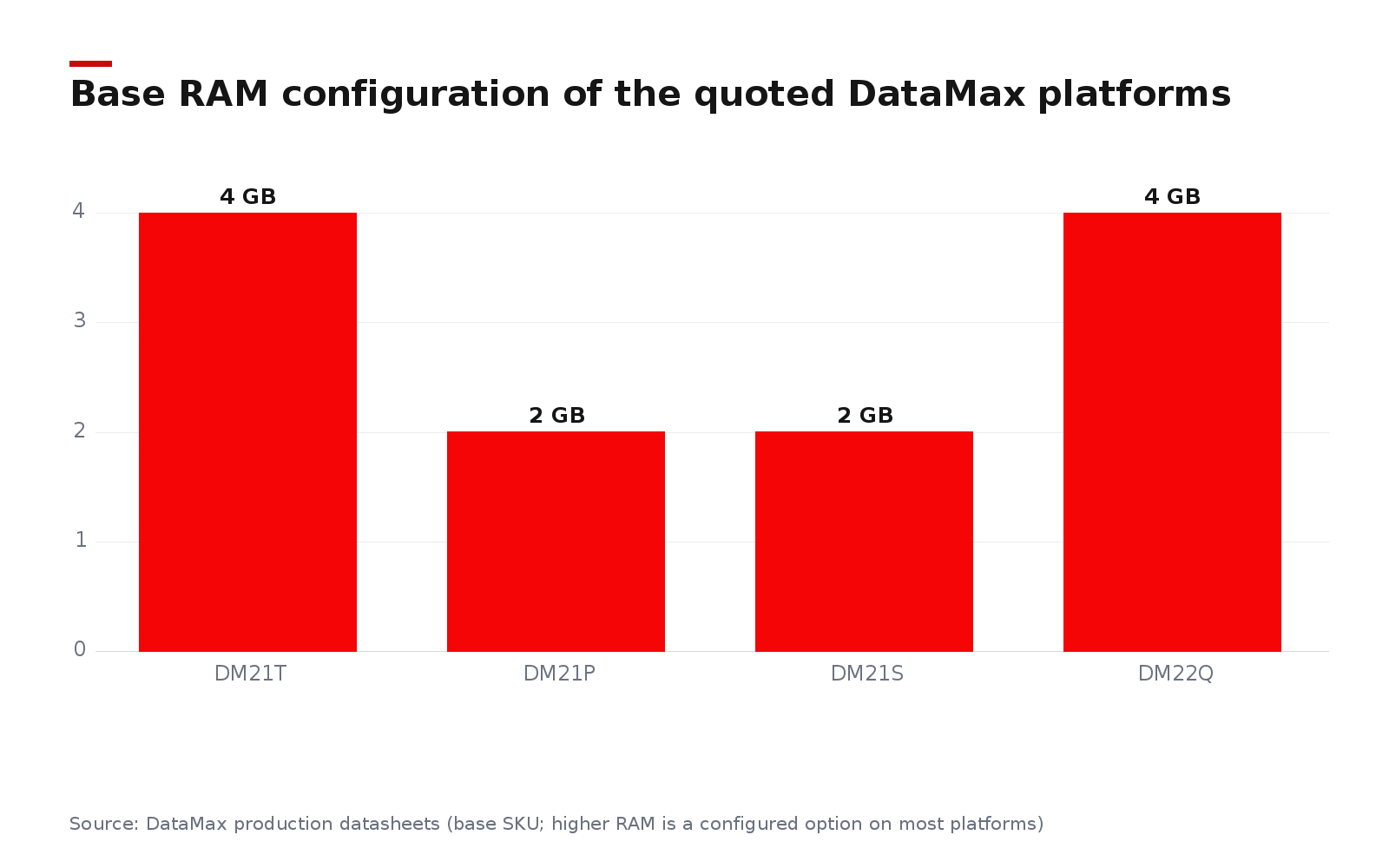
The same figures, in searchable form:
| Platform | Base RAM |
|---|---|
| DM21T | 4 GB |
| DM21P | 2 GB |
| DM21S | 2 GB |
| DM22Q | 4 GB |
The chart is a base-configuration comparison, not a performance score. A 4GB base does not establish faster application loading, and 2GB does not by itself determine acceptability. Storage endurance, middleware memory use, operator application count and sustained thermal conditions belong in the acceptance plan.
The field-by-field distinction prevents category errors during tender evaluation. DM21T is the quoted premium UHD and cloud-gaming fit, with a higher stated decode ceiling and a USB 3.0 port, but its listed HDMI output has no HDMI input. DM21P is the defined operator middleware fit and explicitly lists optional HDCP 2.2, while its base Ethernet remains 100M. DM21S is the white-label fit with AOSP Android 14 and a 2GB / 16GB base. DM22Q is gaming-oriented, with 4GB / 64GB base and 4K@60 decode listed. These are procurement directions, not substitutes for the frozen production configuration.
Each model name should remain linked to its own evidence set. The supplier should state which device was tested, whether the test used the base memory configuration or an option, which firmware image was installed and whether optional DRM was enabled. If a quotation combines a DM21T decode statement with a DM21P operating system or network line, the configuration is internally inconsistent and must be returned for clarification. A valid android tv box quotation should permit procurement to reconstruct one device from its own document, without combining attributes from several family members.
The base memory chart creates a useful tender-control point. A buyer may approve DM21T at 4GB for a pilot, then discover that the production order sheet carries a different RAM tier selected by the factory. The acceptance record should therefore include the installed memory configuration, not just the model name. Conversely, a 2GB platform may be technically adequate when the operator middleware, background services and update mechanism are controlled. The correct question is whether the shipped configuration passes the operator workload under the specified conditions.
Model naming should remain exact throughout procurement. A quote that substitutes a family label, an 8K marketing description or an unapproved platform name prevents a direct comparison with the production datasheet. Procurement should preserve the model, hardware revision, memory tier, ROM tier, network option, operating-system baseline and firmware identifier as separate fields. If any one changes, the supplier should identify whether it is a new order code, a sample-only variation or an engineering change requiring revalidation.
The DataMax product facts support platform selection, but they do not replace a target-market compliance review. The buyer should confirm the production datasheet for current dimensions, power details, approved accessories and destination-specific variants before committing to enclosure, rack or hospitality installation plans. It should also confirm the complete software and DRM scope against the operator application. The model table is the commercial baseline; the acceptance matrix and build record are the release evidence.
Buyer situations, ranked by what they punish
Operator deployments punish configuration drift and provisioning failure. IPTV middleware, conditional access, DRM, multicast behaviour and remote-management workflows must work as one system. For those programmes, DM21P is the defined fit for a 4K IPTV or operator middleware set-top box. The decisive questions are whether the production image includes the required middleware and whether the quoted configuration includes every licensed DRM feature.
Integrators punish unverifiable mode handling. A display, AVR, distribution amplifier or conferencing display may alter the advertised capability. The hardware must therefore be tested with the actual signal chain. DM21T offers the highest stated decode ceiling in this group at 4K@120 for several codecs, includes USB 3.0 and has a 1G network option. Its absence of HDMI input also needs to be checked against any capture, switching or room-control design.
Venue and hospitality deployments punish installation complexity and physical integration. Wi-Fi, Ethernet and USB service access may all matter, but the operator box must fit the furniture plan without causing thermal or cable-management problems. The dimensions are not supplied in the product facts and must be confirmed against the production datasheet.

The scene illustrates why installation context matters: the compact box may be hidden behind a wall-mounted television, while power, network and signal connectivity remain outside the viewer’s sightline. Thermal access and service procedures still apply despite the hidden location.
White-label OTT programmes punish software and branding ambiguity. DM21S is identified for IPTV or OTT white-label work on AOSP Android 14, with 2GB / 16GB as the quoted base and optional RAM and storage tiers. The buyer should define launcher, wallpaper, update channel, telemetry, regional certification and device-approval requirements before artwork freezes.
| Buyer situation | Primary requirement | Model direction | Evidence required before approval |
|---|---|---|---|
| IPTV operator | Middleware, DRM, provisioning and multicast | DM21P | Operator-stack integration test and licence flows |
| Premium UHD / cloud-gaming | Decode ceiling, I/O and network options | DM21T | End-to-end 4K mode test on the target display chain |
| White-label OTT | Android 14 image, branding and update control | DM21S | Frozen software-build specification and acceptance script |
| Gaming-oriented | CPU platform, 4GB base, connectivity | DM22Q | Latency, sustained-load and thermal test |
| Hospitality integrator | Physical fit, network, service access | Confirm by configuration | Mechanical drawing, current draw and installed-mode sample |
| Residential broadband bundle | Device identity, Wi-Fi delivery and remote support | Confirm by configuration | Provisioning, reboot recovery and household-network test |
| Retail display network | Stable output, remote recovery and scheduled operation | Confirm by configuration | Long-run playback, power-cycle and service-access evidence |
The ranking concerns operational consequence, not class status. An operator programme carries the highest cost when licensing, provisioning or a firmware difference makes a fleet unusable after installation. A premium display programme is exposed to an unsupported mode, HDR mismatch or USB bottleneck that appears only with the chosen television and source. A white-label programme is exposed to an unauthorised launcher, update endpoint or image drift that undermines the brand. A venue programme is exposed to inaccessible cables, blocked IR paths and unstable wireless service.
These exposures produce different evidence. An operator wants device identity, licence state, restart persistence and remote-management records. An integrator wants EDID, mode, audio and control-protocol results. A white-label owner wants an image hash, artwork package and update procedure. A hospitality operator wants installation drawings, power information, thermal guidance and a service path. The DataMax engineering review should begin with the failure that the programme cannot tolerate, then map it to the appropriate model and evidence package.
A practical scoring exercise keeps this ranking testable. Give each scenario one mandatory acceptance condition and one programme cost. An operator might treat failed post-reboot provisioning as mandatory and fleet rollback as the cost. A premium integrator might require the intended 4K mode on the actual display chain and classify repeated mode failure as the cost. A white-label owner might require an approved launcher and update endpoint, with an unauthorised storefront as the cost.
The matrix also exposes cases where no listed model should be selected until more evidence is available. If a hospitality project requires dimensions, thermal limits or a particular control interface that are absent from the supplied facts, the project remains at the data-request stage. If a retail deployment requires remote recovery for each outlet, the buyer must confirm the operator software, management channel and recovery process before naming a platform.
For each shortlisted configuration, ask the supplier for an installed-mode sample where the programme includes hidden installation, operator middleware or branded software. The sample should carry the intended base or option configuration, the approved image and the actual power and network accessories. This exposes integration problems before tooling, artwork or a fleet rollout is locked. The buyer can then compare like with like, using the same display, network and recovery sequence for every candidate.
What goes wrong after the PO
The first failure mode is semantic substitution. A quotation says “8K,” the purchase order repeats it, and the acceptance test checks only whether a 4K image appears. The programme then discovers that the configured output is lower than the commercial claim. Prevent that by attaching a technical mode table to the PO and requiring the supplier to state every capped parameter.
The second failure mode is optional-feature ambiguity. “Widevine L1 / PlayReady optional” is not equivalent to both licences enabled. “RJ45 100M (1G opt)” is not equivalent to a 1G SKU. “4GB; 16/32/64GB optional” is not equivalent to a 4GB build. Every option needs a SKU, quantity, firmware and regional destination. Missing production specifications should be confirmed against the production datasheet.
Field trap
An output label can pass a codec test yet fail in the room. Firmware scaler limits, HDMI negotiation, EDID handling, unsupported chroma combinations and display compatibility can each prevent the intended mode. Require a mode matrix from every production image.
Software-version drift is another commercial defect. AOSP Android 14 identifies the platform layer, not the shipped build. A later unit may carry a different launcher, security patch, middleware release, device tree, bootloader or firmware. Tie approval to an immutable build identifier and an approved update channel.
Thermal behaviour is usually treated as a late surprise. A decode profile accepted in a short demonstration may not remain stable during continuous playback. Ask for the applicable burn-in or aging procedure, ambient conditions, runtime, failure criteria and sample-retention rule. DataMax can provide evidence for the production configuration, but the buyer should require the test conditions and acceptance limits rather than merely a completed report.
Physical integration also creates avoidable rework. If the unit is hidden behind a television, confirm ventilation, IR path, Wi-Fi reception, Ethernet placement and service access. Product dimensions are absent from the supplied facts, so confirm them against the production datasheet. Do not infer mechanical suitability from a product rendering.
Certification scope creates a related trap. A report issued for one radio configuration, destination or hardware revision does not automatically cover a changed RAM module, enclosure, antenna or firmware. The buyer should map each document to the model, revision, destination and production configuration. If the android tv box is sold under an operator-owned brand, the brand approval and the manufacturer’s compliance evidence remain separate deliverables.
Service logistics can fail after installation even when the hardware is correct. A hidden product may need a remote image, middleware diagnosis or firmware repair that cannot be reached through a physical port. The software plan should cover remote update, failed-update recovery, boot-loop behaviour, device identity and log collection. For operator middleware, include the service workflow and who can execute it. For a branded android tv box, include the approved launcher’s diagnostics and the boundary between customer support and factory support.
Commercial discrepancies often follow these technical ones. A purchase order may name one RAM tier while the packing list records only the model; a carton label may show 100M Ethernet while the sample had the 1G option; or a DRM statement may appear in the sales response without an enabled licence in the build. Reconciliation must compare four records: quotation, purchase order, factory configuration and accepted sample. The order of precedence and process for approving deviations should be agreed before the first shipment.
Finally, distinguish certification scope. A device may be tested with one display or network, then deployed across a different fleet. A certificate or report applies only to the stated variant, firmware and test boundary. Request the applicable target-market compliance records through DataMax’s compliance evidence process, with every attachment mapped to the ordered SKU.
A costly sequence follows when acceptance is defined only at receipt. The warehouse compares model names, the engineering team separately inspects a demonstration unit and the operator later discovers that the production Ethernet option differs from the sample. None of those documents identifies the same configuration. A better process creates one “golden configuration” record before shipment and uses its model, revision, RAM, ROM, network, DRM and firmware identifiers to compare the quotation, purchase order, carton label and test record.
Recovery planning should be part of acceptance. Define what happens if the device loses network access during an update, if the operator middleware refuses a licence, if the attached television changes EDID after a power cycle or if the enclosure blocks the remote-control path. Each event needs a named owner, a diagnostic method and a permitted recovery outcome.
Verification you can ask for on paper
Factory verification starts at SMT and AOI. The evidence trail should connect the production lot to the board revision, component setup, inspection result and non-conformance disposition. A generic statement that the line uses inspection is insufficient; the reviewer needs the dated record that identifies the tested units or represented sample.
Ask for evidence that identifies the unit and revision under test. A valid packet contains the model, hardware revision, memory configuration, firmware build, test date, environmental conditions, acceptance criteria and result. A factory declaration without those fields cannot support a volume acceptance decision.
The image illustrates the deployed context where the compact operator box sits out of sight but remains part of the active AV chain.
The paper review should reconcile three records: the purchase order, the factory build record and the acceptance record. If they differ, the PO remains the commercial source of intent, while the production build record establishes what was made. Any approved deviation should be signed and mapped to the affected serial range.
A practical review packet for each model should identify the SMT line, AOI programme revision, inspected board family, functional-test coverage, firmware image, application bundle and traceability method. The reviewer should be able to follow one serial range through the process without relying on a presentation slide. For a model with optional network and DRM variants, the record must also show which option was fitted and tested. If the line uses a common test script across several android tv box models, the script still needs model-specific limits and expected outputs.
For high-volume programmes, a video factory audit can test whether the documented process matches the observed line. DataMax invites buyers to request an audit scoped to SMT, AOI, firmware flashing, functional testing and aging for the relevant model. The agenda should include the exact DUT configuration and the evidence files to be reviewed, not just a general factory walkthrough.
The same discipline applies to regulatory and target-market work. “Android TV box” is a device category, not a universal approval status. Market, radio, EMC, network-security, accessibility and content requirements can affect the accepted configuration. Use the certification and compliance material only where it matches the destination and ordered variant; otherwise request the current document set.
A final paper check should confirm acceptance ownership. Procurement compares the shipment with the PO; engineering compares modes, applications and firmware; the factory answers deviations and traceability; compliance confirms the document scope. Each function should sign only its own evidence. This prevents an unsigned “sample passed” statement from being treated as approval of a fleet-wide configuration.
The evidence packet should also state sampling logic and the disposition of excluded units. A representative sample can support process verification, but it does not erase the need to reconcile configuration or identify failed inspections. Ask how many units were inspected, whether the AOI programme revision matched the current board, how non-conformances were repaired or reworked, and how the final shipment was segregated from unresolved material.
For software-heavy programmes, add a build-provenance file. It should identify the firmware build, launcher, middleware package, DRM configuration, update endpoint and device-specific provisioning data. The factory can then prove that the tested android tv box software corresponds to the production image. If the operator supplies the middleware or branding package, the document should identify its version and approval status.
Entry tier versus commitment tier
The quoted range offers a practical entry-versus-commitment comparison, but not a single universal “basic” and “premium” ladder. Memory, output performance and connectivity options differ by platform. The selection must follow the workload rather than the largest headline.
| Dimension | Entry direction | Commitment direction | Procurement consequence |
|---|---|---|---|
| Operator IPTV | DM21P base: 2GB / 8GB, AOSP Android 11 | DM21P with selected RAM/ROM and enabled optional DRM | Quote the operator stack and licence state explicitly |
| Premium UHD / cloud-gaming | DM21T base: 4GB / 64GB | DM21T with selected family options, 1G and required DRM | Validate 4K@120 paths in the complete display chain |
| White-label OTT | DM21S base: 2GB / 16GB | DM21S with selected RAM/ROM and Android 14 image | Freeze launcher, branding and update policy |
| Gaming-oriented | DM22Q base: 4GB / 64GB | DM22Q with selected RAM/ROM, 1G and required optional features | Validate latency, sustained load and thermal behaviour |
| Network | RJ45 100M | 1G option where stated: DM21T, DM21S and DM22Q | Assign an option code; do not treat DM21P as having a 1G option |
| USB and peripherals | Basic USB allocation varies by model | DM21T includes USB3.0 x1 plus USB2.0 x1 | Match accessories and transfer requirements to the selected SKU |
| Software commitment | Listed AOSP baseline | Frozen image, application bundle and approved update channel | Record firmware and software owner before approval |
| Evidence commitment | Sample-level demonstration | SKU-level traceable build and factory evidence | Map records to serial ranges and destination |
The commercial gain from a commitment tier comes from control, not decorative specification. Pin the exact RAM/ROM combination, network speed, DRM set, software build and evidence package. That prevents a nominal platform match from becoming an unqualified shipment.
The comparison should be made at total programme level. A base configuration may suit a controlled pilot with one application and a known display, while a volume deployment may need more memory, a different network option, licensed DRM, remote management and stronger traceability. The right tier is the lowest controlled configuration that passes the workload and acceptance tests, not the model with the largest headline feature.
A useful commercial gate is the configuration delta. Record the entry sample’s RAM, ROM, Ethernet, DRM and firmware alongside the proposed volume configuration. Every changed field should carry a reason, an owner and a revalidation action. Moving from base 2GB to a selected 4GB tier may be necessary for the middleware, but it still requires an application and stability check; adding 1G changes the transport under test; enabling DRM changes the licence and provisioning path. The delta makes the commitment tier auditable.
Before finalizing the programme, ask DataMax to review the SKU list, target-market certification scope and middleware/DRM checklist against the intended deployment. For technical evaluation, an engineering team can also prepare a video audit or configuration inquiry with the acceptance script attached.
When requesting a quotation by email, attach the SKU list, target-market certificates, middleware/DRM checklist, required output-mode matrix and required SMT/AOI/aging evidence to [email protected]. That package lets procurement, engineering and the factory assess the same android tv box definition rather than relying on a category label. Samples can be requested through sample ordering once the acceptance environment is defined.
Further reading
- Guide android tv box for isps
- DTS:X Android TV box guide
- DRM compliance solutions
- Telecom solutions
- Amlogic Android TV boxes
- DataMax DM21T specifications and fit
- DataMax DM21P specifications and fit
FAQ
Does an 8K Android TV Box necessarily output 8K?
No. The quoted DataMax platforms associated with 8K-positioned marketing are datasheet-limited to 4K output or decode, depending on model. DM21T lists several 4K@120 decode paths; DM22Q lists 4K@60. Buyers must specify the exact end-to-end mode and reject unsupported output claims.
Which DataMax model is intended for operator IPTV middleware?
DM21P is the stated fit for a 4K IPTV or operator middleware set-top box. It uses Amlogic S905Y4 with quad Cortex-A35, AOSP Android 11 and a 2GB / 8GB base configuration. RAM, storage and DRM options must be selected explicitly in the quotation and PO.
Is a higher RAM option enough to qualify a premium product?
No. RAM affects capacity, but premium qualification also depends on processor architecture, decode and output limits, I/O, network configuration, software integration and sustained operation. Use the platform fit as the starting point, then validate the complete production configuration against the intended application.
What evidence should accompany a volume quotation?
Request an SKU-level configuration record, production traceability, SMT/AOI results, functional-test criteria, aging conditions, firmware identifier and relevant target-market compliance documents. Each record should identify the tested model, hardware revision and configuration so it can be reconciled with the shipment.
Can DataMax support a factory or video audit?
Yes, DataMax can arrange an evidence-led factory or video audit scoped to the selected model and production process. A useful agenda covers SMT, AOI, firmware flashing, functional testing, aging and document traceability. Buyers can review the process through the manufacturer and factory quality resources.
Is a codec test sufficient to approve an android tv box?
No. A codec test covers only one part of the path. Acceptance should also exercise the production application, output negotiation, display or receiver, audio route, DRM flow, network reconnection, reboot, update and recovery behaviour. The test record should identify the source format, output mode, device configuration and firmware so the result can be reproduced on a later production lot.




