The short answer first
| Decision area | Lower-commitment route | Higher-capability route |
|---|---|---|
| Best fit | IPTV, OTT, or white-label deployment where cost and operational standardization dominate | Premium UHD, cloud-gaming, or gaming-led deployment where decode capability and headroom matter |
| Representative DataMax options | DM21P or DM21S | DM21T or DM22Q |
| Procurement focus | Freeze the exact RAM/ROM, DRM, Ethernet, and operating-system combination | Validate the stated codec ceiling, interface configuration, thermal behavior, and long-term software path |
The direct answer is that an android tv box should be selected as a lifecycle commitment, not as a codec headline. The quoted DataMax range spans Android 11 and AOSP Android 14, two base-memory configurations, and several decode ceilings. A buyer comparing Amlogic-based products should therefore separate three decisions: the application and middleware baseline; the display, DRM, and codec contract; and the factory evidence required to reproduce the same configuration in later builds.
For an ISP or pay-TV operator, the DM21P is positioned for 4K IPTV and operator middleware. For a white-label OTT program, the DM21S provides a newer AOSP Android 14 baseline. For premium UHD or cloud-gaming requirements, the DM21T provides the highest stated decode figures among these platforms. The DM22Q targets gaming-oriented use with AOSP Android 14 and 4GB/64GB base memory.
The common procurement mistake is to compare launch labels, then leave RAM tiers, Ethernet options, DRM options, and firmware scope outside the PO. A procurement-ready request should use the inquiry form and state the required platform, RAM/ROM combination, Android baseline, DRM package, codec ceiling, Ethernet speed, connectivity, OS-availability window, and evidence required. This approach turns an android tv box quotation into a reproducible appliance definition rather than a model-name comparison.
The platform shortlist with datasheet values
| Model | SoC and processor | OS | RAM/ROM | DRM | Primary fit |
|---|---|---|---|---|---|
| DM21P | Amlogic S905Y4, quad Cortex-A35 | AOSP Android 11 | 2GB / 8GB; 4GB; 16/32/64GB optional | Widevine L1 / PlayReady / HDCP 2.2 optional | 4K IPTV / operator middleware set-top box |
| DM21S | Amlogic S905Y5, quad Cortex-A55 | AOSP Android 14 | 2GB / 16GB; 2/4/8GB; 16/32/64GB optional | Widevine L1 / PlayReady optional; Dolby Vision/DTS | 4K Android TV box for IPTV/OTT white-label |
| DM21T | Amlogic S905X5, quad Cortex-A510 (ARMv9) | AOSP Android 14 | 4GB / 64GB; family options | Widevine L1 / PlayReady optional | Premium UHD / cloud-gaming box |
| DM22Q | Amlogic S905X5M, quad Cortex-A55 up to 2.5GHz | AOSP Android 14 | 4GB / 64GB; 2/4/8GB; 16/32/64GB optional | Widevine L1 / PlayReady optional; Dolby Vision/DTS | Gaming-oriented Android TV box |
The selection should begin with the quoted processor and OS rather than the model label. DM21P pairs the Amlogic S905Y4 and quad Cortex-A35 with AOSP Android 11. DM21S advances to the Amlogic S905Y5 and quad Cortex-A55 with AOSP Android 14. DM21T uses the Amlogic S905X5 and quad Cortex-A510 with ARMv9, while DM22Q uses the Amlogic S905X5M and quad Cortex-A55 up to 2.5GHz. These are quoted processor configurations, not performance multipliers that can be compared without application and memory tests.
Decode requirements should also be written precisely. DM21P lists AV1 [email protected], VP9/H.265 4K@60, and H.264 4K@30. DM21S lists AV1 / H.265 [email protected] 4K@60. DM21T lists H.266/VVC [email protected] 4K@120, AV1/VP9/H.265 4K@120, AVS3 4K@120, H.264 4K@60, and inline AI-SR. DM22Q lists AV1/H.265 L5.1 4K@60 and inline AI-SR, with no NPU TOPS stated.
Connectivity differs at the line level. DM21P has HDMI 2.0b output x1, USB2.0 x2, TF, S/PDIF, 3.5mm AV, RJ45 100M, Wi-Fi6 2x2, BT5.4, and DC 5V/2A. DM21S has HDMI 2.0b output, S/PDIF, AV, USB2.0 x2, TF, RJ45 100M with 1G optional, and Wi-Fi6 2x2 plus BT5.4. DM21T has HDMI 2.0b output with no HDMI input, USB2.0 x1, USB3.0 x1, TF, S/PDIF, AV, RJ45 100M with 1G optional, and Wi-Fi6 plus BT5.4. DM22Q has HDMI 2.0b output, USB2.0 x2, TF, S/PDIF, AV, RJ45 100M with 1G optional, and Wi-Fi6 2x2 plus BT5.4.
A procurement spreadsheet should preserve the distinction between a quoted base configuration and a configurable option. DM21P is quoted at 2GB / 8GB with 4GB and 16/32/64GB optional. DM21S is quoted at 2GB / 16GB, with 2/4/8GB RAM and 16/32/64GB ROM optional. DM22Q is quoted at 4GB / 64GB, with 2/4/8GB and 16/32/64GB optional. DM21T is quoted at 4GB / 64GB with family options. Any android tv box approval sheet that says only “2GB” or “4GB” is incomplete because storage, RAM tier, and factory configuration remain unresolved.
Base memory is only a starting configuration.
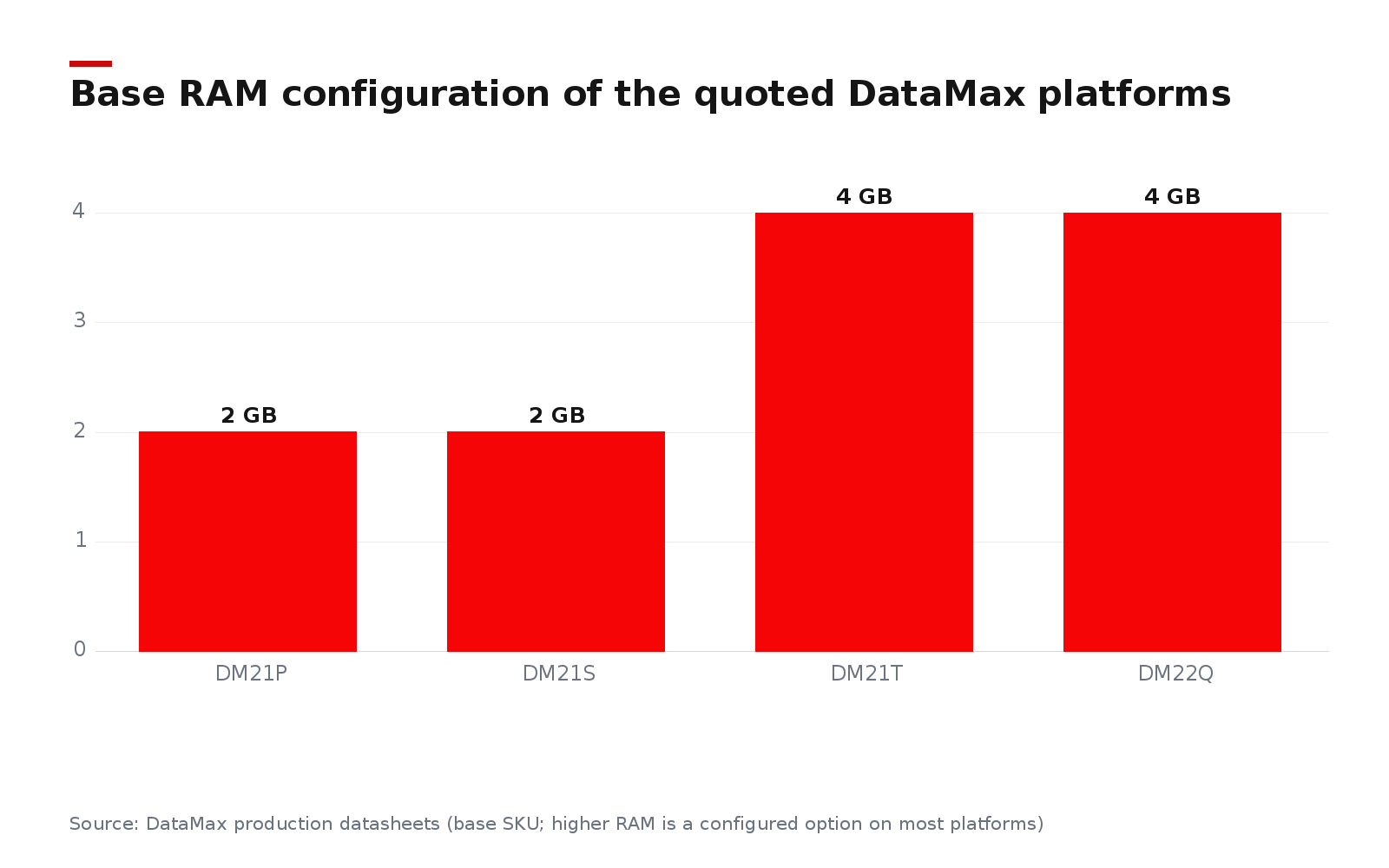
The same figures, in searchable form:
| Platform | Base RAM |
|---|---|
| DM21P | 2 GB |
| DM21S | 2 GB |
| DM21T | 4 GB |
| DM22Q | 4 GB |
The chart is a configuration floor, not a benchmark. For example, a 2GB unit may be appropriate for a tightly controlled IPTV image, while a 4GB unit may better tolerate a heavier launcher, background services, or gaming workload. The application test still decides suitability. If an android tv box proposal uses a higher RAM tier, record the exact RAM and ROM values against the SKU, then request a configuration-controlled sample for that build rather than assuming it behaves like the base unit.
How the requirement actually works
An IPTV or OTT product is the intersection of four contracts. The hardware contract defines the SoC, memory, interfaces, and power input. The media contract defines supported codecs, profiles, levels, frame rates, and output behavior. The content-protection contract defines DRM and HDCP obligations. The software-lifecycle contract defines the AOSP baseline, middleware integration, update responsibility, and the availability period for fixes.
The operating-system baseline changes integration risk. AOSP Android 11 and AOSP Android 14 are not interchangeable from an application-porting perspective. A buyer should require the exact build identifier, launcher or TV launcher behavior, device authorization, Google APIs status, middleware compatibility, and the party responsible for integration. Where Google certification, Widevine provisioning, Play Store delivery, or Android TV compliance is required, confirm against the production datasheet and certification plan rather than inferring it from an AOSP label.
DRM must be separated into security level and display path. Widevine L1, PlayReady, HDCP 2.2, Dolby Vision, and DTS are different obligations. “Optional” means the buyer must specify the selected package; it does not establish that every production unit carries that package. A practical acceptance record should capture the device identifier used for provisioning, the test service, the protected stream profile, and the display or output path used for validation.
Codec capability is also a chain rather than a single checkbox. Source encoding, decoder profile and level, display timing, HDMI mode, TV compatibility, and application rendering determine the outcome. The quoted 4K@60 or 4K@120 entries therefore need an acceptance stream and display fixture. H.264 4K@30 on DM21P and H.264 4K@60 on DM21T are materially different line items.
Memory configuration affects more than installed application count. On an operator device, the memory footprint includes the OS, middleware, telemetry, DRM processes, and background services. The quoted base configurations are 2GB/8GB for DM21P, 2GB/16GB for DM21S, and 4GB/64GB for DM21T and DM22Q. Optional tiers exist, so the PO must identify one exact configuration rather than refer to “the 4GB model” or “the high-memory version.”
The distinction between decode capability and display capability controls the validation method. A hardware decoder may support a listed profile while the application path, protected source, television, or installed middleware imposes another limit. For an android tv box acceptance plan, use a stream encoded with the exact profile and level, pair it with the intended HDMI mode, record the display model, and document the result. A test on a generic 4K@60 screen cannot validate a 4K@120 requirement.
Ethernet selection is equally specific. RJ45 100M is the quoted standard on all four DataMax models, while 1G is optional on DM21S, DM21T, and DM22Q. An operator should calculate the access-network path, middleware traffic, guide-data behavior, VOD profile, and local traffic pattern before requesting the optional assembly. A nominal interface label should not be used to promise an application throughput result.
Lifecycle ownership must also be separated by layer. The board supplier may control bootloader and BSP integration, the brand may own launcher and middleware, and the operator may own device authorization, provisioning, policy, or application delivery. Each layer needs a named owner and escalation path. Otherwise, an android tv box can pass factory acceptance yet lack a defined route for a bootloader fault, security patch, middleware regression, or licence-service change.
Two routes, one bill of differences
| Commercial and technical item | Standardized route | Capability-led route |
|---|---|---|
| Platform direction | DM21P or DM21S | DM21T or DM22Q |
| OS baseline | DM21P: AOSP Android 11; DM21S: AOSP Android 14 | DM21T and DM22Q: AOSP Android 14 |
| Base memory | DM21P: 2GB/8GB; DM21S: 2GB/16GB | DM21T and DM22Q: 4GB/64GB |
| Decode emphasis | DM21P: AV1 [email protected], VP9/H.265 4K@60, H.264 4K@30 | DM21T: VVC [email protected], AV1/VP9/H.265 and AVS3 at 4K@120; DM22Q: AV1/H.265 L5.1 4K@60 |
| Ethernet | 100M quoted; 1G optional on DM21S | 100M quoted; 1G optional on DM22Q |
| Procurement risk | Configuration ambiguity and middleware support window | Higher expectation density, thermal validation, and application-level performance proof |
The standardized route minimizes the number of variables that need separate technical approval. For a fleet with one middleware build, consistent DRM policy, and a stable television profile, DM21P is the operator-middleware option. DM21S extends that route to AOSP Android 14 and a larger quoted base ROM. The purchasing gain comes from reuse: one image recipe, one firmware branch policy, one installation process, and one evidence format across units.
The capability-led route starts with the media ceiling. DM21T is the relevant option when the requirement explicitly calls for 4K@120 decoding across its quoted codec list or H.266/VVC [email protected]. DM22Q is the gaming-oriented route with a quoted Amlogic S905X5M, quad Cortex-A55 up to 2.5GHz, 4GB/64GB base memory, and Dolby Vision/DTS listed as optional DRM. Neither route should be selected from the word “gaming”; both require an application benchmark, thermal test, and sustained-load acceptance.
The bill of differences should contain no generic quality language. For the standardized route, price the exact RAM/ROM, OS, DRM, Ethernet, and update-support scope. For the capability-led route, add the 120 Hz test fixture, 4K media acceptance set, thermal evidence, and the production image identifier. Any missing line remains a quotation divergence until the supplier confirms it in writing.
The commercial difference is operational reuse, not simply a lower specification. A standardized program can use one BOM revision, one device image, one packaging instruction, and one field-replacement procedure. A capability-led program may require separate image branches, display-specific validation, and an explicit list of excluded claims. A procurement comparison should therefore calculate the number of approved configurations, test procedures, firmware artifacts, and supplier escalations required per model.
One practical example is an ISP planning an IPTV launch with an optional OTT application. Selecting one controlled image for both workloads may reduce validation burden, but only if the memory tier, DRM package, Ethernet option, and codec list match. Adding a second SKU without a second acceptance profile creates two controlled products, not flexibility. The android tv box decision should be reviewed against deployment volume, operational reuse, and the cost of maintaining separate binaries.
Deployment scenarios and the spec each needs
| Deployment scenario | Primary requirement | Model direction | Specification line to freeze |
|---|---|---|---|
| IPTV operator | Middleware stability and operator deployment | DM21P direction | Amlogic S905Y4, AOSP Android 11, 2GB/8GB, Widevine L1, HDCP 2.2 option, RJ45 100M |
| OTT white-label program | Newer AOSP baseline and branded launcher | DM21S direction | Amlogic S905Y5, AOSP Android 14, 2GB/16GB, selected Dolby Vision/DTS package |
| Premium UHD service | High-frame-rate 4K codec set | DM21T direction | Amlogic S905X5, AOSP Android 14, 4GB/64GB, 4K@120 codec acceptance, 1G Ethernet option |
| Cloud-gaming venue | Decoder coverage, sustained application load, network behavior | DM21T direction | Exact codec profile list, Ethernet option, HDMI output mode, application benchmark |
| Gaming-oriented retail program | Gaming positioning with Android 14 and 4GB base memory | DM22Q direction | Amlogic S905X5M, 4GB/64GB, AV1/H.265 L5.1 4K@60, selected DRM package |
| Digital-signage integrator | Peripheral fit, stable image, power and recovery | Confirm against production datasheet | USB count and type, AV output, Ethernet, power input, kiosk recovery behavior |
An operator deployment needs the middleware image and DRM provisioning to be treated as part of the appliance, not as preinstalled assumptions. DM21P’s quoted RJ45 100M may align with the intended access-network design, but the buyer should confirm against the production datasheet. The acceptance plan should cover guide data, channel switching, rights handling, restart behavior, and recovery after network loss.
An integrator installing boxes in hospitality, retail, or signage environments needs physical interfaces and deterministic boot behavior to match the room design. The quoted models provide combinations of USB, AV, S/PDIF, TF, Ethernet, and wireless connectivity, but the exact external enclosure, power supply, mounting method, and signage application may fall outside the quoted facts. Confirm those against the production datasheet rather than deriving them from the SoC class.
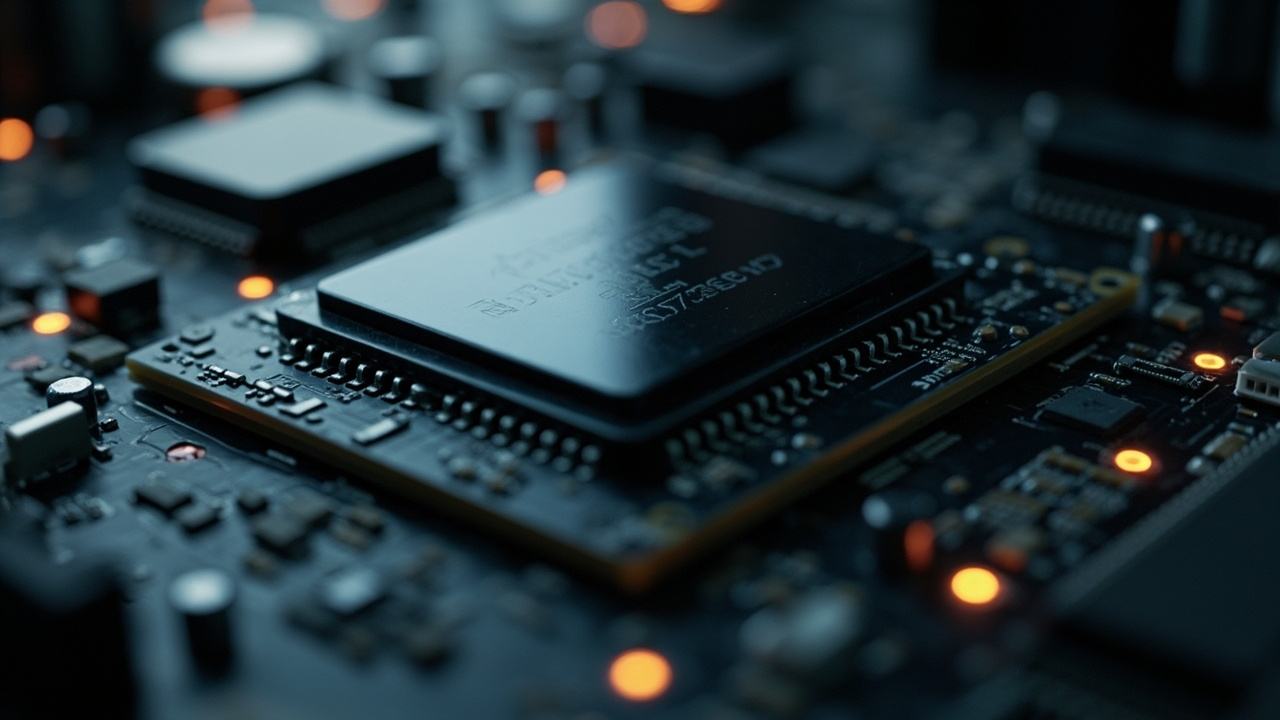
The photograph illustrates the practical scale of the selection decision: one board-level component anchors the processor, memory, power, storage, and connectivity choices that must survive across production lots.
A premium UHD or gaming venue adds a display-dependent acceptance layer. DM21T’s quoted 4K@120 decode figures require a television, source, and HDMI mode that support the intended presentation path. DM22Q’s quoted 4K@60 ceiling must be preserved in every launch artifact. For an ISP program covering both segments, separate SKUs and acceptance profiles are safer than forcing one platform across both workloads.
Scenario evidence should be written as a repeatable script. For IPTV, record channel-change time, guide retrieval, entitlement failure handling, restart recovery, and network-loss behavior on the target home network. For OTT, record launcher navigation, application install/update behavior, account state retention, and protected playback. For signage, define the permitted boot loop, USB or network source behavior, remote-management scope, and recovery method. These tests expose whether an android tv box fits the actual room or operator workflow rather than the laboratory configuration.
What goes wrong after the PO
The most frequent post-PO failure is configuration drift. A quotation may name a platform and list 4GB, 16GB, or 64GB without identifying whether that represents the base SKU or an optional tier. If engineering, procurement, and the factory use different meanings for “standard” or “high version,” the received units may differ from the approved sample. Freeze the RAM/ROM, storage type if applicable, OS image, Ethernet speed, and DRM package as separate PO lines.
Field trap
A codec claim is not a lifecycle control. If the datasheet ceiling is 4K while sales material carries an 8K label, the PO and approval artwork must state 4K. Otherwise, the factory can build a compliant device against the technical specification while the channel creates an unsupported expectation.
Another failure occurs when DRM is listed as optional but not selected. The quotation may appear compliant until a device cannot initialize the required licence path. Specify Widevine L1, PlayReady, HDCP 2.2, Dolby Vision, and DTS independently because each has a different approval and test route. Record the provisioning owner and production secret-handling boundary; those details are operational controls rather than marketing labels.
Field trap
An Ethernet 1G option is not equivalent to a standard RJ45 100M configuration. If the application, middleware, or deployment network assumes gigabit Ethernet, mark 1G as mandatory on DM21S, DM21T, or DM22Q rather than “optional preferred.”
Firmware availability is the third major risk. AOSP Android 11 baseline and AOSP Android 14 baseline create different software maintenance demands. A buyer should require the update owner, supported security-fix process, image-retention rule, and escalation route. Do not infer a promised update period from the OS name; confirm it against the production datasheet and the supplier’s written lifecycle statement.
Finally, sample-to-fleet differences often begin below the user interface. A different memory supplier, boot image, Wi-Fi module, tuner arrangement, or firmware branch can alter qualification time even when the enclosure is unchanged. The sample must therefore be locked by configuration identifier, and the factory must demonstrate that the same controlled build produces the submitted units.
Thermal behavior is another common quotation divergence. A decoder profile listed at 4K@120 does not establish that every cabinet, power adapter, room temperature, and continuous session will sustain the intended mode. For a high-refresh android tv box program, define the test duration, ambient condition, display mode, source profile, and failure criterion. The buyer should also decide whether a recovered thermal event must trigger replacement, investigation, or a software limitation notice.
Certification scope can drift in the same way. Hardware similarity does not prove that every SKU, memory tier, or firmware image is covered by the same evidence. The PO should identify which certifications are required, which model and configuration they cover, and whether changing the OS image or wireless assembly invalidates any part of that scope. Request the underlying document or laboratory record rather than a portfolio-level statement.
How to choose, step by step
- Start with the workload Write whether the unit serves operator IPTV, white-label OTT, premium UHD, cloud gaming, gaming-led retail, or signage. Do not let one requirement list span incompatible display or middleware targets.
- Fix the media contract Name every required codec, profile, level, frame rate, DRM component, HDCP path, and television mode. Use the quoted platform ceilings to shortlist rather than to infer output beyond the datasheet.
- Choose the platform direction Select DM21P for the quoted operator-middleware fit, DM21S for the quoted white-label fit with AOSP Android 14, DM21T for the quoted premium UHD and 4K@120 capability, or DM22Q for the quoted gaming-oriented fit. Confirm unresolved details against the production datasheet.
- Freeze the configuration Name one RAM/ROM combination, Ethernet speed, Wi-Fi/Bluetooth configuration, port set, power input where quoted, DRM package, and OS build. Replace “equivalent,” “optional,” and “high version” with exact values.
- Define the acceptance sample Include a labelled sample, its configuration identifier, test streams, display and network fixtures, boot time, reboot recovery, thermal procedure, middleware workflow, and DRM test record.
- Write the lifecycle boundary Assign responsibility for bootloader, AOSP integration, middleware, security updates, app compatibility, device provisioning, and production image retention. Obtain written confirmation rather than relying on generic update language.
- Release the RFQ Use the sample request form or the inquiry form. The first message should contain the deployment scene, workload, exact platform candidate, RAM/ROM, OS baseline, codec and DRM requirements, Ethernet speed, port needs, lifecycle-owner split, and required test evidence.
The RFQ should contain pasteable specification lines rather than prose. Example: “Model: DM21T; SoC: Amlogic S905X5; OS: AOSP Android 14; RAM/ROM: 4GB/64GB; required decode: AV1/VP9/H.265 4K@120 and H.266/VVC [email protected] 4K@120; Ethernet: 1G required; output: HDMI 2.0b, no HDMI input; DRM: Widevine L1 and PlayReady required; update and provisioning responsibilities: to be stated.” A separate line should identify every optional feature not selected, preventing it from being inferred later.
A second example illustrates the value of exact wording. “Model: DM21S; SoC: Amlogic S905Y5; OS: AOSP Android 14; RAM/ROM: 2GB/16GB; Ethernet: RJ45 100M; decode: AV1 / H.265 [email protected] 4K@60; DRM: Widevine L1 and PlayReady selected; Dolby Vision/DTS excluded unless separately approved; power, enclosure, and mounting: confirm against the production datasheet.” This format exposes every unresolved item without turning it into a presumed specification.
The final gate should be a signed configuration record rather than a verbal approval. Attach the datasheet, BOM identifier, image identifier, sample label, test results, packaging revision, and document the person authorized to approve a future change. This is especially important when the android tv box program uses an optional RAM or Ethernet tier: the approved baseline must remain visible to engineering, procurement, and the factory.
For broader platform education, the android tv box guide for ISPs explains the canonical selection context; the comparison here adds Amlogic model differentiation, lifecycle boundaries, and supplier-evidence requirements. The 4K 60fps Android TV box guide helps determine whether a 60 Hz media ceiling is sufficient before the buyer commits to a higher-refresh platform.
Questions to put in the supplier review
The supplier review should turn variables into records. Ask for the controlled model and configuration identifier behind the quotation, the SoC marking verification method, the exact base and optional memory configuration, the OS image identifier, the DRM production process, and the build-control plan. These records allow procurement to compare a production proposal with an approved sample rather than compare product names.
- SMT evidence Request the material list, stencil and paste records, placement records, and deviation approvals relevant to the SoC, memory, storage, network, and wireless components.
- AOI evidence Request the inspection recipe, inspection coverage, defect disposition, and re-test record for the approved board configuration.
- Functional and dark-room evidence Ask for display output tests, audio path tests, Ethernet and wireless checks, USB enumeration, storage read/write checks, and the dark-room evidence used for the configured camera or display subsystem, where applicable to the production build.
- Aging evidence Request the burn-in or aging sample plan, load profile, duration, environmental condition, failure criterion, and quarantine rule for failed units.
- Audit trail Require traceability from incoming material through SMT, AOI, firmware loading, functional test, aging, packing, and shipment, with a defined record owner and retention period.
- Change notification Request advance approval requirements for SoC, memory, storage, network, wireless, power, PCB, firmware, middleware, and packaging changes.
Review output: a configuration-controlled evidence pack that links the submitted sample, production build, and shipment records. DataMax can coordinate factory review and sample preparation against the quoted platform, but the buyer must define the workload and acceptance conditions in the RFQ.
The audit should answer a simple chain of custody: which hardware revision was built, which components were fitted, which image was installed, which test record proves the result, and which serial identifier links that record to the shipment. A statement that quality control passed is not a substitute for the underlying trace.
Ask specifically how the factory prevents an approved 2GB/8GB sample from becoming a different RAM tier, or how an optional 1G Ethernet assembly is controlled. The answer should identify configuration verification at a defined production stage, not rely on visual inspection alone. The factory’s quality process and compliance evidence can form part of the review, while applicable certification scope should be confirmed against the production model.
Require a sample record that can be reconciled in both directions. Procurement should trace a serial identifier from packing back to its test record; engineering should trace a test record back to the installed firmware and component configuration. If those directions do not meet, the evidence pack cannot resolve a field failure efficiently. The android tv box supplier should also state how replacement samples are selected: an approved golden sample, a newly built unit from the current lot, or a unit selected from finished stock.
A practical close-out record should contain the approved datasheet, labelled photograph of the sample, exact component and memory configuration, OS build, media test matrix, DRM evidence, port and network results, packaging specification, lifecycle responsibility matrix, and change-control commitment. For a broader build request, the DataMax manufacturing discussion can begin the factory review, while certification information helps identify which documents require formal validation. The custom development discussion is relevant when the operator middleware, launcher, provisioning process, or enclosure requires a controlled change beyond the quoted base platform.
Further reading
- Guide android tv box for isps
- Widevine L1 certification guide
- Dolby Atmos Android TV box guide
- TV box vendor selection checklist
- AOSP vs GMS solution notes
- DataMax DM21P specifications and fit
- DataMax DM21S specifications and fit
FAQ
Which DataMax platform should an ISP choose for IPTV?
The DM21P is the direct fit in the quoted range because it is positioned for 4K IPTV and operator middleware set-top boxes. It uses the Amlogic S905Y4, AOSP Android 11, and a quoted 2GB/8GB base configuration. The final selection still depends on middleware compatibility, DRM selection, Ethernet design, television requirements, and firmware support ownership.
Is a higher RAM configuration automatically better?
No. Higher RAM may reduce pressure when the OS, middleware, DRM processes, and application compete for memory, but it does not prove better sustained performance. Freeze the exact RAM/ROM combination in the PO. The available optional tiers include 4GB and 16/32/64GB on DM21P, 2/4/8GB and 16/32/64GB on DM21S and DM22Q, and family options on DM21T.
Does the DM21T support 8K output?
The quoted datasheet caps DM21T output and decode at 4K, including listed 4K@120 capabilities for selected codecs. Do not claim 8K output. DM22Q likewise has a quoted maximum of 4K@60. Procurement artwork, middleware copy, and operator documentation should use the production datasheet limits.
What should be included in an Amlogic platform RFQ?
Include the model, SoC, RAM/ROM, Android baseline, codec profile, DRM package, Ethernet speed, ports, connectivity, power input where applicable, update responsibility, provisioning owner, sample configuration, test evidence, and change-control process. Optional features must be marked either required or excluded. Send these lines through the inquiry form.
How can a buyer prevent sample-to-production drift?
Lock the sample by configuration identifier and require manufacturing traceability across component fitting, SMT, AOI, firmware loading, functional test, aging, packing, and shipment. Ask the factory to explain how RAM tier, Ethernet speed, wireless module, SoC, and firmware branch are verified. A visual match to the sample is insufficient for a controlled production program.
Which guide helps compare AOSP and certified Android TV?
The AOSP versus Google Android TV guide helps decide the software baseline and distribution route. It complements this model comparison by separating OS-level obligations from the quoted hardware and media capabilities.