
The procurement answer in one screen
Before signing an Android TV box quotation, confirm six items: SoC identity, operating-system baseline, memory configuration, licensed DRM, physical I/O, and the exact video profiles the pipeline will deliver. These fields determine whether the device fits an IPTV service, OTT application, gaming workload or commercial installation. android tv box what-is is therefore a terminology check, not a chipset shopping exercise: “Android TV box” describes a device category, while the procurement-grade definition is a specified Android platform with declared compute, media, security, connectivity and lifecycle evidence.
The Amlogic S905X3 name in the query is a generation term, not a sufficient product specification. Confirm the exact processor variant, Android release, AOSP or Google TV designation, RAM/ROM options, Widevine level, output mode and required interfaces against the production datasheet. A supplier that says “Android TV” without stating AOSP Android 11, AOSP Android 14 or another explicit baseline has not closed the operating-system requirement.
For IPTV, also verify Widevine L1 or the required PlayReady configuration, AV1/H.265 decoding at the intended frame rate, and HDCP where protected output is required. For commercial use, demand production traceability, SMT/AOI records, burn-in or aging evidence and a controlled firmware-update path. The short answer to android tv box what-is is: an Android-based TV endpoint whose software and hardware must be specified together, with every operational claim tied to a datasheet, test record or contractual acceptance criterion.
Field rule
Write chipset, OS baseline, RAM/ROM, DRM, codec ceiling, output interface and connectivity in the same specification line. A nameplate or marketplace attribute list is not a production acceptance record.
A practical example shows why this matters. An operator can provision a unit with the wrong OS release, but the middleware may require a specific Android baseline. A distributor can approve a launcher image, but the resulting boot sequence may not match the production build. A venue can receive a device with the wrong Ethernet option, and the playback failure then appears to be an application defect rather than a configuration error. The same six checks prevent different departments from accepting different meanings of “Android TV box.”
The final sign-off question is simple: can every claim in the quotation be traced to the production datasheet, a selected option line, or an agreed test record? If not, the buyer has a category name rather than a purchasable platform. That distinction is the central answer to android tv box what-is and should govern the rest of the RFQ.
Options placed side by side
The main buying distinction is the depth of product commitment: logo customization, launcher customization, a maintained firmware branch, or a joint hardware/software ODM program. Each deeper tier changes the evidence the buyer must hold. Logo print requires visual proof but not a software release branch. Boot-logo and launcher work requires a defined user-experience boundary. Firmware branching requires version control, update ownership and regression criteria. A joint hardware/software ODM engagement adds schematic, PCB, sourcing, certification and production-control responsibilities.
| Option | Core scope | Evidence required | Primary procurement exposure |
|---|---|---|---|
| Logo print only | Exterior branding | Artwork proof and sample inspection | Brand mismatch or print-position dispute |
| Boot logo plus launcher | Startup and home-screen presentation | Approved images, launcher build and device samples | Update conflicts and inconsistent behavior |
| Firmware feature branch | Operator-specific software line | Branch ownership, build records and regression results | Fragmentation and upgrade responsibility |
| Joint hardware/software ODM | Board, enclosure, firmware and deployment program | Design, sourcing, certification and factory-control records | Change control, qualification and launch timing |
The following editorial scale ranks planning depth, not engineering performance or audited production results.
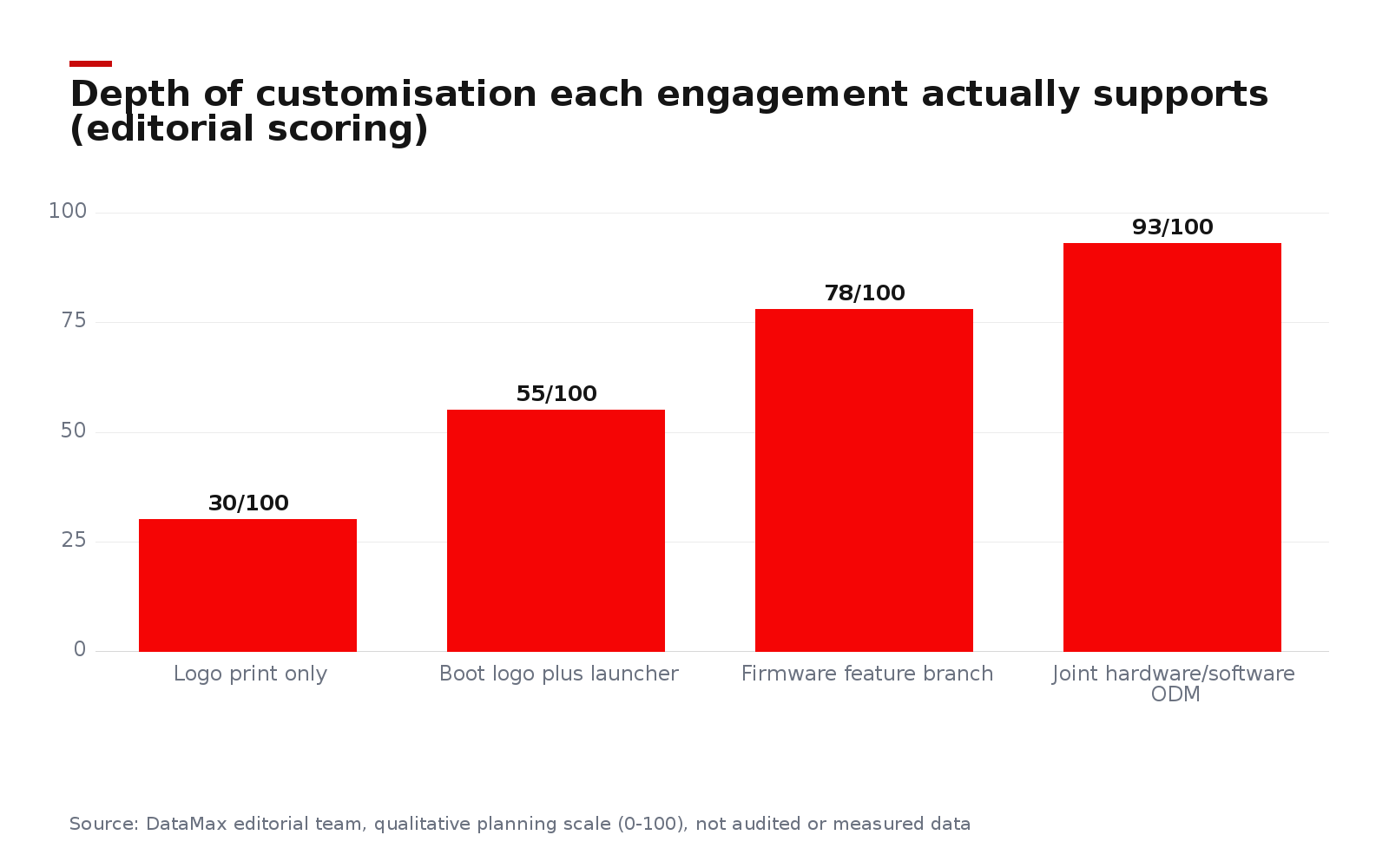
The same figures, in searchable form:
| Engagement model | Editorial score |
|---|---|
| Logo print only | 30/100 |
| Boot logo plus launcher | 55/100 |
| Firmware feature branch | 78/100 |
| Joint hardware/software ODM | 93/100 |
A procurement example shows the difference. A distributor ordering branded shells can approve an exterior image and inspect a sample. A pay-TV operator needs a controlled application build, middleware integration, DRM provisioning and an OTA update path. The first order can close through artwork approval; the second cannot close until the software acceptance matrix identifies device, connection, playback, update and recovery tests. This establishes the boundary for android tv box what-is: category language establishes the device, while contract language establishes the commitment.
The choice also changes the buyer’s evidence burden. Logo print requires a controlled artwork revision and a golden sample. Launcher work requires boot-order behavior, screen assets, localization and update-regression criteria. A firmware branch requires a named baseline, build cadence, security-patch responsibility and a supported-device registry. A joint ODM program adds component substitutions, engineering-change control, enclosure tooling, certification ownership and production yields. A brand owner should select the engagement depth that matches the operational risk, not the depth that appears in the most elaborate proposal.
Definitions a buyer cannot outsource
Amlogic S905X3 identifies a processor family position. It does not establish the operating system, memory, wireless configuration, licensed DRM, port arrangement or thermal design of the finished box. A buyer must distinguish a processor name from a platform name and from a production SKU. The processor line belongs in the bill of materials; RAM/ROM, storage, connectivity and software belong in the product specification.
AOSP Android 11 and AOSP Android 14 identify Android platform baselines without, by themselves, establishing Google TV certification or access to Google Play. AOSP builds can support operator middleware, OTT applications and controlled enterprise distribution. Where a program depends on Google applications or a particular commercial Android TV distribution, the requirement needs separate confirmation against the production datasheet.
Widevine L1 is a Widevine security level designation commonly relevant to premium streaming. PlayReady identifies a separate DRM ecosystem. HDCP 2.2 concerns protected digital output and must be reconciled with the declared HDMI implementation and source path. A chipset decode list does not prove that the retail device has a valid Widevine device-level license, a PlayReady implementation, or a specified HDCP output mode.
AV1, VP9, H.265/HEVC, H.264, H.266/VVC and AVS3 are video coding standards. Profile, level, resolution and frame rate form one compatibility statement. “4K” alone is incomplete. A buyer needs, for example, the stated combination of codec, Main profile or Main10 profile, level, resolution and frame rate, followed by an acceptance stream containing that exact format.
HDMI 2.0b identifies the output interface claimed by the product facts. It does not by itself establish 4K120 capability, HDR format negotiation, input functionality, HDCP behavior or the complete end-to-end playback envelope. The DataMax DM21T specification includes HDMI 2.0b output and explicitly states no HDMI input; output and input must not be conflated.
Wi-Fi 6, BT5.4, RJ45 100M and optional 1G Ethernet describe interface classes. They do not settle antenna layout, regulatory certification, driver support, multicast behavior, IPTV transport acceptance or VLAN handling. Those deployment properties need their own test evidence.
OTA is the update path for changing firmware, configuration and applications. Its existence is different from safe update behavior. Specify target scope, staging policy, failure recovery, signature or authorization controls, version reporting, rollback expectations and who owns field support. This is the operational meaning behind android tv box what-is when the device must remain deployed in the field rather than merely complete a showroom demonstration.
Two more procurement terms need precise treatment. “Media support” describes decode capability, not necessarily display capability: the source can be decoded while the selected output mode, display, cable and sink cannot accept the intended resolution or frame rate. “Memory” separates volatile RAM from persistent storage; application cache, log volume, OTA staging space and local content determine whether the declared ROM is operationally sufficient. Neither phrase should be reduced to a number in a catalogue without a workload assumption.
The definitions also apply to system boundaries. An Android build can support a launcher, middleware and an update client, yet the commercial service may also require provisioning, entitlement, telemetry, middleware authentication and recovery behavior. Ask whether those functions are implemented by the platform, the operator, a middleware vendor or an application partner. This ownership map is more useful than a generic “full Android” description because it determines who must correct an integration failure.
Real DataMax platforms, field by field
The available DataMax product facts show four distinct platform directions. They should be compared by workload and commercial fit, not by an “8K” marketing label. The production datasheet remains the controlling document where a configuration or option is not stated.
| Model | Fit | SoC | OS | RAM / ROM | DRM and media | Ports and connectivity |
|---|---|---|---|---|---|---|
| DM21P | 4K IPTV / operator middleware set-top box | Amlogic S905Y4, quad Cortex-A35 | AOSP Android 11 | 2GB / 8GB; 4GB; 16/32/64GB optional | AV1 [email protected]; VP9/H.265 4K@60; H.264 4K@30. Widevine L1 / PlayReady / HDCP 2.2 optional | HDMI 2.0b out x1; USB2.0 x2; TF; S/PDIF; 3.5mm AV; RJ45 100M; Wi-Fi6 2x2 + BT5.4; DC 5V/2A |
| DM21S | 4K Android TV box for IPTV/OTT white-label | Amlogic S905Y5, quad Cortex-A55 | AOSP Android 14 | 2GB / 16GB; 2/4/8GB; 16/32/64GB optional | AV1 / H.265 [email protected] 4K@60. Widevine L1 / PlayReady optional; Dolby Vision/DTS | HDMI 2.0b out; S/PDIF; AV; USB2.0 x2; TF; RJ45 100M (1G optional); Wi-Fi6 2x2 + BT5.4 |
| DM21T | Premium UHD / cloud-gaming box | Amlogic S905X5, quad Cortex-A510 (ARMv9) | AOSP Android 14 | 4GB / 64GB; family options | H.266/VVC [email protected] 4K@120; AV1/VP9/H.265 4K@120; AVS3 4K@120; H.264 4K@60; inline AI-SR. Widevine L1 / PlayReady optional | HDMI 2.0b out, no HDMI in; USB2.0 x1 + USB3.0 x1; TF; S/PDIF; AV; RJ45 100M (1G opt); Wi-Fi6 + BT5.4 |
| DM22Q | Gaming-oriented Android TV box | Amlogic S905X5M, quad Cortex-A55 up to 2.5GHz | AOSP Android 14 | 4GB / 64GB; 2/4/8GB; 16/32/64GB optional | AV1/H.265 L5.1 4K@60; inline AI-SR, with no NPU TOPS stated. Widevine L1 / PlayReady optional; Dolby Vision/DTS | HDMI 2.0b out; USB2.0 x2; TF; S/PDIF; AV; RJ45 100M (1G opt); Wi-Fi6 2x2 + BT5.4 |
DM21P is the operator-oriented baseline in the supplied facts: AOSP Android 11, Amlogic S905Y4 and optional Widevine L1, PlayReady and HDCP 2.2. DM21S moves to AOSP Android 14 with Amlogic S905Y5 and a white-label IPTV/OTT fit. DM21T and DM22Q share AOSP Android 14 and Amlogic S905X5-family processors, but their media envelopes differ: DM21T lists H.266/VVC [email protected] 4K@120 plus AV1, VP9, H.265 and AVS3 at 4K@120, while DM22Q lists AV1/H.265 L5.1 4K@60.
The port evidence changes procurement decisions as much as codec support. DM21P explicitly includes two USB2.0 ports, 100M RJ45, a TF slot, S/PDIF, 3.5mm AV and HDMI 2.0b output. DM21S provides a different memory baseline and makes 1G Ethernet optional. DM21T provides one USB2.0 and one USB3.0 port but no HDMI input. DM22Q provides two USB2.0 ports and optional 1G Ethernet. A buyer should not select by decoder headline alone; the required peripheral path must match the confirmed port list.
Do not translate any product name into an 8K claim. The supplied DM21T and DM22Q facts cap the stated output/decode envelope at 4K; the production datasheet must control. For every model, optional means optional: do not order against it until the supplier confirms the exact production configuration. The terminology underlying android tv box what-is becomes procurement-ready only when every optional statement has been converted into a selected line item.
The operator, the integrator and the venue
Operators, integrators and venue owners ask similar platform questions but accept different risk models. An operator focuses on service continuity, middleware, entitlement, multicast transport, DRM and fleet updates. An integrator focuses on display connection, control, mounting, network behavior and installation repeatability. A venue owner focuses on signage playback, peripherals, operating hours, recovery after power loss and support access.
| Situation | Primary requirement | Verification priority | Model direction |
|---|---|---|---|
| • Pay-TV/IPTV operator | • Operator middleware, managed DRM and controlled updates | • Middleware integration, licence provisioning, OTA recovery | • DM21P for AOSP Android 11 operator middleware, or DM21S for AOSP Android 14 |
| • OTT distributor | • White-label launcher, Widevine L1 and streaming formats | • App playback, account flow, 4K60 stream and update behavior | • DM21S |
| • AV/IT integrator | • Stable HDMI output, Ethernet, control and installation fit | • Display matrix, EDID behavior, reboot and peripheral tests | • Select by confirmed ports and installation environment; confirm against the production datasheet |
| • Gaming-oriented program | • Higher media envelope, responsiveness and feature integration | • Exact codec/frame-rate acceptance, input latency methodology and sustained behavior | • DM21T for stated 4K@120 media support |
| • Digital-signage venue | • Persistent playback and recovery after power interruption | • Scheduled launch, app state, cache policy and reboot evidence | • Choose a platform whose confirmed configuration matches the player application |
A practical example exposes a specification gap. A venue might assume that a box named for premium UHD supports every advertised UHD format. The correct procurement action is to submit a test matrix containing AV1, VP9, H.265, H.266/VVC, AVS3 and H.264 streams at the required resolution and frame rate, then require the selected platform’s exact declared support. For DM21T, the supplied facts identify a 4K@120 envelope for several codecs; for DM22Q, they identify AV1/H.265 L5.1 4K@60.
The same scene requires network discipline. A multicast IPTV endpoint and a signage player have different traffic patterns, even if both use Android. Specify source addresses, transport behavior, DHCP or static addressing, DNS, multicast handling and VLAN expectations where applicable. The direct interpretation of android tv box what-is in this section is role-specific: the box is a managed endpoint, an integration target or a venue appliance, and each role demands a different acceptance test.
The integrator adds physical constraints that are easy to omit from a technical comparison. HDMI direction, USB generation, Ethernet speed, audio output, power method, mounting orientation and cable routing can determine whether an otherwise capable device is installable. A display wall program should record the target display’s accepted input modes, EDID behavior and resolution timeout policy. A hospitality program should test remote-control behavior, account login, channel retention and recovery after a forced restart.
The venue owner adds operating constraints. Digital-signage schedules often rely on deterministic launch after power restoration, local media availability, cache control and unattended operation. An operator may instead prioritize entitlement persistence, network reconnection and staged firmware rollout. These are separate acceptance matrices even when both use the same AOSP baseline. The platform name is shared; the definition of acceptable service is not.
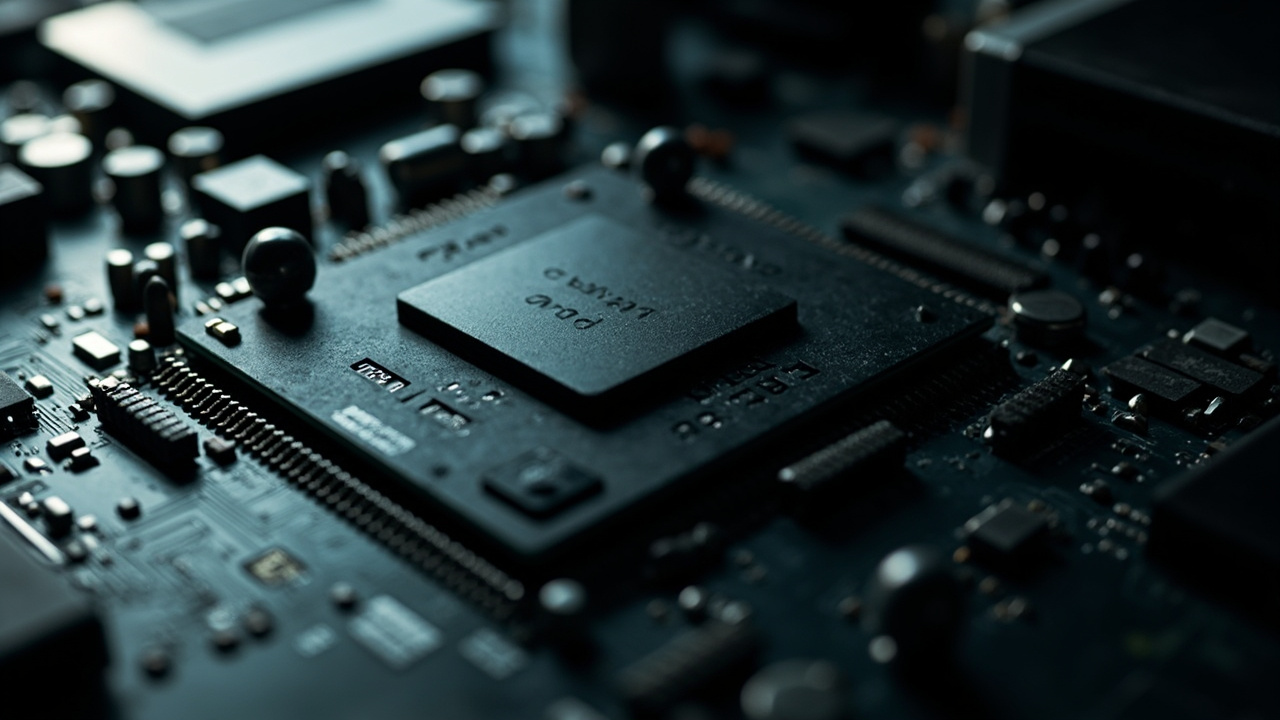
The visible SoC package is only one layer of the procurement decision. Memory, regulators, Ethernet, wireless modules, connectors and thermal components influence the finished behavior, while software configuration determines whether those capabilities are exposed and validated.
A good site survey closes those gaps before sample approval. Record the display model and firmware, available input, preferred network connection, power outlet, peripheral inventory, room temperature, maintenance window and service-access route. Then tie each observed condition to an RFQ line or an acceptance test. This prevents a generic sample demonstration from becoming the unverified definition of the production installation.
How to choose, step by step
Start with the workload, not the processor generation. Define the service, screen, network, DRM, codec, peripheral and update requirements. Then select the model direction, exact configuration and evidence package. This sequence prevents a familiar chipset name from becoming an unexamined default.
A pasteable RFQ line should follow this structure:
Supply the exact production model and configuration; state SoC, AOSP or other OS baseline, selected RAM/ROM, selected DRM, supported codec-profile-level-resolution-frame-rate combinations, HDMI output/input, USB, Ethernet, wireless and audio interfaces; provide firmware update and recovery scope; include factory traceability, AOI, functional-test and aging evidence for the shipment.
The first message in an RFQ for this topic should contain the deployment role, target screen and network, OS baseline, required DRM, accepted codec matrix, mandatory ports, expected configuration and evidence required. Request samples through the sample-order route only after that line is written, because an unconfigured sample cannot validate a production variant.
The first RFQ message should also separate mandatory from desirable requirements. Mark the selected codec combinations, output direction, Ethernet speed, selected DRAM and storage, DRM implementation, operating system baseline and update ownership as mandatory. Keep alternatives such as 1G Ethernet or additional storage in a clearly identified option line. This prevents a quoted model from appearing compliant merely because it offers several related configurations.
Validate the sample against the same sequence used in the RFQ. Check physical ports, boot behavior, application installation, account flow, network reconnection, media playback and update recovery. Record the firmware build and selected options on the sample record. If the sample differs from the requested configuration, resolve that difference before the acceptance matrix is approved; otherwise the test result cannot be transferred to the production shipment.
This decision method clarifies android tv box what-is in eight controllable fields: identity, OS, memory, media, security, interfaces, fleet management and evidence. For broader term definitions, use the canonical best Android TV box glossary and index as the indexing reference.
What goes wrong after the PO
The most common post-PO failure is semantic drift: a sales sheet resolves into a specification that procurement, engineering and the operator interpreted differently. “Android TV” may become AOSP Android 14 in one document and Google TV in another. “Widevine supported” may become Widevine L1 in an acceptance plan. “4K” may become 4K60 for AV1 and 4K120 for H.265. Each substitution changes test results and can invalidate certification assumptions.
Field trap
An 8K marketing name is not evidence of 8K output. The supplied DM21T and DM22Q product facts cap the declared envelope at 4K. If a quotation, packaging or portal record claims 8K, hold release until the production datasheet and tested output evidence resolve the conflict.
Another failure occurs when optional DRM becomes an assumed entitlement. Widevine L1, PlayReady, Dolby Vision and DTS appear in product facts with optional qualification. A project that requires one of them must name it in the purchase order and receive a device-specific implementation record. “DRM-ready” is too weak because it does not identify the security level or the licensing and provisioning path.
Interface naming creates a third failure class. USB2.0 and USB3.0 differ materially for storage or peripheral behavior; RJ45 100M and optional 1G differ for network design; HDMI output and HDMI input are not interchangeable. A count such as “three USB ports” may also conceal a missing USB3.0 requirement. Specify count, generation, connector form, host/device role and intended use.
Firmware ownership can fail after shipment. A launcher customized for a white-label launch may conflict with a security patch, regional build or OTA campaign. Without a named branch owner, build number and update sequence, the device can lose the launcher, entitlement integration or operational configuration. The cost is not only replacement inventory: it includes retesting, field dispatch, subscriber interruption and delayed content operation.
A fourth failure is version drift across procurement, engineering and the supplier. The purchase order may name one RAM/ROM configuration while the quotation sheet lists a family range and the factory record points to another build. The error can remain hidden until storage pressure, update failure or a media cache problem appears. Correct it by attaching a configuration code to each line and requiring that code in the build record, test record and shipment label.
A fifth failure involves acceptance streams that do not represent production. A laboratory clip may omit the operator’s DRM entitlement, audio path, network source or display mode. The device then passes a generic test but fails in service. Acceptance material should state content protection, codec, profile, level, resolution, frame rate, audio, display and network conditions. The result must apply to the exact firmware and configuration being delivered.
The procurement meaning of android tv box what-is must therefore include traceability. An unresolved name or option creates ambiguity; an unresolved acceptance criterion creates a dispute. Capture exceptions against a specific production configuration and require closure before the purchase order reaches manufacturing.
Verification you can ask for on paper
Factory verification should connect the ordered SKU to the inspected hardware and released firmware. The evidence chain should allow a quality engineer to trace a serial-numbered sample from SMT and inspection through functional testing, aging and shipment release. Generic statements that the line is “100% tested” do not establish that chain.
Evidence request
Ask DataMax for a video factory audit or a package of SMT, AOI, aging and shipment-release evidence specific to the selected model and configuration. The request should identify the exact DataMax platform, required DRM, OS baseline and test streams so the evidence is relevant rather than generic.
The DataMax factory-quality evidence should answer which line performed each test, which revision was tested, what pass criteria applied, what sample population was used and how deviations were dispositioned. A dark-room check, where used by the production process, should have a defined scope: display artifacts, backlight condition, image retention or another approved visual criterion. The buyer should not assume that every model uses every listed process.
For the software side, request the exact firmware build identifier, update instructions, recovery procedure, application version and configuration export. Pair those documents with the hardware build record. A firmware image that works on the sample but lacks traceability to the production hardware can create more operational risk than an undocumented configuration.
An audit request should be tied to the acceptance matrix. For an operator, request the middleware build, provisioning record and update-recovery procedure. For a distributor, request the approved launcher and splash assets. For a venue, request the scheduled-launch configuration and power-recovery test. For a gaming-oriented program, request the exact media streams, display mode and sustained-playback procedure. One generic factory packet cannot answer all of these questions.
The release file should also state exceptions. If a test was waived, a component was substituted under an approved change, a sample was repaired or a configuration was downgraded, that exception needs a disposition and an owner. An accurate exception trail is stronger than a packet showing only passing records, because it tells the buyer what was not covered.
This evidence package completes the decision-grade answer to android tv box what-is: the definition is not merely “a box that runs Android,” but a controlled product configuration whose chipset, OS, media, DRM, interfaces, update mechanism and manufacturing evidence are mutually consistent. For factory support, invite DataMax to review the evidence through the manufacturer page and state the selected configuration, mandatory ports, DRM choice and acceptance streams.
Further reading
- Best Android TV Box: Glossary and Index of Selection Terms
- Edge computing boxes
- 4K 60fps Android TV box guide
- Rockchip Android TV box guide
- Dolby Vision Android TV box guide
- DataMax DM21P specifications and fit
- DataMax DM21S specifications and fit
FAQ
What does “Android TV box” mean in procurement?
It means a TV endpoint running an Android platform, but the phrase alone is not a purchasable specification. Procurement should require the exact processor, AOSP or Google TV designation, Android release, RAM/ROM, DRM, media formats and interfaces. This defines android tv box what-is at specification level.
Does an Amlogic processor guarantee 4K or Widevine L1?
No. A processor name does not establish the finished device’s complete output envelope, licensed DRM level, application integration or production configuration. Require the selected model’s datasheet, exact option selections and an acceptance test using the intended codec streams.
Is AOSP Android 14 the same as Google TV?
Not necessarily. AOSP Android 14 identifies an Android platform baseline, while Google TV is a separate distribution and certification context. Confirm the actual production software, included applications, update path and certification status against the production datasheet.
Why do quotations disagree about USB, Ethernet and HDMI?
Quotations often list interface families without counts, generations, directions or selected options. Specify USB2.0 versus USB3.0, RJ45 100M versus optional 1G, and HDMI output versus HDMI input. These distinctions affect peripherals, network design and installation acceptance.
What evidence should accompany an Android TV box shipment?
Request a build identifier, authorized BOM reference, SMT and AOI records, functional-test results, aging evidence, deviation approvals and firmware traceability. The records must match the exact model and configuration shipped, rather than describing a generic production line.
Can a buyer validate custom launcher and OTA behavior before volume?
Yes. Define launcher screens, startup behavior, application flows, update staging, failure recovery and version reporting as acceptance criteria. Validate them on approved samples with the production firmware before authorizing the volume configuration.




