

Before the terminology: the purchasing decision
“Wholesale” describes the transaction structure, not a technical platform category. For a retail kiosk network, the decisive requirement is a repeatable hardware baseline that can boot under central control, render the intended content, survive daily operating hours, and return a clear fault signal. The relevant question is not whether a box is “commercial grade,” but whether its production configuration, operating system, device management, connectivity, and test evidence can support the same rollout across every site.
android tv box wholesale therefore means more than obtaining units at volume. It means locking the bill of materials, identifying which options require written approval, defining the burn-in and inspection sequence, and prescribing replacement behavior. The wholesale Android TV box topic covers the broader commercial framework; this page narrows that framework to retail kiosk networks.
For a fixed-display retail deployment, DataMax DM21P is the operator-oriented starting point: it is fitted as a 4K IPTV and operator middleware set-top box. A white-label OTT fleet may instead fit the DM21S profile. Gaming-led environments require a separate decoding and input comparison. The initial sourcing decision should therefore assign each site to a device role before requesting samples, rather than send one proposed configuration to every operator.
The purchase order should identify one model family, one exact production configuration, one firmware baseline, one control-plane method, and one inspection procedure. Those five records prevent the supplier from treating “same box” as an interchangeable commercial description. For example, a 100M Ethernet requirement and a 1G Ethernet option are different infrastructure commitments; a storage option and a fixed storage quantity are different procurement commitments; and a required DRM service is different from a platform whose DRM support is described as optional.
Decision rule: approve a model family, a fixed configuration, a management requirement, and an inspection method as four separate lines in the RFQ. If any one remains ambiguous, sample approval cannot establish volume-product equivalence.
A practical retail-kiosk RFQ should also name the site profile. Record whether the screen is staff-operated, customer-operated, or unattended; whether the application is interactive or scheduled playback; whether payment or identity workflows are involved; and whether the unit is replaced locally or returned for repair. Those details determine whether Ethernet, Wi-Fi, USB, AV, audio, and recovery behavior belong in the critical path. A source that only lists model names is not yet an android tv box wholesale offer in the operational sense, because it does not establish what will be manufactured, tested, or deployed.
How to choose, step by step
Start with the kiosk workload, not the product list. A menu board showing scheduled HTML or video has different thermal, storage, and lifecycle needs from a checkout display running an interactive operator application. Record the display resolution and refresh rate, codec mix, operating period, network method, audio requirement, remote or touch input, and whether staff can replace the unit without technician dispatch.
- Define the device role Classify each site as operator middleware, IPTV, white-label OTT, signage, or gaming, then reject any candidate whose intended fit does not match that role.
- Freeze the production specification State the SoC, operating system, RAM/ROM combination, storage option, output interface, network interface, radio configuration, and DRM position as exact RFQ lines.
- Define the control plane State whether the fleet requires Android Management API, a proprietary device-management system, operator middleware, kiosk-mode launch behavior, remote application deployment, or another named mechanism.
- Separate standard and optional features Mark Widevine L1, PlayReady, HDCP 2.2, Dolby Vision, DTS, wired-network variants, and ROM options as either required or excluded. “Optional” does not constitute approval.
- Specify evidence before the production order Require the approved golden sample, firmware version, package label, serial convention, burn-in duration, fault-replacement threshold, and production test record.
- Validate in the real installation Test the supplied power, display, network, sound, application path, and physical mounting. A laboratory image does not prove field interoperability.
The resulting specification should paste directly into a request for quotation. A usable line reads: “AOSP Android 14, 4GB RAM, 64GB storage, HDMI 2.0b output, Wi-Fi6 and BT5.4, Widevine L1, production firmware version identified, management method defined, and golden-sample serial number recorded.” The factory can then quote an auditable configuration rather than a family name.
Build the RFQ in a second layer for operational acceptance. One line can require that the unit reach a managed launcher after a power interruption without staff intervention. Another can require reconnection after the venue’s network gateway restarts. A third can require an identified fault state or recovery action when the application cannot reach its service. These are more useful than a generic “reliable” statement because they produce observable pass or fail results during the sample pilot.
The store rollout plan should also identify what is excluded. If the buyer will not authorize HDMI input, the quotation must not imply it. If the site requires a specific Ethernet speed, an optional faster interface cannot be treated as equivalent. If the display is SDR-only, a premium codec profile does not create additional value and can complicate validation. Conversely, if the kiosk handles protected streaming, the required DRM and output-protection path must appear in the RFQ rather than remain a discussion item.
If comparing broader platform options, the AOSP versus Google Android TV guide helps determine the operating-system baseline before the RFQ is issued. Once the workload is known, android tv box wholesale sourcing becomes a specification exercise: every exception and option must be visible before the commercial comparison starts.
What goes wrong after the purchase order
The most common divergence begins with the quotation. “Same model” may conceal different memory configurations, storage tiers, firmware builds, radio modules, network interface rates, accessory sets, or regional certification packages. The unit name alone is therefore not a control document.
Field trap
A quotation naming a model but omitting RAM/ROM, SoC, OS build, DRM, Ethernet speed, radio configuration, power supply, and packaging creates a configuration baseline that the factory cannot reproduce consistently. Each omitted field becomes a substitution dispute when goods arrive.
A second failure is assuming that an installed application represents a complete retail-kiosk design. Content playback can pass while boot behavior, USB handling, network recovery, orientation, screen density, audio routing, or operator middleware integration remains undefined. The acceptance test must cover the complete operating path.
Field trap
“Passes Google certification” does not define the device-management architecture, update policy, kiosk lock state, application ownership, log collection, or replacement procedure. A retail rollout can satisfy a store application while remaining operationally difficult to administer across distributed sites.
Other post-order failures are traceable. A firmware image can differ from the approved sample. A display mode can be selected manually rather than enforced. A serial number can be duplicated or printed without traceable work-order data. A power adapter can change after validation. An operator application may require a network behavior that the site does not provide. Each case calls for a named control rather than a broad quality statement.
A common inventory failure is separating procurement from deployment. The purchasing record may identify a model and quantity, while the warehouse record contains only a generic product label. Once units reach regional hubs, nobody can determine which RAM/ROM, firmware, radio, or Ethernet option is inside a carton. The corrective procedure is to preserve the production configuration code and unit identity through receipt, site allocation, installation, and repair. The inventory system should connect those records rather than reconstructing the configuration from a supplier invoice weeks later.
Another failure occurs when optional features appear in sales material but not in the order. A quotation may mention Widevine L1, PlayReady, Dolby Vision, DTS, 1G Ethernet, or a larger storage option while the technical order only says “the applicable model.” Procurement should convert every dependency into a binary commercial line: approved configuration, excluded configuration, or pending qualification with a named approval owner and decision deadline.
Commercial divergence also appears in the treatment of samples. The sample must become the golden unit: hardware revision, firmware build, application bundle, remote-control behavior, accessories, label, and packaging are all recorded. Production units are then compared against that record, not against a product photograph. When a field changes, the buyer approves a new golden unit and a revision notice; the factory should not silently substitute it.
The retailer should define nonconformance handling before the shipment. Specify the evidence the buyer will provide, whether photographs or logs are sufficient for initial triage, the permitted rework route, the retest requirement, and the replacement threshold. A rapid swap policy is operationally different from a return-to-depot policy, and both affect the spare-unit calculation. Without that agreement, a small percentage of field issues can become a site-wide service incident.
For a fleet-wide android tv box wholesale program, these failures are configuration-governance failures. The corrective mechanism is not a broader promise of quality; it is a controlled baseline with revision control, evidence, and an exception process.
Verification you can ask for on paper
Factory control begins with component traceability. Request the approved bill of materials, production firmware identifier, software-build procedure, and inspection records. The evidence chain should connect incoming components, SMT assembly, programmed firmware, test results, packaging, and shipment. The buyer does not need every proprietary record; it does need enough evidence to identify nonconforming material and prevent it reaching the field.
- Incoming inspection Match components and labels against the approved BOM and record lot or batch information where the factory’s process supports it.
- SMT and AOI evidence Require confirmation that solder-joint inspection and automated optical inspection were applied at the defined process points, with exceptions dispositioned against the golden sample.
- Software-programming control Record the firmware image identifier, flashing result, boot result, and the approved application or middleware version.
- Functional test Verify HDMI output, USB ports, TF interface, S/PDIF, AV, Ethernet, Wi-Fi, Bluetooth, audio, storage, and the required remote or touch path as applicable.
- Burn-in and dark-room validation Define duration, operating load, thermal conditions, and fault criteria. For displays or AV paths, require dark-room inspection where the display or active source can expose defects.
- Audit and release Reconcile serial numbers, nonconformance dispositions, golden-sample status, packing records, and shipment quantities before release.
Audit packet
Request: approved BOM revision; firmware build identifier; SMT/AOI summary; burn-in procedure; functional test record; serial-number range; nonconformance summary; and a photograph of the production carton and product label. These records should be tied to a defined production lot.
The evidence should be arranged as a chain, not as a folder of unrelated certificates. First identify the approved component set and firmware. Next identify the production lot and the units covered by the test record. Then reconcile the tested quantity with the packed quantity and shipment quantity. Finally, document any exception, its disposition, and the retest result. This approach lets the buyer investigate a suspected deviation without assuming that every unit in the lot shares an identical failure mode.
For a retail application, add application-level checks to the factory evidence. Require the agreed launcher to appear, the designated application bundle to match its approved identifier, network association to complete, and the defined recovery condition to trigger. A boot test alone does not confirm that a cash-counter or self-service workflow can complete. The acceptance script should state the input sequence, expected display, expected audio, service dependency, timeout, and pass condition.
Thermal validation should reflect the intended enclosure and power source rather than only the development bench. Ask how long the unit operates, what video or application load runs, how ambient conditions are established, and what observations are recorded during burn-in. If the box is hidden behind a display or mounted in a confined cabinet, the enclosure changes the thermal path and should be represented in the sample arrangement.
Dark-room inspection has a narrower purpose. It is relevant where display output, backlight, or an active AV source can expose visible defects that are less obvious under normal room lighting. The request should specify which screen mode, source, and defect classes are inspected rather than treating dark-room inspection as a universal quality certificate.
For the factory’s wider control framework, review factory quality and the applicable certifications evidence. Requirements remain project-specific: do not infer a certification package or regulatory approval from a chipset, operator, or display format alone. The audit packet for android tv box wholesale should state what the factory actually performs and which records demonstrate it.
Two routes, one bill of differences
A retail rollout generally follows one of two sourcing routes. The first uses a fixed configuration with limited substitutions and a stringent golden-sample lock. The second permits a configurable platform built around an approved option matrix. Both routes require controlled acceptance, but they allocate change authority differently.
| Decision field | Fixed configuration | Controlled option matrix |
|---|---|---|
| Best fit | Large fleets with identical sites and stable applications | Mixed retail formats with controlled regional or operational variation |
| Change authority | Buyer approval required for any hardware or firmware change | Factory may assemble only combinations listed in the signed matrix |
| Quotation control | One fixed BOM and one golden-sample identity | Base SKU plus enumerated storage, Ethernet, DRM, and accessory options |
| Production evidence | Lot-linked inspection and test records | Record must identify the selected option combination for each unit |
| Operational risk | Lower configuration drift; less flexibility | Greater flexibility; higher traceability and approval burden |
| Site allocation | One configuration for all approved site classes | Named configuration code assigned to each site class |
| Sample burden | One golden sample plus selected region accessories | Golden sample for every materially distinct option combination |
| Firmware control | One approved image and update path | Approved images mapped to each permitted combination |
| Change mechanism | Formal deviation and reapproval | Matrix update, revision notice, and affected-lot review |
For a controlled matrix, the commercial schedule should identify each permitted option by exact field value. “1G Ethernet where available” is weaker than “RJ45 1G on SKU B, RJ45 100M on SKU A.” Likewise, “DRM included” must identify Widevine L1, PlayReady, HDCP 2.2, Dolby Vision, or DTS only where those entries appear in the approved product configuration.
A controlled matrix also needs negative rules. State that a faster Ethernet option is not permitted where the switch is limited to 100M, that an unapproved storage capacity is not a substitute, and that a different OS build cannot be introduced after sample approval. Negative rules are particularly useful because they close apparently helpful factory substitutions that would otherwise alter the tested configuration.
The fixed route normally produces simpler administration because every unit follows one BOM and one firmware path. It is appropriate when stores use the same application, display mode, and network service. The option route is more useful when a chain has premium rooms, operator counters, and generic menu boards, but it creates a separate configuration-governance workload. The buyer should budget time for maintaining the matrix, golden samples, labels, firmware mappings, and site records.
As the specification becomes more complete, quotations become more comparable because the factory and buyer are discussing the same deliverable. The values above are editorial scoring for planning, not a measured benchmark. Send the RFQ through the inquiry desk; the first message should identify the device role, fixed production fields, golden-sample requirement, target installation quantity without substituting for commercial negotiation, and required audit evidence.
How the retail-kiosk requirement actually works
A retail-kiosk device operates in a managed presentation state. The unit boots, connects, obtains configuration, launches a defined surface, prevents unintended navigation, and reports its state. These are system behaviors; they do not follow automatically from AOSP Android 14 or from “Android TV box” in a quotation.
The operating system is a baseline, not the entire solution. AOSP Android 14 on a hardware platform can support kiosk use when the firmware, launcher, device owner, application deployment, update policy, and recovery process are designed together. For distributed fleet management, the RFQ should name the mechanism: Android Management API, a specific commercial device-management platform, operator middleware, or a supplier-developed control service. The buyer must also state who can enroll a unit, revoke a license, deploy an application, lock the user experience, collect logs, and initiate a factory reset.
Enrollment and policy flow should be explicit. A new unit may use a preloaded enrollment screen, an application-based activation process, operator middleware, or another mechanism. The RFQ should identify the trigger, the identifiers exchanged, the behavior after enrollment, and the behavior after the device is removed from the fleet. This prevents a mismatch between the management server and the application’s assumption that a device is already enrolled.
Content delivery is a separate plane. Retail content may originate from a local application cache, a managed download, operator middleware, or a network service. The device must retain the selected launcher and permitted applications after reboot, and the content path must not depend on a consumer storefront being manually reopened. For paid or protected content, the buyer must also confirm service entitlement and licensing responsibilities rather than assuming that DRM support on the box resolves operator-side provisioning.
DRM and display security are separate controls. Widevine L1 protects certain protected-content paths, while HDCP 2.2 governs output protection requirements for the relevant link and sink combination. PlayReady, Dolby Vision, and DTS add distinct licensing or processing obligations. “DRM ready” does not establish which service is enabled, which keys are provisioned, what displays are supported, or whether the operator has completed licensing.
- Execution path Identify OS build, firmware, application, launcher, and device-management method.
Networking should be specified separately. Wi-Fi6 2x2 and BT5.4 identify radio capability, not guaranteed coverage or association behavior. RJ45 100M and the optional 1G configuration are different infrastructure requirements. Confirm the venue’s switch capacity, addressing method, authentication, DNS, multicast behavior where needed, and recovery expectations. A hard-wired route can simplify kiosk operation, but its availability depends on the selected model’s exact port configuration.
The display path needs equally exact treatment. HDMI 2.0b output establishes an interface, while the source resolution, refresh rate, color behavior, audio format, and sink capabilities determine whether the intended presentation is achieved. A kiosk that renders a working menu but selects the wrong mode after an update is not field-ready. Add a reboot test, a resolution or refresh-rate check, an audio-routing check, and a forced network recovery to the acceptance script.
This mechanism is what turns android tv box wholesale purchasing into fleet management. The hardware is only the endpoint; enrollment, content, display, network, and recovery policies determine whether it can remain unattended across multiple sites.
The platform shortlist with datasheet values
The shortlist is a role allocation, not a performance league table. Select the platform whose stated fit matches the retail site and then preserve its exact configuration in the RFQ. Unlisted options require confirmation against the production datasheet.
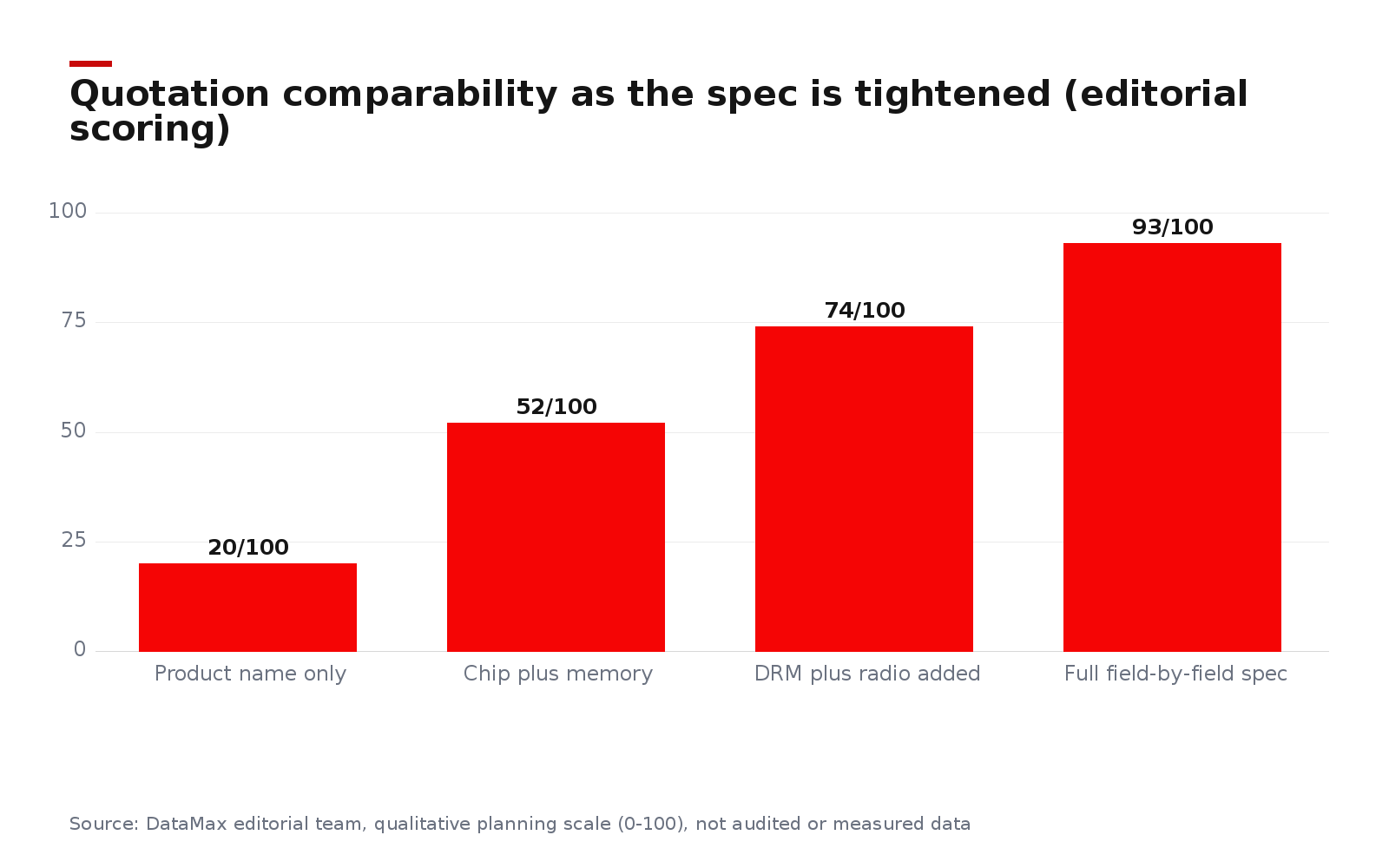
The same figures, in searchable form:
| Specification level | Editorial score |
|---|---|
| Product name only | 20 |
| Chip plus memory | 52 |
| DRM plus radio added | 74 |
| Full field-by-field spec | 93 |
Source: DataMax editorial team, qualitative planning scale (0-100), not audited or measured data. Values use the /100 suffix context.
| Model and fit | Platform and memory | Video and DRM | Interfaces and radio |
|---|---|---|---|
| DM21P 4K IPTV / operator middleware set-top box | Amlogic S905Y4, quad Cortex-A35; AOSP Android 11; 2GB / 8GB; 4GB; 16/32/64GB optional | AV1 [email protected]; VP9/H.265 4K@60; H.264 4K@30; Widevine L1 / PlayReady / HDCP 2.2 optional | HDMI 2.0b out x1; USB2.0 x2; TF; S/PDIF; 3.5mm AV; RJ45 100M; Wi-Fi6 2x2 + BT5.4; DC 5V/2A |
| DM21S 4K Android TV box for IPTV/OTT white-label | Amlogic S905Y5, quad Cortex-A55; AOSP Android 14; 2GB / 16GB; 2/4/8GB; 16/32/64GB optional | AV1 / H.265 [email protected] 4K@60; Widevine L1 / PlayReady optional; Dolby Vision/DTS | HDMI 2.0b out; S/PDIF; AV; USB2.0 x2; TF; RJ45 100M; 1G optional; Wi-Fi6 2x2 + BT5.4 |
| DM21T Premium UHD / cloud-gaming box | Amlogic S905X5, quad Cortex-A510 (ARMv9); AOSP Android 14; 4GB / 64GB family options | H.266/VVC [email protected] 4K@120; AV1/VP9/H.265 4K@120; AVS3 4K@120; H.264 4K@60; inline AI-SR; Widevine L1 / PlayReady optional | HDMI 2.0b out; no HDMI in; USB2.0 x1 + USB3.0 x1; TF; S/PDIF; AV; RJ45 100M; 1G opt; Wi-Fi6 + BT5.4 |
| DM22Q Gaming-oriented Android TV box | Amlogic S905X5M, quad Cortex-A55 up to 2.5GHz; AOSP Android 14; 4GB / 64GB; 2/4/8GB; 16/32/64GB optional | AV1/H.265 L5.1 4K@60; inline AI-SR; no NPU TOPS stated; Widevine L1 / PlayReady optional; Dolby Vision/DTS | HDMI 2.0b out; USB2.0 x2; TF; S/PDIF; AV; RJ45 100M; 1G opt; Wi-Fi6 2x2 + BT5.4 |
For the DM21P, the stated fit directly supports IPTV and operator middleware. Its declared baseline is AOSP Android 11 with 2GB RAM and 8GB storage, and the listed memory options include 4GB and optional 16GB, 32GB, or 64GB storage. Its interface list includes one HDMI 2.0b output, two USB2.0 ports, TF, S/PDIF, 3.5mm AV, RJ45 100M, Wi-Fi6 2x2 with BT5.4, and DC 5V/2A. The protected-content fields are stated as Widevine L1, PlayReady, and optional HDCP 2.2, so the exact required service and optional status still belong in the purchase specification.
The DM21S direction applies to a 4K Android TV box for IPTV/OTT white-label use. Its stated platform is Amlogic S905Y5 with quad Cortex-A55 and AOSP Android 14. The stated baseline is 2GB / 16GB, with 2GB, 4GB, 8GB, 16GB, 32GB, and 64GB memory/storage options recorded in the product facts. The RFQ should select exact values rather than repeat the whole range. Its listed interfaces include HDMI 2.0b output, S/PDIF, AV, two USB2.0 ports, TF, RJ45 100M, 1G optional, and Wi-Fi6 2x2 with BT5.4. Widevine L1 and PlayReady are optional, while Dolby Vision and DTS are stated in the product facts.
The DM21T is positioned for premium UHD and cloud-gaming use. Its stated platform is Amlogic S905X5 with quad Cortex-A510 (ARMv9), AOSP Android 14, and 4GB / 64GB family options. The decode list includes H.266/VVC [email protected] 4K@120, AV1, VP9, and H.265 at 4K@120, AVS3 4K@120, H.264 4K@60, and inline AI-SR. It has HDMI 2.0b output with no HDMI input, one USB2.0 port, one USB3.0 port, TF, S/PDIF, AV, RJ45 100M, 1G opt, Wi-Fi6, and BT5.4. Widevine L1 and PlayReady are optional.
The DM22Q is described as gaming-oriented. Its stated platform is Amlogic S905X5M with quad Cortex-A55 up to 2.5GHz, AOSP Android 14, and a 4GB / 64GB baseline, with 2GB, 4GB, 8GB, 16GB, 32GB, and 64GB options recorded. The stated decode profile is AV1/H.265 L5.1 4K@60 with inline AI-SR; no NPU TOPS figure is stated. Widevine L1 and PlayReady are optional, and Dolby Vision and DTS are stated in the product facts.
No platform should be described as 8K output. The DM21T and DM22Q headline naming must not override their stated 4K limits. Any proposed storage, Ethernet, or DRM combination must be confirmed against the production datasheet. This discipline is essential for android tv box wholesale because an ambiguous display claim can create a mismatch between the quoted unit, the approved sample, and the production order.
Where this matters in a deployment
A deployment matrix prevents a retail rollout from treating every screen as the same technical object. The operator, integrator, and venue owner may each control a different part of the stack: the operator controls middleware and content delivery; the integrator controls displays, power, network, and mounting; the venue owner controls site access and replacement handling.
| Situation | Primary requirement | Model direction |
|---|---|---|
| Pay-TV or operator-managed retail counter | Operator middleware, stable STB role, controlled provisioning | DM21P direction; confirm middleware, DRM, storage, and management requirements |
| White-label OTT venue screen | Android 14 baseline, branded launcher, app deployment, Ethernet preference | DM21S direction; confirm the exact RAM/ROM, 1G Ethernet, and DRM combination |
| Premium display room with cloud gaming | 120 Hz decode path, premium UHD profile, high-bandwidth storage use | DM21T direction; use stated 4K capabilities only |
| Gaming-oriented display cabinet | Gaming fit, AV1/H.265 4K@60, operator control | DM22Q direction; validate controller, input, and application behavior separately |
| Self-service retail kiosk | Locked surface, touch workflow, recovery, Ethernet, staff replacement | Choose by measured workload and interfaces; confirm against the production datasheet |
| Food-court menu board | Long operating period, scheduled content, simple recovery, remote updates | Use a fixed configuration after burn-in and power-cycle validation; select against codec and network needs |
| Pharmacy consultation screen | Managed account separation, controlled navigation, auditability, local service replacement | Favor a locked managed surface and traceable unit identity; validate operator policy separately |
| Premium live-sports lounge | 4K@60 content path, controlled network traffic, protected playback | DM21S or another stated 4K@60 direction; confirm DRM, Ethernet, and display behavior |
| Interactive product demonstration | Touch input, application update, network recovery, frequent staff access | Select by validated USB and display requirements; confirm touch and accessories against the production datasheet |
The operator and integrator responsibilities should be separated in the acceptance plan. The operator validates middleware enrollment, content authorization, application workflows, and remote policy. The integrator validates the physical display, network path, audio, power, mounting, and recovery after power loss. The venue owner validates staff access, local swap authorization, and site operating procedures. A device can pass laboratory tests while failing one of these ownership boundaries.
The photograph shows the physical endpoint behind the visible screen: a compact operator box can disappear behind a wall-mounted television while retaining the power, network, and signal path that the application depends on.
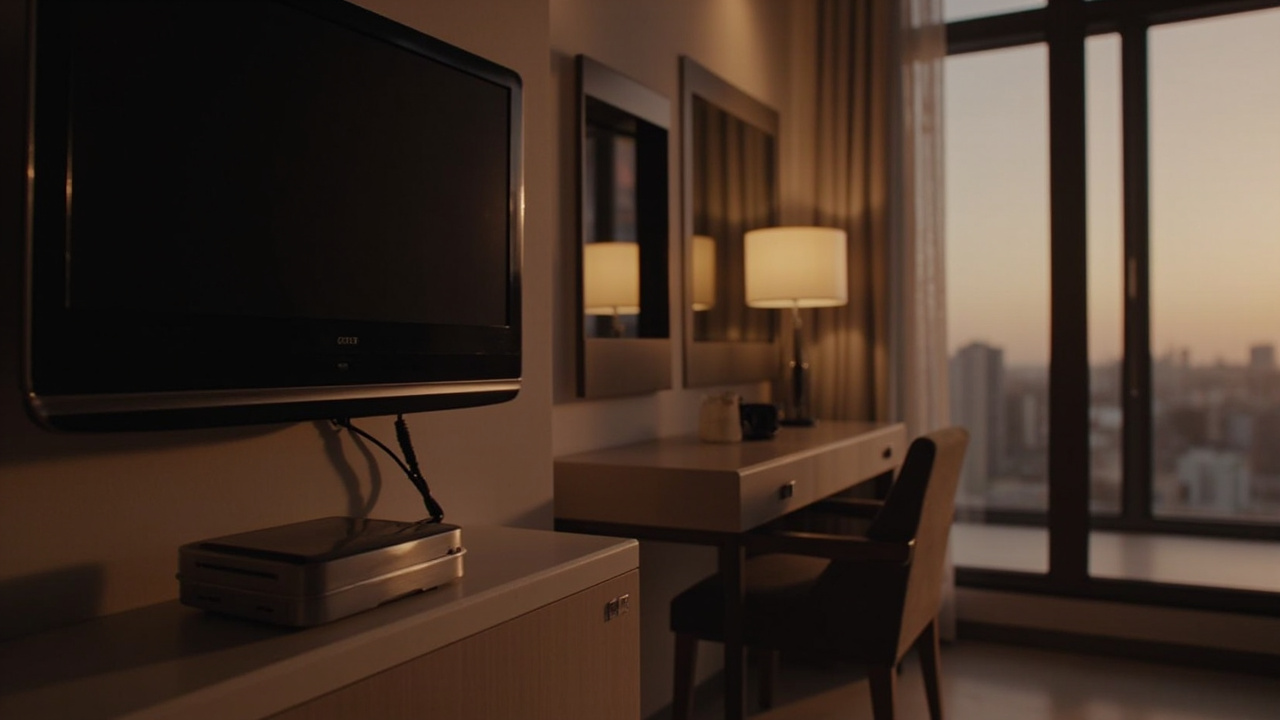
In this scene, field success depends on the less visible layers. The hotel room at dusk provides a controlled display environment, but the hidden box still needs stable boot behavior, network association, service recovery, and a documented swap procedure. The same logic applies to a retail menu board, checkout kiosk, or waiting-area display. Inventory management should track the unit identity, firmware, site assignment, and fault history; a serial number without an operational record does not create fleet visibility.
A pilot should run through normal operating cycles rather than a short demonstration. Include repeated power cycles, scheduled content changes, network interruption and restoration, application restart, remote enrollment, and the venue’s local replacement procedure. Record the observed time to recover and the identity of the person able to perform each action. Those observations become the acceptance evidence for the wider rollout.
The scene also shows why placement and ventilation remain procurement variables. A hidden enclosure can affect thermal conditions and cable access even when the display appears unaffected. The approved installation drawing, power specification, mounting method, and service clearance should therefore travel with the hardware record. Where the production datasheet does not state an environmental limit, confirm it against the production datasheet rather than inferring a value.
For a managed pilot, request samples through the sample-order workflow. The first message should contain the venue type, display and audio requirements, wired or wireless preference, management method, application path, codec/DRM needs, proposed model, and required production-evidence fields. The operator-tier Android TV box solution provides a further reference point for deployments governed by operator middleware.
Before release, the rollout owner should sign one deployment record per configuration. It identifies the model, exact option combination, firmware, application, management method, golden sample, display mode, network method, installation drawing, accessory set, and test evidence. The DataMax contact team can use that record to align factory configuration with site requirements. A disciplined android tv box wholesale program ends with an installed, traceable unit—not merely a model name in a purchase order.
Further reading
- Guide wholesale android tv box
- DRM compliance solutions
- Telecom solutions
- Amlogic Android TV boxes
- Google TV devices
- DataMax DM21P specifications and fit
- DataMax DM21S specifications and fit
FAQ
What does android tv box wholesale mean for a retail rollout?
It means a repeatable volume supply arrangement built around an approved production configuration, firmware, management method, accessories, inspection process, and delivery record. The model name alone is insufficient. A buyer should require a field-by-field specification, an identified golden sample, and production evidence linked to the shipped units.
Can AOSP Android 14 be used for a managed retail kiosk?
AOSP Android 14 can support a managed kiosk when the firmware, launcher, device owner, application deployment, update policy, logging, and recovery process are defined together. Android certification does not automatically provide these operational controls. Name the management mechanism and acceptance procedure in the RFQ.
Should every retail location use the same TV-box configuration?
Not necessarily. Use a common baseline for common site functions, then permit controlled variants for higher-refresh displays, wired networking, operator middleware, or white-label applications. Each variant needs an explicit BOM, firmware status, test result, and golden-sample record so flexibility does not create configuration drift.
What production evidence should accompany an android tv box wholesale order?
Request the approved BOM revision, firmware identifier, SMT and AOI summary, burn-in procedure, functional test record, serial-number range, nonconformance disposition, and packaging identification. The factory should define the evidence against its actual process and connect it to the production lot.
Which DataMax model fits an operator-managed retail screen?
The DataMax DM21P is the direct direction because its stated fit is a 4K IPTV and operator middleware set-top box. Confirm the exact memory, storage, DRM, firmware, interfaces, and management requirements against the production datasheet before ordering.
How should a buyer compare quotations from different suppliers?
Normalize every quotation into the same fields: platform, OS, RAM/ROM, video formats, DRM, display output, network, radio, ports, power, accessories, management, firmware, testing, packaging, and delivery terms. Reject comparisons based only on model names or headline resolutions, then validate the normalized configuration through samples.




