What the answer hinges on
Selling an android tv box as a deployable SKU depends on evidence, not on a headline specification. Before sign-off, confirm five things: the intended operator or OTT use; the exact hardware and software configuration; protected-content and codec requirements; interface, network, and regulatory fit; and the production evidence needed to reproduce units across batches.
Each item has a verification method. Validate the platform against the actual service, not only against a catalog page. Freeze the bill of materials, operating-system build, firmware branch, and approved peripherals in the SKU record. Test Widevine, PlayReady, HDCP, HDMI, Wi-Fi, and decoding in the final enclosure and firmware image. Map the product to the target market’s certification and radio requirements. Finally, trace the unit from SMT inspection through aging, dark-room validation, packaging, and shipment release.
The commercial decision is a match between two documents: the customer’s minimum acceptance criteria and the manufacturer’s controlled production record. An RFQ that says “4K Android TV box” is not a sellable specification. It leaves the processor family, Android release, memory configuration, DRM level, output mode, network interface, regulatory package, branding, middleware integration, and test evidence unresolved. Each unresolved item can become a late change, duplicated sample batch, certification obstacle, or field-return category.
The models below provide a platform map, not a universal recommendation. DM21P is positioned for operator middleware set-top-box work, while DM21S serves IPTV/OTT white-label programs. DM21T targets premium UHD and cloud-gaming workloads, and DM22Q targets gaming-oriented applications. Confirm every production configuration against the production datasheet before issuing an order or customer-facing claim.
For a procurement team, the first decision is not which specification sounds strongest. It is which specification can be repeated in the next build. A model name with an unresolved storage option, radio variant, display mode, or middleware image cannot support a stable channel, retailer listing, or operator tender. The sellable unit is therefore the approved combination of hardware, software, service, enclosure, packaging, and evidence. That definition should be signed before any volume commitment is created.
Entry tier versus commitment tier
The entry tier changes the device’s identity without materially redesigning the platform. Boot-logo and launcher artwork, packaging, a controlled regional software build, and basic operator branding are appropriate when the service stack and hardware architecture are already accepted. The commitment tier changes firmware behavior, hardware options, validation depth, and supply planning across the SKU family. It is appropriate when the buyer needs a differentiated product, middleware integration, custom interfaces, or synchronized multi-region releases.
| Decision area | Entry tier | Commitment tier |
|---|---|---|
| Brand expression | Logo print or boot logo plus launcher treatment | Coordinated launcher, UI, packaging, firmware, and accessory identity |
| Software scope | Approved AOSP build with controlled configuration | Feature branch, middleware integration, regional variants, and release governance |
| Hardware scope | Existing configuration with documented options | Selected memory, interfaces, mechanical, and connectivity changes subject to review |
| Validation | Functional, codec, DRM, interface, and sample approval | Extended soak, stress, certification, traceability, and revision-control evidence |
| Supply commitment | Project-level approval and forecast | SKU-specific change control, build window, and forecast governance |
| Regional scope | One approved market, radio configuration, and software image | Multiple market images, packaging sets, radio evidence, and controlled release order |
| Middleware | Existing deployment procedure accepted without product-specific changes | Product-specific middleware branch, entitlement flow, diagnostics, and upgrade procedure |
| Change window | Configuration remains fixed after sample approval | Documented revision, requalification, and customer notice process |
The choice should follow the project risk, not a generic feature checklist. A basic resale product can remain in the entry tier if its software image, DRM service, target market, and interface set are fixed and proven. A wholesale program involving multiple operators, regional firmware, or custom packaging usually needs commitment-tier controls because a small variation can propagate through certification and support.
For procurement, score the tier at the start. If one unresolved item could change the PCB, antenna, regulatory filing, middleware image, or validation plan, move the project to the commitment tier before samples are ordered. Otherwise, keep the entry tier and spend effort on configuration control rather than unnecessary variation.
A practical distinction is the number of controlled variants. An entry-tier retail program may have one approved image and one packaging revision. A commitment-tier operator program may require separate software identifiers, radio evidence, packaging sets, service credentials, and validation records for each region. The second case is not automatically more expensive, but its evidence structure is larger. Quote and release work should be broken down by SKU rather than by model family.
Use a change trigger list to prevent silent escalation. Changing the remote-control protocol, boot sequence, launcher permissions, Ethernet option, antenna, memory population, or firmware branch should reopen the relevant review. A print-artwork change can remain low complexity if it does not alter regulatory declarations, packaging content, or the approved visual identity. A software-build change is different because it can affect boot, middleware discovery, update behavior, codecs, and DRM paths.
The mechanism behind the spec
A sellable SKU is a configuration object linking commercial identity to technical and manufacturing records. At its core are six layers: the SoC and board revision; memory and storage; AOSP image and application layer; display, media, and protected-content functions; external interfaces and mechanical data; and the production-test route assigned to that exact configuration.
The operating-system statement must be precise. “AOSP Android 11” identifies the Android release and AOSP base, but it does not by itself establish Google Play certification, Google TV certification, Widevine conformance, operator middleware readiness, or production update support. AOSP and Google Android TV also represent different platform relationships; assess the target distribution and update obligations separately. The broader distinction is covered in the canonical guide to Android TV boxes for ISPs.
Codec capability has several independent layers. A decoder may support AV1, H.265/HEVC, VP9, or H.264 at defined levels and frame rates, while the HDMI output path has its own format and frame-rate limit. Test the complete path with the target resolution, refresh rate, color format, HDR policy, and application. A nominal 4K decoder does not prove 4K output under every source and display combination.
DRM and copy protection require the same discipline. Widevine L1, PlayReady, HDCP, and any Dolby Vision or DTS arrangement are separate implementation and licensing questions. Confirm the security level, supported service, key-delivery configuration, display route, and production image together. “Optional” in a platform summary means the exact SKU still requires confirmation against the production datasheet.
Connectivity must also be treated as an acceptance criterion. RJ45 at 100M, an optional 1G configuration, Wi-Fi6, and BT5.4 may sound interchangeable on a shortlist, but they alter cabling, driver, radio-validation, thermal, and user-experience decisions. Record the antenna arrangement and regional radio configuration because the same printed board can require different radio evidence for different markets.
The mechanism should be visible in the contract. Attach a configuration annex containing the model, board revision, memory population, firmware identifier, build target, launcher, middleware version, preinstalled applications, update method, port map, region, radio configuration, packaging revision, and approved accessories. Give every line a revision and a named acceptance owner. This converts a catalogue attribute into a purchasable object: if the enclosed unit and the released image disagree, there is a concrete baseline against which the discrepancy can be found.
The same principle applies to updateability. A signed image, recovery path, and package-delivery method are operational mechanisms, not administrative notes. If the device cannot receive the intended service image, the field unit may remain technically compliant with the original sample but commercially unable to support a changed entitlement, launcher, or middleware version. State whether updates are local, network-managed, or operator-controlled, and define the rollback behavior that the support team is expected to use.
Which DataMax models actually sit here
The four DataMax platforms occupy different technical positions. The table below reproduces only the supplied product facts; optional configurations remain conditional and must be confirmed against the production datasheet.
| Model | SoC and OS | Memory / storage | Media and DRM | Interfaces |
|---|---|---|---|---|
| DM21P 4K IPTV / operator middleware set-top box | Amlogic S905Y4, quad Cortex-A35 AOSP Android 11 | 2GB / 8GB 4GB; 16/32/64GB optional | AV1 [email protected]; VP9/H.265 4K@60; H.264 4K@30 Widevine L1 / PlayReady / HDCP 2.2 optional | HDMI 2.0b out x1; USB2.0 x2; TF; S/PDIF; 3.5mm AV; RJ45 100M; Wi-Fi6 2x2 + BT5.4; DC 5V/2A |
| DM21S 4K Android TV box for IPTV/OTT white-label | Amlogic S905Y5, quad Cortex-A55 AOSP Android 14 | 2GB / 16GB 2/4/8GB; 16/32/64GB optional | AV1 / H.265 [email protected] 4K@60 Widevine L1 / PlayReady optional; Dolby Vision/DTS | HDMI 2.0b out; S/PDIF; AV; USB2.0 x2; TF; RJ45 100M (1G optional); Wi-Fi6 2x2 + BT5.4 |
| DM21T Premium UHD / cloud-gaming box | Amlogic S905X5, quad Cortex-A510 (ARMv9) AOSP Android 14 | 4GB / 64GB family options | H.266/VVC [email protected] 4K@120; AV1/VP9/H.265 4K@120; AVS3 4K@120; H.264 4K@60; inline AI-SR Widevine L1 / PlayReady optional | HDMI 2.0b out (no HDMI in); USB2.0 x1 + USB3.0 x1; TF; S/PDIF; AV; RJ45 100M (1G opt); Wi-Fi6 + BT5.4 |
| DM22Q Gaming-oriented Android TV box | Amlogic S905X5M, quad Cortex-A55 up to 2.5GHz AOSP Android 14 | 4GB / 64GB 2/4/8GB; 16/32/64GB optional | AV1/H.265 L5.1 4K@60; inline AI-SR (no NPU TOPS stated) Widevine L1 / PlayReady optional; Dolby Vision/DTS | HDMI 2.0b out; USB2.0 x2; TF; S/PDIF; AV; RJ45 100M (1G opt); Wi-Fi6 2x2 + BT5.4 |
The commercial interpretation is direct. DM21P is the operator-oriented option, with AOSP Android 11 and optional HDCP 2.2 listed in its field set. DM21S gives a white-label program a newer Android release and broad storage options, while retaining 100M Ethernet as the base configuration. DM21T is the high-frame-rate premium platform, including 4K@120 decoder paths and USB3.0, but it has no HDMI input. DM22Q focuses on 4K@60 gaming-oriented use with optional Dolby Vision/DTS.
These differences matter at RFQ stage. “Gaming” can mean frame rate, input latency, controller behavior, storage loading, or sustained thermal performance. The supplied facts support codec and interface claims, but they do not provide measured latency, game certification, or thermal results. Do not convert a use-case label into an unstated performance promise.
The optional fields deserve explicit procurement treatment. For example, an order requesting DM21S with 1G Ethernet must identify that option, while the base field is RJ45 100M. A DM21T request must preserve the stated absence of HDMI input because an installer may otherwise plan a capture or loop-through arrangement around a port that is not present. For DRM and audio options, place the requested service and selected configuration in the SKU annex, then attach the corresponding production report.
The chart below compares planning depth, not measured product performance.
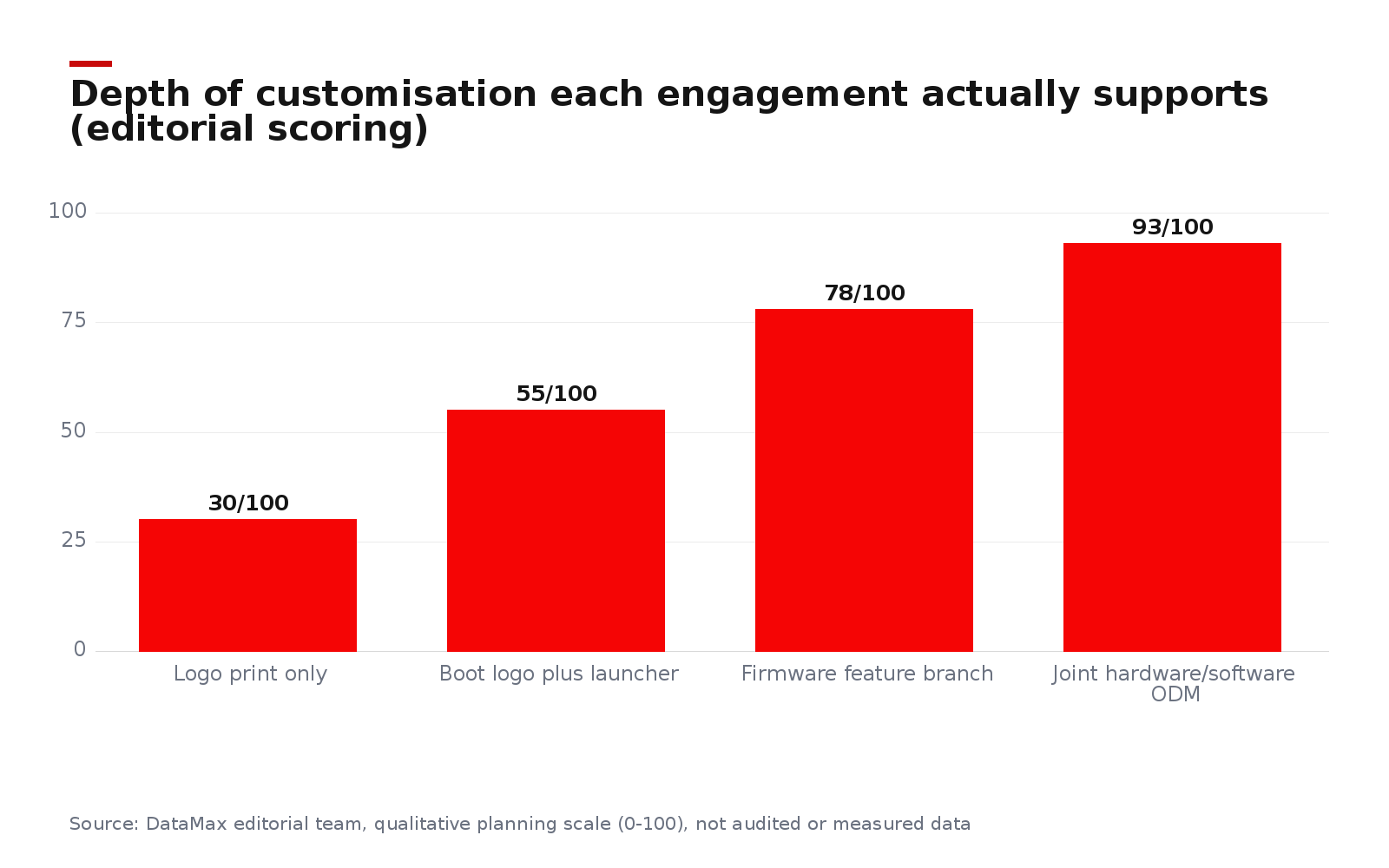
The same figures, in searchable form:
| Engagement option | Editorial score |
|---|---|
| Logo print only | 30 |
| Boot logo plus launcher | 55 |
| Firmware feature branch | 78 |
| Joint hardware/software ODM | 93 |
Source: DataMax editorial team, qualitative planning scale (0-100), not audited or measured data.
For an operator RFQ, the DM21P row can be copied as a starting baseline, but the order must distinguish the standard 2GB/8GB population from listed alternatives and the optional protected-content fields. For a white-label retail RFQ, DM21S provides the Android 14 family context, yet its storage and Ethernet options remain choices. The same rule applies to DM21T and DM22Q: model names identify platforms, not complete production SKUs.
The “inline AI-SR” wording on DM21T and DM22Q should remain qualitative. The supplied facts expressly provide no NPU TOPS figure for DM22Q, so a buyer should not create an artificial performance metric from the feature label. If workload quality or latency is an acceptance condition, define the source, display, application, duration, and measurement method in the RFQ. That requirement can then be tested without making an unsupported hardware claim in the catalogue.
Where this matters in a deployment
The correct platform depends on where the unit operates and which failure the deployment must avoid. An IPTV operator needs stable service integration and predictable middleware behavior. A streaming distributor needs regional branding, package control, and a repeatable channel or retail SKU. An integrator may prioritize accessible AV outputs, wired networking, and mounting or cabling behavior. A cloud-gaming or premium UHD program needs the highest applicable media path, but must also distinguish source decoding from output capability.
| Situation | Primary requirement | Model direction | RFQ evidence to request |
|---|---|---|---|
| Operator IPTV rollout | Middleware deployment and managed service integration | DM21P direction; assess operator middleware fit | Exact Android image, middleware deployment procedure, DRM and interface test report |
| IPTV/OTT white-label retail program | Brand control with Android 14 family platform | DM21S direction | Boot and launcher assets, storage option, regional software build, packaging approval |
| Premium UHD showroom | High-frame-rate decode path and premium presentation | DM21T direction | Source-to-display test matrix, HDMI 2.0b output verification, 4K@120 application test |
| Cloud-gaming service | Media capability plus gaming-oriented configuration | DM21T or DM22Q after workload validation | Application compatibility, sustained-run evidence, storage behavior, input-latency methodology |
| Commercial AV installation | Wired stability, connector set, and controlled configuration | Select by Ethernet and AV requirements | Interface drawing, port population, firmware configuration, installation image |
| Digital-signage deployment | Stable launcher, update control, and fit with display environment | Entry-tier platform with controlled launcher | Autostart behavior, kiosk policy, update method, storage endurance plan |
| Hospitality room deployment | Remote-control behavior, service isolation, and recovery | Direction depends on operator integration | Pairing procedure, reset policy, signed image, support and update procedure |
| Telecom CPE deployment | Wired network fit, provisioning, and operator middleware | DM21P or another exact platform after middleware review | Provisioning guide, Ethernet test, identity and entitlement flow, regional compliance scope |
| Promotional event channel | Targeted content, controlled launcher, and fast content revision | Entry-tier platform with managed update method | Content-loading procedure, rollback method, boot behavior, packaging identification |
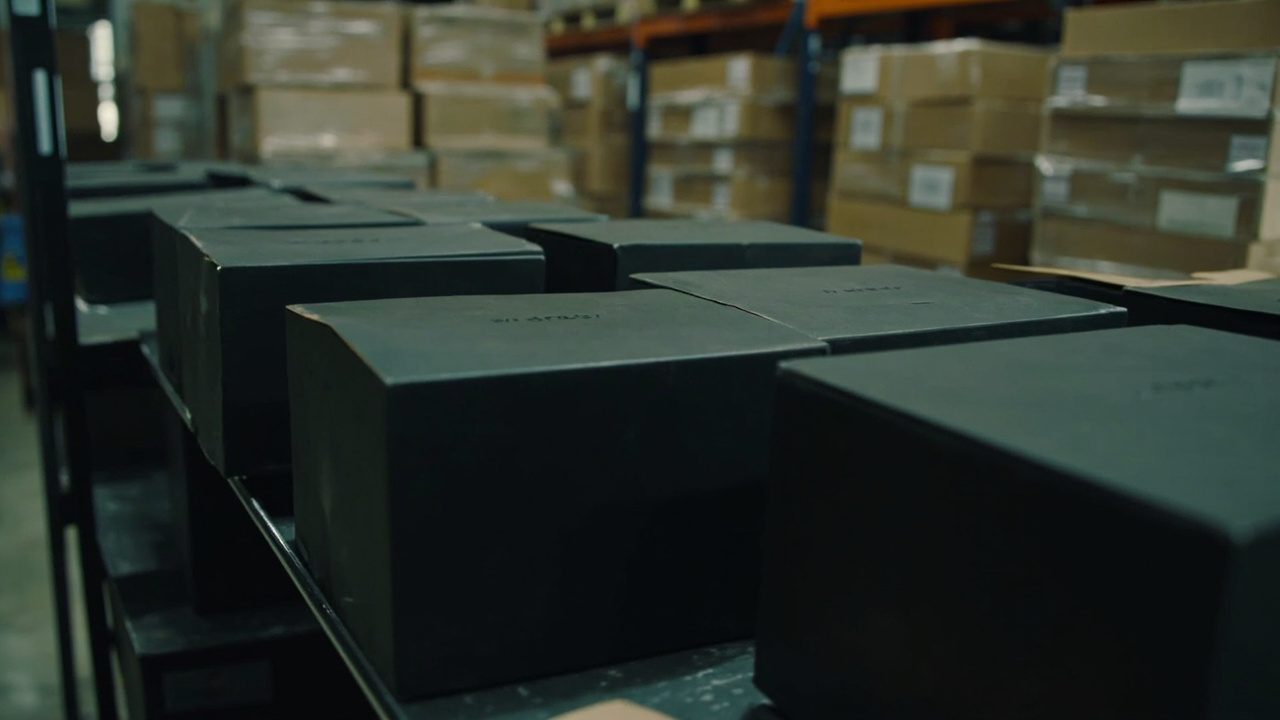
The scene below is representative of fleet handling: identical units, neutral packaging, and repeatable warehouse movement. Production control must connect the visible configuration to the hidden evidence record.
For operators, an attractive retail specification can still fail at subscriber activation if the middleware build, device identity, entitlement flow, and firmware update policy are not aligned. For white-label channels, a generic box can become unsellable if the packaging, launcher, remote-control behavior, and preloaded account flow disagree. Integrators need a stable port map and power/network design, while gaming programs need evidence under sustained load rather than a feature-matrix claim.
The deployment matrix should become a customer acceptance matrix. Each row must identify the test method, evidence owner, pass condition, and release state. That prevents the SKU from being approved on the basis of one successful demonstration unit.
Consider an operator with both an IPTV head end and an OTT storefront. The same physical platform may need distinct entitlement flows, launch behavior, and update policies. A single generic launcher approval is insufficient if it obscures how the unit transitions into the service. Require two software identifiers and two acceptance paths, even if the hardware baseline is shared.
A venue integrator may work from a drawing rather than a media specification. The RJ45 speed, S/PDIF availability, AV connector set, power input, and absence of HDMI input determine installation design. The product selection should therefore precede cable schedules and display cutovers. An installer should not discover a missing interface after the hardware has reached the site.
The selection sequence that removes rework
Start with the service boundary, not the SoC. Identify whether the device terminates IPTV middleware, runs an OTT storefront, operates as a branded Android TV product, or functions as a display-attached player. Write the mandatory output, decoder, DRM, network, and operating-system requirements into acceptance language. Then map them to one platform.
- Freeze the use case Record the service, market, installation environment, display, network, source resolution, protected-content model, and operator middleware. Exclude preferences that lack an acceptance test.
- Freeze the hardware baseline Name the model, SoC, RAM/ROM, Ethernet speed, wireless configuration, port set, enclosure, power supply, and approved accessories. Mark every optional field as an explicit selection rather than leaving it implied.
- Freeze the software baseline Record the AOSP release, firmware branch, build identifier, launcher, middleware, update method, signed configuration, and region. A software image must be tied to a board revision and SKU number.
- Turn features into test lines Replace “premium playback” with codec, resolution, frame rate, source, output, display, and application combinations. Replace “DRM ready” with service, security level, content type, display path, and license acquisition procedure.
- Approve samples in the final configuration Use production-intent units, target packaging, approved accessories, and representative displays and networks. Record defects by serial number and disposition.
- Release the SKU record Attach the golden sample, schematics or interface documents where available, firmware checksum, test report, packaging proof, compliance scope, and revision history. Any later change reopens affected evidence.
A practical RFQ line reads: “DM21S, Amlogic S905Y5, quad Cortex-A55, AOSP Android 14, 2GB/16GB, HDMI 2.0b out, 2 x USB2.0, TF, S/PDIF, AV, RJ45 100M, Wi-Fi6 2x2 + BT5.4; AV1 and H.265 [email protected] 4K@60; Widevine L1 and PlayReady optional subject to final configuration approval.” This is still a quotation template: confirm each selected option against the production datasheet before conversion to an order line.
Include change-control language. A revised Android image, RAM or storage population, antenna, remote control, enclosure, power adapter, launcher, or target-market radio configuration can invalidate evidence. The buyer should define which changes require written approval and which remain inside the approved SKU baseline.
Separate the production-intent sample from the development sample. The former should use the intended board revision, memory population, image, enclosure, radio configuration, and accessories. Record what was tested and what was excluded. A development unit can establish feasibility, but it cannot replace a production-intent unit when the acceptance procedure requires the final enclosure, final firmware, or final packaging.
Use an exception process as well. If a required test fails, record the serial number, firmware build, test condition, observed result, diagnosis, repair, replacement, and retest. Do not silently exclude the failed unit or average the result across a batch. The buyer can then decide whether the defect is isolated, systemic, or caused by an out-of-date test fixture.
Convert the sequence into a spreadsheet with one row per acceptance claim. Each row should contain the SKU, test method, sample identifier, result, evidence link, owner, and approval date. When an engineer changes an image or a buyer changes the storage population, the owner can identify the affected rows rather than restarting the entire verification exercise. This is especially important for an android tv box program with regional firmware and packaging variants.
Failure modes that reach the field
Most field failures originate from quotation ambiguity or evidence detached from the shipped configuration. A sample may contain an optional 1G Ethernet interface while the production build uses 100M. A retail label may promise a codec that the approved firmware does not expose. A regional radio build may differ from the unit demonstrated at headquarters. These discrepancies become expensive when firmware updates, packaging, certifications, or deployed fleet volumes depend on one consistent baseline.
Field trap
A “4K” line without resolution, frame rate, codec, color format, source, display, and application is not an acceptance criterion. The declared decoder set does not establish end-to-end playback or output. Test the final SKU and record the complete playback chain.
A second trap is treating DRM as a checkbox. Widevine L1, PlayReady, HDCP, Dolby Vision, and DTS each have distinct conditions and evidence. Optional DRM support in a platform summary cannot be copied into an order as an unconditional commitment. Record the licensed service, security level, key path, display configuration, and test content before the customer-facing specification is approved.
Field trap
Do not use a platform-level “optional” marker as a purchasing decision. RAM, storage, Ethernet speed, audio formats, DRM, and wireless variants must be selected and frozen per SKU. Confirm against the production datasheet, then verify the physical sample and production evidence.
Thermal behavior, storage endurance, update rollback, remote-control pairing, and peripheral compatibility also need explicit tests when they matter to the deployment. A support incident can begin as a simple “device stopped working” while the underlying cause is an unlocked power option, an exhausted internal storage, a failed update, or a peripheral outside the qualified list. The SKU record should define support boundaries and known limitations before volume rollout.
Commercial quotations diverge when they omit revision numbers and acceptance ownership. Request a response that names the board, Android build, firmware identifier, sample phase, test standard or customer procedure, evidence format, and change rule. That prevents a development sample from being mistaken for an approved production configuration.
Other common failures cross the purchasing boundary. A buyer may approve a launcher that later blocks operator discovery or middleware activation. A distributor may change the power adapter, which introduces an electrical difference not represented by the model code. An integrator may substitute a different HDMI cable or display mode and attribute the result to the box. The controlled record must therefore cover approved accessories, cable assumptions, display configuration, and the exact network used for acceptance.
The commercial claim should also match the evidence scope. If the test uses one target application, one display, and one build, the release record should not imply certification for every application, display, region, or service. State the tested matrix and its boundaries. That protects both parties: the buyer knows what has been demonstrated, while the supplier knows which additional conditions require a separate validation activity.
A common escalation follows an unclear quotation for an android tv box: the supplier treats a platform capability as a selected SKU option, while the buyer treats the quotation as a final configuration. The remedy is operational. Add a “selected configuration” column to the quotation, prohibit defaults in optional fields, and require the buyer’s initials on each conditional line. A sample can then prove the selected combination rather than merely the model family.
The evidence trail from SMT to shipment
A sellable SKU requires traceability from component population to the released unit. The evidence trail connects incoming material, SMT placement, AOI inspection, assembly, firmware flashing, functional test, aging, dark-room display validation, packaging, and shipment release. Each record must identify the production lot and the configuration under test.
DataMax’s production evidence should make each claim traceable: model and revision, firmware build, test result, inspection record, packaging configuration, and shipment lot. Request a video factory audit or a focused evidence package through factory quality or the manufacturer overview.
The best audit package answers the buyer’s questions without relying on a generic factory presentation. Ask for a sample of SMT/AOI records, an aging log, dark-room display results, firmware/version traceability, packaging approval, and a configuration-to-shipment reconciliation. DataMax can structure this evidence around the exact SKU, while the buyer’s acceptance procedure determines pass criteria.
The final commercial gate is revision control. Attach the evidence package to the SKU identifier, record its validity, and state which changes reopen testing. A changed board, image, antenna, memory population, or accessory list should not inherit evidence that belonged to the earlier configuration. That discipline turns the engineering inquiry into a controlled release rather than a sequence of assumptions.
Before shipment release, reconcile the physical unit against the SKU record at least three times: at work-order setup, after firmware flashing, and during final packing. The work order controls what may be assembled; the flashing record confirms what image was installed; the packing record confirms what carton, label, accessory set, and region were associated with the unit. A discrepancy at any point should trigger quarantine and disposition rather than a manual override without a record.
For volume programs, retain representative exceptions as well as passing results. A sample of AOI false calls, repair records, dark-room failures, and replaced components can reveal process weaknesses that a summary pass rate conceals. The production report should identify whether a repaired unit was retested, which tests it repeated, and whether the repair changed its configuration. This creates a usable evidence trail across the lot and the SKU revision.
The evidence package should also explain the route from one android tv box unit to the shipment lot. A serial identifier can link the enclosure, board, firmware, test records, repair history, carton, and pallet without claiming that a generic laboratory report proves every production unit. The buyer can then define its own sampling points while seeing which records exist for reconciliation.
Further reading
- Guide android tv box for isps
- Telecom solutions
- Amlogic Android TV boxes
- Google TV devices
- AV1 Android TV box guide
- DataMax DM21P specifications and fit
- DataMax DM21S specifications and fit
FAQ
What makes an android tv box sellable?
A sellable SKU has a frozen commercial identity, hardware configuration, software build, tested acceptance criteria, and traceable production evidence. The model name alone is insufficient. RAM and storage, DRM, codecs, output, Ethernet speed, regional firmware, packaging, and test status must match the approved sample. Procurement should attach each evidence item to a SKU identifier and revision.
Can an entry-tier android tv box support white-label branding?
Yes, when the required customization is limited to controlled brand assets, boot presentation, launcher treatment, packaging, or an approved regional build. The engagement must still freeze the software image and verify the final production unit. A larger feature-branch or joint ODM scope is appropriate when middleware, interface behavior, or hardware must change.
Which DataMax model fits operator middleware?
DM21P is explicitly positioned for 4K IPTV and operator middleware set-top-box applications. It lists an Amlogic S905Y4, quad Cortex-A35, AOSP Android 11, 2GB/8GB, and optional Widevine L1, PlayReady, and HDCP 2.2. Confirm the exact production configuration and middleware requirements against the production datasheet.
Does 4K decoding guarantee 4K output?
No. Decode capability, source format, application behavior, HDMI output configuration, display support, refresh rate, and color handling are separate test conditions. Validate the complete source-to-display chain on the final firmware, enclosure, cable, and target display. A decoder claim by itself is not an end-to-end performance guarantee.
What evidence should accompany a production shipment?
Request configuration traceability, SMT and AOI records, functional-test results, aging logs, dark-room display validation, firmware identification, packaging approval, and shipment-lot reconciliation. A useful review also samples exceptions and repairs rather than showing only passing records. The customer should define which configuration changes invalidate prior evidence.
What should accompany an RFQ for an android tv box?
Attach the model shortlist, target market and certification scope, middleware or application requirements, codec and DRM acceptance criteria, port and network constraints, and expected volume scenario. Also request the proposed firmware baseline, sample-validation plan, change-control process, and evidence package. Email [email protected] with the SKU list, target-market certificates, middleware/DRM checklist, and required validation evidence.