
The procurement answer in one screen
android tv box price for a small cable operator should be treated as the landed cost of an operable subscriber unit, not the supplier’s unit quote alone. A defensible comparison includes the specified SoC and memory, Android configuration, video decode, DRM position, connectivity, operator middleware work, pilot yield, firmware lifecycle, certification evidence, warranty handling, and the cost of replacing defective units in the field. The right baseline is the model whose production configuration matches the service, followed by a written quotation against an identical RFQ.
The DataMax shortlist has 4 distinct procurement directions. DM21P is the operator-focused 4K IPTV unit for middleware-led deployments. DM21RTD addresses operators or retailers requiring a Google-certified non-Google-TV AOSP+GMS configuration. DM21S serves IPTV and OTT white-label work on AOSP Android 14. DM21T is the higher-memory UHD and cloud-gaming direction, not the default low-cost operator box.
For a small operator, negotiate on the delivered configuration and evidence, not an abstract price tier. Require the supplier to state memory, storage, operating system, DRM, decode modes, Ethernet speed, power requirements, custom middleware, certification scope, and pilot quantity in the quotation. The broader factory-price method is covered in the canonical factory price Android TV box guide. For an initial RFQ, send the selected model, target configuration, operator software, required ports, certification jurisdiction, pilot volume, destination, delivery schedule, and evidence requirements in the first message.
A practical screen is to compare 4 columns: hardware configuration, software and rights scope, inspection evidence, and field-recovery responsibility. A quotation missing any column is not yet a decision-grade android tv box price for an operator rollout. Keep each line tied to one approved build, because a lower figure that changes RAM/ROM, Ethernet speed, DRM status, firmware image, or test coverage is a different procurement object.
How the requirement actually works
An operator set-top box performs 5 connected functions: display output, protected content playback, operator application execution, network management, and service recovery. The device must receive and decode operator video, establish DRM sessions, render the CA or middleware interface, maintain IP connectivity, and provide a controlled firmware update path. A low quotation that omits any of these functions may describe a different product rather than a cheaper version of the same product.
The first procurement axis is the Android and application environment. AOSP Android 11 on DM21P supports an operator middleware approach without implying a Google Mobile Services or Google TV commercial configuration. DM21RTD is identified as a Google-certified non-Google-TV AOSP+GMS SKU, but the operator still needs a precise software and certification scope in the production datasheet. DM21S and DM21T use AOSP Android 14. These labels describe platform direction, not the complete middleware, service integration, update mechanism, or device-management solution.
The second axis is media and rights handling. Decode support, display output, and DRM are separate controls. A processor may decode a codec while the HDMI output mode, panel capability, application path, or licence service constrains what the subscriber sees. Widevine L1, PlayReady, and HDCP 2.2 are listed as optional on DM21P; DM21S and DM21T list Widevine L1 and PlayReady as optional. A buyer must therefore state whether those licences and output protection are required in the delivered configuration. Dolby Vision and DTS are listed for DM21S; other model requirements must be confirmed against the production datasheet.
The third axis is operator connectivity. Ethernet, Wi-Fi, USB, HDMI, audio, and power interfaces determine installation choices and peripheral support. The listed RJ45 ports are 100M on all 4 models; 1G Ethernet is optional on DM21S and DM21T. That distinction affects wired throughput, local services, and whether the operator wants a guaranteed 100M baseline or a specified 1G option.
The fourth axis is scale and lifecycle. A small cable operator may begin with a controlled pilot, but quotation logic must include repeatability. The relevant mechanism is not simply unit economics; it is configuration control across pilot and volume batches. Memory population, PCB revision, Wi-Fi module, tuner arrangement, firmware baseline, middleware image, and certification scope can all change the operational outcome. The supplier must show which variables are locked for the programme.
The fifth axis is factory accountability. SMT assembly, AOI inspection, firmware flashing, boot verification, dark-room display testing, ageing, RF checks, and outbound audit records reduce uncertainty around the delivered unit. The operator should identify which evidence applies to the model, production lot, and purchased configuration rather than accept a generic factory statement.
The platform shortlist with datasheet values
The shortlist below separates operator utility from premium media capability. It does not attach numerical prices to DataMax products because the provided product facts contain no commercial values. Any android tv box price conclusion must therefore use a quotation against the exact rows below.
| Model | SoC and platform | Memory | Media and DRM | Connectivity | Deployment direction |
|---|---|---|---|---|---|
| DM21P | Amlogic S905Y4, quad Cortex-A35; AOSP Android 11 | 2GB / 8GB; 4GB; 16/32/64GB optional | AV1 [email protected]; VP9/H.265 4K@60; H.264 4K@30; Widevine L1 / PlayReady / HDCP 2.2 optional | HDMI 2.0b out x1; USB2.0 x2; TF; S/PDIF; 3.5mm AV; RJ45 100M; Wi-Fi6 2x2 + BT5.4; DC 5V/2A | 4K IPTV / operator middleware set-top box |
| DM21RTD | Realtek RTD1325; GMS-certified AOSP | Confirm against the production datasheet | AV1 capable | Confirm against the production datasheet | Operators/retail requiring a Google-certified non-Google-TV AOSP+GMS SKU |
| DM21S | Amlogic S905Y5, quad Cortex-A55; AOSP Android 14 | 2GB / 16GB; 2/4/8GB; 16/32/64GB optional | AV1 / H.265 [email protected] 4K@60; Widevine L1 / PlayReady optional; Dolby Vision/DTS | HDMI 2.0b out; S/PDIF; AV; USB2.0 x2; TF; RJ45 100M (1G optional); Wi-Fi6 2x2 + BT5.4 | 4K Android TV box for IPTV/OTT white-label |
| DM21T | Amlogic S905X5, quad Cortex-A510 (ARMv9); AOSP Android 14 | 4GB / 64GB (family options) | H.266/VVC [email protected] 4K@120; AV1/VP9/H.265 4K@120; AVS3 4K@120; H.264 4K@60; inline AI-SR; Widevine L1 / PlayReady optional | HDMI 2.0b out (no HDMI in); USB2.0 x1 + USB3.0 x1; TF; S/PDIF; AV; RJ45 100M (1G opt); Wi-Fi6 + BT5.4 | Premium UHD / cloud-gaming box |
DM21P offers the clearest operator starting point because its platform fields include an RJ45 100M port, operator middleware fit, AOSP Android 11, and 2GB / 8GB baseline memory. DM21S raises the operating-system generation to Android 14 and provides a 2GB / 16GB baseline, making it the more natural IPTV/OTT white-label candidate when the programme requires that platform direction. DM21RTD should enter the shortlist only where a Google-certified non-Google-TV AOSP+GMS configuration is itself a requirement.
DM21T carries 4GB / 64GB and decode paths up to 4K@120, but its fit is premium UHD and cloud gaming. Its listed absence of HDMI input also rules out a common pass-through workflow. The production datasheet caps output and decode at 4K; no 8K output should be claimed.
The table should be read as a quotation template, not a catalogue ranking. If an operator requires a 1G Ethernet controller, a confirmed Widevine L1 arrangement, a particular RAM population, or an HDMI input, that value must be entered into the RFQ before comparing the resulting android tv box price. DM21RTD’s unlisted memory, ports, and power details should remain “confirm against the production datasheet” rather than being inferred from adjacent models.
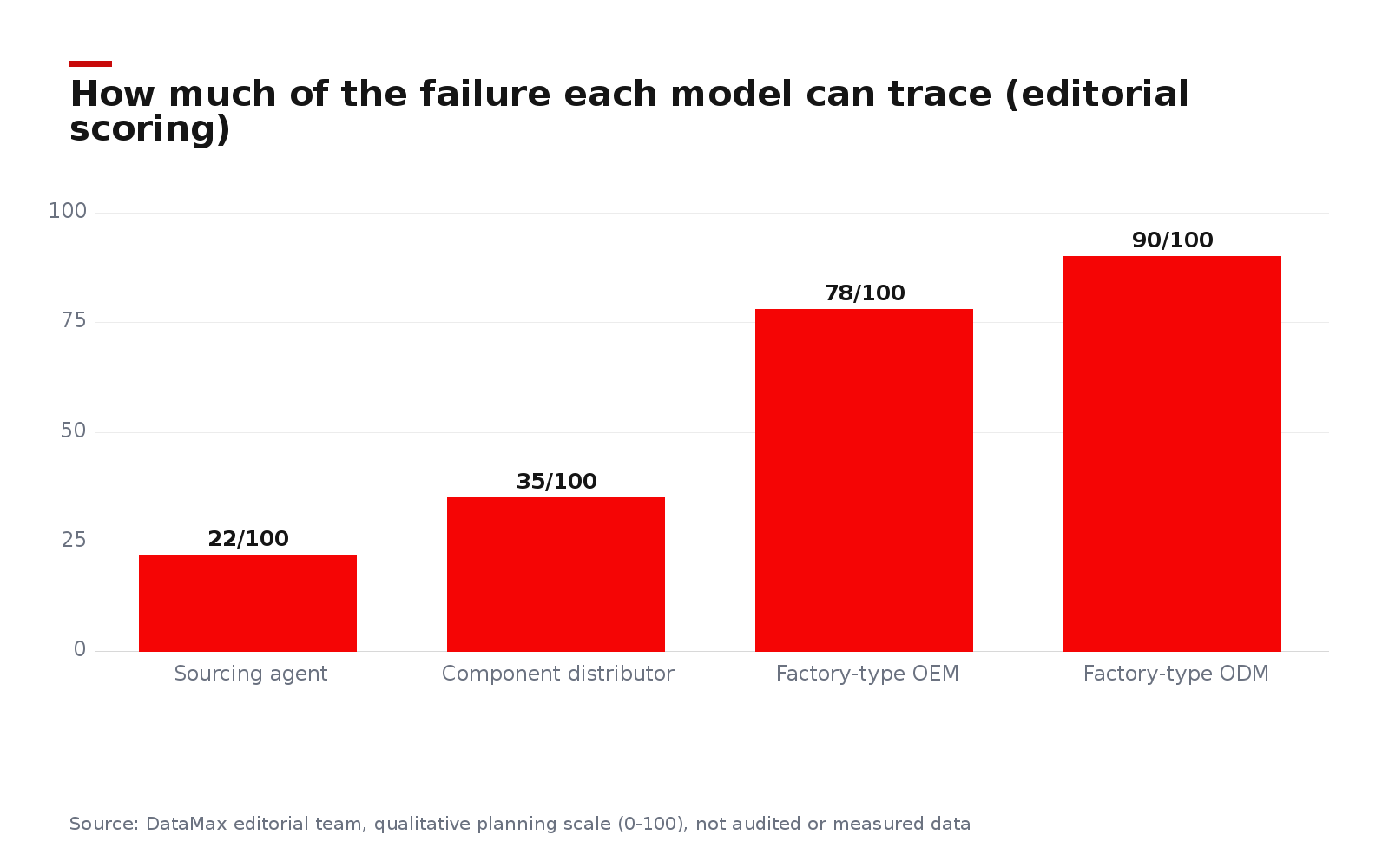
The same figures, in searchable form:
| Supply-chain role | Editorial score (/100) |
|---|---|
| Sourcing agent | 22 |
| Component distributor | 35 |
| Factory-type OEM | 78 |
| Factory-type ODM | 90 |
Where this matters in a deployment
A small cable operator is usually managing 3 competing installation realities: subscriber premises, local network conditions, and the operator’s ability to recover failed devices remotely. A box selected from a headline unit price may fit the demonstration set but fail at installation because Ethernet is not present, Wi-Fi coverage is weak, the middleware expects a specific interface, or the service uses features not enabled in the delivered firmware.
| Deployment situation | Primary requirement | Model direction | Quotation control |
|---|---|---|---|
| IPTV pilot with operator middleware | Wired Ethernet, controlled platform integration | DM21P first; DM21S for an AOSP Android 14 white-label direction | Lock middleware image, firmware baseline, RJ45 100M and field-update route |
| Retail or operator channel requiring certified GMS | Google-certified non-Google-TV AOSP+GMS SKU | DM21RTD | Require certification scope and production identity to be stated |
| OTT package sold under a service brand | Android 14, IPTV/OTT white-label fit, 16GB storage baseline | DM21S | Lock AOSP image, optional 1G Ethernet, Widevine/PlayReady and Dolby Vision/DTS requirement |
| Premium UHD or cloud-gaming service | 4GB / 64GB, high-frame-rate decode | DM21T | Specify supported 4K@120 modes, optional 1G Ethernet, and no-HDMI-in constraint |
| Self-install set with variable household networking | Wi-Fi 6, BT5.4, wired fallback | DM21P, DM21S or DM21T according to platform | Specify antenna configuration, RF qualification, Ethernet speed and recovery procedure |
For an operator middleware deployment, the key field example is a 100M Ethernet-connected DM21P running the agreed AOSP image, operator application, CA interface, EPG, entitlement flow, and remote update procedure. The quotation should identify whether middleware integration is standard or a separate engineering deliverable. Otherwise, a low hardware figure can conceal a separate software cost or an assumption that the operator supplies the complete application.
For an OTT or white-label deployment, the integration boundary changes. Branding, storefront policy, account handling, analytics, recommendation, and parental controls may sit outside the hardware image. DM21S gives the buyer an Android 14 platform with 2GB / 16GB baseline storage and an optional 1G Ethernet route. The RFQ must say which application layer DataMax supplies and which remain the operator’s responsibility.
For premium UHD, DM21T is a different bill of requirements rather than an automatic upgrade from DM21P. It supports 4GB / 64GB and several 4K@120 decode paths, including H.266/VVC [email protected], AV1, VP9, H.265 and AVS3. It is appropriate where the content chain, display, application and network can exploit those capabilities. A standard-IPTV operator without such a service path should compare the actual required features rather than pay for unused specification.
The matrix also exposes the value of a controlled pilot. For a 25-unit operator trial, retain the same model, image, remote-control procedure, and RFQ baseline used for the intended volume run. Do not treat the pilot as a showroom exercise. Include the actual Ethernet path, HDMI display, IR or network control method, and service entitlement flow. A pilot that differs in firmware or accessories creates an evidence gap between the tested unit and the quoted production unit.
Turning the question into a spec line
A useful RFQ turns android tv box price from an open-ended request into a comparison of delivered configurations. Use the same model, memory population, software baseline, licence requirements, port set, service scope, destination and inspection package on every quotation line. If suppliers quote different configurations, the resulting figures do not support a purchasing decision.
- Define the service path State whether the unit is an operator middleware IPTV terminal, a Google-certified AOSP+GMS unit, an IPTV/OTT white-label product, or a premium UHD/cloud-gaming terminal. Record codec, resolution, frame-rate and DRM obligations.
- Lock the hardware configuration Name the model, SoC, RAM/ROM population, Ethernet speed, Wi-Fi generation, port set, power supply, tuner arrangement, package contents and destination regulatory requirements. Confirm every value against the production datasheet.
- Lock the software boundary Specify AOSP or GMS-certified AOSP, Android version, operator image, middleware, app permissions, update channel, device-management interface, analytics, logo, boot sequence and post-sale support responsibility.
- Define the rights configuration State Widevine L1, PlayReady, HDCP 2.2, Dolby Vision, DTS and any service-specific licence obligations as included, optional, excluded or subject to confirmation. Do not treat “optional” as delivered.
- Attach quality evidence Define SMT/AOI records, firmware flashing checks, boot and network tests, display/dark-room testing, ageing, RF evidence, sampling rules and traceability identifiers for the quoted lot.
- Compare commercial terms Ask each supplier to separate unit hardware, tooling, firmware, middleware, certificates, packaging, freight, duty treatment, test allowance and replacement procedure. Request a pilot quotation and the volume-production quotation using the same configuration.
- Convert to landed operating cost Normalize the quoted configurations, add explicitly approved integration and logistics items, and calculate the programme cost per deployed unit. Keep field failure assumptions outside the hardware price and record them separately.
A pasteable RFQ line for a DM21P-led operator pilot could read: “Quotation for DM21P, Amlogic S905Y4 with quad Cortex-A35, AOSP Android 11, 2GB / 8GB, AV1 [email protected], VP9/H.265 4K@60, H.264 4K@30, HDMI 2.0b output x1, USB2.0 x2, TF, S/PDIF, 3.5mm AV, RJ45 100M, Wi-Fi6 2x2 with BT5.4 and DC 5V/2A; state Widevine L1, PlayReady and HDCP 2.2 inclusion; include operator middleware integration, firmware build, pilot inspection evidence and delivery terms.”
The first message sent through the inquiry form should contain that model line, the service architecture, required DRM, destination, target pilot quantity, requested evidence package, and the date the quotation must remain valid. The buyer should not ask only for the lowest unit figure. A comparable request asks for the delivered configuration, separate software scope, test evidence and replacement terms. Samples can be requested through the sample-order route when the operator needs a pre-production validation unit before programme approval.
For DM21S, the RFQ should identify whether the quoted configuration is the 2GB / 16GB baseline and whether 1G Ethernet is required. For DM21RTD, request the exact Google-certified non-Google-TV AOSP+GMS scope and complete the missing memory and port fields from the production datasheet. For DM21T, request the selected 4K@120 media modes, optional 1G Ethernet, and written acknowledgement that HDMI 2.0b output has no HDMI input.
Where quotations quietly diverge
Field trap
A supplier may compare an AOSP image with a GMS-certified AOSP configuration, or quote the same model with different RAM/ROM populations and DRM options. Those are not equivalent units. An apparently lower android tv box price may represent a different software baseline, licence state, storage population or port configuration.
The first divergence is platform definition. “Android TV box” can refer to AOSP, AOSP+GMS, or a Google TV configuration, but the product facts identify DM21RTD specifically as GMS-certified AOSP and a non-Google-TV SKU. Require the quotation to identify the actual software image and certification scope. Do not let a category label substitute for a build identifier.
The second divergence is the meaning of decode support. DM21T’s listed H.266/VVC [email protected], AV1, VP9, H.265 and AVS3 paths reach 4K@120, while its output remains specified at 4K through HDMI 2.0b. The production datasheet caps output and decode at 4K, so an 8K output claim is not a valid comparison. Likewise, HDMI 2.0b output on DM21T has no HDMI input, which affects pass-through plans.
The third divergence is optional rights support. “DRM-ready” does not specify the delivered licence arrangement. Widevine L1, PlayReady, and HDCP 2.2 are optional on DM21P. DM21S and DM21T list Widevine L1 and PlayReady as optional. A buyer must state the required combination and obtain confirmation that it is included in the quotation and production image.
The fourth divergence is network speed. Every listed model has RJ45 100M; DM21S and DM21T offer 1G as an option. A quotation must identify the installed Ethernet controller and negotiated speed. For a 100M unit, that limit is part of the product definition rather than a fault; for an operator assuming 1G, discovering the limitation after deployment creates avoidable service and procurement work.
The fifth divergence is the evidence package. A factory can offer a unit price while excluding firmware flashing, ageing, display inspection, RF calibration, burn-in or lot traceability. The cost of a missing test is not merely the component value; it includes replacement logistics, subscriber contact, technician time, truck rolls, repeated middleware diagnostics and delayed programme revenue. Those effects belong in the commercial model even though they are not embedded in the factory quotation.
A sixth trap is the “same model” shortcut. DM21P lists 2GB / 8GB baseline and optional memory populations, while DM21S lists 2GB / 16GB baseline and several optional populations. If one supplier quotes the baseline and another quotes a different population, the apparent price gap may simply be a different bill of materials. Request a configuration attachment with every quotation and require written approval before substitutions.
Questions to put in the supplier review
A factory review should test whether the supplier can connect an observed unit to the quoted model and production process. Request evidence for the exact configuration, not a generic brochure. For operator hardware, the review chain should cover component preparation, SMT placement, AOI, firmware flashing, boot verification, network and RF checks, display/dark-room testing, ageing and final audit.
- Identity and configuration Ask how the sample, quotation, production board and shipping carton are linked. Request the exact SoC, RAM/ROM population, PCB revision, wireless module, tuner arrangement, port configuration and power supply used in the quoted build.
- SMT and AOI evidence Request line records or controlled summaries showing SMT and AOI inspection for the production lot. Establish which defects the AOI coverage detects and how detected boards are quarantined, reworked or scrapped.
- Software flashing and boot Request the firmware write procedure, image identifier, boot-result record and failure-disposition process. Confirm that the operator middleware image, launcher, permissions and update channel match the approved build.
- Dark-room and media checks Ask which display panels, output modes and media paths are tested. The evidence should connect the test method to the decoded formats and HDMI output configuration that the operator has ordered.
- Ageing and RF evidence Request ageing duration criteria, thermal and boot-cycle records, Ethernet and Wi-Fi checks, Bluetooth checks where fitted, and the sample size or lot coverage agreed in the purchase specification.
- Final audit and traceability Review carton labels, serial identifiers, shipment records, non-conforming material controls and the escalation route for a field failure. Ask which records can be retrieved for the lot later.
Evidence acceptance rule: tie every requested record to 1 model, 1 production configuration, 1 production lot and 1 stated test criterion. A photograph of a production line without a configuration or lot link is context, not traceability. Confirm the supplier’s evidence format, retention period and shipment linkage in the purchase specification.
The buyer should also interview the engineering and quality owners, not only the commercial contact. Ask who approves a SoC substitution, how a RAM/ROM change is controlled, when a wireless module becomes unavailable, and how a bootloader or middleware incompatibility is detected. A controlled change process matters because a small operator can be exposed to fragmented fleets when suppliers alternate components without operator approval.
A factory audit should be treated as part of procurement diligence. DataMax invites an operator or engineering team to request a video factory audit or model-specific SMT/AOI/aging evidence through the factory-quality page. For production responsibility and integration capability, the manufacturer overview is the appropriate starting point. The review should conclude with a corrective-action list, named evidence owners and agreed closure criteria before the pilot is approved.
For any operator programme, the evidence specification should be embedded in the purchase document. A separate “quality required” statement is too weak because it does not define the lot boundary, sampling rule, failure classification, quarantine process or evidence delivery. Keep the RFQ, approved configuration, test plan and commercial schedule versioned together.
The comparison buyers actually make
Buyers should compare 4 commercial positions, not 4 model labels. The sourcing agent may assemble a low-cost box from purchased components, but programme traceability can be limited when component, firmware and quality records are divided across suppliers. The component distributor adds channel support but may not own the complete production or software configuration. A factory-type OEM controls more of the manufacturing and integration path. A factory-type ODM can combine product definition, software adaptation and production accountability, which is why its editorial trace score is 90 rather than 78, 35 or 22.
| Comparison point | Entry sourcing position | Factory-led position | Operator decision |
|---|---|---|---|
| Model control | Off-the-shelf configuration | Model and production configuration controlled under RFQ | Specify every accepted substitute and change-control route |
| Software | Standard image; operator work may sit outside the quotation | Image, middleware, update and validation scope can be contractually separated | Define who owns CA, EPG, storefront, device management and updates |
| DRM | Optional support may be quoted separately | Included rights configuration can be written into the build | Name Widevine L1, PlayReady, HDCP 2.2, Dolby Vision and DTS requirements |
| Test evidence | Basic functional test or buyer-specific audit | Lot-linked SMT, AOI, flashing, dark-room, ageing and audit records | Attach the evidence list to the purchase order |
| Change control | Component or firmware changes may arrive through separate channels | Approved revision, notification and requalification process | Require written approval before any configuration substitution |
| Commercial model | Low visible unit figure; more integration and recovery may sit with the buyer | Higher visible configuration value; landed and integration items can be separated | Compare delivered cost and programme risk, not catalogue figures |
The 4 DataMax models support different commitments within that structure. DM21P is the operator-middleware baseline. DM21RTD is the certified GMS route. DM21S is the Android 14 IPTV/OTT white-label direction with 2GB / 16GB baseline. DM21T is the 4GB / 64GB premium UHD and cloud-gaming route. None should be treated as a price-only tier.
The final comparison sheet should have 1 row per commercial line and 1 quoted configuration per row. Include hardware, software, licences, tooling, inspection, packaging, logistics, duty treatment, payment timing and pilot terms. Exclude any value not present in the written quotation. If a supplier declines to state a value, record “not confirmed” rather than filling the cell from a brochure.
For small operators, the most useful purchasing position is a pilot with contractual configuration control, followed by a volume order tied to the same approved build and evidence requirements. That structure makes android tv box price auditable: each supplier quotation can be traced to a model, software image, rights configuration, port set, test package and delivery condition. It also reduces the risk of a low initial figure becoming a higher deployment cost after middleware, certification, test, replacement and change-control assumptions are resolved.
Further reading
- Guide factory price android tv box
- Android TV boxes
- Rockchip Android TV boxes
- Edge computing boxes
- 4K 60fps Android TV box guide
- DataMax DM21P specifications and fit
- DataMax DM21RTD specifications and fit
FAQ
Which DataMax model is the primary choice for a small cable operator?
DM21P is the clearest starting direction for 4K IPTV and operator middleware because the facts identify that fit, AOSP Android 11, 2GB / 8GB baseline memory and RJ45 100M connectivity. Choose DM21S when AOSP Android 14 and 2GB / 16GB baseline storage align better with an IPTV/OTT white-label programme. Use DM21RTD only where the Google-certified non-Google-TV AOSP+GMS requirement is mandatory.
Does a lower android tv box price always mean a better procurement choice?
No. A lower unit figure can exclude optional Widevine L1, PlayReady or HDCP 2.2, omit middleware integration, or quote a different memory population, Ethernet speed or software baseline. Compare identical production configurations and separate hardware, software, licences, testing and logistics. The lowest visible unit figure can become the highest programme cost when field failures, substitutions or integration gaps are added later.
What must be included in a first RFQ for this topic?
Include the selected model, exact RAM/ROM, SoC, Android and certification state, required decode modes, DRM, Ethernet speed, Wi-Fi and Bluetooth, port list, operator software, destination, pilot quantity, delivery terms and requested SMT/AOI/aging evidence. State which components DataMax supplies and which remain operator responsibilities. Send this information through the inquiry page or request a sample through the sample-order page.
Is DM21T the operator choice for every premium IPTV package?
No. DM21T provides 4GB / 64GB and decode paths including H.266/VVC [email protected], AV1, VP9, H.265 and AVS3 at 4K@120, but it is positioned for premium UHD and cloud gaming. Its HDMI 2.0b output has no HDMI input, and the production datasheet caps output and decode at 4K. Use it only when the content, display, application and network design justify the higher configuration.
What factory evidence should a small operator require?
Require configuration-linked evidence covering SMT, AOI, firmware flashing, boot testing, display or dark-room checks, ageing, RF and Ethernet tests, final audit, serial identification and shipment records. The evidence must identify the model, production configuration and lot. A general factory photograph or catalogue statement does not demonstrate traceability for the delivered units.
How should an operator compare two quotations with different memory options?
Treat the configurations as separate products until reconciled. Record RAM/ROM, SoC, Android image, DRM inclusion, Ethernet controller, ports, firmware, middleware and inspection coverage for each line. Ask the supplier to restate the alternative against one approved baseline, then compare the landed and integration cost. A storage or processor difference is a technical change, not a discount category.




