What the answer hinges on
If the deployment has fixed Ethernet, controlled mains power, and a repeatable installation pattern, start with an android tv box manufacturer that supports signed firmware, device management, remote provisioning, and repeatable production testing. If the same hardware must carry operator middleware, a proprietary launcher, payment workflows, or deep hardware changes, use a joint hardware/software ODM engagement. Most retail programmes fall between those positions: they need a stable Android TV platform with controlled customisation.
The direct answer to android tv box manufacturer selection is not a model name or chipset. It is whether the supplier can demonstrate a closed evidence loop from requirement to production: hardware revision control, firmware provenance, Android compatibility evidence, DRM configuration, OTA failure handling, factory inspection, and field traceability. A chain with several venues also needs a serviceable SKU policy and controlled spares strategy.
This page covers the retail and kiosk angle rather than the generic buying framework. For the broader selection method, see the android tv box manufacturer topic. Send the supplier a target screen mode, DRM service, network topology, Android build target, launcher responsibility, OTA policy, packaging requirement, and acceptance test. DataMax can map that requirement pack to the platforms below. Any configuration absent from the current production facts must be confirmed against the production datasheet before entering an RFQ.
The decision also depends on operational ownership. A factory can produce a stable hardware revision, but it cannot alone guarantee a retailer’s payment workflow, content entitlement, location mapping, or service response. Classify the requirement before requesting a quotation: stock configuration, branded configuration, firmware feature branch, or joint hardware/software programme. That classification determines which evidence matters and prevents the quotation from comparing unlike scopes.
What goes wrong after the PO
The most expensive failure is a mismatch between the quoted device and the deployed network. A quotation may describe a branded shell, a launcher, and an assumed Android experience, while production omits operator-specific provisioning, DRM claims, network recovery, or required diagnostic interfaces. The gap then appears during depot staging, when each unit must be boxed, labelled, and returned to its venue.
Field trap
Do not accept “Android TV compatible” as an acceptance criterion. Require the exact AOSP Android version, launcher or middleware responsibility, GMS/EDLA position, Widevine level and PlayReady position, HDCP requirement, and update mechanism to appear in the purchase specification.
A second fork concerns network dependence. A kiosk with reliable Ethernet can be designed around fixed-network recovery and central configuration. A portable or intermittently connected unit needs explicit Wi-Fi provisioning, local fallback behaviour, captive-portal handling, and an operational decision about retry limits. Neither behaviour can be inferred from the presence of RJ45 or Wi-Fi 6 on a datasheet.
Commercial trap
A unit-level quotation can conceal programme costs for firmware branches, security keys, certification, packaging artwork, operator middleware integration, device identity, spare units, and OTA hosting. Request a configuration-controlled bill of materials and a separate list of recurring engineering responsibilities.
Other post-PO failures are less visible. A firmware image may install successfully but lose its launcher after an OTA update. Asset identifiers may not map to the production test record. A revised SoC or memory configuration may pass engineering samples but create a different thermal, regulatory, or compatibility profile. Close quotation divergence through an approved golden sample, hardware revision number, firmware build identifier, and signed production acceptance record. Without those controls, the purchase order records what was intended rather than what was built.
Packaging drift creates a retail-specific failure. One carton carries the correct serial-number convention, another has only a model label, and a third contains an accessory absent from the purchase specification. The warehouse cannot reliably reconcile the asset record, and the installer cannot determine the hardware revision or firmware baseline. Make packaging artwork, label format, accessory count, serial-number placement, and configuration revision one controlled release package.
Another failure occurs when the kiosk is tested in a laboratory but not in its operating condition. A screen that passes at 60 Hz on an office display may behave differently with a long HDMI cable, commercial panel, USB touch overlay, or amplifier. A Wi-Fi-first unit may pass its bench test but fail after venue credentials, captive portals, or DHCP renewals change. State the acceptance environment: display model, cable path, network method, power source, peripheral set, and restart policy.
The “latest image” request creates further risk. A retailer may ask for the newest Android build without confirming application compatibility, middleware certification, device-management tooling, or update-image availability. Later release gaps become engineering work, and an update can create a mixed fleet with different launcher versions and recovery behaviour. Freeze the Android baseline, identify the approved build number, define the update cadence, and state permitted movement between releases.
The commercial remedy is a clearer scope and controlled acceptance package. Require the quotation to separate hardware, branding, packaging, software integration, certification, OTA, and ongoing engineering, then identify exclusions. If it says only “Android TV box,” the launcher, DRM, network recovery, and rollback remain open until a responsible party and acceptance method are named.
Verification you can ask for on paper
Factory verification is a chain of records, not a pass/fail certificate. For a retail kiosk programme, ask the android tv box manufacturer to show how each control connects to the serial number, hardware revision, and firmware image used at the packing station.
- Requirement baseline Freeze screen mode, DRM service, network design, Android version, launcher or middleware split, OTA ownership, accessories, packaging, and labelling in a numbered specification.
- Incoming inspection Record component identity, quantity, condition, and lot traceability for parts whose substitution could alter boot, decoding, connectivity, or regulatory performance.
- SMT and AOI evidence Retain line records and inspection results tied to the production lot, with defect codes and disposition rules visible to the programme team.
- Boot and interface validation Check HDMI output, USB, Ethernet, Wi-Fi, Bluetooth, audio, storage, remote input, and power recovery against the approved configuration.
- Software and DRM validation Confirm the exact firmware build, launcher, device identity, update policy, Widevine and PlayReady status, and other claimed capability on the production image.
- Dark-room and display checks Record panel output, screen modes, display-related observations, and synchronization results under defined test conditions.
- Burn-in and aging Apply the approved runtime and thermal cycle, monitoring restarts, network stability, decoding, and accessory operation, then retain exceptions by serial number.
- Audit and release Approve the golden sample, packaging evidence, test records, device labels, and firmware checksum before releasing the production lot.
Evidence request for the RFQ: request an SMT line record, AOI report format, aging procedure, dark-room test procedure, firmware release note, update-control method, and sample device-history record. The evidence must show the test method and disposition logic; a production-line photograph is not control evidence.
For AV integrations, dark-room work should cover the actual signal chain. Record the target refresh rate, colour format, HDR policy, audio route, and downstream display or capture device. For IPTV or operator deployments, add DRM playback, channel change, guide data, entitlement failures, network reconnection, and reboot recovery. A factory pass does not replace the buyer’s end-to-end acceptance test. Request a factory-quality evidence review or video factory audit focused on SMT/AOI, aging, and release traceability.
Ask for more than “quality documents.” Request one redacted SMT line record, one AOI inspection report, one aging exception report, one display-test procedure, and one firmware-release manifest. Confirm that each record includes serial number, hardware revision, lot number, operator, result, defect code, disposition, retest result, and final release decision. A record that lists only “pass” may show that testing occurred without showing that failures were controlled.
For a multi-site programme, request a sample of the complete device history: incoming inspection, line assembly, software image identifier, display result, aging result, packing record, and shipment record. The objective is not disclosure of another buyer’s information. It is to understand the chain within the candidate supplier’s controlled process. If a serial-level exception cannot travel from inspection to packing, a fleet-level rejection report is unlikely to provide adequate traceability.
Define dark-room testing by the failure question. An information display requires stable output and restart recovery. A demonstration unit requires sustained playback and the specified frame-rate path. Operator content adds entitlement response and DRM-failure presentation. A gaming unit adds input-latency observations, sustained rendering, and accessory recovery. The same screen can host these tests, but it does not create the same acceptance criteria.
Aging should likewise be workload-specific. A static menu kiosk and a unit decoding continuous 4K should not share an undefined burn-in procedure. Define runtime, ambient conditions, power cycling, network transitions, playback content, and the observations that trigger rejection or retest. Keep the approved procedure and production records linked to the same firmware and hardware baseline.
Entry tier versus commitment tier
The practical divide is between a configuration-led purchase and a jointly engineered programme. Entry tier limits the supplier to an established platform plus agreed branding, packaging, firmware settings, and configuration control. Commitment tier adds a feature branch, middleware or launcher integration, hardware revision, security-key process, custom OTA, or broader hardware/software responsibility.
The chart is a planning aid, not a supplier scorecard. A logo-only engagement may suit static menu displays with a stable operating system. A joint ODM route may be justified when the kiosk must integrate a proprietary payment terminal, sensor, hardened enclosure, maintained launcher, or fleet spanning several hardware revisions. Complexity adds variants that must be frozen, tested, provisioned, and supported.
| Dimension | Entry tier | Commitment tier |
|---|---|---|
| Product basis | Established DataMax platform | Platform selected against a jointly managed feature set |
| Software scope | Approved launcher, boot asset, packaging, and configuration | Feature branch, middleware, launcher, security, or OTA work |
| Hardware scope | Standard port layout and enclosure | Revision or accessory changes where justified |
| Acceptance | Golden-sample and production test | End-to-end functional, regression, and update acceptance |
| Release control | Configuration and firmware manifest | Branch ownership, release gates, rollback, and migration plan |
| Programme role | Buyer specifies outcome; supplier executes | Joint engineering, validation, and release governance |
Entry tier fits a first retail rollout where the operating system is accepted, the launcher is simple, and the device does not manage a complex application workflow. It reduces release-control complexity. Its limitation is that later middleware, peripheral, or update-policy changes may require a new engineering scope rather than a routine configuration change.
Commitment tier fits a chain needing operator middleware, device-management identity, a controlled security process, custom peripherals, or a maintained launcher with regression testing. The supplier is no longer only manufacturing a box; the programme includes software behaviour, release governance, and possibly hardware revisions. Interfaces must therefore be explicit: who signs the application release, owns the update server, approves a rollback, and diagnoses a device that loses network registration.
A third tier is often useful: branded configuration without a new feature branch. It includes packaging artwork, boot asset, serial labels, a preinstalled application, and controlled settings. It suits an application and device already proven when retail identity, installation, or packaging still needs control.
Change management exposes the difference. In entry tier, a model or memory option may undergo configuration review if it remains within the approved platform. In commitment tier, the same change may alter thermal behaviour, application compatibility, test coverage, or the OTA image. Define which changes are allowed without a new sample, which need written approval, and which trigger a new acceptance cycle.
For example, a retailer adding menu displays at 1080p may need a stable AOSP Android 14 device, Ethernet, a controlled launcher, and simple packaging. That is entry-tier or branded configuration if the base platform is qualified. A national IPTV deployment using operator middleware, entitlement services, managed launcher, and site provisioning needs commitment-tier governance because acceptance includes software workflow and fleet update recovery.
DataMax can support either route, but the programme boundary should be written before sample approval. Ask the supplier to identify which work is standard, configuration, engineering, or excluded. A clear boundary determines who can sign each acceptance gate; a long capability list does not.
How the requirement actually works
An Android TV device is a controlled client, not simply a small computer with an HDMI socket. The operating system provides the runtime; the launcher presents the application surface; the DRM agent and licence server determine protected-content playback; and the update mechanism maintains fleet serviceability. A retail programme must assign all four responsibilities.
The build decision starts with AOSP versus a Google-certified Android TV distribution. AOSP provides control over firmware composition and a device-specific image, but application distribution, service compatibility, and device-use requirements need separate assessment. GMS and EDLA certification are distinct programme tracks, not interchangeable labels. For protected streaming, Widevine L1 or L3 and HDCP 2.2 or 2.3 must be confirmed against the device, content, display path, and licence architecture.
The update architecture must specify the control plane, package identity, scheduling, failure handling, and recovery target. A client update normally downloads a signed package, verifies it, applies it safely, reports status, and boots into the new image. Operational policy must state whether devices may remain on the previous image, how long failure can persist, what retry rule applies, and who owns the infrastructure. A branch without rollback moves fleet failures into a common release event.
Device identity crosses several layers. Serial number supports manufacturing and service inventory; Android device or registration identity supports management; DRM device identity supports licensing; and retail location identity may live in an application or MDM record. These identifiers must not be conflated. One record may map a unit to serial number and site; another maps the installation to an operator account or licence.
serial, hardware revision
enrolment and policy
licence requests
asset and workflow
For a retail network, the android tv box manufacturer owns the hardware and firmware boundary. The retailer, integrator, or software operator owns the content workflow, DRM account policy, location data, and service-level targets. That separation prevents the factory from being judged for an application outage and prevents the buyer from overlooking device-level incompatibility.
Kiosk mode changes operating-system responsibility. A terminal may need a constrained home screen, restricted navigation, controlled application installation, and predictable recovery after power loss. These behaviours can sit in an approved launcher or system configuration, but the specification must identify the enforcement point. A launcher visible at boot is not equivalent to a device that prevents access to system settings or background applications.
HDCP and DRM are separate gates. HDCP protects the display path; DRM governs whether the client can obtain and use a content licence. Test the chain from application through DRM service, device identity, decoder, HDMI output, and display or capture equipment. If a downstream display or scaler changes the usable path, acceptance should use the same class of equipment installed in the venue.
For a managed fleet, Android Management API or Android Management policies can support enrolment, policy application, and lifecycle control. The supplier’s role may be limited to enabling required system capability and providing a stable update mechanism. If another management platform is used, define required device information, enrolment trigger, policy timing, network requirements, and recovery behaviour.
Update policy is release management. Define the signing authority, package identifier, rollout window, failure threshold, retry behaviour, permitted rollback, and control-plane owner. A fixed estate can stage updates by site or device group. Remote sites require an update mechanism that tolerates intermittent connectivity and recovers without a technician visiting every installation.
The platform shortlist with datasheet values
The shortlist starts with workload, not decode marketing. DM21P targets operator middleware and 4K IPTV. DM21S targets a 4K IPTV/OTT white-label device with a newer AOSP baseline. DM21T targets premium UHD and cloud gaming with stated 4K@120 decode capabilities and inline AI-SR. DM22Q targets gaming-oriented use with an Amlogic S905X5M platform. The values below come from the supplied product facts; confirm against the production datasheet before ordering.
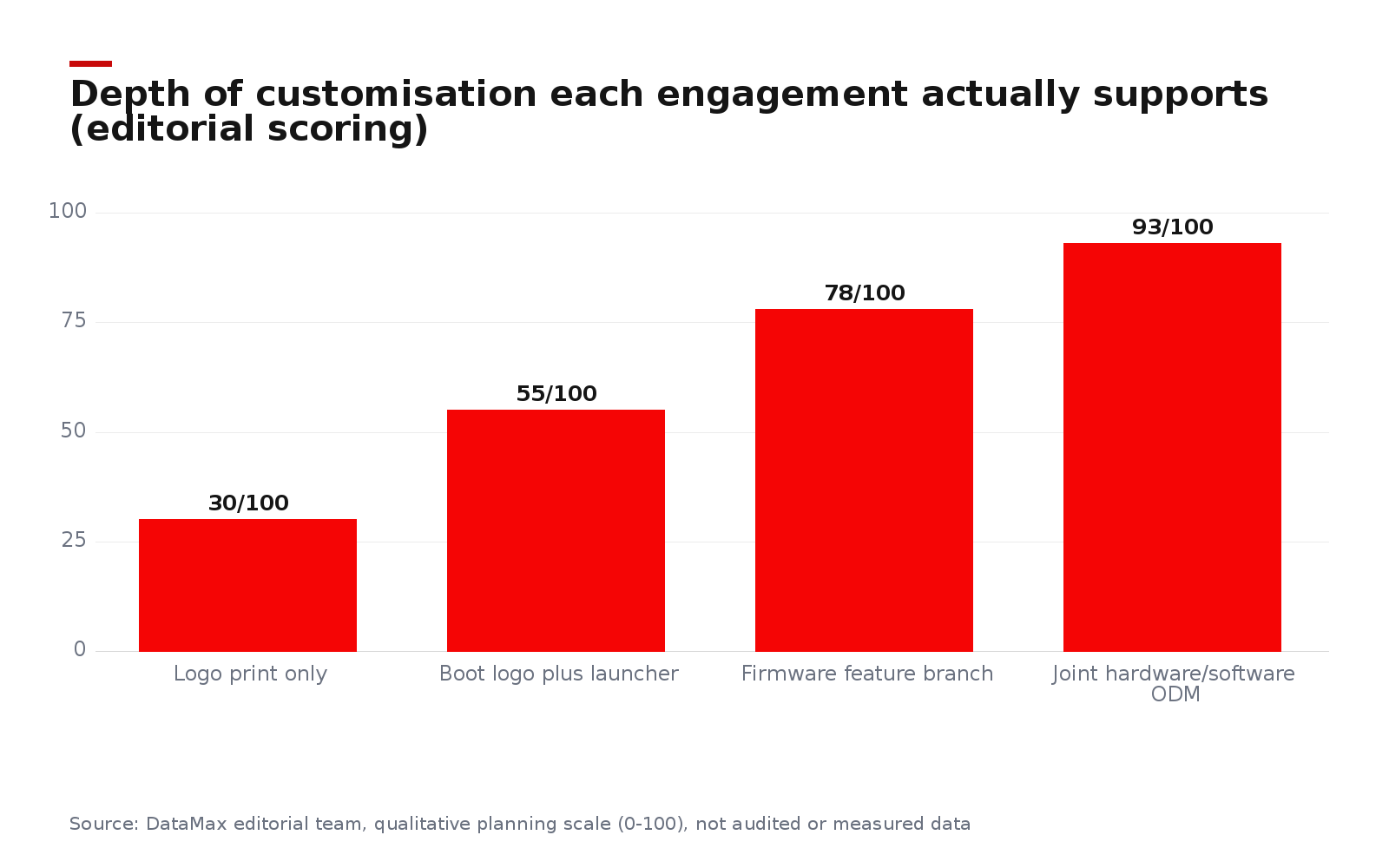
The same figures, in searchable form:
| Engagement option | Editorial score |
|---|---|
| Logo print only | 30/100 |
| Boot logo plus launcher | 55/100 |
| Firmware feature branch | 78/100 |
| Joint hardware/software ODM | 93/100 |
| Model | SoC and OS | RAM / storage | Decode and DRM | Interfaces |
|---|---|---|---|---|
| DM21P | Amlogic S905Y4, quad Cortex-A35; AOSP Android 11 | 2GB / 8GB; 4GB; 16/32/64GB optional | AV1 [email protected], VP9/H.265 4K@60, H.264 4K@30; Widevine L1 / PlayReady / HDCP 2.2 optional | HDMI 2.0b out x1, USB2.0 x2, TF, S/PDIF, 3.5mm AV, RJ45 100M, Wi-Fi6 2x2 + BT5.4, DC 5V/2A |
| DM21S | Amlogic S905Y5, quad Cortex-A55; AOSP Android 14 | 2GB / 16GB; 2/4/8GB; 16/32/64GB optional | AV1 / H.265 [email protected] 4K@60; Widevine L1 / PlayReady optional; Dolby Vision/DTS | HDMI 2.0b out, S/PDIF, AV, USB2.0 x2, TF, RJ45 100M (1G optional), Wi-Fi6 2x2 + BT5.4 |
| DM21T | Amlogic S905X5, quad Cortex-A510 (ARMv9); AOSP Android 14 | 4GB / 64GB; family options | H.266/VVC [email protected] 4K@120, AV1/VP9/H.265 4K@120, AVS3 4K@120, H.264 4K@60; inline AI-SR; Widevine L1 / PlayReady optional | HDMI 2.0b out (no HDMI in), USB2.0 x1 + USB3.0 x1, TF, S/PDIF, AV, RJ45 100M (1G opt), Wi-Fi6 + BT5.4 |
| DM22Q | Amlogic S905X5M, quad Cortex-A55 up to 2.5GHz; AOSP Android 14 | 4GB / 64GB; 2/4/8GB; 16/32/64GB optional | AV1/H.265 L5.1 4K@60; inline AI-SR (no NPU TOPS stated); Widevine L1 / PlayReady optional; Dolby Vision/DTS | HDMI 2.0b out, USB2.0 x2, TF, S/PDIF, AV, RJ45 100M (1G opt), Wi-Fi6 2x2 + BT5.4 |
The table excludes claims beyond the supplied facts. No 8K output capability is stated for DM21T or DM22Q. Operators, integrators, and buyers should verify display mode, HDCP, audio, DRM, and network options against the production datasheet and final configuration rather than deriving them from a family-level name. White-label packaging and boot-asset changes belong to the customisation route, not the base comparison.
Use DM21P when the stated fit matches the requirement: 4K IPTV or an operator middleware set-top box. The configuration includes AOSP Android 11, 2GB / 8GB as the stated base, and 16/32/64GB storage options. Its interfaces include RJ45 100M, Wi-Fi6 2x2, BT5.4, two USB2.0 ports, HDMI 2.0b output, S/PDIF, 3.5mm AV, and TF. Verify how they map to a middleware build, display, payment peripheral, and network design.
Use DM21S for a 4K Android TV box intended for IPTV/OTT white-label work and an AOSP Android 14 baseline. The stated base is 2GB / 16GB, with other RAM and storage options listed. Its decode statement is AV1 / H.265 [email protected] 4K@60. Widevine L1 and PlayReady are optional, while Dolby Vision/DTS are stated. Confirm the exact configuration, including RJ45 100M with 1G optional.
Use DM21T when the workload calls for premium UHD or cloud gaming and the complete display chain supports the required 4K@120 presentation. The facts state Amlogic S905X5, quad Cortex-A510 (ARMv9), AOSP Android 14, 4GB / 64GB, and inline AI-SR. The stated decode list includes H.266/VVC [email protected] 4K@120, AV1/VP9/H.265 4K@120, AVS3 4K@120, and H.264 4K@60. Its HDMI output has no HDMI input, which matters when an application expects pass-through.
Use DM22Q for a gaming-oriented Android TV box. The facts state Amlogic S905X5M, quad Cortex-A55 up to 2.5GHz, AOSP Android 14, and 4GB / 64GB, with other memory options. AV1/H.265 L5.1 4K@60 and inline AI-SR are stated; no NPU TOPS figure is provided. Two USB2.0 ports, RJ45 100M with 1G optional, and Wi-Fi6 2x2 + BT5.4 are included. Controller and accessory support must be confirmed against the production datasheet.
Across the models, the choice is a controlled trade-off. Android 14 appears on DM21S, DM21T, and DM22Q, while DM21P has AOSP Android 11. Memory, Ethernet options, decode statements, and DRM positions differ. Do not collapse the shortlist into one “4K Android TV box” claim. Its procurement value comes from mapping a named workload to a written configuration and validating that configuration.
Where this matters in a deployment
A retail network usually combines installation environments. A wall-mounted information or ordering kiosk has fixed Ethernet, controlled mains power, and a stable viewing distance. A portable demonstration unit may depend on Wi-Fi, intermittent power, and frequent movement. A hospitality-room controller may need a specific audio path. An operator-branded IPTV endpoint may require middleware, entitlement handling, and a controlled image.
Rows of identical compact black Android TV boxes on warehouse shelving with neutral packaging, pallets and packing station in background, soft industrial light, photorealistic product journalism, no readable text, no brand logos.
| Situation | Primary requirement | Model direction | Acceptance focus |
|---|---|---|---|
| Fixed retail information kiosk | Stable AOSP image, controlled launcher, Ethernet-first operation | Start with DM21S or DM21P; compare AOSP version and interfaces | Boot, launcher, power recovery, asset mapping, packaging |
| Operator IPTV or middleware endpoint | Operator integration, DRM path, stable remote update | DM21P is the stated fit; validate middleware and firmware responsibilities | Licence playback, channel workflow, reboot, update recovery |
| Premium UHD product demonstration | High frame-rate decode and display capability | DM21T direction; validate the complete HDMI and display chain | 4K@120 source, format, HDCP, audio, sustained presentation |
| Gaming-oriented retail display | Controller input, low-latency presentation, storage and memory headroom | DM22Q direction; verify accessory support against the production datasheet | Game rendering, input path, thermal behaviour, recovery |
| Multi-site AV integrator rollout | Serial-level traceability, uniform packaging, repeatable burn-in | Select by controlled SKU and evidence rather than model family | Golden sample, test records, label scan, site configuration |
For an operator programme, distinguish device responsibility from service responsibility. DM21P’s fit for 4K IPTV and operator middleware makes it a sensible starting point, but middleware must be tested against the final image, network, and DRM service. For an integrator deploying several retailer sites, production consistency matters more than a headline feature: one pack, one model revision, one firmware baseline, and one serial-number convention reduce site rework.
For a branded retail project, ask DataMax about custom development and packaging as separate line items. Artwork may be straightforward; the difficult part is ensuring that boot asset, launcher, serial label, asset database, and physical packaging identify the same approved configuration. A sample request can validate mechanical footprint and interfaces, but it cannot replace a written acceptance matrix.
A fixed information kiosk presents one operational problem: deterministic recovery. Its acceptance run should include cold start, normal application launch, forced power removal, network interruption, DHCP renewal, display reconnection, and recovery into the approved launcher. If the site uses Ethernet, test Ethernet rather than accepting a passing Wi-Fi result. Check the asset record at label scanning, because a correct image on an incorrectly labelled unit can still produce a wrong rollout.
An ordering or payment kiosk adds input and transaction responsibility. Identify the touch overlay, payment peripheral, USB or network interface, audio output, and recovery behaviour. The factory can verify electronic connection against an approved configuration, but the retailer must verify the end-to-end transaction and failure state. A test that merely opens the application does not establish that failed payment leaves the device safe and recoverable.
A portable demonstration unit changes physical and network assumptions. Include its power source, Wi-Fi credentials, moving display, and temporary peripherals in the pilot. A fixed Ethernet model may still provide the decode performance, but acceptance must reflect actual connectivity. Wi-Fi 6 identifies a radio capability; venue access-point coverage, authentication, and roaming determine the result.
For operator IPTV, site acceptance should include channel retrieval, guide data, entitlement denial, protected playback, reboot, update application, and recovery after network loss. DRM and HDCP claims must match the final configuration. For premium UHD, use the intended panel and source path, verify the stated decode mode in context, and observe sustained behaviour. For gaming, verify controller path, application rendering, network behaviour, and recovery under actual load.
Multi-site integrators should issue a site matrix rather than a generic installation sheet. Record retailer, venue, display, audio route, network method, power source, peripheral set, asset-label format, software image, and commissioning owner. Every difference becomes an explicit configuration decision, preventing one retailer’s accessory or display mode from silently creating a new SKU.
The selection sequence that removes rework
Begin with the use case, constrain the platform, then define the programme boundary. The sequence below turns the generic term android tv box manufacturer into an RFQ that a factory can quote and a buyer can audit.
IPTV, kiosk, UHD, gaming
mode, licence, HDCP
SoC, OS, memory, ports
branding, middleware, OTA
golden sample and release
Paste these request lines into the RFQ:
- “Quote one proposed DataMax model against the attached workload, and state every configuration not present in the current production datasheet for confirmation.”
- “Provide the exact AOSP Android version, launcher responsibility, GMS/EDLA position, Widevine and PlayReady position, and HDCP requirement.”
- “List HDMI mode and output, Ethernet speed, USB, audio, storage, Wi-Fi, Bluetooth, power, remote, and accessory requirements.”
- “Separate base platform, branding, packaging, firmware branch, middleware, provisioning, OTA, and certification responsibilities.”
- “Provide SMT/AOI, burn-in, dark-room, functional test, and release-record samples linked to serial number and hardware revision.”
- “State the golden-sample approval process, firmware identifier, update rollback method, defect-disposition process, and change-control route.”
Use the model table to create the first comparison, not to freeze the order. DM21P points toward operator middleware; DM21S toward an AOSP Android 14 IPTV/OTT white-label deployment; DM21T toward premium UHD or cloud gaming; DM22Q toward gaming-oriented retail. Confirm every exact option against the production datasheet.
Define the pilot in the RFQ. Specify sample count, intended display and network environment, continuous-operation duration, peripherals, application build, DRM service, and acceptance participants. A golden sample is not merely the first working unit. It represents the proposed production configuration, and its approval should record hardware revision, firmware image, packaging, accessories, and observed results.
Turn the sequence into a decision record. Step one selects workload and environment. Step two fixes output, DRM, HDCP, and content requirements. Step three selects SoC, OS, memory, storage, and ports. Step four assigns branding, launcher, middleware, management, OTA, and packaging ownership. Step five creates test, traceability, and release gates. Each step needs an owner and dated output; otherwise the next supplier response can reopen a settled requirement.
Keep unresolved items visible. If the retailer requires 1G Ethernet but the selected configuration states RJ45 100M with 1G optional, request written confirmation of the proposed configuration. If an application requires an input path, include it in interface review. If the operator asks for a particular GMS or EDLA position, request programme status. These are specification questions, not assumptions for final assembly.
The final release gate should join the approved requirement sheet, golden sample, production test record, and firmware-release manifest. If one changes, determine whether it is cosmetic, a configuration substitution, or a new acceptance cycle. This control prevents the common post-PO failure: an electrically correct device that is operationally incompatible with the fleet workflow.
Send the first message through the RFQ inquiry. It should contain the target model, screen mode, DRM service, network topology, OS requirement, OTA owner, packaging scope, and target quantity. For an independent check, ask the DataMax manufacturing team for a video factory audit or evidence specific to SMT/AOI, aging, serial traceability, and OTA release control for retail kiosk deployments.
Before issuing the purchase order, compare the quotation line by line against the approved requirement sheet. Confirm that model, Android version, memory, storage, interfaces, DRM position, launcher scope, packaging, test evidence, and delivery terms are visible. A quotation that silently substitutes a platform, leaves an option open, or combines unrelated services should return with a marked discrepancy. The completed RFQ should make the android tv box manufacturer accountable to the same release definition used by receiving.
Further reading
- Guide android tv box manufacturer
- Rockchip Android TV box guide
- Dolby Vision Android TV box guide
- RFQ checklist for device procurement
- Android TV boxes
- DataMax DM21P specifications and fit
- DataMax DM21S specifications and fit
FAQ
Can an AOSP Android TV box support a branded retail launcher?
Yes, provided launcher ownership, integration responsibility, permissions, update method, and acceptance criteria are defined. A branded boot image or packaging alone does not create a managed kiosk experience. Specify the expected home screen, navigation policy, application distribution, device reset behaviour, and recovery path before approving the firmware scope.
Which model fits an operator IPTV deployment?
DM21P is the stated fit for a 4K IPTV and operator middleware set-top box. Its AOSP Android 11 baseline, Amlogic S905Y4, and stated interfaces provide the starting point. Confirm middleware, DRM service, HDCP, network configuration, and any unlisted options against the production datasheet.
Does a retail kiosk require GMS certification?
Not automatically. The requirement depends on applications, distribution model, device-use constraints, and operating policy. AOSP controls the firmware baseline, while GMS and EDLA represent separate certification routes. State the required application catalogue and commercial distribution method in the RFQ.
How should a buyer verify factory quality for a kiosk fleet?
Request evidence tied to serial number, hardware revision, and firmware build: incoming inspection, SMT line records, AOI results, functional testing, dark-room procedure, aging results, exception disposition, and release approval. A sample record demonstrates the control method more effectively than a general quality statement.
What should be included in a retail Android TV RFQ?
Include workload, screen mode, DRM and HDCP requirements, Android baseline, launcher or middleware scope, network topology, ports, power, remote and accessories, OTA ownership, branding, packaging, test evidence, delivery schedule, and proposed model. Any option outside the current production datasheet should be marked for written confirmation.
Can one hardware model cover several retailer sites?
A controlled SKU can support multiple sites if display, power, network, peripheral, and operating requirements are compatible. Differences in enclosures, remotes, audio, or network installation may require separate SKUs. Use a site matrix and one approved configuration manifest to prevent local substitutions from creating unmanaged variants.
When is a joint hardware/software ODM engagement justified?
Use the commitment tier when the kiosk requires a dedicated launcher, operator middleware, feature branch, security-key process, custom peripherals, or controlled OTA beyond the selected platform. The RFQ should assign software, hardware, certification, update, and acceptance ownership before samples are approved.
What evidence prevents mixed configurations?
Require one hardware revision, firmware identifier, packaging revision, and serial-number convention per approved SKU. Link the golden sample, production test record, firmware-release manifest, label artwork, and shipment record. Classify every change as cosmetic, substitutive, or acceptance-affecting.