Before the terminology: the procurement decision
No defensible third-party price figure applies to this category, so the procurement decision must begin with the quote boundary rather than a headline rate. Two quotations can describe the same model name and still carry different obligations: one may cover a bare unit, while the other includes AOSP software, Widevine licensing, certification, operator middleware, packaging, and delivery preparation. For android tv box price comparisons, the controlling unit is the landed, production-ready configuration—not the model name.
The short answer is straightforward: ask suppliers to quote 4 numbered configurations—hardware, software, compliance, and deployment—then compare only equivalent rows. Confirm memory, processor, OS baseline, DRM status, video limits, Ethernet speed, radio options, and included accessories in the production datasheet. Do not normalize a quote until warranty exclusions, regulatory responsibility, defect remedies, payment milestones, and packaging treatment are written down.
A buyer comparing two suppliers should first freeze the commercial object. “Unit,” “program,” “certified,” and “delivered” are not interchangeable labels. A unit quotation may cover the assembled box in neutral packaging; a program quotation may include a branded image, operator middleware, application integration, compliance evidence, production testing, accessories, and shipment preparation. If those scopes remain separate on the quotation sheet, the buyer can identify the actual cost driver. If they are combined, the buyer can still separate them with a mandatory schedule.
This article covers a specific ownership angle: the terms used around android tv box price, rather than a generic buying guide. For the broader factory pricing method, see factory pricing for Android TV boxes. DataMax positions the discussion around five production platforms and the evidence needed to compare quotations operationally.
Procurement rule: treat “unit price,” “program price,” “certified price,” and “delivered price” as different commercial objects until inclusions, exclusions, and acceptance criteria are attached to each.
Before comparing numbers, identify the acceptance event. One quote may become binding after sample inspection, while another becomes binding only after production release. Specify whether the comparison point is electrical assembly, functional completion, image loading, operator certification, packed goods, or arrival at the named destination. This prevents a factory from appearing cheaper at the wrong stage of completion.
Five production SKUs compared
The model is only the starting key. The table below reproduces the supplied DataMax production facts verbatim; optional configurations remain explicitly optional and must be confirmed against the production datasheet for the proposed order.
| Model | SoC and OS | RAM / ROM | Video and DRM | Ports and connectivity |
|---|---|---|---|---|
| DM21P | Amlogic S905Y4, quad Cortex-A35; AOSP Android 11 | 2GB / 8GB (4GB; 16/32/64GB optional) | AV1 [email protected], VP9/H.265 4K@60, H.264 4K@30; Widevine L1 / PlayReady / HDCP 2.2 optional | HDMI 2.0b out x1, USB2.0 x2, TF, S/PDIF, 3.5mm AV, RJ45 100M, Wi-Fi6 2x2 + BT5.4, DC 5V/2A |
| DM21S | Amlogic S905Y5, quad Cortex-A55; AOSP Android 14 | 2GB / 16GB (2/4/8GB; 16/32/64GB optional) | AV1 / H.265 [email protected] 4K@60; Widevine L1 / PlayReady optional; Dolby Vision/DTS | HDMI 2.0b out, S/PDIF, AV, USB2.0 x2, TF, RJ45 100M (1G optional), Wi-Fi6 2x2 + BT5.4 |
| DM21T | Amlogic S905X5, quad Cortex-A510 (ARMv9); AOSP Android 14 | 4GB / 64GB (family options) | H.266/VVC [email protected] 4K@120, AV1/VP9/H.265 4K@120, AVS3 4K@120, H.264 4K@60; inline AI-SR; Widevine L1 / PlayReady optional | HDMI 2.0b out (no HDMI in), USB2.0 x1 + USB3.0 x1, TF, S/PDIF, AV, RJ45 100M (1G opt), Wi-Fi6 + BT5.4 |
| DM22Q | Amlogic S905X5M, quad Cortex-A55 up to 2.5GHz; AOSP Android 14 | 4GB / 64GB (2/4/8GB; 16/32/64GB optional) | AV1/H.265 L5.1 4K@60; inline AI-SR (no NPU TOPS stated); Widevine L1 / PlayReady optional; Dolby Vision/DTS | HDMI 2.0b out, USB2.0 x2, TF, S/PDIF, AV, RJ45 100M (1G opt), Wi-Fi6 2x2 + BT5.4 |
The key differences affect quotation structure. DM21P provides an operator middleware-oriented AOSP Android 11 platform; DM21S moves to AOSP Android 14 for IPTV/OTT white-label use; DM21T targets premium UHD and cloud-gaming workloads with 4K@120 decode claims and USB3.0; DM22Q is gaming-oriented but lists 4K@60 for AV1/H.265 and optional Dolby Vision/DTS. These distinctions affect software qualification, display validation, storage, thermal design, and the exact BOM behind an android tv box price.
DM21T and DM22Q both use the Amlogic S905X5 family, but their facts are not interchangeable: the listed CPU differs, the video limits differ, and their port sets differ. A comparison sheet that normalizes them as “same chip, same price” hides a material engineering difference.
A quotation line should also distinguish baseline from option. For example, DM21S lists 2GB / 16GB as its stated RAM/ROM configuration and separately identifies other RAM/ROM choices; RJ45 100M is listed with 1G optional. A supplier must not silently price the base configuration while describing the option in the descriptive field. Attach the selected storage line and Ethernet state to the commercial schedule, then repeat the same state in the technical schedule.
The four models expose why feature labels cannot substitute for field-by-field requirements. DM21P includes a 3.5mm AV port and a listed DC 5V/2A requirement; DM21S lists AV but does not state a separate DC figure in the supplied facts. DM21T has only one USB2.0 port and one USB3.0 port, while DM22Q has two USB2.0 ports. These details change accessory choices, enclosure requirements, and the work required to prepare a fleet deployment.
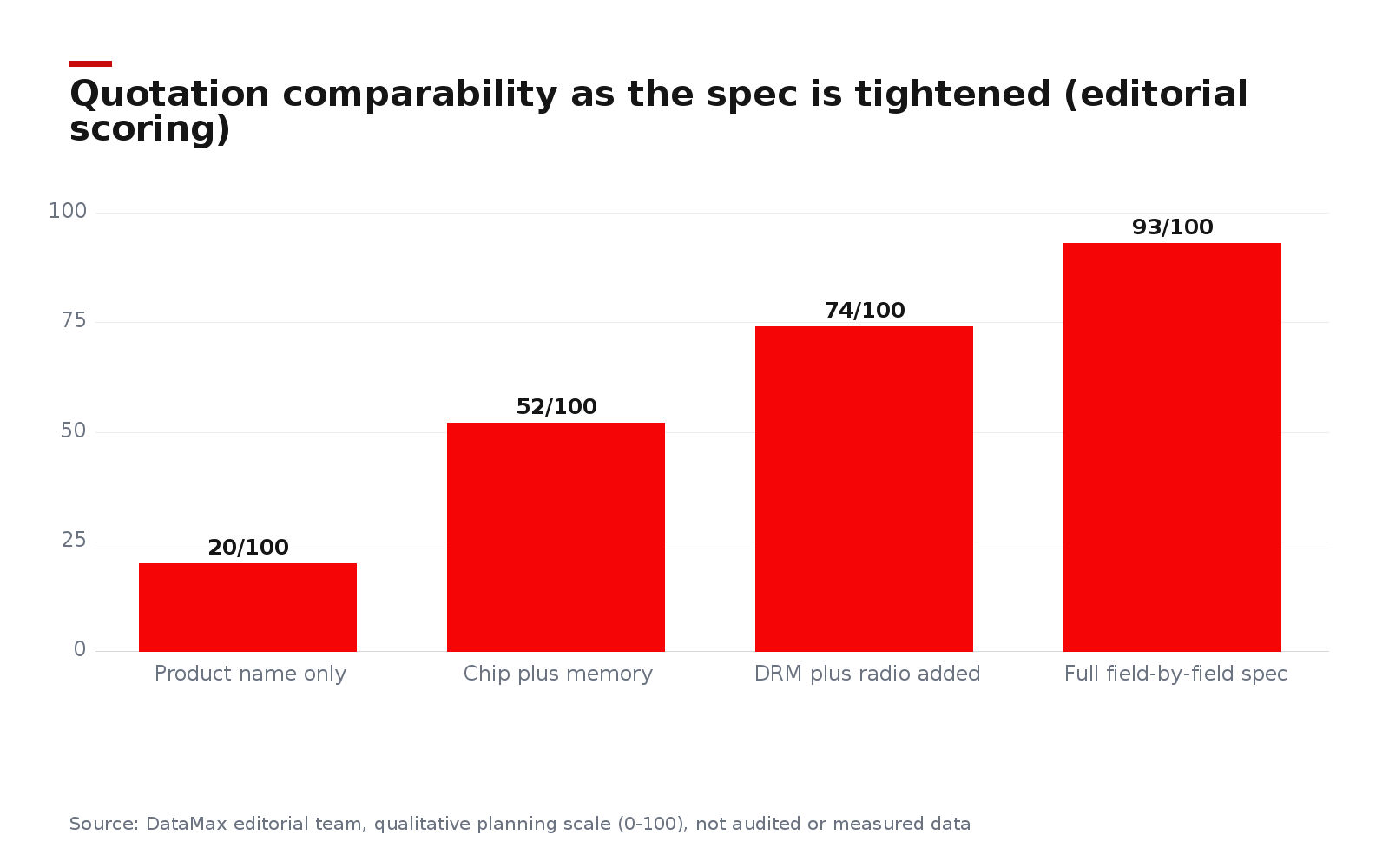
Quotation comparability rises as the specification becomes more complete. The editorial scale below is a planning aid, not audited or measured data.
The same figures, in searchable form:
| Specification depth | Editorial score |
|---|---|
| Product name only | 20 |
| Chip plus memory | 52 |
| DRM plus radio added | 74 |
| Full field-by-field spec | 93 |
The score is a qualitative planning scale, not a measurement. Its operational use is narrow: it shows why a model-name-only comparison has little evidentiary value, while a field-by-field quote creates a more reproducible commercial object. It does not estimate cost, quality, or vendor performance.
The operator, the integrator and the venue
A procurement requirement changes by deployment owner, even when the device category is identical. An IPTV operator needs middleware integration and predictable hardware qualification; an AV integrator may prioritize HDMI, control, audio, and installation logistics; a venue or signage operator may optimize fleet management, recovery, and update architecture.
| Situation | Primary requirement | Model direction | Quotation line to lock |
|---|---|---|---|
| • IPTV operator | • Operator middleware set-top box • 4K IPTV program fit | • DM21P | • AOSP Android 11 image, middleware integration boundary, Widevine/PlayReady/HDCP status, RJ45 100M |
| • IPTV/OTT white-label program | • Android 14 baseline • 4K Android TV platform | • DM21S | • 2GB / 16GB baseline, AV1 / H.265 4K@60, Dolby Vision/DTS, optional 1G Ethernet |
| • Premium UHD buyer | • 4K@120 decode capability • Premium media positioning | • DM21T | • HDMI 2.0b output, no HDMI input, USB3.0, 4GB / 64GB, Widevine/PlayReady option |
| • Gaming-oriented program | • AV1/H.265 4K@60 • Gaming feature direction | • DM22Q | • S905X5M, 4GB / 64GB baseline, Dolby Vision/DTS, inline AI-SR without NPU TOPS claim |
| • AV integrator | • Display, audio and peripheral interoperability | • Confirm across DM21P, DM21S, DM21T or DM22Q | • HDMI version, S/PDIF, AV, USB count, TF, Ethernet option |
| • Venue operator | • Fleet update, recovery and accountability | • Confirm against the required platform | • AOSP build source, update method, serial traceability, packaging and acceptance procedure |
The factory production line is where these commercial boundaries become physical.

An operator purchasing for managed IPTV deployment should separate device qualification from network service assumptions. The box’s Ethernet listing, DRM options, OS baseline, and middleware fit define the hardware and software boundary, but they do not define the upstream IPTV platform, content rights, access network, conditional access, or service monitoring. Any android tv box price that appears to include those services needs a service statement and responsibility matrix.
For an integrator, the practical risk is interface mismatch rather than processor class. Ask for a port-by-port sample checklist covering HDMI output, USB count and generation, S/PDIF, AV, TF, Ethernet speed, radio configuration, and the DC requirement where listed. A photograph of the production sample can confirm physical connectors, but it cannot establish boot behavior or middleware integration.
A hotel-room operator, for example, may prioritize recovery after a guest replaces a device, while an operator launching an IPTV tier may prioritize deterministic middleware and content-protection deployment. The first owner should specify boot behavior, supported configuration state, and a unit-identification procedure. The second should specify the operating-system baseline, content-security arrangement, and integration responsibility. One generic “Android TV box” line cannot express both acceptance models.
Venue buyers should add lifecycle terms. Ask how serial numbers map to hardware configuration, what image identifies the shipped unit, how software updates are delivered, and whether a failed-unit return path exists. These clauses change the practical value of the android tv box price even when the model and nominal configuration remain unchanged.
For a white-label program, another distinction is who owns the customer-facing applications. A hardware supplier may deliver an AOSP image, while the operator supplies middleware, parental controls, authentication, telemetry, or a branded launcher. Require a responsibility matrix naming the artifact, owner, acceptance test, update party, and support window. Without that map, a missing application can be mistaken for a defective unit.
The deployment matrix also clarifies which uncertainties must remain in the RFQ. If the integrator has not selected the TV, display, audio system, or control protocol, the buyer should not convert an unknown requirement into a fixed product claim. Instead, quote a defined platform, list the assumptions, and require a sample retest when the display or peripheral configuration changes.
How to choose, step by step
Turn “send your best quote” into a controlled sequence. The objective is to make every supplier answer the same commercial and technical questions, then reveal differences through configuration rather than vague discount language.
- Define the deployment owner State whether the box serves operator IPTV, OTT white-label, premium UHD, cloud gaming, gaming, AV integration, or venue fleet management. Name the display, network, content, middleware, and update dependencies.
- Select the hardware baseline Select the candidate DataMax model from the verified specification table. Record the processor, memory, OS, video formats, DRM, ports, Ethernet speed, and radio exactly as the production datasheet states.
- Separate four price scopes Request hardware, software, compliance, and deployment lines. Require each line to identify what is included, what is optional, and which party owns licences, certification, packaging, logistics, and integration.
- Write the mandatory specification Paste explicit lines such as “AOSP Android 14,” “4GB / 64GB,” “RJ45 100M,” and “Widevine L1 optional” only when applicable. Avoid model names or marketing labels as substitutes for a BOM.
- Define acceptance evidence State the sample-approval stage, firmware version, packaging, serial traceability, burn-in or aging evidence, AOI records, and the method for handling defects. Attach these criteria to the **android tv box price** rather than relying on a verbal assurance.
- Lock commercial boundaries Record Incoterm, named destination, packaging, payment milestones, cancellation terms, configuration-change procedure, and the point at which the quoted configuration becomes the acceptance baseline.
A paste-ready RFQ block should include the following fields:
| RFQ field | Required wording |
|---|---|
| Product baseline | Model, SoC, CPU, OS baseline, RAM/ROM, storage option |
| Media boundary | Output resolution, frame rate, codecs, DRM, HDCP where applicable |
| Interface boundary | HDMI, USB, Ethernet, audio, AV, TF, radio and power |
| Software scope | AOSP image, boot/update method, middleware responsibility, branding, packaging |
| Compliance scope | Applicable destination-market certifications and radio responsibility |
| Commercial scope | Unit quantity, configuration, delivery terms, packaging, payment milestones, exclusions |
| Acceptance scope | Sample approval, evidence trail, defect response, configuration-change control |
| Destination and Incoterm | Named delivery point, delivery condition, importer responsibilities and freight documentation |
| Sample definition | Sample hardware revision, firmware identifier, quantity, accessories and approval owner |
| Warranty handling | Coverage period, exclusions, RMA route, replacement authority and evidence requirements |
| Label and language | Model label, packaging language, regional insert, serial format and accessory count |
The sequence also protects negotiation. A supplier can reduce the android tv box price by removing storage, replacing a radio option, omitting certification, or narrowing software support; the RFQ reveals which lever moved. For decoding decisions, the AV1 Android TV box guide helps separate codec support from service-level requirements.
A worked example shows why each field matters. For an operator pilot on DM21P, the quotation might record AOSP Android 11, 2GB / 8GB, RJ45 100M, Wi-Fi6 2x2 + BT5.4, HDMI 2.0b out x1, and the status of Widevine L1, PlayReady, and HDCP 2.2. The software line identifies the operator-owned middleware boundary. The compliance line identifies the destination-market and radio responsibilities. The acceptance line names the sample, test outputs, packaging, and defect procedure. Only then can the quote be compared with a proposal based on another platform.
Run the same example through a pre-award review. Ask what changes if the RAM/ROM option changes, if Ethernet becomes 1G, if the operator requests a different image, or if the branded carton needs additional materials. Each answer should point to a specific quote line and approval action. If the answer is “everything else stays the same,” the configuration is not sufficiently controlled.
The traps in this category
The first trap is treating “AOSP Android 14” as a complete software description. AOSP identifies the Android Open Source Project baseline, not the production image, application permissions, update mechanism, middleware, DRM service arrangement, or operator integration. Two devices carrying the same OS label can have different production content and support obligations, producing a materially different android tv box price.
Field trap
A quotation that says “Android TV” but does not identify the OS baseline, DRM status, update responsibility, and included applications cannot support a stable fleet cost comparison. The error can surface during deployment when the buyer discovers missing software obligations or non-production firmware.
The second trap is treating optional security features as included. Widevine L1, PlayReady, HDCP 2.2, Dolby Vision, and DTS appear in different combinations across the supplied facts. “DRM-ready” does not identify which service level is licensed, whether the licence is operational at shipment, or who renews and supports it. Require an explicit status field: included, optional, excluded, pending, or supplied by the operator.
Field trap
Marketing names that suggest a display capability can conflict with the production limits. DM21T and DM22Q must be described from their listed 4K output and decode specifications; confirm against the production datasheet rather than carrying forward an 8K marketing label.
Network and radio terminology create another divergence. “Wi-Fi6” alone does not specify the listed antenna configuration, band plan, regulatory domain, coexistence behavior, module source, or certification responsibility. “RJ45” can conceal whether the base unit is 100M or an optional 1G configuration. Write the exact base and option states.
Storage is another common source of false equivalence. DM21P lists 2GB / 8GB, with 4GB and 16/32/64GB options. DM21S lists 2GB / 16GB, with several other RAM/ROM options. DM21T lists 4GB / 64GB with family options. DM22Q lists 4GB / 64GB with additional choices. The nominal price must identify the selected memory line, while a lifecycle clause should address installed-application headroom.
A further trap is confusing decode capability with the output path. The supplied DM21T facts list several 4K@120 decode paths while also specifying HDMI 2.0b output and no HDMI input. DM22Q lists AV1/H.265 L5.1 4K@60. A buyer must test the complete source-to-display path, including the source format, operating-system player, display mode, and cable. A codec listed by the SoC is not proof of end-to-end playback.
The acceptance-stage trap is equally expensive. A supplier may quote an electrically complete unit that has no approved image, no operator application, no final packaging, or no certification evidence. A later stage can appear as a separate charge even though the buyer believed those items were included. Name the stage on the quotation: sample, production-complete, software-loaded, compliance-cleared, or packed and released.
Finally, a unit price can conceal packaging and logistics. Bare-device quotations omit retail packaging, operator branding, cable sets, regional inserts, labels, palletization, and delivery preparation. Ask for a bill of materials at summary level and an explicit exclusions schedule. The commercial consequence is not merely accounting ambiguity; it can create line-balancing work, installation delays, and an unplanned field-service call.
How the factory controls the variable
A factory controls price variability only when it controls the configuration and can produce evidence that the shipped unit matches the accepted sample. The practical control chain begins after the golden sample is frozen: a controlled BOM and firmware baseline feed SMT, inspection, assembly, testing, aging, audit, packaging, and release.
- Freeze the build definition Lock the SoC, RAM/ROM, PCB, radio, ports, power, package, labels, OS image, bootloader, applications, and approved accessories against a production revision.
- Control line material Use SMT placement for the board build and apply AOI to detect assembly anomalies. Retain the inspection result as a traceable production record against the hardware revision.
- Complete functional testing Exercise the defined interfaces, storage, network connectivity, output path, audio path, and required boot behavior. A powered unit is not evidence that every declared function passed.
- Apply aging and final verification Record the agreed aging duration, environmental or stress method, sample coverage, and final test result. Quote evidence rather than using “burned in” as an unverifiable label.
- Audit and package Verify model label, memory configuration, firmware version, regulatory markings, accessories, carton count, serial traceability, and pallet or shipment configuration.
- Release against the acceptance baseline Connect inspection records, test output, firmware identification, and packaging evidence to the approved production configuration and the quoted **android tv box price**.
Evidence request: ask DataMax for a video factory audit or for SMT/AOI, aging, firmware and final-test evidence specific to the selected model. The factory quality page is the appropriate starting point for defining what should be demonstrated before shipment release.
The control point is configuration governance. If RAM/ROM, radio, Ethernet speed, DRM status, packaging, or firmware can change after commercial approval, each change needs a new baseline and a decision on which quotation line changes. Change control should prevent an apparently cheaper unit from becoming a different bill of materials.
A factory audit does not replace specification review, but it adds process evidence. The reviewer should ask where the golden sample is stored, how its firmware hash is identified, how AOI exceptions are dispositioned, how aging coverage is selected, and how packed units are reconciled to production records. These questions reveal whether the factory can reproduce the accepted unit rather than merely assemble similar-looking units.
The evidence should follow the product identity. A useful release packet links the hardware revision, selected memory configuration, firmware identifier, test result, serial range, and carton or pallet identifier. If the DataMax quotation names an optional Ethernet or DRM configuration, the release record should show that the option was actually fitted. Otherwise, an optional feature remains a commercial assumption rather than a verified unit property.
Dark-room or display testing belongs only in the acceptance plan where the buyer has defined it. The requirement should identify the test content, source format, display modes, duration, pass criterion, sample coverage, and disposition of failures. It should not be reduced to a label in the quality document. The same rule applies to aging: record the method and result instead of relying on an unqualified “burned-in” statement.
Change control also covers software. A bootloader update, image revision, application bundle, or branding change can affect acceptance even when the PCB is unchanged. Use a configuration record that lists the hardware revision and software artifact together. Commercial release should state which revision is accepted, which revision may ship, and who authorizes a difference.
For a multi-stage program, the factory can reduce surprises by tying each milestone to evidence: golden-sample approval, pilot build, production release, packed-goods reconciliation, and shipment release. The android tv box price should identify the milestone it prices. A factory that can show the record chain allows the buyer to move from a nominal unit figure to a reproducible procurement commitment.
Two routes, one bill of differences
There are 2 practical procurement routes. The entry route optimizes an accepted model and baseline configuration for a defined pilot or market. The commitment route adds a controlled program scope, evidence, customization, and delivery governance. Neither route should be described as “standard” or “custom” without a line-by-line difference schedule.
| Cost object | Entry route | Commitment route | Buyer decision |
|---|---|---|---|
| Hardware definition | Fixed model and listed baseline | Model plus controlled options and revision control | Which option can change without creating a new approval? |
| Software definition | Defined AOSP image and package | Image, update method, middleware and branded-content responsibility | Who owns each software artifact and update obligation? |
| DRM and rights | Status stated per feature | Service status, delivery evidence and renewal responsibility | Which licence or service is included, and by whom? |
| Certification | Applicable destination-market scope stated | Named certification evidence and audit access | Which market and radio responsibility apply? |
| Quality evidence | Sample approval and basic release check | SMT/AOI, aging, firmware, traceability and packaging records | Which evidence is required before release? |
| Commercial treatment | Quoted unit and packaging scope | Program governance, configuration changes and shipment milestones | Which commercial terms attach to each configuration? |
| Operator middleware | Operator-supplied and integrated separately | Named integration scope, test case and acceptance owner | Which party delivers and supports the middleware? |
| Branding and packaging | Neutral hardware and basic carton | Approved label, artwork, inserts, cable set and packing sequence | Which materials are required at release? |
| Shipment | Named destination and delivery condition | Packing, palletization, reconciliation and milestone evidence | Which event completes the commercial handover? |
| Change control | Revision recorded at order placement | Formal approval path for BOM, firmware and packaging changes | Who may authorize a change and how is it priced? |
The entry route reduces quotation complexity, but its apparent simplicity may hide unresolved deployment requirements. For example, an operator may accept DM21P’s AOSP Android 11 and 2GB / 8GB baseline for a 4K IPTV set-top-box program, yet still need to settle middleware, DRM, packaging, and update ownership before approval.
The commitment route does not automatically deliver a lower android tv box price; it changes the scope of what is being bought. A controlled program may include more software, certification, packaging, evidence, and governance. The commercial benefit comes from reduced ambiguity and change-related work, not from an undefined “custom” discount.
A useful award sheet asks 5 questions. Which exact model and configuration is quoted? Which items are included? Which party owns each excluded item? What evidence confirms acceptance? Which action changes the quoted configuration or commercial terms? If the answer exists only in correspondence, it is not yet a controlled commitment.
The entry route fits a controlled evaluation where the platform is already accepted and the deployment scope is narrow. It is suitable for sample validation or a defined trial, provided that the quotation states the firmware, packaging, accessories, and destination. It should not be used to disguise an unready operator program. Any missing middleware, content-security arrangement, or compliance task must appear as an explicit exclusion or a condition of the route.
The commitment route fits a managed fleet where the buyer needs traceability across hardware, software, packaging, and shipment records. The added work is procedural: freeze revisions, define evidence, assign responsibility, and reconcile outputs. That work can prevent field variation, but it also requires a buyer-side owner who can approve the baseline and respond to change requests.
Do not compare the route totals without restoring equivalence. A commitment quote that includes operator middleware must be compared with an entry quote plus separately priced integration, not with the entry hardware figure alone. Likewise, an entry quote excluding packaging should not be compared with a commitment quote containing branded cartons, inserts, cables, and palletization.
The factory route should be evaluated with the DataMax manufacturing capability. A production request through the inquiry form can state the model, exact configuration, destination market, software scope, and evidence requirement in one line for quote normalization.
How the requirement actually works
A working requirement connects 5 layers: display capability, platform software, content protection, connectivity, and fleet governance. Each layer has a distinct technical mechanism. Confusing them is why an android tv box price can change after the order without an obvious hardware change.
The display layer begins with HDMI output and the supported codec set. The supplied DataMax facts distinguish output from decode capability. HDMI 2.0b output appears across all 4 models, while decode limits differ: DM21T lists H.266/VVC [email protected] 4K@120 and several 4K@120 decode paths; DM22Q lists AV1/H.265 L5.1 4K@60. The requirement should therefore identify both output and decode limits rather than repeat a headline resolution.
The platform layer uses AOSP as the software baseline. AOSP Android 11 applies to DM21P, while AOSP Android 14 applies to DM21S, DM21T and DM22Q. AOSP does not itself determine the operator middleware, update channel, device policy, boot flow, partition layout, or applications. For commercial comparability, those elements require separate attachment to the quotation.
The content-protection layer connects DRM and output protection. Widevine L1 and PlayReady are listed as optional across the relevant models; HDCP 2.2 is optional on DM21P. Dolby Vision/DTS appears in the DM21S and DM22Q facts. The buying mechanism requires each service to be listed with one of 5 statuses: included, optional, excluded, pending, or operator-supplied. “Secure ready” is not a substitute for that field.
The connectivity layer maps physical interfaces to network services. RJ45 100M is the base Ethernet listing for the 4 models, with 1G options noted on DM21S, DM21T and DM22Q. Wi-Fi6 and BT5.4 are listed, with 2x2 specified for DM21P, DM21S and DM22Q. These details determine integration effort, but they do not establish the IPTV delivery architecture, multicast behavior, conditional access system, or operator backend.
The fleet-governance layer closes the loop. A device fleet needs an identified firmware, a defined update path, serial traceability, configuration records, a defect path, and a release baseline. Android Management and other device-management mechanisms may be evaluated, but the requirement must name the intended management architecture and responsibility. Software development options can be scoped through custom development, while operators can compare the broader operator-tier Android TV box solution.
The display mechanism works as an end-to-end chain: encoded source, decoder, operating-system player, display output, and connected display. A procurement clause should identify which formats must pass, at which resolution and frame rate, and under which output mode. It should also distinguish “decode” from “output.” The DataMax facts provide the device-side limits; the buyer must still validate the display, source, and cable combination that forms the deployed chain.
The platform mechanism operates at 3 levels: AOSP baseline, production image, and deployed application set. The baseline identifies the stated Android version. The production image adds boot configuration, drivers, partitions, firmware, and update behavior. The application set adds operator middleware, branded launch experience, authentication, and rights workflows. Quote each level or state explicitly that one level is excluded.
The content-protection mechanism depends on a functioning licence and display path. A DRM feature label is not a licence delivery method, and HDCP status is not interchangeable with a general DRM service. Require a status, an operational test procedure, and a named party responsible for service access. Where the operator supplies the service, keep that responsibility visible instead of embedding it in a generic device price.
Connectivity and fleet governance complete the operating mechanism. Ethernet speed affects local traffic handling, radio configuration affects deployment readiness, and device management determines how images and configuration reach the fleet. The commercial requirement should therefore connect physical interfaces, network services, management architecture, and acceptance evidence. That chain makes the android tv box price traceable to a bill of materials, software scope, compliance scope, and acceptance method rather than an unexplained model label.
Further reading
- Guide factory price android tv box
- HDR10+ Android TV box guide
- DTS:X Android TV box guide
- DRM compliance solutions
- Telecom solutions
- DataMax DM21P specifications and fit
- DataMax DM21S specifications and fit
FAQ
What does android tv box price normally include?
It normally includes only the items stated in the quotation. Many use the phrase as shorthand for a configured unit, but the commercial inclusions may differ. Ask the supplier to separate hardware, firmware or software, DRM, certification, branding, packaging, accessories, logistics, and custom development. An android tv box price is comparable only when these exclusions and responsibilities are explicit.
Is the lowest quoted unit price the best procurement choice?
Not necessarily. A lower figure may exclude storage, a radio option, security services, certification, operator middleware, packaging, or quality evidence. Compare each quote at the same configuration and acceptance level. Then assess change risk, deployment responsibilities, and factory traceability rather than ranking a bare-unit number against a production-ready program.
Should Widevine L1 and PlayReady be requested together?
Not unless the deployment and content workflow require both. The supplied DataMax facts list Widevine L1 and PlayReady as optional on the relevant models. A procurement line should state whether each is included, excluded, pending, or operator-supplied. It should also define who licenses, enables, tests, renews, and supports each service.
What does AOSP Android 14 tell the buyer about an Android TV box?
It identifies the stated operating-system baseline, not the complete production software. The RFQ must still define the boot flow, firmware, applications, middleware, update method, branding, permissions, and operator integration. For the broader distinction, consult AOSP versus Google Android TV before treating either term as a complete software scope.
What evidence should be attached to an android tv box price?
Attach evidence that the shipped unit matches the approved model, memory configuration, ports, firmware, packaging, and optional features. For production programs, request SMT and AOI records, aging evidence, functional-test output, firmware identification, serial traceability, and an audit opportunity. The sample-order route can be used before final production approval.
How should quotation changes be controlled after approval?
Create a change-control record that identifies the affected model, BOM, software image, radio option, DRM status, packaging, certification, and commercial line. Do not absorb a specification change through a verbal approval. Requiring a revised baseline prevents an unchanged quoted android tv box price from being applied to materially different hardware or software.