

What the answer hinges on
An RFQ lands in a procurement inbox stating “600 retail kiosks, Android TV boxes,” but the display mode, Ethernet speed, middleware image, and recovery procedure remain undefined. The direct answer for android tv box wholesale is to treat the purchase as a managed-device programme: specify the counter workflow, freeze the hardware and software configuration, approve a golden sample, and release production only after a pilot batch passes.
The decision turns on 5 variables: the screen and network path, the operator middleware, the DRM and licence workflow, the physical installation method, and the evidence required at handoff. The commercial model then changes the risk allocation. A catalogue SKU with fixed RAM/ROM and ports is straightforward to quote. A white-label programme with custom firmware, packaging, provisioning, or regional compliance needs its own change control and acceptance criteria.
DataMax should quote the exact model, memory configuration, firmware baseline, port map, codec and DRM requirements, test package, and delivery scope. For a broader treatment of channel structure, see the wholesale Android TV box guide. This page addresses only the retail-kiosk operating model: what must be specified, what must be evidenced, and where quotations diverge after the purchase order.
A counterexample shows why a catalogue-only approach breaks down. One store rollout may begin with 200 counters using wired IPTV and 400 kiosks using operator-managed OTT, each with different display timing and middleware. If both groups sit on one loosely worded order line, the factory can produce a physically identical box while missing the software identity, network option, or packaging requirement that separates the configurations.
The procurement team should request a configuration schedule rather than rely on one line of “600 retail units.” Each line should identify model, RAM/ROM, port options, firmware identifier, application image, DRM position, packaging revision, test regime, and applicable site group. The golden sample then becomes the common reference for every line, while a deviation report prevents an approved sample from being silently replaced by an equivalent-looking alternative.
Procurement rule: one approved specification, one golden sample, one pilot-batch sign-off, and one production baseline. A product name alone is not a deployable configuration.
The operator, the integrator and the venue
The same floor plan creates 3 different buying situations. An IPTV operator may control authentication, middleware, licence delivery, and fleet telemetry. An AV integrator may prioritize HDMI compatibility, audio routing, wall mounting, and recovery after power cycling. A venue owner may care about simple restart behaviour, compactness, cabling, and replacing units without sending technicians across multiple sites.
| Situation | Controlling requirement | Model direction |
|---|---|---|
| Operator-managed IPTV counter | Operator middleware, managed login, DRM workflow, stable Ethernet or Wi-Fi path | DM21P for operator middleware or DM21S for a current AOSP white-label baseline |
| Retail display managed by an AV integrator | HDMI 2.0b output, 4K delivery, optical or analogue audio as required, USB service access | DM21S for general OTT/IPTV use; DM21T when higher decode capability is required |
| Gaming-led interactive retail counter | 4K motion handling, controller connectivity, stable firmware and operator application control | DM22Q for the gaming-oriented Android TV profile; DM21T for premium UHD/cloud-gaming use |
| Multi-site rollout with central operations | Fleet provisioning, repeatable firmware, burn-in testing, spare-unit planning and audit evidence | Select the platform first, then create a controlled programme around the selected SKU |
| Pharmacy or service counter with restricted access | Physical security, controlled USB access, operator account, predictable recovery | DM21P when operator middleware dominates; DM21S when a white-label AOSP Android 14 baseline is required |
| Premium showroom with motion-led content | Higher refresh-rate decode, controlled application environment, stable 4K output | DM21T for premium UHD/cloud-gaming requirements; validate the complete display chain |
| Store group with mixed wired and wireless sites | Explicit Ethernet option, Wi-Fi survey, identical application and image, site-specific configuration records | Use DM21S, DM21T, or DM22Q only after recording the applicable network option per model |
| Airline ticketing counter with strict uptime | Deterministic startup, operator session, wired network, defined recovery and quick unit substitution | DM21P or DM21S, subject to the operator middleware and network acceptance test |
Ownership determines the acceptance split. The operator may accept the image, account model, and content session; the integrator may accept HDMI, audio, display mode, and peripherals; the venue may accept mounting, power, store network, and physical access. One release checklist should name each owner and prevent a gap between hardware delivery and operational activation.
For example, a pharmacy counter might use an operator middleware image, one S/PDIF connection to the display amplifier, a fixed Ethernet service point, and a recovery procedure that permits a local operator to restart the unit after a network interruption. The quotation must identify who supplies the middleware, who loads the certificates, who validates the application, and who replaces a failed unit. A box specification alone leaves all 4 actions unassigned.
Network architecture also changes the hardware decision. A counter with a wired backbone makes RJ45 the preferred primary path; the listed 100M Ethernet implementations should be checked against the actual access-network design, while 1G configurations are optional on DM21S, DM21T, and DM22Q. A Wi-Fi-dependent deployment must account for RF survey, credentials, captive-portal behaviour, and roaming rather than treating Wi-Fi6 as automatic coverage.
In a staging warehouse, identical units should be allocated to the same role, but hardware identity must remain traceable. Photograph the serial label, record the hardware revision, install the approved image, and associate the device with its site. The retail venue determines the mount, power source, cable length, display mode, and service-access route; the factory should not infer these from a generic kiosk package.
The staged fleet should also be physically segregated by configuration. Put operator-middleware units in one labelled area, integrator-managed units in another, and spares in a third area with their own configuration records. Mixing a 100M RJ45 unit with an optional 1G unit before site assignment makes the hardware revision difficult to verify at dispatch. This is especially relevant in android tv box wholesale programmes where one model name can carry several configuration permutations.
How to choose, step by step
Turn the retail use case into acceptance-testable lines before comparing models. A workable RFQ asks the supplier to state the proposed model, SoC, RAM/ROM, operating system, output resolution and refresh-rate limits, wired and wireless options, port count, DRM position, codec requirements, firmware provenance, packaging, and evidence required for production acceptance.
- Define the counter workflow Record the applications, account model, startup behaviour, content sources, peripherals, operating hours, power-cycle pattern, and whether a technician can physically reach each unit.
- Freeze the display and network contract State HDMI versus Wi-Fi playback, display resolution, audio destination, Ethernet speed, DHCP or static addressing, DNS, VPN, multicast, and the required uptime target.
- Lock software and security Identify AOSP Android 11 or Android 14, operator middleware, update ownership, certificate provisioning, Widevine L1 and PlayReady expectations, HDCP requirements, and the application signing plan.
- Select the platform by workload Compare the fixed DataMax configurations against the workload; do not infer extra performance from a model family or optional memory line.
- Approve a golden sample Test the exact configuration on the target display, network, application set, and access method. Record serial number, firmware hash, image identifier, and observed results.
- Run a pilot batch Use the pilot to validate burn-in, packaging, firmware consistency, operator provisioning, recovery, and spare-unit workflow before releasing the production order.
- Freeze the purchase-order configuration Attach the approved specification, golden-sample reference, pilot report, firmware identifier, packing list, delivery schedule, and change-control conditions.
A buyer can paste the following structure into an RFQ: “Supply model [exact model] with [RAM/ROM], [RJ45 option], [DRM line], [firmware identifier], and [packaging revision]. Each unit must boot to [launch state], pass [display test] at [resolution and refresh limit], connect through [network method], expose [port set], and carry [serial or lot identifier]. The acceptance package must include [evidence list]. Changes to SoC, memory, Ethernet option, firmware, accessories, or packaging require written approval.” This converts descriptive requests into comparison lines.
Do not collapse codec, output, and display capability into one phrase. A device may decode a 4K stream while the connected television, scaler, or HDMI input operates at a lower mode. Likewise, a 4K@120 decode claim does not establish that the whole retail display chain accepts 4K@120. The RFQ should distinguish source format, decoder limit, HDMI output mode, and test-display capability.
The software identity needs equal precision. AOSP Android 11 and AOSP Android 14 are different baselines, while a launcher, operator middleware, device certificate, and application build add further variables. Ask whether the supplier installs the image, delivers it for customer installation, or ships units without operator software. Also state how updates are applied, whether the customer can block unintended updates, and what evidence identifies an approved image after shipment.
The RFQ should request separate lines for “standard catalogue configuration” and “programme-specific modification.” Without that separation, a quotation can appear to include regional branding, operator middleware, custom packaging, and fleet provisioning while actually covering only a generic box. For a first request, send the counter count, target model, required RAM/ROM, display and network profile, middleware, DRM position, packaging scope, destination, and target delivery window through the RFQ form.
Before issuing the order, hold a configuration review with engineering, operations, procurement, and the deployment owner. Compare the quotation line by line against the approved sample and attach a signed configuration schedule. The review should end with named responsibility for firmware loading, certificates, site accounts, network configuration, burn-in evidence, packaging, and spares. That step prevents procurement from treating technical approval and operational activation as the same event.
What goes wrong after the PO
The most expensive ambiguity is rarely the hardware itself. It is the unrecorded dependency between a box, an application, a display, and a network. For example, 4K decoding does not guarantee that the commercial display, HDMI input, scaler, and cable path accept the intended format. Likewise, Widevine L1 capability does not establish the level, device-binding rules, source type, or key-delivery configuration of a particular content service.
Field trap
The quotation says “4K Android TV box,” but the production datasheet caps output and decode at 4K. Treating promotional “8K” wording as a delivery specification can create acceptance disputes, unnecessary platform costs, and display-chain failures.
A second divergence appears in “optional” configurations. Optional Ethernet speed, storage, DRM, Dolby Vision/DTS, or other capabilities must be resolved into explicit yes/no lines. “RJ45 1G optional” cannot remain open after the purchase order if the retail network design assumes 1G. Likewise, a software-licensing request is not equivalent to a permanent hardware DRM entitlement.
The remaining failures are operational. Firmware built during the pilot may differ from the production image. Labels may omit the RAM/ROM configuration. Packaging may change without approval. A batch may pass functional testing without exercising prolonged display output. Operators may lack the account, certificates, URLs, or provisioning credentials needed at deployment. These issues are controlled through revision control, configuration records, and a pilot rather than through more adjectives in the quotation.
Field trap
A 100M RJ45 implementation and an optional 1G implementation are not interchangeable procurement lines. An unspecified “network-ready” box can pass a supplier test while failing the operator’s access-network, multicast, or VPN validation at the site.
Another common post-order failure is a mismatch between the sample and the delivered build revision. The sample may contain a corrected driver, later middleware, or a revised packaging insert that is absent from production. Require the production unit to carry the same hardware revision, firmware identifier, configuration label, and approved accessory set. A photograph of the carton is not sufficient evidence because it does not identify the internal image or option board.
Content operations expose another weak line. A test loop may use only 1 codec, 1 resolution, or 1 audio format, while stores need a broader set. The RFQ should name the required source formats, output resolution, refresh-rate ceiling, and audio destination. It should also define whether DRM is needed on the device model, the commercial service, or both. These are separate acceptance decisions, and the correct one depends on the content contract.
The spares process should be defined before shipment. Record whether spare units share the production firmware, whether they are pre-enrolled, whether they have installed certificates, and who authorizes substitution. A spare without the correct image may consume more rollout time than the failed unit it replaces. A controlled programme can set aside units by configuration, label them separately, and include the same firmware and packing records.
Before release, require a deviation report that identifies every difference between the approved golden sample, pilot batch, and production order. No firmware, port, memory, power supply, packaging, or accessory change should remain implicit. This is the point at which android tv box wholesale programme control prevents a nominal substitution from becoming an uncontrolled fleet variation.
How the factory controls the variable
Factory control begins with a traceable build route and ends with an evidence package tied to the production batch. SMT placement quality, AOI results, component substitutions, firmware flashing, display output, network functions, aging, and final packing must connect to serial or lot identity. The evidence chain matters because a box can be electrically sound yet carry the wrong image, wrong storage configuration, or wrong accessories.
- Prepare the controlled build file Match the approved golden sample, firmware identifier, hardware revision, memory configuration, power supply, packaging, and accessories to the purchase order.
- Control placement and inspection Record SMT and AOI evidence for the production lot; flag substitutions or component-direction deviations for engineering disposition.
- Verify software identity Flash the approved image, verify the build identifier, and record application, service, and update configuration before final test.
- Run electrical and I/O checks Test the specified ports, power, output path, network options, Bluetooth where fitted, storage, and required peripherals.
- Apply an aging regime Exercise the unit across a defined display, application, network, and power-cycle profile before final acceptance.
- Complete dark-room visual inspection Check the panel image for defects such as lines, dead pixels, flicker, backlight variation, or unstable output under the agreed test conditions.
- Pack and release by lot Bind serial identity, configuration label, firmware record, test result, packaging contents, and shipment paperwork to the released batch.
The build file is the control point for android tv box wholesale orders. It should reconcile the purchase order with the engineering sample, approved packaging, and operator image. If the requested RAM/ROM or Ethernet configuration differs from the platform’s standard line, the deviation should be visible before SMT release, not discovered during final inspection.
SMT/AOI evidence supports process control, but it does not prove the finished unit meets the application requirement. AOI can identify assembly anomalies; it cannot validate a middleware licence, a display mode, or the operator’s network path. The acceptance chain must therefore combine manufacturing evidence with functional testing against the signed counter profile.
Aging should reproduce relevant stress rather than apply an undefined duration. For an operator IPTV counter, cycle between approved content, menus, and network reconnects. For a cloud-gaming profile, include the agreed controller, application transition, and sustained output sequence. For a general OTT display, include the required media formats and operating window. The test protocol should identify stimuli, duration, pass criteria, and observed result.
Dark-room visual inspection should use the approved content and display arrangement. Record the test mode, duration, screen condition, and unit identity. If a defect appears only after a specific application or power cycle, the unit must be returned to that condition during retest. A generic “display normal” result is not evidence for a specific retail workflow.
Audit trail: request the actual sequence of evidence applicable to the programme: SMT/AOI records, firmware flashing record, functional-test output, aging report, dark-room inspection report, configuration label, packing record, and approved sample references. DataMax can be asked for a video factory audit or programme-specific evidence through the factory-quality page.
The evidence should be readable during a receiving audit. A folder containing mixed images from several orders is weaker than records indexed by model, RAM/ROM, firmware identifier, lot, and date. Ask whether the released unit can be traced back to the build file and whether the packing list reflects the same configuration as the test record. Missing traceability should be corrected before shipment, not after a site team discovers an image mismatch.
The acceptance regime must fit the deployment. A retail counter that runs a fixed video loop needs a different test profile from a cloud-gaming unit handling input devices and fast application transitions. The factory can control build consistency, but only the operator can define the content, network, accounts, and site behaviour that matter operationally. Both sides therefore need a signed test protocol, with every pass result tied to the released lot rather than a generic model name.
Two routes, one bill of differences
For a retail network, the practical comparison is between a catalogue configuration and a committed programme. The catalogue route is suitable where the application, display, network, and firmware already exist. The committed route adds controlled firmware, packaging, fleet workflow, pilot evidence, and a release baseline. The second route costs more because the supplier is accepting more process and documentation obligations, not because the basic product category changes.
| Line | Catalogue route | Committed programme route |
|---|---|---|
| Firmware | Standard AOSP image with stated baseline | Frozen operator image, image identifier, and change process |
| Configuration | Published RAM/ROM and port selection | Per-SKU configuration sheet and substitution control |
| Branding and packaging | Neutral packaging or separately scoped option | Approved artwork, labels, accessories, and packing sequence |
| Testing | Standard functional release evidence | Golden sample, pilot-batch tests, aging, visual inspection, and signed report |
| Provisioning | Customer or integrator handles site activation | Defined enrolment, certificates, accounts, and handoff responsibility |
| Change control | Order-level configuration check | Written approval required before hardware, software, or packaging changes |
| Scalability | Repeat orders against an established configuration | Phased release using pilot evidence and lot traceability |
| Acceptance ownership | Buyer validates the finished configuration | Written RACI separates factory, integrator, operator, and venue duties |
| Spares | Stock follows the catalogue configuration | Spares are pre-staged, labelled, imaged, and linked to site allocation |
| Nonconformance | Disposition handled against the purchase order | Deviation report reviewed before release and again before substitution |
| Deployment data | Customer retains activation responsibility | Defined handover includes site, serial, image, account, and asset records |
The route choice should follow deployment complexity. A small pilot can use a standard configuration if it is genuinely standard. A rollout spanning multiple operators, store formats, or firmware variants needs programme control because the variables multiply faster than the box count suggests. A quote that bundles software, deployment, and hardware under one description still lacks the line-by-line comparison needed for audit.
For example, an operator may want 1 national retail programme but 3 regional content portals. Under the catalogue route, the buyer receives units against 1 model line and handles image differences internally. Under the committed route, the configuration schedule defines each regional image and the pilot validates all 3 before production release. Neither approach requires unnecessary platform variation; the difference is where the software-control responsibility and evidence sit.
The committed route should not mean unlimited customization. Scope the exact artwork, middleware modifications, accessories, testing, and deployment services. Require a written exclusion list for cables, displays, site installation, network commissioning, licences, and operator accounts. This prevents a hardware quotation from absorbing obligations that the buyer or venue owns.
For example, a 100-counter pilot with no regional artwork may use the catalogue route, but its release still needs a configuration schedule and golden sample. A 2,000-counter rollout with 4 store formats, 2 network methods, and operator middleware should use the committed route. The defining variable is configuration count and change frequency, not unit count alone.
To request programme-specific terms, ask the supplier to identify catalogue assumptions, included services, excluded services, and acceptance evidence in the first message. The sample-order page is suitable when the buyer wants to verify the physical configuration before defining the production baseline. This approach keeps android tv box wholesale comparisons focused on measurable obligations rather than vague programme language.
How the requirement actually works
“Retail kiosk” is a deployment profile, not a hardware standard. At the device layer, the platform must boot the approved Android image, expose the required interfaces, decode the supplied media, render to the selected display, and recover predictably from application or power interruptions. The application layer supplies the operator workflow. The network layer supplies content, address assignment, authentication, and management. These layers must be tested together.
- Hardware SoC, RAM/ROM, output, ports, power, and network interface
- Platform AOSP Android 11 or Android 14, device drivers, firmware image, and update path
- Application Middleware, launcher, account model, certificates, and local peripherals
- Service Content source, DRM, access network, identity, telemetry, and field recovery
AOSP Android means the platform baseline is Android Open Source Project rather than a Google-certified Android TV build. Procurement teams should not infer Google Play, Google Mobile Services, Android TV compatibility, or an EDLA certification from the word “Android.” If the rollout depends on those services or approvals, they must be specified separately. The AOSP versus Google Android TV guide provides the relevant background.
The boot path is an acceptance mechanism, not just a convenience. The RFQ should define the state visible after power restoration: launcher, operator portal, last session, or recovery screen. It should identify whether the unit starts the application automatically, whether a network outage blocks startup, and how a technician reaches system settings. A device that boots correctly on the bench may still fail the venue’s recovery procedure if the approved application does not restart under the specified network condition.
DRM also requires precise wording. Widevine L1 and PlayReady identify security levels or technologies supported by particular configurations; they do not guarantee every content provider, subscription, device-binding rule, or service-level entitlement. HDCP 2.2 can be specified on DM21P as optional. Optional Dolby Vision/DTS support is listed for DM21S and DM22Q, while DM21T lists Widevine L1 and PlayReady as optional. Every commercial requirement should therefore enter the RFQ as an explicit configuration line.
The content path can use stored playback, network unicast, or operator-delivered services, but each needs a distinct acceptance test. Local playback validates the decoder and display path. Network unicast validates addressing, authentication, and session continuity. Multicast or managed-IPTV validation belongs at the site because access-network controls may be outside the box. The RFQ should not use “IPTV ready” as a substitute for a delivery method and test procedure.
Network terms need similar discipline. The listed platforms provide RJ45 100M implementations, with 1G optional on DM21S, DM21T, and DM22Q. Wi-Fi6 2x2 and Bluetooth 5.4 are listed for DM21P and DM21S; DM21T and DM22Q list Wi-Fi6 and Bluetooth 5.4. RF conditions, DHCP behaviour, multicast delivery, VPN support, and certificate enrolment remain site and application acceptance items.
Wi-Fi6 describes a radio generation, not guaranteed application throughput. Store steel, partitions, display interference, and backhaul congestion can affect the counter experience. A survey should identify the intended SSID, authentication method, address assignment, signal condition at the installed position, and recovery behaviour after access-point loss. For wired deployment, the RFQ should settle whether 100M is sufficient or whether the optional 1G line is required before the purchase order.
This layered definition is central to android tv box wholesale compliance. A supplier can meet every stated hardware line and still miss the service requirement if the network method, account, certificate, content licence, or recovery behaviour was never written as an acceptance item. Conversely, a clear matrix between device, platform, application, and service makes each supplier response measurable.
The platform shortlist with datasheet values
The shortlist separates operator middleware, general white-label IPTV/OTT, premium UHD/cloud gaming, and gaming-oriented deployments. Every value below is taken from the supplied product facts; unlisted performance, dimensions, certifications, and service conditions must be confirmed against the production datasheet.
| Model | SoC and OS | RAM / ROM | Decode and DRM | Interfaces |
|---|---|---|---|---|
| DM21P | Amlogic S905Y4, quad Cortex-A35; AOSP Android 11 | 2GB / 8GB; 4GB; 16/32/64GB optional | AV1 [email protected], VP9/H.265 4K@60, H.264 4K@30; Widevine L1 / PlayReady / HDCP 2.2 optional | HDMI 2.0b out x1, USB2.0 x2, TF, S/PDIF, 3.5mm AV, RJ45 100M, Wi-Fi6 2x2 + BT5.4, DC 5V/2A |
| DM21S | Amlogic S905Y5, quad Cortex-A55; AOSP Android 14 | 2GB / 16GB; 2/4/8GB; 16/32/64GB optional | AV1 / H.265 [email protected] 4K@60; Widevine L1 / PlayReady optional; Dolby Vision/DTS | HDMI 2.0b out, S/PDIF, AV, USB2.0 x2, TF, RJ45 100M (1G optional), Wi-Fi6 2x2 + BT5.4 |
| DM21T | Amlogic S905X5, quad Cortex-A510 (ARMv9); AOSP Android 14 | 4GB / 64GB; family options | H.266/VVC [email protected] 4K@120, AV1/VP9/H.265 4K@120, AVS3 4K@120, H.264 4K@60; inline AI-SR; Widevine L1 / PlayReady optional | HDMI 2.0b out (no HDMI in), USB2.0 x1 + USB3.0 x1, TF, S/PDIF, AV, RJ45 100M (1G opt), Wi-Fi6 + BT5.4 |
| DM22Q | Amlogic S905X5M, quad Cortex-A55 up to 2.5GHz; AOSP Android 14 | 4GB / 64GB; 2/4/8GB; 16/32/64GB optional | AV1/H.265 L5.1 4K@60; inline AI-SR (no NPU TOPS stated); Widevine L1 / PlayReady optional; Dolby Vision/DTS | HDMI 2.0b out, USB2.0 x2, TF, S/PDIF, AV, RJ45 100M (1G opt), Wi-Fi6 2x2 + BT5.4 |
For an operator middleware set-top box, DM21P is the direct fit. For a 4K Android TV white-label programme, DM21S provides an AOSP Android 14 baseline and selectable memory. DM21T targets premium UHD and cloud-gaming requirements with 4K@120 decode capabilities; its output remains capped at 4K, and it has no HDMI input. DM22Q targets gaming-oriented Android TV use with 4K@60 decoding.
Use DM21P when the operator middleware and Android 11 baseline fit the deployed service. Use DM21S when the programme benefits from an AOSP Android 14 baseline and its listed white-label configuration. DM21T is the relevant direction for premium UHD or cloud-gaming workflows that require the stated higher decode capabilities, while DM22Q addresses the gaming-oriented profile. These are workload directions, not substitutes for validation against the target display, controller, network, and application.
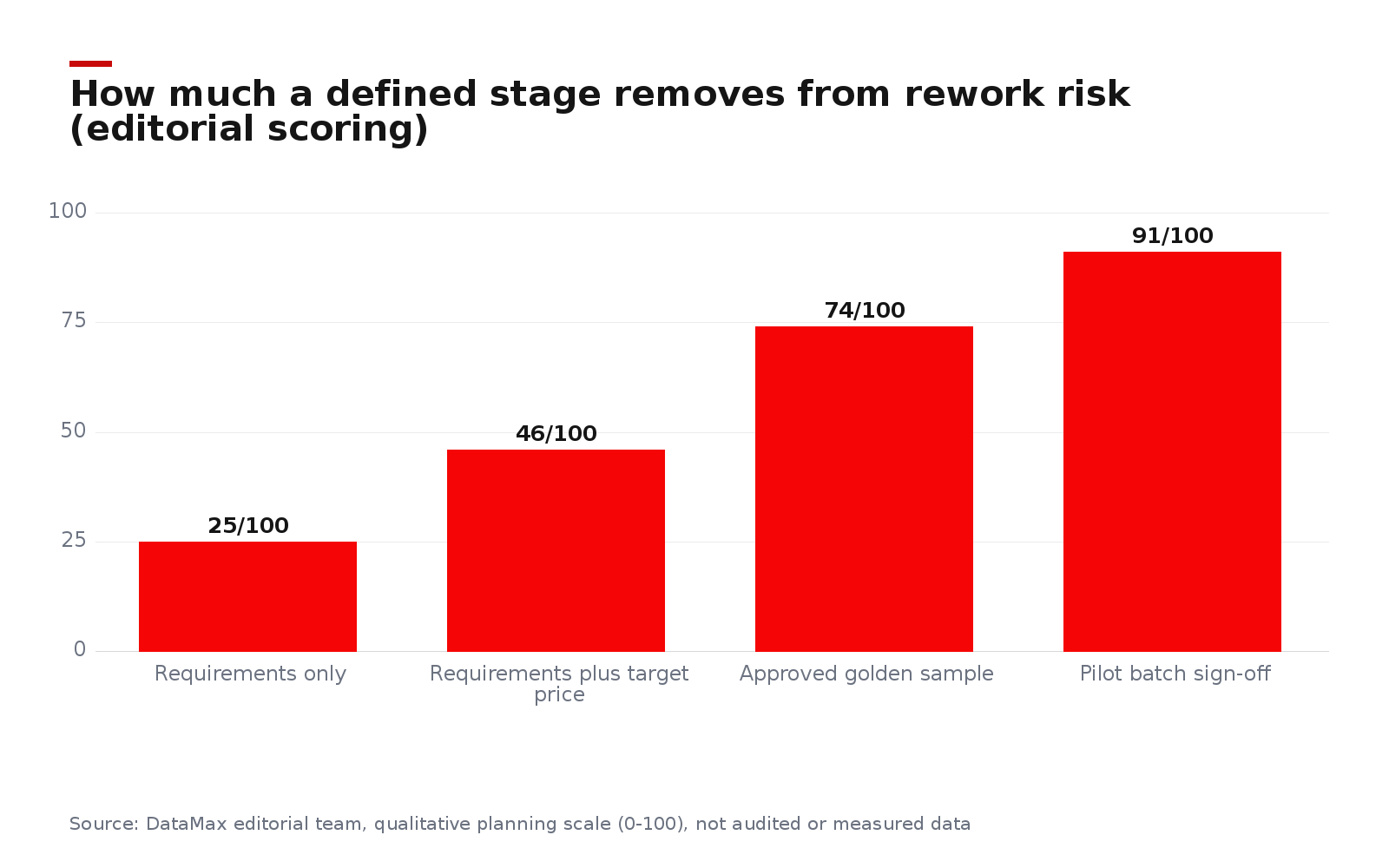
The chart below ranks procurement controls by their editorial value in reducing avoidable rework risk. It is a qualitative planning scale, not audited or measured performance data.
The same figures, in searchable form:
| Stage | Editorial score |
|---|---|
| Requirements only | 25/100 |
| Requirements plus target price | 46/100 |
| Approved golden sample | 74/100 |
| Pilot batch sign-off | 91/100 |
Source: DataMax editorial team, qualitative planning scale (0-100), not audited or measured data
The scores are editorial, not measurements. Their operational meaning is the sequence: requirements create a baseline, an approved golden sample locks physical and software identity, and pilot sign-off tests batch consistency before production release. For android tv box wholesale enquiries that combine a shortlist with audit requirements, send the counter count, selected model, exact RAM/ROM, target display and network profile, middleware, DRM line, packaging scope, destination, and delivery window through the DataMax contact page. The engineering team can then map the quotation to a controlled sample and pilot sequence.
Further reading
- Guide wholesale android tv box
- RFQ checklist for device procurement
- Android TV boxes
- Rockchip Android TV boxes
- Edge computing boxes
- DataMax DM21P specifications and fit
- DataMax DM21S specifications and fit
FAQ
What should a retail-kiosk RFQ specify?
Specify the counter workflow, display resolution and refresh-rate limits, audio connection, Ethernet speed, Wi-Fi dependence, applications, middleware, account model, DRM requirement, RAM/ROM, power and mounting method, packaging, destination, and delivery window. Require the supplier to identify catalogue assumptions and optional features explicitly. Attach the target screen, network, and application profile so the supplier can return testable acceptance lines. Confirm the final production datasheet before approval.
Which DataMax model fits an operator-managed IPTV counter?
DM21P is positioned for operator middleware set-top boxes and lists AOSP Android 11, 2GB / 8GB with 4GB and larger optional storage, RJ45 100M, and Widevine L1 / PlayReady / HDCP 2.2 optional. The required RAM/ROM, DRM entitlement, firmware image, and middleware must be fixed in the order configuration. Confirm all current platform values against the production datasheet before release.
Can one Android TV box model serve every retail counter?
Only when the display, network, application, power, and peripherals are identical across sites. Counter formats often diverge in Ethernet availability, audio routing, controller use, mounting, and operator ownership. Use a fixed catalogue model where requirements match, but divide the rollout into controlled configurations when site or software conditions differ. Give each configuration its own golden-sample reference, packaging code, and deployment record.
What evidence should accompany the production shipment?
Request batch-linked evidence for SMT/AOI, firmware flashing, functional testing, aging, dark-room visual inspection, configuration labels, packing, and approved sample references. The evidence should identify the released lot and configuration. For android tv box wholesale orders, require a deviation report before any production change is accepted. Confirm that the evidence is indexed by model, RAM/ROM, firmware identifier, lot, and date rather than mixed into an undifferentiated test folder.
Does Widevine L1 guarantee every retail streaming service?
No. The platform capability does not establish a service provider’s licence terms, subscription entitlement, device-binding policy, or key-delivery configuration. List each content service and its required security level in the RFQ, then verify the final application and account in the golden-sample or pilot test. Treat hardware DRM, commercial service access, and application signing as separate procurement lines because one does not establish the others.
When should a buyer move from samples to a pilot batch?
Move when the exact RAM/ROM, firmware, display output, network configuration, peripherals, packaging, and target application pass on the approved sample. The pilot should then validate batch consistency, provisioning, recovery, aging, and field workflows. Pilot sign-off provides stronger rework control than an isolated bench test. Freeze the pilot result as the production baseline and require written approval for hardware, firmware, accessory, or packaging changes.




