

The purchase decision behind “Google Play” terminology
An android tv box advertised as “with Google Play” is commercially meaningful only when the supplier identifies the licensed software stack, permitted device identifiers, certification status, and update responsibility. A retail badge proves nothing about an ISP programme, and “AOSP Android” does not automatically include Google Mobile Services or the Google Play Store. The decision is contractual: require the application distribution model, Google Play licensing status, Widevine and PlayReady position, certification evidence, and post-delivery update path to appear separately in the quotation and acceptance schedule.
That distinction prevents a late-stage blocker. Approved silicon, installed applications, DRM-grade playback, operator middleware, and regulatory evidence can be valid while the claimed Google Play environment remains incomplete, non-transferable, or unsupported in the destination market. Start with the application entitlement because it defines what customers can install and how the device is serviced. Then verify Android compatibility, Widevine security level, hardware decoding, network behaviour, and factory evidence.
For a broader architecture overview, use the canonical Android TV box guide for ISPs. This page addresses the narrower android tv box question created by “with Google Play”: what must be proven before an operator, distributor, or integrator accepts that description.
DataMax uses the product families here as engineering examples, not as an assertion that every variant has Google Play certification. The DM21S is the closest white-label OTT/IPTV reference in the supplied data, but certification and licence status must be confirmed against the production datasheet and accepted commercial terms. For a controlled RFQ, request the device-identifier model, Google Play configuration, middleware baseline, and compliance dossier for the exact SKU.
“Google Play available” describes an end-user proposition; “Google Play supportable” describes an engineering proposition. The first asks whether a store appears in the approved user experience. The second asks whether every production unit can register, download, update, play protected content, recover after failure, and remain aligned with a defined commercial entitlement. Contract against the second proposition because it survives changes to retailer, distributor, or installer.
A distributor may request the same unit as a retailer and expect the store to remain available after a customer changes service plans. That expectation fails unless the specification defines whether registration is transferable, who owns the device record, and who can remove or replace applications. A one-line store claim answers none of those conditions.
The approval document also changes by channel. A retail buyer may need a market-specific configuration statement, application compatibility list, and first-boot registration procedure. An operator buyer needs those artefacts plus launcher control, middleware provisioning, device-management ownership, and an update responsibility schedule. The android tv box label therefore creates different evidence packages for different channels, even when the hardware is identical.
How Google Play support is actually implemented
“Android” is the operating-system family. “Google Play” is an application and service ecosystem requiring Google Mobile Services or an explicitly managed Google TV distribution arrangement. A device can run AOSP Android, expose HDMI and USB, and play protected media without providing the Play Store. Buyers should not treat “Android 14” and “Google Play” as interchangeable specifications.
Four layers to separate in the RFQ
- Operating system Identify the exact AOSP or Google-certified Android release, build identifier, security-patch baseline, launcher, device model, and update window.
- Application distribution State whether the Play Store is included, who provisions the licensed account or device registration, and whether operators may replace or restrict applications.
- Protected-content service List Widevine, PlayReady, HDCP, Dolby Vision, or DTS as separate deliverables with required security levels and licence-server evidence.
- Operational control Assign provisioning, over-the-air update, remote monitoring, application allow-listing, recovery, and first-boot responsibility.
For paid video, Widevine security level is a content-delivery requirement, not a convenience feature. The operator’s streaming service, licence server, account, device constraints, and reference-device policy determine suitability. A chipset label or retailer listing cannot replace an end-to-end playback test. Confirm against the production datasheet whether Widevine L1 and PlayReady are populated on the ordered configuration; optional statements in the product facts do not establish a licence level.
Acceptance should follow the complete licence flow. Register a device with an entitled account, open the operator’s protected title, confirm that a licence is issued, and exercise seek, pause, quality selection, and restart. Repeat after a power interruption and a network outage. This distinguishes a device containing a Widevine-capable binary from one operating within the operator’s account and device policy.
The hardware-service boundary
The SoC and Android build influence codec support, DRM integration, power behaviour, and memory pressure. Specify observable outcomes: supported resolution and frame rate, audio and video format matrix, protected-stream startup, seek latency, thermal stability, and recovery after network loss. These outcomes are more useful than an unqualified codec claim.
A common mistake is to treat “Google Play” as an application to sideload. The Play Store application is not the licence. Device registration, service configuration, binary compatibility, package management, account policy, and Google-side certification can constrain what a supplier can lawfully and technically deliver. The seller should identify the distribution arrangement in writing and provide evidence appropriate to it.
Review the architecture as one chain rather than disconnected labels. The SoC executes the Android image and media path; the image determines application compatibility; the device record establishes service entitlement; and the DRM licence server authorises protected playback. A defect at any hand-off can surface as “store unavailable” even when the hardware passes a display test.
| Layer | Buyer evidence | Field symptom if unverified | Acceptance action |
|---|---|---|---|
| Operating system | Release, build identifier, launcher, patch baseline | Approved application fails to install or launch | Install from the approved manifest on the production build |
| Application distribution | Store presence, account model, registration owner | Store opens but account or device registration fails | Register with the destination-market entitlement |
| Protected content | Widevine or PlayReady level and licence-path result | Playback refusal, restricted quality, or failed seek | Run the operator’s stream and restart sequence |
| Device management | Provisioning, OTA, allow-list, recovery procedure | Application removed, update blocked, or device unrecoverable | Exercise reset, update, and recovery procedures |
Distinguish fixed and variable configuration. The Android build, hardware revision, launcher, preinstalled applications, and destination-market configuration should be frozen. Account details and customer records remain operational variables, but their ownership must be defined. Mixing them produces an approval request without a stable object to approve.
Add an application-control profile to the software specification. Define whether the launcher may be replaced, whether a customer can install an unauthorised package, whether installation requires managed policy, and whether remote diagnostics are permitted. Without that profile, nominal Google Play capability can conflict with operator middleware, payment controls, or venue security.
The resulting android tv box acceptance plan should have four separate pass records: boot, store registration, application operation, and protected playback. A single combined test can hide the owner of a failure and send the supplier to the wrong engineering team.
Which DataMax platforms fit the requirement
The supplied facts establish hardware and AOSP baselines, but they do not provide model-level Google Play certification evidence. The table records only verified fields and marks the commercial Google Play position for confirmation. It is not a certification matrix.
| Model and fit | SoC and OS | Memory | Media and DRM | Connectivity and output |
|---|---|---|---|---|
| DM21P 4K IPTV / operator middleware set-top box | Amlogic S905Y4, quad Cortex-A35 AOSP Android 11 | 2GB / 8GB 4GB; 16/32/64GB optional | AV1 [email protected]; VP9/H.265 4K@60; H.264 4K@30 Widevine L1 / PlayReady / HDCP 2.2 optional | HDMI 2.0b out x1; USB2.0 x2; TF; S/PDIF; 3.5mm AV; RJ45 100M; Wi-Fi6 2x2 + BT5.4; DC 5V/2A |
| DM21S 4K Android TV box for IPTV/OTT white-label | Amlogic S905Y5, quad Cortex-A55 AOSP Android 14 | 2GB / 16GB 2/4/8GB; 16/32/64GB optional | AV1 / H.265 [email protected] 4K@60 Widevine L1 / PlayReady optional; Dolby Vision/DTS | HDMI 2.0b out; S/PDIF; AV; USB2.0 x2; TF; RJ45 100M (1G optional); Wi-Fi6 2x2 + BT5.4 |
| DM21T Premium UHD / cloud-gaming box | Amlogic S905X5, quad Cortex-A510 (ARMv9) AOSP Android 14 | 4GB / 64GB family options | H.266/VVC [email protected] 4K@120; AV1/VP9/H.265 4K@120; AVS3 4K@120; H.264 4K@60; inline AI-SR Widevine L1 / PlayReady optional | HDMI 2.0b out (no HDMI in); USB2.0 x1 + USB3.0 x1; TF; S/PDIF; AV; RJ45 100M (1G opt); Wi-Fi6 + BT5.4 |
| DM22Q Gaming-oriented Android TV box | Amlogic S905X5M, quad Cortex-A55 up to 2.5GHz AOSP Android 14 | 4GB / 64GB 2/4/8GB; 16/32/64GB optional | AV1/H.265 L5.1 4K@60; inline AI-SR (no NPU TOPS stated) Widevine L1 / PlayReady optional; Dolby Vision/DTS | HDMI 2.0b out; USB2.0 x2; TF; S/PDIF; AV; RJ45 100M (1G opt); Wi-Fi6 2x2 + BT5.4 |
The practical distinction is application workload. The DM21P is positioned for operator middleware, while the DM21S targets white-label IPTV/OTT work. The DM21T and DM22Q target premium or gaming-oriented use cases, with different SoCs and decode envelopes. None of those positions substitutes for a Google Play entitlement or an operator’s compatibility approval.
Translate the operator’s workload into a model question. For managed IPTV with an operator launcher and controlled middleware, DM21P is the stated fit, but its Android 11 baseline and 2GB / 8GB starting memory must be accepted against the application set. For an Android 14 white-label service, DM21S aligns with the stated IPTV/OTT positioning and provides 2GB / 16GB as the listed baseline.
For a premium service, DM21T’s listed 4GB / 64GB memory and 4K@120 decode families distinguish it from the other supplied platforms. That distinction matters only if the content, output device, application, and thermal test case use those capabilities. For a gaming-oriented offer, DM22Q provides the stated gaming position, 4GB / 64GB baseline, and two USB2.0 ports. The model direction does not certify its store, DRM, or destination-market configuration.
The editorial graphic below compares how readily each sourcing model can expose traceability. It is a planning aid, not a measured factory-performance claim.
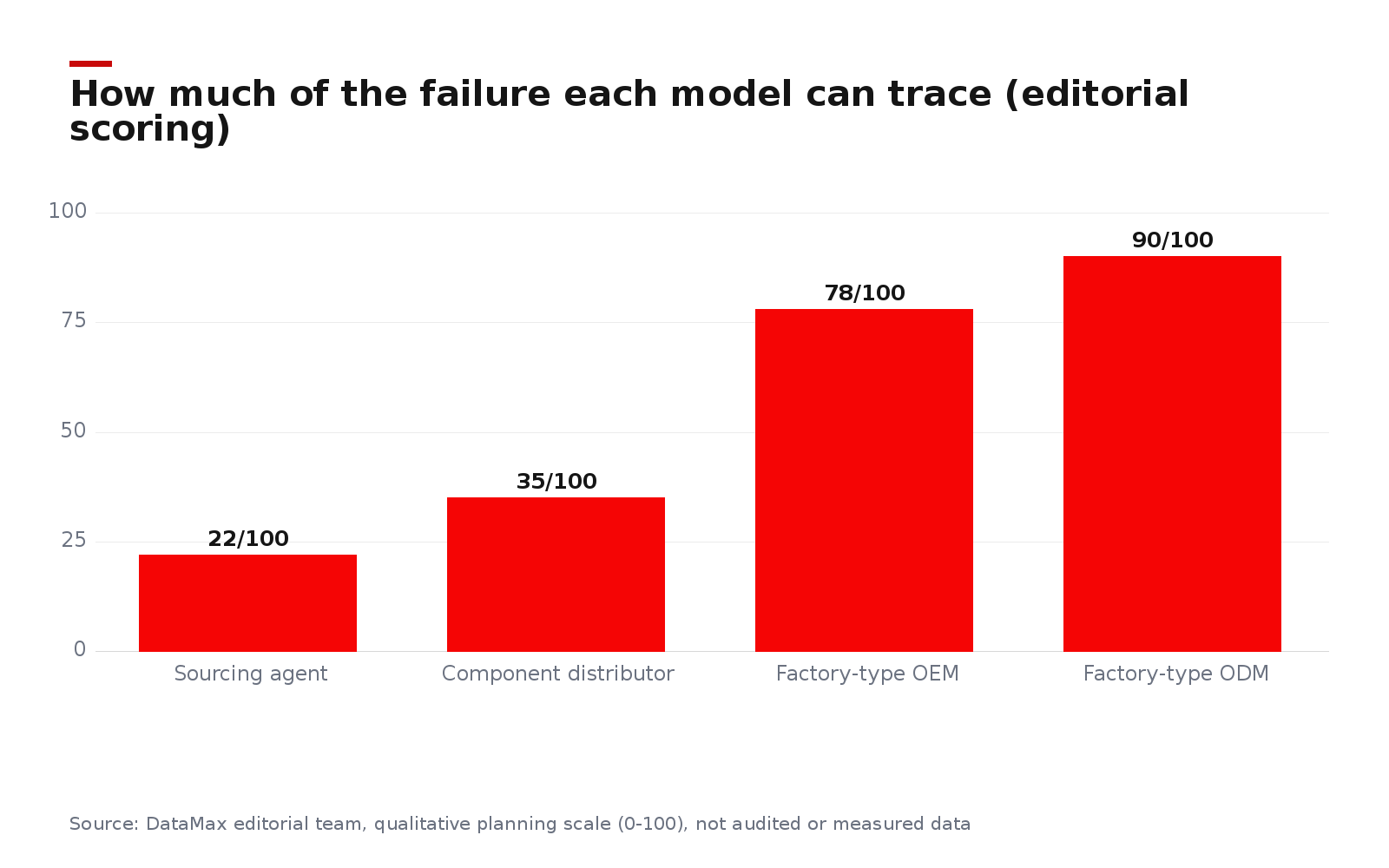
The same figures, in searchable form:
| Model | Editorial score |
|---|---|
| Sourcing agent | 22/100 |
| Component distributor | 35/100 |
| Factory-type OEM | 78/100 |
| Factory-type ODM | 90/100 |
For procurement, the graphic explains why a factory-type ODM may offer a more coherent evidence trail than a loose sourcing chain, but it does not prove an individual project’s auditability. Request evidence for the named factory, production line, and ordered configuration. See the DataMax factory-quality capability and request a video audit or SMT, AOI, and aging records linked to the selected SKU.
The score identifies where documentary gaps arise. A sourcing agent may coordinate external parties without controlling firmware loading or application registration. A component distributor may identify components but not own the final configuration. A factory-type OEM or ODM can connect those steps, but only if the purchase order and quality plan require it. The score guides the question; it does not answer it.
For an operator programme, record why each candidate is excluded. “Android 11 baseline” may be acceptable for a fixed middleware image but unsuitable for an application requiring a newer target API. “4K@120 decode family” may be unnecessary for linear IPTV but relevant to cloud gaming. Recording exclusions prevents a later quotation revision from reintroducing an unsuitable platform without review.
Deployment scenarios and the specification each needs
The same storefront claim creates different risks across operator, integrator, and venue programmes. An IPTV operator may control the launcher and middleware, while a commercial integrator may need local applications and peripheral flexibility. A gaming-oriented programme adds sustained-performance pressure, but decode capability does not establish Google Play certification.
| Scenario | Primary requirement | Model direction | Evidence to require |
|---|---|---|---|
| • Operator IPTV with controlled middleware | • Stable AOSP baseline • Operator provisioning • Protected playback • Ethernet and AV integration | • DM21P for 4K IPTV • DM21S for Android 14 white-label | • Middleware image specification • Device provisioning procedure • DRM playback matrix • Update responsibility schedule |
| • AV/IT integration | • HDMI and USB compatibility • Application or signage environment • Stable recovery after network loss | • DM21S where Android 14 and dual USB are priorities | • Peripheral test list • First-boot and factory-reset procedure • AV output test report |
| • Premium UHD or cloud-gaming deployment | • Higher 4K decode load • 4GB / 64GB baseline • Sustained thermal stability | • DM21T for the stated 4K@120 decode family • Confirm suitability against the actual application | • Codec-profile matrix • Thermal and aging record • Application compatibility report |
| • Gaming-oriented retail or hospitality | • 4GB / 64GB baseline • AV1/H.265 playback • Stable UI and store access | • DM22Q as the gaming-oriented starting point | • Store entitlement evidence • RAM/storage endurance test • Language and region validation |
| • Venue signage or distributed screens | • Managed applications • Remote update and recovery • Deployment repeatability | • Select from the exact commercial requirement rather than generic Android positioning | • Device-management compatibility • OTA recovery log • Golden-sample and serialisation record |
Operator projects should include a first-boot test. Connect the proposed unit to the actual provisioning environment, complete device registration, launch the operator application, play a protected title, and simulate a reset. This exposes dependencies that a retail demonstration does not, including server-side device policy, launcher permissions, and middleware-specific codec calls.
Integrator projects need a peripheral and recovery matrix. Record each supported HDMI resolution, the behaviour of 100M Ethernet and any optional 1G configuration, USB device classes, audio output, and recovery after network removal. Name the tested peripheral by model and firmware; “USB compatible” leaves interpretation to the installer.
For venue deployments, application lifecycle matters more than the visible store. Confirm whether the venue operator can prohibit third-party installation, deploy signed applications, retrieve logs, update through OTA, and recover from a failed update. A signage programme using Android Management has different evidence requirements from a consumer retail programme.
Implementation also depends on what happens after the shopper leaves the store. The product may move from a retail account to a managed operator account, lose network access, or be reset by a technician. Acceptance should include account migration, application reinstallation, device re-registration, and recovery—not only installing one application.

The photograph illustrates the physical layer beneath software claims: a SoC package, memory, and PCB routing must be matched to the binary and display path. Component identity supports debugging, but it does not establish Google Play licensing. For platform context, compare the AOSP versus Google Android TV distinction.
Separate first boot from routine service. First boot asks whether the unit reaches the intended launcher, registers with the authorised service, and exposes the correct catalogue. Routine service asks whether it recovers from a reboot, restores approved applications, processes an update, and returns to a known state after an application crash. Both conditions need an owner, procedure, and recorded result.
For a distributed retail channel, add a serialisation test. Scan the device record, associate it with the market and customer channel, install the approved application set, and confirm that it cannot appear under an unintended regional entitlement. For a venue estate, test restart control, OTA recovery, and local network loss instead of a consumer account flow.
The selection sequence that removes rework
Turn the commercial statement into testable RFQ lines. Begin with the operating environment, move through the application and DRM model, then narrow hardware and factory evidence. This order prevents a low-cost quotation from creating a deployment blocker.
- Define the destination and distribution model State country, language, customer profile, retail versus managed use, and whether the Play Store is required at first boot or only during authorised service.
- Name the entitlement owner Require the supplier to state who holds or administers the relevant Google arrangement, who owns device registrations, and who handles service or policy changes.
- Specify the software baseline Request the exact Android release, build identifier, launcher, launcher-control method, preinstalled applications, update channel, and patch baseline.
- Freeze protected-content requirements Define Widevine and PlayReady security level, HDCP path, codec profile, resolution, frame rate, and the operator’s licence-server acceptance test.
- Match hardware to workload Select memory, storage, Ethernet, Wi-Fi, USB, output, and decode requirements from the supplied model facts; avoid adding an undocumented option to the quotation.
- Attach production evidence Link the device model, SoC, firmware, software build, factory, production line, and certificate records to one traceable SKU baseline.
A pasteable RFQ line can read: “Each unit shall be delivered with the agreed Android/Google Play distribution configuration for market [market], application [application], DRM [required level], model [model], build [release], device-registration owner [owner], and update responsibility [owner]. The supplier shall provide [certificate/registration evidence] and reproduce the approved test on units from the production lot.”
Do not leave “with Google Play” as the entire line. It combines certification, application distribution, account or device registration, and operational support. If the buyer cannot name each owner, engineering cannot resolve ambiguity efficiently. For deeper hardware decisions, compare the 4K Android TV box guide, but tie the final model choice to measured workloads.
Add an evidence-closure clause. Request the model number, hardware revision, firmware build, launcher version, service-package version, device-registration procedure, protected-playback report, destination-market certificates, and update responsibility. Each item should identify whether it is available, requires operator action, or remains unavailable.
Define the pilot-to-production boundary. A sample is approved only for the exact image and hardware revision shown; a production change requires written notice. Include the sample serial number, date, firmware build, application manifest, regional settings, and test result. Then state the sampling plan for the production lot and the evidence required before shipment release.
For a managed IPTV launch, the purchase specification names the model, Android build, operator launcher, middleware version, application allow-list, Widevine or PlayReady acceptance test, Ethernet option, destination certificates, and update owner. An equivalent SKU may be proposed, but it remains a deviation requiring technical and commercial approval rather than an implied substitution.
For a consumer-store project, the line is shorter but still specific. It names the destination market, device-registration model, store presence, application compatibility set, supported codec profile, output mode, privacy or parental-control requirements, and after-sales reset process. “Retail ready” defines none of those fields.
Add a failure clause. Define what happens if the store fails registration, an approved application is removed, an update blocks on the launcher, or a protected title cannot issue a licence. State whether the supplier replaces units, provides a corrected image, or supports software remediation. This converts an ambiguous service promise into a measurable obligation.
Failure modes that reach the field
Most failures arise from ambiguous scope, not a missing store icon. The quotation says “Google Play enabled”; production carries a generic AOSP image; certification applies to another binary or identifier; and the operator discovers that its middleware cannot register the box. Each hand-off creates a variant procurement did not authorise.
Field trap
A retailer badge is not device certification. If the RFQ does not identify the software build, device model, registration arrangement, and update owner, the factory may ship a functional device that fails the operator’s activation workflow. Require the same approved image on pilot and production units, with build identifiers retained in the delivery record.
Protected playback has a second trap: “HDCP” or “Widevine” without a tested path. The product facts list DRM as optional on relevant models, so each quotation must resolve whether the feature is populated, licensed for the destination, and verified against the operator’s account policy. The field result may be playback refusal, degraded resolution, failed seeking, or unsupported output.
Field trap
Do not infer Google Play entitlement from AOSP Android, a Widevine option, or a codec capability. Each addresses a different layer. A mismatch may surface only after device registration, app installation, or protected-stream playback, creating reverse logistics, replacement stock, and operator-level escalation.
Other divergence points are storage wording, optional Ethernet speed, regional Wi-Fi certification, launcher differences, update expiry, and “family option” configurations. Quotation-to-production drift is controlled through a golden sample, serial-number traceability, build freeze, and acceptance sampling—not a broad claim that units are “equivalent.”
An application-compatibility failure may be mistaken for a store failure. The store can install an application that rejects the device profile, display capability, input method, or background service. The correction then belongs to the application owner. Maintain separate logs for store installation, application first launch, protected-media playback, and operator middleware registration so each fault is assigned correctly.
A region mismatch creates another escalation. The store is present, but the account, language, catalogue, service entitlement, or local regulatory configuration does not match the destination. Do not solve this through undocumented sideloading. Require the supplier to identify the supported arrangement for the exact market and demonstrate first-boot registration there.
Hardware options can drift between sample and production. “RJ45 100M (1G optional)” does not authorise substituting the Ethernet component without approval, because network provisioning, thermal design, and certification can change. The same rule applies to optional memory, storage, Dolby Vision/DTS, Widevine, PlayReady, and HDCP. Optional means a quotation decision, not an assumed population.
Update expiry creates delayed risk. A device can pass installation and playback tests but fail after the distributor stops receiving an operating-system build or an application publisher rejects an obsolete binary. The agreement should state the update process, operating-system baseline, application compatibility policy, and ownership of extension work.
Maintain a configuration record containing the model, SoC, RAM/ROM, operating system, Google Play arrangement, DRM position, application set, launcher, network options, and certificate identifiers. Each pilot finding then changes the approved record, not merely the sales description.
Diagnostic separation determines escalation cost. A store icon that opens but cannot complete registration differs from an application that installs but rejects the device profile. Capture network logs, package-manager results, account-registration responses, DRM licence errors, and device identifiers under one serial number. Without that evidence, field returns are misclassified as the same generic store problem.
The evidence trail from SMT to shipment
Factory control begins with component traceability and ends with an application- and service-level acceptance record. The objective is a chain that lets a reviewer move from a shipment record back to the responsible process and forward to the device configuration.
- SMT and material control Record the ordered model, SoC, memory configuration, PCB revision, component lots, and approved substitutions under change control.
- Inspection and programming Capture AOI results, programming records, display and network checks, and deviations against the golden sample.
- Software loading Bind the serial number to the exact firmware, launcher, preinstalled application set, regional configuration, and device-registration process.
- Aging and playback validation Run the specified AV, codec, Wi-Fi, Ethernet, USB, thermal, protected-content, and application tests on the agreed lot sampling plan.
- Audit and shipment release Reconcile production quantities, deviations, certificates, serial ranges, and approved sample results before dispatch.
For this programme, request an evidence pack tied to the exact SKU: serial-number range and hardware revision; SMT and AOI summary; software build and application manifest; Google Play configuration or entitlement evidence applicable to the declared arrangement; Widevine and PlayReady playback results; ageing summary; destination-market certificates; and golden-sample sign-off. This pack is a project deliverable, not a substitute for the production datasheet.
Separate system-level evidence from project-level evidence. A production datasheet describes the approved product configuration, while a project evidence pack describes what was built and tested for the customer. Keep both linked through the SKU. If the datasheet describes optional DRM, the project record must show whether it was populated on ordered units.
SMT and AOI evidence establishes process control around assembly, but it does not prove application entitlement. Software-loading evidence links the hardware serial range to firmware, launcher, regional image, and application manifest. Playback evidence connects that build to the protected-content test. Shipment release reconciles the evidence to dispatched units.
Aging should reflect the operating profile. For managed IPTV, combine continuous playback with network interaction and recovery. For gaming-oriented use, include the application and sustained workload rather than only a codec loop. For an integrator’s display wall, include output resolution, peripherals, restart behaviour, and network-loss recovery. A test unrelated to deployment may miss the decisive failure.
The SoC photograph illustrates why component-level records matter, but photography cannot establish provenance or performance. Likewise, a video audit can support factory assessment, yet reconcile what was shown with the actual production line and ordered configuration. DataMax can provide a manufacturer capability walkthrough or arrange a video factory audit focused on SMT, AOI, ageing, and the Google Play-oriented acceptance path.
For operator programmes, auditability includes the update lifecycle. Determine who can publish an OS or application build, how an emergency build reaches provisioned devices, how rollback works, and how a device leaves a retired platform configuration. Assign that ownership before shipment.
A practical evidence index uses stable file names and revision fields. One record identifies the ordered model and hardware revision; another identifies firmware and launcher; another identifies the application manifest and regional configuration. The release note links these records to sampled serial numbers and test date. A later audit can then determine whether the shipped unit matches the approved android tv box configuration rather than a marketing label.
Options placed side by side
The four DataMax models create distinct commercial baselines, but the supplied facts do not establish identical Google Play arrangements. The comparison combines verified hardware positioning with decisions still requiring confirmation. It does not assign an unsupported certification status.
| Option | Verified baseline | Best-fit direction | Commercial gate to close |
|---|---|---|---|
| DM21P | Amlogic S905Y4; AOSP Android 11; 2GB / 8GB; HDMI 2.0b x1; USB2.0 x2; RJ45 100M | 4K IPTV and operator middleware programmes prioritising a lower-version AOSP baseline | Confirm Android release support, Google Play arrangement, exact optional RAM/ROM and DRM configuration, and update responsibility |
| DM21S | Amlogic S905Y5; AOSP Android 14; 2GB / 16GB; HDMI 2.0b; USB2.0 x2; RJ45 100M with 1G optional | 4K IPTV/OTT white-label projects requiring Android 14 and flexible configuration | Confirm Google Play/licensing, launcher control, Dolby Vision/DTS population, Ethernet option, and production image |
| DM21T | Amlogic S905X5; AOSP Android 14; 4GB / 64GB; 4K@120 decode families; USB2.0 x1 + USB3.0 x1 | Premium UHD or cloud-gaming workloads with a stated high-frame-rate decode envelope | Confirm application compatibility, sustained thermal result, Google Play arrangement, and optional Ethernet configuration |
| DM22Q | Amlogic S905X5M; AOSP Android 14; 4GB / 64GB; AV1/H.265 4K@60; USB2.0 x2 | Gaming-oriented Android TV programmes with 4GB / 64GB and dual USB | Confirm Google Play arrangement, DRAM/storage population, Dolby Vision/DTS population, and 1G Ethernet option |
For a white-label OTT project, DM21S is the straightforward direction from the supplied facts because its stated fit combines Android 14, IPTV/OTT white-label use, and 2GB / 16GB storage. For operator middleware, DM21P offers a distinct 4K IPTV position. DM21T is differentiated by its stated 4K@120 decode families and one USB3.0 port. DM22Q is differentiated by its gaming-oriented fit and S905X5M platform.
An operator may want store access without consumer-style application management. The choice is not simply AOSP versus a certified store; it is a defined launcher, application allow-list, update channel, device-management method, and entitlement owner. The supplied facts do not establish that service package, so it remains a project-specific closure item.
Storage should be a workload decision rather than a headline. DM21P starts at 2GB / 8GB and lists 4GB plus 16/32/64GB as optional. DM21S starts at 2GB / 16GB and lists 2/4/8GB plus 16/32/64GB as optional. DM21T lists 4GB / 64GB with family options, while DM22Q starts at 4GB / 64GB and lists additional memory and storage options. Freeze the actual population for each SKU.
DRM comparison requires the same discipline. The facts list Widevine L1 and PlayReady as optional on relevant models, with Dolby Vision/DTS appearing on DM21S and DM22Q; DM21P also lists HDCP 2.2 as optional. “Available” must become an ordered configuration and operator-side playback result. No row represents universal protected-content approval.
The final selection should not rank store logos. Rank evidence: confirmed distribution arrangement, destination-market eligibility, operator DRM test, exact hardware build, production traceability, and update ownership. Request sample evaluation through the sample-order workflow and a specification sheet freezing every variable. The custom-development capability can assess operator middleware, branding, provisioning, and acceptance requirements.
To move an android tv box programme from sample approval to shipment, email [email protected] with the SKU shortlist, destination market and required certificates, the middleware and DRM checklist, and the target Google Play distribution arrangement. DataMax’s engineering team can return the applicable production datasheet, evidence list, and sample plan for review.
Further reading
- Guide android tv box for isps
- DTS:X Android TV box guide
- DRM compliance solutions
- Telecom solutions
- Amlogic Android TV boxes
- DataMax DM21P specifications and fit
- DataMax DM21S specifications and fit
FAQ
Does an AOSP Android TV box include Google Play?
No. AOSP Android is the upstream operating-system baseline and does not by itself establish the Google Play Store, Google Mobile Services, device registration, or commercial licensing arrangement. The quotation and acceptance record must identify each element separately. For an android tv box, require the distribution model, entitlement owner, target market, and approved software build.
Can Widevine L1 be selected from the chip specification alone?
No. Widevine L1 appears in the supplied DataMax facts as an optional feature on relevant models, but the final population and playback result must be confirmed against the production datasheet. The device should also pass the operator’s licence-server, account-policy, codec, output, and stream tests. A protected-content claim without a tested configuration remains incomplete.
What should a buyer request before approving a Google Play-enabled sample?
Request the exact model and hardware revision, Android build identifier, launcher, preinstalled application manifest, distribution or registration arrangement, destination-market certificates, Widevine and PlayReady test results, and update owner. Retain the golden sample and serial traceability. These artefacts connect the commercial claim to the unit that will ship.
Is Android 14 automatically preferable for an operator programme?
No. The operating-system release is only one dependency. Operator middleware compatibility, device management, security-patch policy, DRM behaviour, application certification, and supported-update duration may matter more. Compare AOSP baselines through the operator-tier Android TV box solution, then test the exact production image.
How can a buyer prevent Google Play requirements changing after ordering?
Freeze the commercial requirement in the purchase specification and attach the approved golden sample, software build, application list, and certificate list. Require notice and formal approval before changes to SoC, memory, launcher, applications, region configuration, or update ownership. Reconcile these items against each serial or serial range.
Can DataMax provide factory evidence for this application?
DataMax can discuss relevant manufacturing and validation evidence, including SMT, AOI, ageing, and the shipment evidence chain. Evidence must be tied to the exact SKU, production line, build, and destination market. Request a video factory audit or project-specific evidence pack through the inquiry process rather than accepting a generic factory overview.




