What the answer hinges on
| Decision axis | What to verify | Procurement consequence |
|---|---|---|
| AV1 implementation | Codec profile, level and maximum resolution/frame rate | “AV1 support” alone does not establish equivalent playback capability |
| Base platform | SoC, OS, base RAM/ROM and fixed port configuration | Freeze the exact production SKU in the purchase order |
| Operator integration | DRM, middleware, LAN, update path and certification evidence | Validate the complete application and delivery environment |
| Lifecycle | Component traceability, burn-in evidence and change-control records | Approve revisions through a controlled evidence trail |
Selecting an android tv box for AV1 requires more than confirming that the codec name appears in a datasheet. The decision turns on the SoC, Android generation, stated AV1 profile and level, base memory, operator middleware, DRM configuration, physical interfaces and the factory’s ability to document changes over the product lifecycle. For operator IPTV, an entry platform may be sufficient when the delivery path and feature set are controlled. Premium UHD, cloud-gaming or differentiated retail applications require a newer processor and more memory headroom.
The four DataMax platforms below differ in a commercially meaningful way. DM21P and DM21S start with 2GB RAM; DM21T and DM22Q start with 4GB. Their operating systems span AOSP Android 11 and Android 14, while their SoCs range from Amlogic S905Y4 to Amlogic S905X5M. Those differences affect upgrade duration, operator-image integration and application workload planning; they do not, by themselves, prove service quality.
This article compares only the disclosed production facts. For the broader definition and category boundaries, read what an Android TV box is—and what it is not. The lifecycle question is equally important: AV1 hardware capability can remain stable while storage, memory, middleware, keys, certification or component revisions change.
Which DataMax models actually sit here
| Model | SoC and operating system | Memory and media | DRM and connectivity |
|---|---|---|---|
| DM21P | Amlogic S905Y4, quad Cortex-A35; AOSP Android 11 | 2GB / 8GB base; 4GB and 16/32/64GB optional; AV1 [email protected], VP9/H.265 4K@60, H.264 4K@30 | Widevine L1 / PlayReady / HDCP 2.2 optional; HDMI 2.0b out x1, USB2.0 x2, TF, S/PDIF, 3.5mm AV, RJ45 100M, Wi-Fi6 2x2 + BT5.4, DC 5V/2A |
| DM21S | Amlogic S905Y5, quad Cortex-A55; AOSP Android 14 | 2GB / 16GB base; 2/4/8GB and 16/32/64GB options; AV1 / H.265 [email protected] 4K@60 | Widevine L1 / PlayReady optional; Dolby Vision/DTS; HDMI 2.0b out, S/PDIF, AV, USB2.0 x2, TF, RJ45 100M with 1G optional, Wi-Fi6 2x2 + BT5.4 |
| DM21T | Amlogic S905X5, quad Cortex-A510 (ARMv9); AOSP Android 14 | 4GB / 64GB; family options; H.266/VVC [email protected] 4K@120, AV1/VP9/H.265 4K@120, AVS3 4K@120, H.264 4K@60; inline AI-SR | Widevine L1 / PlayReady optional; HDMI 2.0b out with no HDMI input, USB2.0 x1 + USB3.0 x1, TF, S/PDIF, AV, RJ45 100M with 1G optional, Wi-Fi6 + BT5.4 |
| DM22Q | Amlogic S905X5M, quad Cortex-A55 up to 2.5GHz; AOSP Android 14 | 4GB / 64GB; 2/4/8GB and 16/32/64GB options; AV1/H.265 L5.1 4K@60; inline AI-SR, with no NPU TOPS stated | Widevine L1 / PlayReady optional; Dolby Vision/DTS; HDMI 2.0b out, USB2.0 x2, TF, S/PDIF, AV, RJ45 100M with 1G optional, Wi-Fi6 2x2 + BT5.4 |
DM21P is the operator-oriented starting point: its disclosed fit is a 4K IPTV and operator-middleware set-top box. Its AV1 statement includes [email protected], while the companion H.265 path reaches 4K@60. Widevine L1, PlayReady and HDCP 2.2 are optional, so each must be written into the order rather than inferred from the product family.
DM21S moves to AOSP Android 14 and lists AV1 / H.265 [email protected] at 4K@60. Its disclosed fit is a 4K Android TV box for IPTV/OTT white-label deployments. Dolby Vision and DTS appear in the facts, but the exact implementation and certification scope should be confirmed against the production datasheet.
DM21T has the highest stated video ceiling in this group: AV1, VP9 and H.265 at 4K@120, plus H.266/VVC [email protected], AVS3 and H.264 4K@60. It also provides USB3.0 and one USB2.0 port. The output and decode ceiling is 4K; no 8K claim should enter an RFQ.
DM22Q uses Amlogic S905X5M with quad Cortex-A55 up to 2.5GHz and lists AV1/H.265 L5.1 at 4K@60. Its inline AI-SR is disclosed, but no NPU TOPS figure is stated. Its maximum decode and output ceiling is 4K@60, not 8K.
The base-memory comparison is intentionally narrow. Higher RAM tiers exist on most platforms, but each production unit still needs a fixed line-by-line RAM and ROM allocation.
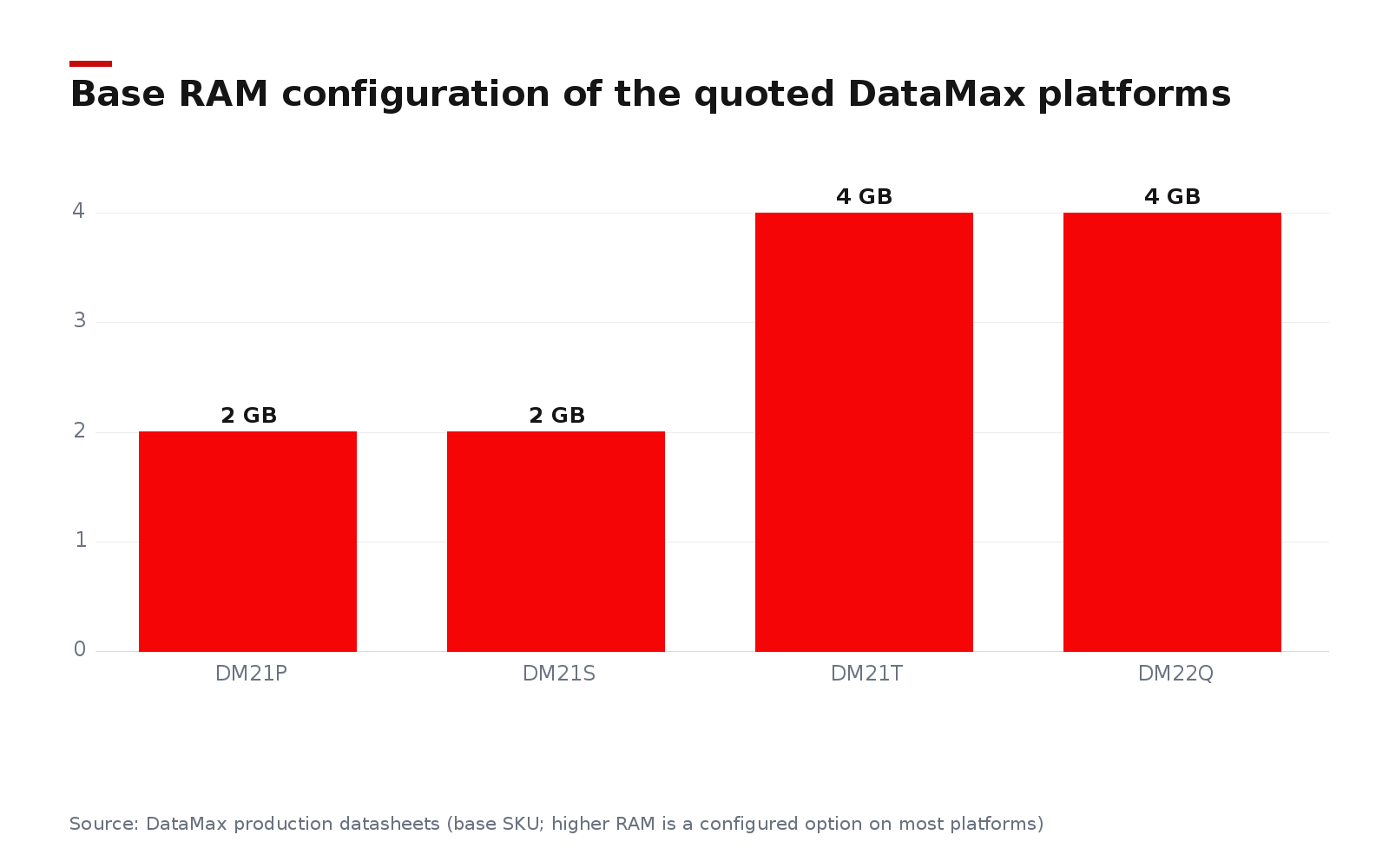
The same figures, in searchable form:
| Platform | Base RAM |
|---|---|
| DM21P | 2 GB |
| DM21S | 2 GB |
| DM21T | 4 GB |
| DM22Q | 4 GB |
Source: DataMax production datasheets (base SKU; higher RAM is a configured option on most platforms). Base configuration only; optional RAM tiers exist and must be fixed line-by-line in the PO.
The mechanism behind the spec
AV1 is an open, royalty-free codec specification developed by the Alliance for Open Media. A decoder does not merely “recognize AV1”: it must parse a valid bitstream, apply the applicable profile, level and tools, reconstruct frames correctly and sustain the operator’s resolution and frame-rate target. The profile and level therefore belong in the acceptance test, not only in a feature matrix.
AOMedia’s AV1 Bitstream & Decoding Process Specification defines the codec process and is the appropriate reference when a decoder-level question arises. The source card states that “AV1 is the open, royalty-free codec specification developed by AOMedia; AV2 announced for year-end 2025 launch.” Any later codec roadmap should remain separate from this four-platform AV1 comparison.
Three hardware and software layers determine practical performance. First, the SoC contains the video decode engine and processing cores. Second, Android exposes the required media framework, codec integration, output path and DRM behavior. Third, the operator application supplies the stream, playback policy, middleware and device management functions. A codec can decode correctly in isolation yet fail an operator acceptance test because of output mode, buffering, network behavior or the chosen protection scheme.
The disclosed SoC families represent different processing and platform baselines. DM21P pairs Amlogic S905Y4 with quad Cortex-A35 and AOSP Android 11. DM21S uses Amlogic S905Y5, quad Cortex-A55 and AOSP Android 14. DM21T introduces Amlogic S905X5, quad Cortex-A510 with ARMv9 and AOSP Android 14. DM22Q uses Amlogic S905X5M and quad Cortex-A55 up to 2.5GHz. These are architecture facts, not guarantees of application performance.
Memory should be evaluated against workload rather than a generic “fast” label. A 2GB platform can serve a constrained IPTV profile, but background services, middleware, browser use, diagnostics and update staging consume working memory. A 4GB platform offers more allocation headroom for premium UI, gaming or heavier local workflows. It does not remove the need to measure resident memory, process startup behavior and recovery under sustained playback.
DRM and copy protection are separate control chains. Widevine L1, PlayReady and HDCP 2.2 require implementation, key delivery, display-path and policy validation. An optional DRM statement means that the exact shipped configuration must be checked. The AOSP versus Google Android TV deployment guide helps distinguish the platform baseline from the application and certification work around it.
For operator lifecycle management, DRM provisioning, application signing, secure boot policy and update delivery are part of the product architecture. The selected android tv box therefore needs both decode capability and an operable security chain. A benchmark clip without DRM is not equivalent to a protected service session.
Entry tier versus commitment tier
| Decision area | Entry posture | Commitment posture |
|---|---|---|
| Leading model direction | DM21P for operator IPTV; DM21S for 4K IPTV/OTT white-label | DM21T for premium UHD or cloud-gaming workloads; DM22Q for gaming-oriented Android TV |
| Processor baseline | Amlogic S905Y4 or Amlogic S905Y5; quad Cortex-A35/A55 | Amlogic S905X5 or Amlogic S905X5M; quad Cortex-A510 or Cortex-A55 |
| OS baseline | AOSP Android 11 on DM21P; AOSP Android 14 on DM21S | AOSP Android 14 on DM21T and DM22Q |
| Memory posture | DM21P and DM21S list 2GB base RAM | DM21T and DM22Q list 4GB base RAM |
| Video ceiling | DM21P AV1 [email protected]; DM21S AV1 / H.265 [email protected] 4K@60 | DM21T AV1/VP9/H.265 4K@120; DM22Q AV1/H.265 L5.1 4K@60 |
| Interface posture | RJ45 100M listed; USB2.0 x2 on both entry models | DM21T adds USB3.0; DM22Q remains USB2.0 x2 |
| Commercial risk | Higher dependence on tight application, middleware and memory scoping | More integration investment; requires a justified workload and longer maintenance plan |
The entry posture minimizes platform commitment where the service is tightly bounded. DM21P fits operator IPTV with operator middleware and has 2GB / 8GB base storage. Its RJ45 100M and two USB2.0 ports match a constrained set-top-box design. The operational risk is under-scoping: if the deployed application becomes heavier than anticipated, the memory decision becomes expensive to reverse.
DM21S offers a different entry trade-off. AOSP Android 14 and 4GB / 16GB base storage provide a newer OS baseline, yet RAM remains 2GB. It also exposes 1G Ethernet as an option. For an integrator selling a 4K IPTV/OTT white-label product, that combination may be appropriate when the operator image is stable, bandwidth requirements are understood and external peripherals are modest.
The commitment posture starts with workload ceilings rather than codec labels. DM21T supports AV1/VP9/H.265 4K@120 and uses a 4GB / 64GB base configuration. Its USB3.0 port and 4K@120 media position are relevant for premium UHD and cloud-gaming requirements. The cost of choosing it is greater engineering exposure: the application, display, network and QA matrix must justify the higher platform envelope.
DM22Q sits between media ceiling and gaming orientation. Its base memory is 4GB, Ethernet 1G is optional and AV1/H.265 reaches 4K@60. Because no NPU TOPS figure is stated, an RFQ that relies on measured neural acceleration should request test evidence rather than infer it from inline AI-SR.
Where this matters in a deployment
| Situation | Primary requirement | Model direction | Validation focus |
|---|---|---|---|
| Operator IPTV | • Stable operator middleware • Controlled AV1 service tier • Predictable fleet updates | • DM21P direction • DM21S if Android 14 is required | • DRM configuration • LAN behavior • Recovery from interrupted playback |
| IPTV/OTT white-label | • Custom launcher and applications • 4K@60 AV1/H.265 • Retail-ready interface set | • DM21S direction • Upgradeable memory only if scoped | • Operator image signing • Brand and regional settings • Update cadence |
| Premium UHD | • 4K@120 media ceiling • Higher memory headroom • Advanced video feature set | • DM21T direction | • Display and source capability • Protected-stream behavior • Sustained thermal performance |
| Cloud gaming | • Input and latency requirements • Stable network path • Android 14 platform | • DM21T for 4K@120 media • DM22Q for gaming orientation | • Actual input path • LAN option • Session recovery |
| Digital signage | • Stable kiosk behavior • Peripheral and network requirements • Managed application lifecycle | • Entry platform where workload is bounded | • Peripheral fit • Device-management integration • Restart persistence |
An operator can use the AV1 tier as a service-design input, but not as a substitute for stream profiling. Confirm bitrate, resolution, frame rate, profile, level, HDR or SDR path, audio configuration and DRM from the real head-end output. Test each representation with the operator middleware, because the device decoder capability does not guarantee that every origin-generated rendition has been encoded correctly.
For an AV/IP integrator, display and cable compatibility may be as decisive as the set-top-box specification. DM21T’s 4K@120 capability still requires a compatible source, display, cable and format negotiation. Its HDMI 2.0b output and absence of HDMI input also constrain installation topology. The 4K 60fps Android TV box guide provides a useful format-level reference for projects whose real requirement is 4K@60.
For a venue deployment, power, network and recovery behavior can outweigh peak codec capability. Both entry models list RJ45 100M; DM21S, DM21T and DM22Q list 1G Ethernet as optional. That distinction should be tied to actual traffic, provisioning concurrency and switch infrastructure. A higher advertised decoder level cannot compensate for packet loss, unstable DHCP or an unsuitable Wi-Fi plan.
For cloud gaming, the service path is different from file-based playback. Network latency, input devices, session state and sustained throughput require dedicated testing. DM21T’s 4K@120 media ceiling may suit demanding display paths, while DM22Q’s gaming orientation provides a separate platform direction. Neither fact proves end-to-end cloud-gaming performance.
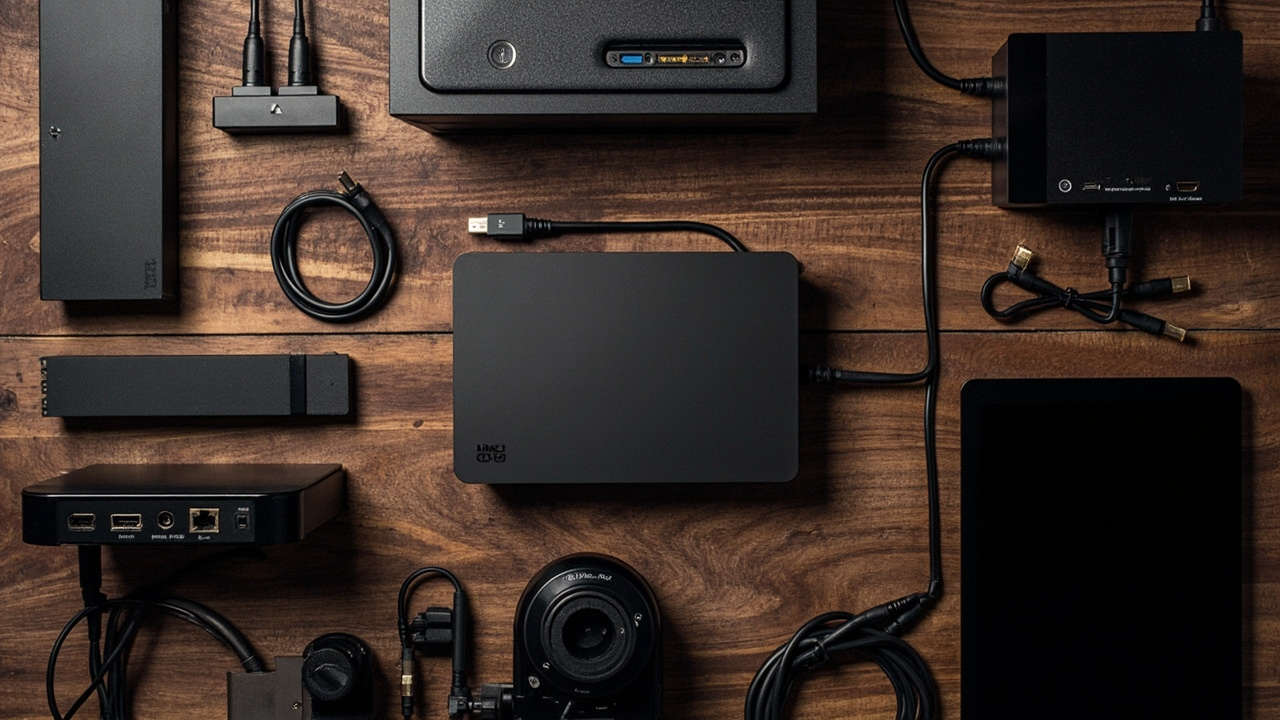
The photograph below shows where decode silicon, memory and board-level design meet. Those physical relationships help explain why SoC generation, board routing, memory selection and thermal validation belong in the same engineering review.

A buyer should align each platform with the dominant workload, not the most demanding specification in the catalog. A 4K@60 service may not need 4K@120, and an IPTV middleware with controlled features may not justify a premium platform. The correct question is which constraint stops the deployment if the chosen baseline reaches its limit.
The traps in this category
Field trap
A codec name without profile, level, resolution and frame rate is not a complete specification. “AV1 capable” can describe materially different decode paths. Require the production datasheet and an acceptance test against the exact service rendition.
The first quotation trap is ambiguous codec language. DM21P specifies AV1 [email protected]. DM21S states AV1 / H.265 [email protected] 4K@60. DM21T states AV1/VP9/H.265 4K@120. DM22Q states AV1/H.265 L5.1 4K@60. These statements do not create a common benchmark. A supplier may substitute one model for another if the RFQ contains only “AV1 4K,” creating a performance and lifecycle mismatch that appears only after volume approval.
The second trap is treating optional features as standard. Widevine L1, PlayReady, HDCP 2.2, Dolby Vision, DTS and 1G Ethernet are listed as optional on the relevant models. “Optional” does not mean unavailable; it means the delivered configuration must be fixed and verified. Put each feature in the SKU, factory acceptance criteria and regulatory or content certification evidence.
Field trap
Marketing labels can exceed the production ceiling. The disclosed DM21T and DM22Q facts cap output and decode at 4K; any 8K statement is outside the permitted production specification. A technically attractive quotation can fail simply because its output claim is inconsistent with the approved model.
A third trap is confusing RAM family options with a quoted configuration. DM21P, DM21S and DM22Q have optional memory tiers; DM21T has family options. The chart uses base RAM only. A sample evaluated with more RAM may behave differently from the base SKU, while a production PO that omits the memory line may be interpreted differently by the seller and factory. Specify RAM, ROM and any boot or partition allocation in the order.
The fourth trap is underpricing lifecycle governance. An android tv box product can enter production with the correct SoC but later encounter an OS image change, middleware update, certificate rotation, storage substitution or component revision. These changes can affect AV1 playback, DRM, boot behavior and update reliability. The quotation should identify revision-control responsibility, not leave lifecycle assumptions inside the manufacturing folder.
Finally, distinguish Android from Android TV certification. The disclosed models use AOSP Android 11 or AOSP Android 14. AOSP describes the base platform; the actual operator experience also depends on the launcher, Google services, apps, certification status and middleware. Request the exact software baseline and commercial deployment configuration rather than inferring it from a chip family. The AOSP and Android TV guide helps frame that distinction.
A decision path for the RFQ
- Define the service rendition Record AV1 profile, level, resolution, frame rate, bitrate, HDR/SDR mode, audio and DRM for every tier. Include fallback renditions used during faults or network changes.
- Choose the platform class Use DM21P for the disclosed operator-IPTV direction, DM21S for 4K IPTV/OTT white-label work, DM21T for premium UHD or cloud-gaming media ceilings, and DM22Q for gaming-oriented Android TV work.
- Freeze base and configured SKU Write SoC, OS, RAM, ROM, codec limits, DRM status, Ethernet speed, port set and regional software into one model line. Do not leave options to an “equivalent” clause.
- Define integration responsibilities Name the owner of launcher, middleware, applications, certificates, provisioning, remote management, OTA or MDM policy, operator APIs and first-line field diagnosis.
- Convert claims into acceptance tests Require sustained playback, seek/channel-change behavior, boot time, recovery, thermal operation, network stability, protected-content playback and output-mode checks using production firmware.
- Attach lifecycle controls Require PCN or equivalent change notice, BOM and software revision traceability, golden samples, firmware retention, spare-part policy, production window and escalation contacts.
A pasteable RFQ line for the media requirement can read: “Device shall decode the contracted AV1 stream at the specified profile/level, resolution and frame rate without frame drops during the agreed endurance interval; protected and unprotected renditions shall pass separately.” Add display, audio and network conditions because “successful playback” is otherwise subjective.
A hardware line can read: “Soc, AOSP version, RAM/ROM, HDMI output, USB port count and type, Ethernet rate, Wi-Fi/Bluetooth configuration and optional DRM shall match the approved production datasheet. Any substitution requires prior written approval.” This clause protects the buyer from a processor or memory change that is technically functional but commercially unapproved.
An acceptance line can read: “Supplier shall provide a golden sample, installed image identifier, codec test vectors or operator streams, boot and channel-change results, sustained-playback result, reboot recovery result and defect log. Pilot acceptance shall precede volume release.” The factory evidence should be linked to the exact sample and PO revision.
A lifecycle line can read: “Supplier shall maintain hardware revision, software revision, component traceability and production-test records through the agreed program window. Proposed changes affecting SoC, RAM/ROM, display interface, DRM, connectivity or Android baseline shall be notified before implementation.”
Do not use “equivalent” without defining the controlled fields. For AV1, equivalence requires at least the contracted profile, level, output format, sustained decode path and application environment. The deeper AV1 Android TV box guide can help refine the codec requirement before this line reaches procurement.
The evidence trail from SMT to shipment
The factory evidence trail should connect every physical unit to the released hardware, software and test configuration. It begins with approved production files, not a generic factory photograph. The BOM must identify the selected SoC, memory and other configured components; the production image must identify the released OS and application build. Any deviation becomes a controlled exception rather than an undocumented substitution.
- SMT and placement verification Record line recipe, board revision, component placement, soldering parameters and first-article inspection results.
- AOI and inspection Link AOI results to board revision and inspection criteria, with documented handling of detected defects.
- Assembly and firmware loading Capture board serial, hardware revision, image identifier, provisioning state and operator configuration.
- Soak and dark-room testing Run the released stress profile, then complete the planned dark-room visual check under controlled conditions.
- Functional and media tests Verify interfaces, network, boot, AV1 test content, protected playback where contracted, output mode and recovery.
- Shipment release Bind the test record, golden sample, firmware and hardware revision to the shipment batch and retain traceability.
Evidence package request: hardware revision, BOM status, AOI records, aging or soak result, dark-room record, AV1 playback log, DRM configuration record, golden-sample identifier, firmware checksum, packing record and approved engineering-change list.
The chain matters because decode performance is not controlled by component placement alone. A correctly soldered board can still carry the wrong image, an incomplete license service, an incorrect output mode or an unreleased driver. Conversely, a board with no obvious hardware fault can show intermittent playback if thermal, memory or network conditions are not tested.
For AV1 acceptance, retain evidence that identifies the exact stream and display path. The test record should state the device model, hardware revision, image build, output resolution and frame rate, stream profile/level, duration, result and observed anomalies. For protected content, record the DRM configuration without exposing sensitive service credentials.
Factory governance should also answer who can approve a change. A process change, alternate memory device, SoC revision or Android image update can affect the platform’s lifecycle evidence. The release record should connect the change to test impact and customer notification. The factory quality evidence page provides the appropriate route for an audit request focused on SMT, AOI, aging and dark-room records.
For a direct factory discussion, DataMax can review the evidence chain against the intended deployment and identify which records need to accompany the shipment. The manufacturer page is the appropriate starting point for a video factory audit or a request for topic-specific SMT/AOI/aging evidence before the PO is released.
Further reading
- Android TV Box: What It Is and What It Is Not
- Widevine L1 certification guide
- Dolby Atmos Android TV box guide
- TV box vendor selection checklist
- AOSP vs GMS solution notes
- DataMax DM21P specifications and fit
- DataMax DM21S specifications and fit
FAQ
Is AV1 support alone enough to compare these platforms?
No. Compare AV1 together with profile, level, maximum resolution, frame rate, SoC, OS, memory and operator software. DM21P, DM21S, DM21T and DM22Q disclose different combinations, from AV1 [email protected] to AV1/VP9/H.265 at 4K@120. A procurement specification should describe the exact service rendition and acceptance result.
Which model is the best starting point for operator IPTV?
DM21P is explicitly positioned for 4K IPTV and operator middleware, with AOSP Android 11, 2GB / 8GB base memory and AV1 [email protected]. DM21S is the direction when AOSP Android 14 is required for a 4K IPTV/OTT white-label product. Final selection depends on middleware, DRM, memory and network requirements.
Does 4GB RAM make a platform suitable for cloud gaming?
It provides more memory headroom, but memory is only one constraint. DM21T lists AV1/VP9/H.265 at 4K@120, 4GB / 64GB base memory and USB3.0. DM22Q lists 4GB / 64GB, AV1/H.265 L5.1 at 4K@60 and a gaming-oriented fit. Network latency, input support, sustained throughput and session recovery still require testing.
Are Widevine L1, PlayReady and Dolby Vision included?
The disclosed product facts describe Widevine L1, PlayReady, HDCP 2.2, Dolby Vision and DTS as optional on the relevant models. Include each required feature in the exact SKU and purchase order, then request certification and production configuration evidence. Confirm the final implementation against the production datasheet.
What lifecycle evidence should be requested before shipment?
Request traceable hardware and software revisions, BOM status, SMT records, AOI results, aging or soak evidence, dark-room inspection, AV1 playback logs, DRM configuration records, firmware identifiers, golden-sample evidence and a controlled engineering-change list. These records should identify the tested configuration rather than describe the process generically.