

The short answer first
Before approving an android tv box for a hospitality fleet, confirm 5 control points: the exact hardware configuration, Android and BSP baseline, licensed DRM position, audio output path, and lifecycle support. Each requires a document, not a capability phrase. The hardware BOM and Android build must identify the processor, RAM/ROM, ports, wireless options, and power supply. The firmware evidence must show the BSP branch, security-patch policy, recovery process, and update delivery method. The commercial evidence must define named firmware maintenance, end-of-life notice, and spare-parts support without relying on an unquantified warranty promise.
For audio, verify the physical and logical path end to end: source application → decoder and mixer → output format → connector → amplifier or display → measured acoustic result. A 3.5 mm AV jack or S/PDIF port on the datasheet does not establish usable stereo separation, channel stability, latency, or venue-noise performance. Those require acoustic measurements on the final application and audio chain.
The platform fit follows from the deployment. A wired operator or IPTV room points toward the DM21P. A cellular hospitality room without reliable Wi-Fi points toward the DM33H. A white-label OTT deployment points toward the DM21S. A premium UHD or cloud-gaming requirement points toward the DM21T. The wider selection logic is covered in Android TV box for ISP projects.
android tv box projects should not be signed off on chipset branding alone; firmware traceability, audio validation, and lifecycle commitments determine fleet cost.
Sign-off checklist
- Freeze a sample-level BOM and identify every production variation.
- Match the AOSP release to an approved BSP image and patch baseline.
- Verify DRM licensing, output protection, and deployment rights.
- Test each supported audio format, connector, channel mode, and routing mode.
- Obtain an evidence package covering manufacturing, aging, and field support.
A complete sign-off record should also identify the responsible supplier contact for hardware changes, image integration, application failures, network enrollment, and field replacement. A hospitality estate can operate hundreds or thousands of units under the same commercial agreement while still containing several incompatible configurations. Labeling the equipment as “Android 14” or “4K” cannot reconcile those differences. The acceptance file should connect the model name, serial-number range, RAM/ROM, network option, image identifier, audio configuration, and shipment destination. It should also identify any accessories required at the room level, such as an amplifier, IR receiver, remote control, SIM profile, HDMI cable, or Ethernet adapter. Where a feature remains subject to a production option, the buyer should record “confirm against the production datasheet” rather than assume inclusion. For fleet procurement, the measurable object is not the demonstration unit; it is every image and hardware variant permitted to enter the managed population.
Two routes, one bill of differences
Fleet sourcing usually separates into a transactional hardware route and a lifecycle-commitment route. The former optimizes the initial configuration sheet; the latter prices the operational burden over the deployment period. A quotation can appear complete under the first route while leaving firmware maintenance, EOL communication, recovery policy, and spare-parts continuity undefined.
| Control area | Transactional route | Lifecycle-commitment route |
|---|---|---|
| Configuration control | Orderable SKU and stated RAM/ROM | Sample-level BOM, firmware identifier, and approved change process |
| BSP support | Operating system label only | Named firmware branch, update cadence, security process, and recovery procedure |
| Audio validation | Connector presence | Format, routing, latency, channel, and acoustic test report |
| Lifecycle | Warranty-period wording | Defined EOL notice and spare-parts support window |
| Manufacturing evidence | Basic production sampling | SMT/AOI records, aging evidence, configuration audit, and traceability |
The lifecycle-commitment route is not a promise of indefinite support. It is an operational control that identifies who maintains the image, how patches are qualified, what notice accompanies EOL, and how replacement units remain configurable. For a hospitality estate, the relevant unit is the managed device population rather than a single living-room unit.
A second commercial decision is whether BSP work is a shared platform or a fleet-specific branch. A shared image reduces integration variants and simplifies qualification. A dedicated branch can address a fixed middleware, launcher, UI, and audio policy, but it adds fork-management obligations. Do not allow “custom” to conceal an unmanaged image with no owner or release train.
The transactional route can work when the buyer operates a fixed number of rooms, accepts a frozen application set, and does not require remote fleet recovery. It becomes expensive when middleware updates, regional content changes, or replacement hardware create configuration drift. The lifecycle route adds contractual and engineering effort at the outset, but it gives the operator a basis for replacement, rollback, and image recovery. Its measurable deliverables should include named image owners, an approved change procedure, a staging cohort, a rollback path, an EOL communication channel, and a definition of compatible spare hardware.
Audio can also create two different bills of differences. A pilot may accept HDMI audio because the demonstration television supplies amplification. A rolling room deployment may require S/PDIF into a fixed DSP or amplifier, or analog output into a local analog amplifier. Those configurations need separate qualification records even when they share one model and SoC. A lifecycle quote should state which output routes remain supported after an application or middleware change, not merely which sockets are present on the enclosure.
How the requirement actually works
BSP support is the hardware abstraction and integration layer beneath the Android framework. It includes kernel and device-tree configuration, board initialization, display and video pipelines, audio HAL and mixer routing, input handling, networking, power management, boot flow, recovery, and peripheral drivers. AOSP Android 11 or Android 14 identifies the platform family; it does not identify the production image, patch baseline, middleware build, or support responsibility.
For a hospitality deployment, the audio architecture requires an explicit route. A digital route may traverse the SoC decoder, Android audio mixer, audio HAL, S/PDIF or HDMI output, then an external amplifier. An analog route may terminate at a 3.5 mm AV or AV connector. Applications must use the correct Android AudioFlinger and AudioPolicy configuration, including source type, stream type, volume policy, mute behavior, and output-device selection. A common fault is audio playback through HDMI while the venue expects a local speaker output, or stereo being downmixed to mono because the active output profile is incomplete.
HDMI also presents separate video and audio obligations. The HDMI 2.0b output must be validated with the target display, EDID, resolution, color mode, HDCP configuration, and surround or downmix capability. S/PDIF must be checked for the supported sample rate and channel layout. An analog jack must be checked for electrical noise, channel separation, pop, mute behavior, and sustained playback. None of those outcomes can be inferred from a port list.
Network control is separate from application delivery. An operator-managed fleet may require authenticated device enrollment, middleware entitlement, configuration delivery, logging, and remote diagnostics. Android Management APIs can manage certain Android device fleets, while TR-069-style management applies in broadband access ecosystems and is not a native feature of every Android image. The selected architecture must state which controller owns device identity, update policy, configuration, telemetry, and recovery.
DRM must be checked independently of codec support. AV1, VP9, and H.265 decode capability do not confer Widevine L1, PlayReady, or HDCP rights. Confirm the exact service level, licensing model, device certification status, output-protection path, and contractual entitlement for the target application. The procurement record should identify which party holds those rights.
For fleet operations, define the update architecture before deployment: staging, pilot cohort, staged rollout, rollback, device-group segmentation, and maximum failed-device exposure. Update delivery over the internet may be inappropriate where the network is managed, costly, intermittent, or operationally restricted. A local image distribution method can be preferable for closed hospitality estates.
The architecture record should map each layer to an owner. The board-support owner supplies drivers and image builds; the middleware owner supplies the launcher, entitlement flow, and application integration; the OEM or operator controls enrollment, deployment groups, and monitoring; the venue integrator owns displays, amplifiers, speakers, and room wiring. The audio acceptance report should then identify which layer controls each behavior. For example, an incorrect mixer path is an Android configuration issue, while an unsupported speaker impedance or gain structure is an installation issue.
An android tv box used as a managed endpoint also requires boot-path documentation. State whether recovery depends on a local button, an update package, a network command, or a reinstall through a maintenance interface. Define the expected behavior when an update corrupts the active partition, when application data is erased, or when device enrollment is lost. For operator middleware, define reauthorization after a network interruption and whether cached rights remain available. These procedures convert an abstract support statement into actions that a field technician can execute without rebuilding the room system.
The platform shortlist with datasheet values
The four models below cover materially different deployment directions. Use the production datasheet and the current PDP as the configuration authority; catalogue summaries may differ from production values.
| Model | SoC and OS | RAM/ROM | DRM | Connectivity and physical I/O |
|---|---|---|---|---|
| DM21P | Amlogic S905Y4, quad Cortex-A35; AOSP Android 11 | 2GB / 8GB; 4GB RAM; 16/32/64GB optional | Widevine L1 / PlayReady / HDCP 2.2 optional | HDMI 2.0b out x1; USB2.0 x2; TF; S/PDIF; 3.5mm AV; RJ45 100M; Wi-Fi6 2x2 + BT5.4; DC 5V/2A |
| DM33H | Allwinner H618, quad Cortex-A53; AOSP Android 14 | 2GB / 16GB; 4GB / 32GB optional | No Widevine row on datasheet | HDMI 2.0b out; 2x Type-C, one 5V/2A power and one data; SIM x1, 4G Quectel EG915N, 5G optional; Wi-Fi6 2T2R; no RJ45; 70x70x17mm |
| DM21S | Amlogic S905Y5, quad Cortex-A55; AOSP Android 14 | 2GB / 16GB; 2/4/8GB RAM; 16/32/64GB optional | Widevine L1 / PlayReady optional; Dolby Vision/DTS | HDMI 2.0b out; S/PDIF; AV; USB2.0 x2; TF; RJ45 100M, 1G optional; Wi-Fi6 2x2 + BT5.4 |
| DM21T | Amlogic S905X5, quad Cortex-A510 (ARMv9); AOSP Android 14 | 4GB / 64GB; family options | Widevine L1 / PlayReady optional | HDMI 2.0b out, no HDMI in; USB2.0 x1 + USB3.0 x1; TF; S/PDIF; AV; RJ45 100M, 1G opt; Wi-Fi6 + BT5.4 |
DM21P is the wired operator-oriented option: its RJ45 100M port and both digital and analog audio paths suit controlled IPTV rooms. The optional 4GB RAM and larger ROM choices must be ordered explicitly. The Widevine L1, PlayReady, and HDCP 2.2 entries are optional, so a buyer must not assume licence inclusion without confirming the ordered configuration.
DM33H addresses cellular hospitality and no-Wi-Fi signage through its SIM slot and 4G Quectel EG915N modem, with 5G optional. It has no RJ45 port. Its datasheet does not include a Widevine row; licensed applications need separate confirmation against the production datasheet and proposed service level. Do not state a Bluetooth version for this model.
DM21S is the white-label IPTV/OTT direction, with AOSP Android 14 and a broader connector set. “Dolby Vision/DTS” in the DRM row should be handled as an optional capability requiring the associated commercial and technical entitlement, not a universal bundle.
DM21T addresses premium UHD and cloud-gaming workloads. Its decode list includes AV1, VP9, and H.265 at 4K@120, while H.266/VVC [email protected] is listed at 4K@120. The production datasheet caps output and decode at 4K; do not translate marketing references into an 8K output claim.
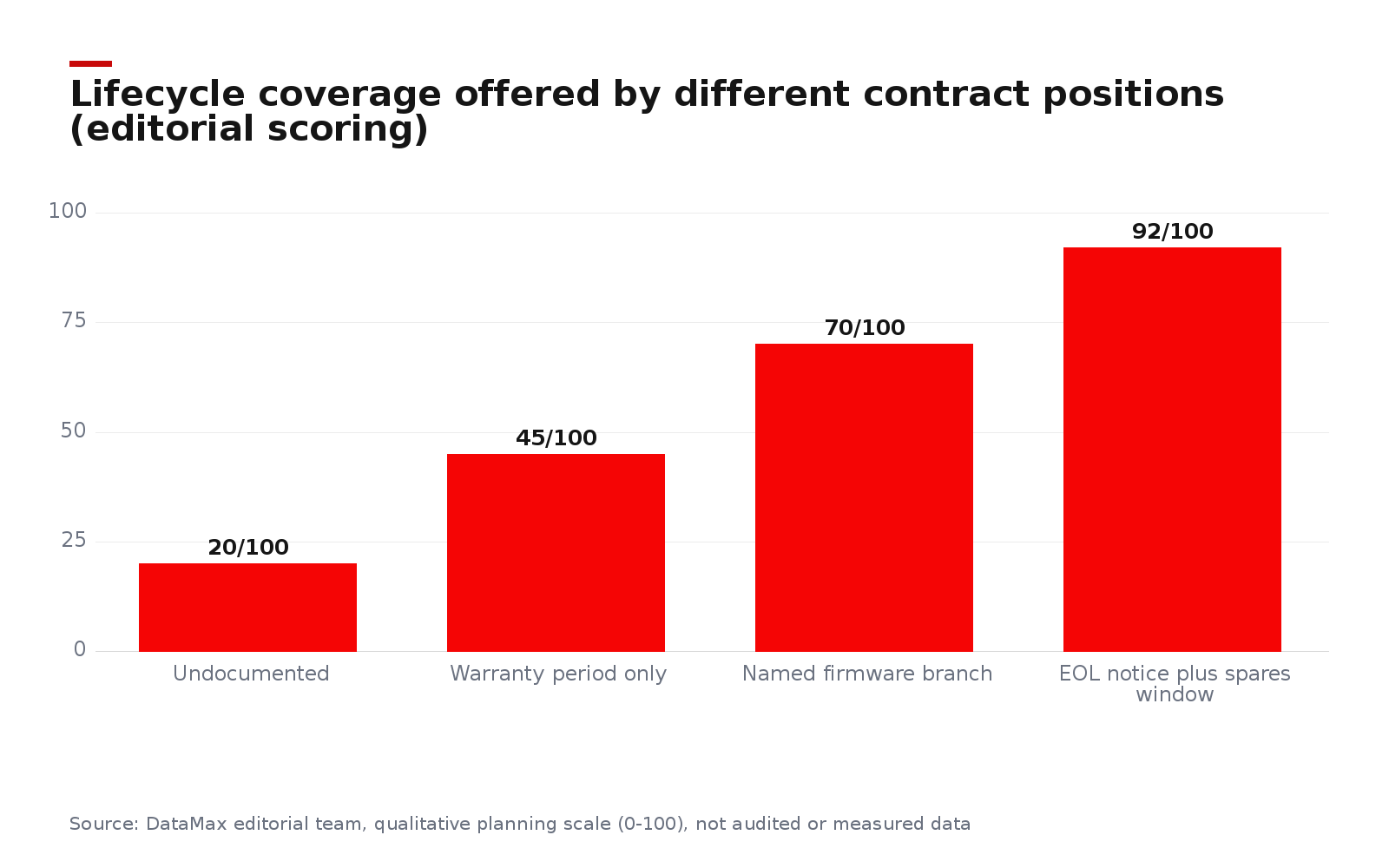
The same figures, in searchable form:
| Contract position | Editorial score |
|---|---|
| Undocumented | 20 |
| Warranty period only | 45 |
| Named firmware branch | 70 |
| EOL notice plus spares window | 92 |
Source: DataMax editorial team, qualitative planning scale (0-100), not audited or measured data.
The shortlist is a routing aid, not a universal ranking. For a wired operator estate, the presence of RJ45 on DM21P and DM21S may decide the first filter; the DM21P basis remains AOSP Android 11, while DM21S uses AOSP Android 14. For cellular use, DM33H moves the network dependency to the SIM and requires a different acceptance plan. For premium video, DM21T provides the listed 4K@120-class decode and higher memory tier. The buyer should not infer decoder capability on DM33H from another model’s table, and should not infer a licensed DRM row where the datasheet does not provide one.
The platform column also drives the evidence schedule. DM21P calls for Ethernet stability, middleware qualification, S/PDIF and 3.5mm AV routing tests, and explicit ordering of the 4GB RAM or larger ROM options. DM21S calls for Android 14 application qualification, an optional 1G Ethernet decision, and verification of the optional Widevine L1 and PlayReady positions. DM33H calls for carrier, APN, SIM, signal, DNS, DHCP, and reconnect testing; licensed video remains unresolved unless confirmed against the production datasheet. DM21T calls for display-mode, sustained decode, thermal, input, and cloud-service testing.
Each row should become a controlled configuration record. Include the exact RAM/ROM combination, modem option, network option, image identifier, licensed feature set, power supply, packaging label, and serial range. A family option is not an order until it is written as one accepted value. That discipline matters because an android tv box fleet can otherwise contain units with the same enclosure and model name but different storage, cellular hardware, and licensed capabilities.
Deployment scenarios and the spec each needs
Hospitality fleets divide by network control, audio topology, application rights, and display capability. The correct model direction follows those constraints. The matrix below does not replace application testing; it identifies the first technical filter.
| Situation | Primary requirement | Model direction | Evidence to request |
|---|---|---|---|
| Operator-controlled IPTV room | Ethernet, middleware stability, operator middleware | DM21P | Network soak, middleware qualification, audio and HDMI matrix |
| Hospitality room with unreliable Wi-Fi | Cellular connectivity without RJ45 | DM33H | SIM provisioning, signal survey, carrier test, streaming continuity |
| White-label OTT room | Android 14, optional 1G Ethernet, digital and analog audio | DM21S | Launcher certification, OTA test, output-routing matrix |
| Premium UHD or cloud-gaming suite | 4K@120-class decode and higher memory tier | DM21T | Display compatibility, sustained thermal test, decode stability |
| Digital-signage corridor | Remote management, scheduled playback, autonomous recovery | Model depends on network and audio topology | Recovery test, schedule persistence, management audit |
For operator rooms, the DM21P fits because the wired path removes Wi-Fi variability and supports middleware deployment. Audio testing should include ring tones, UI sounds, guide audio, Dolby or DTS content where licensed, and alarm output across S/PDIF and the 3.5 mm AV jack. Confirm how the installed middleware selects the active Android output device.
For cellular hospitality, the DM33H’s SIM architecture suits a venue where running Ethernet is costly or prohibited. The acceptance test must include the target carrier, APN, authentication method, signal profile, DHCP behavior, DNS, captive portal interaction, and VPN or middleware requirements. Its 70x70x17mm dimensions are documented, but thermal behavior behind furniture and power-budget stability still require enclosure testing.
For white-label OTT rooms, the DM21S offers AOSP Android 14 with optional 1G Ethernet. The integrator must prove launcher behavior, remote-control discovery, deep links, account state restoration, and audio-device selection. If the venue uses distributed speakers, S/PDIF is the preferred first test path; analog AV needs separate validation.
For premium UHD or cloud-gaming spaces, the DM21T aligns with the higher-memory 4GB / 64GB family option and 4K@120 decode entries. Acceptance should use the target television, game service, network path, and controller. The absence of HDMI input must be included in the room design, because pass-through use cases cannot be assumed.

The photograph illustrates the operational reality: a hospitality fleet is not a retail shelf. Identical housings can conceal different RAM, ROM, modem, firmware, and accessory configurations, so fleet labeling and serialized configuration records are essential.
The specification differs further when the audio endpoint is a distributed ceiling speaker, a stereo amplifier, a zone mixer, or the television itself. Specify whether the endpoint consumes HDMI, S/PDIF, or analog audio; identify the amplifier or display model; and record the required channel layout. A hospitality operator should also test interruption behavior. A ringing phone, OTA installation, reboot, alarm, or loss of network must not silence the room permanently. For the DM33H, the power source must support cellular warm-up, reconnection, and sustained operation without uncontrolled reboots. For every route, ask whether volume changes initiated by the remote affect all output devices consistently and whether mute state survives a source change.
A second deployment split is between guest-room use and controlled signage. Guest rooms can have changing networks, captive portals, support calls, and ad-hoc remote-control actions. Signage normally needs scheduled playback, deterministic boot, autonomous recovery, and unattended updates. The second profile can tolerate fewer interactive features while requiring stronger watchdog behavior, configuration retention, and operational telemetry. Neither use case justifies an open-ended support clause.
Turning the question into a spec line
A useful RFQ converts an open-ended request for “BSP support” into evidence-bearing statements. The following sequence moves from deployment constraints to a testable order line.
- Define the operating profile State the Android release, chipset, RAM/ROM, network method, display resolution, application set, and expected daily operating period.
- Define the audio route Name the source formats, channel modes, connector, amplifier or display model, target latency, and whether local, HDMI, or S/PDIF output is required.
- Define the image Require the BSP identifier, firmware branch, security-patch baseline, update mechanism, recovery method, middleware version, and installed application baseline.
- Define lifecycle control Require named firmware maintenance, EOL notice, spare-parts support, configuration retention, and change-notification procedures.
- Define acceptance evidence List factory records, audit evidence, burn-in duration, acoustic measurements, network tests, codec tests, and recovery results.
- Freeze the order line Record the model, memory configuration, modem option, firmware identifier, DRM entitlement, accessories, and test destination.
A pasteable RFQ line could read: “DM21P, 2GB / 16GB production configuration, AOSP Android 11 image with named BSP branch, Widevine L1 / PlayReady / HDCP 2.2 licensing status confirmed in writing, S/PDIF plus 3.5mm AV routing, RJ45 100M, target-market middleware, staged OTA with rollback, and acceptance evidence covering SMT/AOI, aging, HDMI, audio, and recovery.” The line is an example of specification structure; each populated value must come from the production datasheet and signed quotation.
Audio acceptance criteria should be equally concrete: identify the test signal and level, channel mode, connector, display or amplifier model, measurement equipment, observation window, permitted channel imbalance, permitted audible artifacts, and pass/fail action. “Audio works” cannot be audited or reproduced.
For cellular projects, replace Ethernet assumptions with carrier and SIM acceptance criteria. For premium UHD, specify the display model and supported mode rather than a resolution label alone. For operator middleware, identify the middleware version, authorization method, entitlement server, and interaction with system audio focus.
The output should be a frozen configuration plus evidence schedule. A model name alone is not a purchase order line because optional RAM, ROM, Ethernet speed, modem generation, DRM, and firmware features can change the delivered unit.
A second RFQ line can define the hospitality fleet as a managed population. It can require serial-number traceability from SMT through shipment, a firmware identifier attached to each hardware configuration, an update pilot before fleet rollout, a documented rollback trigger, and a spare-unit process that preserves the same image and accessory list. Include the target room count as an operational input if it affects staging, although the volume decision remains with the buyer. Require delivery planning by wave so that one image can be qualified in a small first wave before broader installation.
A third RFQ line should state the service boundary. Name the parties responsible for board drivers, Android image maintenance, middleware, application entitlement, device enrollment, remote management, venue networking, display configuration, amplification, and physical installation. Define where support requests are logged, what diagnostic data is required, and how a patch moves from defect reproduction through qualification and deployment. Without this boundary, a field fault can pass between the OEM, middleware provider, operator, and integrator without an owner.
For each candidate android tv box, retain the same question set even when the model changes. This creates comparable evidence across proposals. It also prevents a cellular product from being judged against an Ethernet acceptance plan, or an optional DRM capability from being treated as an included entitlement. The final specification should contain one resolved configuration, one named image, one test matrix, and one evidence schedule.
Where quotations quietly diverge
The largest divergence usually sits between the BOM and the managed product. One quotation may describe a board family, while another specifies a SKU with a different memory configuration or modem. Another may treat Widevine as inherent when the order line leaves the option unresolved. These are configuration-control failures, not cosmetic differences.
Field trap
A quoted “HDMI 2.0b” port does not establish a room-ready audio path. If the venue amplifier is analog but the quotation only confirms HDMI, the integrator may discover an unusable output after installation. The correction cost includes adaptor redesign, retesting, and repeat deployment rather than a simple configuration change.
Field trap
AOSP Android 14 does not by itself identify the supported BSP branch or security-patch baseline. A later production image may also carry different peripheral and audio drivers. Require the image identifier, build date, configuration checksum, and change-control route; otherwise an “identical” replacement unit can behave differently in the same room.
Optional-feature wording creates another divergence. The DM21P lists Widevine L1, PlayReady, and HDCP 2.2 as optional. The DM21S and DM21T list Widevine L1 and PlayReady as optional. Confirm the ordered entitlement, not the catalogue capability. For DM33H, the absence of a Widevine row means a licensed streaming requirement needs explicit confirmation against the production datasheet and proposed configuration.
Memory configuration is similarly easy to misread. A family may support multiple RAM and ROM combinations, while a specific order is still singular. Capture RAM and ROM in the purchase order, device-label record, and factory configuration export. The same applies to the DM21S 1G Ethernet option and DM33H 5G option.
Audio acceptance can diverge between a successful demonstration and repeatable fleet behavior. A demonstration sample may use one display, one stream, and one room configuration. Production validation should cover target hardware, repeated boot, channel changes, application restart, network loss, update rollback, and sustained playback. Unsupported routing can remain hidden until the user changes output.
Finally, lifecycle language may hide ownership. “OS support provided” does not identify the responsible party, branch, cadence, qualification process, or EOL handling. Replace it with operational clauses and attach the evidence schedule.
Other divergences appear in the accessories and update path. One proposal may include a remote, power adapter, HDMI cable, or SIM kit while another treats them as customer-supplied. One may stage updates over the public internet while another expects a local media repository or operator platform. The commercial comparison should list each included item, its quantity, the responsible supplier, the approved substitute, and the test destination.
Power naming can be similarly misleading. A USB-C receptacle may carry power, data, or both depending on the port and cable; a barrel connector may use a different voltage or current rating. Require the exact power supply and cable arrangement, then test boot, restart, display wake, and update behavior under the specified supply. The quotation should not leave the venue installer to discover which adapter belongs to each model.
For the android tv box lifecycle, “patch support” needs an observable meaning. Require the branch identifier, supported application baseline, qualification test, staging procedure, rollback condition, change notification, and replacement compatibility. Also define whether the EOL process applies to the model, the hardware revision, the firmware branch, the middleware version, or the licensed service. Treating these as one event creates avoidable service interruptions when only one layer is ending.
Questions to put in the supplier review
The supplier review should trace hardware production through field support. At SMT, ask for production-line routing records, component substitutions, firmware-flashing records, and serial-number linkage. AOI or equivalent inspection evidence must cover the assembled board, not only a pre-production inspection report. Configuration audits should reconcile the physical unit with the approved BOM, RAM/ROM, modem presence, and firmware image.
- Incoming and SMT evidence Review component traceability, line records, AOI results, rework logs, and deviation approvals against the approved production BOM.
- Image and identity control Verify each serial number against the flashing record, image identifier, checksum, configuration, and hardware variant.
- Functional and aging evidence Review USB, HDMI, Ethernet or cellular, audio output, boot, recovery, and network test results, including the documented aging duration and sample plan.
- Release audit Match production units, firmware bundle, packaging labels, accessory list, and shipment records to the signed order.
- Field feedback loop Define defect coding, root-cause ownership, patch qualification, replacement traceability, and EOL communication.
A complete evidence file should connect the signed configuration to the produced unit: model and memory variant, modem option, image identifier, test result, serial number, inspection status, and shipment record. For an **android tv box** fleet, the data becomes more valuable when stored by device group and firmware branch rather than as disconnected PDF reports.
Ask whether the factory can provide a video factory audit with access to SMT, AOI, programming, functional test, aging, and packing areas. DataMax publishes its factory-quality process, and an operator can also request a manufacturer capability review with evidence specific to this fleet.
The review should close with a configuration dossier: approved hardware, named BSP image, audio test matrix, middleware and DRM checklist, manufacturing records, update procedure, and lifecycle plan. Buyers can request samples before committing the fleet order.
Email [email protected] with the SKU list, target-market certificates, middleware and DRM checklist, and required audio and lifecycle evidence. The review then has 4 concrete inputs to evaluate against one android tv box configuration rather than a generic hospitality brief.
During the factory walkthrough, follow one serial number from component verification through firmware programming, functional test, aging, packing, and shipment. Inspect the actual test interface used by operators rather than only reviewing a sample report. For audio, ask to see the signal source, configured route, connected amplifier or display, measurement method, and failed-unit disposition. For cellular units, ask to see SIM insertion, network registration, reconnect, and signal-loss handling. For update qualification, ask where firmware images are stored and how the build identifier is matched to approved hardware.
The final review record should also define retention and access. Identify the owner of SMT and AOI data, the owner of firmware release records, and the person who authorizes a configuration change. Establish how a distributor, operator, and DataMax can each retrieve the evidence relevant to a serialized unit. A android tv box program that cannot retrieve the image and test record for a failing replacement risks replacing hardware repeatedly while leaving the root cause unchanged.
Further reading
- Guide android tv box for isps
- Dolby Atmos Android TV box guide
- TV box vendor selection checklist
- AOSP vs GMS solution notes
- Telecom and pay-TV operator solutions
- DataMax DM21P specifications and fit
- DataMax DM33H specifications and fit
FAQ
Does AOSP Android 11 or Android 14 include BSP support?
No. AOSP identifies the Android platform family, while BSP support covers device drivers, kernel configuration, board initialization, audio routing, recovery, updates, and production maintenance. The quotation must identify the actual firmware branch, image build, patch baseline, and responsible support process.
Can every Android TV box serve as a hospitality fleet device?
No. Suitability depends on stable updates, remote management, recovery, network behavior, audio routing, application rights, and physical logistics. A fleet of 500 devices also requires configuration traceability, spare-unit planning, and a documented field-defect process.
Does an S/PDIF port guarantee good venue audio?
No. It establishes a digital output capability, not the complete audio result. The source application, decoder, mixer, HAL, connector, amplifier, speakers, acoustic environment, and measurement criteria must be validated together.
Should cellular and Ethernet hospitality devices use the same image?
Only if their hardware, modem, network behavior, and operator requirements are fully supported by that image. A cellular SKU may need different drivers, provisioning, power behavior, and field procedures. Freeze both the hardware configuration and BSP branch in the order record.
What lifecycle evidence should accompany a fleet quotation?
Request the named firmware branch, update and rollback process, security-patch baseline, EOL notice procedure, spare-parts support, configuration-retention method, and change-notification route. A warranty statement alone does not describe the complete managed lifecycle.
What should be audited before shipment?
Audit the approved BOM, AOI and rework records, firmware-flashing traceability, functional tests, aging evidence, audio and network results, packaging, and shipment reconciliation. The audit should link each production serial number to its hardware and firmware configuration.




