

The decision before the Atmos label
A Dolby Atmos android tv box is a device that can output an Atmos-compatible audio experience only when its decoding chain, source material, HDMI path, display or AVR, and downstream configuration support that experience. The label alone is not evidence of Atmos playback, and a decoder is not a certification. The procurement decision should therefore separate four questions: what the box claims to decode, what its HDMI implementation can carry, what the connected audio device can render, and what licensing or partner requirements apply.
For an operator, integrator, or distributor, the first line of the RFQ should describe the required end-to-end result, not merely the marketing term. Request the exact chipset, operating-system baseline, audio formats, output resolution and refresh-rate limits, HDCP status, DRM configuration, port inventory, and evidence used for the claim. A model should enter the shortlist only after the supplier can map those requirements to a production configuration and its verification records.
This focused view complements the canonical discussion of Dolby Atmos Android TV Box buyer mistakes. It does not target the generic query for an android tv box; its narrower purpose is to establish when an Atmos claim is technically meaningful and how to verify it before volume commitment.
The practical distinction is straightforward:
- Atmos decoding describes a software or hardware capability.
- Atmos output describes the negotiated HDMI and audio path.
- Atmos rendering occurs in the television, soundbar, AVR, or other endpoint.
- Atmos certification or licensing is a separate commercial and compliance process.
- Feature availability can still depend on content, app, region, account, and service configuration.
That chain also prevents a common sourcing error: comparing a box’s processor with a television’s capability list and treating both as equivalent. The source must carry the encoded audio, the set-top box must decode and package it correctly, and the endpoint must expose a usable mode. One broken link prevents the intended experience.
A practical procurement example shows why the distinction matters. A buyer may request a 4K@60 service, a 5.1 or object-based audio path, Widevine L1 for protected playback, and a stable HDMI connection to a television with an integrated soundbar. The supplier should identify which requirement is implemented by the box, which is implemented by the endpoint, and which is controlled by the content owner. A response such as “Dolby Atmos supported” does not answer that allocation of responsibility.
The decision is therefore not whether the word Atmos appears in a datasheet. The decision is whether the exact SKU, firmware, service, region, endpoint, and license can produce a repeatable result under the acceptance procedure.
How Atmos, HDMI, and content actually work
Dolby Atmos is an audio format and object-based rendering system, not a synonym for “surround sound.” An Atmos-capable source may deliver object metadata alongside audio channels. The rendering endpoint uses that information to create a presentation appropriate to its connected speaker layout. A television or AVR may provide a summarized or alternate presentation rather than reproducing a cinema object mix.
In a set-top-box architecture, the chain has six identifiable stages:
- A provider packages encoded audio, commonly with Dolby Digital Plus for streaming applications.
- The application or middleware requests the stream and passes it to the platform audio framework.
- The android tv box decodes the compressed audio and retains the necessary channel or object metadata.
- The HDMI output negotiates a supported audio format with the television or AVR.
- The endpoint renders or converts the audio for its speaker configuration.
- Licensing, application policy, and region settings determine what the service exposes.
The distinction between decoding and output is crucial. A platform may contain an Atmos-capable decoder yet depend on an application, negotiated HDMI mode, or endpoint configuration for the feature to become usable. Conversely, a device with a generic surround decoder does not become Atmos-capable merely because an HDMI cable carries multichannel PCM.
The same discipline applies to video. HDR10+ and high-dynamic-range implementation questions interact with display capability, while 4K 60 fps Android TV Box selection must be verified against the application, source, display, and firmware profile. No processor label can substitute for an end-to-end signal test.
For procurement, request four distinct artifacts:
- the exact audio codec list and decoder implementation path;
- the HDMI output specification and relevant firmware behavior;
- the DRM and service-license configuration, where protected playback is required;
- a reproducible test record using a licensed source and a named reference endpoint.
When the supplier uses the term “Dolby Atmos” on a product page, ask which of these it means. For general industry context, Dolby Atmos for Android TV platforms provides the wider technical framing, but a buyer still needs configuration-specific evidence.
A useful acceptance worksheet records the source identifier, source codec, audio language, selected output device, HDMI audio mode, endpoint model, endpoint firmware, speaker layout, observed rendering, and restart behavior. If the result changes after a firmware update, the worksheet must be repeated. This protects the buyer from treating a one-time laboratory result as a permanent product capability.
The video and audio paths should be recorded separately before they are combined. A 4K video test confirms the display and HDMI path for video; it does not prove that the same path negotiated the required audio mode. Likewise, a successful audio decode trace does not prove that the television exposes the selected mode to the user.
For an operator, the content entitlement can be the decisive control. The same hardware image may show a licensed feature in one market, hide it in another, or require a specific account state. The RFQ should therefore identify the target market and service rather than accepting a feature list that has no application context.
DataMax platforms and their documented boundaries
DataMax’s supplied product facts support the following distinctions. They do not provide a blanket Atmos certification statement for every model, so buyers should confirm the exact Atmos implementation, licensing, and production configuration against the production datasheet.
| Model and fit | Platform and OS | Documented decode and DRM | Relevant output and connectivity |
|---|---|---|---|
| DM21P 4K IPTV / operator middleware set-top box | Amlogic S905Y4, quad Cortex-A35 AOSP Android 11 | AV1 [email protected], VP9/H.265 4K@60, H.264 4K@30 Widevine L1 / PlayReady / HDCP 2.2 optional | HDMI 2.0b out x1; USB2.0 x2; TF; S/PDIF; 3.5mm AV; RJ45 100M; Wi-Fi6 2x2 + BT5.4; DC 5V/2A 2GB / 8GB; 4GB and 16/32/64GB optional |
| DM21S 4K Android TV box for IPTV/OTT white-label | Amlogic S905Y5, quad Cortex-A55 AOSP Android 14 | AV1 / H.265 [email protected] 4K@60 Widevine L1 / PlayReady optional; Dolby Vision/DTS | HDMI 2.0b out; S/PDIF; AV; USB2.0 x2; TF; RJ45 100M; 1G optional; Wi-Fi6 2x2 + BT5.4 2GB / 16GB; 2/4/8GB and 16/32/64GB optional |
| DM21T Premium UHD / cloud-gaming box | Amlogic S905X5, quad Cortex-A510 (ARMv9) AOSP Android 14 | H.266/VVC [email protected] 4K@120, AV1/VP9/H.265 4K@120, AVS3 4K@120, H.264 4K@60; inline AI-SR Widevine L1 / PlayReady optional | HDMI 2.0b out, no HDMI in; USB2.0 x1 + USB3.0 x1; TF; S/PDIF; AV; RJ45 100M; 1G optional; Wi-Fi6 + BT5.4 4GB / 64GB; family options |
| DM22Q Gaming-oriented Android TV box | Amlogic S905X5M, quad Cortex-A55 up to 2.5GHz AOSP Android 14 | AV1/H.265 L5.1 4K@60; inline AI-SR, no NPU TOPS stated Widevine L1 / PlayReady optional; Dolby Vision/DTS | HDMI 2.0b out; USB2.0 x2; TF; S/PDIF; AV; RJ45 100M; 1G optional; Wi-Fi6 2x2 + BT5.4 4GB / 64GB; 2/4/8GB and 16/32/64GB optional |
The table deliberately preserves the supplied boundaries. It does not convert Dolby Vision or DTS into a Dolby Atmos declaration, and it does not infer Atmos support from S/PDIF, HDMI, or processor capability. “Dolby Vision/DTS” remains exactly that documented option list; the relationship between those terms and the intended audio experience must be confirmed against the production datasheet.
Likewise, the available figures do not justify describing every platform as a certified Atmos product. A buyer asking for Dolby Atmos may need a specific production image, service application, license, and regional configuration. Those items are outside the supplied facts and therefore remain confirmation items.
The platform families also serve different engineering positions. DM21P is positioned for operator middleware, DM21S for IPTV/OTT white-label work, DM21T for premium UHD and cloud-gaming workloads, and DM22Q for gaming-oriented deployments. Those fit labels help narrow the brief; they do not settle the Atmos question.
A concrete shortlist entry should therefore look like this: “DM21S, AOSP Android 14, 2GB / 16GB, Dolby Vision/DTS as documented; Atmos decode, output, licensing, and endpoint validation to be confirmed against the production datasheet.” This avoids converting a roadmap possibility into an orderable fact.
The model audit is best used as a planning aid rather than a technical ranking of the four platforms. It asks where configuration ownership and failure traceability are likely to sit across operating models.
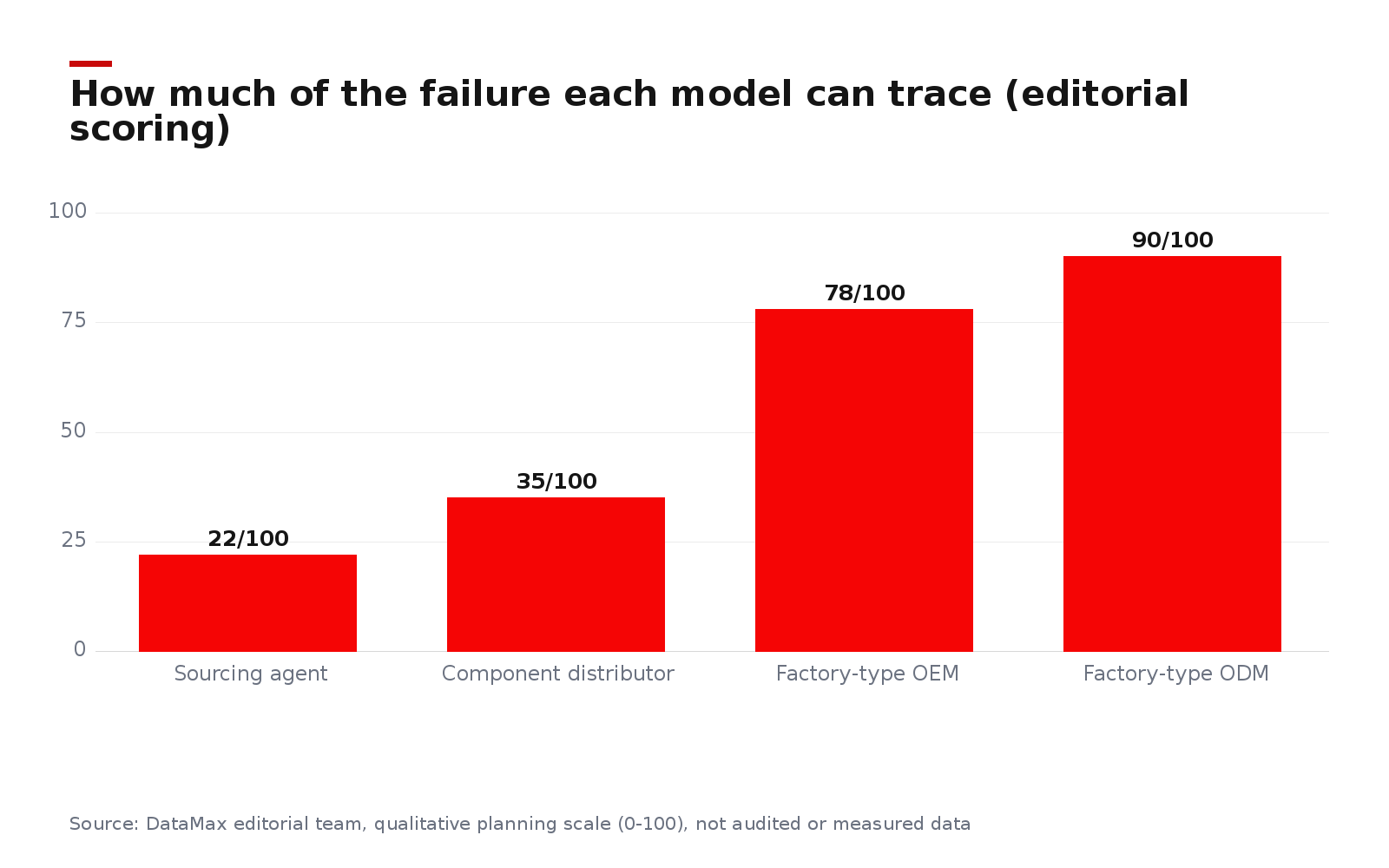
The same figures, in searchable form:
| Operating model | Editorial score |
|---|---|
| Sourcing agent | 22/100 |
| Component distributor | 35/100 |
| Factory-type OEM | 78/100 |
| Factory-type ODM | 90/100 |
The chart is a qualitative editorial planning scale, not audited or measured data. It does not assign a 22, 35, 78, or 90 score to DM21P, DM21S, DM21T, or DM22Q. It indicates that a buyer should examine ownership boundaries more closely when the purchasing arrangement sits farther from the factory.
Deployment scenarios and the evidence each requires
The same phrase can describe different engineering obligations. An IPTV operator may be managing headroom, entitlement, middleware, and service continuity. A hotel integrator may be balancing room-control integration with hidden installation. A distributor may need white-label packaging and repeatable certification files. A gaming platform may prioritize frame rate and input response while still requiring immersive audio.
| Deployment | Primary requirement | Evidence required | DataMax model direction |
|---|---|---|---|
| Operator IPTV | Middleware compatibility, managed software, content entitlement, stable audio output | Application certification, decode trace, HDMI audio test, DRM configuration, firmware update procedure | DM21P as an operator-oriented candidate; confirm Atmos and production configuration |
| Hospitality room | Compact enclosure, controlled boot, network service, television or AVR integration | Port map, recovery procedure, room-control test, endpoint compatibility, concealed thermal test | DM21S or another compact platform; confirm dimensions and Atmos against the production datasheet |
| White-label OTT | Operator interface, identity, content-service configuration, repeatable SKU control | Golden image, application compatibility matrix, DRM records, label approval, change-control record | DM21S for IPTV/OTT white-label; confirm Atmos support, licensing, and final BOM |
| Premium UHD / cloud gaming | Video throughput, latency, audio-video synchronization, sustained thermal performance | 4K test vectors, frame and audio timing capture, thermal run, endpoint audio test | DM21T as a candidate; no Atmos claim is inferred from its decode list |
| Gaming-oriented retail | Input handling, sustained application performance, storage, update policy | Application qualification, sustained-load report, update test, output and synchronization capture | DM22Q as a candidate; confirm Atmos and exact configuration |
The hospitality scene makes the physical architecture visible: a television appears to be the sound source, while a compact operator box may sit behind it and carry the streaming or IPTV workload. The installer still needs to know whether the television or an AVR renders the object mix, which HDMI input carries the audio, and whether the room-control system can select the correct source.

For operators, a promising laboratory demonstration is insufficient if the service entitlement cannot be delivered in the target market. The account must have the appropriate content rights, the application must expose the relevant option, and the selected television or AVR must accept the negotiated signal. Regional licensing and service policy therefore belong in the acceptance plan.
For integrators, the practical test is not “Does the menu contain Atmos?” It is “Can the guest select the service, does audio start cleanly, does the display identify the expected mode, and does a reboot recover the route?” A five-step field script catches more integration defects than an isolated codec test.
That field script should cover source selection, service launch, audio negotiation, channel change, and recovery after power cycling. It should also record whether the endpoint is the television, a soundbar, or an AVR. A single model can pass in a showroom and fail in a room where the default HDMI input, television settings, or room-control macro differs.
For a distributor, the scene changes into a configuration-control problem. The distributor may need a branded launcher, regional application set, preloaded account, and a repeatable SKU definition. The distributor should request the approved image identifier, boot behavior, update channel, default source, network configuration, and service entitlement assumptions for each market.
The selection sequence that removes rework
Start with the end experience, then work down the chain. This sequence turns an ambiguous marketing request into RFQ lines that can be compared between suppliers.
- Define the source and service State whether the requirement concerns IPTV, OTT, gaming, local media, or another application. Name the streaming service, region, account entitlement, source codec, and protected-content requirements.
- Define the endpoint Specify the television, soundbar, or AVR, its firmware, speaker configuration, supported HDMI audio modes, and available ports. State whether Atmos rendering occurs in the endpoint or elsewhere.
- Freeze the video target Record the required output and content limits such as 4K@60, including whether HDR, high frame rate, and audio-video synchronization must coexist.
- Specify the platform Provide the required SoC, AOSP or Google Android TV baseline, RAM/ROM tier, app set, update method, bootloader, provisioning, and regional requirements. Do not let a brand name substitute for a configuration.
- Map connectivity List HDMI, USB, Ethernet, Wi-Fi, Bluetooth, audio, storage, and any input or capture requirements. Include RJ45 speed, USB generation, and whether a later option must be the standard build.
- State DRM and content security Specify Widevine L1, PlayReady, HDCP, service licensing, key-delivery conditions, and evidence required by the content owner.
- Define acceptance evidence Require sample logs, decode and output reports, endpoint matrices, certification records, update procedures, and factory-quality evidence before volume approval.
A pasteable RFQ line might read: “Provide the production chipset and Android baseline; exact AV1, H.265 and audio decoder list; Dolby Atmos decode, package/output behavior, partner-license status and target-region availability; HDMI output specification; Widevine, PlayReady and HDCP configuration; required RAM/ROM; connectivity; licensed-source test procedure; and sample acceptance report. State any Atmos capability as production-confirmed, optional, roadmap, or unsupported.”
The classification prevents ambiguity. “Production-confirmed” means the exact SKU and firmware have passed the named test. “Optional” means the buyer must specify it in the BOM. “Roadmap” belongs in a planning annex, not the product specification. “Unsupported” closes that candidate for the requirement.
Commercial terms should remain separate from technical approval. Pricing, volume commitments, payment conditions, and delivery terms belong in the quotation, while the RFQ freezes the verifiable configuration. If a supplier changes the SoC, Android baseline, memory tier, output mode, or licensing arrangement, the approval should return to engineering rather than being silently inherited by the purchase order.
For example, a 4K@60 operator requirement should name the source resolution, frame rate, color mode, HDR state, and HDMI endpoint. A gaming requirement may additionally need sustained 4K@120 behavior, but an audio acceptance test still has to define the source and endpoint. The same model can therefore pass one technical brief and fail another without any hardware change.
The sequence should end with a configuration signature rather than a loose feature list. At minimum, record model, SoC, OS build, memory tier, storage tier, output configuration, Ethernet option, DRM build, application build, service market, endpoint model, and firmware revision. Each component of that signature should match the evidence pack.
Failure modes that reach the field
The most expensive defect is usually a broken link hidden by a plausible component list. A processor may support an audio format, but the production image may not expose it. A service may provide an encoded stream, but entitlement may not expose it. A device may decode it, but the television or AVR may be connected to the wrong input or configured differently.
Field trap
A decoder test does not prove Atmos delivery. If the target endpoint does not recognize the negotiated HDMI audio format, the user can receive ordinary multichannel output, a fallback mode, or silence. Acceptance must record the source mode, box output, endpoint recognition, and rendered result in one continuous test.
Another trap is documentation drift. A quotation may carry a marketing descriptor from an earlier product revision while the production datasheet contains different output limits. The RFQ must identify the exact SKU, firmware, application build, and region.
Field trap
Do not infer certification from Dolby Vision or DTS text. Those documented options are not interchangeable with an Atmos claim. Require a separate statement covering audio decode, HDMI behavior, partner licensing, target applications, and endpoint validation.
Additional field failures have recognizable signatures:
- Audio-video drift: the source starts, but lip synchronization fails after buffering. Test sustained playback, seek, channel change, and a reboot.
- Recovery failure: the service disappears after a network interruption. Test captive portals, Ethernet changes, application restart, and power cycling.
- Endpoint incompatibility: the television menu does not expose the expected mode. Record firmware and feature settings rather than replacing hardware at random.
- DRM mismatch: the application loads but protected playback is refused. Compare account, region, device registration, key delivery, and the exact Widevine or PlayReady build.
- Thermal or power instability: short tests pass, but extended decode causes instability. Log the duration, ambient condition, output mode, and power supply.
- Update regression: a supposedly compatible golden image passes installation but a remote update changes behavior. Make update and rollback procedures part of acceptance.
Quotations diverge most often at precisely these boundaries: optional versus standard configuration, chipset revision, memory tier, Android baseline, output limit, wireless antenna, Ethernet speed, and DRM state. A matrix with a status for every boundary is more useful than a one-line “compatible” response.
Three less visible failures deserve explicit tests. First, a regional service can omit an audio option even when the firmware contains the decoder. Second, a television firmware update can change HDMI negotiation while the box remains unchanged. Third, a unit can pass after a cold boot but expose a different default audio route after a restart; the acceptance script must therefore include repeated power cycles.
A second-source transition creates another risk. The replacement may retain the same external enclosure and connector labels while using a different firmware branch, Ethernet option, memory tier, or regional image. Engineering should compare configuration signatures rather than infer equivalence from the model name.
DataMax can provide the relevant platform facts and production evidence, but an Atmos-enabled SKU still requires a defined application, firmware, license, and endpoint. For engineering review, DataMax can supply the sample configuration and compatibility matrix used to build that evidence trail.
The evidence trail from SMT to shipment
Factory control should connect assembly, inspection, firmware, and functional testing to the same SKU. The objective is not to collect unrelated certificates; it is to trace a shipped unit back to the configuration that passed the agreed test.
- Incoming control and traceability Record component lots for the SoC, memory, HDMI interface, network components, and power subsystem. Link each production lot to the approved BOM, firmware image, application build, and configuration record.
- SMT and AOI verification Use solder paste inspection, placement verification, AOI, and the supplier’s approved process controls to detect assembly defects. Retain the route, recipe, inspection record, and exception disposition against the lot.
- Assembly and firmware loading Verify the correct board revision, connectors, antennas, and configured memory. Capture flash and provisioning results, including serial, network, and service identifiers.
- Functional and media validation Exercise HDMI output, Ethernet, Wi-Fi, Bluetooth, USB, storage, audio ports, remote control, and installed applications. Where Atmos is required, use the licensed source and named endpoint defined in the acceptance plan.
- Aging and environmental screening Run the approved burn-in or aging procedure under controlled load. Link failures and retests to serial numbers, then retain evidence of disposition.
- Dark-room and visual checks Inspect display output for image geometry, artifacts, stable video, and the expected menus. For this audio requirement, pair visual review with the recorded HDMI audio negotiation.
- Audit and release Audit the lot against the Golden Sample, approved BOM, test limits, and packaging record. Release only after exceptions are closed or formally accepted.
For a volume program, request the evidence index before physical audit: BOM revision, firmware hash, test-plan revision, sample serial traceability, lot disposition, failure-retest log, AOI record, aging result, and the applicable certification documents. The index should lead to source records rather than replacing them with a summary certificate.
A video factory audit can verify the physical control points, while an evidence request can check how data is linked. DataMax’s factory-quality controls are the relevant starting point for this kind of review. For a buyer needing an independent manufacturing structure, the manufacturer overview should be tied to the same SKU and process.
The evidence index should also identify which records are lot-level, board-level, firmware-level, or serial-level. AOI results belong to the production lot and process route; a Golden Sample comparison belongs to the approved configuration; a functional audio test may belong to a sampled unit; and provisioning records may be needed for each serial number. Mixing these levels makes it impossible to determine the scope of the claim.
A change-control record closes the main loop. If the SoC stepping, memory supplier, HDMI component, antenna, Android build, middleware version, or service application changes, the buyer needs to know whether the prior test remains representative. The release record should identify which tests were rerun and which evidence was carried forward.
The photograph concept also reveals why field acceptance matters. In a hotel room, the compact box may be concealed behind a television, making it difficult to identify a wrong source or firmware state. The guest sees only the television interface. A recoverable installation and traceable asset record are therefore operational requirements, not laboratory conveniences.
Options placed side by side
The available DataMax platforms occupy different engineering roles, but their Audio Atmos readiness cannot be ranked from the supplied facts. A buyer should compare the documented platform capability separately from the Atmos evidence still required.
The operating-model comparison below clarifies ownership rather than product performance. A factory-type ODM has the strongest potential configuration linkage in this editorial assessment, while a sourcing agent has the weakest. That is a planning statement, not a measured result or a guarantee about any individual supplier.
| Operating model | Primary control boundary | Buyer evidence request | Main sourcing risk |
|---|---|---|---|
| Sourcing agent | Specification and supply-chain coordination rather than direct production control | Approved BOM, identified factory, configuration record, test report, and escalation path | Ownership may be split among the agent, factory, software provider, and licensor |
| Component distributor | Component supply and assembly coordination | Lot traceability, approved-board list, firmware load record, functional-test linkage, and change notice | A nominally identical SKU may contain different components or firmware revisions |
| Factory-type OEM | Customer-defined product and production execution | Golden Sample, BOM revision, firmware hash, AOI record, aging result, and release audit | Responsibility boundaries must be stated between OEM, software team, and customer |
| Factory-type ODM | Integrated platform, hardware, firmware, and production design | Architecture record, component qualification, configuration matrix, serial traceability, and factory audit | Fast platform changes can outpace documentation unless change control is explicit |
At the product level, use the documented differences rather than an invented feature ranking:
| Model | Documented performance position | Configuration implication | Atmos evidence status |
|---|---|---|---|
| DM21P | Amlogic S905Y4, quad Cortex-A35; AOSP Android 11; 2GB / 8GB with stated options | Operator middleware-oriented; RJ45 100M, HDMI 2.0b out, S/PDIF | Confirm decode, output, licensing, and endpoint behavior against the production datasheet |
| DM21S | Amlogic S905Y5, quad Cortex-A55; AOSP Android 14; 2GB / 16GB with stated options | IPTV/OTT white-label; RJ45 100M with 1G optional; Dolby Vision/DTS documented as optional | Do not infer Atmos from Dolby Vision/DTS; require a separate production statement |
| DM21T | Amlogic S905X5, quad Cortex-A510 (ARMv9); AOSP Android 14; 4GB / 64GB family options | 4K@120 classes for several codecs; HDMI 2.0b out without HDMI input | Audio capability is not established by the supplied decode list; confirm separately |
| DM22Q | Amlogic S905X5M, quad Cortex-A55 up to 2.5GHz; AOSP Android 14; 4GB / 64GB with stated options | Gaming orientation; AV1/H.265 L5.1 4K@60; Dolby Vision/DTS documented as optional | Confirm Atmos implementation, service availability, and endpoint test results |
For an operator-led program, DM21P or DM21S may align with the stated fit. For a premium UHD or cloud-gaming brief, DM21T is the relevant direction. For gaming-oriented retail, DM22Q is the relevant direction. These are selection directions, not blanket Atmos approvals.
The final commercial comparison should include the selected memory tier, Ethernet option, interface branding, application build, service market, partner-license terms, update obligation, certification evidence, and warranty terms in the actual quotation. Any item absent from the production datasheet must remain labelled “confirm against the production datasheet.”
A shortlist can be made more rigorous with two columns: “documented now” and “required to approve.” For example, DM21S has a documented AOSP Android 14 baseline and 2GB / 16GB configuration, while Atmos decode, output behavior, licensing, and endpoint validation remain confirmation items. That format prevents unresolved engineering questions from disappearing into commercial language.
Before approval, ask DataMax Sales to align the evidence pack with the target SKU list, market-specific certification requirements, middleware and DRM checklist, licensed Atmos test source, and named display or AVR endpoint. That attachment list lets engineering and procurement review the same configuration rather than exchanging disconnected feature claims.
For a controlled handoff, email [email protected] with the SKU shortlist, target-market certification requirements, middleware and DRM checklist, named endpoint, and required acceptance report. DataMax can also support a sample request or a video factory audit through the factory-quality process, with SMT, AOI, aging, dark-room, and shipment records tied to the selected configuration.
Further reading
- Dolby Atmos Android TV Box: The Question Buyers Get Wrong
- DTS:X Android TV box guide
- DRM compliance solutions
- Telecom solutions
- Amlogic Android TV boxes
- DataMax DM21P specifications and fit
- DataMax DM21S specifications and fit
FAQ
Does Dolby Atmos support make an android tv box a certified product?
No. Support, decoder availability, HDMI behavior, application exposure, partner licensing, and certification are separate points. A buyer should request the exact production statement and test evidence for the SKU, firmware, service market, and endpoint. A generic Atmos mention is insufficient for volume approval.
Can Dolby Vision or DTS wording prove Dolby Atmos support?
No. Dolby Vision concerns video presentation, while DTS identifies a separate audio technology. The supplied DataMax model facts list Dolby Vision/DTS for some options, but that does not establish Atmos decode, output, or licensing. Confirm the audio feature against the production datasheet and require an endpoint test.
Which DataMax model should an IPTV operator evaluate first?
DM21P is positioned as an operator middleware set-top box, while DM21S is positioned for IPTV/OTT white-label work. The selection still depends on middleware, memory tier, connectivity, application, service market, and Atmos evidence. Confirm the production configuration rather than selecting from the product family name alone.
What endpoint is needed to validate Atmos output?
Use the exact television, soundbar, or AVR named in the deployment specification, with its firmware and speaker configuration recorded. Test the complete source-to-render chain, including the negotiated HDMI mode and resulting audio output. A decoder-only test does not establish the user-visible result.
Does HDMI 2.0b alone guarantee an Atmos experience?
No. HDMI 2.0b is an interface specification, not an Atmos certification or application guarantee. The box still needs suitable audio processing, correct firmware, an eligible source, an appropriate endpoint, and any required partner or service licensing.
What evidence should accompany a volume order?
Request the SKU list, approved BOM revision, firmware hash, AOI and aging records, serial-level traceability, update procedure, DRM checklist, target-market certification file, licensed-source test procedure, and named endpoint acceptance record. A factory audit can then verify how those records connect to production.
Can a codec decoder prove that an Atmos feature is available to users?
No. A decoder establishes one technical layer only. The application, account entitlement, target region, firmware policy, HDMI negotiation, endpoint support, and required license can each limit availability. The acceptance record must follow one source through selection, playback, negotiation, rendering, restart, and recovery.
Why should the RFQ identify the exact endpoint model and firmware?
An endpoint can change supported audio modes, menus, rendering behavior, and update behavior without a change to the set-top box. Recording the television, soundbar, or AVR model and firmware makes the test reproducible and allows the buyer to distinguish a box defect from an endpoint configuration issue.




