

Before the terminology: the procurement decision
A Dolby Vision android tv box is not a purchasable compliance status by itself. It is a box whose software path, display output, display adaptation and content-rights chain can be demonstrated against a Dolby Vision profile and a defined television workflow. The purchase order should therefore identify the required codec, playback behavior, output mode and evidence package—not merely print “Dolby Vision certified” beside a model name.
For an operator, OTT service provider, distributor or integrator, the decision has 4 gates. First, confirm that the terminal is android tv box architecture suitable for managed deployment rather than a general-purpose tablet profile. Second, require a supplier to identify which products actually carry Dolby Vision and DTS in their controlled configuration. Third, bind the display, source content, application and licence service to the acceptance test. Fourth, prevent a golden sample from silently becoming a specification substitute for production units.
The central risk is configuration drift: a review unit may display Dolby Vision while a production batch changes firmware, SoC sourcing, application build or memory configuration. A quotation can also conflate Dolby Vision, Dolby Atmos and DTS, which describe different parts of the audiovisual chain.
Field trap
A Dolby Vision badge on a quote is not an acceptance criterion. Ask for the exact profile, output path, test method and production-lot evidence before approval.
The commercial decision is not simply whether the hardware can show a Dolby Vision test pattern. It is whether the complete chain can reproduce the approved user experience across every ordered configuration, through every firmware update and within the support process the operator intends to run. That is the standard this review applies.
A buyer should also decide who owns each exception. If the supplier supplies AOSP firmware, the operator may own middleware certification, device provisioning, channel rights and display integration. If a distributor controls packaging, regional applications and retail update policy, the acceptance gate must include those parties. A single product approval cannot cover every downstream configuration automatically.
How to choose, step by step
The RFQ should force each bidder to resolve the requirement into testable fields. Start with the service profile: live IPTV, transactional OTT, white-label retail, cloud gaming or signage. Specify whether Dolby Vision applies to live channels, applications, preloaded content or all three. Identify target panel capabilities, supported refresh rates and the acceptable non-Dolby-Vision fallback.
Then turn that chain into procurement lines. The following sequence prevents a generic “4K Android” quote from surviving technical evaluation.
- Define the viewing class Record the required Dolby Vision profile and source type. Do not accept “Dolby Vision enabled” without a profile, source and fallback rule.
- Name the terminal Require the proposed model, SoC, Android release, RAM/ROM configuration and HDMI revision to appear on the quotation line.
- Separate playback from output Distinguish supported video decode from display output. A decoder capability does not prove that the complete path negotiates the intended high-bandwidth mode.
- Define media rights Specify Widevine L1, PlayReady or both, together with the licence service, device provisioning method and content-service requirements.
- Bind the firmware Name the firmware branch, application build, launcher, middleware and regional or operator configuration included in the sample.
- Define the sample gate State the required unit count, test content, display configuration, pilot duration and defect disposition before production approval.
- Freeze change control Require notice and re-approval for SoC, PCB, memory, firmware, middleware, application, bootloader and supplier changes.
A directly pasteable RFQ line is: “Bid shall state the proposed model, SoC, AOSP Android release, RAM/ROM, video profiles, DRM implementation, HDMI output, Dolby Vision applicability, DTS applicability, test method, firmware identifier, sample configuration and proposed change-control process.”
The first message sent with the RFQ should contain the target profile, device count, deployment country, content applications, display requirements and required evidence. DataMax can receive that package through the inquiry form; an engineering buyer can also request production samples through sample ordering. A sample request is not itself a production approval.
For an operator, the RFQ should also distinguish commercial evaluation from technical acceptance. A supplier may demonstrate a working profile on a development image, while the production image includes a different launcher, operator middleware or regional service package. The technical response should identify the image used for the evidence, the build identifier and whether the demonstrated application is preinstalled or downloadable.
The display reference should be equally specific. State the panel model or accepted display class, native resolution, refresh rate, firmware version, HDR mode, HDMI cable requirement and whether the display is operated in a fixed consumer or integrator mode. Without those fields, two suppliers can test different paths and submit incomparable Dolby Vision claims.
The buyer can use a 3-column response sheet: requirement, bidder response and evidence reference. Every “supported” entry should point to a test record, production statement or datasheet field. Unsupported requirements should be marked “not offered” or “requires qualification,” rather than left as an assumption that engineering will discover after the order.
What goes wrong after the PO
Most post-PO failures originate from imprecise words that survive because several parties interpret them differently. “Same as sample” can preserve the golden unit while failing to control the batch behind it. “Dolby Vision” may omit the profile and source. “Android TV” can conceal an AOSP build without the required service behavior, and “4K” can describe decode, output or display capability as if they were interchangeable.
Hardware substitution creates a second risk. A quoted SoC can change while the model name, enclosure and firmware UI remain visually identical. Component substitutions in memory or storage can alter thermals, application compatibility and update behavior. If the purchase order says only “equivalent”, the operator has surrendered the ability to compare like with like.
Field trap
“Equivalent” is not an engineering control. List every field that may not change without written approval, including SoC, PCB revision, RAM/ROM, boot image, firmware, middleware, applications and Dolby Vision implementation.
A third failure occurs between approval and operations. The production batch may match the golden sample, but the operator’s provisioning system may not enrol it correctly, the middleware may lack the approved channel list, or a regional application may receive an incompatible package. A fourth failure is evidentiary: supplier screenshots, unsupported marketing claims and one laboratory report cannot demonstrate lot consistency.
The cost of these failures is rarely limited to a single returned unit. It can include blocked channel packaging, delayed field deployment, retailer relabelling, licence-service investigation, unnecessary inventory segregation and software releases that cannot be reproduced. Recovery time increases when the supplier cannot provide the exact sample, firmware and test environment used for approval.
Use 3 commercial gates. At quotation, require complete technical disclosure. At sample approval, require a signed configuration record and test results. At shipment, require a production-lot identity and change declaration. For an operator with an existing middleware, add an enrolment test against the operator platform before the pilot closes.
A practical failure register should record the observed condition, affected serial or lot range, firmware build, test display, expected result, actual result and containment action. For example, a channel-change failure can affect the operator application even if the video decoder remains stable; an enclosure label mismatch can delay retail deployment even if the media path passes. Combining these issues into one “Dolby Vision defect” description prevents the supplier from applying the wrong corrective action.
Change control should also cover configuration managers rather than only hardware revisions. A middleware build, launcher resource, certificate, device-provisioning template or remote-access rule can alter the user experience without changing the model number. The contract should identify which changes require notification, which require written approval and which require a new golden sample.
Verification you can ask for on paper
Factory verification must produce a traceable chain from component assembly to finished terminal. The buyer should request evidence that identifies the production lot, unit or serial range, software build, test equipment and acceptance result. Screenshots are supporting material; a reviewable record is stronger.
The factory’s quality process should connect the following evidence. This sequence is also the basis for a supplier-quality audit.
- SMT and component control Review line records, approved-part lists, solder inspection coverage, first-article records and any substitution notices.
- Boot and firmware identity Require boot-image, firmware and application identifiers that can be tied to each test record.
- Assembly verification Review continuity, port, indicator, audio and network checks according to the supplier’s actual line control plan.
- Aging and thermal operation Examine burn-in duration, load profile, ambient conditions, failure logging and disposition of aged units.
- Display and media test Review HDMI negotiation, supported output, playback, synchronization, reboot recovery and application launch results.
- Dark-room and optical checks Assess black levels, uniformity and panel-related checks against the defined display reference.
- Final audit and traceability Link the final test to serial number, operator configuration, packing record and shipment lot.
Ask each bidder to mark which records exist, which were produced for the quoted configuration and whether the evidence is retained by serial range. A claimed factory process without a sample record is not lot-verification evidence.
The display test must use a named reference chain. Record the panel model or operating mode, resolution, refresh rate, HDR or Dolby Vision metadata, HDMI cable and display firmware where relevant. Reproducing a visual judgment without the reference setup makes later comparisons unreliable.
For Dolby Vision, request repeatable content and an explicit expected result. Clarify whether the test covers application launch, playback start, seek or channel change, audio synchronization, reboot, standby recovery, firmware update and fallback to another format. The evidence should identify whether the result was measured, observed or declared by the supplier.
DataMax publishes its factory-quality framework at factory quality. The buyer should still request the records for the proposed configuration rather than infer that a general capability statement covers the PO. Compliance information is a separate evidence stream from display-media qualification.
The evidence request should specify the retention unit. A batch-level pass report can establish that a lot was inspected, but serial-level records can connect a field failure to a component, firmware image or test station. If neither is available, the buyer can require a staged sample audit during the pilot and a documented sampling plan for the first production shipment.
Temperature testing should be linked to the intended enclosure, power supply and signal load. A bench test outside the intended thermal environment does not establish stable display negotiation or media playback inside the packaged unit. For an installed channel, the factory test and installer test should use different relevant checks: factory evidence validates repeatable assembly, while installer evidence validates the actual TV, cable and room configuration.
For firmware, request a build manifest rather than only a version string. The manifest should identify the bootloader, system image, operator partition, middleware, launcher, applications and update policy included in the quoted configuration. This becomes essential when a production shipment contains several regional images under one distributor order.
Two routes, one bill of differences
The decision can be reduced to 2 commercial routes. Route A relies mainly on a verbal commitment. Route B combines contract clauses, a golden sample and a pilot gate. The difference is not the logo on the box; it is the amount of ambiguity transferred to the operator after signature.
The qualitative ranking below is an editorial planning scale, not audited or measured data. It visualizes how control density changes across the order lifecycle.
The lead-in scores rank risk-control mechanisms, not device performance.
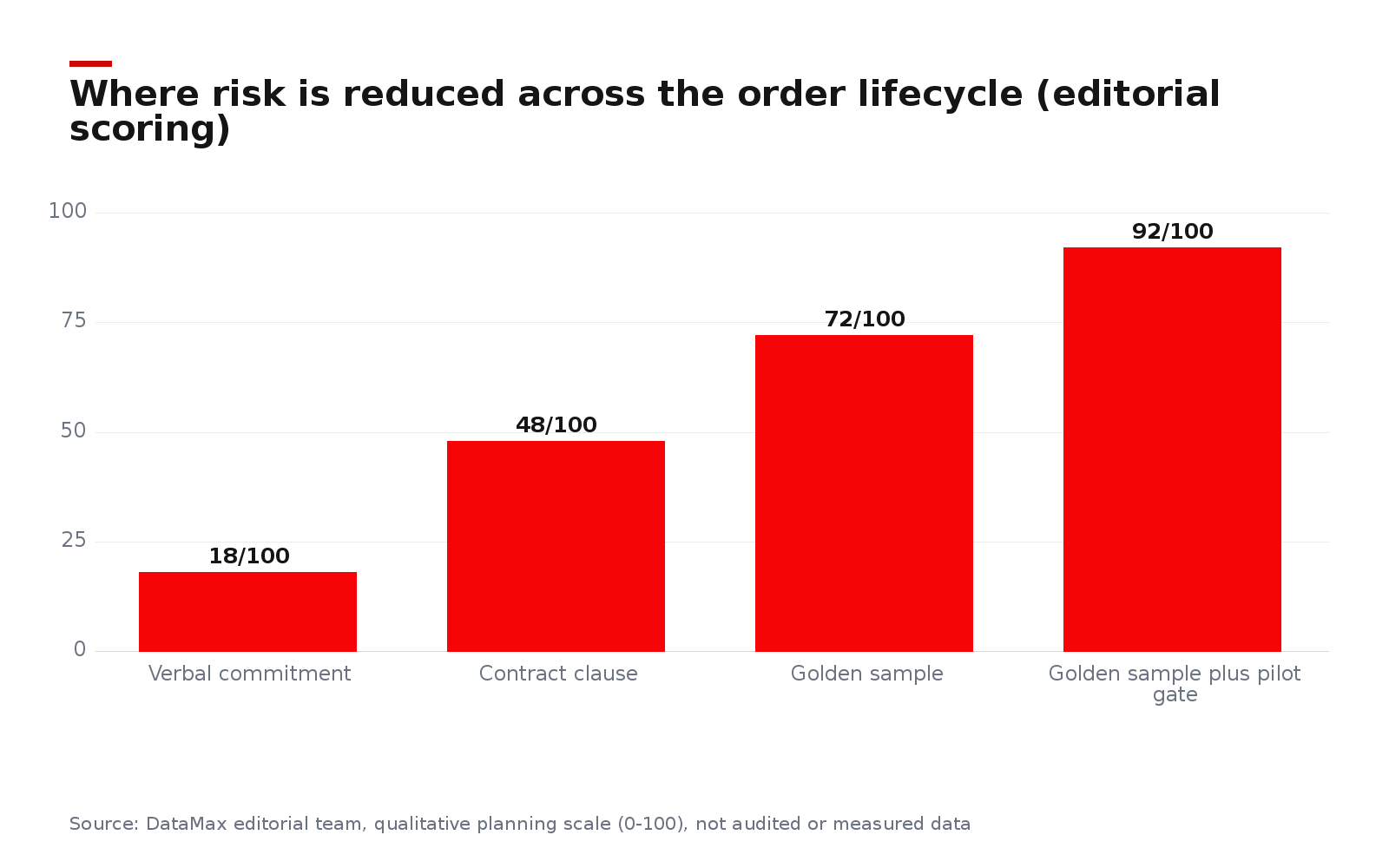
The same figures, in searchable form:
| Control mechanism | Editorial score |
|---|---|
| Verbal commitment | 18 |
| Contract clause | 48 |
| Golden sample | 72 |
| Golden sample plus pilot gate | 92 |
| Decision field | Low-control route | Controlled route |
|---|---|---|
| Dolby Vision statement | “Supported” without profile or test method | Profile, source, reference setup and repeatable test results |
| Golden sample | Optional visual demonstration | Serialized, photographed and frozen by firmware hash |
| Change control | Supplier discretion | Written approval for enumerated hardware and software changes |
| Pilot | Commercial sample only | Operator enrolment, live content, reboot and recovery gate |
| Shipment evidence | Generic production statement | Lot-linked records and defect disposition |
| DRM provisioning | DRM name without operator workflow | Licence path, device identity, enrolment and recovery test |
| Failure response | Case handled by return portal | Defined containment, analysis, replacement and corrective-action workflow |
| Regional variants | One model label across all packages | Separate software, packaging and acceptance records for each variant |
Entry tier is suitable for controlled evaluation or a non-critical channel. The commitment tier fits programs where firmware continuity, operator middleware, retail packaging or field failure has material operational impact. The incremental cost of controls should be compared with the cost of holding inventory, replacing firmware or recalling a batch, not merely with the unit price.
The contract-clause route adds enforceable expectations but remains weaker than a tested golden sample because legal wording cannot establish every configuration behavior. The golden-sample route binds a physical reference but still needs a pilot gate to expose operator enrolment, network dependency and recovery issues. The final route therefore combines documentary, physical and operational controls.
For a distributor with several retail territories, the controlled route should define one master hardware baseline and an explicit list of permitted software variants. Each variant should have its own package artwork, launcher or middleware version, service contract and test record. Otherwise, a compliant factory unit can become an incorrect retail configuration before it reaches the consumer.
How the requirement actually works
Dolby Vision is a display and content technology involving encoded video, metadata, display adaptation and compatible hardware throughout the chain. A source can carry Dolby Vision information, but the terminal must decode or pass the relevant signal, negotiate the display mode, process metadata and render the intended presentation. This is why decoder capability alone is insufficient evidence.
For this procurement category, the android tv box also has to integrate with the television ecosystem. AOSP Android 11 or Android 14 describes the software baseline supplied by DataMax, not automatic Google Play certification. The operator must separately assess applications, device management, licensing, middleware and service integration.
Separate 4 capability fields:
- Codec capability describes what the media engine can decode, such as AV1, H.265 or H.266/VVC.
- DRM capability describes the protected-content path, including Widevine L1 or PlayReady when listed.
- Display output describes the HDMI output interface and its stated capabilities.
- Dolby Vision implementation describes the complete source-to-display path supported by the model and controlled software.
Audio is a separate chain. Dolby Atmos and DTS may be listed alongside Dolby Vision, but audio codec support does not demonstrate Dolby Vision video support, and a Dolby Vision video path does not establish multichannel-audio output behavior.
HDMI 2.0b appears across the DataMax shortlist, so a buyer must not infer that every Dolby Vision profile, 4K refresh-rate combination or source format is enabled by that interface label. Likewise, H.265 or AV1 decoding does not guarantee application-level playback, DRM compatibility or display adaptation.
- Encoded video and rights state
- Application or broadcast delivery path
- Decoder capability
- Output negotiation and metadata path
- Matched high-bandwidth mode
- Reference viewing configuration
- Start, seek, channel change, reboot and recovery
- Serial-linked production record
If Dolby Vision is not explicit in a product’s controlled facts, the procurement position is “confirm against the production datasheet”. If it is explicit, still require the profile and test boundary. Engineering standards and implementation details are covered in the broader Dolby Atmos android tv box guide, which helps separate audio assumptions from video requirements.
The source format matters as much as the terminal label. A live IPTV path, transactional OTT application and locally stored file can use the same nominal codec but reach the media engine through different containers, demuxers, DRM modules and buffering systems. Acceptance should therefore identify both the business source and the technical stream properties, including frame rate, color format and metadata handling.
The application layer can impose further limits. A DRM-protected stream may start successfully but fail after a channel change, resume from standby or run through a cloud-gaming service. A white-label launcher may request an output mode that differs from a system player. Test the selected application and navigation path, not a synthetic file played from a developer menu.
The display negotiation is equally consequential. A capable source and terminal can still fail when the television, operating mode, firmware or cable does not expose the intended mode. A controlled acceptance procedure must document the display’s reported input state and the fallback used when a high-bandwidth mode is unavailable. That fallback should meet the service’s published experience rather than merely produce a picture.
The platform shortlist with datasheet values
The DataMax shortlist contains 4 platforms, but Dolby Vision availability is not uniform. The buyer should not infer that every listed decoder or DRM capability creates a Dolby Vision commitment. Use the exact model configuration and confirm the production implementation against the production datasheet.
| Model | Fit | SoC and processor | OS | RAM/ROM | DRM statement |
|---|---|---|---|---|---|
| DM21P | 4K IPTV / operator middleware set-top box | Amlogic S905Y4, quad Cortex-A35 | AOSP Android 11 | 2GB / 8GB (4GB; 16/32/64GB optional) | Widevine L1 / PlayReady / HDCP 2.2 optional |
| DM21S | 4K Android TV box for IPTV/OTT white-label | Amlogic S905Y5, quad Cortex-A55 | AOSP Android 14 | 2GB / 16GB (2/4/8GB; 16/32/64GB optional) | Widevine L1 / PlayReady optional; Dolby Vision/DTS |
| DM21T | Premium UHD / cloud-gaming box | Amlogic S905X5, quad Cortex-A510 (ARMv9) | AOSP Android 14 | 4GB / 64GB (family options) | Widevine L1 / PlayReady optional |
| DM22Q | Gaming-oriented Android TV box | Amlogic S905X5M, quad Cortex-A55 up to 2.5GHz | AOSP Android 14 | 4GB / 64GB (2/4/8GB; 16/32/64GB optional) | Widevine L1 / PlayReady optional; Dolby Vision/DTS |
| Model | Decode statement | Ports and connectivity |
|---|---|---|
| DM21P | AV1 [email protected], VP9/H.265 4K@60, H.264 4K@30 | HDMI 2.0b out x1, USB2.0 x2, TF, S/PDIF, 3.5mm AV, RJ45 100M, Wi-Fi6 2x2 + BT5.4, DC 5V/2A |
| DM21S | AV1 / H.265 [email protected] 4K@60 | HDMI 2.0b out, S/PDIF, AV, USB2.0 x2, TF, RJ45 100M (1G optional), Wi-Fi6 2x2 + BT5.4 |
| DM21T | H.266/VVC [email protected] 4K@120, AV1/VP9/H.265 4K@120, AVS3 4K@120, H.264 4K@60; inline AI-SR | HDMI 2.0b out (no HDMI in), USB2.0 x1 + USB3.0 x1, TF, S/PDIF, AV, RJ45 100M (1G opt), Wi-Fi6 + BT5.4 |
| DM22Q | AV1/H.265 L5.1 4K@60; inline AI-SR (no NPU TOPS stated) | HDMI 2.0b out, USB2.0 x2, TF, S/PDIF, AV, RJ45 100M (1G opt), Wi-Fi6 2x2 + BT5.4 |
DM21S and DM22Q carry the explicit Dolby Vision/DTS statement in the supplied DRM field. DM21P and DM21T do not, so Dolby Vision must be confirmed against the production datasheet rather than inferred from codec or SoC class. For DM21T and DM22Q, the supplied facts cap output and decode at 4K; no 8K output should be claimed.
DM21P remains the operator-middleware-oriented option in the supplied facts. DM21S targets IPTV/OTT white-label work and explicitly lists Dolby Vision/DTS. DM21T prioritizes premium UHD and cloud-gaming decode paths. DM22Q targets gaming-oriented deployment and also explicitly lists Dolby Vision/DTS.
For a Dolby Vision-led review, start with DM21S or DM22Q, then verify the actual profile, application, output mode and production evidence. Use the RFQ inquiry to request a written model-to-requirement mapping rather than relying on family-level statements.
The selection logic should remain requirement-led. If the priority is explicit Dolby Vision/DTS in the supplied facts, compare DM21S and DM22Q. If the priority is the stated operator-middleware fit, evaluate DM21P while obtaining separate confirmation of Dolby Vision. If the priority is the stated premium UHD or cloud-gaming fit, evaluate DM21T, again with Dolby Vision confirmed separately.
The distinction between standard and optional fields is material. “Widevine L1 / PlayReady optional” means the buyer must establish whether those options are present in the quoted order. “HDCP 2.2 optional” on DM21P requires the same clarification. Optional connectivity, such as 1G on listed RJ45 configurations, must be written as an ordered line rather than inferred from the family range.
A controlled DataMax RFQ should identify one proposed model and one exact configuration. It should not ask for a family-level comparison and then award a model whose stated memory or connectivity fields differ. If alternatives are permitted, the acceptance sheet should show how each option changes the Dolby Vision path, interface set, software baseline and required evidence.
Where this matters in a deployment
The same hardware becomes a different procurement object across operator, integrator and venue programs. The unit must fit the management plane, content source, display estate and failure-recovery process. A venue demonstration can conceal the population-management issues that dominate an operator rollout.
Rows of identical compact black Android TV boxes on warehouse shelving with neutral packaging, pallets and packing station in background, soft industrial light, photorealistic product journalism, no readable text, no brand logos.
| Situation | Primary requirement | Model direction | Procurement evidence |
|---|---|---|---|
| IPTV operator with managed middleware | Stable device image, operator integration and controlled updates | DM21P; confirm Dolby Vision against the production datasheet | Enrolment test, firmware baseline, update rollback and lot records |
| IPTV/OTT white-label program | Retail-ready software, explicit Dolby Vision/DTS statement and repeatable media behavior | DM21S | Dolby Vision profile, source, reference display and packaged-sample test |
| Premium UHD or cloud-gaming service | Advanced 4K decode path and defined output behavior | DM21T; confirm Dolby Vision against the production datasheet | Codec matrix, display negotiation, sustained playback and thermal evidence |
| Gaming-oriented consumer channel | 4K gaming-oriented platform with explicit Dolby Vision/DTS statement | DM22Q | Application path, input/display use case, Dolby Vision test and configuration freeze |
| Hotel, retail or hospitality integrator | Remote recovery, interface consistency and fleet replacement readiness | Select from the model whose controlled configuration matches the integration; confirm Dolby Vision per model | Provisioning, recovery, spare-unit and failure-disposition procedure |
For an operator rollout, the highest risk is a mismatch between device provisioning and the application entitlement path. For an AV integrator, it is uncontrolled display variation across rooms or venues. For a distributor, it is packaging or firmware divergence between regional batches. The relevant android tv box may be the same, but the acceptance test must follow the deployment model.
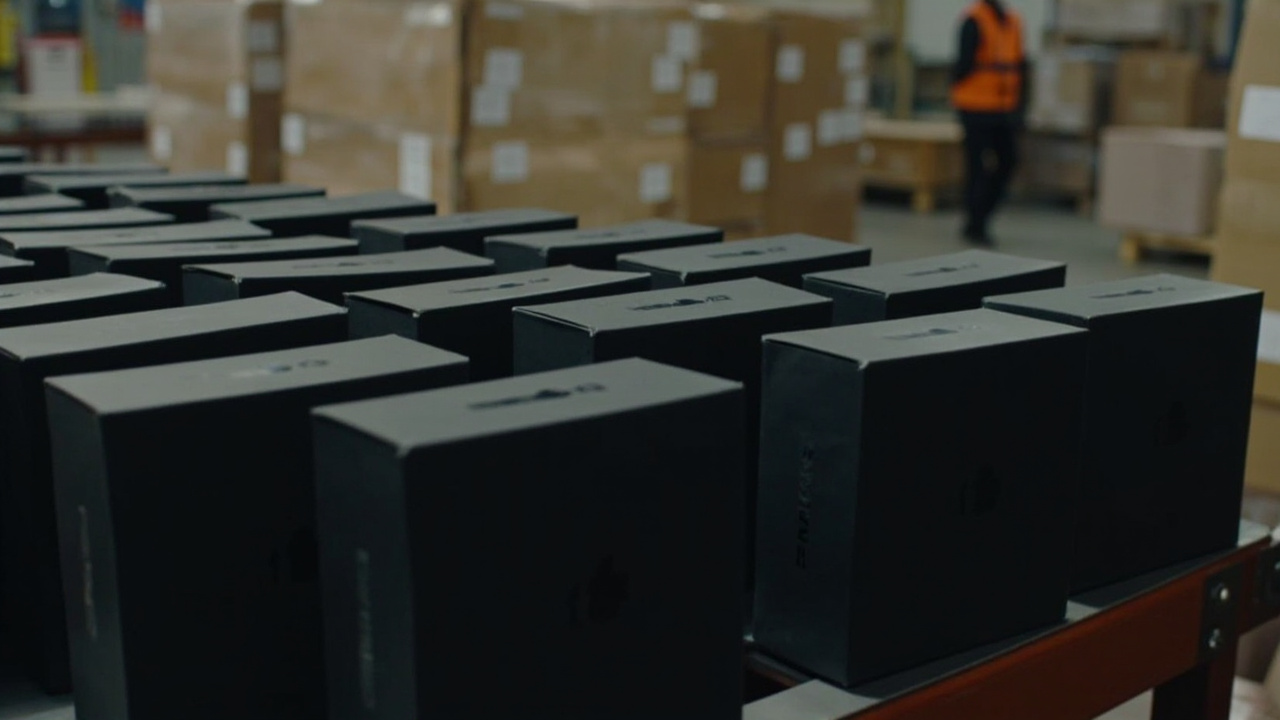
A field photograph of identical units is useful evidence only if it is connected to a record. Request packaging revision, serial or lot range, firmware identifier, operator configuration and inspection date. Otherwise, visual sameness proves little about Dolby Vision behavior.
In an operator network, the pilot should include at least 1 physical TV from each intended display class, a protected live or transactional source, an operator-provisioned identity, a channel-change sequence, a reboot and a standby recovery. The test should also record the access network because local playback, multicast IPTV and internet-delivered OTT can expose different buffering, DNS and licence-service dependencies.
For a hospitality integrator, the priority shifts from peak codec capability to consistency and recovery. The acceptance procedure should cover room display power-up, remote-control behavior, service launch, channel list, network reconnection and remote recovery. A spare-unit strategy should identify whether replacement units carry the same firmware and operator configuration.
For retail distribution, packaging and labelling require their own gate. The unit inside the carton must match the declared model, RAM/ROM option, connectivity option and region-specific software. The retailer should receive one traceable golden packaged sample, and production cartons should be checked against it. A Dolby Vision claim on external packaging without the corresponding model and configuration record adds marketing risk rather than evidence.
For a cloud-gaming or premium-UHD service, latency, sustained playback, thermal behavior and output negotiation may matter more than a simple launch test. The relevant android tv box therefore needs a longer pilot that includes repeated sessions, network variation and recovery from service interruption.
For buyer teams ready to progress, send the target profile, panel references, application list and proposed pilot configuration through DataMax contact. The HDR10+ android tv box guide provides a useful next comparison when the display requirement extends beyond Dolby Vision.
A procurement dashboard should track 4 states for every deployment: documentary qualification, sample qualification, pilot qualification and production-lot acceptance. Moving a model between states requires a named approver and the associated evidence. This prevents a display demonstration in a laboratory from being mistaken for a completed field qualification.
The deployment record should also include a negative-result log. Unsupported source combinations, unavailable display modes, failed DRM states or non-qualified applications should be visible to operators rather than discovered in the field. Defining those boundaries before shipment reduces ambiguity and gives support teams a controlled response when a customer’s TV, source or regional service differs from the approved configuration.
Further reading
- Guide android tv box for isps
- Rockchip Android TV boxes
- Edge computing boxes
- 4K 60fps Android TV box guide
- Rockchip Android TV box guide
- DataMax DM21P specifications and fit
- DataMax DM21S specifications and fit
FAQ
Does HDMI 2.0b prove Dolby Vision support?
No. It identifies the stated output interface, not the complete source-to-display implementation. A buyer still needs the supported profile, source format, display mode, firmware configuration and repeatable acceptance result. For DataMax models without an explicit Dolby Vision statement, confirm against the production datasheet.
Can a golden sample approve a production batch?
It can form part of the approval, but not by itself. The golden sample must be frozen by firmware and configuration, and the production-lot evidence must show that critical hardware and software remain controlled. A signed sample record, change-control clause and pilot gate provide stronger traceability.
Which DataMax models explicitly list Dolby Vision?
The supplied production facts explicitly list Dolby Vision/DTS for DM21S and DM22Q. DM21P and DM21T do not carry that statement in the provided facts. For either unstated model, confirm against the production datasheet rather than inferring support from codec capability.
Is an AOSP Android build automatically Google Play certified?
No. AOSP Android 11 or Android 14 identifies the stated software baseline. Device certification, application distribution, Google services, device management, DRM provisioning and operator middleware are separate qualification items. Include each one in the RFQ when required.
What should the first RFQ message contain?
Include the target Dolby Vision profile, source types, content applications, target display capabilities, deployment country, proposed device configuration, required test evidence, sample expectations and change-control requirements. This gives the supplier enough information to map the requirement to a specific model and software build.
How should procurement compare quoted display claims?
Require each bidder to use the same source content, reference display, HDMI path, firmware, procedure and result fields. Compare decode, DRM, output negotiation, metadata handling, application playback and recovery separately. A matching “4K” label alone does not establish equivalent behavior.




