
Before the terminology: the decision
If the campus housing project still requires DTS:X decoding in the installed-room audiovisual path, treat the android tv box as a legacy compatibility decision rather than a fresh 4K platform decision. Specify the exact codec profile, bitstream constraints, licensing path, display chain, and service-level evidence before comparing models. If the requirement is actually Dolby or DTS audio in rooms, separate that from video decoding and confirm which HDMI sink, AVR, or television must support the delivered signal.
Most readers evaluating a campus-housing refresh sit on the operator side: they manage rooms, student support, network access, and the replacement cycle rather than a dedicated consumer AV bench. Their immediate choice is whether to preserve a known DTS:X workflow, migrate the rooms to a supported Android TV ecosystem, or deploy a fixed-function IPTV terminal for the lowest operational surface area. The purchasing path is therefore:
For the broader platform decision, see the canonical android tv box for ISPs guidance. This article covers only the legacy DTS-X campus-housing angle. The short answer is to avoid accepting “DTS-X capable” as a sufficient RFQ line. Require a testable decoder clause, an explicit source and sink relationship, and evidence tied to the delivered configuration. DataMax’s current platform facts should be evaluated against that requirement; where a specific DTS-X implementation detail is absent, confirm it against the production datasheet rather than inferring compatibility from a chipset, operating system, or HDMI label.
Where quotations quietly diverge
A quotation can describe the decoder in the vendor’s reference media, while the project supplies an MP4 container with a DTS:X stream inside it. Container support, codec support, profile support, and level support are separate gates. “DTS:X” alone identifies no bit rate, resolution, frame rate, channel layout, or output pathway. The buyer must ask whether the box decodes the stream, passes it through, or merely advertises an associated DTS feature.
The first divergence is the role of the device. A streaming-only box must decode protected content before rendering it. A tuner or gateway may output a transport stream over IP, while the endpoint decodes the video and audio. A passthrough design must preserve the encoded DTS:X stream through HDMI, and the television or AVR becomes the decoder. These are not interchangeable acceptance tests.
Field trap
A supplier may quote “DTS-X” for the reference Android build while the campus proposal uses a different media pipeline, DRM wrapper, output mode, or room television. Define the exact test asset and end-to-end playback path. Cost of failure: a batch can pass an internal demo but fail in rooms where the student support team cannot diagnose codec, HDMI, or sink incompatibility.
The second divergence is terminology across component documents. HDMI 2.0b identifies an interface version, not guaranteed DTS:X passthrough. Android’s media framework does not by itself prove that an OEM configuration exposes the required decoder. A codec SDK statement does not prove that the licensed content can be decoded under the project’s rights. Conversely, a successful unit demo does not prove fleet consistency.
Field trap
Do not let “4K,” “Dolby Vision,” “DTS,” and “DTS:X” sit in one unstructured feature cell. Record whether each item is decode, pass-through, licensing, or display support. Cost of failure: a matrix can appear compliant while no responsible party owns the end-to-end test.
The third divergence is the legacy baseline itself. A project may preserve an old model name, UI, middleware, or remote-control behavior while requesting a new hardware revision. A procurement team can therefore compare apparent model families while actually comparing different software images. Require the quote to identify the exact hardware revision, Android image, middleware branch, build identifier, and test-report configuration. If those fields are not documented, confirm them against the production datasheet.
A fourth divergence appears when the project describes an “IPTV channel” without defining whether the content is delivered as multicast, unicast, a downloaded file, or an application package. The transport method changes the receiver, buffering, error recovery, and licensing sequence. A legacy DTS-X test performed from local storage does not prove that a network-delivered stream is decoded correctly after packet loss or reconnection. The acceptance procedure should name the delivery method, stream format, and recovery behavior.
A fifth divergence concerns content ownership. The media vendor may know which codec profile it encoded, while the residence operator owns the display, network, and support process. Procurement should identify which party supplies the acceptance asset, which party signs the room pilot, and which party owns a failed unit after installation. A quotation that names no acceptance owner leaves the legacy requirement commercially unenforceable.
Questions to put in the supplier review
A factory review should trace one production unit from component issue to the room acceptance test. The goal is not a generic “pass” statement; it is evidence that the same decoder configuration used for quotation is present in the shipped configuration.
- Freeze the acceptance asset Specify codec, profile, level, resolution, frame rate, container, audio layout, bit rate, duration, and whether the stream is encoded, passed through, or decoded by the box.
- Freeze the display chain Identify the internal distribution amplifier, HDMI switch, television, AVR, extractor, or encoder between the terminal and the room display. State the expected input and output formats.
- Trace production inspection Request SMT stencil and placement records, AOI or programmed-test results, serial traceability, and the firmware image identifier associated with the tested serial number.
- Run media and endurance tests Review decode or pass-through results, boot stability, network reconnection, thermal behavior, and repeated startup or aging results for the same image.
- Close the evidence chain Tie the certificate or report scope to the exact SoC, OS image, firmware, model, and intended output mode.
Evidence rule: ask for the report title, issuing body, model covered, report number, issue date, applicable standard or test method, result, and the pages showing the equipment configuration. A bare PDF screenshot does not establish scope. For broader manufacturing evidence, request a factory video audit focused on SMT/AOI, aging, and firmware-to-serial traceability for this project.
The quote should also name the fallback position if the legacy decoder cannot be guaranteed. A responsible answer may offer one of 3 routes: maintain the legacy-certified platform, replace the room sink with a model that explicitly supports the project’s required codec path, or remove DTS:X from the content workflow through an approved transcode or alternative distribution process. Route 1 preserves continuity but carries maintenance risk. Route 2 changes room hardware and testing. Route 3 may alter rights, latency, or quality and therefore cannot be assumed from the device alone.
For an android tv box refresh, request a sample-level test before fleet approval. The sample should run the stated middleware and image, connect through the proposed chain, and play the acceptance asset. Record elapsed startup, output mode, audio behavior, and recovery after network loss. Keep the room television and AVR model in the test record; replacing one of them can invalidate the result.
Ask the supplier to distinguish certification from qualification. Certification may establish that a defined product or process passed a named test. Qualification shows that the delivered campus configuration works with the supplied content, room devices, network, and operating procedure. A certificate for a generic Android build does not qualify the final room chain, and a successful pilot does not guarantee that every production unit carries the same image unless the serial and firmware records are linked.
The supplier should also state which variables it controls. Media configuration, Android image, middleware, remote control, network client, and room display compatibility may involve different suppliers. An ODM may control the hardware image and application integration but have no authority over the television vendor’s firmware. The quote must identify the boundary of responsibility so that an acceptance failure is routed to the party able to correct it.
A procurement example illustrates the distinction. If the requirement is legacy audio passthrough, request a bitstream capture at the box output and verify that the same encoded format reaches the AVR. If the requirement is local decode and analog or digital output conversion, request the decoded output format and channel layout instead. If DRM surrounds the stream, identify the license server, device binding, cache behavior, and renewal sequence. These are separate tests even when all 3 use the word “DTS:X.”
The comparison buyers actually make
Campus-housing buyers rarely compare one device against another in isolation. They compare the commercial consequences of 3 acquisition routes: a fixed-function IPTV endpoint, an Android TV set-top box with a preserved legacy media path, or a current Android TV platform after the room chain is modernized.
| Decision dimension | Fixed-function IPTV endpoint | Android TV box preserving legacy media path | Current Android TV platform |
|---|---|---|---|
| Primary operating objective | Controlled operator service with the narrowest application surface | Retain room workflow and app-based functions while preserving a defined codec route | Use a current OS and broader platform capabilities after validating the display chain |
| DTS:X issue to close | Confirm whether decoding occurs at the endpoint or in a downstream display | Prove the exact legacy decode or pass-through route in the delivered image and chain | Confirm any current codec requirement; do not assume legacy support from the class name |
| Evidence emphasis | Service workflow, channel recovery, remote control, and device management | Media test asset, sink interoperability, firmware control, and fleet repeatability | Android image provenance, application compatibility, update control, and room-chain testing |
| Operational trade-off | Less consumer-app flexibility, but fewer app-layer variables | Higher configuration complexity because codec and application behavior coexist | Current platform support, but possible incompatibility with legacy media or older displays |
| RFQ outcome | Use only if the operator workflow does not require Android TV functions | Use when continuity requires a documented legacy media path | Use when the migration scope includes replacing or updating unsupported room components |
The “commitment tier” is not automatically the premium model. For this angle, a current premium decoder does not establish DTS-X capability. The comparison must be made against the required behavior, the licensed content path, and the room display. A higher specification can still fail the legacy requirement if the decoder route or output configuration is absent.
Evidence quality also changes the decision. The following editorial scale ranks documents a buyer can request from weak assertion to independently discoverable certificate detail. It is a qualitative planning scale, not measured data or an audit result.
A supplier statement may be enough to open an RFQ, but it is not enough to close a legacy decoder requirement. The procurement file should connect the selected evidence to the production model and the acceptance asset.
A practical comparison should also include the consequences of changing the room chain. Retaining the television and AVR reduces installation work but may preserve an unsupported codec limitation. Replacing the sink can remove a passthrough barrier, yet it introduces model matching, cabling, firmware, and resident disruption. Transcoding at the origin removes the endpoint decoder burden, but it consumes processing, changes the stream, and may require rights review. These are operational costs, not merely technical checkboxes.
The Android route adds a policy layer. A campus may restrict sideloaded applications, require managed enrollment, or control updates centrally. A fixed-function terminal can be simpler to support, while an Android device needs an application update policy, remote-management workflow, and image ownership. Legacy compatibility is therefore not enough by itself; the buyer must decide who can change the software after deployment without invalidating the codec acceptance.
Definitions a buyer cannot outsource
Codec identifies a coding method. Profile defines constraints within that method, such as resolution, chroma format, bit depth, or coding tools. Level defines operational limits such as bit rate, macroblock rate, or sample rate. Container carries one or more encoded streams; it does not identify the codec inside. DRM controls access to protected content and can constrain which decoders may receive the clear stream. These distinctions determine the valid DTS-X test asset.
A pass-through terminal does not render DTS:X video; it carries the encoded signal to another decoder. A decode terminal receives the encoded stream, applies the decoder, and produces output for the display path. The buyer must select one architecture and write it into the specification. If both are required, specify the modes, priority, and fallback behavior.
The Android media path matters because the project is not merely a chipset. AOSP Android 11 and AOSP Android 14 identify operating-system baselines, while the production build still contains platform components, vendor drivers, middleware, and configuration choices. Confirm the MediaCodec implementation, output composition, DRM integration, and DTS licensing path in the exact image.
The room-side chain is equally specific. HDMI 2.0b describes the DataMax output interface on the listed platforms, but it does not establish whether a connected television or AVR accepts DTS:X passthrough. If the box decodes audio and sends PCM or another supported digital audio format, document that conversion. If the content remains encoded, verify the intermediate switch, distribution device, and display separately.
Finally, “legacy” should be converted into lifecycle language. Name the application or middleware that must continue, the room control system, the source interface, the audio receiver, the television, and the expected replacement interval. A requirement written as “same as old model” is not testable. A requirement written as a set of named interfaces and media behaviors can be sampled, accepted, and escalated.
The distinction between decode and pass-through has contractual consequences. Decode acceptance can normally be observed as rendered media at the endpoint, subject to the intended output format. Passthrough acceptance requires examination of the bitstream or an equivalent sink-side result because a television may display the picture while silently dropping the audio. If the room television and AVR are different devices, the procurement team should state which one owns audio rendering and which one is responsible for accepting the stream.
The service architecture also affects where errors can be observed. In a multicast design, an upstream headend may provide the common stream and the endpoint may recover local network loss. In a unicast application design, the application may manage playback, authentication, and retry behavior. A device-level decoder statement covers neither orchestration layer. Acceptance should therefore include at least 1 normal channel change, 1 stream interruption, and 1 recovery scenario using the intended delivery route.
Real DataMax platforms, field by field
The listed DataMax platforms provide the comparison set for an RFQ. They are not presented as confirmed DTS-X implementations: the supplied product facts do not state DTS-X decode or pass-through for these models. Any legacy codec commitment must be confirmed against the production datasheet and a model-specific media test.
| Model | SoC and OS | Memory | Decode and DRM facts | Ports and connectivity |
|---|---|---|---|---|
| DM21P | Amlogic S905Y4, quad Cortex-A35; AOSP Android 11 | 2GB / 8GB; 4GB; 16/32/64GB optional | AV1 [email protected], VP9/H.265 4K@60, H.264 4K@30; Widevine L1 / PlayReady / HDCP 2.2 optional | HDMI 2.0b out x1; USB2.0 x2; TF; S/PDIF; 3.5mm AV; RJ45 100M; Wi-Fi6 2x2 + BT5.4; DC 5V/2A |
| DM21S | Amlogic S905Y5, quad Cortex-A55; AOSP Android 14 | 2GB / 16GB; 2/4/8GB; 16/32/64GB optional | AV1 / H.265 [email protected] 4K@60; Widevine L1 / PlayReady optional; Dolby Vision/DTS | HDMI 2.0b out; S/PDIF; AV; USB2.0 x2; TF; RJ45 100M; 1G optional; Wi-Fi6 2x2 + BT5.4 |
| DM21T | Amlogic S905X5, quad Cortex-A510 (ARMv9); AOSP Android 14 | 4GB / 64GB; family options | H.266/VVC [email protected] 4K@120; AV1/VP9/H.265 4K@120; AVS3 4K@120; H.264 4K@60; inline AI-SR; Widevine L1 / PlayReady optional | HDMI 2.0b out, no HDMI in; USB2.0 x1 + USB3.0 x1; TF; S/PDIF; AV; RJ45 100M; 1G opt; Wi-Fi6 + BT5.4 |
| DM22Q | Amlogic S905X5M, quad Cortex-A55 up to 2.5GHz; AOSP Android 14 | 4GB / 64GB; 2/4/8GB; 16/32/64GB optional | AV1/H.265 L5.1 4K@60; inline AI-SR, no NPU TOPS stated; Widevine L1 / PlayReady optional; Dolby Vision/DTS | HDMI 2.0b out; USB2.0 x2; TF; S/PDIF; AV; RJ45 100M; 1G opt; Wi-Fi6 2x2 + BT5.4 |
The platform selection should follow the requirement rather than the suffix. DM21P is positioned for 4K IPTV and operator middleware set-top-box work, with AOSP Android 11. DM21S targets 4K Android TV box programs for IPTV/OTT white-label work on AOSP Android 14. DM21T is positioned for premium UHD and cloud-gaming box use, while DM22Q is positioned for gaming-oriented Android TV box use. These fit statements guide the RFQ conversation; they do not establish DTS-X behavior.
Confirm the selected production configuration against the production datasheet before ordering. Request an android tv box sample and provide the acceptance asset, room chain, proposed middleware, and output mode in the first message so the sample is configured for the relevant test rather than a generic feature demonstration.
The model table should be read as a fact boundary rather than a ranking. DM21P and DM21S carry distinct SoCs and Android baselines, so their software images, media integrations, and update paths require separate qualification. DM21T and DM22Q list decode capabilities for their respective production facts, but neither supplied fact establishes DTS:X. The phrase “Dolby Vision/DTS” on DM21S and DM22Q must not be rewritten as “DTS:X.”
Connectivity also affects the pilot. A room deployment limited to 100M RJ45 may need a different network acceptance procedure from one using the optional 1G configuration. Wi-Fi6 2x2 and BT5.4 availability does not establish the in-building radio survey or the preferred room connection. The buyer should specify whether the deployment depends on wired Ethernet, wireless access, or a fallback path and require each proposed configuration to be tested.
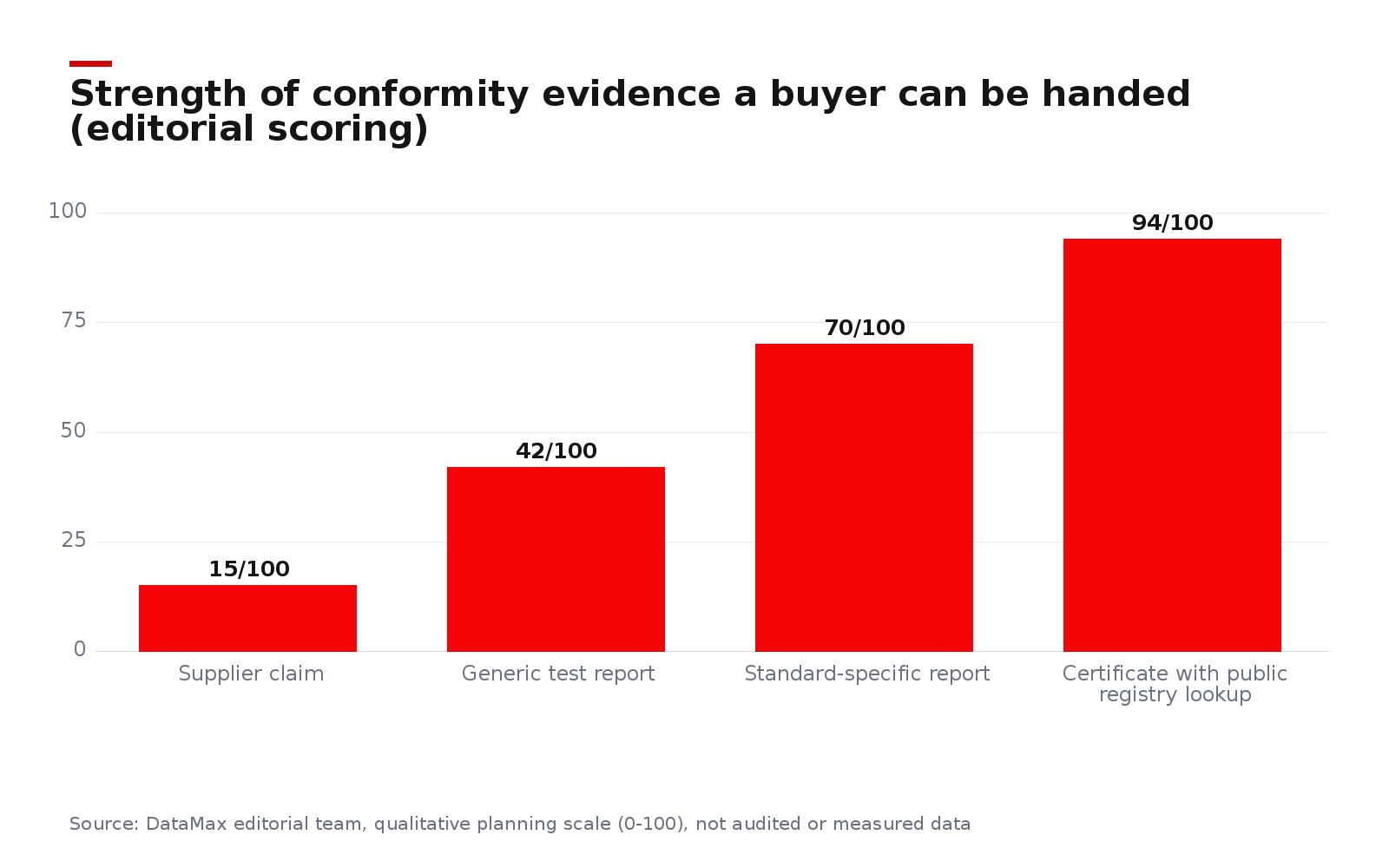
The same figures, in searchable form:
| Evidence option | Editorial score |
|---|---|
| Supplier claim | 15/100 |
| Generic test report | 42/100 |
| Standard-specific report | 70/100 |
| Certificate with public registry lookup | 94/100 |
Buyer situations, ranked by what they punish
Different operators and integrators fail in different ways. A pay-TV operator is likely to punish service interruption and inconsistent firmware behavior. A campus IT team is likely to punish network instability, unsupported room control, and support complexity. A residential AV integrator is likely to punish an ambiguous codec or HDMI path because troubleshooting occurs at the television or AVR.
| Situation | Primary requirement | Model direction | Acceptance focus |
|---|---|---|---|
| Operator-managed IPTV rooms | Stable middleware, channel continuity, remote management | DM21P direction; validate exact image and legacy codec requirement | Channel recovery, reboot behavior, room-control workflow, and serial-level firmware traceability |
| OTT white-label deployment | Current Android baseline and branded application experience | DM21S direction; confirm codec path separately | App launch, authentication flow, network reconnection, and UI behavior on the specified television |
| Premium UHD room refresh | High-resolution video output and room-media flexibility | DM21T direction; confirm DTS-X status in production configuration | 4K output, display compatibility, audio routing, and the legacy acceptance asset |
| Gaming-oriented common-area or residential room | 4K gaming-oriented platform and connectivity | DM22Q direction; do not infer DTS-X from Dolby Vision/DTS notation | Input latency where relevant, output stability, network recovery, and display modes |
| AV integrator-managed refresh | Named sink chain and explicit codec responsibility | Choose by verified chain fit rather than model class | End-to-end media playback across the switch, AVR, television, and audio extractor |
The field scene matters because a bench test can conceal room-level faults. The photograph should show the controlled environment used to reproduce the issue.
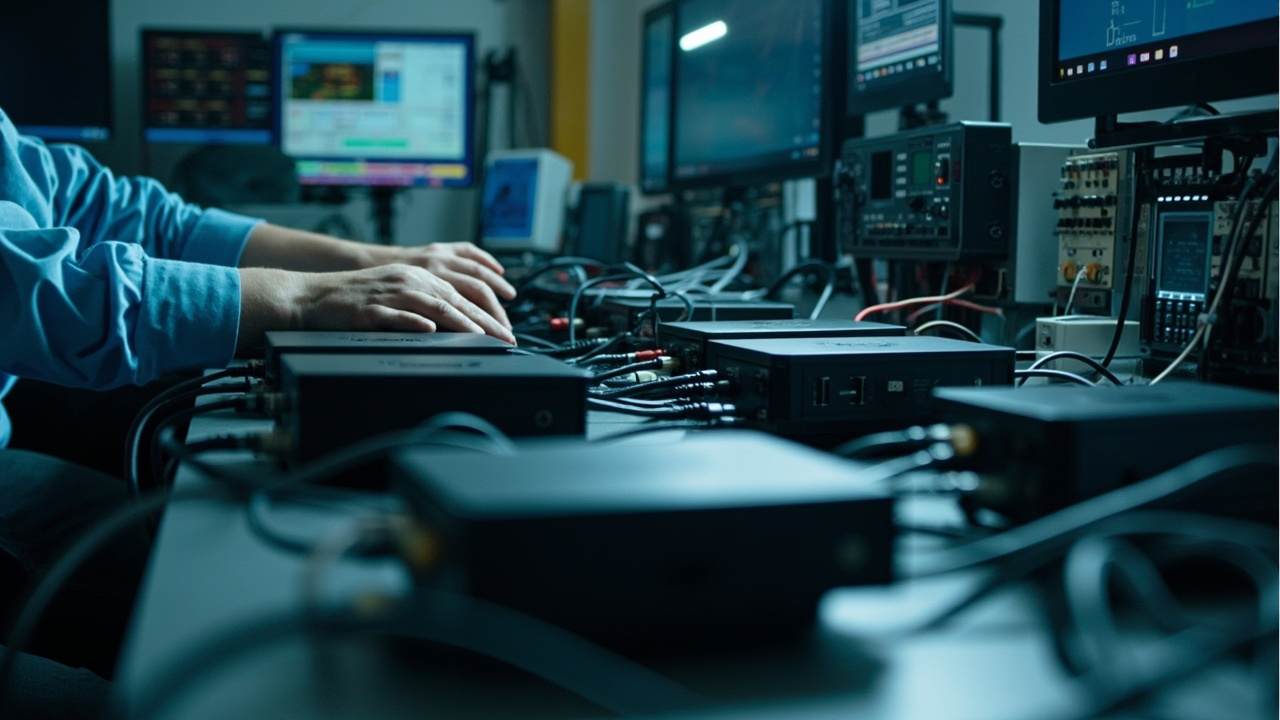
In a real campus lab, engineers need the complete chain visible: source, terminal, network, HDMI path, display, and measurement equipment. If an integrator reproduces the failure, request photographs and logs from the same topology. One unit connected directly to a television may pass while a distribution amplifier or capture card rejects the format.
The ranking principle is simple: first identify which failure creates the highest operational cost. Frequent room reboots favor firmware and thermal control. Intermittent audio favors sink and format validation. App failures favor Android image and middleware validation. Codec failures require a controlled asset and a documented decode or pass-through architecture. Procurement evidence should be weighted against that failure, not against a generic feature score.
An operator-managed residence has a different priority from a common-area gaming room. In the residence, the operator may favor predictable recovery and centralized imaging because support is distributed across many rooms. In a common area, an integrator may favor display modes, HDMI behavior, and an application experience that survives frequent visitors changing inputs. In both cases, the model suffix is less informative than the acceptance procedure.
A student-support organization adds another constraint: the failure indication must be diagnosable without opening the device. A visible network state, a stable error screen, a recoverable sign-out path, and a documented serial lookup can prevent a minor media issue from becoming a technician visit. These operational requirements should be added to the RFQ even when the codec test passes.
A decision path for the RFQ
The RFQ should force each party to name a responsibility. Start with the requirement, then select the platform, then lock evidence and acceptance. Do not begin with a model number.
- Define the legacy behavior State “DTS:X decode,” “DTS:X passthrough,” or a different requirement, followed by the exact test asset and room chain.
- Choose the operational tier Decide between a controlled IPTV endpoint, an Android TV box with a validated legacy path, and a current platform migration that includes any necessary sink changes.
- Shortlist against the facts Use DM21P, DM21S, DM21T, or DM22Q only where its published fit, OS, memory, decode, DRM, and connectivity match the written requirement; confirm all production details against the production datasheet.
- Attach evidence Require model-specific media results, configuration records, and traceability from test unit to production image.
- Approve a sample and pilot Test in representative rooms, including restart, network loss, neighboring-channel interference where applicable, and sink reconnection.
- Freeze the order configuration Attach the accepted sample serial, model revision, firmware, middleware, room-equipment list, test asset, and acceptance record to the purchase order.
A usable RFQ line reads: “Confirm whether the proposed DM21S production configuration decodes or passes through the supplied DTS:X acceptance asset on the specified HDMI chain; identify the codec profile, level, output mode, licensing dependencies, and reportable test evidence.” Replace the model only after the requirement and evidence clauses are written.
For this topic, the first inquiry message should contain the target DataMax model, deployment count and room count, legacy codec requirement, acceptance-asset specification, proposed television and AVR models, middleware or application version, network topology, and required evidence. Send that RFQ detail so the response addresses the real configuration rather than repeating generic platform features.
If the factory document set is incomplete, request a video audit or targeted SMT/AOI, aging, and firmware-traceability evidence through DataMax manufacturing. The RFQ is ready to issue when each requirement has an owner, each model fact has a source, and each acceptance condition has a named test. For the wider ISP selection framework, return to the canonical android tv box for ISPs guide.
A second RFQ line should assign the end-to-end path: “Supplier demonstrates decode or passthrough from the supplied source through the named HDMI switch, AVR or extractor, and television; buyer records the output mode, audio behavior, startup result, and recovery after network interruption.” This wording prevents a direct bench connection from being mistaken for room acceptance.
The order should freeze revision control as well as hardware. Attach the accepted Android build, middleware version, application version, codec configuration, remote-control mapping, and any display preset. If a later unit has a different build or a replacement display appears in inventory, it should enter the same acceptance gate. The selected android tv box is therefore a configuration record, not merely a box code.
Further reading
- Guide android tv box for isps
- Rockchip Android TV box guide
- Dolby Vision Android TV box guide
- RFQ checklist for device procurement
- Android TV boxes
- DataMax DM21P specifications and fit
- DataMax DM21S specifications and fit
FAQ
Does HDMI 2.0b prove DTS-X support?
No. HDMI 2.0b describes the interface version; it does not establish DTS-X decoding or passthrough. The RFQ must identify whether the box decodes the stream or carries it to a compatible sink. Require the exact production configuration, room chain, acceptance asset, and model-specific evidence. The listed DataMax models specify HDMI 2.0b output, but DTS-X behavior is not stated in their supplied facts.
Can a DataMax model be selected from the legacy model name alone?
No. A legacy model name may conceal a different SoC, Android image, middleware branch, firmware, and output configuration. Write the required decode or passthrough behavior into the specification, then compare candidate models against their production datasheets. For an android tv box program, ask for a sample tested with the proposed room television, AVR, switch, and media asset before fleet approval.
What should a DTS-X acceptance asset contain?
It should state the codec profile and level, resolution, frame rate, bit rate, container, audio channel layout, duration, and DRM state. It should also identify whether the content must be decoded, passed through, or converted. Play the same file through the proposed box and room chain, then record output mode, startup, stability, and recovery. A supplier demo without the named asset is not a repeatable acceptance test.
Does a “Dolby Vision/DTS” statement satisfy a DTS-X requirement?
No. Dolby Vision is a video system, while DTS and DTS:X identify different audio propositions. Even a DTS statement does not establish DTS-X profile support, decode mode, or passthrough. Require a separate, testable clause for the required audio route. The supplied DM21S and DM22Q facts include “Dolby Vision/DTS”; confirm any DTS-X requirement separately against the production datasheet.
Which DataMax model is the natural starting point for an operator program?
DM21P is positioned for 4K IPTV and operator middleware set-top-box work, while DM21S is positioned for 4K Android TV box programs for IPTV/OTT white-label work. That positioning does not settle a DTS-X requirement. Compare the exact OS image, memory, decode, DRM, connectivity, middleware, and room-chain evidence. Use the model fit only after the legacy behavior has been defined.
Can a successful direct-to-television sample replace a room pilot?
No. A direct connection can hide problems introduced by an HDMI switch, distribution amplifier, AVR, extractor, or encoder. It can also miss network recovery behavior that occurs only when content is delivered by the intended service. Run the pilot through the same device topology and representative operating modes planned for deployment. Record any substitutions, because changing the television, AVR, firmware, or network path can invalidate the earlier result.




