
What the answer hinges on
If the service must receive a physical DVB-C broadcast, specify a tuner and DVB-C front end in the set-top box. If the service is delivered over IP through an operator app, middleware, or OTT platform, specify an Android TV platform and validate the application, DRM, decoder, and network requirements together. Most readers evaluating an android tv box comparison are deciding between two signal paths, not between two cosmetic versions of the same product.
The DVB-C path terminates at a tuner, demodulator, transport-stream demultiplexer, video decoder, and display output. Its procurement risk concentrates in RF tuning, channel-plan configuration, conditional access, regional broadcast standards, and stability during signal loss. The Android path terminates at an application, DRM service, codec pipeline, and display output. Its risk concentrates on Android compatibility, application certification, content-security policy, account provisioning, network quality, and update control.
That fork determines which specification lines belong in the PO. A broadband-only project should not buy a DVB-C reference design merely because it looks like a set-top box. A broadcast-dependent project should not assume that an Android TV box with an RJ45 port can replace a DVB-C receiver. The relevant decision is whether the tuner and broadcast stack are mandatory or whether delivery is entirely over IP.
The DataMax platforms shortlisted here are Android-based IPTV/OTT boxes. They do not replace a specified DVB-C tuner path without engineering approval. For the broader purchasing framework, see the canonical guide to Android TV boxes for sale explained for buyers. This comparison remains focused on the ownership decision: identify the signal boundary, then verify the complete playback and manufacturing chain rather than comparing labels alone.
What goes wrong after the PO
The first common failure is treating “IPTV,” “OTT,” and “DVB-C” as interchangeable labels. IPTV can mean managed multicast delivery, internet-delivered video, or operator middleware hosted on a specific device. A DVB-C product adds RF reception to an IP-capable device; it does not remove the need to specify RF, demodulation, transport-stream handling, conditional access, and channel behavior.
A second failure is specifying output resolution or codec labels without a complete end-to-end constraint. For example, a decoder advertised for 4K@60 does not by itself guarantee 4K service delivery. The source profile, container, DRM, HDMI mode, display, HDCP path, application decoder selection, and playback pipeline must all align. A test conducted with one local file is not equivalent to an operator service test with account issuance, network jitter, and a protected-content session.
Field trap
A quotation that lists “4K,” “Dolby Vision,” “Widevine L1,” and “Android” without a fixed ROM/RAM configuration, DRM option state, port map, OS release, and firmware-update responsibility can change materially after purchase order approval.
Costly divergence also appears in accessories and deployment dependencies. A model with 100M Ethernet may be adequate for one channel, but the quotation should not treat that as proof of multi-stream performance. If an optional 1G Ethernet is required, it must be a configured line item rather than an assumption. Likewise, HDMI 2.0b output does not create an HDMI input path, and a TF slot does not identify the supported filesystem or card-generation requirement.
The third failure is accepting a mixed software evidence pack. A chipset vendor’s codec claim, an operator’s APK test result, a security review of the production image, and a factory aging report may describe different builds. Ask for the exact base SKU, ROM/RAM tier, firmware revision, application package, region, and test configuration connected to each report. For an operator rollout, also identify whether the unit is enrolled through an Android Management API, operator middleware, or local configuration.
Field trap
Do not infer DVB-C reception from a television-shaped enclosure, an Android TV operating system, an S/PDIF output, or an RJ45 connector. Each addresses a different function.
A fourth failure occurs when procurement treats a successful pilot as evidence of fleet stability. A pilot may use one network segment, one display, one account model, and one application version. Fleet acceptance should add power cycling, sustained playback, thermal behavior, account recovery, update rollback, and randomized unit traceability. For a DVB-C design, add RF level sweeps, weak-signal behavior, neighboring-channel rejection, channel rescan after power loss, and transport-stream error recovery to the test plan.
The fifth failure is a scope mismatch between the test sample and the production order. A sample configured with 1G Ethernet, 4GB RAM, or a specific ROM tier cannot validate a later order with 100M Ethernet, 2GB RAM, and a different ROM tier without a configuration delta review. The sample label, quotation, purchase order, factory test record, and shipped carton should reconcile to the same revision.
This is where an android tv box comparison becomes commercially consequential. A low quotation may conceal unpriced tuner integration, failed protected-content certification, operator middleware changes, or factory evidence that applies to another model. The cost of correcting those gaps appears in tooling delays, certification rework, delayed field deployment, and replacement inventory rather than on the original unit-price line.
Verification you can ask for on paper
A defensible verification chain links design evidence to the units that will ship. It is not enough to receive an ISO certificate and a factory presentation. The evidence should identify the factory, production line, firmware build, hardware revision, test method, acceptance rule, and record location. The document owner and revision date matter because a superseded report cannot prove the state of the next production lot.
- Define the frozen configuration Record model, SoC, RAM/ROM, OS release, decoder profile, DRM state, ports, region, and firmware-update policy on the PO and inspection record.
- Review SMT and AOI evidence Ask for inspection coverage, defect classes, sampling method, equipment identifiers, and records for the production batch or representative build.
- Review aging and dark-room records Confirm the burn-in duration, loaded channels or applications, thermal conditions, restart cycles, and disposition of failed units.
- Validate the deployed application Tie an APK, middleware version, DRM flow, account, network profile, and display target to the tested configuration.
- Audit traceability Reconcile the carton label, serial number, hardware revision, firmware image, inspection record, and packing list to one production evidence chain.
Request a redacted evidence index rather than only selected screenshots: document owner, revision date, production lot, equipment identifier, sample size, pass criterion, and storage or access procedure. The index should show which evidence applies to the ordered SKU.
For DVB-C additions, the verification pack must extend beyond generic Android-box checks. It should cover the specified tuner and demodulator, channel scan behavior, transport-stream continuity, signal-loss recovery, electronic-program-guide data, conditional-access integration, and regional channel-plan configuration. The receiver must be tested against the actual operator head end or an approved test environment.
For the Android path, require evidence of boot into the production image, application installation, DRM license acquisition, secure playback output, network association, OTA rollback where applicable, and recovery after application or service interruption. A laboratory report using a different image does not close this requirement. Specify whether the factory or the operator owns the signing key, whether the test account is live, and whether the displayed frame rate is measured at the service source or inferred from a codec profile.
A procurement example is a hotel rollout requiring 4K channel acceptance on each room display. The acceptance sheet should name the display model, EDID mode, HDMI mode, application build, account type, service profile, bitrate, startup time, reconnection behavior, and pass criterion for continuous playback. A second sheet should cover the factory line: serial-number range, image identifier, SMT/AOI record, dark-room sample, aging duration, failed-unit segregation, and packing reconciliation. Those two sheets prevent a successful showcase unit from becoming the sole acceptance basis.
For an operator-managed fleet, add an enrollment test. The device should appear once in the management console, receive the intended policy and application, retain that identity after a factory reset, and return its diagnostic state without exposing another subscriber’s account data. If management is not required, remove that line from the RFQ rather than implying a capability from Android alone.
The factory can support a technical review through DataMax factory quality. Invite the supplier to present a video factory audit or provide SMT/AOI, aging, and dark-room evidence tied to the DVB-C-versus-Android decision. A credible response will separate process capability from model-specific certification.
Entry tier versus commitment tier
The comparison should separate “device selection” from “program commitment.” Entry-tier hardware can serve a controlled pilot where the operator already owns the application, DRM account, middleware, and display environment. Commitment-tier hardware is justified when the supplier must guarantee a broader integration, stable lifecycle, certified application delivery, or repeatable fleet provisioning. The tier describes the depth of contractual control, not merely the processor or display capability.
| Decision area | Entry tier: controlled pilot | Commitment tier: fleet program |
|---|---|---|
| Signal path | Existing IP application and known network | Locked DVB-C or IP architecture with operator acceptance |
| Configuration | Acceptable SKU change during validation | Fixed RAM/ROM, SoC, OS, ports, and firmware baseline |
| Software | Supplier installation and manual retest | Signed image, release process, update ownership, rollback criteria |
| DRM and content | One known service and display chain | Service matrix covering license, codec, output, and account paths |
| Quality evidence | Representative unit report | Batch traceability, audit access, and exception governance |
A DVB-C requirement increases commitment because the tuner and broadcast chain introduce hardware-specific validation. The Android path may appear simpler because the application runs on a general operating system, yet it moves risk into signing, account management, device policy, OTA, and middleware integration. Neither path automatically has lower lifecycle risk. The practical difference is that DVB-C defects often emerge at the RF, channel-plan, and CA boundaries, while Android defects often emerge at the application, account, DRM, and update boundaries.
Do not confuse a low bill of materials with a low integration burden. For example, an IP-only pilot with a known OTT application may start with a 2GB/16GB platform and a controlled account population. A regional fleet can require the same application but add device enrollment, persistent identity, recovery after service interruption, and update rollback. That is a commitment-tier software requirement even if the hardware SKU does not change.
Do not confuse the physical enclosure with the decode path either. An AV output, S/PDIF output, and HDMI output can support different display and audio arrangements, but none establishes RF reception. Conversely, adding a tuner does not automatically create Android-based channel navigation, EPG synchronization, CA integration, or secure IP playback. The quotation should state which architecture owns each function.
An entry-tier decision should include a named stop condition. For example, “proceed with pilot hardware only after the production application completes 2 hours of protected 4K playback, network reconnection, and cold-start recovery on the target display.” A commitment-tier decision should state the recurring control: signed image, fixed firmware revision, serialized records, change notification, and rejection of unapproved substitutions.
This android tv box comparison should also distinguish platform suitability from operational maturity. A newer Android release creates migration work; it does not automatically provide a stable operator image. Conversely, an established image may be operationally preferable if its middleware, update mechanism, and application certification remain supported. The PO should capture that operational state, not only the release number.
The right tier is the one whose unresolved interfaces your engineering team can own. The DataMax team can help convert the shortlist into fixed RFQ lines through an inquiry; the first message should contain the signal path, required RAM/ROM, OS release, decoder and DRM requirements, target ports, deployment quantity, and verification evidence required. Include the display model and expected service profile so the supplier can distinguish an application test from a full service-chain test.
How the requirement actually works
A DVB-C receiver converts a physical broadcast carrier into a transport stream. The tuner selects an RF channel, the demodulator recovers transport-stream symbols, and the demultiplexer separates elementary streams. Conditional access may control access to encrypted services. The decoder then renders video and audio for the TV or downstream display path. The channel list and service behavior are not automatically interchangeable with an IP application catalogue.
The Android TV path starts with network-delivered content. A service may use managed IPTV multicast, unicast HTTP-based delivery, an operator middleware application, or a consumer OTT application. Android provides the runtime and platform services; the application selects content, negotiates DRM, invokes decoders, and presents frames and audio. Widevine L1 concerns protected-content security in the specified device implementation, while PlayReady identifies a separate Microsoft DRM path. HDCP 2.2 applies to the protected display interface when enabled and negotiated.
These paths can coexist. An Android-based set-top box can include a DVB-C tuner, but the architecture must specify how channels enter the application, how EPG data is synchronized with operator services, how DRM or CA applies, and how the UI identifies services. Two independent decoders may be required for picture-in-picture or service recording, but the exact implementation and available silicon resources must be confirmed against the production datasheet.
For a 4K program, specify the complete chain. AV1 MP-10, VP9, H.265, and H.264 profiles may appear in product facts, but each requires a matching service profile and display path. Dolby Vision and DTS claims also require service, application, firmware, and output compatibility. The product name alone is not a technical acceptance criterion. A practical service matrix should list each channel, codec, resolution, frame rate, bitrate, audio format, DRM system, HDCP state, application, and test result.
The Android side also needs operating constraints. AOSP Android 11 and AOSP Android 14 identify the platform line, but the buyer must establish application compatibility, update ownership, device enrollment, secure boot expectations, and regional software support. If the operator intends to distribute its own middleware, APK signing, permissions, background execution, recovery, and upgrade behavior require separate acceptance criteria. A generic application launch is not sufficient.
The DVB-C side needs signal constraints. Specify the input frequency range, channel bandwidth, modulation profile, signal level range, channel plan, CA arrangement, EPG source, and recovery behavior. If both DVB-C and IP are required, define whether one decoder session is shared, whether separate outputs are needed, and whether switching latency is part of acceptance. Those engineering questions should be resolved before comparing chassis or Android releases.
A shared architecture needs an ownership diagram. Identify which subsystem opens the content source, which component performs conditional access or DRM, which component owns the EPG, where entitlement data resides, and which firmware release is tested. If service switching must preserve a single account session, that behavior belongs in the application acceptance test rather than being inferred from the hardware decoder list.
This is why an android tv box comparison is useful only when the signal path appears in every row. Codec lists without service delivery, port lists without physical layout, and “Android” labels without a release and update policy produce a comparison on paper but not a deployable specification.
The platform shortlist with datasheet values
The four platforms below cover distinct Android TV roles. They should be selected against application, output, connectivity, and lifecycle requirements rather than by chipset generation alone. Every listed value below comes from the supplied DataMax product facts; other configurations require confirmation against the production datasheet and the PO. The shortlist addresses Android-based IPTV/OTT use cases, not an implied DVB-C receiver qualification.
| Model | SoC and OS | RAM / ROM | Decode and DRM | Interfaces |
|---|---|---|---|---|
| DM21P | Amlogic S905Y4, quad Cortex-A35; AOSP Android 11 | 2GB / 8GB; 4GB and 16/32/64GB optional | AV1 [email protected]; VP9/H.265 4K@60; H.264 4K@30; Widevine L1 / PlayReady / HDCP 2.2 optional | HDMI 2.0b out x1; USB2.0 x2; TF; S/PDIF; 3.5mm AV; RJ45 100M; Wi-Fi6 2x2 + BT5.4; DC 5V/2A |
| DM21S | Amlogic S905Y5, quad Cortex-A55; AOSP Android 14 | 2GB / 16GB; 2/4/8GB and 16/32/64GB optional | AV1 / H.265 [email protected] 4K@60; Widevine L1 / PlayReady optional; Dolby Vision/DTS | HDMI 2.0b out; S/PDIF; AV; USB2.0 x2; TF; RJ45 100M, 1G optional; Wi-Fi6 2x2 + BT5.4 |
| DM21T | Amlogic S905X5, quad Cortex-A510 (ARMv9); AOSP Android 14 | 4GB / 64GB; family options | H.266/VVC [email protected] 4K@120; AV1/VP9/H.265 4K@120; AVS3 4K@120; H.264 4K@60; inline AI-SR; Widevine L1 / PlayReady optional | HDMI 2.0b out, no HDMI in; USB2.0 x1 + USB3.0 x1; TF; S/PDIF; AV; RJ45 100M, 1G optional; Wi-Fi6 + BT5.4 |
| DM22Q | Amlogic S905X5M, quad Cortex-A55 up to 2.5GHz; AOSP Android 14 | 4GB / 64GB; 2/4/8GB and 16/32/64GB optional | AV1/H.265 L5.1 4K@60; inline AI-SR; Widevine L1 / PlayReady optional; Dolby Vision/DTS | HDMI 2.0b out; USB2.0 x2; TF; S/PDIF; AV; RJ45 100M, 1G optional; Wi-Fi6 2x2 + BT5.4 |
The base RAM split defines a useful first procurement filter.
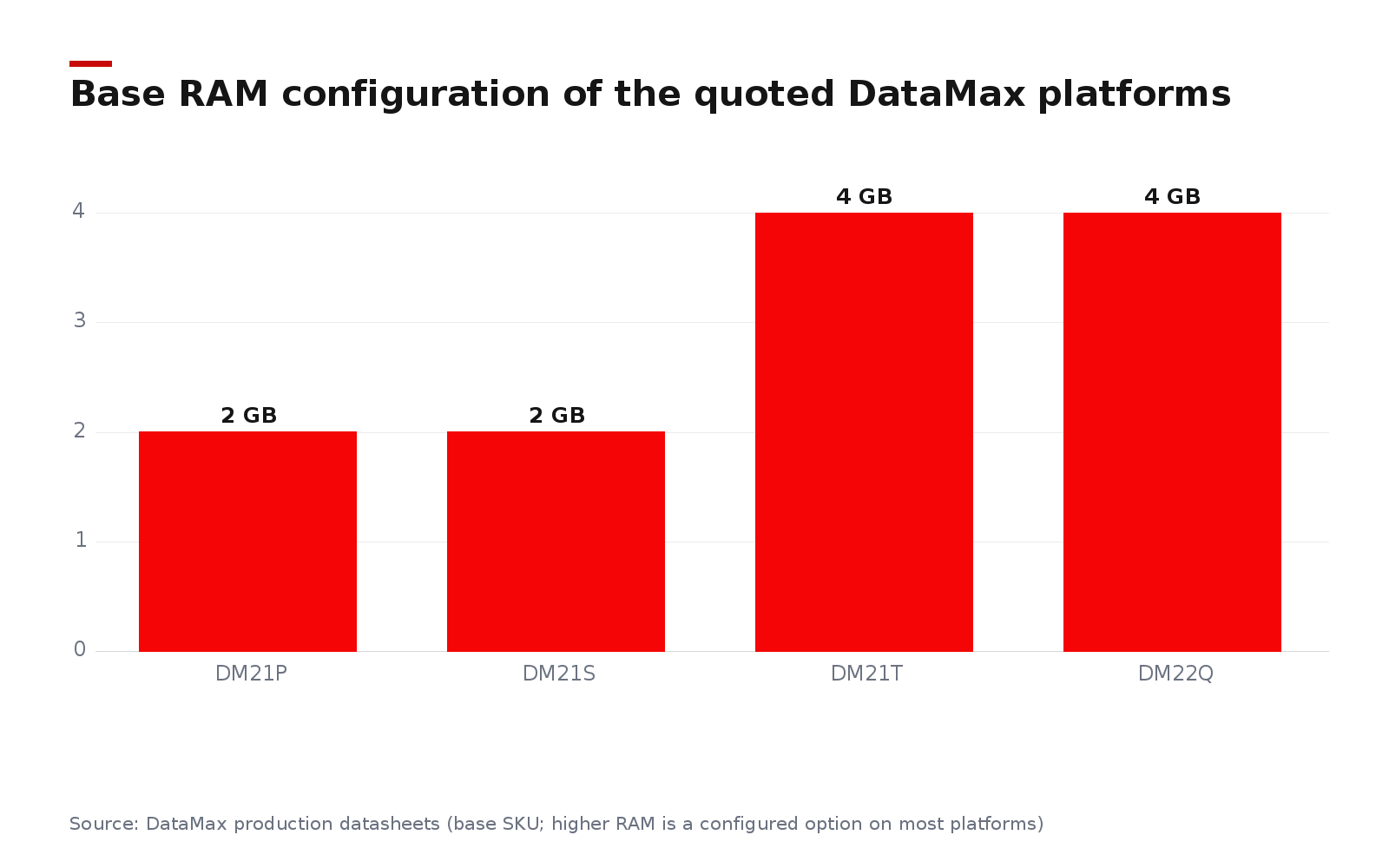
The same figures, in searchable form:
| Model | Base RAM |
|---|---|
| DM21P | 2 GB |
| DM21S | 2 GB |
| DM21T | 4 GB |
| DM22Q | 4 GB |
DM21P fits a 4K IPTV or operator middleware set-top-box role. Its listed AV1 and 4K decode support is relevant to operator validation, while the AOSP Android 11 baseline and 100M Ethernet are configuration facts that must be checked against the service requirement. Its optional HDCP 2.2 and memory tiers should appear as explicit PO lines when required.
DM21S targets 4K Android TV IPTV/OTT white-label work. AOSP Android 14, 2GB/16GB base memory, Dolby Vision/DTS, and optional 1G Ethernet make it a distinct operating and feature direction from DM21P. For a white-label launch, the branding, application signing, remote-control behavior, update channel, and service certification remain separate acceptance work.
DM21T fits a premium UHD or cloud-gaming box, with 4GB/64GB base memory, 4K@120 decode capabilities, and inline AI-SR. Its datasheet caps output and decoding at 4K; do not claim 8K output. It also has no HDMI input, so any workflow requiring source capture must use a different device or an explicitly engineered external arrangement.
DM22Q is gaming-oriented, with 4GB/64GB base memory, 4K@60 decode, and inline AI-SR. No NPU TOPS figure is stated, so the buyer should not use an inferred compute value. Dolby Vision/DTS and optional Ethernet states must be fixed on the quotation.
All platform claims must be checked against the production datasheet before a PO is released. The base RAM chart is a screening aid, not a performance benchmark: it does not establish application memory headroom, sustained decode behavior, or thermal performance. For the DVB-C alternative, the procurement record should state “separate tuner architecture required” rather than treating any of these Android models as drop-in broadcast receivers.
The table should be converted into a compliance matrix rather than pasted into a generic product request. Each row needs a proposed value, a production-datasheet value, an evidence reference, and an approval owner. For example, DM21S should show “AOSP Android 14” on both sides and identify the firmware image used for application certification. DM21T should show “4K@120 decode” while the acceptance cell separately records the maximum supported output.
A second pass checks dependencies that sit outside the SoC line. The operator still needs an application package, a signing arrangement, a DRM service relationship, a network profile, a display model, and an update process. If the display cannot accept the target frame rate, the decoder’s advertised capability does not create the requested viewing result. This is the practical limit of RAM-based screening in any android tv box comparison.
Where this matters in a deployment
The deployment environment changes which failure dominates. A cable operator may require DVB-C reception alongside IP services, making tuner and channel-plan evidence decisive. An ISP may already operate an IPTV head end and need Android middleware, identity, provisioning, and house integration. A streaming operator may prioritize DRM, codec coverage, and update control over broadcast hardware. The correct product direction therefore begins with the service operation, not the enclosure category.
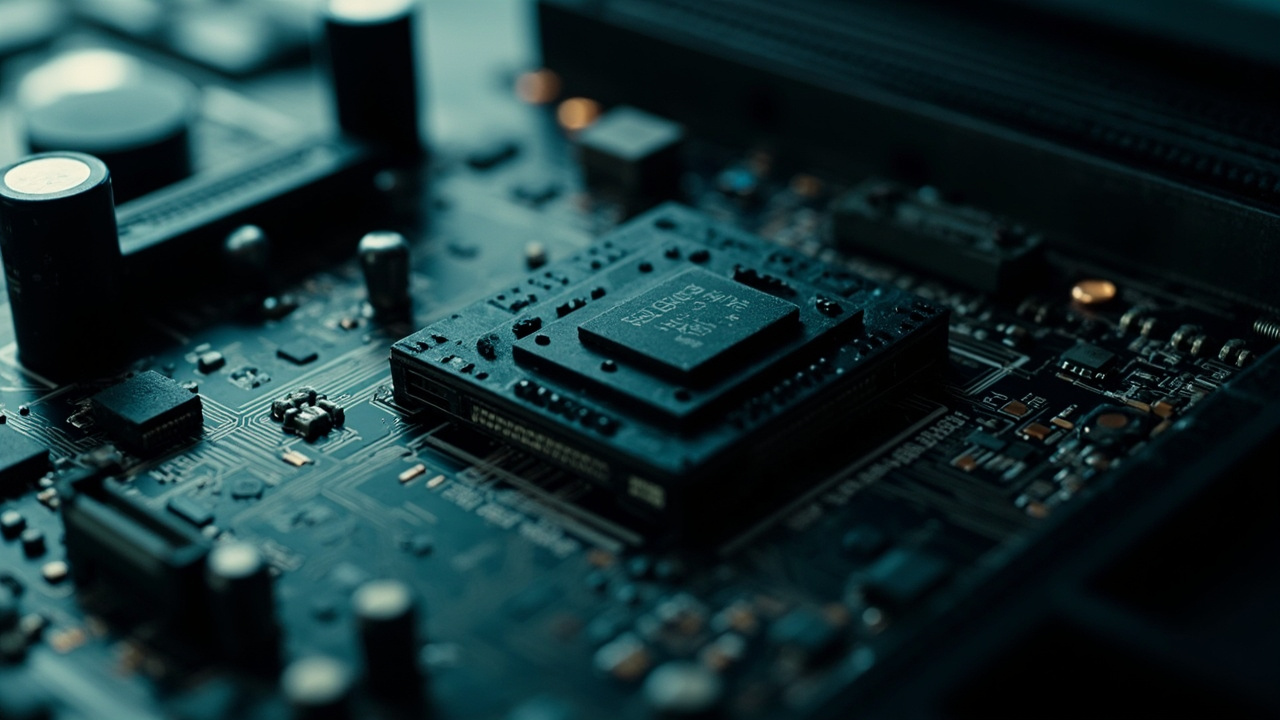
The photograph below shows the physical implementation boundary where an SoC-based Android platform meets memory, PCB routing, and power delivery. It illustrates why codec capability in a datasheet cannot establish production quality without board-level and aging evidence.
| Situation | Primary requirement | Model direction | Validation emphasis |
|---|---|---|---|
| IPTV operator with managed middleware | Stable IP delivery, operator integration, 4K capability | DM21P or DM21S | Middleware build, DRM, LAN behavior, update procedure |
| OTT white-label launch | AOSP Android 14 and application-led differentiation | DM21S | App signing, account flow, codec/display matrix |
| Premium UHD or cloud gaming | 4K@120 decode capability and higher base memory | DM21T | Frame-rate limits, thermal behavior, no unsupported 8K claim |
| Gaming-oriented retail program | Android 14, 4K@60 decode, gaming peripherals | DM22Q | Input path, sustained performance, service certification |
| Broadcast-dependent MVPD | DVB-C tuner and transport-stream chain | Android platform only if the DVB-C add-on is engineered and specified | RF test, channel scan, CA, EPG, signal-loss recovery |
For a regional ISP migrating from DVB-C to IPTV, the legacy broadcast requirement and the new application requirement should be separated into two acceptance tracks. The RF track needs tuner, demodulator, CA, channel-plan, EPG, and signal-loss evidence. The IP track needs middleware, identity, service delivery, DRM, update control, and LAN behavior. A device that passes only the IP track does not discharge the broadcast obligation.
For a hotel or hospital deployment, power recovery and local support may outweigh a larger codec list. The operator should test cold start, service reconnection, remote-control mapping, display EDID behavior, account expiry, and recovery after network loss. USB and AV requirements also need a physical placement check: a connector present in the datasheet may be inaccessible in the final enclosure or wall bracket.
For digital signage, the application update mechanism may be more important than peak decode capability. The buyer should define device identifiers, enrollment, remote application deployment, failure reporting, and image rollback before selecting a platform. If screens operate independently, the test matrix should include intermittent broadband and central service recovery rather than only a stable wired network.
An integrator combining broadcast and IP services needs a further architectural record. State whether the operator expects a single remote, a unified channel list, a single entitlement system, simultaneous playback, or source switching. The data supplied for the DataMax models does not establish those capabilities. Treat them as open engineering requirements rather than implied benefits of HDMI, USB, or Android integration.
For each matrix row, attach an accountable test. An operator row needs the exact middleware build and network profile. A white-label row needs an APK signing trial. A premium UHD row needs 4K frame-rate and thermal evidence. A broadcast row needs RF sweeps and channel-plan records. This android tv box comparison then becomes a procurement instrument because every direction has a measurable closure condition.
This matrix is directional, not a final approval. A deployment that requires DVB-C needs a documented tuner architecture and validation; none of the supplied DataMax model facts establish that function. For each row in this android tv box comparison, convert the validation emphasis into named tests and attach the results to a frozen SKU.
The selection sequence that removes rework
Start with the signal path, not the model. Write “DVB-C RF reception” or “IP-only Android TV delivery” as the first RFQ line. If both are required, state the tuner, channel count, standards, conditional-access boundary, EPG source, and whether simultaneous decode is needed. This prevents a mechanical comparison of Android versions from hiding the more expensive broadcast integration.
Pasteable RFQ language should be testable. Instead of “premium hardware,” write: “4K@60 service certification required; AV1/H.265 L5.1 support must be demonstrated on the production image.” Instead of “latest Android,” write: “AOSP Android 14, fixed build identifier, update responsibility stated.” Instead of “factory tested,” write: “Provide SMT/AOI, dark-room, and aging evidence tied to the production lot, with acceptance criteria and traceability to serial numbers.”
For a DVB-C request, add: “Specify tuner model, supported channel bandwidth and modulation, RF input range, conditional-access boundary, EPG source, channel-plan delivery, signal-loss recovery time, and test results against the operator reference environment.” These lines force the supplier to answer the broadcast interface rather than offer a generic Android enclosure.
For the Android request, add: “Specify application package and signing owner, account and DRM flow, network profile, HDMI mode, supported display chain, OTA/rollback responsibility, and the production image identifier used for service certification.” These lines connect the hardware choice to the content and update architecture.
For samples, use sample ordering and ask for the production-equivalent configuration rather than an unspecified display unit. The sample request should identify the exact RAM/ROM, optional Ethernet state, OS release, application build, display, network profile, and acceptance sequence. For engineering alignment, use DataMax custom development to assess DVB-C integration, middleware, or application-specific work.
The first message for an RFQ should contain the signal path, service codec matrix, target model, required RAM/ROM, OS release, DRM profile, port map, deployment quantity, and the evidence needed for approval. The DataMax contact team can structure the response as a line-by-line compliance matrix. That format exposes omissions before tooling, production, or fleet commitments create rework.
A final sequence check compares the sample, quotation, and purchase order in the same order. Verify model, SoC, OS, RAM/ROM, optional Ethernet, decoder, DRM, outputs, and firmware baseline. Then confirm that the proposed evidence names that configuration. If any field changes, repeat application certification and any relevant playback test; a paper-equivalent label does not prove that behavior remains unchanged.
The selection is complete when an engineer can trace every requirement to a datasheet value, an acceptance test, or an explicitly unresolved item with an owner. No unresolved item may remain behind a phrase such as “equivalent” or “to be advised.” That discipline turns the android tv box comparison into a controlled technical decision rather than a model-name shortlist.
Further reading
- Android TV Box For Sale: Catalogue Versus Commissioned
- Rockchip Android TV box guide
- Dolby Vision Android TV box guide
- RFQ checklist for device procurement
- Android TV boxes
- DataMax DM21P specifications and fit
- DataMax DM21S specifications and fit
FAQ
Can an Android TV box replace a DVB-C receiver?
Only when the required DVB-C signal path is explicitly engineered and validated. An Android TV box may run operator applications over IP, but the supplied DataMax model facts do not establish a DVB-C tuner, demodulator, CA, or EPG function. Require a platform-level architecture, RF test plan, channel-plan procedure, and acceptance evidence before replacing the broadcast receiver.
Which DataMax model is the first choice for an IPTV pilot?
DM21P fits a 4K IPTV or operator middleware role, while DM21S fits a 4K Android TV IPTV/OTT white-label program with AOSP Android 14. Select by fixed RAM/ROM, application, DRM, connectivity, and lifecycle requirements rather than model name alone. Confirm the production datasheet and the ordered configuration before approval.
Does 4K decode guarantee 4K playback?
No. End-to-end playback also depends on the delivered codec profile, application support, DRM, firmware, HDMI mode, display capabilities, and content pipeline. Require a playback matrix using the actual service, account, display, and production image. A chipset capability statement or local-file demonstration alone is insufficient.
Should the PO specify base RAM or a higher tier?
Specify the exact RAM/ROM on the PO. The base configurations shown are 2GB for DM21P and DM21S and 4GB for DM21T and DM22Q. Optional tiers must be selected line-by-line rather than left as “or equivalent,” especially where application memory behavior, storage endurance, or thermal validation applies.
What evidence should a factory provide before approval?
Request a configuration-linked evidence index covering SMT/AOI, aging, dark-room testing, firmware identity, application or middleware validation, and unit-to-record traceability. Ask for a video factory audit or the underlying records. The documents must apply to the ordered hardware and software build, with revision dates and pass criteria visible.
Can Dolby Vision or AV1 be assumed from the model name?
No. Confirm each feature against the supplied datasheet, selected RAM/ROM configuration, operator or OTT service, application, DRM flow, and display chain. Some DataMax models list Dolby Vision/DTS or AV1 capability while other DRM and output functions remain optional, so the PO needs explicit configuration lines and service-level acceptance results.




