The procurement answer in one screen
| Decision point | What must be aligned | Buyer evidence |
|---|---|---|
| Commercial intent | Certified AOSP distribution versus operator-managed Android TV | Scope by ordered SKU |
| Platform | SoC, Android release, GMS build and device certification | Build identification and certificate lookup |
| Media rights | Decoder capability, DRM implementation and display path | Content-service test report |
| Operations | OTA, network, middleware and field recovery | Acceptance procedure and audit trail |
android tv box procurement is not satisfied by a catalogue label, a Google Play logo, or a chipset-based inference. The dependency chain runs from the exact production SKU through its AOSP image, GMS build, model registration, Widevine implementation, service agreement and hardware configuration. Each link can invalidate the next. For the narrow requirement represented here, DM21RTD is the direct DataMax platform: its stated OS is GMS-certified AOSP.
The immediate answer is therefore narrow. Specify the model and configuration, require the certificate and registry trail for that identity, confirm DRM and service licensing for the actual image, and verify the delivered hardware against production records. Do not infer GMS status from RAM, Android version, codec support or the presence of Google applications. For the broader operating model, see the canonical guide to android tv box choices for ISPs.
A practical example is an operator issuing one RFQ for a retail-bound terminal. The quotation should identify one production model, one hardware revision and one firmware branch, rather than promising a certification position for every variant in the family. If the buyer later requests a different Ethernet option or memory configuration, the responsible engineer must state whether that change is inside the certified scope, outside it or requiring renewed assessment. This prevents a nominally compliant sample from becoming an uncontrolled fleet baseline.
Real DataMax platforms, field by field
DataMax offers four relevant TV-box platforms, but only one carries the stated GMS-certified AOSP requirement. That distinction prevents a common quotation error: treating the entire L1 family as interchangeable when their OS, certification position and decode profiles differ.
| Model | SoC and OS | Memory | Decode and DRM | Interfaces |
|---|---|---|---|---|
| DM21RTD | Realtek RTD1325; GMS-certified AOSP | Confirm against the production datasheet | AV1 capable | Confirm against the production datasheet |
| DM21P | Amlogic S905Y4, quad Cortex-A35; AOSP Android 11 | 2GB / 8GB; 4GB; 16/32/64GB optional | AV1 [email protected]; VP9/H.265 4K@60; H.264 4K@30; Widevine L1 / PlayReady / HDCP 2.2 optional | HDMI 2.0b out x1; USB2.0 x2; TF; S/PDIF; 3.5mm AV; RJ45 100M; Wi-Fi6 2x2 + BT5.4; DC 5V/2A |
| DM21S | Amlogic S905Y5, quad Cortex-A55; AOSP Android 14 | 2GB / 16GB; 2/4/8GB; 16/32/64GB optional | AV1 / H.265 [email protected] 4K@60; Widevine L1 / PlayReady optional; Dolby Vision/DTS | HDMI 2.0b out; S/PDIF; AV; USB2.0 x2; TF; RJ45 100M, 1G optional; Wi-Fi6 2x2 + BT5.4 |
| DM21T | Amlogic S905X5, quad Cortex-A510 (ARMv9); AOSP Android 14 | 4GB / 64GB; family options | H.266/VVC [email protected] 4K@120; AV1/VP9/H.265 4K@120; AVS3 4K@120; H.264 4K@60; inline AI-SR; Widevine L1 / PlayReady optional | HDMI 2.0b out, no HDMI in; USB2.0 x1 + USB3.0 x1; TF; S/PDIF; AV; RJ45 100M, 1G opt; Wi-Fi6 + BT5.4 |
The field table deliberately leaves unstated data blank rather than estimating it. DM21RTD’s SoC, OS and AV1 capability are explicit, while RAM, storage, DRM detail and ports must be confirmed against the production datasheet. For DM21P, DM21S and DM21T, “optional” identifies configuration decisions rather than universal availability. The RFQ must name the selected memory, Ethernet, DRM and codec configuration.
That distinction matters during sample approval. A sample with 100M RJ45 may demonstrate connectivity but cannot approve a 1G option; a unit with Widevine L1 selected but no confirmed service authorization cannot close the content-service gate. The comparison record should therefore have one line for every ordered option and one acceptance method for each. “Available” is not an acceptance criterion.
Netflix reported that “88% of large-screen devices (TVs, set-top boxes, streaming sticks) submitted for Netflix certification 2021-2025 supported AV1; nearly all submitted since 2023, vast majority full 4K@60fps.” The denominator is devices submitted for certification, not every device shipped.
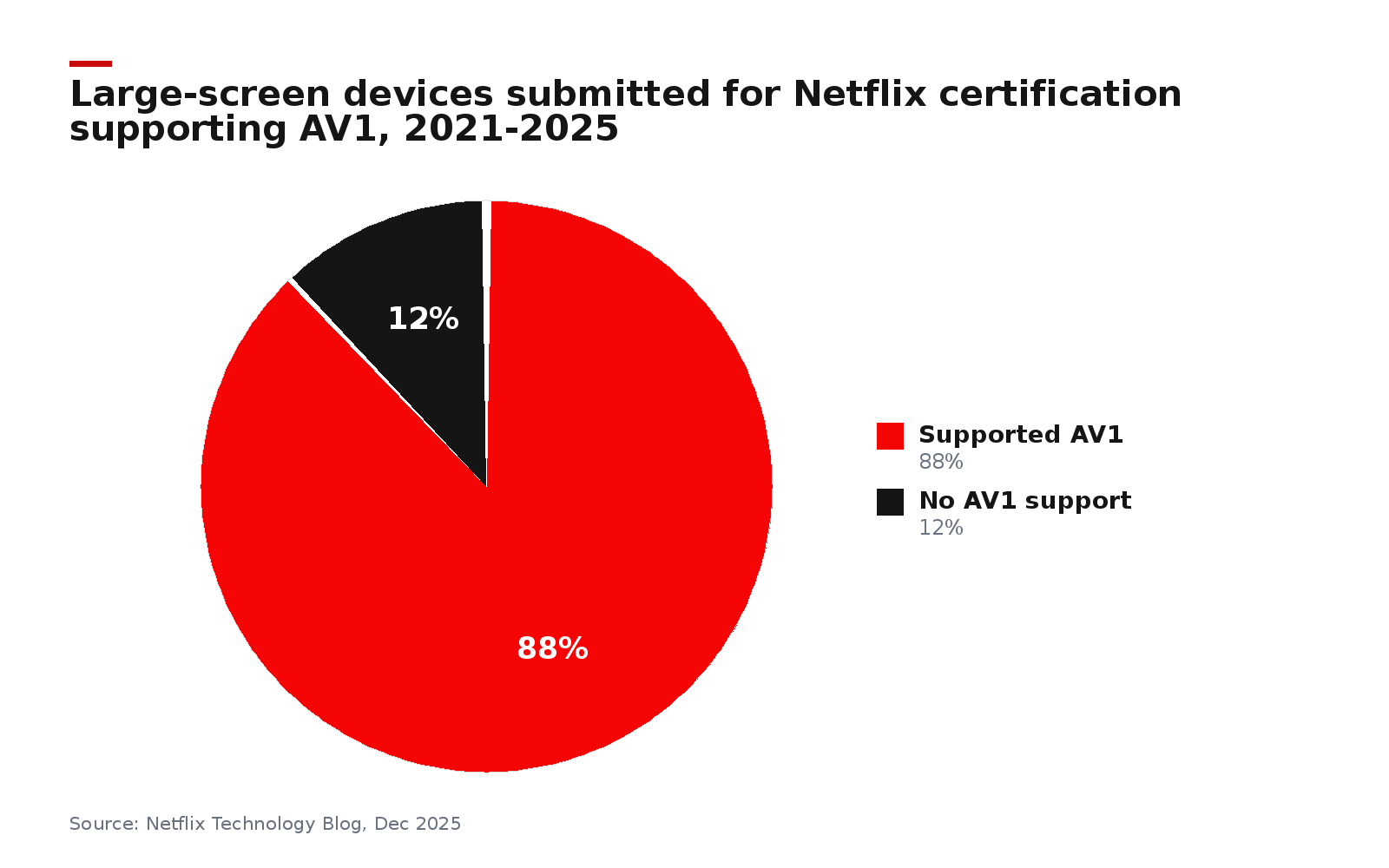
The same figures, in searchable form:
| Submission support | Share |
|---|---|
| Supported AV1 | 88% |
| No AV1 support | 12% |
Source: Netflix Technology Blog, AV1 — Now Powering 30% of Netflix Streaming (2025-12-01)
The source provides a useful procurement benchmark without proving any individual DataMax model’s status. A buyer can use the figure to justify testing AV1 on the target application, but the acceptance result must come from the ordered model, production image, display and service account. The same discipline applies to every decoder claim in the table.
Definitions a buyer cannot outsource
“GMS-certified” is a product- and build-level condition, not a chipset attribute. The dependency chain starts with a declared Google-certified device model, a production hardware configuration and an AOSP software build. Google Mobile Services certification then covers the implementation submitted for assessment. A related Google Play device registration may have separate status and device identity. A buyer should request the exact identifiers and compare them with the public registry rather than accepting “GMS-enabled” as a technical synonym.
The device declaration normally needs more than a marketing name. The relevant fields may distinguish the model, SoC, memory configuration, build fingerprint, application package set and build release. A certificate associated with one model designation should not be transferred to another by analogy, even when the enclosure, brand or retail distribution are identical. The registry lookup is useful because it establishes the public identity; the internal build record remains necessary to establish what was actually shipped.
GMS and EDLA also describe different ecosystems. Google Mobile Services supports Android applications and services outside the Android TV device ecosystem; EDLA certification applies to Google TV / Android TV devices designed around Google TV functionality. The requirement for a non-Google-TV AOSP+GMS product must therefore be written explicitly. The AOSP versus Google Android TV comparison provides the architecture distinction, while certification evidence settles the selected SKU.
The OS label has a second dependency: build provenance. “AOSP Android 14” alone does not establish which GMS package is integrated, which build identifiers were submitted, or whether the production image is the assessed image. Request the build number, package revision, device model, hardware suffix, application package set and firmware-release procedure. For a fleet, the release train needs a repeatable mapping from hardware revision to image and certificate identity.
DRM forms another chain. Widevine L1 describes secure software-based protection, but a usable implementation also depends on device integrity, key provisioning, display capabilities and service authorization. HDCP 2.2 concerns the protected display path rather than general streaming compatibility. PlayReady may be named separately. Optional DataMax DRM features are not proof that a quotation includes them, so identify them as mandatory line items.
The protected-content test should follow the complete route. A service streams encrypted media, the application invokes the selected DRM implementation, the device receives a license, the platform verifies the display path, and the content renders at the required profile. A local codec file proves only hardware decode. A non-protected application proves only application launch. Neither substitutes for the protected playback test on the production image.
Android TV deployments also involve update and policy enforcement. Android Management API, EMM, TR-069 and operator middleware can address different layers: enrollment, policy, device management and STB middleware integration. None substitutes for Google certification. Conversely, certification does not prove middleware readiness. Define separate acceptance gates for Play functionality, operator portal, IPTV entitlement, OTA rollback, analytics and field recovery.
A useful acceptance matrix contains seven rows: public identity, installed applications, protected playback, operator middleware, update authority, network behavior and field recovery. Each row needs the selected image, test account, expected result and record location. This prevents one successful app launch from being used as evidence for all six other obligations.
Options placed side by side
The commercial choice is not simply “certified versus uncertified.” It is a choice between a narrowly defined certified AOSP SKU and broader AOSP platforms whose configuration, licensing and operator integration carry different obligations.
| Criterion | DM21RTD | DM21P | DM21S | DM21T |
|---|---|---|---|---|
| Stated fit | Operators/retail requiring a Google-certified non-Google-TV AOSP+GMS SKU | 4K IPTV / operator middleware | 4K white-label IPTV/OTT | Premium UHD / cloud gaming |
| OS statement | GMS-certified AOSP | AOSP Android 11 | AOSP Android 14 | AOSP Android 14 |
| Memory detail | Confirm against the production datasheet | 2GB / 8GB plus optional configurations | 2GB / 16GB plus optional configurations | 4GB / 64GB; family options |
| DRM statement | Confirm against the production datasheet | Widevine L1 / PlayReady / HDCP 2.2 optional | Widevine L1 / PlayReady optional; Dolby Vision/DTS | Widevine L1 / PlayReady optional |
| Primary procurement variable | Certificate identity and production build | Middleware and optional feature configuration | White-label software and optional network configuration | Codec, performance and interface configuration |
The matrix also identifies what each quotation must settle. For DM21RTD, the first settlement is certification scope, not a feature race. For DM21P, the operator middleware and Android 11 baseline define the integration task. For DM21S, the white-label application and optional Ethernet path determine the BOM. For DM21T, the required codec profile, display mode and interface set determine the acceptable configuration. These are different approval problems with different evidence.

The same figures, in searchable form:
| Evidence option | Editorial score |
|---|---|
| Supplier claim | 15/100 |
| Generic test report | 42/100 |
| Standard-specific report | 70/100 |
| Certificate with public registry lookup | 94/100 |
Source: DataMax editorial team, qualitative planning scale (0-100), not audited or measured data. The scores rank evidence types for planning; they are not audited measurements.
A DM21RTD quotation should lead with the exact certified configuration. A DM21P quotation should lead with Android 11, the selected memory and optional DRM implementation. DM21S adds Android 14 and white-label software, while DM21T brings a different codec and performance envelope. These are distinct bill-of-materials decisions, not interchangeable performance tiers.
One comparison failure appears when a buyer treats “GMS-certified AOSP” as a feature that can be added to another platform at quotation time. Certification is attached to an assessed implementation; it is not a software toggle. Any alternative proposal must therefore return to the beginning of the chain and demonstrate its own model, hardware, build, package and registry identity. A reduced quotation line saves comparison time but creates technical and commercial ambiguity later.
The operator, the integrator and the venue
The buying situation determines which dependency becomes critical. An operator buying a managed access product needs service continuity and fleet control. An integrator needs interface stability, middleware certification and predictable configuration. A venue or brand owner needs display-path compatibility and a controlled channel application.
| Situation | Primary requirement | Model direction | Acceptance evidence |
|---|---|---|---|
| Operator or ISP | Google-certified non-Google-TV AOSP+GMS SKU with fleet lifecycle control | DM21RTD | Registry lookup, production identity and update procedure |
| Operator middleware project | AOSP Android 11, 4K IPTV fit and configurable DRM | DM21P | Middleware test matrix and selected BOM |
| OTT or white-label integrator | AOSP Android 14, AV1 / H.265 4K@60 capability | DM21S | Application certification and device configuration record |
| Premium or cloud-gaming venue | Advanced 4K@120 decode set, including AV1/VP9/H.265 and AVS3 | DM21T | Display-path test and workload acceptance |
For an operator, the first dependency is identity: the deployed units must match the registered and certified configuration. The second is lifecycle: updates must preserve the approved stack. The third is recovery: a failed update should not strand the terminal. An android tv box procurement policy should name the release owner, rollout cohort, rollback trigger and recovery method. It should also require confirmation that the operator middleware remains compatible with the selected Android release.
A practical operator pilot should use a controlled cohort rather than an unqualified mass release. The pilot record should capture each unit serial, hardware revision, firmware build, certificate identity, service account, middleware version and network profile. After the pilot, the buyer can decide whether an observed failure belongs to the device identity, service authorization, local application, network control or display path. That classification determines the corrective owner and prevents repeated firmware changes without diagnosis.
For integrators, interface ambiguity creates rework. DM21P’s stated ports include HDMI 2.0b output, two USB2.0 ports, TF, S/PDIF, 3.5mm AV, RJ45 100M and Wi-Fi6 2x2 plus BT5.4. If the installation requires a different Ethernet option or physical arrangement, that requirement must be resolved before the purchase order. “android tv box” in a room-control package should not mean a generic rectangle with HDMI.
The integrator’s room-control worksheet should specify cable direction and quantity, network topology, audio extraction, power source, application launch mode, remote-input behavior and recovery method. For example, a room using an optical-audio receiver needs the S/PDIF route in the accepted test; a room relying on network control needs the Ethernet speed and discovery procedure recorded. Interface capability without a room-level test leaves installation variation unresolved.
For venues, decoder capability is only one part of the chain. The selected DM21S or DM21T must be paired with a display that accepts its output, and the protected-content path must support the required DRM. Dolby Vision and DTS appear in the DM21S product facts, while the DM21T facts list Widevine L1 and PlayReady as optional. A venue acceptance script should therefore name the application, resolution, refresh rate, audio route and protection profile rather than relying on a “4K ready” label.
The operating duration also belongs in the venue acceptance record. A short demonstration proves launch and decode, but it may not expose network reconnection, thermal stability, repeated power cycles or service-license behavior. The venue team can combine an application playback matrix with a power-cycle sequence and an operator-prescribed soak test. The result becomes a repeatable installation procedure rather than a one-time visual demonstration.

The procurement owner for each scenario needs one shared document: the selected model, hardware configuration, software build, certification record, application baseline and change-control route. That prevents operator, integrator and venue teams from validating different interpretations of the same android tv box order.
Where quotations quietly diverge
Quotations often collapse several independent states into one phrase: “certified,” “licensed,” “optional” and “supported.” Each word hides a different acceptance condition.
Field trap
A quotation saying “Widevine L1” may mean the SoC can support it, the firmware can expose it, or the production SKU has completed a service-specific test. Require the DRM implementation and service-device status for the ordered configuration; otherwise a nominally compatible box can fail content authorization, key provisioning or display-path acceptance.
Field trap
A catalogue entry describing an android tv box as “GMS certified” is insufficient if the quotation omits the model identity, hardware suffix and production image. A certificate for one build does not automatically cover a RAM, storage, Ethernet, regional image or operator-customized variant. Record the certified scope and require written confirmation for each production change.
The first divergence is product identity. DM21RTD is identified as a GMS-certified AOSP product, but its memory, ports and detailed DRM provisions are not supplied in the available facts. Any quotation filling those gaps must be corrected rather than inferred. The same rule applies across the family: optional fields are order choices, not baseline entitlements.
The second divergence is “Android version.” AOSP Android 11, AOSP Android 14 and GMS-certified AOSP describe different software baselines in the stated facts. Buyers should not ask only for “Android 14” or “GMS.” Those phrases omit the application set, update mechanism and certification identity needed for operational control.
A third divergence is the acceptance population. A decoder test may use a local USB file, a browser stream, an operator application or a protected commercial service. The test method can change the result because the application, DRM stack, profile selection and server-side policy participate. A quotation should therefore list each service and application used during qualification; “AV1 test passed” without a method is too broad for a fleet acceptance record.
The fourth divergence is the meaning of “optional.” In the DataMax facts, optional Widevine L1, PlayReady, HDCP 2.2, Ethernet speed, memory and Dolby Vision/DTS items become binding only when selected into the ordered configuration. The purchase order should distinguish “not selected,” “selected and accepted” and “selected but pending service authorization.” This prevents an unpriced option from silently becoming a field dependency.
The commercial consequence appears late when a sampled unit lacks the quoted GMS package, a deployment lacks a required DRM entitlement, or a late Ethernet change invalidates the production record. Each failure forces remobilization, revalidation and replacement rather than a simple firmware edit. For qualification evidence, use the certifications process; confirm certificates and DRM or security provisions per ordered SKU, not per catalogue page.
A change-control clause can contain this risk. It should identify the approved model, hardware revision, image identifier, certificate scope and optional configuration; state which changes require written notice; require revalidation for affected functions; and prohibit silent substitution. The clause gives the buyer an enforceable decision point before a changed unit reaches the line.
Turning the question into a spec line
The RFQ should translate the commercial request into a configuration line that can be matched, sampled and audited. Sequence the dependencies from fixed requirements to optional variants.
- Define the commercial class State whether the requirement is Google-certified non-Google-TV AOSP+GMS, operator-managed AOSP, a white-label OTT terminal or a premium decoder platform. Do not leave “certified android tv box” as the only line.
- Name the platform Identify the DataMax model, SoC, Android or GMS-certified AOSP baseline, memory, storage and every selected option. For DM21RTD, fields absent from current product facts must be confirmed against the production datasheet.
- Freeze the media contract Record required codec profile, resolution, frame rate, HDR path, audio path, DRM implementation and service authorization. State whether Widevine L1, PlayReady, HDCP 2.2, Dolby Vision or DTS is mandatory.
- Freeze the interface contract Specify HDMI output, Ethernet speed, Wi-Fi, Bluetooth, USB, TF, AV, S/PDIF and power from the selected configuration. Treat optional Ethernet and DRM selections as BOM lines, not preferences.
- Define fleet behavior Add OTA enrollment, release approval, rollback, operator middleware, application whitelist, telemetry and recovery procedures to the acceptance plan.
- Bind evidence to identity Attach the certificate or registry result, build identifiers, selected order configuration and test reports. Every document must resolve to the same model and production variant.
A paste-ready starting line is: “Selected DataMax model: [model]; SoC: [value]; OS baseline: [value]; RAM/ROM: [value]; selected ports: [values]; DRM: [mandatory/optional status]; codec/display requirement: [profile]; certification scope: [model/build and registry reference]; operator software baseline: [version]; OTA and rollback requirement: [procedure].”
The line must not use “equivalent” for certified identity unless the supplier provides written evidence that the proposed configuration is the assessed one. It should also prohibit unapproved substitution of SoC, Android release, GMS package, Ethernet option or DRM configuration. The operator can then evaluate quotations as controlled variants instead of paraphrased feature claims.
A complete RFQ should add fields for region, language, operator application package, enrollment authority, update cadence, rollback threshold, factory audit access and sample quantity. Region matters because applications, networking assumptions and regional image content can alter qualification. Language matters because it becomes part of the software baseline. Update cadence and rollback threshold matter because a certified build that cannot be maintained operationally may be unsuitable for a managed fleet despite passing a registry lookup.
For a tailored project, the engineering inquiry route should receive the exact requirement matrix, not merely a product name. If physical samples are needed, request them through sample ordering before approving a fleet configuration.
The sample request can carry the same control logic as the production order. State the required certificate identity, production image, selected memory and ports, DRM entitlement, target application, display model, network profile and recovery sequence. Record the serial, hardware revision and build of each sample. Without that mapping, a successful demonstration remains a generic product result rather than evidence for the proposed fleet configuration.
Verification you can ask for on paper
Factory verification is the bridge between a certificate and the physical unit. The evidence trail should connect incoming components, assembled hardware, firmware loading, ageing, inspection and shipment. For an android tv box, the useful question is not whether an SMT line exists; it is whether records can link one finished unit to its declared configuration.
The document request should name the production model rather than the factory generally. For example, the supplier should provide the AOI plan applicable to the DM21RTD line and the approved image-loading instruction for that model. If a request instead yields a presentation containing unrelated projects, the buyer still lacks traceability for the ordered configuration. DataMax can provide the relevant evidence through its manufacturer profile, while the factory quality evidence request can focus the audit.
The ageing procedure needs measurable acceptance rules. Ask for the duration, ambient and product-surface conditions, power state, network connection, number of power cycles, boot criteria and sample frequency. “Burn-in passed” without those fields cannot be repeated at an incoming inspection. The sample functional test should use the same release image, application configuration and selected outputs as the production order, or it may validate a laboratory state that will not reach deployment.
Evidence package to request: model and hardware revision; ordered configuration; firmware and GMS build identifiers; certificate or registry reference; DRM and service test records; SMT material records; AOI inspection results; ageing procedure and results; sample functional-test record; firmware-loading reconciliation; and approved deviation list. Dates, signatories and record identifiers should link the package to the shipment.
This package protects both sides. The supplier can demonstrate process control, while the buyer can distinguish a configuration mismatch from a field failure. It also supports change management: if the Ethernet option, memory or production image changes, the same trace must show who approved the change and which evidence must be repeated.
A useful audit trail is searchable in one direction. Starting from the purchase order, the buyer should reach the ordered BOM, line instruction, image-loading record, inspection result, sample test and shipment lot. Starting from a shipment serial, the reverse path should reach the same approval chain. Any broken link identifies a gap to close before volume release rather than a matter for field diagnosis.
Certification and security requirements remain separate from manufacturing records. The compliance documentation should be checked against the actual order, while factory evidence establishes whether the approved configuration was built. Both chains must resolve to one model, hardware revision, software build and shipment record. That closes the procurement loop between an android tv box specification and the physical terminal accepted by the operator or venue.
Further reading
- Guide android tv box for isps
- AV1 Android TV box guide
- AOSP vs Google TV guide
- HDR10+ Android TV box guide
- DTS:X Android TV box guide
- DataMax DM21RTD specifications and fit
- DataMax DM21P specifications and fit
FAQ
Is every GMS-certified AOSP device an Android TV device?
No. A Google-certified non-Google-TV product can use AOSP with GMS and have an operator-specific television interface. Android TV and Google TV have distinct ecosystem and certification contexts. State the intended application, interface and certification route explicitly, and avoid using “Android TV” as a substitute for the formal product classification.
Does Widevine L1 guarantee Netflix or other service playback?
No. L1 identifies a protected implementation level, while service authorization also depends on the device profile, application, server-side entitlement and account policy. The DRM and service-device status must be validated for the exact ordered SKU. Optional DRM wording in a quotation should be converted into a mandatory line or removed.
Can an AV1-capable chipset be advertised without AV1 certification?
No. Hardware decode capability does not establish that a service will recognize the device or authorize protected content. Codec support should be tested through the target application on the production image. For an android tv box requirement, include the required profile, resolution, frame rate, display path and service acceptance in the specification.
What evidence should be requested for a certified production SKU?
Request the certificate or registry result, certified model identity, hardware and software build scope, public lookup method, DRM configuration and records linking the certificate to the delivered batch. A generic test report or supplier statement should not be accepted as a substitute. The operator should be able to reconcile every document with one model and production revision.
Does factory ageing prove GMS certification?
No. Ageing can reveal stability, boot, thermal, network and power-cycle issues, but it does not establish GMS certification. The evidence chain must keep certification and manufacturing records separate while linking them through the exact device identity. A complete package combines the certificate scope with build loading, inspection and functional-test records.
How should firmware changes be controlled after deployment?
Treat each production image as a controlled configuration tied to hardware revision, certification scope and operator requirements. Define approval ownership, staged rollout, telemetry thresholds, rollback triggers and recovery testing. If a change alters the certified identity or another controlled boundary, obtain written approval and repeat the relevant verification before fleet deployment.
What should happen if a late BOM change invalidates prior samples?
Quarantine approval of the changed configuration and return to the affected acceptance gates. Reconcile the new model, hardware revision and software build against the certificate scope, then repeat the relevant certification, DRM, service, middleware, interface and factory records. The original sample result remains valid only if the change is demonstrably outside its tested boundary and the authorized approval record states that conclusion.
How many qualification stages should a fleet release use?
Use a staged sequence: engineering sample, controlled pilot, limited production cohort and fleet release. Each stage should have a named exit criterion, such as registry identity, protected playback, middleware compatibility, interface validation, power-cycle recovery and rollback verification. The cohort size and promotion decision belong to the operator’s risk policy; evidence from one stage should not be silently reused when the configuration changes.