

Before the terminology: the certification decision
| Claim presented | Buyer decision | Required evidence |
|---|---|---|
| “Google certified” on a catalogue page | Do not approve for deployment | Model and SKU identification plus a registry lookup |
| “Android TV certified” with a report | Conditionally approve pending scope review | Report covering the exact platform and software build |
| Certified model, matching production configuration | Proceed to sample validation | Certificate, registry record, build identification, and factory evidence |
A android tv box certification claim is procurement-relevant only when its evidence identifies the exact device, software baseline, market, and production configuration. For an operator, integrator, or brand owner, the central question is not whether a supplier says “Google certified”; it is whether the ordered unit can be traced to a valid certification record without assuming that every RAM, ROM, regional, middleware, or firmware variant inherited the same status.
Certification terminology also needs discipline. Google certification may cover Android platform requirements, device compatibility, application behavior, or a partner ecosystem. These are different assurance scopes. A supplier’s certificate should therefore be read against the program named on the document, the certified model identifier, and the current registry result. “AOSP Android” in the product specification and “Google-certified Android TV” in commercial language are not interchangeable claims.
The practical answer is to separate three decisions: platform eligibility, model-level certification evidence, and production conformity. The first determines whether the operating system and device can enter the relevant program. The second identifies what Google or the relevant certification owner recognizes. The third asks DataMax to show that the delivered hardware and software match that record. Confirm all 3 against the production datasheet and certification artifacts for the ordered SKU.
A procurement example makes the distinction operational. An operator may receive a 2GB / 16GB quotation for a model whose sample was documented with 4GB / 32GB; that is not a harmless storage variation when the evidence package is the release gate. The buyer should return the quotation for correction and require one named configuration, one software baseline, and one evidence mapping. The same rule applies to an optional 1G Ethernet port, an operator-specific image, and a market-specific application bundle.
Five production SKUs compared
The available DataMax L1 platforms differ in operating-system baseline, processor generation, memory configuration, decode envelope, connectivity, and intended deployment position. The table keeps those distinctions explicit instead of presenting certification as a substitute for product selection.
| Model | SoC and OS | RAM / ROM | Decode capability | DRM | Interfaces |
|---|---|---|---|---|---|
| DM21P | Amlogic S905Y4, quad Cortex-A35; AOSP Android 11 | 2GB / 8GB; 4GB; 16/32/64GB optional | AV1 [email protected]; VP9/H.265 4K@60; H.264 4K@30 | Widevine L1 / PlayReady; HDCP 2.2 optional | HDMI 2.0b out x1; USB2.0 x2; TF; S/PDIF; 3.5mm AV; RJ45 100M; Wi-Fi6 2x2 + BT5.4; DC 5V/2A |
| DM21S | Amlogic S905Y5, quad Cortex-A55; AOSP Android 14 | 2GB / 16GB; 2/4/8GB; 16/32/64GB optional | AV1 / H.265 [email protected] 4K@60 | Widevine L1 / PlayReady optional; Dolby Vision/DTS | HDMI 2.0b out; S/PDIF; AV; USB2.0 x2; TF; RJ45 100M; 1G optional; Wi-Fi6 2x2 + BT5.4 |
| DM21T | Amlogic S905X5, quad Cortex-A510 (ARMv9); AOSP Android 14 | 4GB / 64GB; family options | H.266/VVC [email protected] 4K@120; AV1/VP9/H.265 4K@120; AVS3 4K@120; H.264 4K@60; inline AI-SR | Widevine L1 / PlayReady optional | HDMI 2.0b out; no HDMI in; USB2.0 x1 + USB3.0 x1; TF; S/PDIF; AV; RJ45 100M; 1G opt; Wi-Fi6 + BT5.4 |
| DM22Q | Amlogic S905X5M, quad Cortex-A55 up to 2.5GHz; AOSP Android 14 | 4GB / 64GB; 2/4/8GB; 16/32/64GB optional | AV1/H.265 L5.1 4K@60; inline AI-SR | Widevine L1 / PlayReady optional; Dolby Vision/DTS | HDMI 2.0b out; USB2.0 x2; TF; S/PDIF; AV; RJ45 100M; 1G opt; Wi-Fi6 2x2 + BT5.4 |
These specifications describe platform capability, not automatic certification status. A decoder marked “Widevine L1” does not prove that a particular server-side entitlement, application release, or commercial agreement has been completed. Likewise, Dolby Vision/DTS and HDCP entries do not replace a complete playback and rights test on the intended display chain.
The distinctions guide procurement. DM21P targets 4K IPTV and operator middleware, with the oldest stated OS baseline among these four products. DM21S targets 4K IPTV/OTT white-label work and combines Android 14 with a more restrained media-envelope specification. DM21T addresses premium UHD and cloud-gaming use, including 4K@120 decode for several listed codecs and inline AI-SR. DM22Q is gaming-oriented and lists 4K@60 AV1/H.265 support, but it provides no stated NPU TOPS figure. Its maximum listed output/decode level is 4K@60; do not substitute an 8K claim.
For every candidate android tv box, write the intended OS image, regional build, middleware, DRM configuration, and display mode into the qualification record. Ask DataMax to confirm certification scope per ordered SKU through the certification evidence process. Do not infer program status from the processor, Android version, or the word “certified.”
The port differences affect test planning as well as certification. DM21P states RJ45 100M, while DM21S, DM21T, and DM22Q list 1G as optional; a sample must therefore be checked against the purchased network configuration. DM21T states USB2.0 x1 plus USB3.0 x1 and no HDMI input, while the other listed platforms have different USB arrangements and no stated HDMI input. These are not cosmetic substitutions when an acceptance script expects a specific peripheral, storage path, or capture workflow.
A practical comparison sheet should add 4 columns to the catalogue table: exact RAM/ROM, enabled DRM package, regional image identifier, and certificate or registry reference. If any cell is blank, the release package remains conditional. That prevents a supplier from answering “certified” with a product-family statement while the delivery team is already preparing a different image.
Where the terminology comes from
The evidence chain has 4 distinct layers. A robust claim must survive every layer without substituting one for another.
Platform baseline. Android compatibility is established through required tests rather than visual similarity. The Android Compatibility Definition and Compatibility Test Suite define the baseline behavior expected of an Android device implementation. Android TV has an additional device form-factor and user-experience framework. Google Play certification adds device, application, and policy requirements; it should not be described merely as a hardware badge.
Program and device family. A device family may cover several SKUs, but each shipped variant must fall inside the certified definition. Buyers should record the declared product name, manufacturer, model identifier, hardware version, software build, and any regional or network-operator differentiation relevant to the registry record. A generic test report without those fields is weaker evidence than a public registry lookup.
Application and content path. Android TV certification can coexist with DRM and streaming work that remains outside the platform certificate. Widevine L1 is a protected-software and hardware capability implemented under a licensing framework; PlayReady, HDCP, Dolby Vision, and DTS involve separate ecosystems. Server-side licensing, profile support, display capability, application behavior, and anti-tamper controls must be validated as an end-to-end service.
Production conformity. The certified evaluation unit and the production unit must share the controlled characteristics covered by the submission. Memory configuration, firmware, bootloader state, secure-element arrangement, operator middleware, build fingerprint, and manufacturing line can affect what the buyer is actually receiving. DataMax’s documented control evidence should connect the shipment to the approved configuration.
A further distinction matters for content planning. Netflix reported that “88% of large-screen devices (TVs, set-top boxes, streaming sticks) submitted for Netflix certification 2021-2025 supported AV1.” This is a certification-submission population, not a claim about every device shipped. The same source stated that “AV1 powers approximately 30% of all Netflix viewing.”
Source: Netflix Technology Blog, AV1 — Now Powering 30% of Netflix Streaming (2025-12-01)
This distinction explains why codec capability should be recorded separately from commercial readiness. The engine’s capability, the application’s negotiated profile, the DRM path, the CDN manifest, the entitlement service, and the display chain all need compatible settings. For broader platform-selection context, see the canonical guide to android tv box for ISPs; this article focuses narrowly on making certification testable.
The application layer needs its own acceptance record. A generic launcher test does not establish that an MVPD app, IPTV middleware, account flow, purchase path, parental control, operator-specific network service, or update agent behaves correctly. The tester should record the app version, signed package, account state, entitlement response, playback profile, and recovery behavior. A certificate can remain valid while an application release, server contract, or regional policy changes independently.
The term “certified model” also requires a date-aware check. A registry result should be captured on the review date, together with any expiry, suspension, revision, or model-family boundary. A PDF without date and status is weaker than a live record, while a live record without a supplier configuration map remains incomplete. The buyer needs both temporal status and physical-unit identity.
The comparison buyers actually make
The meaningful comparison is not “certified” versus “uncertified.” It is between assurance strength, operational commitment, and the depth of evidence attached to the exact order. A supplier declaration can start a technical conversation, but it cannot authorize fleet deployment.
The editorial ranking below compares the usefulness of evidence a buyer can be handed to an audit or deployment team. It is not measured performance, an audited score, or a substitute for certificate verification.
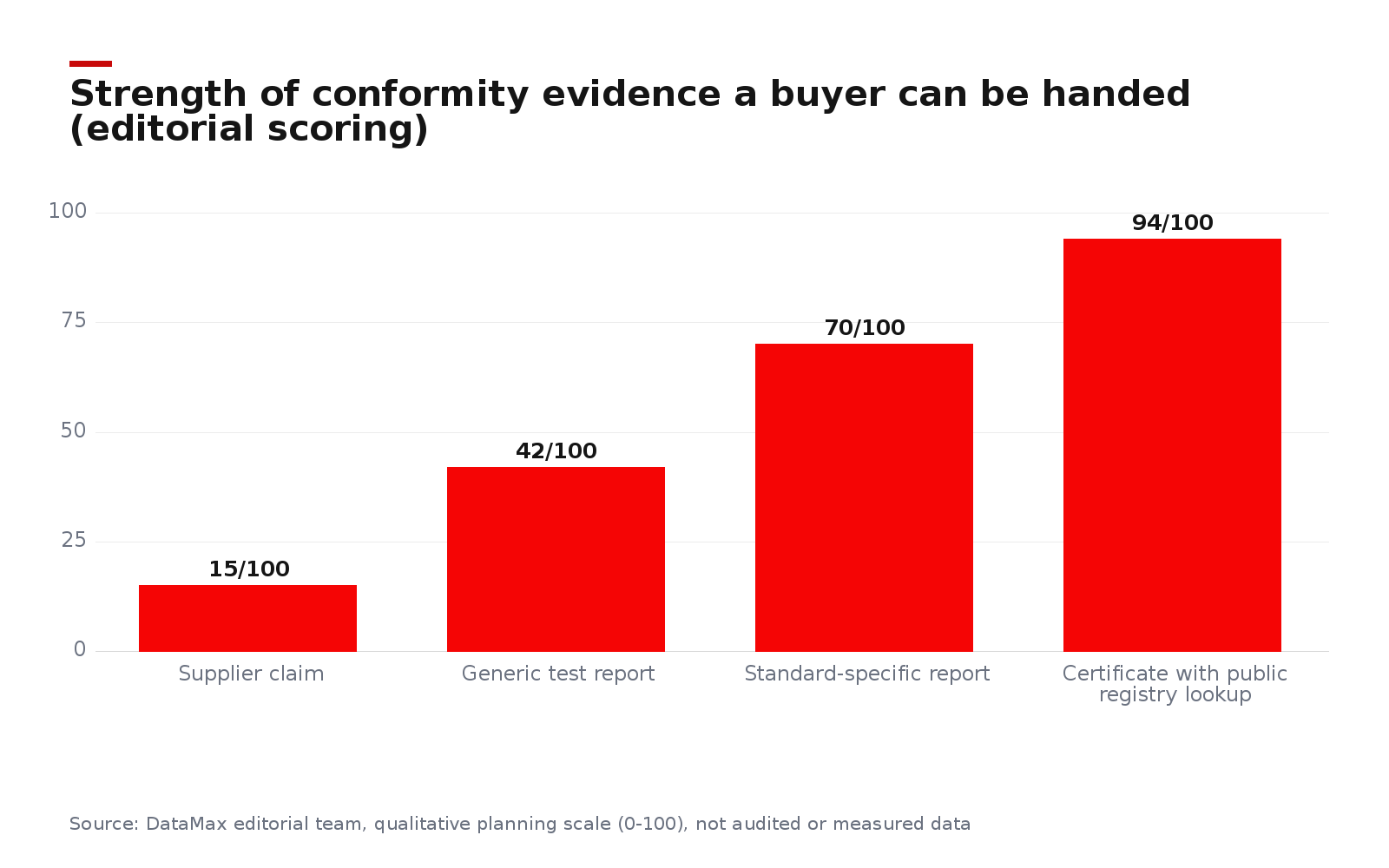
The same figures, in searchable form:
| Evidence option | Editorial score |
|---|---|
| Supplier claim | 15/100 |
| Generic test report | 42/100 |
| Standard-specific report | 70/100 |
| Certificate with public registry lookup | 94/100 |
Procurement should still apply a 2-level approval gate. Level 1 accepts a model into sample evaluation when the supplier provides a certificate or registry reference, the program scope is understood, and the commercial quotation identifies the exact configuration. Level 2 approves volume only after factory evidence and sample testing close the configuration gap.
The commitment tier changes the evidence burden. A trial order may use a supplier declaration plus sample validation, while an operator rollout across thousands of deployed endpoints should require traceable records, change notification, and a controlled firmware process. An integrator carrying a customer-branded service must also control which claims appear in its sales materials.
For each android tv box, compare 5 bill-of-difference lines: certification program, certified model identifier, exact SKU configuration, software-build responsibility, and change-control obligation. A lower-cost SKU can still be preferable if its evidence is complete and the workload fits. A higher-capability SKU is not preferable merely because it decodes more codec profiles.
The practical distinction is between capability and permission. Hardware decode support, DRM module presence, and platform certification may all be necessary, but none alone guarantees that an operator can launch its service. Require the chain from model evidence through signed firmware, middleware, service authorization, display validation, and field update acceptance.
Netflix’s certification-submission data provides a useful commercial comparison signal. The following distribution is limited to submitted devices and must not be presented as a shipment share.

The same figures, in searchable form:
| AV1 support in submitted devices | Share |
|---|---|
| Supported AV1 | 88% |
| No AV1 support | 12% |
Source: Netflix Technology Blog, AV1 — Now Powering 30% of Netflix Streaming (2025-12-01)
A buyer can use this distribution to ask whether a proposed android tv box will participate in future service profiles, but not to infer an individual certification. The DataMax decode table identifies AV1 support for DM21P, DM21S, DM21T, and DM22Q. The commercial test still has to prove that the intended application, DRM flow, entitlement service, content profile, and display chain negotiate a working session.
Buyer situations, ranked by what they punish
A deployment’s failure is not equally expensive across operator, integrator, and vertical-use cases. Rank the situation first, then map its punitive requirement to the platform direction. This prevents a premium specification from being selected merely because it is available.
| Buyer situation | What failure costs most | Primary requirement | Model direction |
|---|---|---|---|
| IPTV operator fleet | Image inconsistency and middleware failure at scale | Stable build control, operator integration, controlled updates | Start with DM21P or DM21S; confirm the final operator middleware build |
| MVPD or OTT white-label launch | Brand, app, DRM, or region claim failing in the field | Model-level certification scope and application-path validation | Evaluate DM21S against the branded image and service requirements |
| AV integrator | Display, EDID, audio, and control integration defects | HDMI and AV behavior across the specified display chain | Validate the selected DM22Q or DM21T with the actual television and control system |
| Premium UHD or cloud-gaming venue | Frame-rate, thermal, or media-path shortfall | 4K@120 decode where required, sustained operation, suitable interfaces | Use DM21T as the stated 4K@120-capable direction |
| Digital-signage operator | Unattended recovery and image drift | Stable recovery behavior, remote management, and configuration traceability | Compare DM21P and DM21S against the installed management client |
Operators punish scale defects: one bad image multiplied across a subscriber estate becomes an incident wave. Their release package should pin the model, memory variant, OS image, middleware version, bootloader policy, update server, and rollback procedure. Certification evidence must follow that package, not sit in a separate supplier folder.
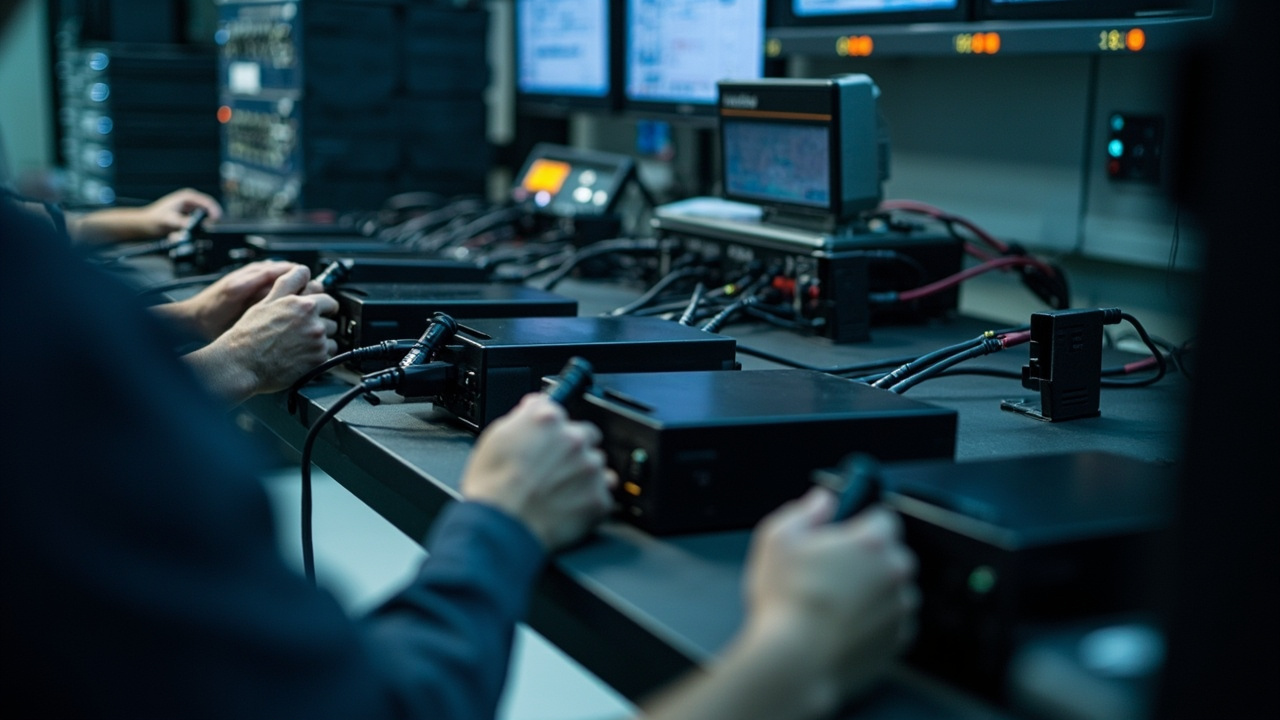
Integrators punish interoperability defects. A compliant platform can still fail because the television rejects a mode, EDID negotiation changes behavior, an AVR exposes limited audio support, or the control layer expects an unavailable port. The test bench should therefore include the production television, network, remote-control path, and audio receiver. The photograph below illustrates the intended validation setting: a telecom engineering bench with physical set-top boxes, HDMI and network connections, instruments, and engineer intervention.
Venue and gaming operators punish sustained-performance and recovery defects. They should test the stated mode, thermal condition, power source, and access pattern rather than relying on a decoder table. For AV1 capability, use the Netflix submission data as a market-planning signal, not a device-level entitlement: “88% of large-screen devices (TVs, set-top boxes, streaming sticks) submitted for Netflix certification 2021-2025 supported AV1.”
Source: Netflix Technology Blog, AV1 — Now Powering 30% of Netflix Streaming (2025-12-01)
A practical ranking is: operator fleet first for fleet-control risk, premium venue second for mode-performance risk, integrator third for interoperability risk, and signage fourth unless unattended recovery dominates. For any android tv box, preserve the selected sample, its report, and its production configuration as a repeatable test kit.
The situations can also be converted into distinct test campaigns. An operator pilot should run a golden-image comparison against a full Ethernet and Wi-Fi network transition test, a signed middleware launch test, and a rollback test. An integrator acceptance should add the selected television, receiver, control system, and required peripheral. A gaming venue should run the stated high-frame-rate media path for a sustained interval under its specified power and thermal conditions.
The ranking is about cost of failure, not model prestige. A 4K IPTV fleet can punish configuration drift more severely than a missing headline codec, while a gaming venue can punish a frame-rate shortfall more severely than a registry-format difference. Both outcomes are resolved by tying the selected model to a testable requirement.
Failure modes that reach the field
The most expensive failure is a category error: treating “Google-certified” as a complete product promise. The certificate may apply to a family or a particular configuration, while the quotation changes the RAM, ROM, firmware, middleware, region, or accessories. A legitimate certificate can then be quoted in a context where the delivered unit is not the evaluated unit.
Field trap
A catalogue-level badge does not establish certification for the ordered SKU. If the quotation says 16GB/32GB/64GB “optional,” the RFQ must name one memory configuration and state which certification evidence applies to it. Confirm against the production datasheet and the ordered build record.
A second trap confuses media capability with service readiness. “AV1” in a decode row does not establish a successful AV1 title through the operator’s CDN, DRM system, application release, entitlement service, and television chain. Widevine L1 likewise does not prove that the commercial service has the corresponding licence-server and device-enrollment path. The field symptom may be manifest playback, negotiation failure, no license, or a resolution drop.
Field trap
Do not accept “certified” and “DRM ready” as test results. The acceptance test must name the application version, content profile, DRM security level, display model, firmware build, and expected session behavior. An undefined test setup can pass while the production path fails.
Additional failure modes propagate through configuration and factory drift:
- Registry mismatch. The model name in the certificate differs from the OEM name, regional suffix, or production label. Procurement must preserve both identifiers and their mapping.
- Image drift. A support update changes boot behavior, middleware integration, certificate handling, or recovery. A certification record may not explain operational suitability of the new image.
- Option ambiguity. A quotation lists optional 1G Ethernet or optional Widevine L1/PlayReady, but the purchase order does. The delivered feature set can therefore diverge from the evaluated configuration.
- Display-chain mismatch. The box outputs a supported format, but the television, AVR, scaler, or distribution amplifier changes the negotiated mode.
- Rights overstatement. A codec, DRM, or audio label is represented as a complete service entitlement rather than a platform capability.
- Audit gap. The buyer receives a PDF but cannot determine which factory, build, or production run it supports.
The safest evidence packet contains 6 layers: commercial configuration, platform and model identifiers, certificate and registry result, software-build identifier, factory production record, and field acceptance result. Each layer needs an owner and date. A missing layer is not proof of failure, but it is a release gate.
Two additional operating failures deserve separate treatment. The first is a device-enrollment gap: the hardware passes local DRM and application tests, but the service cannot provision the device because its identifier, regional parameter, or certificate binding differs from the production record. The second is an update failure: a device passes initial acceptance but a later package removes a required launcher permission, changes boot verification, or fails to reach the recovery server.
These are not interchangeable with platform certification. They are operational dependencies that need owners. For an operator, the enrollment owner should sit with the service and security teams, while the update owner should sit with release engineering and field operations. For a venue integrator, the same product may need a fixed image, a different management client, and an acceptance script for each display environment.
The cost of getting this wrong is paid in different places. A configuration mismatch can trigger replacement stock, recertification review, certification spend, delayed launch, or a public claim that cannot be supported. A DRM-path failure can create a visible service incident. An update failure can fragment a fleet into multiple behavioral groups. None of these consequences is prevented by a more emphatic catalogue label; each requires a named control and evidence.
The selection sequence that removes rework
Move from an attractive device description to a controlled release package in 7 steps. Each step has a defined output, so procurement, engineering, and compliance work from the same evidence.
- State the use case Record IPTV, OTT, AV integration, signage, or cloud-gaming scope; include the region, display model, service operator, middleware owner, and expected operating period.
- Set the hard constraints Define codec, DRM, HDMI, Ethernet, Wi-Fi, update, security, and certification requirements before comparing catalogue features.
- Select a platform direction Compare the supplied DataMax specifications by intended fit, then exclude any SKU whose configured option is not documented.
- Freeze the commercial configuration Name the exact model, RAM/ROM, OS image, firmware branch, regional profile, middleware, accessories, and volume commitment.
- Validate certification evidence Match the supplier evidence to the certified model identifier and registry entry; record the program, scope, status, and any restrictions.
- Run representative sample tests Cover boot, update, recovery, application launch, licensed playback, networking, remote control, display modes, and sustained operation.
- Close the production file Attach factory traceability, inspection results, packaging data, firmware identification, and a signed golden sample before release.
Convert the sequence into RFQ lines. A usable certification line asks: “Provide the current certificate or registry reference for model [identifier], including the certified manufacturer name, program, status, evaluation date, and a written mapping to DataMax SKU [model and RAM/ROM].” A second line asks for the software baseline: “State the production OS image, build identifier, regional configuration, middleware version, bootloader status, and update policy shipped with this order.” A third line separates platform capability from commercial service readiness: “Identify which Widevine L1, PlayReady, HDCP, Dolby Vision, DTS, AV1, VP9, H.265, H.266/VVC, and AVS3 capabilities are enabled, optional, licensed, or not supplied; identify the required test service.”
Factory evidence should be equally specific: “Provide the production-line route, AOI or inspection record, aging-test scope, dark-room or display-test applicability, firmware-loading record, and serial-to-build traceability.” A request for all facilities evidence without identifying the process and production window is too broad to audit.
Keep the decision auditable. The model description in the quotation should match the sample, the sample should match the golden unit, and the golden unit should match the factory record. DataMax can review the required compliance package through the compliance enquiry route. Certificates, DRM, and security provisions must be confirmed per ordered SKU, not inferred from a catalogue page.
For broader platform strategy, the selection sequence can be reconciled with the operator-tier android tv box solution and the canonical android tv box for ISPs guide. The output remains the same: an approved configuration, not a marketing adjective.
The acceptance record should include failure behavior as well as success behavior. A tester should document what happens after a failed application launch, denied license request, interrupted OTA, loss of Ethernet, failed Wi-Fi association, unauthorized remote command, or display reconnection. The expected result can include a retry, a diagnostic message, a safe recovery, or a controlled quarantine; without a predefined rule, the same behavior may be interpreted differently by the factory, integrator, and operator.
A release file can therefore be indexed by 5 artifacts: the approved configuration sheet, the evidence mapping, the signed golden sample, the factory release record, and the field acceptance report. Any later model substitution, memory change, image revision, or middleware upgrade should be assessed against those 5 artifacts rather than treated as a routine stock substitution.
How the factory controls the variable
Factory control converts certification evidence into a repeatable production variable. DataMax’s process must bind the hardware variant, image, inspection result, and shipment identity. The evidence trail should permit a buyer to move backward from a serial number to the unit’s build and forward to the packed shipment.
- Material and line control Match the ordered component configuration to the approved build sheet before SMT release, including memory option, SoC, radio path, interfaces, and identified security components.
- SMT and AOI verification Capture the defined inspection evidence for assembly defects and component placement, then retain it against the production lot and date.
- Software loading Load the controlled image, record its build identifier, and prevent unreleased firmware from entering the shipment stream.
- Functional and aging verification Execute the agreed test coverage for boot, interfaces, network, decode, display, audio, and stability under the defined aging scope.
- Dark-room or applicable visual verification Apply only where screen output or panel-related behavior is part of the declared test plan; record the equipment, sample, and acceptance rule.
- Audit and release Compare the finished unit with the golden sample and release record, retain traceability evidence, and quarantine exceptions.
The records should form a chain rather than a folder of unrelated reports:
- Purchase order Ordered model and RAM/ROM
- Approved build sheet
- Certification evidence mapped to the ordered SKU
- Production lot SMT and AOI records
- Component traceability
- Software-loading and firmware identifier
- Test release Functional, aging, and applicable dark-room evidence
- Golden-sample comparison
- Exception and quarantine disposition
- Shipment Serial list and packing record
- Certificate and configuration archive
- Field acceptance result
Audit-ready release record: retain the exact certification mapping, approved build sheet, image fingerprint, inspection results, aging scope, applicable visual-test evidence, serial list, and signed sample comparison as one traceable package. A generic report without model and lot linkage is not release evidence.
For the actual platform, the supplied DataMax facts establish four different configurations. A memory option does not alter the need for traceability: each production variant requires its own build identifier and mapping. The same rule applies to optional Ethernet speed, optional DRM packages, and operator middleware. No DataMax model should be described as certified unless the applicable evidence is supplied and verified.
A line supervisor needs a simple exception rule: any mismatch among the purchase order, approved build sheet, loaded image, test record, and golden sample sends the unit to quarantine. The disposition should be recorded against the serial number rather than only a batch number. For recurring defects, the corrective action should identify whether the cause lies in material substitution, SMT placement, software loading, fixture calibration, test coverage, or configuration control.
The evidence review can use 3 levels. A documentary review checks naming, configuration mapping, revision control, and record linkage. A sample review checks the ordered hardware and software against the retained evidence. A video factory audit observes the actual material release, SMT/AOI process, software-loading station, aging area, test records, quarantine handling, and shipment archive. The chosen level should match the deployment commitment and the consequence of configuration drift.
DataMax can support this control point with a factory-quality evidence review or a manufacturing audit request. Ask for SMT/AOI records, aging evidence, and the traceability chain specific to the proposed android tv box order. A video factory audit can establish process control, while sample testing establishes the device behavior; both remain necessary parts of a defensible release.
Further reading
- Guide android tv box for isps
- Widevine L1 certification guide
- Dolby Atmos Android TV box guide
- TV box vendor selection checklist
- AOSP vs GMS solution notes
- DataMax DM21P specifications and fit
- DataMax DM21S specifications and fit
FAQ
Does “Google certified” mean every configuration of a set-top-box model is certified?
No. Certification can be defined for a model family or a controlled configuration. The buyer must verify the exact model identifier, hardware version, software build, and permitted options against the certificate and registry record. Confirm applicability per ordered SKU with DataMax, and retain the result in the release file.
Can AOSP Android 11 or Android 14 be treated as Google Android TV certification?
No. AOSP is an operating-system baseline. Google Android TV certification involves a separate compatibility and program framework. Certification status must be demonstrated through the named program’s evidence rather than inferred from the Android version printed in a specification or from the presence of a Google-branded application.
Does Widevine L1 prove that all streaming services will play?
No. Widevine L1 establishes a device DRM implementation under the applicable framework. Service-side licensing, application support, account authorization, content profile, display capability, and regional entitlement must also work. Validate the complete service path with the intended application, content, display, and production image.
Is AV1 support sufficient to meet an operator’s 4K requirements?
No. AV1 decoding is only one part of the path. Specify resolution, frame rate, HDR profile, DRM, application support, network performance, and display behavior. Netflix’s 2021–2025 certification-submission data indicates 88% AV1 support, but it does not describe every device shipped or guarantee an individual deployment.
Which DataMax model should a buyer choose for certification-led evaluation?
Choose from deployment fit rather than certification wording alone. DM21P is stated for 4K IPTV and operator middleware, DM21S for 4K IPTV/OTT white-label work, DM21T for premium UHD and cloud-gaming use, and DM22Q for gaming-oriented deployment. Confirm the production configuration and evidence against the intended use case.
What factory evidence should be requested before volume approval?
Request the approved build sheet, SMT/AOI records, software-loading identifier, functional and aging results, applicable dark-room evidence, exception dispositions, and serial-to-shipment traceability. Also request the certification mapping and a signed golden-sample comparison so deployment evidence remains linked to production units.
Can one certificate cover all regional firmware images?
Do not assume so. A regional image may affect the application, account, rights, network, update, or policy path even when the hardware is unchanged. Require the certificate scope, model identifier, regional build, and permitted configuration to be reviewed together, then verify the shipped image against the approved release record.




