The short answer first: read the ownership language before the price
An RFQ lands with eight supplier responses: one claims full device ownership, another supplies components, and the rest use “factory,” “partner,” or “solution provider” without defining responsibility. The decisive question is not whether a company calls itself an android tv box manufacturer. It is who owns the BOM, controls the firmware, signs the production record, and carries defects after shipment.
For procurement, the useful distinction is ownership. A sourcing agent can arrange components and assembly, but accountability remains fragmented. A factory-type OEM supplies a platform defined by the customer, while a factory-type ODM contributes a product platform and configurable hardware or software. The stronger factory model normally offers a clearer audit trail and a more direct corrective-action path, but it does not replace a specification review.
A defensible RFQ should state the required operating-system baseline, memory tier, codec and output limits, DRM configuration, connectivity, regulatory scope, branding method, firmware-update responsibility, pilot acceptance criteria, and production evidence format. It should also require each bidder to identify who owns the hardware design, Android build, application signing, secure provisioning, supplier selection, and end-of-life handling.
Treat “Google TV,” “Android TV,” “AOSP Android,” and “Google-certified” as different requirements. The product portfolio relevant to this decision includes the DataMax DM21P for 4K IPTV and operator middleware, while broader platform selection is covered in android tv box manufacturer capabilities and ownership terms. DataMax positions itself as an OEM/ODM manufacturer, but each proposal still needs model-level and project-level confirmation.
The practical test is simple: if the quote does not identify the production site, release owner, software maintainer, test evidence, and defect workflow, the commercial term has not established accountability. A model number, chipset, logo, or certification claim cannot fill that gap. This matters when a buyer plans to deploy hundreds or thousands of units, because a late responsibility gap becomes an ecosystem problem involving operators, applications, certificates, and field updates.
The answer therefore rejects a single-label procurement model. Treat the commercial label as an entry point, then map each layer to an owner, artifact, and acceptance criterion. The same answer applies whether the request originates from a pay-TV operator, OTT brand owner, AV integrator, or commercial venue operator. The ownership map matters more than the label because the same visible enclosure can conceal different BOM, firmware, signing, testing, and support arrangements.
Buyer situations, ranked by what they punish
Different deployments fail in different ways. An operator may lose service visibility, an integrator may face device incompatibility, and a venue operator may encounter fleet-management friction. Rank the project by the failure it can least tolerate, then map that risk to the required factory responsibility.
| Buyer situation | Primary requirement | Factory responsibility to demand | Model direction |
|---|---|---|---|
| Pay-TV or IPTV operator | Managed deployment and repeatable firmware | Controlled Android build, update procedure, provisioning and production traceability | DM21P for operator middleware fit; DM21S where Android TV and white-label requirements dominate |
| OTT platform or brand owner | Fast application integration with protected playback | Own or clearly assign firmware signing, Widevine and PlayReady integration, QA ownership and app release control | DM21S for a 4K IPTV/OTT white-label fit |
| AV or IT integrator | Simple installation and predictable interfaces | Locked interface behavior, documented ports, network behavior, recovery method and labeling | DM21P or DM21S; use DM22Q when gaming-oriented behavior is the differentiator |
| Commercial venue or signage operator | Fleet visibility, stable power-on behavior and remote support | Defined provisioning path, update boundaries, serial traceability and a support escalation matrix | DM21P where operator middleware is central; confirm fleet-management requirements against the production datasheet |
| Premium UHD or cloud-gaming buyer | High-frame-rate 4K media and stronger compute headroom | End-to-end 4K validation at the stated frame rate, firmware performance limits and explicit HDMI output mode | DM21T for premium UHD/cloud-gaming fit |
The photograph below shows the kind of controlled electronics environment a factory claim must eventually substantiate. Automated placement alone does not prove component traceability, operator training, or change control; those require separate records.
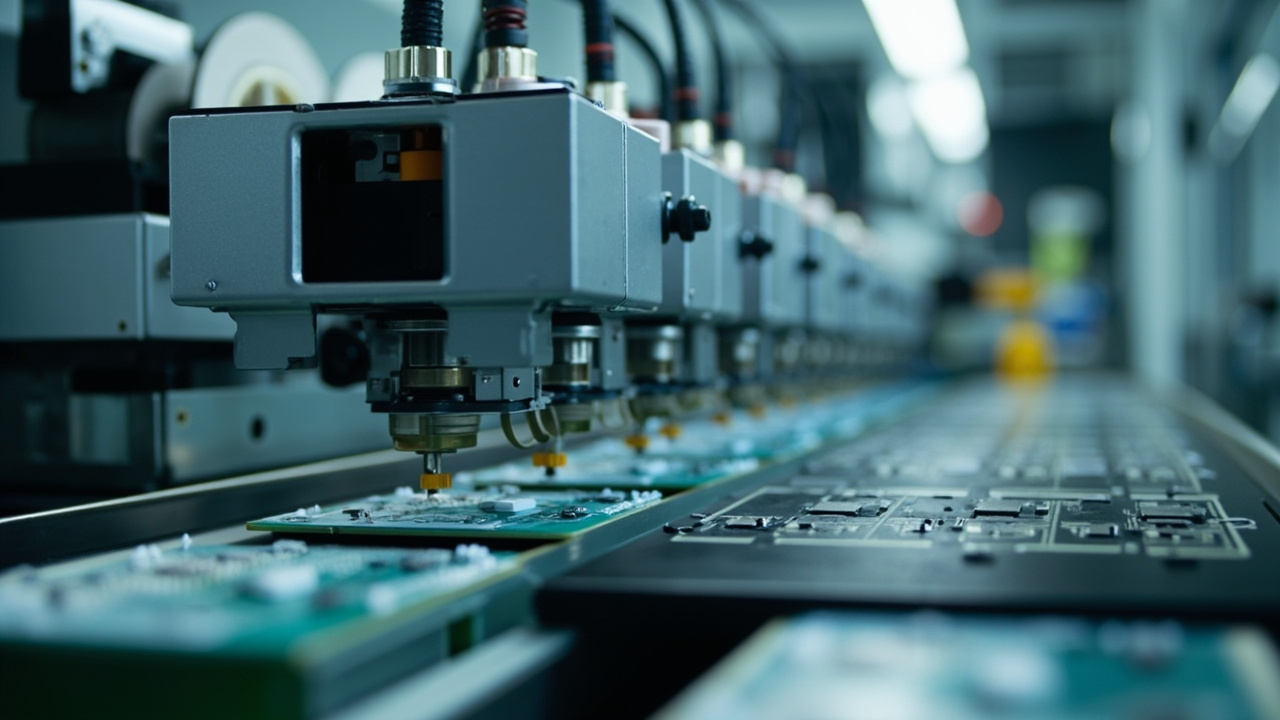
A staged warehouse may show boxes with finished labels while concealing who performed board assembly, which lot contained the Wi-Fi module, or whether the OS image was validated after installation. Conversely, a visible SMT line does not establish application-level playback compliance. Buyers should use the line as context for an evidence trail, not as evidence by itself.
The matrix also exposes where “manufacturer” language becomes insufficient. An operator procurement team may accept a platform with an established middleware integration but still need serial-level configuration records. An OTT brand owner may prioritize application signing and a secure update path over factory tooling. An integrator may need a known port map and stable recovery behavior more than a particular codec tier. A venue operator may need fleet-management behavior that cannot be inferred from the chipset or enclosure.
A practical sequence is to write the unacceptable failure first. For example: “A failed protected-playback test cannot be accepted after deployment.” “A changed network interface cannot be accepted without engineering notice.” “A device without a recoverable boot image cannot enter the pilot.” Each statement becomes an acceptance clause, and each clause identifies the responsible party. The matrix is therefore a starting contract map, not a substitute for one.
A second ranking axis is recovery time. If the operator can replace one failed unit from stock, interface consistency may rank above factory customization. If the device enters a managed access network and cannot be physically reached, firmware update control and recovery rank higher. If a venue changes artwork or applications monthly, release and update ownership rank higher than peak codec performance. These scenarios can point to the same android tv box manufacturer while producing materially different acceptance clauses.
A decision path for the RFQ
Convert the commercial relationship into a sequence of gates. First define the product, then qualify the supplier model, then verify the build and production process. Every gate should have an artifact that can be reviewed without relying on a sales conversation.
- Define the product boundary State the operating system, Google TV versus AOSP requirement, application ownership, codec baseline, maximum output mode, DRM service level, interface, storage, RAM, networking and port list. Name the exact DataMax model only after those requirements are aligned.
- Assign commercial responsibility Ask each bidder to mark the proposed relationship as sourcing, distributor, factory-type OEM or factory-type ODM. Require disclosure of the legal contracting entity, production site, responsible design owner, component sourcing owner and post-shipment support owner.
- Convert claims into RFQ lines Replace “high quality,” “full support” and “Google TV certified” with measurable obligations: acceptance sample count, test sequence, firmware version, region, certification configuration, serial format, labeling, packaging, change-notification period and defect-response process.
- Qualify the engineering evidence Request build documentation, codec and DRM validation records, interface-control information, update mechanism, secure-key process and a production test specification. Confirm that evidence corresponds to the proposed configuration rather than a reference design.
- Run pilot production Use a controlled sample with recorded serial numbers and component lots. Test boot, network, HDCP output, permitted applications, update recovery, port behavior, thermal operation and user-facing labeling before approving volume production.
- Approve the release baseline Record the approved BOM, Android image, application versions, certificates, packaging and accessories. Define what constitutes a change requiring written approval and what evidence is required after that change.
For the opening RFQ, paste these lines into the specification:
- “Operating system: state AOSP Android, Google TV or Android TV, including version and build-source responsibility.”
- “Playback and output: list required codecs, maximum resolution, frame rate and HDMI output mode.”
- “DRM: identify Widevine security level, PlayReady configuration, HDCP requirement and licence-service integration owner.”
- “Manufacturing: identify production site, assembly model, traceability method and authorized production-test record.”
- “Firmware: define signing owner, update mechanism, rollback responsibility and support period.”
- “Acceptance: define sample size, test script, defect categories and release-approval authority.”
Use the inquiry form to request an RFQ response. The first message should contain the target application segment, required OS, intended model or chipset constraint, RAM/ROM tier, DRM and codec needs, port list, expected pilot quantity, target market, labeling approach, and the person authorized to approve the production baseline. That evidence lets an android tv box manufacturer quote the right configuration rather than a generic catalog box.
The decision path also protects against false equivalence between quotations. Two bids can list the same RAM and codec terms while differing in OS maintenance, Ethernet speed, certification scope, or traceability. Require each bidder to answer the same six questions in the same order, then attach one configuration sheet to the commercial response. If a line remains blank, treat it as an engineering scope item rather than accepting an implied commitment.
For an operator, the pilot gate should include a managed-device workflow, a recovery method, and a change record tied to the firmware identifier. For a white-label owner, include application preload, branding assets, certificate custody, and the update owner. For an integrator, include port behavior, remote-control requirements, power behavior, and the exact label or packaging deliverable. A good RFQ makes each supplier show its responsibility rather than asking whether it can “support the project.”
A final gate should examine exceptions. Require each bidder to state what happens when a component becomes unavailable, a DRM service test fails, a region-specific radio requirement changes, or a customer application discovers a firmware defect. The response should identify notification, containment, retest, and release authority. Without an exception route, the proposed process may work only under the exact conditions represented by the sample.
The traps in this category
Most quotation differences are not engineering miracles. They are undefined boundaries. A product may be described as certified while the quoted board revision, firmware build or regional application set differs from the sample. “Support” may mean software diagnosis, component replacement or manufacturing rework. “Custom” may cover a logo, carton, preload, application port or an actual hardware change.
Field trap
A Widevine L1 claim does not by itself establish that the proposed device configuration passes your playback test. If the operator requires L1, specify the device security design, protected-path behavior, certificate provisioning and application playback test. A failed L1 requirement can strand an entire programme after tooling and deployment preparation.
Field trap
Do not let a product label override the datasheet. For example, marketing language around the DM21T or DM22Q may imply an 8K class, but the supplied production facts cap relevant output or decoding at 4K. The procurement comparison must use 4K@120 for the stated DM21T decode classes and 4K@60 for DM22Q, not an inferred 8K output.
Another frequent trap is an Android image whose source is specified but whose lifecycle is not. “AOSP Android 14” does not answer who maintains the build, patches security issues, rotates certificates, manages release notes or approves an application update. Require the exact image identifier, build fingerprint, update mechanism, rollback method and party responsible for each layer.
DRM presents a third trap. Widevine L1 and PlayReady are separate integration obligations, while HDCP is a protected-output requirement. Do not combine those labels into a single “DRM ready” checkbox. A quote should identify the exact security configuration and validation responsibility.
Finally, distinguish factory ownership from design ownership. An ODM may own a reusable platform while the customer controls branding, packaging and applications. An OEM may build a customer-defined design but source critical modules through third parties. Either structure can work; the failure occurs when the RFQ assumes that one label automatically transfers every responsibility.
Several additional quotation ambiguities deserve explicit wording. “Wi-Fi enabled” does not identify antenna layout, regulatory domain, or installed radio configuration. “Same chipset” does not guarantee the same board, memory, thermal design, or power supply. “Google TV” can be used loosely where the actual baseline is AOSP Android, so require the image name and build source. “4K” can describe decode, render, output, or display acceptance, so each stage needs a separate limit. These are inexpensive clarifications before an RFQ; they are expensive corrections after tooling.
The same distinction applies to memory language. “2GB plus 8GB” identifies capacity but not the exact release tuple, application allocation, update headroom, or regional SKU. An android tv box manufacturer should quote a configuration identifier that binds RAM/ROM to board revision and image baseline. Optional wording must also have an owner: identify whether the option is available for the selected region, whether it changes the certification scope, and whether the pilot sample represents the proposed order.
Verification you can ask for on paper
Factory verification starts with the production route. Ask the proposed manufacturer to map each assembly and test stage to a document owner. The evidence should connect component receipt, board assembly, programming, firmware loading, functional test, packaging and shipment.
- Incoming-material control Request supplier approval records, lot identifiers, incoming inspection criteria and evidence that approved alternatives are not substituted without written authorization.
- SMT and AOI evidence Ask for the process flow, first-article inspection record, AOI configuration or approved inspection method, defect disposition and line-repair traceability. Confirm that the record references the same board revision offered for quotation.
- Program and image control Request software-loading records, approved firmware identifiers, signing-key custody process and a record linking each programmed unit to its hardware serial.
- Aging and burn-in evidence Define the burn-in duration, environmental conditions, workload and pass criteria in the RFQ. Request a batch log that records exceptions rather than displaying only a generic pass result.
- Dark-room and display validation Require a documented method for visual defect detection, plus defined checks for output stability and installed application behavior. Ask for sample records tied to the pilot lot.
- Audit trail and release record Obtain the production audit, non-conformance process, corrective-action workflow and release baseline. A sign-off sheet without serial coverage is weaker than a searchable record.
Ask for an evidence index, not a folder of unrelated photographs. Each item should state the board revision, firmware version, serial or lot range, process stage, test method, acceptance limit, result, exception and corrective-action owner. The factory audit request should cover SMT, AOI, aging and dark-room records for the quoted model and manufacturing route.
DataMax can support a review of the manufacturing route through its factory-quality materials. A useful request includes a video factory audit covering SMT placement, inspection stations, firmware programming, burn-in racks, dark-room checks and finished-goods traceability. Ask for evidence that matches the proposed configuration and release baseline, not generic footage from another product line.
The evidence index should be sampled rather than accepted as a binary promise. Select one production lot and trace several serial numbers backward to component lots, forward to firmware programming, and onward to final test. Then select one failed or reworked unit and identify the non-conformance, repair action, retest result, and release decision. This small trace exercises the actual evidence system and can expose gaps that a polished presentation cannot.
Also request the document format before signing: searchable PDF, spreadsheet, or controlled database export should identify revision and retention rules. The buyer should be able to determine which evidence belongs to the quoted board revision, approved BOM, and current firmware baseline. A video walkthrough remains useful for seeing the process, but the index, test specification, and serial-linked records are the auditable portion. Factory audit evidence should be requested for the actual manufacturing route and proposed release, not an unrelated reference line.
One practical check is to ask how the factory responds to a field failure involving a specific serial number. The answer should trace the unit to its board, image, component lots, inspection result, repair history, and release approval. If the android tv box manufacturer can only provide a generic quality policy, the RFQ should require serial-linked records before the pilot is approved.
Entry tier versus commitment tier
The cheapest quotation may represent an entry configuration, not an equivalent product. Compare the bill of differences explicitly: ownership, OS baseline, memory, codec ceiling, DRM, networking, test depth, support boundary and release control.
| Criterion | Entry tier | Commitment tier | RFQ decision |
|---|---|---|---|
| Commercial model | Sourcing agent or component distributor | Factory-type OEM or factory-type ODM | Name the contracting entity and production site |
| Design control | Often combines modules or customer-supplied references | Customer-defined OEM or reusable ODM platform | State who owns schematic, layout, bootloader and Android image |
| Memory | Lower or configuration-dependent tier | Fixed, approved tier per model and region | Require RAM/ROM in the release baseline |
| DRM | Optional or separately scoped | Named service level and validation responsibility | Separate Widevine, PlayReady and HDCP obligations |
| Production evidence | Basic incoming and final test | Traceable AOI, programming, aging and audit evidence | Define required records before the PO |
| Firmware lifecycle | Third-party or limited update responsibility | Defined maintainer, release notes and rollback path | Attach update and security procedures |
| Commercial risk | More coordination layers and blurred accountability | Greater factory commitment and coordination before release | Match the model to programme criticality |
| Regulatory and radio evidence | May be inherited from a module without project-level mapping | Region, configuration, and responsible approver are identified | Request the applicable evidence for the destination market |
| Packaging and branding | Often a logistics subtask | Defined artwork, revision, label, and serial workflow | Attach the approved packaging and labeling files |
| Change control | Informal substitution or component notices | Written notice, impact assessment, and customer approval path | Define notification, exception, and rollback rules |
The editorial ranking below is a planning aid for assigning factory evidence. It is not measured performance data.
A commitment tier usually demands a controlled release baseline, deeper pilot testing and contractual change control. It may also require custom development, so use the custom-development page to define that scope. An entry tier can still fit smaller or less regulated projects, provided the buyer accepts narrower responsibility and obtains equivalent evidence for the actual production route.
The tiers should be judged by the cost of the omitted control. If the entry proposal cannot name the production site, it cannot produce a meaningful serial trace. If it cannot identify the Android build maintainer, a security patch or rollback instruction has no accountable owner. If it cannot separate Widevine, PlayReady and HDCP, the application team cannot decide whether a protected-playback failure belongs to software, provisioning, hardware, or the rights service. The entry tier becomes suitable only when these omissions do not affect programme acceptance.
A commitment tier also carries obligations in both directions. The buyer must freeze requirements, respond to engineering questions, and approve changes through one named authority. The factory must maintain the baseline, notify deviations, and preserve the evidence trail. This exchange creates a usable operating model: fewer parties interpret the same specification independently, and every accepted change has a dated record.
The commitment tier also changes the pilot geometry. Instead of accepting a display carton containing an unspecified board, the buyer can receive traceable units representing the proposed revision, image, memory, radio option, DRM option, and labeling route. That does not prove every future lot is identical; it creates a baseline against which deviations can be assessed. For an android tv box manufacturer, that measurable difference is more useful than an unsupported claim of superior quality.
The mechanism behind the spec
The terminology describes different layers of control. A sourcing agent connects supply and demand. A component distributor controls inventory and channel relationships. A factory-type OEM manufactures a product designed to the customer’s requirements. A factory-type ODM designs and supplies a platform that the customer configures. These are commercial labels, so the contract must map each technical function to a party.
The OS label determines only part of the mechanism. AOSP provides the Android Open Source Project baseline. Android TV is the TV-oriented Android platform and may be delivered through an OEM or certified device path. Google TV is a Google-branded experience with additional application and certification requirements. A supplier’s use of one term does not prove that another requirement has been met. Confirm the exact build, application distribution model, signing authority and update mechanism.
Hardware capability also needs end-to-end interpretation. A decoder supporting AV1 or H.265 at 4K@60 does not guarantee every application, HDMI sink, display mode or resolution will interoperate at that rate. HDMI 2.0b output, the display’s accepted refresh rate, the application’s decode path and the selected firmware jointly determine the result. For the DM21T, the stated 4K@120 decode classes should be tested against the actual output path rather than inferred from codec support.
DRM adds a licence flow between the application, rights server, device security implementation and protected output. Widevine L1 denotes a device security level, not an end-to-end service promise. PlayReady and HDCP have separate configuration and validation responsibilities. A complete RFQ identifies the licence-server topology, test service, device security requirements, certificate provisioning and playback-output requirement.
Connectivity also changes the risk model. A 100M RJ45 variant and a 1G optional variant are not equivalent for large IPTV or OTT traffic tests. Wi-Fi6 2x2 and Bluetooth 5.4 describe the listed wireless configuration, but deployed throughput still depends on radio design, antenna implementation, interference, region approval and network conditions. The final variant therefore belongs in the approved BOM and test script.
The deeper mechanism is configuration control. Hardware identifiers, bootloader settings, Android image, certificates, preinstalled applications, packaging, and label data form one release baseline. A factory can manufacture the same visible model while producing materially different units if those fields are not locked. The buyer should therefore treat a model name as a family label and a configuration identifier as the orderable object.
That distinction also applies to performance claims. Inline AI-SR is a stated feature on the DM21T and DM22Q, but the supplied facts do not state NPU TOPS for DM22Q. It would be unsafe to translate the feature into an unprovided TOPS figure or promise a particular upscaling result. The procurement mechanism should require the exact media pipeline, source format, output mode, display, and acceptance footage to be documented for the approved configuration.
For an android tv box manufacturer evaluation, the useful architecture map therefore has 6 layers: commercial ownership, hardware design, Android image, protected playback, manufacturing execution, and fleet lifecycle. A supplier may own some layers and outsource others. The RFQ should expose that topology instead of asking for a single certification or facility photograph. Responsibility becomes defensible only when each layer has a named owner, an artifact, and an acceptance rule.
Which DataMax models actually sit here
DataMax provides four relevant L1 platforms, but each serves a different procurement direction. The table uses only the supplied product facts; configurations not stated should be confirmed against the production datasheet.
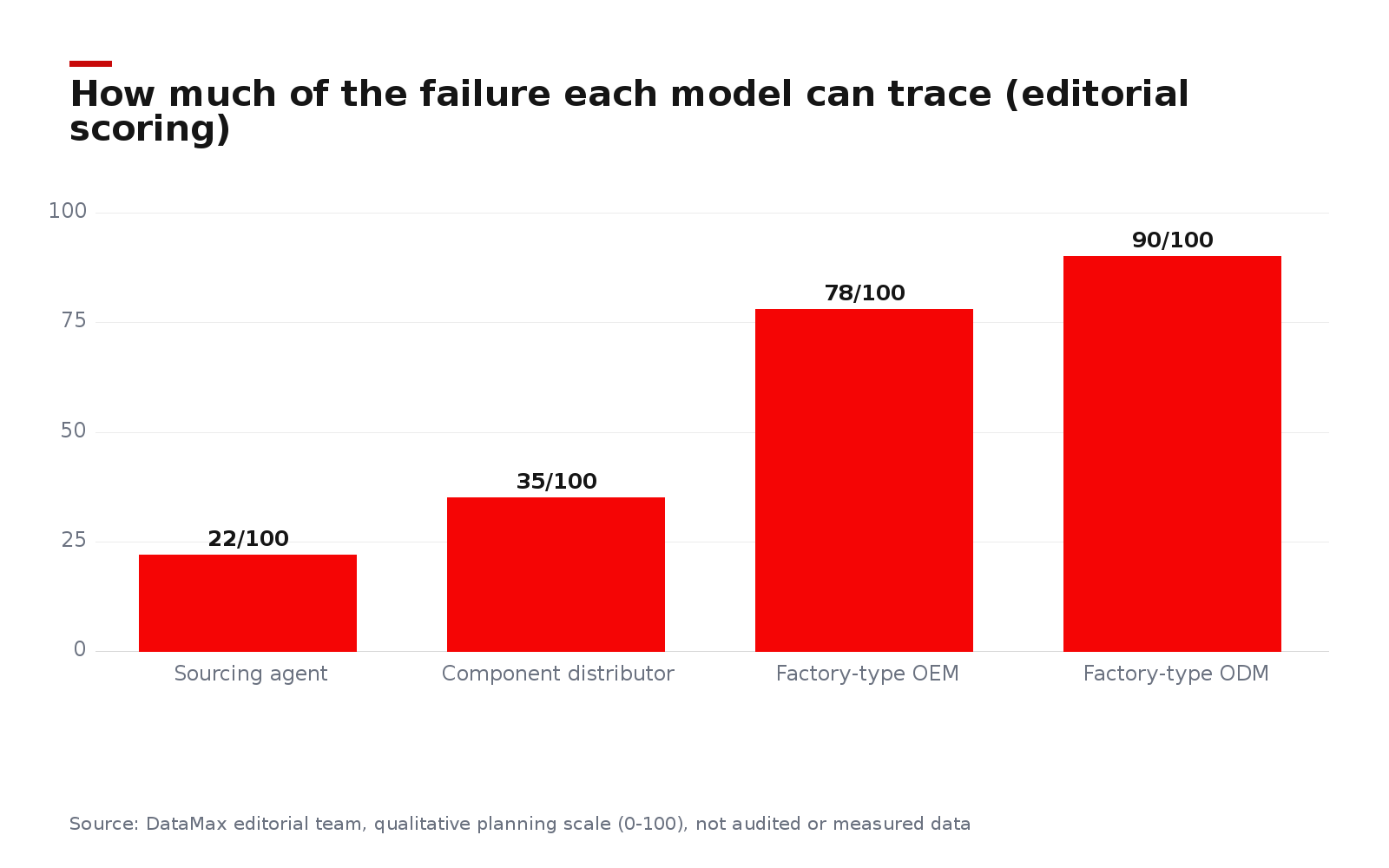
The same figures, in searchable form:
| Relationship model | Editorial score |
|---|---|
| Sourcing agent | 22 |
| Component distributor | 35 |
| Factory-type OEM | 78 |
| Factory-type ODM | 90 |
Source: DataMax editorial team, qualitative planning scale (0-100), not audited or measured data.
| Model and fit | Platform and OS | Memory | Decode and DRM | Interfaces |
|---|---|---|---|---|
| DM21P — 4K IPTV / operator middleware set-top box | Amlogic S905Y4, quad Cortex-A35; AOSP Android 11 | 2GB / 8GB; 4GB; 16/32/64GB optional | AV1 [email protected]; VP9/H.265 4K@60; H.264 4K@30. Widevine L1 / PlayReady / HDCP 2.2 optional | HDMI 2.0b out x1; USB2.0 x2; TF; S/PDIF; 3.5mm AV; RJ45 100M; Wi-Fi6 2x2 + BT5.4; DC 5V/2A |
| DM21S — 4K Android TV box for IPTV/OTT white-label | Amlogic S905Y5, quad Cortex-A55; AOSP Android 14 | 2GB / 16GB; 2/4/8GB; 16/32/64GB optional | AV1 / H.265 [email protected] 4K@60. Widevine L1 / PlayReady optional; Dolby Vision/DTS | HDMI 2.0b out; S/PDIF; AV; USB2.0 x2; TF; RJ45 100M; 1G optional; Wi-Fi6 2x2 + BT5.4 |
| DM21T — Premium UHD / cloud-gaming box | Amlogic S905X5, quad Cortex-A510 (ARMv9); AOSP Android 14 | 4GB / 64GB; family options | H.266/VVC [email protected] 4K@120; AV1/VP9/H.265 4K@120; AVS3 4K@120; H.264 4K@60; inline AI-SR. Widevine L1 / PlayReady optional | HDMI 2.0b out with no HDMI in; USB2.0 x1 + USB3.0 x1; TF; S/PDIF; AV; RJ45 100M; 1G opt; Wi-Fi6 + BT5.4 |
| DM22Q — Gaming-oriented Android TV box | Amlogic S905X5M, quad Cortex-A55 up to 2.5GHz; AOSP Android 14 | 4GB / 64GB; 2/4/8GB; 16/32/64GB optional | AV1/H.265 L5.1 4K@60; inline AI-SR, with no NPU TOPS stated. Widevine L1 / PlayReady optional; Dolby Vision/DTS | HDMI 2.0b out; USB2.0 x2; TF; S/PDIF; AV; RJ45 100M; 1G opt; Wi-Fi6 2x2 + BT5.4 |
Choose DM21P when the fit is an operator middleware set-top box and the listed Android 11 platform aligns with the deployment. Choose DM21S for a 4K IPTV/OTT white-label direction with AOSP Android 14. Choose DM21T for the listed premium UHD and cloud-gaming decode classes, subject to display and application validation. Choose DM22Q for the gaming-oriented fit, but keep its 4K@60 ceiling and unstated NPU performance outside any unsupported promise.
The comparison also shows why “same 4K box” is an inadequate selection category. The DM21P uses Amlogic S905Y4 and AOSP Android 11, while the other three listed platforms use AOSP Android 14 and different Amlogic variants. Memory options, Ethernet options, USB counts, DRM options, and decode ceilings also vary. A buyer should not accept a substitute merely because the retailer category is the same; the RFQ must name the platform and the exact approved configuration.
For optional rows, treat “optional” as a quotation decision, not a delivered capability. Confirm whether Widevine L1, PlayReady, HDCP 2.2, Dolby Vision/DTS, 1G Ethernet, and alternate storage require a separate configuration or approval. For the DM21T, the absence of HDMI input is an interface constraint that can affect installation and signal-routing plans. For the DM21P, the stated 100M RJ45 and DC 5V/2A power requirement belong in the deployment design.
Before treating any row as a release specification, contact DataMax with the exact region, application set, branding method and required optional features. Confirm production availability, certification scope and any unlisted detail against the production datasheet. This discipline turns an android tv box manufacturer label into an accountable supply relationship rather than an ambiguous category term.
The commercial next step should be a project-specific quotation rather than a catalogue response. The sample request should identify the selected model, memory configuration, required DRM options, target application set, destination market, labeling requirement, and pilot acceptance tests. Ask for the same evidence set requested for volume production. A sample that cannot be traced to the proposed configuration is useful as an engineering sample, but not as proof of a release baseline.
Further reading
- Guide android tv box manufacturer
- RFQ checklist for device procurement
- Android TV boxes
- Rockchip Android TV boxes
- Edge computing boxes
- DataMax DM21P specifications and fit
- DataMax DM21S specifications and fit
FAQ
What does “Android TV box manufacturer” usually mean?
It can refer to an OEM factory, an ODM platform owner, a distributor, or an agent coordinating several suppliers. The commercial term alone does not establish design ownership, firmware control, manufacturing responsibility, or defect handling. Require the RFQ to identify the contracting entity, production site, design owner, software maintainer, component sourcing owner, and post-shipment support party.
Is a factory-type ODM always better than an OEM?
No. A factory-type ODM can provide a mature platform and repeatable base configuration, while a factory-type OEM can build a customer-defined design when the programme needs distinct hardware, interfaces, or branding. The better choice depends on the required differentiation, verification burden, release-control model, and whether the customer needs to retain design ownership. Compare written responsibilities rather than labels.
Which certification claims should be verified before ordering?
Verify the exact OS family and version, Google TV or Android TV status where applicable, Widevine security level, PlayReady configuration, HDCP requirement, radio approvals, and destination-market compliance. A quotation containing a certification logo does not prove that the ordered board revision, firmware build, region, and application configuration match the certified sample.
What factory evidence should accompany a pilot approval?
Request records covering incoming materials, SMT, AOI, firmware programming, aging, dark-room testing, final function, serial traceability, non-conformance handling, and pilot release approval. Each record should identify the relevant board and firmware version, lot or serial range, method, acceptance criterion, result, exception, and corrective-action owner. Generic facility photographs are supporting context, not a substitute.
Can low-cost TV boxes use the same application and DRM configuration?
Usually not without validation. Codec support, protected-output paths, secure provisioning, memory, thermal behavior, and HDMI mode handling can vary even when two products share a similar specification label. Use the proposed production configuration for application playback, DRM, network, recovery, and interface testing. Any unlisted configuration should be confirmed against the production datasheet.
What should the first RFQ message contain?
Include the deployment type, operating-system requirement, application ownership, chipset or model constraint, RAM/ROM tier, codec and maximum output needs, DRM requirements, port list, destination market, branding approach, expected pilot quantity, and release-approval owner. This information enables an order-samples request and prevents a supplier from quoting an unrelated configuration.