
What the answer hinges on
The decisive question is not whether an android tv box advertises “H.265”; it is whether the exact production SKU supports the required HEVC profile, level, resolution, frame rate and output path alongside the operator’s DRM, middleware and networking obligations. The strongest DataMax match is DM21P for an operator middleware set-top box because its stated decode set includes H.265 4K@60 and Widevine L1, while DM21S targets 4K IPTV and OTT white-label deployments, DM21T extends the stated codec envelope for premium UHD and cloud gaming, and DM22Q serves gaming-oriented use.
For procurement, specify constraints rather than a codec slogan. A request for “4K HEVC support” can resolve to a device with H.265 [email protected] 4K@60, but it can also hide an HDMI bottleneck, a storage configuration mismatch, a missing DRM option, or a product whose quoted capability differs between the base SKU and a configured order. The chipset name is evidence only when tied to a fixed datasheet revision and purchase order.
H.265 is also the video codec used by HEVC, but codec support does not establish HDR behaviour, audio passthrough, output frame rate, app compatibility or successful entitlement issuance. For the broader platform selection process, see the ISP Android TV box selection guide. This article isolates the codec and platform-fit decision for an android tv box program.
The practical answer is therefore a four-part specification: identify the exact codec envelope, select the model whose stated fit matches the deployment, lock every optional component and software package, and validate the golden sample with production streams. A datasheet claim establishes the starting point; it does not establish the accepted configuration. That distinction matters when an operator deploys hundreds or thousands of units across multiple firmware revisions, because a missing option can be discovered only after the units have reached a distribution centre.
A further procurement issue is scope discipline. H.265 decoding, H.264 compatibility, AV1 readiness, gaming decode limits and audio certification may sit in separate documents. An RFQ that combines them without separating mandatory requirements from roadmap features invites substitutions that look technically acceptable but fail operator acceptance. Keep the source inventory, delivery architecture, DRM contract and device configuration as separate approval records.
Where the terminology comes from
HEVC is the video coding standard commonly called H.265. In procurement language, “H.265 4K” is incomplete because it does not identify the bitstream profile, tier, level, pixel format, frame rate, colour representation or output interface. The four DataMax platforms use different stated HEVC envelopes: DM21P lists VP9/H.265 4K@60; DM21S lists H.265 [email protected] 4K@60; DM21T lists H.265 4K@120 within a broader codec set; DM22Q lists H.265 L5.1 4K@60. These are product facts, not interchangeable performance guarantees.
The application path starts with an IPTV, OTT, gaming or signage service delivering an encoded stream. The decoder must accept the stream, then the device must negotiate HDMI output with the television or display, while the software path must support the selected DRM and playback application. A hardware decoder therefore solves only one stage. An HDMI 2.0b output listed on all four platforms also needs to be checked against the target display mode and refresh-rate plan rather than inferred from a codec table.
DRM introduces another boundary. DM21P lists Widevine L1 and PlayReady, with HDCP 2.2 optional. DM21S, DM21T and DM22Q list Widevine L1 and PlayReady as optional, while DM21S and DM22Q also list Dolby Vision and DTS. Optional means a contractual option, not a base configuration. Each RFQ should therefore state the content-protection package separately from HEVC decoding.
AOMedia’s AV1 specification describes AV1 as an open, royalty-free codec specification developed by AOMedia. That ecosystem position matters because AV1 is also relevant to next-generation delivery, but it should not obscure the actual channel requirement: AV1, VP9 and HEVC can coexist in a decoder specification. Confirm the operator’s current and planned stream mix before allocating silicon, test bandwidth or certification effort.
Source: AOMedia, AV1 Bitstream & Decoding Process Specification
Profile and level should be treated as acceptance inputs. MP-10 denotes Main 10, while L5.1 identifies a level constraint associated with the stated decode capability. A stream that exceeds the selected profile or level may decode incorrectly, trigger fallback software paths or fail outright. Conversely, a device can decode a compliant stream but still fail at the television if the display, cable or mode configuration does not match.
The delivery layer also changes the test obligation. Multicast IPTV can expose the decoder to transport errors, packet loss and tightly timed channel changes. Unicast OTT can add adaptive-bitrate switching, authentication and app-state restoration. A fixed signage feed may appear simpler but requires uninterrupted looping and recovery from a network interruption. These are different acceptance tests even when all three carry the same nominal H.265 label.
Finally, distinguish decode from output. DM21T states H.265 4K@120 decode within a broader codec set, but its listed HDMI 2.0b output must still be tested with the intended television. The supplied facts do not establish every display mode, colour format or HDR handshake. Any RFQ requiring 4K@120 presentation should name the source frame rate, output mode, television model and acceptance procedure together.
Five production SKUs compared
The four quoted platforms, rather than five, form the comparable DataMax set for this angle. Their fit and base memory configurations are distinct enough to support an RFQ, but one specification field must never be normalized: each model’s memory is a base configuration with additional options stated in the production facts. The comparison below keeps the base RAM values separate from the configurable storage tiers.
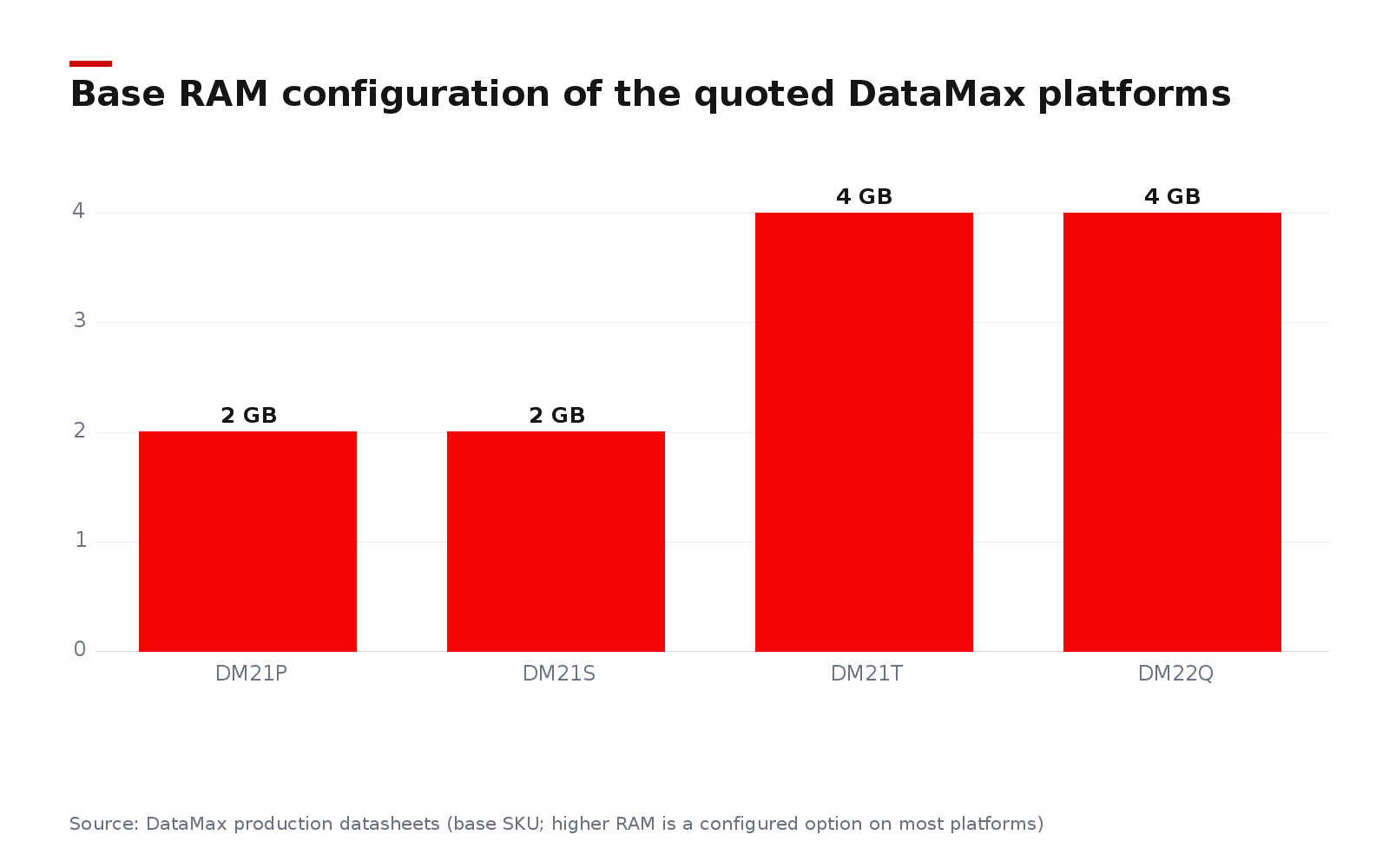
The same figures, in searchable form:
| Platform | Base RAM | Source context |
|---|---|---|
| DM21P | 2 GB | DataMax production datasheets (base SKU; higher RAM is a configured option on most platforms) |
| DM21S | 2 GB | DataMax production datasheets (base SKU; higher RAM is a configured option on most platforms) |
| DM21T | 4 GB | DataMax production datasheets (base SKU; higher RAM is a configured option on most platforms) |
| DM22Q | 4 GB | DataMax production datasheets (base SKU; higher RAM is a configured option on most platforms) |
| Model and fit | Compute and OS | Memory | Decode and DRM | Interfaces |
|---|---|---|---|---|
| DM21P 4K IPTV / operator middleware set-top box | Amlogic S905Y4, quad Cortex-A35 AOSP Android 11 | 2GB / 8GB 4GB; 16/32/64GB optional | AV1 [email protected]; VP9/H.265 4K@60; H.264 4K@30 Widevine L1 / PlayReady; HDCP 2.2 optional | HDMI 2.0b out x1; USB2.0 x2; TF; S/PDIF; 3.5mm AV; RJ45 100M; Wi-Fi6 2x2 + BT5.4; DC 5V/2A |
| DM21S 4K Android TV box for IPTV/OTT white-label | Amlogic S905Y5, quad Cortex-A55 AOSP Android 14 | 2GB / 16GB 2/4/8GB; 16/32/64GB optional | AV1 / H.265 [email protected] 4K@60 Widevine L1 / PlayReady optional; Dolby Vision/DTS | HDMI 2.0b out; S/PDIF; AV; USB2.0 x2; TF; RJ45 100M (1G optional); Wi-Fi6 2x2 + BT5.4 |
| DM21T Premium UHD / cloud-gaming box | Amlogic S905X5, quad Cortex-A510 (ARMv9) AOSP Android 14 | 4GB / 64GB family options | H.266/VVC [email protected] 4K@120; AV1/VP9/H.265 4K@120; AVS3 4K@120; H.264 4K@60; inline AI-SR Widevine L1 / PlayReady optional | HDMI 2.0b out (no HDMI in); USB2.0 x1 + USB3.0 x1; TF; S/PDIF; AV; RJ45 100M (1G opt); Wi-Fi6 + BT5.4 |
| DM22Q Gaming-oriented Android TV box | Amlogic S905X5M, quad Cortex-A55 up to 2.5GHz AOSP Android 14 | 4GB / 64GB 2/4/8GB; 16/32/64GB optional | AV1/H.265 L5.1 4K@60; inline AI-SR (no NPU TOPS stated) Widevine L1 / PlayReady optional; Dolby Vision/DTS | HDMI 2.0b out; USB2.0 x2; TF; S/PDIF; AV; RJ45 100M (1G opt); Wi-Fi6 2x2 + BT5.4 |
For a normal IPTV middleware deployment, the DM21P is the direct operator fit; for a white-label OTT product with a newer AOSP baseline, DM21S is the relevant comparison; DM21T is the choice when the RFQ explicitly requires the broader 4K@120 codec set or inline AI-SR; DM22Q targets a gaming orientation with 4GB base RAM and stated H.265 L5.1 4K@60 decoding. Do not replace “4K@120 decode” with “4K@120 display output”; the production facts cap output and decode at 4K and do not establish 8K output.
The storage column also carries procurement consequences. DM21P’s base 2GB/8GB configuration must be distinguished from its stated 4GB and 16/32/64GB options. DM21S moves from a 2GB/16GB base to stated 2/4/8GB RAM and 16/32/64GB storage options. DM21T starts at 4GB/64GB with family options, while DM22Q starts at 4GB/64GB and also lists 2/4/8GB RAM options. These ranges are alternatives, not cumulative entitlements.
The interface differences can decide the model before codec testing begins. DM21P explicitly includes a 3.5mm AV output and DC 5V/2A supply. DM21T has one USB2.0 port, one USB3.0 port and no HDMI input. A universal remote, game controller, storage accessory or peripheral attached to those ports may change the RFQ. Conversely, no additional port should be inferred merely because another model lists it.
OS baselines can affect application planning. DM21P uses AOSP Android 11, while the other three use AOSP Android 14. The facts do not establish Google Android TV certification or every preinstalled application. If the programme requires a particular store, launcher, middleware build or device-management service, state that requirement separately and validate the image rather than deriving it from the AOSP version.
The operator, the integrator and the venue
An IPTV operator starts with the service contract: stream profile, DRM, middleware, entitlement, multicast or unicast delivery and home-network behaviour. A 4K channel encoded with HEVC is not enough information to issue a hardware RFQ. Add the required level, frame rate, HDR mode, audio format and whether the set-top box must support a legacy operator middleware image. That requirement set points toward the DM21P operator middleware platform, provided the selected configuration matches the programme.
An AV or IT integrator works from the display and room. For a boardroom, hotel room or corporate display, specify the display input, supported resolution and refresh rate, audio extraction need, mounting method, remote-control protocol and network ownership. The integrator should test the proposed model and television together rather than infer compatibility from HDMI 2.0b alone.
A venue deploying digital signage has a different bottleneck: continuous playback, centralized updates, device recovery and content scheduling. An android tv box selected for an H.265 pilot must survive the venue’s update policy and physical network. A gaming-oriented model may suit an interactive display, while a standard IPTV fit may suit a managed operator estate.
| Situation | Requirement to fix | Model direction |
|---|---|---|
| IPTV operator middleware | 4K operator service; H.265 profile and frame rate; Widevine/PlayReady; fixed Ethernet topology | DM21P direction; verify middleware image and exact memory option |
| IPTV/OTT white label | AOSP Android 14 baseline; branded launcher and apps; 4K HEVC; optional DRM | DM21S direction; fix storage, Ethernet and DRM configuration |
| Premium UHD or cloud gaming | 4K@120 codec envelope, inline AI-SR, broader codec set | DM21T direction; validate source content and display path |
| Gaming-oriented venue | H.265 L5.1 4K@60; 4GB base RAM; low-latency input and sustained operation | DM22Q direction; confirm controller, network and display behavior |
| Digital-signage rollout | Continuous H.265 playback, centralized management, recovery process | Choose by management stack and endurance evidence, not codec alone |
| Premium hotel-room deployment | 3.5mm AV, fixed Ethernet, operator middleware, remote-control integration | DM21P direction where its stated interfaces match; validate room-control system |
| Cloud-gaming exhibition | H.265 4K@120 decode, USB3.0 peripheral path, no HDMI-in capture requirement | DM21T direction; confirm source delivery, controller and display modes |
| White-label retail channel | Branded launcher, 4K HEVC, 1G Ethernet option, optional content protection | DM21S or DM22Q direction; decide by workload and software package |

The macro image illustrates where procurement risk concentrates: the SoC, memory and board are physically coupled, but the commercial capability is defined by how those components are configured, tested and combined with software. Treat the photograph as illustrative and validate every platform claim against the production datasheet.
For an operator, the useful evidence packet includes the channel inventory, middleware image, network assumptions and representative entitlement test cases. For an integrator, it includes display models, cables, control protocol, audio-routing diagram and room-management interface. For a venue, it includes the operating schedule, update mechanism, recovery expectation and environmental conditions. The model does not remove these project-specific obligations.
A pilot should separate three outcomes: successful decode, successful secure playback and successful presentation. Record each separately in the test log. A green decode result does not prove that the licence was issued or that the television negotiated the intended mode. This method exposes failures before a fleet is committed and creates a reusable acceptance template for the next model comparison.
A decision path for the RFQ
Begin with content, not silicon. Write the required stream inventory into the RFQ: service type, HEVC profile and level, resolution, frame rate, HDR mode, audio and DRM. Require the bidder to identify which stated capability satisfies each line. If a future stream format is required, name it explicitly rather than relying on “multi-codec”.
Next, lock the device configuration. Quote the model and base RAM, then state every selected RAM and storage option line-by-line. The base configurations differ across the four DataMax platforms, and optional tiers must be fixed in the purchase order. Also state the SoC exactly as the approved datasheet names it: Amlogic S905Y4 for DM21P, Amlogic S905Y5 for DM21S, Amlogic S905X5 for DM21T and Amlogic S905X5M for DM22Q.
- Define the video envelope Record each mandatory codec, profile, level, pixel format, resolution and frame rate. Add HDR, audio and DRM as separate lines.
- Select the operating baseline Choose AOSP Android 11 for the stated DM21P fit or AOSP Android 14 for the other three models. Add any Google Android TV, certification or middleware requirement separately.
- Fix hardware configuration Name the SKU, base memory, selected RAM and storage, Ethernet speed option and required ports. Prevent substitution through a model-number-only line.
- Define the software package List launcher, applications, middleware, update mechanism, regional settings, DRM integration and production security requirements.
- Attach objective evidence Request sample playback reports, interface checks, factory process evidence and relevant target-market compliance records.
- Approve a golden sample Test the exact software, hardware and accessory configuration before volume release and make it the configuration reference for the PO.
A practical RFQ line is: “Provide an IPTV set-top box based on the approved DM21P configuration, with stated H.265 4K@60 decode, Widevine L1 and PlayReady, HDCP 2.2 as the selected option, the specified RAM and storage, RJ45 100M, and a documented AOSP Android 11 software image.” The line is stronger because it binds the application requirement to one model without rewriting the datasheet’s decode claim.
For evaluation, normalize the quotations. A lower quote that omits optional DRM, uses a different storage tier, lacks the required Wi-Fi or Ethernet option, or supplies an unapproved OS image is not equivalent. This is the point at which procurement should demand an itemized bill of differences rather than compare headline specifications.
Turn each comparison into an auditable response. Require a column for “requirement”, one for “manufacturer response”, one for “evidence reference” and one for “acceptance method”. Do not accept a model name as a response to an OS, memory or DRM line. The evidence reference should point to a datasheet revision, test report, certification record or approved golden-sample record.
Resolve conflicts before the commercial review. If a quotation offers a newer OS but changes the stated SoC, or adds storage while removing the optional DRM package, record the full difference rather than highlighting the improvement. If the requirement cannot be met, mark it open with a named owner and due date. A blank cell is not equivalent to “included”.
Use a two-stage acceptance gate. Stage 1 is technical: representative streams, DRM issuance, output modes, network behaviour and peripheral operation pass on the sample. Stage 2 is production: the build code, firmware identifier, memory and storage options, ports and certificates match the approved sample. A codec test alone satisfies neither gate completely.
The traps in this category
The first trap is treating a chipset name as proof of a complete delivery chain. A decoder can support H.265 while the application lacks the required profile, the TV negotiates an unsuitable mode, the DRM service withholds a licence, or the installed image lacks the operator middleware. Validate playback with representative streams and the target display.
Field trap
A quotation that says “4K HEVC” without a profile, level and frame rate is not an equivalent technical offer. A mismatch at purchase-order stage can trigger software rework, failed acceptance tests, component substitution and a delayed operator launch.
The second trap is reading optional capabilities as standard. HDCP 2.2 is optional on DM21P. Widevine L1 and PlayReady are optional on DM21S, DM21T and DM22Q. The 1G Ethernet option is available on DM21S, DM21T and DM22Q, while RJ45 100M is the stated base interface on all four platforms. Dolby Vision/DTS is listed for DM21S and DM22Q. A quotation must name the selected configuration and attach the production datasheet revision.
Field trap
Do not upgrade a marketing label into a technical capability. The production facts for DM21T cap output and decode at 4K, while DM22Q’s maximum is 4K@60; neither supports an 8K claim in the supplied facts. Treating 8K wording as an acceptance criterion creates an unprovable requirement.
There is also a RAM-capacity trap. The chart exposes only base RAM—2 GB for DM21P and DM21S, 4 GB for DM21T and DM22Q—and does not normalize the optional tiers. A quoted 4 GB/64 GB unit is different from a base 2 GB/8 GB unit. Base configuration only; optional RAM tiers exist and must be fixed line-by-line in the PO.
Finally, avoid confusing codec support with a complete user experience. An android tv box may decode the stream but still fail thermal, memory, boot, update-control or app-certification requirements. The quotation should identify the operating image, application set and test evidence, not just the silicon.
One failure mode is testing a short promotional clip instead of the operator’s actual payload. A short file may omit Dolby Vision metadata, dynamic HDR, multichannel audio, seamless channel switching or the particular Main 10 profile used in production. Obtain sanitized but representative test assets and test across cold start, channel change, standby recovery and repeated playback.
Another failure mode is accepting a display photograph rather than an output-mode record. A visible 4K image does not reveal whether the device presented the intended refresh rate, colour format or HDR mode. Ask for capture data or an instrumented display log, and state whether the result is decode-only or end-to-end presentation.
A third failure mode is normalizing the Ethernet line. RJ45 100M is the stated base on all four platforms, with a 1G option listed for DM21S, DM21T and DM22Q. If the design requires 1G, write that option into the PO and test it with the intended switch, cable and service traffic. The same caution applies to optional DRM: “listed” and “selected” must occupy separate fields.
How the factory controls the variable
The factory controls this variable by preserving a traceable chain from component issuance to the accepted finished unit. SMT places the specified SoC, memory and supporting components; AOI checks assembly-level visual defects; aging exercises the assembled board; and a dark-room visual inspection exposes enclosure or display-related issues that are not visible in normal production lighting. These controls must be tied to the approved SKU and build revision, not merely cited as general factory capabilities.
- Lock the build definition Match the production datasheet revision, approved SoC, memory configuration, OS image and accessory list to a unique build code.
- Control line placement Verify material identity and placement at SMT, then retain the inspection result for the production lot.
- Run AOI Inspect the assembled PCBA for placement and soldering anomalies before software loading.
- Load controlled firmware Record the image identifier, bootloader state and configuration applied to each accepted lot.
- Age and exercise the unit Run the specified burn-in or aging procedure before final assembly.
- Complete dark-room inspection Check the finished device under controlled lighting and document the release decision.
- Audit the evidence chain Reconcile input inspection, SMT, AOI, aging, dark-room and final test records against shipment quantities.
For a deployment built around an android tv box, request a video factory audit or a topic-specific evidence pack showing SMT/AOI, aging and dark-room records, plus the exact production datasheet and firmware revision. DataMax can be asked to tie the evidence to the quoted SKU rather than provide disconnected process photographs.
Decoding capability must then be verified at the product level. Use encoded streams matching the operator’s profile, level, frame rate and HDR requirements, and exercise the target DRM service and application. Pair playback testing with HDMI output verification, Ethernet or Wi-Fi behavior, audio routing and the required peripherals. The result should identify the exact golden sample and its software configuration.
The audit trail should be legible to procurement and engineering. For each lot, show component lot identity where controlled, line records, AOI result, aging duration and disposition, dark-room result, firmware identifier, final test result and authorized shipment link. Where DataMax evidence differs from a generic claim, the engineering team should reconcile it before the PO is released.
Build the final test around the same path as the customer experience. Insert the network, authenticate, request content, obtain the DRM licence, decode, render and output. Repeat under the applicable operating conditions, including cold start and repeated channel changes. Record whether the issue is content, entitlement, decoding, display negotiation, application or network; without that split, a failed playback test produces little corrective information.
Version control is the second half of factory control. The approved image identifier, launcher version, middleware build, application bundle, certificate set and configuration file must correspond to the golden sample. If an update mechanism is required, define when updates are allowed, how rollback is handled and which devices receive each build. A factory can assemble identical boards and still ship different commercial configurations if software state is not controlled.
Audit sampling should also include substitutions. For each reported lot, verify that the SoC marking, memory configuration, storage option, Ethernet variant and DRM package correspond to the purchase order. Escalate any engineering change that affects codec claims, output interfaces or certifications. DataMax’s factory-quality information and certification records can form part of the review, while final acceptance remains tied to the selected production configuration.
Two routes, one bill of differences
The lower-commitment route is the base configuration: select the smallest stated platform whose decode and interface requirements match the deployment. The commitment route adds the exact RAM and storage tiers, optional DRM, faster Ethernet, a white-label software image and stronger production evidence before shipment. Neither route should be sold as “more codec”; the difference lies in configuration certainty and launch risk.
| Decision line | Entry route | Commitment route |
|---|---|---|
| Model basis | Choose one of DM21P, DM21S, DM21T or DM22Q from the stated fit | Same approved model, with a golden sample and locked build code |
| Memory | Base RAM and base storage remain explicitly identified | Selected RAM and storage written line-by-line in the PO |
| Codec wording | Use the model’s exact stated H.265 envelope | Add representative stream profiles, frame rates and output verification |
| DRM and feature options | Mark optional capabilities as pending configuration | Name the selected Widevine, PlayReady, HDCP, Ethernet and audio options |
| Software | Record OS baseline and required application package | Freeze firmware, launcher, middleware, apps and update procedure |
| Factory evidence | Request standard production documentation | Request lot-linked SMT/AOI, aging, dark-room and final-test evidence |
| Acceptance | Functional sample check against the RFQ | Golden-sample regression plus shipment inspection against locked specifications |
| Interfaces | List required ports and the stated Ethernet variant | Lock port set, selected 1G option where applicable and accessory list |
| Change control | Record requested changes for quotation comparison | Require approval before any SoC, memory, firmware or certification change |
| Delivery traceability | Identify model and configuration on packing documents | Link build code, firmware, test disposition and shipment lot |
The editorial scale below ranks procurement readiness, not measured performance:
For a strict H.265 4K IPTV programme, DM21P and DM21S are the direct comparison because their stated H.265 ceilings are 4K@60. DM21T becomes relevant when the requirement reaches the broader 4K@120 decode set, while DM22Q serves the gaming-oriented 4K@60 envelope. An android tv box decision should follow that exact requirement boundary, not a generic “HEVC ready” label.
The bill of differences is not only a purchasing record; it is a change-control tool. Every added memory tier, optional DRM package, Ethernet variant, image or port creates another item that must be confirmed in the golden sample and shipment inspection. Removing an option can be as consequential as adding one because it may alter the hardware, firmware or certification evidence.
DataMax can support the next step with a platform inquiry or a sample request. Before issuing a volume PO, email [email protected] with the SKU list, approved memory and storage options, target-market certificates, middleware and DRM checklist, and the requested SMT/AOI/aging evidence pack.
Further reading
- Guide android tv box for isps
- H.265 HEVC Android TV box guide
- Widevine L1 certification guide
- Dolby Atmos Android TV box guide
- TV box vendor selection checklist
- DataMax DM21P specifications and fit
- DataMax DM21S specifications and fit
FAQ
Does H.265 support mean an Android TV box is ready for 4K?
No. H.265 support covers video decoding, not the complete 4K service path. A buyer must also verify the required profile, level, frame rate, HDR mode, DRM package, application support, HDMI output and network configuration. The DataMax model sheets provide the baseline decode claims, while the golden sample must prove the deployment.
Which DataMax platform matches a 4K IPTV operator middleware box?
The DM21P is the direct fit because its stated use is a 4K IPTV and operator middleware set-top box. It lists H.265 4K@60, Widevine L1, PlayReady and optional HDCP 2.2, with AOSP Android 11. Confirm the selected memory, storage, DRM and Ethernet configuration against the production datasheet.
Should a buyer choose the DM21T for 4K@120 content?
Choose DM21T only when the source and output requirements justify its stated 4K@120 decode envelope. Its production facts also list H.266/VVC [email protected] 4K@120, AV1, VP9, H.265 4K@120, AVS3 4K@120, H.264 4K@60 and inline AI-SR. Decoder capability does not by itself establish the display mode, and no 8K output claim is supported.
Is 2 GB RAM enough for a 4K Android TV box?
The DataMax facts list 2 GB base RAM for DM21P and DM21S, and 4 GB for DM21T and DM22Q, with optional tiers. RAM adequacy depends on OS image, applications, middleware and operating mode. The RFQ should lock the exact option rather than ask the supplier to choose a suitable tier during production.
What evidence should accompany an H.265 RFQ?
Request the production datasheet revision, exact SoC, memory and storage, OS image, DRM selection, interface configuration, representative playback results and HDMI verification. For production assurance, also request lot-linked SMT/AOI, aging, dark-room and final-test records. A codec headline without configuration evidence does not establish acceptance readiness.
Does DataMax offer Android TV boxes for ISP and operator deployments?
DataMax provides the quoted DM21P, DM21S, DM21T and DM22Q platforms for the stated IPTV, OTT, premium UHD, cloud-gaming and gaming-oriented uses. The broader procurement and software baseline considerations are covered in the ISP Android TV box selection guide. Final suitability depends on the fixed production configuration and target-market requirements.




