

The short answer first
An RFQ lands with two versions of the same platform: a catalogue line promising Android 11, 2GB/32GB, RK3562 and 500 cd/sqm, while the production datasheet specifies Hi3751, AOSP Android 9, 1GB/8GB and 300 cd/sqm. That contradiction decides the RFQ: an android display is not a purchasable configuration until the SKU, operating system, silicon, memory, panel brightness, power input and evidence package are frozen in the purchase order. The more demanding the deployment, the more expensive an ambiguous specification becomes.
Hi3751 remains relevant for 1080p digital-signage work, but it should not be positioned as a 4K Android TV platform. The DataMax DS43H fits hospitality, hospital and restaurant wall signage with its 43-inch TFT LED panel, 1920x1080 resolution, 300 cd/sqm brightness and HDMI/LVDS inputs. Its stated decode ceiling is 1080P@60 with VP9 10-bit, with no 4K or AV1. For operator IPTV or OTT boxes requiring 4K decoding, a different architecture is required.
Lifecycle assessment must cover three linked records: the hardware bill of materials, the Android and middleware maintenance boundary, and the factory’s verification evidence. A product page, catalogue and purchase order should agree. Where they do not, request the production datasheet and a signed SKU matrix before approval. This article focuses on that comparison rather than a generic platform overview; the broader procurement framing is covered in Hi3751 Android display: the question buyers get wrong.
A second decision-grade point is that this platform choice is workload-specific. DS43H combines a 43-inch display and Hi3751 into a defined signage appliance. DM21P, DM21RTD and DM21S separate media processing from the television and address different operator, retail and white-label requirements. An android display decision therefore needs an application profile, not merely a diagonal-size or processor comparison. The same nominal feature can have different consequences in a managed IPTV network, a hospital information system and a restaurant menu controller.
Decision rule: treat the production datasheet as the controlling reference only after DataMax confirms it applies to the ordered SKU. Freeze every conflicting catalogue field in a signed SKU matrix before the purchase order is released.
Buyer situations, ranked by what they punish
Deployment context determines which error causes the greatest operational loss. An operator with a managed IPTV estate punishes middleware, DRM and update failures. A hospital or restaurant operator punishes panel brightness, input compatibility and long-running service. An integrator quoting a display enclosure around a 43-inch panel needs mechanical and electrical constraints fixed before fabrication. A white-label OTT programme punishes an Android build that reaches retail without the intended applications and rights.
| Situation | Primary requirement | Model direction | Failure exposed |
|---|---|---|---|
| Operator IPTV deployment | Managed middleware, DRM and 4K media path | DM21P or DM21S | Wrong DRM, codec or memory tier |
| Retail or operator programme requiring certified Android | Google-certified non-Google-TV AOSP+GMS SKU | DM21RTD | Uncertified build or mismatched application set |
| Hospital wall signage | 1080p panel, controlled deployment and defined inputs | DS43H | Catalogued 4K-class platform substituted for stated panel platform |
| 4K Android TV white-label programme | AV1/H.265 4K@60 and newer Android baseline | DM21S | Hi3751 limits inherited from 1080p signage |
| Custom enclosure or integrator build | Fixed dimensions, input, power and thermal constraints | DS43H subject to mechanical confirmation | Late discovery of power or interface mismatch |
| Retail chain with certified application distribution | Google-certified non-Google-TV identity and controlled image | DM21RTD | Source build lacks the required certification or applications |
| Hospital patient-information wall | 1080p signage with fixed inputs and installation envelope | DS43H | Signal source, enclosure or temperature assumptions differ |
| IPTV upgrade with 4K encoder requirements | 4K@60 codec path and operator middleware | DM21P | 1080p decoder creates black-frame or restart symptoms |
| OTT retail launch requiring a newer OS baseline | AOSP Android 14 with 4K media support | DM21S | Older Android image delays app validation |
| Integrator consolidating panel and player tenders | Exact dimensions, input direction and power configuration | DS43H after drawing review | Cutout, cable route or mains interface is invalid |
The ranking should not be based on unit performance alone. Consider the consequence and reversibility of each error: a replacement set-top box can be swapped through distribution, while a wall-mounted panel may require access, lift installation and content recertification. A mismatched power input can damage the installation path; an uncertified Android image can block application publication; an understated codec requirement can cause intermittent playback failures under network conditions.
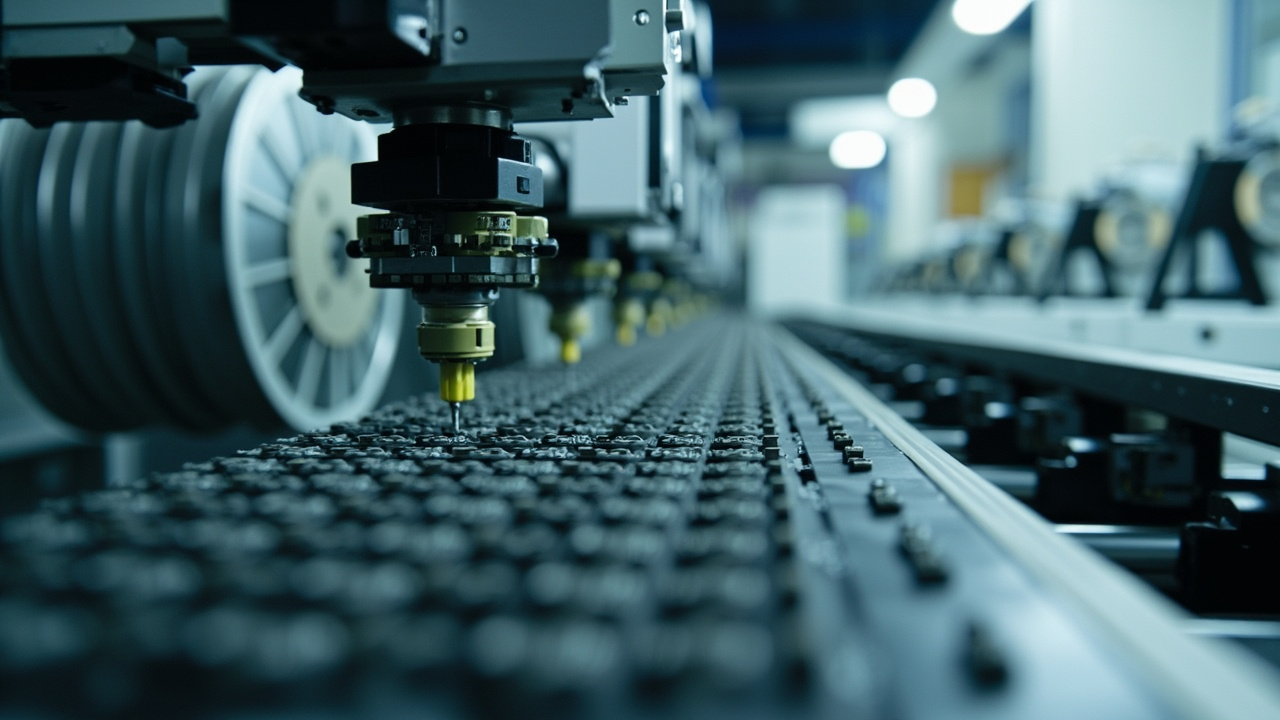
A modern SMT line shows where the practical work begins: components are placed onto boards before the configuration becomes a purchaseable platform. Production evidence must connect those boards to the exact panel, enclosure, firmware and Android image. During factory acceptance, the buyer can select a finished unit, trace its serial number to the inspection record and inspect the physical labels against the approved android display SKU matrix. That audit is more valuable than a general factory presentation because it tests configuration reproducibility, not merely process capability.
The procurement consequence differs by site. In an IPTV headend rollout, a codec mismatch may affect many subscribers and require a staged firmware rollback. In a hospital, a failed network or input path can interrupt information services and trigger local operational workarounds. In a restaurant, brightness and viewing angle may determine readability rather than raw decoding performance. Rank the requirement by business interruption, remediation effort and whether substitution is physically practical.
A second ranking axis is certification. DM21RTD addresses operators and retailers requiring a Google-certified non-Google-TV AOSP+GMS SKU. DS43H’s stated AOSP Android 9 identity does not establish a comparable retail certification scope. When the application package depends on Google distribution services, the android display requirement should name certification status explicitly and require the delivered build to match the approved image.
A decision path for the RFQ
Convert the RFQ from a model name into a set of acceptance lines. The sequence below separates application requirements from factory options and prevents an attractive headline specification from overriding a constrained product.
- Define the deployment envelope State the location, mounting method, ambient conditions, expected daily operating window, signal source and whether content is managed by an operator or local signage application.
- State the media contract Write the required resolution, refresh rate, codec profiles, HDR or SDR expectation, DRM system and licensing model. For DS43H, the stated support is 1080P@60 plus VP9 10-bit, with no 4K/AV1.
- Freeze the platform identity Record the exact SoC and operating system. “Hi3751 Android display” may refer to different catalogue entries, but only the confirmed SKU line defines what is delivered.
- Freeze memory and storage Identify RAM and ROM for every deployment profile. Treat 4GB RAM and 16GB, 32GB or 64GB storage as options only where the stated product facts expressly allow them.
- Lock the physical and electrical interface Specify panel size and resolution, brightness, contrast, viewing angle, backlight rating, inputs, outputs, dimensions, power input and operating temperature.
- Attach the evidence list Require production-datasheet revision, firmware identity, Android build record, inspection evidence, burn-in or aging record, packaging label, carton mark and serial traceability.
- Place the same matrix in the PO Attach the signed SKU matrix to the purchase order and require any future substitution to pass documented approval. The signed matrix controls over catalogue shorthand.
The RFQ should ask for exceptions, not just affirmative claims. A response saying “Android supported” is weaker than one specifying “AOSP Android 9 for DS43H, with image version recorded before shipment.” Likewise, “HDMI” is weaker than a complete port map with quantity and direction. These lines reduce approval cycles because engineering can resolve them without reconstructing intent from a catalogue export.
A pasteable RFQ line should look like this: “One DataMax DS43H signage platform with HiSilicon Hi3751 quad 32-bit A53 and Mali-450, AOSP Android 9, 1GB/8GB, 43-inch TFT LED at 1920x1080 and 300 cd/sqm, HDMI input, LVDS input, USB2.0 x4, RJ45 100M, confirmed power configuration, dimensions 989x578.5x60.3mm, operating range 0-50C, and the attached production evidence package.” It should end with: “Any departure from this matrix requires written buyer approval before build release.”
A second line can isolate the media and content boundary: “Acceptance content shall be 1080P@60 using the agreed VP9 10-bit profile and the declared HDMI or LVDS source path. 4K and AV1 are outside the stated DS43H decode scope.” This prevents an integrator from using the box’s network capability as evidence of local 4K media handling. It also creates a testable result rather than an ambiguous promise that the product supports modern video.
For an operator tender, append separate lines for middleware version, provisioning method, DRM requirements, application package, update responsibility, device-management expectations and recovery image. For a signage tender, append the signage application, display schedule, network dependence, input source, physical mounting constraints and panel-use profile. The same android display platform can pass one contract and fail the other because the acceptance evidence differs.
Do not omit the replacement rule. Require the supplier to state whether hardware revisions, Android images, panel suppliers, power modules or memory configurations can change during the programme. If any can change, define who approves the change, how samples are revalidated, and how existing deployed units remain identifiable. A change-control line prevents a successful pilot from drifting into an unqualified production run.
The traps in this category
The main trap is configuration ambiguity. Hi3751 identifies a processor family, not the complete platform. Android version, panel brightness, memory and power can vary in separate source documents. If a quotation combines fields from different products, it creates a platform that may never enter production.
Field trap
A catalogue line naming RK3562, 2GB/32GB and 500 nit conflicts with the DS43H product facts naming Hi3751, 1GB/8GB and 300 cd/sqm. Do not treat the catalogue line as an alternative configuration unless DataMax confirms it as a defined orderable SKU. The field cost is not merely documentation debt: an enclosure, thermal model, firmware image or procurement plan may already assume the wrong platform.
Field trap
The DS43H facts conflict on power: one line specifies DC12V/2A, while another describes AC100-240V<=85W. Confirm the production power option against the signed datasheet and PO. If the enclosure or site provides mains AC but the device expects DC, the installation interface and safety review change even though the panel remains 43 inches.
A second trap is conflating display capability with decoder capability. A 1920x1080 panel does not decode 4K media merely because the attached box has an AV1-capable SoC, and an AV1-capable SoC does not add AV1 support to a platform whose stated decode profile excludes it. The source, resolution, codec and output path must be evaluated together.
A third trap is treating “Android” as the application boundary. An AOSP image can expose different launcher behaviour, device-policy controls, application permissions and update mechanisms. A GMS-certified AOSP image has an additional certification dimension, but the supplied DM21RTD facts do not establish its complete media, memory or port configuration. Those fields must be confirmed against the production datasheet rather than inferred from another platform.
A fourth trap is accepting “same panel” without same controls. Two 1920x1080 panels can differ in brightness, contrast, viewing angle, backlight, input arrangement and physical dimensions. For DS43H, the quoted 989x578.5x60.3mm body, 89deg viewing angle, 1500:1 contrast, 6ms response and 0-50C range must be checked against the enclosure drawing and site heat conditions. An android display selected by panel size alone can still fail mechanical installation or readability review.
Commercial quotations can also hide lifecycle boundaries. “Android 9” identifies a platform generation, but it does not establish security-update cadence, middleware support responsibility, app compatibility, recovery process or replacement availability. Those terms belong in the support schedule. Likewise, a 50,000-hour backlight figure describes the stated panel parameter; it is not a blanket operating-life promise for the complete display or its electronics.
Do not turn an absent specification into an implied approval. “DRM not listed” does not establish suitability for protected streaming. “No 4K/AV1” must be treated as an exclusion for DS43H, not as a promise that another source format can bypass the constraint. The purchase record should identify absent features explicitly where they affect acceptance. That discipline turns an android display comparison into a set of enforceable product boundaries.
Verification you can ask for on paper
Factory control must produce a traceable chain from the DS43H panel specification to the finished unit. “Tested” without an evidence record is not enough for a volume programme or a wall-mounted installation. The evidence should be selectable by production lot, panel serial, board serial and shipment carton.
- Incoming material controls Request the approved-component list for panel, power supply, main board and cables, with lot-level inspection records and substitution rules.
- SMT and AOI evidence Ask for line inspection records, AOI review for the assembled PCB and approved rework control. The record should identify the board revision and production date.
- Program and functional test Require evidence covering ports, HDMI and LVDS input, network connectivity, audio output where applicable, storage, USB, wireless functions and the specified Android build.
- Display and image verification Request a test method for resolution, panel illumination, interface output, burn-in screening and the applicable display parameters. For DS43H, compare the production record with 1920x1080, 300 cd/sqm, 1500:1, 6ms and 89deg as stated in the product facts.
- Aging or burn-in record Obtain the defined duration, operating mode, sample coverage and rejection criteria. Confirm the wording rather than assuming that every unit receives an identical continuous run.
- Audit trail and shipment trace Link the serial number to the test record, firmware image, carton label, packing list and factory audit trail.
Minimum evidence pack: approved BOM, PCB revision, AOI result, functional test report, image/version record, aging procedure and result, panel/board serial traceability, carton mark, packing list and signed SKU matrix. For this comparison, also request the Android build record and the evidence covering 1080P@60, VP9 10-bit, panel brightness and the confirmed power input.
The factory should explain sample-versus-100-percent coverage. A process may use 100-percent automatic electrical testing while using sampling for destructive or long-duration aging. A sample plan is acceptable when its scope is explicit; an undocumented assumption is not. The DataMax factory-quality record should show how inspections connect to the same SKU sold to the buyer, rather than relying on generic capability statements.
Define the evidence hierarchy before approval. The production datasheet defines the offered configuration; the approved BOM identifies the components; the AOI and functional records demonstrate board assembly and test results; the image record identifies software; the packing evidence connects hardware to the shipment. A catalogue image or marketing sheet cannot override that chain. If the chain contains an unresolved gap, the correct status is “pending verification,” not “assumed compliant.”
For a wall-mounted android display, request a sample trace using one proposed serial number. The buyer should be able to locate the board revision, test result, firmware identity and carton mark. The review should also verify the physical nameplate, approved model code and supply configuration. This is especially important where the enclosure drawing and purchase order were derived from separate documents.
For operator hardware, add a provisioning and recovery record to the paper audit. State whether the device identity is provisioned before shipment, how the approved image is applied, how a failed application installation is recovered and what record proves the intended middleware version. These controls connect factory acceptance to field deployment. A factory test that proves only Android boot does not prove that the operator’s application, DRM or device-management workflow will complete.
The buyer can request a video factory audit through DataMax’s manufacturing capability, but should focus the audit on the variables material to this comparison. Review SMT placement and AOI controls for the specified board, functional test instructions for the correct input path, aging procedures for the intended duty cycle, and the mechanism that prevents catalogue substitutions. A generic tour establishes context; these records establish whether the approved android display can be reproduced.
Entry tier versus commitment tier
“Entry” and “commitment” describe programme scope, not guaranteed performance. The entry tier can serve a controlled 1080p signage project where the application, enclosure and service path are stable. The commitment tier applies when 4K media, operator middleware, newer Android, certification, broader memory options or managed deployment creates a higher engineering burden.
| Criterion | Controlled signage entry | Operator or white-label commitment |
|---|---|---|
| Representative direction | DS43H | DM21P, DM21RTD or DM21S |
| Platform fit | 43-inch hospital, hospitality and restaurant wall signage | 4K IPTV, certified AOSP+GMS, or 4K white-label Android TV |
| SoC direction | Hisilicon Hi3751 quad 32-bit A53 with Mali-450 | Amlogic S905Y4 quad Cortex-A35, Realtek RTD1325, or Amlogic S905Y5 quad Cortex-A55 |
| Android baseline | AOSP Android 9 | AOSP Android 11, GMS-certified AOSP, or AOSP Android 14 |
| Media ceiling | 1080P@60 plus VP9 10-bit; no 4K/AV1 | DM21P: AV1 [email protected], VP9/H.265 4K@60, H.264 4K@30; DM21S: AV1 and H.265 [email protected] 4K@60 |
| DRM direction | Not stated in DS43H facts | DM21P: Widevine L1, PlayReady, HDCP 2.2 optional; DM21S: Widevine L1 and PlayReady optional |
| Lifecycle control | Panel, image, input and power SKU lock | Firmware, middleware, DRM, certification and optional memory tier lock |
| Memory posture | 1GB / 8GB stated | DM21P: 2GB / 8GB with stated options; DM21S: 2GB / 16GB with stated options; DM21RTD: confirm against the production datasheet |
| Interface posture | Integrated panel with HDMI input, LVDS input, USB2.0 x4 and RJ45 100M | HDMI output, network, wireless, USB, AV and audio interfaces vary by model; use the model-specific port map |
| Certification posture | AOSP identity stated; no GMS scope stated | DM21RTD is the stated Google-certified non-Google-TV AOSP+GMS direction |
| Primary lifecycle dependency | Panel supply, control-board revision, power module and image | Application compatibility, middleware, DRM, certification and update ownership |
| Quotation risk | Conflicting Android, power and alternative catalogue fields | Optional DRM, memory, storage and certification fields can be mistaken for standard content |
The lifecycle distinction is architectural. DS43H integrates a display into a defined signage appliance, so component obsolescence affects panel supply, control-board revisions, power modules and the Android image. A set-top box separates media compute from the television, allowing a clearer operator refresh cycle but introducing middleware, DRM, app and network obligations. Neither path removes lifecycle management; it relocates it.
Entry-tier procurement should concentrate its controls on mechanical integration, input compatibility, brightness, image stability and image maintenance. A signage controller may remain physically installed for years, so panel supply continuity, spare-unit matching and firmware reproducibility can be as important as boot speed. The quotation should request a spare-part strategy and the exact identifiers needed to reorder a matching unit.
Commitment-tier procurement adds media security and fleet management. The relevant android display acceptance test may include a protected-content licence request, middleware installation, operator provisioning, recovery after application failure and identification of the build in the field. That scope differs from a wall-signage acceptance test, even where both devices carry an Android user interface.
The mechanism behind the spec
Hi3751 is specified as a quad 32-bit A53 with Mali-450 graphics. The four CPU cores and 32-bit architecture describe the compute class; they do not by themselves determine user-interface responsiveness, storage endurance, codec support or Android feature availability. Those depend on the complete board, memory implementation, firmware, drivers and selected Android image.
The display path begins at the source. A player decodes compressed media into frames, the graphics pipeline composites those frames, and HDMI or LVDS carries the signal to the panel. Decode support must match the source profile, while the panel resolution and interface path must match the output. For DS43H, 1080P@60 and VP9 10-bit define the stated media capability; HDMI input and LVDS input define its stated physical input routes.
DRM is a separate delivery layer. Widevine L1, PlayReady and HDCP 2.2 do different work: the first two govern protected software licensing in set-top-box deployments, while HDCP protects a video link. The stated option on DM21P must be ordered and verified; it should not be assumed for every SKU. Likewise, AV1 capability, an AV1 codec profile and a completed platform implementation are separate claims. Procurement language should preserve those distinctions.
Android adds a maintenance boundary. AOSP Android 9, AOSP Android 11, GMS-certified AOSP and AOSP Android 14 imply different feature and certification scopes. The application must be validated against the actual build. For a GMS programme, certification and the intended application set must be included in the delivery definition rather than treated as a distributor’s later responsibility.
The panel specification is equally mechanical. A 43-inch TFT LED display at 1920x1080 and 300 cd/sqm cannot be assessed as a generic “43-inch Android television.” Its 1500:1 contrast, 6ms response, 89deg viewing angle, stated 50,000-hour backlight and 0-50C operating range define the quoted physical envelope. An enclosure that limits airflow, sunlight exposure or ambient temperature can invalidate the assumed operating condition.
Codec support operates below the display interface. A decoder accepts a compressed bitstream, reconstructs video frames and delivers them through the graphics and output path. A 1920x1080 panel can still receive a 1080P@60 signal, while a decoder that cannot process the selected source profile may fail before the panel is relevant. The DS43H exclusion of 4K and AV1 therefore belongs in the source-design stage, not merely in the panel specification.
DRM introduces another handshake. The application requests a licence through the device’s protected path, the licence authorises permitted content under its policy, and protected video may require an output-side protection mechanism such as HDCP. A set-top-box procurement line should identify which DRM systems are required, whether support is optional or included, and what test stream or device will demonstrate the delivered licence flow. An android display requirement without those distinctions leaves security acceptance undefined.
AOSP also changes what the buyer must validate. An AOSP build provides the Android platform baseline, while GMS-certified AOSP adds a defined Google Mobile Services identity for the stated non-Google-TV use case. Neither label substitutes for application compatibility testing. The buyer should confirm launcher behaviour, input handling, permissions, update mechanism, recovery path and the exact image assigned to the order.
Panel lifecycle is not processor lifecycle. The stated 50,000-hour backlight figure belongs to the DS43H panel specification; it does not establish the service interval for the controller, power module, Android image or application. A credible programme definition records which components DataMax supports, which the integrator supports, how a replacement is configured and how the android display identity remains traceable after repair.
Which DataMax models actually sit here
The model comparison must begin with the platform’s stated fit, not the fact that several products can display an Android UI. DS43H is the signage-specific platform in the supplied DataMax facts. DM21P, DM21RTD and DM21S serve operator or set-top-box use cases where 4K decoding, middleware or certification drives the choice.
The base RAM chart distinguishes compute tiers, but it does not resolve the DS43H configuration conflicts. Those must be handled through the signed SKU matrix.
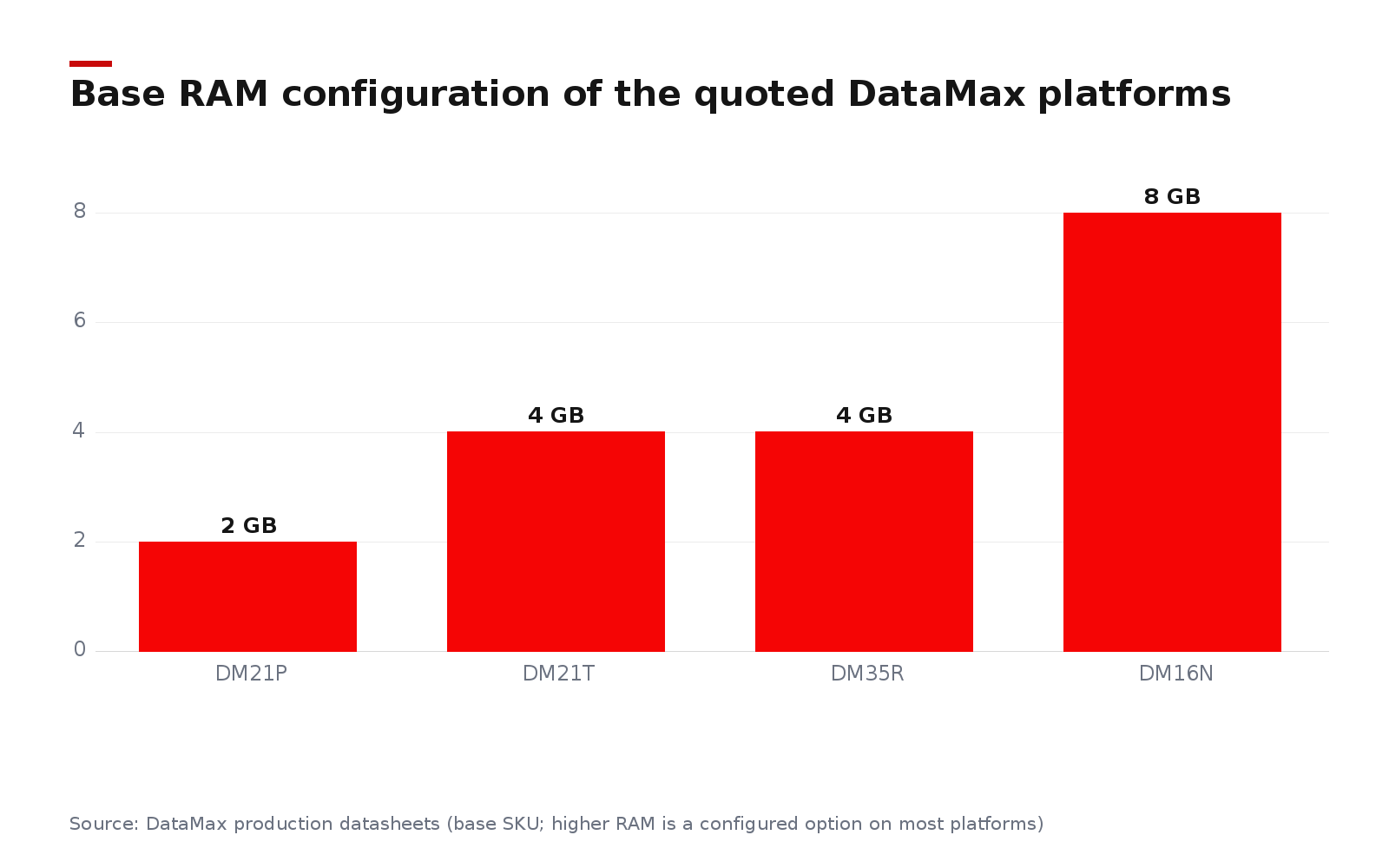
The same figures, in searchable form:
| Model | Base RAM |
|---|---|
| DM21P | 2 GB |
| DM21T | 4 GB |
| DM35R | 4 GB |
| DM16N | 8 GB |
| Model | SoC and OS | RAM/ROM | Display and media | Interfaces and fit |
|---|---|---|---|---|
| DS43H | HiSilicon Hi3751 quad 32-bit A53, Mali-450; AOSP Android 9 | 1GB / 8GB | 43-inch TFT LED, 1920x1080, 300 cd/sqm, 1500:1, 6ms, 89deg; 1080P@60 and VP9 10-bit; no 4K/AV1 | HDMI input, LVDS input, USB2.0 x4, RJ45 100M with 1G optional, DC12V/2A; 989x578.5x60.3mm; 0-50C; stated 50,000h backlight |
| DM21P | Amlogic S905Y4, quad Cortex-A35; AOSP Android 11 | 2GB / 8GB; 4GB and 16/32/64GB storage optional | AV1 [email protected], VP9/H.265 4K@60, H.264 4K@30; Widevine L1, PlayReady, HDCP 2.2 optional | HDMI 2.0b output x1, USB2.0 x2, TF, S/PDIF, 3.5mm AV, RJ45 100M, Wi-Fi6 2x2 and BT5.4, DC 5V/2A; 4K IPTV and operator middleware |
| DM21RTD | Realtek RTD1325; GMS-certified AOSP | Confirm against the production datasheet | AV1 capable; other media parameters confirm against the production datasheet | Operator and retail fit requiring a Google-certified non-Google-TV AOSP+GMS SKU; port details confirm against the production datasheet |
| DM21S | Amlogic S905Y5, quad Cortex-A55; AOSP Android 14 | 2GB / 16GB; 2/4/8GB RAM and 16/32/64GB storage options stated | AV1 and H.265 [email protected] 4K@60; Widevine L1 and PlayReady optional; Dolby Vision/DTS | HDMI 2.0b output, S/PDIF, AV, USB2.0 x2, TF, RJ45 100M with 1G optional, Wi-Fi6 2x2 and BT5.4; 4K Android TV white-label fit |
For DS43H, do not substitute catalogue claims for the stated production facts: the Android version, power option and any RK3562/2+32/500-nit alternative require confirmation against the production datasheet and an explicit SKU in the PO. Base RAM only indicates the starting configuration; higher RAM tiers on other platforms must also be fixed line by line. DataMax can support this comparison through its manufacturing capability, while sample requests can be handled through sample ordering.
The practical selection is straightforward once the workload is fixed. Choose DS43H when the requirement is a defined 43-inch 1080p signage appliance and the stated exclusions fit the content plan. Choose DM21P for a 4K IPTV or operator middleware direction requiring AOSP Android 11 and the stated media profile. Choose DM21RTD when the programme specifically requires a Google-certified non-Google-TV AOSP+GMS SKU. Choose DM21S when the programme needs AOSP Android 14 with the stated 4K AV1/H.265 direction for a 4K white-label box.
The procurement record should preserve the distinction between stated facts and open items. DS43H’s production facts already establish its principal platform identity, but power and any alternative catalogue configuration still require confirmation. DM21RTD has fewer stated configuration details, so its memory, port map and complete media contract belong in the evidence request. Optional DRM and memory selections for DM21P and DM21S must be written into the order rather than carried as assumptions.
An android display model number alone cannot settle this comparison. The signed matrix should identify the model, SoC, OS, RAM/ROM, media profile, DRM state, ports, power and approved evidence. DataMax can then reproduce the same baseline across pilot and production, while the buyer retains a clear reference for substitution approval and lifecycle support.
Further reading
- Hi3751 Android Display: The Question Buyers Get Wrong
- RFQ checklist for device procurement
- Nigeria SONCAP compliance support
- Compliance support by market
- Allwinner Android TV boxes
- DataMax DM21P specifications and fit
- DataMax DM21RTD specifications and fit
FAQ
Is Hi3751 suitable for a 4K Android TV box?
Not on the stated DS43H facts. Its panel is 1920x1080, and its decode specification is 1080P@60 plus VP9 10-bit with no 4K/AV1. A 4K operator or OTT programme should evaluate DM21P, DM21S or another explicitly qualified platform instead of assuming Hi3751 inherits box-level 4K capability.
Which DataMax model matches a 43-inch hospital sign?
The supplied DS43H facts identify it as the hospitality, hospital and restaurant wall-signage platform. Its stated configuration includes a 43-inch TFT LED panel at 1920x1080 and 300 cd/sqm. Confirm the exact Android, memory, power and any alternative configuration against the production datasheet.
What should be attached to an RFQ for Hi3751?
Attach the signed SKU matrix, production datasheet, approved BOM, PCB revision, Android image record, panel and board serial traceability, AOI report, functional test, aging procedure and result, plus the carton and packing evidence. Also state the media profile, inputs, power option, environmental range and the required maintenance boundary.
Does Widevine L1 apply automatically to the Hi3751 product?
The supplied DataMax facts do not state Widevine support for DS43H. Widevine L1 and PlayReady are stated as optional for DM21P and DM21S. Any protected-content requirement must be named in the SKU matrix and verified on the production configuration rather than inferred from the chipset.
How should conflicting Android and power fields be resolved?
Do not average or reconcile them informally. The DS43H facts include Android 9 and DC12V/2A, while conflicting lines state Android 11 and an AC100-240V<=85W description. DataMax must confirm the controlling production record, and the confirmed fields must appear in the signed PO and physical inspection evidence.
Can lifecycle be assessed from the backlight figure alone?
No. The stated 50,000-hour backlight is one DS43H panel parameter, not a complete operating-life promise. Lifecycle also depends on the Android image, application compatibility, update responsibility, replacement sourcing, panel availability and the ability to reproduce the approved configuration. Email [email protected] with the SKU list, target-market certification requirements, middleware/DRM checklist and proposed production evidence pack so the engineering review can be tied to one baseline.




