

Before the terminology: the decision
An RFQ reaches engineering with one line: “Hi3751 Android display.” The requested product may be a 43-inch wall-mounted signage player, not a television. The first answer is to separate the display endpoint from the Android appliance. android display is shorthand, not an acceptance specification, and the processor name cannot resolve panel resolution, interface direction, codec limits, certification, power, or memory.
The stated DS43H route combines a 43-inch TFT LED panel with Hisilicon Hi3751 and AOSP Android 9. Its production facts specify 1GB/8GB, 1920×1080, 1080P@60, VP9 10-bit, and no 4K/AV1. That makes it relevant to hospital, hospitality, and restaurant wall signage. It does not make it a 4K IPTV set-top box.
A defensible RFQ therefore names the exact model, resolves each “optional” item, fixes the production configuration, and defines sample acceptance. For an integrated panel route, confirm power against the production datasheet. For a 4K operator route, evaluate DM21P, DM21RTD, or DM21S against their stated roles. Send the application, resolution, codecs, OS/certification requirement, power arrangement, and test conditions in the first message through DataMax inquiry.
Before quotation, answer four questions. Is the panel integrated or driven by an external box? Is “display resolution” the source, decoder limit, output, or native panel matrix? Does the project need plain AOSP, GMS-certified AOSP, or an operator image? Which options are ordered rather than merely available?
A hospital corridor example shows why this matters. Scheduled 1080p signage over wired Ethernet may fit the DS43H route if the installation matches the stated panel and environment. A later request for 4K advertising with DRM changes the product class. The controlled response is a revised RFQ, not an assumption that an android display label authorizes a hardware upgrade.
Deployment scenarios and the spec each needs
The same product wording can support several projects, but each scene has a different controlling constraint. Hospital wayfinding prioritizes stable boot, input flexibility, installation access, and operation in the stated temperature range. Restaurant menu boards add ambient-light, viewing-distance, and content-consistency requirements. Operator television projects prioritize 4K decoding, middleware, DRM, and remote operations. The visible endpoint may resemble one category while its acceptance criteria belong to another.
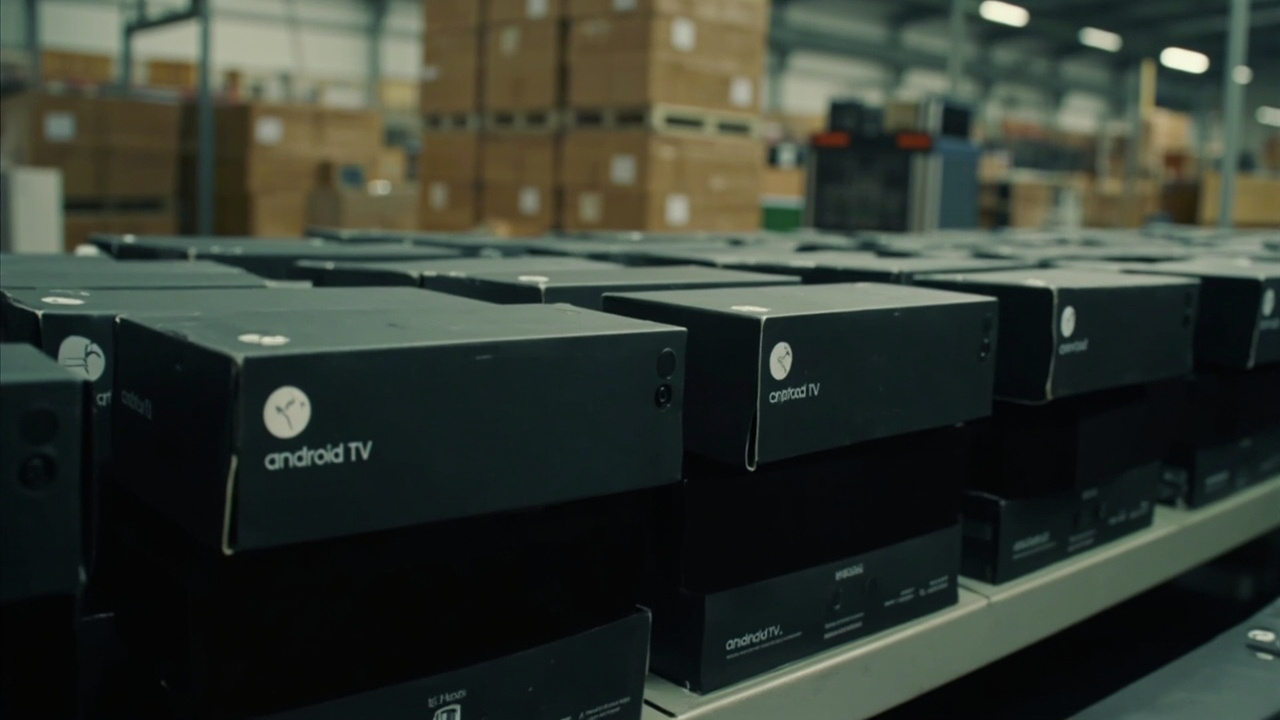
Rows of compact black Android TV boxes on warehouse shelving, with neutral packaging, pallets, and a packing station in the background, show why the quotation needs configuration control. Identical enclosures can conceal different firmware, memory, radio options, and certification.
| Situation | Requirement | Model direction | Evidence required |
|---|---|---|---|
| Hospital or hospitality wall signage | Integrated 43-inch panel, 1920×1080, HDMI in, LVDS in, AOSP playback | DS43H | Panel, input, power, environment, and golden-sample record |
| Restaurant menu board | 43-inch TFT LED panel, controlled playback, wired network | DS43H | Brightness, contrast, viewing-angle, and content test |
| 4K IPTV operator middleware | 4K@60 decoding, middleware image, DRM decision | DM21P | Software, codec vectors, and configuration record |
| Google-certified non-Google-TV requirement | GMS-certified AOSP | DM21RTD | Certification and ordered-device identity |
| 4K IPTV/OTT white-label box | Android 14 AOSP, 4K codec support, optional DRM | DM21S | Branding, signed image, DRM, and storage allocation |
For DS43H, the panel facts are 43-inch TFT LED, 1920×1080, 300 cd/sqm, 1500:1 contrast, 6ms response, 89deg viewing angle, and 50,000-hour backlight. Its stated operating range is 0–50C. Interfaces include HDMI in, LVDS in, USB2.0 ×4, and RJ45 100M with 1G optional. Cable length, controller placement, mounting method, signal distribution, ventilation, and service clearance remain site-engineering inputs.
An operator deployment has a different chain. The middleware image, authentication, entitlement workflow, decoder behavior, DRM, and update route must operate together. For an android display feeding an operator television, “supports 4K” is not an end-to-end acceptance result. The buyer must define who signs the image, approves updates, and recovers a failed deployment.
Restaurant work adds a controlled visual sample. The 300 cd/sqm figure is a configuration reference, not proof of site legibility. Test the menu assets at the proposed viewing distance under actual ambient light. Record the accepted sample and mounting condition because multi-unit consistency depends on installation as well as panel specification.
The matrix routes the request but does not complete the PO. Every order still needs the exact SKU, RAM/ROM, OS image, interface schedule, power arrangement, optional-feature state, and acceptance evidence. Where a field is missing, confirm against the production datasheet rather than infer it from a nearby model.
Turning the question into a spec line
Convert the request into testable lines in a fixed sequence. This prevents an integrated signage panel from being judged as a television decoder, or a box from being approved without display constraints.
- Name the endpoint State whether it is an integrated 43-inch signage display, a TV box, or a certified operator set-top box. Add location, native resolution, viewing distance, daily duty, and installation method.
- Lock production identity Cite the exact DataMax SKU and PDP. For DS43H, state “AOSP Android 9” as the datasheet value; do not silently substitute Android 11.
- Define the media contract Record codec, container, source resolution, frame rate, bit depth, HDR/SDR behavior, and DRM. DS43H supports 1080P@60 and VP9 10-bit, with no 4K/AV1.
- Fix memory and storage Write the ordered RAM and ROM on the PO. For DS43H, use the stated 1GB/8GB PDP configuration unless the supplier confirms another production SKU.
- Schedule interfaces Identify HDMI or LVDS input, USB count, Ethernet speed, radio requirements, mounting, cabling, and service access. Mark each field base, optional, excluded, or unused.
- Fix power Record the production input arrangement exactly. The DS43H facts include DC12V/2A and AC100–240V≤85W, so confirm the selected option against the current production datasheet.
- Define acceptance Require inspection of display output, ports, boot, playback, thermal behavior, networking, packaging, and the agreed evidence package before volume acceptance.
A pasteable signage line reads: “DS43H integrated 43-inch TFT LED display; AOSP Android 9; 1GB RAM/8GB storage; 1920×1080; 1080P@60 and VP9 10-bit; HDMI input and LVDS input; USB2.0 ×4; RJ45 100M with 1G optional; production power configuration confirmed against the datasheet; operating range 0–50C; acceptance by golden sample.”
Attach four documents. The functional specification defines source resolution, panel resolution, playback duties, and external control. The interface schedule lists every port and its ordered state. The software baseline identifies Android release, AOSP/GMS status, image owner, update method, and applications. The acceptance plan identifies assets, pass criteria, sample quantity, and responsible party.
Site constraints belong in the RFQ. The DS43H dimensions are 989×578.5×60.3mm, which affect recess and bracket drawings. The 0–50C range must be checked against an unconditioned corridor or kitchen. Cable routes, service clearance, and the power input belong on the same drawing.
Optional features need contractual treatment. If 1G Ethernet is required, place it on the order line and require identification in the configuration record. If Widevine, PlayReady, HDCP 2.2, Dolby Vision, or DTS is mandatory, state the required state rather than asking whether a family supports it somewhere. Each android display proposal should identify mandatory, excluded, configured, and untested features.
Where quotations quietly diverge
Quotations diverge because identical words carry different scopes. “Hi3751” may identify the processor, while “display” may mean an integrated panel or an output signal. “1080p panel” can be mistaken for 1080p input support. “Android” can omit AOSP status, certification, or the signed image. “1G optional” can become either a quote or a delivery assumption.
Field trap
The DS43H catalogue and production facts may describe different combinations. The stated production configuration is Hi3751, 1GB/8GB, and 300 cd/sqm. Catalogue claims about RK3562, 2GB/32GB, and 500 nit must remain an option until fixed for a specific SKU in the PO. Treating the records as equivalent creates panel, compatibility, and acceptance risk.
Field trap
Power cannot be inferred from a photograph. The facts include DC12V/2A and AC100–240V≤85W. Confirm the production option against the current production datasheet, then specify input voltage, connector, and supply arrangement on the PO. An unresolved power line can invalidate both installation design and sample acceptance.
Operating-system naming creates another divergence. “AOSP Android 9” is not equivalent to a GMS-certified SKU or Android TV certification. The DS43H datasheet states AOSP Android 9 despite wording that may refer to Android 11. The correct response is to identify the controlling production document and freeze the approved revision.
Codec claims need boundaries. A 4K source is not native 4K playback, and a 4K decoder does not make a 1080p panel native 4K. Define source, decode, output, and native resolution separately. For each quotation, verify the exact SoC, RAM/ROM, OS, decode set, DRM state, and ports rather than allowing family-level prose into the order.
Storage language drifts as well. “2GB/8GB,” “up to 16GB,” and a RAM menu describe different obligations. The ordered amount affects application performance, media storage, update capacity, and software commitments. For DS43H, use the stated 1GB/8GB PDP configuration. For DM21P and DM21S, write the selected values line by line.
Interface direction and count require literal comparison. HDMI input on an integrated display differs from HDMI 2.0b output on a box. RJ45 100M with 1G optional is not 1G delivery. Four USB2.0 ports on DS43H differ from two on DM21P or DM21S. Compare port direction, count, physical placement, and operating role.
Certification failures often appear only after integration. A service can reject a unit because its stated Widevine level, PlayReady state, output protection, or GMS environment differs from its requirement. Require the actual sample’s DRM and certification state, then link that sample to the ordered firmware and hardware. Missing evidence should remain “confirm against the production datasheet.”
The evidence trail from SMT to shipment
Factory control converts a model designation into a repeatable product. The evidence trail starts with the approved SKU, proceeds through component traceability and inspection, and ends with records matching the PO. A factory audit should test those relationships rather than merely show an assembly line.
- Freeze the baseline Record BOM, SoC, RAM/ROM, OS image, panel, ports, power, labels, and packaging under a traceable revision.
- Inspect SMT and AOI Review placement and soldering around the processor, memory, power management, network interface, and dense connectors against the approved revision.
- Control assembly and firmware Verify device identity, bootloader, OS image, application installation, network initialization, and output configuration. Prevent a development or regional image from entering the build.
- Age and observe thermals Exercise units under an agreed workload and ambient profile. State duration, conditions, sample count, and failures without extrapolating beyond the test.
- Validate the display path For DS43H, inspect output, panel presentation, image-area anomalies, input switching, and the accepted visual reference under written criteria.
- Link audit to shipment Map the configuration baseline, inspection records, aging result, display result, firmware revision, serial traceability, carton label, and approved samples.
A release file should connect each acceptance claim to a record: SKU revision to BOM, serial number to line test, firmware hash to approved image, display result to inspection stage, and carton label to shipment manifest. This relationship is more auditable than an undated factory photograph because another engineer can retrace it to the goods received.
Request a video factory audit or SKU-specific SMT, AOI, aging, and dark-room evidence through factory quality or manufacturer capabilities. Ask which records are lot-specific, which are sample-based, and which require the buyer’s golden sample. Display panels, firmware images, and component options can differ while the enclosure remains visually identical.
The baseline is the release gate. For DS43H, it should show Hi3751, 1GB/8GB, the Android 9 image revision, panel module, input board, Ethernet state, and selected power arrangement. RK3562, 2GB/32GB, and 500 nit must remain unresolved alternatives rather than being merged into that baseline.
Useful SMT/AOI evidence identifies the line or lot, board revision, inspection stage, covered component groups, defect criteria, and failure disposition. “100% inspection” alone does not explain repaired-board retesting or coverage around high-risk parts. The buyer should request the operational record.
Firmware loading is a high-risk handoff because an electrically sound panel can carry the wrong image. Record image revision, boot result, identity mapping, application package, and network initialization against the serial number. For operator middleware, include the integration version and the party responsible for signing or deployment.
Aging and dark-room inspection should match actual use. A wall unit may run repeated playback, input changes, boot cycles, and network updates. A set-top box should exercise decoding, HDMI output, network, and middleware. State the workload and environmental conditions rather than making a lifetime inference from a finite test.
Before shipment, compare the release file with the carton manifest and goods received. Check model label, power information, ports, accessories, and packaging against the PO. Preserve one sealed unit as a reference where the contract permits, supporting later diagnosis of handling damage, firmware drift, or unauthorized substitution.
Options placed side by side
The comparison is between integrated signage and separate media endpoints, not a contest for the highest specification. DS43H combines a panel and Android player for wall mounting. The other platforms are external boxes intended to feed a television or display through HDMI.
| Model | Form and fit | OS and compute | Memory | Video boundary | DRM status |
|---|---|---|---|---|---|
| DS43H | 43-inch integrated digital-signage display | AOSP Android 9; Hisilicon Hi3751 quad 32-bit A53; Mali-450 | 1GB / 8GB | 1080P@60; VP9 10-bit; no 4K/AV1 | Not stated |
| DM21P | 4K IPTV and operator middleware set-top box | AOSP Android 11; Amlogic S905Y4, quad Cortex-A35 | 2GB / 8GB base; 4GB and 16/32/64GB storage options stated | AV1 [email protected]; VP9/H.265 4K@60; H.264 4K@30 | Widevine L1 / PlayReady; HDCP 2.2 optional |
| DM21RTD | Non-Google-TV SKU requiring GMS-certified AOSP | GMS-certified AOSP; Realtek RTD1325 | Confirm against the production datasheet | AV1 capable | Confirm against the production datasheet |
| DM21S | 4K Android TV box for IPTV and OTT white-label | AOSP Android 14; Amlogic S905Y5, quad Cortex-A55 | 2GB / 16GB base; RAM options 2/4/8GB; 16/32/64GB storage options | AV1 / H.265 [email protected] 4K@60 | Widevine L1 / PlayReady optional; Dolby Vision/DTS stated |
DS43H provides the direct wall-display route because its panel, HDMI input, LVDS input, and enclosure form the stated product. It does not offer a 4K/AV1 pathway. DM21P targets operator middleware and specifies 4K decoding, optional HDCP 2.2, HDMI 2.0b output, two USB2.0 ports, RJ45 100M, Wi-Fi6 2x2, and Bluetooth 5.4. DM21S targets white-label IPTV/OTT with AOSP Android 14.
DM21RTD solves a certification requirement rather than a panel specification. It is the listed route for operators or retailers requiring a Google-certified non-Google-TV AOSP+GMS SKU. Its Realtek RTD1325 and stated AV1 capability are distinct from the detailed codec claims of DM21P and DM21S. Memory and DRM require datasheet confirmation.
The comparison changes by buyer. A hospital rejects a loose box if it cannot be recessed or maintained correctly. A retailer rejects plain AOSP if GMS certification is mandatory. A white-label operator accepts AOSP Android 14 only with a defined application, update, signing, and branding model. The canonical article on the question buyers get wrong provides the broader ownership context.
The following chart compares base RAM only. It does not rank quality. Higher RAM may be configurable, so each PO must fix the selected tier.
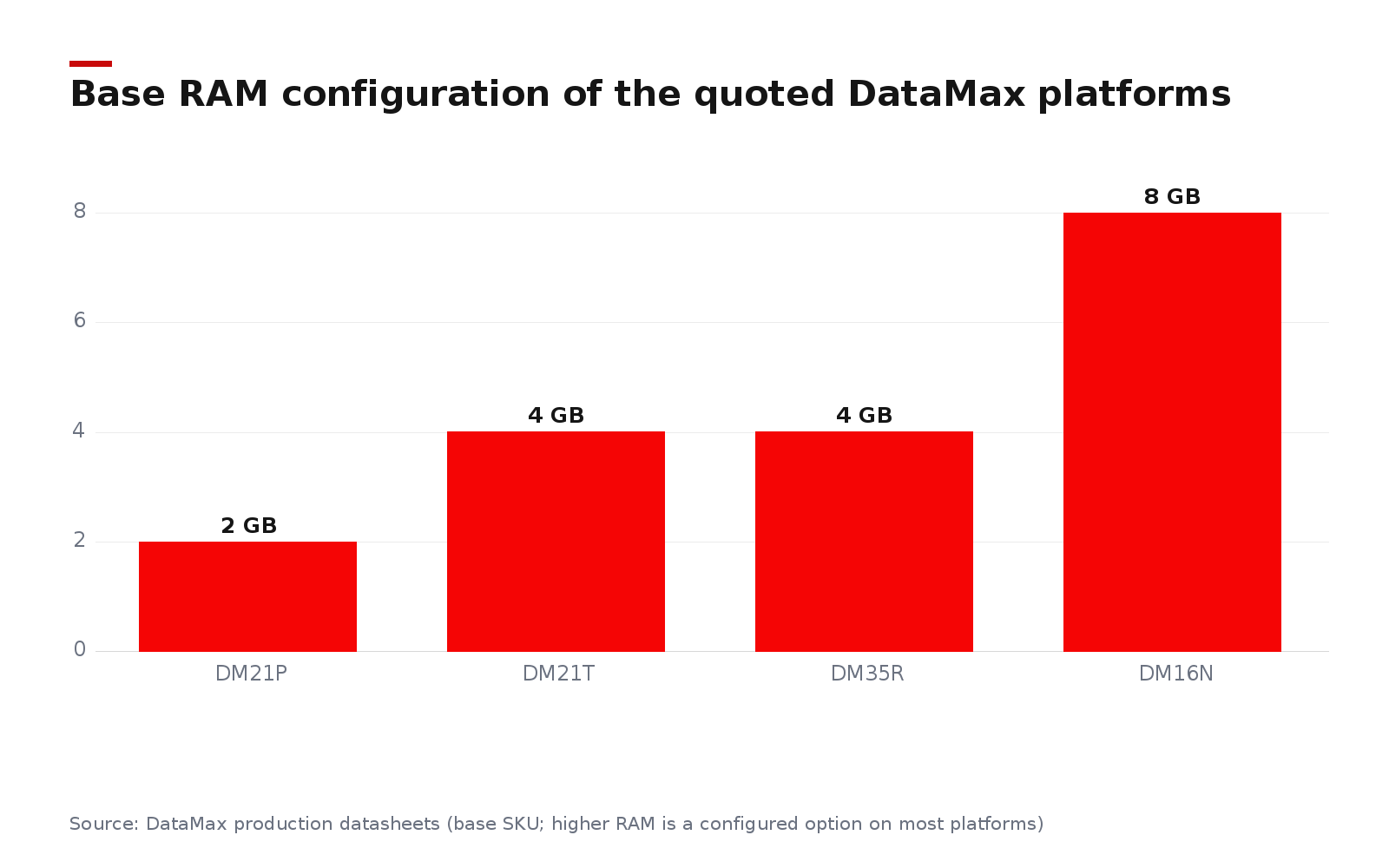
The same figures, in searchable form:
| Model | Base RAM |
|---|---|
| DM21P | 2 GB |
| DM21T | 4 GB |
| DM35R | 4 GB |
| DM16N | 8 GB |
Source: DataMax production datasheets (base SKU; higher RAM is a configured option on most platforms). Base configuration only; optional RAM tiers exist and must be fixed line-by-line in the PO.
The chart is quotation context, not a substitute for the model table. The supplied facts establish DM21P at 2GB and describe larger RAM/storage options, but do not provide complete product facts for DM21T, DM35R, or DM16N. Verify those chart entries against their own production datasheets before using them as alternatives.
Definitions a buyer cannot outsource
“Android display” can denote a display output, an integrated display appliance, or an Android media player. Each creates a different supplier responsibility. Panel resolution is the native pixel matrix; the DS43H panel is 1920×1080. Input resolution is what the controller accepts and renders. HDMI in and LVDS in are listed, but supported modes and scaling behavior require confirmation.
Video decoding is a third boundary. The DS43H facts list 1080P@60 and VP9 10-bit, with no 4K or AV1. A 4K source scaled to 1080p is not native 4K playback. Define source resolution, decode limit, output resolution, and native matrix independently.
AOSP Android 9 identifies the stated DS43H operating system. It does not establish Google Mobile Services, Android TV certification, Widevine level, PlayReady support, or a certified application environment. DM21RTD is explicitly the GMS-certified AOSP route for a non-Google-TV requirement. GMS certification and Android TV certification remain distinct claims.
DRM consists of separate modules and output-protection conditions. Widevine L1, PlayReady, and HDCP 2.2 are not interchangeable. For DM21P, Widevine L1 / PlayReady and optional HDCP 2.2 are stated. For DM21S, Widevine L1 / PlayReady are optional, with Dolby Vision and DTS also stated. Confirm the delivered state and test the service flow.
Ethernet 100M denotes the listed base port; “1G opt” denotes an option rather than guaranteed delivery. Wi-Fi6 2x2 + BT5.4 identifies radio capability, while regional approvals, antenna selection, and deployment remain qualification subjects.
Brightness is not contrast, response time, viewing angle, or backlight life. The DS43H panel values are 300 cd/sqm, 1500:1, 6ms, 89deg, and 50,000-hour backlight. Validate them against ambient light, viewing distance, mounting, and daily duty rather than substituting a conflicting catalogue configuration.
Codec profiles require levels. AV1 [email protected] is not equivalent to a general “AV1 capable” statement. Profile, level, resolution, frame rate, and container support determine actual decoding. DM21P states AV1 [email protected], VP9/H.265 4K@60, and H.264 4K@30. DM21S states AV1 and H.265 [email protected] 4K@60.
Certification evidence should identify the document, ordered hardware, OS image, and application arrangement. For middleware, define the build, API compatibility, authorization service, update channel, and device-attestation requirement. A datasheet label identifies a stated capability; it does not replace end-to-end service validation.
Finally, separate documented product facts from environmental suitability. The DS43H dimensions, 0–50C range, 300 cd/sqm brightness, 89deg viewing angle, and backlight figure define the documented configuration. The site determines actual suitability through a test plan covering ambient light, viewing distance, orientation, ventilation, and duty cycle.
Real DataMax platforms, field by field
The product facts define four DataMax directions. The table keeps each specification attached to its model and marks omissions instead of filling them by inference.
| Field | DS43H | DM21P | DM21RTD | DM21S |
|---|---|---|---|---|
| Model | DS43H | DM21P | DM21RTD | DM21S |
| Fit | Hospitality/hospital/restaurant wall signage | 4K IPTV / operator middleware set-top box | Operators/retail requiring a Google-certified non-Google-TV AOSP+GMS SKU | 4K Android TV box for IPTV/OTT white-label |
| SoC | Hisilicon Hi3751 quad 32-bit A53, Mali-450 | Amlogic S905Y4, quad Cortex-A35 | Realtek RTD1325 | Amlogic S905Y5, quad Cortex-A55 |
| OS | AOSP Android 9 (datasheet) | AOSP Android 11 | GMS-certified AOSP | AOSP Android 14 |
| RAM / ROM | 1GB / 8GB | 2GB / 8GB; 4GB and 16/32/64GB optional | Confirm against the production datasheet | 2GB / 16GB; RAM options 2/4/8GB; 16/32/64GB storage optional |
| Decode | 1080P@60 + VP9 10-bit; no 4K/AV1 | AV1 [email protected], VP9/H.265 4K@60, H.264 4K@30 | AV1 capable | AV1 / H.265 [email protected] 4K@60 |
| DRM | Confirm against the production datasheet | Widevine L1 / PlayReady; HDCP 2.2 optional | Confirm against the production datasheet | Widevine L1 / PlayReady optional; Dolby Vision/DTS |
| Ports | HDMI in, LVDS in, USB2.0 ×4, RJ45 100M (1G opt), DC12V/2A | HDMI 2.0b out ×1, USB2.0 ×2, TF, S/PDIF, 3.5mm AV, RJ45 100M, Wi-Fi6 2x2 + BT5.4, DC 5V/2A | Confirm against the production datasheet | HDMI 2.0b out, S/PDIF, AV, USB2.0 ×2, TF, RJ45 100M (1G optional), Wi-Fi6 2x2 + BT5.4 |
DS43H’s additional panel facts are 43-inch TFT LED, 1920×1080, 300 cd/sqm, 1500:1, 6ms, 89deg, 50,000-hour backlight, 0–50C, and 989×578.5×60.3mm. Confirm its power arrangement against the production datasheet because the supplied facts also include an AC100–240V≤85W variant. The dimensions make installation drawings a pre-order requirement.
The other platforms are external boxes. DM21P is the operator-middleware route, DM21RTD addresses a GMS-certified AOSP requirement, and DM21S addresses an AOSP Android 14 white-label route. Any final android display comparison must use the ordered SKU, not the platform family. Request a sample through DataMax sample ordering, with endpoint, formats, OS requirement, power, storage, and acceptance criteria in the first RFQ message.
Do not transfer familiar box specifications into DS43H. Its HDMI and LVDS connections are inputs, whereas DM21P and DM21S HDMI ports are outputs. Its panel values belong to the integrated display definition. External boxes do not thereby acquire a panel brightness, contrast, viewing angle, or backlight specification.
The processor names also require discipline. DS43H uses Hisilicon Hi3751; DM21P uses Amlogic S905Y4 with quad Cortex-A35; DM21RTD uses Realtek RTD1325; DM21S uses Amlogic S905Y5 with quad Cortex-A55. An android display quotation that changes the processor while retaining the model description needs written clarification before sample approval.
The final evidence package should contain model identity, production datasheet revision, ordered RAM/ROM, power option, OS image, codec list, DRM state, interface schedule, and factory records. For the integrated-panel route, add the golden sample and installation drawing. For factory-side verification, request a video audit of SMT, AOI, aging, dark-room inspection, firmware loading, and carton mapping. This keeps the technical evaluation and commercial approval attached to one configuration.
Further reading
- Hi3751 Android Display: The Question Buyers Get Wrong
- RFQ checklist for device procurement
- Android TV boxes
- Rockchip Android TV boxes
- Edge computing boxes
- DataMax DM21P specifications and fit
- DataMax DM21RTD specifications and fit
FAQ
Is DS43H a 4K Android display?
No. Its stated panel is 43-inch TFT LED at 1920×1080, and its decode specification lists 1080P@60 plus VP9 10-bit, with no 4K or AV1. A project requiring native 4K playback should evaluate a platform whose decoder and output explicitly support it, such as DM21P or DM21S. Confirm the complete screen, source, and output chain.
Which Android version does DS43H use?
The production datasheet states AOSP Android 9. Do not replace it with Android 11 because another title or catalogue uses that wording. Record “AOSP Android 9” in the specification and PO after confirming the approved production revision. The operating-system version alone does not establish GMS or Android TV certification.
Can the DS43H power supply be specified from the catalogue?
The supplied facts conflict: DC12V/2A and AC100–240V≤85W. That is insufficient for installation approval. Confirm the production option against the current production datasheet, then specify input type, connector, and supplied adapter on the PO. Record the same requirement in the site electrical drawing and golden-sample checklist.
Does DS43H support 1G Ethernet as standard?
The stated base port is RJ45 100M, with 1G marked optional. Treat 1G as configured only when the ordered SKU states it and the PO records it. Also assess whether content updates genuinely require more than 100M and whether the selected configuration includes the stated Wi-Fi6 2x2 + BT5.4 connectivity.
Should a signage deployment use DS43H or a set-top box?
Use DS43H for an integrated 43-inch wall display for hospitality, hospital, or restaurant signage. Use DM21P for a 4K IPTV or operator-middleware endpoint, DM21RTD for a GMS-certified non-Google-TV AOSP SKU, or DM21S for a 4K IPTV/OTT white-label box. Integration, certification, media, and installation determine the result.
What evidence should be requested before shipment?
Request the approved SKU baseline, SMT and AOI records, firmware identity, aging results, display or dark-room evidence where applicable, serial traceability, carton mapping, and an approved golden sample. The first RFQ message to DataMax should identify the application, endpoint, source formats, OS requirement, power, environment, and required evidence fields.




