
Before the terminology: the India sign-off checklist
Before approving an in room entertainment hotel programme for India, confirm six items: room-count economics, network topology, content rights, DRM configuration, device management and service ownership. Verification starts with a property-by-property bill of materials, then maps each screen to wired Ethernet or managed Wi-Fi, a licensed content source, a protected playback path, an update policy and a named support owner. The hardware decision follows those constraints; it is not the first decision.
The direct answer is to enter India through a controlled pilot with a documented operating model, not through a catalogue-wide rollout. A hotel operator should select platforms by content path and serviceability, an integrator should specify installation and remote-management interfaces, and a venue or hospitality group should test guest journeys before fleet expansion. The relevant operating catalogue includes operator middleware set-top boxes, IPTV/OTT white-label Android TV boxes and premium cloud-gaming boxes.
DataMax can support product selection and ODM planning, but the production datasheet remains the controlling source for every variant. DRM support, memory configuration, interface options and codec limits must be confirmed against the production datasheet and the selected middleware build. No device can compensate for unlicensed content, an unreliable LAN, undefined support boundaries or a deployment with no recovery path.
The checklist should also separate four decisions that are frequently collapsed into one quotation. First, confirm whether the product is an operator middleware endpoint, a branded Android TV device, a premium media endpoint or a gaming-oriented platform. Second, identify who owns the content licence, authentication service, DRM server and channel schedule. Third, define the room installation: television, audio, wired connectivity, power, remote control, cabinet space and service access. Fourth, establish who can dispatch a replacement, reset a session, approve an application update or change a network policy.
A buyer ready to issue an RFQ can attach the SKU shortlist, room drawings, interface checklist, middleware version, DRM acceptance matrix and pilot-room plan. DataMax’s inquiry channel can then receive the same package used by engineering and procurement, rather than a request based only on a 4K label. A pilot should close only after the intended content path, the actual room wiring and the support escalation route have all been exercised.
The comparison buyers actually make
The practical market-entry comparison is between a constrained entry tier and a deeper platform commitment. The difference is not simply unit specification: it is how much software, identity, branding and lifecycle work must be sustained after delivery.
| Decision area | Entry tier | Commitment tier | Verification evidence |
|---|---|---|---|
| Branding | Logo print only | Boot logo, launcher and deeper product identity | Packaging proof, boot capture and launcher screenshots |
| Software scope | Stock Android TV experience | Firmware feature branch or joint hardware/software ODM | Versioned build, change log and acceptance test |
| Content | Basic IPTV or OTT delivery | Operator middleware, DRM and service integration | Licence evidence, playback test and channel reconciliation |
| Operations | Local installation and manual support | Device management, staged update and remote diagnostics | Policy, update procedure and escalation record |
| Commercial exposure | Lower design burden, more product constraints | More engineering involvement, stronger differentiation control | RFQ responsibility matrix and milestone acceptance |
| Room integration | Fixed reference design | Interface and cabinet design by room archetype | Room drawing, cable schedule and installation test |
| Identity and payment | Operator-controlled or simple guest access | Custom pairing, entitlement or billing workflow | Session test, expiry test and account-isolation record |
| Release governance | Periodic manual replacement or update | Versioned releases, staged rollout and rollback criteria | Release note, update log and recovery exercise |
The editorial comparison below ranks the depth of customisation that each engagement can support. It is a qualitative planning scale, not measured or audited data.
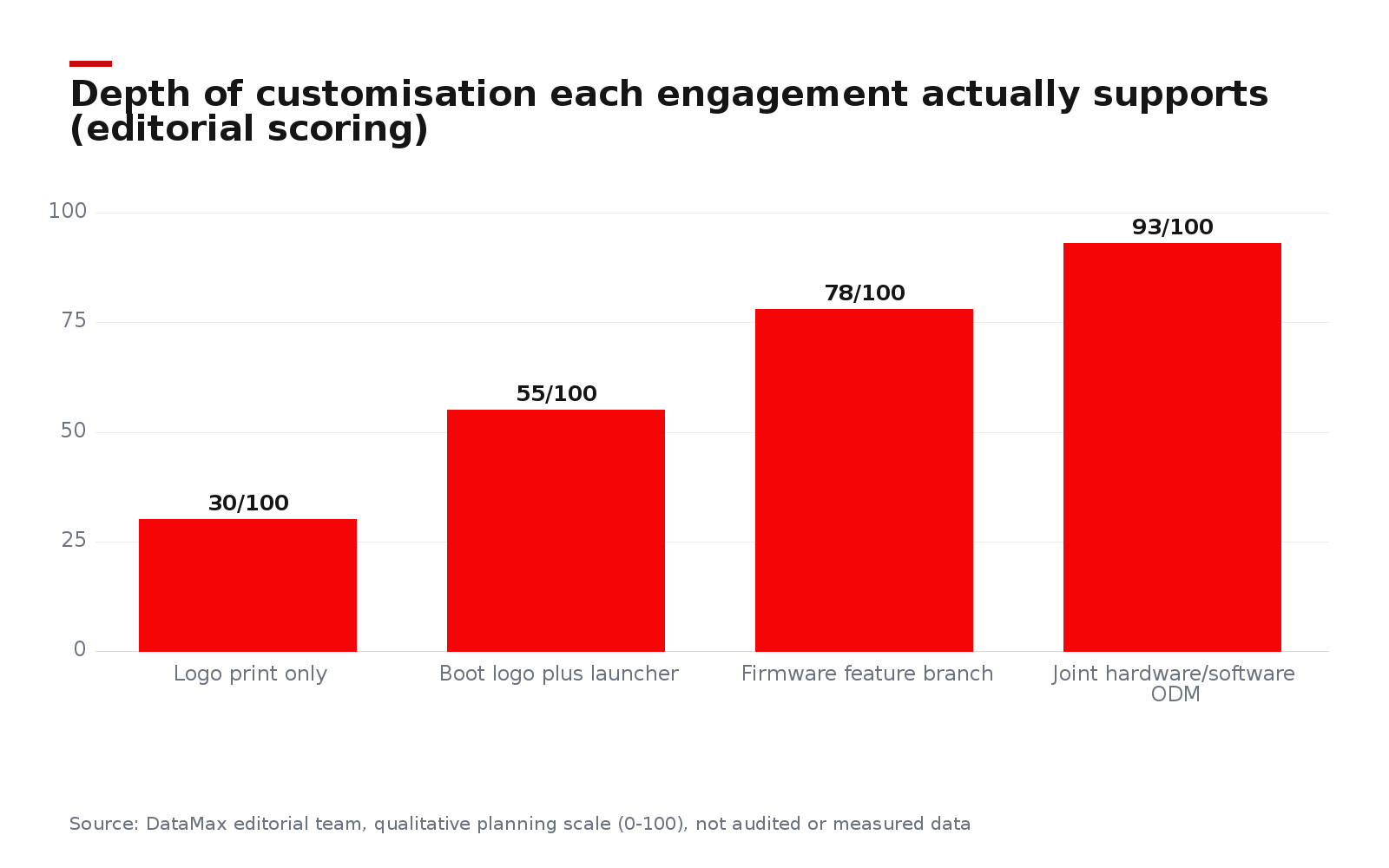
The same figures, in searchable form:
| Engagement | Editorial score |
|---|---|
| Logo print only | 30 |
| Boot logo plus launcher | 55 |
| Firmware feature branch | 78 |
| Joint hardware/software ODM | 93 |
For India, the entry tier suits a property test where content and support processes are already proven. The commitment tier suits a group that needs a branded launcher, middleware integration, fleet policy or a differentiated guest experience. The deeper option carries more governance work: acceptance criteria must cover boot behaviour, update rollback, remote support and the boundary between DataMax and the operator.
A procurement example illustrates the distinction. A property using an existing operator-managed IPTV service may use an operator-approved reference design and focus on Ethernet, middleware compatibility and a controlled room installation. A hotel group commissioning several brands may need a common launcher, a defined login flow and evidence that a release can be reproduced across properties. The second scenario adds engineering work because every visible change and application dependency must remain maintainable after deployment.
The quotation should separate one-time acceptance from recurring obligations. Hardware configuration and firmware loading are release activities. Launcher maintenance, application upgrades, content catalogue changes, entitlement troubleshooting and field replacement are operating activities. Leaving them in a single line item hides the actual cause of a later change request. Record each responsibility, its trigger and the evidence required to close it.
Where the terminology comes from
“In-room entertainment” describes the screen experience delivered to a hotel guest. “Hotel IPTV” commonly means managed live television delivered through the property network, while “OTT” means on-demand or transactional streaming delivered by an application. The hardware may sit beside the television, be concealed in a cabinet, or be integrated into the display installation. The term “content portal” describes a web or application destination; it does not by itself specify the transport, DRM or authentication model.
A practical architecture separates five layers:
- Property network
- Room Ethernet or managed Wi-Fi, DHCP/DNS, VLAN policy and internet routing
- Head-end or gateway connection for operator IPTV
- Identity and session service
- Guest-room pairing, operator authentication and entitlement checks
- Session expiry, account isolation and content-access policy
- Content delivery
- IPTV multicast, managed OTT streaming or a hybrid service
- Origin, CDN or local caching according to property connectivity
- Playback endpoint
- Android TV or operator middleware set-top box connected by HDMI
- Audio, network and update interfaces appropriate to the room
- Operations plane
- Provisioning, device inventory, monitoring, staged updates and recovery
- Property help desk and escalation ownership
DRM is a content-protection layer, not a substitute for a licence. Widevine L1 and PlayReady support are listed for the applicable DataMax SKUs, while HDCP 2.2 is optional on DM21P. Dolby Vision and DTS are listed as optional on DM21S and DM22Q. A buyer must still validate the exact configuration, licence availability, output path, display capability and application integration for the selected model and production build.
For India, the channel path also changes the design. A managed IPTV service can reduce WAN dependence for live channels when the operator supplies the appropriate head-end and multicast design. OTT requires dependable internet throughput and application-level support. Neither architecture should be inferred from the phrase in room entertainment hotel alone; it must be documented in the service specification.
The room network also needs a precise responsibility split. An Ethernet-connected endpoint may receive multicast through a property VLAN and a managed gateway, while an OTT endpoint may use routed internet access and an application session. These paths do not have the same failure profile: a multicast join or VLAN issue can interrupt live television, while an OTT failure may appear as application authentication, CDN reachability, throughput or session expiry. The acceptance test should follow the actual content path rather than treating “network connected” as one checkbox.
A second distinction is between device identity and guest identity. The device may be provisioned to a room, operator account or asset record, while the guest receives a temporary session with defined entitlements. That relationship should be documented as a flow: room endpoint, device credential, guest credential, content entitlement and support diagnostic. This flow exposes whether a failed login belongs to the device, the property network, the identity service or the content platform.
Finally, “4K” is an end-to-end requirement, not a property of one box. The source content, application, DRM path, HDMI route, television mode, audio route and playback engine must operate within their own limits. The platform can decode a stated format, but the service team must verify whether the room actually receives that output. An in room entertainment hotel tender should attach the display model and negotiated output mode to each test record.
Five production SKUs compared
The supplied production facts cover 4 DataMax SKUs rather than 5. The fifth row therefore records “not supplied” rather than introducing an unverified platform. Each listed model remains subject to confirmation against the production datasheet, particularly optional memory, Ethernet, DRM and audio features.
| Model | Fit | SoC and OS | RAM / ROM | Decode and DRM | Interfaces |
|---|---|---|---|---|---|
| DM21P | 4K IPTV / operator middleware set-top box | Amlogic S905Y4, quad Cortex-A35; AOSP Android 11 | 2GB / 8GB; 4GB; 16/32/64GB optional | AV1 [email protected]; VP9/H.265 4K@60; H.264 4K@30; Widevine L1 / PlayReady; HDCP 2.2 optional | HDMI 2.0b out x1; USB2.0 x2; TF; S/PDIF; 3.5mm AV; RJ45 100M; Wi-Fi6 2x2 + BT5.4; DC 5V/2A |
| DM21S | 4K Android TV box for IPTV/OTT white-label | Amlogic S905Y5, quad Cortex-A55; AOSP Android 14 | 2GB / 16GB; 2/4/8GB; 16/32/64GB optional | AV1 / H.265 [email protected] 4K@60; Widevine L1 / PlayReady optional; Dolby Vision/DTS | HDMI 2.0b out; S/PDIF; AV; USB2.0 x2; TF; RJ45 100M, 1G optional; Wi-Fi6 2x2 + BT5.4 |
| DM21T | Premium UHD / cloud-gaming box | Amlogic S905X5, quad Cortex-A510 (ARMv9); AOSP Android 14 | 4GB / 64GB; family options | H.266/VVC [email protected] 4K@120; AV1/VP9/H.265 4K@120; AVS3 4K@120; H.264 4K@60; inline AI-SR; Widevine L1 / PlayReady optional | HDMI 2.0b out, no HDMI in; USB2.0 x1 + USB3.0 x1; TF; S/PDIF; AV; RJ45 100M, 1G opt; Wi-Fi6 + BT5.4 |
| DM22Q | Gaming-oriented Android TV box | Amlogic S905X5M, quad Cortex-A55 up to 2.5GHz; AOSP Android 14 | 4GB / 64GB; 2/4/8GB; 16/32/64GB optional | AV1/H.265 L5.1 4K@60; inline AI-SR, no NPU TOPS stated; Widevine L1 / PlayReady optional; Dolby Vision/DTS | HDMI 2.0b out; USB2.0 x2; TF; S/PDIF; AV; RJ45 100M, 1G opt; Wi-Fi6 2x2 + BT5.4 |
| Fifth production SKU | Not supplied. Confirm against the production datasheet; no model, chipset, operating system or configuration is inferred here. | ||||
For an operator-facing managed service, DM21P is the direct fit by positioning: 100M Ethernet, operator middleware and Android 11. DM21S is the broader Android TV choice where a white-label launcher, OTT applications and optional 1G Ethernet matter. DM21T and DM22Q serve premium or gaming-led propositions, but their additional decode capability should be matched to actual display, service and game requirements rather than used as an unsupported marketing claim.
The supplied facts do not establish a fifth model, India certification status, server-side DRM integration, Android Management configuration, update mechanism or full mechanical dimensions. Those items require documentary confirmation. Procurement should also review the canonical explanation of an in-room entertainment hotel content portal, because that page owns the broader content-portal architecture rather than this India market-entry angle.
The SKU table should not become a substitute for configuration control. “Optional” means the delivered orderable build must be named, not inferred from the product family. A buyer who writes only “DM21S with 1G Ethernet, PlayReady and Dolby Vision” has not yet defined the build because the supplied facts identify those features as optional. Add the approved option codes or the production-datasheet reference, then record the same configuration on the purchase order, test record and packaging evidence.
The comparison also exposes where no model should be short-listed yet. If the requirement depends on India-specific radio approval, a particular HDMI input, a certified remote-control protocol, a prescribed operating system, a server-side management policy or a mechanical drawing, the current facts do not close those items. A request for samples can test physical fit and application behaviour, but a sample does not replace a production configuration review. Buyers can use the sample request route with a written test matrix and explicit note of the production variants under review.
For the same reason, the word “premium” should be converted into measurable service requirements. Higher-resolution decode, optional premium audio, different interface sets or additional memory may influence a platform direction, but each feature must survive an end-to-end test. An in room entertainment hotel shortlist should state which television, audio system, network service and content application are paired with each model. Otherwise, a capable decoder can still produce an under-specified room experience.
Buyer situations, ranked by what they punish
Different buyers fail in different ways. A telecom operator is exposed to subscriber churn and operational load; an integrator is exposed to installation variation; a hotel group is exposed to guest complaints and brand inconsistency; a distributor is exposed to mixed inventory and unclear warranty workflows. Rank the candidate platform against the failure that matters to that buyer.
| Buyer situation | Primary requirement | What failure is punished | Model direction |
|---|---|---|---|
| IPTV or telecom operator | Stable operator middleware, Ethernet path, DRM and provisioning | Session failure, channel interruption and high support volume | Start with DM21P; validate the middleware and licence build |
| Hotel group with OTT-led rooms | Android TV launcher, application control and white-label experience | Guest friction, inconsistent branding and unsupported configuration | Evaluate DM21S with the operator’s application set |
| Premium or suite property | Higher-resolution media handling and optional premium audio | Display mismatch, playback limits and avoidable cost | Assess DM21T against the actual display and service profile |
| Gaming-led hospitality venue | Low-latency interaction, thermal stability and suitable interfaces | Input delay, unstable gaming sessions and thermal throttling | Test DM22Q; do not infer latency from chipset class alone |
| AV integrator | HDMI, audio, USB, network and mechanical fit | Late site rework, adapter dependence and unclear cabling | Create an interface checklist per room and pilot each display path |
| Distributor managing several properties | Consistent orderable build, labelling and traceability | Mixed inventory, unidentified configuration and rework | Freeze the approved SKU, options, packaging and serial process |
| Premium hotel with suite-specific displays | Resolution path, audio capability and service-specific testing | Unverified output mode or avoidable premium-component mismatch | Test DM21T against the exact suite display path |
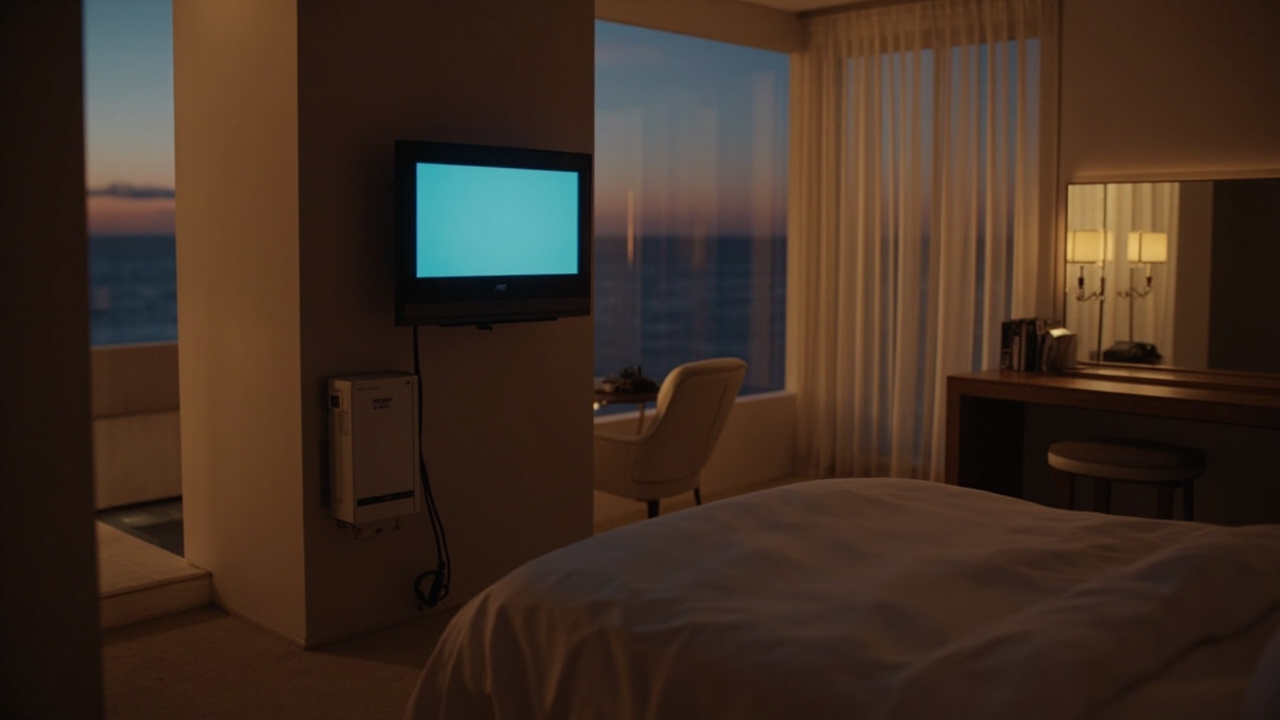
The scene that matters is operational rather than decorative. A modern room can conceal a compact operator box behind a wall-mounted television, while retaining service access to power, Ethernet and recovery controls.
For an AV integrator, the first property to pilot should represent the hardest standard room, not the best-equipped suite. Include the actual television model, soundbar or audio path, Wi-Fi design, Ethernet outlet position and housekeeping access. For an operator, pilot entitlement mapping, channel reconciliation and recovery from an interrupted session. For a hotel group, measure guest-facing steps such as language selection, sign-in friction and exit behaviour.
The ranking principle is simple: select for the failure the buyer cannot absorb. An operator may tolerate a more generic launcher but not weak session reliability; a gaming property may accept fewer interface options but not poor sustained performance; an integrator may accept a fixed configuration but not undocumented connector variants. Each in room entertainment hotel rollout should therefore carry a room archetype, service owner and acceptance method before a platform shortlist is approved.
A practical pilot should create several test cases rather than one happy path. Disconnect and restore the Ethernet connection, renew an expired guest session, switch between live and OTT content, test the intended display mode, invoke the recovery procedure and record the resulting diagnostic. For Wi-Fi rooms, test the planned coverage and access policy. For operator IPTV, reconcile the expected channel list with the received channel list. These cases expose whether the selected endpoint, network and service work together.
The support model should also be exercised. Give the pilot participant the same troubleshooting guide, remote-control pairing process and escalation route proposed for the wider deployment. Record how long diagnosis takes, which evidence must be collected and who authorizes a replacement. A platform that passes a bench demonstration but has no room-level diagnostic process is not ready for an in room entertainment hotel estate, regardless of its codec list.
A decision path for the RFQ
Convert the service requirement into an RFQ before discussing a specific model. The sequence below prevents a hardware-led quote from hiding unresolved content, network and support dependencies.
- Define the service Specify IPTV, OTT or hybrid delivery; guest identity method; content rights; launch languages; payment or subscription handling; and the post-checkout experience.
- Map the room Record television and audio models, HDMI routing, Ethernet availability, Wi-Fi policy, power, cabinet clearance, service access and physical connector requirements.
- Define the software boundary Identify the launcher, middleware, applications, DRM, device management, update method, telemetry and help-desk responsibility for each component.
- Select the hardware class Choose operator middleware, white-label Android TV, premium UHD or gaming orientation only after the service and room constraints are closed.
- Validate the production configuration Confirm SoC, OS, memory, codec, DRM, ports and optional features against the production datasheet and the exact orderable build.
- Pilot and stage rollout Test representative rooms, recover from common failures, inspect the evidence, and approve expansion by property or cohort.
The RFQ should contain pasteable lines rather than marketing adjectives. For example: “Each endpoint must provide HDMI 2.0b output, 100M RJ45 and Wi-Fi6 2x2 plus BT5.4, subject to the selected model and production datasheet.” Another line should state: “The operator shall provide the content licence, authentication service, DRM configuration and final middleware acceptance criteria.” A further line must allocate update authority, spare-unit policy and on-site escalation.
The commercial comparison should also separate one-time engineering from recurring operations. A custom launcher may improve the guest journey, but it creates application ownership, version regression and update-window work. A firmware feature branch may integrate more deeply, but it requires source control, release governance and reproducible builds. A joint hardware/software ODM engagement can address physical and software constraints together, but the RFQ needs explicit acceptance, evidence and change-control clauses. These are the components behind the customisation scale shown earlier.
To close the selection loop, ask for a room-by-room bill of materials, firmware release identifier, codec-and-DRM test matrix, update and rollback procedure, factory test evidence and pilot sign-off record. Do not accept a quote based only on screen size or broad “hotel support” wording. The procurement value is a repeatable deployment whose cost and failure behaviour are visible before expansion.
Turn each line into an evidence request. “Wi-Fi6 2x2 plus BT5.4” should be checked against the approved configuration and paired accessory list. “Operator middleware” should be checked against the named image, version and acceptance test. “HDMI 2.0b output” should be checked with the actual television and room route. “DRM support” should be checked through the relevant content application and licence path. This wording keeps the tender auditable when quotations arrive from different suppliers.
Include non-functional acceptance criteria as well. Define how long the pilot team must retain evidence, which room archetypes are covered, who signs each exception and what triggers a rollback. Require a configuration comparison against the pilot unit, not a generic sample. Any substitution of memory, Ethernet speed, codec profile, operating-system build or optional feature should trigger a documented review before deployment.
For a market-entry programme that crosses several properties, the RFQ should also establish the expansion gate. One approved pilot room is not sufficient evidence for every standard room, suite or Wi-Fi design. Define the number of rooms, properties and archetypes to test, then make fleet expansion conditional on closure of critical exceptions. This protects procurement from converting a successful demonstration into an unsupported estate-wide commitment.
The traps in this category
Quotations commonly diverge because the device, service, licence and room installation are sold as one item while carrying different owners. A DRM-capable device does not prove that a commercial service licence is available. A 4K-capable codec does not prove that the television, HDMI path, display mode or service package delivers that output. A Wi-Fi option does not establish that the property network supports the intended concurrency or multicast design.
Field trap
Do not treat optional memory, 1G Ethernet, HDCP 2.2, Dolby Vision or DTS as standard on every quotation. The supplied facts mark several of these features as optional. A channel-by-channel acceptance matrix should identify the exact orderable configuration; otherwise the apparent product capability may not exist in the delivered fleet.
Field trap
Do not accept a resolution label as the playback specification. The supplied facts cap DM21T and DM22Q at 4K, with their documented frame-rate limits and no HDMI input on DM21T. Validate the display, source, application path and negotiated output mode rather than carrying an unsupported “8K” claim into the **in room entertainment hotel** tender.
The second major trap is operational ambiguity. If the operator owns the middleware while the integrator owns the network and the distributor owns the hardware, a guest-room outage may pass through all three without a single responsible party. The RFQ must define first-line diagnosis, escalation time, evidence capture, replacement flow and the point at which content or entitlement faults return to the operator.
A third trap is assuming that the pilot room represents the estate. Suite displays, integrated soundbars, Wi-Fi-only rooms and operator IPTV rooms create different paths. Record each room archetype and require the acceptance test to match it. A further trap is treating fleet updates as an installation detail: updates can interrupt live service, exhaust storage, alter launcher state or expose an untested application version. A staged rollout and recovery procedure are necessary.
Finally, document regulatory and market requirements only through verified evidence. The supplied facts do not establish India-specific certification or radio approvals for any model. Request the applicable certificates, test reports and production labelling against the orderable configuration, then review them through the relevant certification and compliance route. Do not infer compliance from AOSP, Android 11 or Android 14 alone.
A quotation can also diverge through omitted accessories and installation dependencies. A room drawing may show Ethernet, HDMI and power, but not the required cable, adapter, remote, splitter, extender or local soundbar route. These are not automatically interchangeable: an HDMI path may consume a specific input, a digital audio output may require a compatible receiver, and a network lead may need to meet the property’s installation standard. Require the integrator to return the completed as-built connection list.
Watch for naming collisions. “Premium,” “gaming,” “4K,” “Android TV” and “operator box” describe different scopes, but a brochure can combine them without proving one orderable configuration. Ask for one row per proposed SKU with SoC, operating system, memory, codec set, DRM status, every port and the selected options. If a row contains “optional,” “up to,” “supports” or “variant,” it is not yet a purchase specification.
Finally, distinguish a technical failure from an installation failure. If the box boots but receives no multicast stream, the device may not be the failed element. If the application starts but the television shows the wrong mode, the room route or configuration is incomplete. If an update interrupts a session, the release process needs revision. A structured incident record prevents the support team from replacing a unit whose real fault lies in content, identity, network or firmware policy.
How the factory controls the variable
Factory control begins with a frozen build and a traceable unit. SMT placement, AOI inspection, burn-in or aging, software loading and final inspection should connect to a serial number or another controlled production identity. A factory video audit can reveal whether the process is described accurately; it cannot replace a buyer’s own acceptance criteria.
- Freeze the build record Match SoC, Android version, memory, interfaces, codecs, DRM options, accessories and packaging to the approved RFQ and production datasheet.
- Control board assembly Capture SMT and AOI evidence for the relevant production lot, with deviations identified against the released build and inspection criteria.
- Exercise hardware under load Review aging or burn-in records for representative power, network, storage, interface and thermal cycles rather than relying on a sample power-on.
- Load and identify software Verify the firmware image, serial-to-unit traceability, boot result, network function, output mode, remote-control pairing and installed application set.
- Perform dark-room and final checks Use controlled display, audio, network and remote-control checks to detect panel output, connector and accessory issues.
- Audit the evidence trail Compare test records with the shipment quantity, release identifier, approved configuration and any concessions, then retain acceptance evidence with the project file.
For this project, request evidence that can be indexed by SKU and production lot: SMT/AOI result, aging or burn-in record, dark-room test result, firmware release, serial-to-unit record, packaging check and approved deviation list. DataMax factory documentation is useful only when it maps directly to the purchased configuration.
The factory variable is therefore controlled through linkage, not through a generic statement that the product is tested. Buyers should ask to see the evidence architecture behind factory quality, how it maps to the selected build, and which records accompany the shipment. They can also request a manufacturer capability review or video factory audit focused on SMT, AOI, aging and the final traceability trail.
Before the pilot closes, reconcile the test record with the room solution: connect the actual television and audio path, verify network behaviour, exercise the intended applications and DRM service, test the recovery procedure and document exceptions. For a broader in room entertainment hotel rollout, repeat this acceptance across each room archetype rather than sampling only the easiest installation.
For the RFQ package, email [email protected] with the proposed SKU list, room and interface drawings, target-market certificate requirements, the middleware and DRM checklist, and the required factory evidence. That package gives engineering, compliance and procurement teams a common basis for comparison.
The evidence index should answer five audit questions. Which production lot used the released board build? Which firmware image and serial range were loaded? Which units passed AOI, aging and dark-room records? Which optional features were fitted? Which deviations were approved and where do those units appear in the shipment? If one record cannot be linked to another, the buyer has a traceability gap rather than a complete quality claim.
The final gate is room acceptance, not factory acceptance alone. A unit can pass board-level tests and still expose a room-specific issue involving television negotiation, audio routing, Ethernet placement, remote-control pairing or application entitlement. Conversely, a room issue may belong to the property network and should not be misclassified as a hardware defect. The pilot record should preserve both outcomes so corrective work returns to the correct owner.
Further reading
- in room entertainment hotel: The IRD and Portal Integration
- Telecom solutions
- Amlogic Android TV boxes
- Google TV devices
- AV1 Android TV box guide
- DataMax DM21P specifications and fit
- DataMax DM21S specifications and fit
FAQ
What hardware should an Indian hotel pilot first?
Choose the smallest configuration that satisfies the service and room. An operator-led IPTV pilot may start with DM21P, while an OTT-led white-label programme may suit DM21S. Validate Ethernet, television, audio, launcher, applications, DRM and support ownership. Do not select on 4K positioning alone.
Can DataMax customize the boot logo and launcher?
The engagement scope must be specified separately. The editorial customisation scale places logo print at 30, boot logo plus launcher at 55, firmware feature branch at 78, and joint hardware/software ODM at 93 out of 100. These are qualitative planning scores, not measured performance. Request a mock-up, acceptance criteria and update responsibility for the exact project.
Which DRM configuration should be written into the hotel tender?
State the required service, output path and acceptance method rather than listing DRM logos alone. DM21P lists Widevine L1 and PlayReady, with HDCP 2.2 optional; DM21S, DM21T and DM22Q list Widevine L1 and PlayReady as optional. Dolby Vision and DTS are optional on DM21S and DM22Q. Confirm the production build, licence and application playback.
What factory evidence is useful before a pilot order?
Request firmware-to-serial traceability, SMT and AOI results, aging or burn-in records, dark-room checks, interface verification and an approved deviation list. Evidence should map to the exact SKU and production lot. A video factory audit can validate the process, while the buyer’s room-level acceptance test remains necessary.
How should a hotel group move from pilot to rollout?
Classify rooms by television, audio, network, connectivity and service architecture. Test one representative room from each class, record exceptions, then stage expansion by property or cohort. Update governance, support escalation and replacement handling must be proven before increasing volume across an in room entertainment hotel estate.
Does Android 14 prove suitability for an India hotel deployment?
No. The operating-system version does not prove India certification, content licensing, middleware compatibility, update support or network performance. Request those documents and test results separately. For DM21P, the supplied facts identify AOSP Android 11; for DM21S, DM21T and DM22Q, they identify AOSP Android 14. Confirm the orderable production datasheet.
How many room types should an India pilot cover?
Cover every materially different service path, including wired operator IPTV, OTT over the intended network, any Wi-Fi-dependent room and premium displays with distinct audio or output requirements. A successful standard room does not represent a suite or a Wi-Fi-only room. For each in room entertainment hotel archetype, record the device configuration, network method, application path, failure recovery and acceptance result before expanding the pilot.


