
The procurement answer in one screen
“In room entertainment hotel” describes a guest-room media system rather than one device category. Its procurement scope includes content delivery, operator middleware, DRM, television output, network access, remote control, updates, analytics, support and physical installation. The correct purchase requirement is not a generic “4K hotel box”; it is a field-by-field specification covering SoC, operating system, memory, codec profile, frame rate, DRM, HDMI, Ethernet, radio, audio, middleware and operating responsibility.
For an operator-controlled rollout, the DataMax DM21P is the closest stated fit because its product facts describe a 4K IPTV and operator-middleware set-top box. The DM21S fits IPTV/OTT white-label deployments, the DM21T fits premium UHD and cloud-gaming use cases, and the DM22Q fits gaming-oriented Android TV use. These are product directions, not substitutes for a production-datasheet check.
A buyer should distinguish three quotation levels: product name only, partially specified platform, and full field-by-field schedule. Only the third exposes optional DRM, Ethernet speed, OS baseline, radio configuration and configuration drift before shipment. The first RFQ should state room count, television panel, HDMI path, IPTV/OTT source, DRM obligations, middleware control, Ethernet and Wi-Fi policy, audio output, remote method, OTA ownership, certification documents and field-replacement process. Procurement teams can send DataMax an inquiry with those fields in the first message and request a model recommendation plus production-datasheet confirmation.
The governing rule is simple: an in room entertainment hotel purchase should be approved as a tested configuration, not ordered as a headline resolution. That decision covers both the hardware bill of materials and the operational boundary between operator, hotel, integrator and manufacturer.
A decision path for the RFQ
The RFQ should proceed from room outcome to platform dependencies before asking suppliers to nominate a model. Reversing that sequence converts binary requirements into vague words such as “premium”, “commercial” and “operator grade”. Those terms have no acceptance meaning unless the television, network, service and control ownership are named.
- Define the room outcome Record screen size, native panel resolution, supported source resolution, frame-rate target, HDR policy, audio topology, IPTV and OTT mix, live-service requirement, gaming scope and any television-mode constraint.
- Define control ownership Specify who provisions the device, signs the operator application, manages licences, deploys updates, supplies the remote, monitors health data, replaces failed units and retains configuration records.
- Lock the interface path State HDMI output count, HDMI input needs, Ethernet speed, Wi-Fi and Bluetooth requirement, optical or analogue audio, USB use, power method, remote-control method and physical placement constraints.
- Lock the media obligations Name required DRM systems, HDCP level where relevant, codecs, OS baseline, memory floor, middleware interface, application certification status and update approval process.
- State the evidence requirement Request the production datasheet, approved chipset configuration, OS build, regulatory reports, quality records, firmware-update procedure, accessory schedule and configuration consistency across replenishment.
A pasteable RFQ line reads: “Operator-grade Android TV set-top box for 4K IPTV/OTT; AOSP [version]; [RAM]/[ROM] minimum; [DRM] and [HDCP] mandatory; [codec/frame-rate] required; HDMI 2.0b output ×[number]; Ethernet [speed], Wi-Fi 6 [configuration], Bluetooth 5.4; remote/app/OTA ownership specified; production configuration and supporting documents frozen before order.”
The comparison gate must use identical wording across suppliers. Ask whether “Wi-Fi 6” includes 2×2 radio, whether Bluetooth is required, whether Ethernet is onboard or optional, whether a codec applies to hardware decode or output, whether DRM is integrated or optional, and whether the quoted OS includes every licensed middleware component. An answer without those qualifiers is not a comparable configuration.
Use concrete acceptance evidence at each gate. For IPTV, require channel recovery, multicast behaviour and operator-menu launch. For OTT, require account login, authorised playback and stream stability. For DRM, test the actual service and television path rather than a generic player. For updates, interrupt power during delivery and verify recovery to the approved image.
The final gate is a representative pilot, not a laboratory demonstration. Test the specified television, network switch, content service, login or payment workflow, remote, audio output, target applications, power-loss recovery and update delivery. Convert the result into a golden configuration containing hardware revision, memory configuration, OS image, firmware, middleware, remote, accessory list and approved test script.
The traps in this category
The first trap is treating display capability as device capability. A television panel may advertise 4K, while the box still needs the correct codec decode, output interface, HDMI level, DRM path and display negotiation. Conversely, a codec in a feature list does not prove that the complete service chain will deliver it. Ask for the exact decode profile, frame rate, output capability and service-side constraint.
Field trap
A quotation that says only “4K Android box” can hide a frame-rate gap, optional DRM, a 100M Ethernet port, an app-dependent launch path or an unsupported television mode. The cost is not merely a feature miss: it can surface as unusable playback, failed secure playback, unstable streaming, guest support calls and a field replacement cycle.
The second trap is accepting middleware, DRM, certification and connectivity as if they were bundled. “Android 14” does not identify the operator middleware release, Widevine level, PlayReady implementation, HDCP option, Ethernet configuration or radio layout. “Wi-Fi 6” does not disclose antenna design, band support or concurrent-use expectations. These omissions transfer integration risk to the hotel or operator after acceptance.
Field trap
Do not allow a distributor to substitute a chipset, memory configuration or OS baseline after quotation without written change notice and regression review. A visually identical enclosure can conceal a platform change that alters heat behaviour, app performance, interface options or firmware compatibility.
Other commercial divergences deserve explicit terms. “Included” should identify whether the licence, server-side entitlement, activation process, application integration, player certification, network configuration and remote hardware come from vendor, operator or integrator. “Support” should state the escalation route, diagnostic information, spare-unit process and defect definition. An update promise should include an operating window and approval path for the hotel chain’s security policy.
Accessory ambiguity creates a second field cost. A quotation that lists a television box without the remote, power adapter, HDMI cable, documentation or mounting method can produce different room installation outcomes. Create an accessory schedule with quantity, function, ownership and test responsibility for each line. A model can pass display testing and still fail room commissioning if the correct remote does not pair reliably or the power supply is missing from a replenishment batch.
Terminology can also conceal service limits. “Cloud gaming” describes an application path, not guaranteed latency; “premium UHD” can refer to decoding, processing, output or service delivery; “white label” does not by itself identify application ownership. Each term needs a measurable acceptance criterion. For in room entertainment hotel tenders, attach a traceable test case to every such adjective.
How the factory controls the variable
The factory must convert a commercial specification into a repeatable production configuration. That requires an evidence trail from incoming materials through assembly, firmware loading, inspection, ageing and shipment release. SMT placement alone is insufficient: a correctly soldered board can still carry the wrong memory, radio option, boot image or middleware configuration.
- Freeze the build definition Bind the order to the approved SoC, RAM/ROM, OS version, ports, radio configuration, DRM option, firmware branch, accessories and approved suppliers.
- Control line input and placement Verify component identity, traceability and placement through incoming inspection, SPI/AOI records and defined checks for visually similar or easily substituted parts.
- Load identity into the build Program the correct image and configuration, then verify hardware revision, serial identity, memory configuration, network interfaces and output path before functional testing.
- Exercise the critical paths Test display modes, decode profiles, audio, USB, Ethernet, Wi-Fi, Bluetooth, DRM workflow, update mechanism and operator middleware against the frozen acceptance script.
- Age and observe Run the defined burn-in or ageing procedure under representative load, recording thermal, reboot, network, storage and output anomalies.
- Audit the release Match the packed unit and accessories against the approved configuration, archive test results and retain a traceable link between the production record and shipment lot.
At DataMax, the production team’s evidence should map to the buyer’s specification rather than replace it. For each incoming and production-control point, request the actual record format: component lot, inspection result, programming result, functional test, ageing result and final audit. Ask to see one completed sample and confirm that the same fields are captured for the ordered configuration. The procurement team can review DataMax’s factory-quality process and define sample evidence in the RFQ.
A dark-room or visual check can remain justified for display output, but absence of visible artefacts does not prove correct firmware, DRM workflow, radio calibration or sustained stability. The supplier should identify which checks are automated, which are sampled, what the acceptance limit is and what happens when a result falls outside it.
For operator and hotel acceptance, build a traceability matrix. Map each RFQ field to the production record and the downstream test: SoC to incoming inspection, RAM/ROM to programming verification, OS image to build record, DRM option to configuration audit, Ethernet and radio configuration to functional test, HDMI and decode capability to output test. Any field without both a production record and an acceptance method should be returned for clarification.
The operator and hotel may also require their own security review, network policy, application test and room pilot. Those customer-side gates belong in the rollout plan rather than being confused with manufacturing inspection. A factory release means that the approved configuration was produced and tested; it does not by itself certify property-wide Wi-Fi coverage, service entitlement or guest-account behaviour.
Entry tier versus commitment tier
The entry level names a box and a headline output resolution. It is suitable for exploratory sampling, but it carries the highest risk of hidden incompatibility. The middle level adds chipset and memory, supporting capacity planning while leaving DRM, OS, middleware and interfaces ambiguous. The commitment level freezes every field affecting production, installation and service.
| RFQ level | What the buyer states | What remains exposed | Procurement action |
|---|---|---|---|
| Entry | Model or generic “4K box”; use case | Memory, DRM, codec profile, Ethernet speed, OS, accessories and support | Use for discovery only; do not award a production order from this response |
| Intermediate | SoC, RAM/ROM, OS generation and primary interfaces | Exact configuration, optional-feature status, middleware, certification evidence and configuration control | Compare shortlist and identify the production delta |
| Commitment | Field-by-field hardware, software, service, evidence and accessory schedule | Only explicitly negotiated exceptions remain | Freeze the build definition before purchase order and pilot |
| Deployment addendum | Property network, television model, room design, service and support process | Local RF conditions, power strategy, room inventory and field-replacement logistics | Validate separately from the factory platform configuration |
| Change-control annex | Approval process for SoC, OS, firmware, memory, accessories and supplier changes | Change impact unless regression obligations are defined | Require written notice, review, retest and updated golden configuration |
The cost difference between tiers is primarily quotation effort, not necessarily unit cost. A supplier that answers 20 fields but leaves 10 ambiguities will create clarification cycles, pilot substitutions and potentially non-identical replenishment orders. The commitment tier also clarifies responsibility: who provisions Wi-Fi credentials, hosts applications, owns DRM integration, signs OS updates and replaces a faulty unit.
A further distinction separates platform qualification from property qualification. Platform qualification asks whether the box supports the intended service and interfaces. Property qualification asks whether the television, wall plate, network, power and installation process work in the actual room. One supplier can provide a technically suitable platform while still needing an integrator to solve local installation, television compatibility and network provisioning.
The mechanism behind the spec
An operator-grade room platform has four functional layers: media decode, secure presentation, application execution and service control. Decode converts compressed frames into video signals. Secure presentation adds device-level or service-level entitlement and output-protection requirements. Application execution runs the operator interface or application catalogue. Service control provisions identity, network settings, updates, telemetry and policy.
Hardware video decode is identified by a codec and profile, such as AV1 MP-10 at a stated level and frame rate. The display path adds HDMI version and supported output modes. These are separate fields: decode capability does not itself describe the panel interface, and HDMI version does not establish which codec the SoC can decode.
DRM operates through a licence and entitlement chain. Widevine L1, PlayReady and HDCP describe different elements of that chain, so a quotation should state which are required, optional or excluded. A platform may require valid device identity, licence retrieval, renewal handling and application-level playback integration. Secure playback must be tested through the actual service and television path.
AOSP provides the Android framework baseline, while operator middleware, certified applications, signed firmware and device-management policies determine the room experience. An Android release number does not remove the need to define boot behaviour, update channels, remote handling and recovery after power loss. Android Management can provide a policy-based control architecture, while TR-069-style remote management may be relevant where the selected platform supports it. Neither should be presumed from “operator-grade”; confirm against the production datasheet and software package.
- IPTV multicast, OTT unicast or hybrid delivery
- Live channels, VOD, applications and service identity
- SoC decode, output interface, memory and storage
- DRM, middleware, remote and peripheral interfaces
- Provisioning, OTA, diagnostics, telemetry and spare-unit workflow
- Change control, app certification and policy enforcement
Connectivity follows the deployment model. A wired 100M design can suit a controlled room network, while a 1G option may be preferable for concurrent delivery or future traffic. Wi-Fi 6 can reduce cabling pressure, but RF planning, credentials, spectrum policy and isolation remain the hotel network team’s responsibilities. The box specification should identify the radio configuration without implying that it solves property-wide wireless design.
Bandwidth planning should be based on concurrent streams, control traffic and overhead rather than a single maximum-resolution claim. IPTV multicast can distribute one live stream efficiently across a switched room segment, while unicast OTT and gaming create per-room traffic. Ask the network owner for switch capability, VLAN policy, multicast configuration, internet uplink behaviour and quality-of-service treatment.
The update path is equally important. OTA can distribute a signed image, configuration or application, but the procurement schedule should identify trigger authority, staged deployment, rollback expectations, failed-device reporting and recovery after interrupted installation. For a multi-property operator, consistent updates and spare units are operational requirements rather than software extras.
Which DataMax models actually sit here
The four DataMax platforms differ by stated fit, not by an invented hotel certification tier. Use the production datasheet as the commercial authority and confirm the exact shipped configuration. No model should be selected from the following table without checking the current production build, accessories and optional-feature status.
| Model | SoC | OS | RAM / ROM | DRM |
|---|---|---|---|---|
| DM21P | Amlogic S905Y4, quad Cortex-A35 | AOSP Android 11 | 2GB / 8GB; 4GB RAM and 16/32/64GB ROM optional | Widevine L1 / PlayReady / HDCP 2.2 optional |
| DM21S | Amlogic S905Y5, quad Cortex-A55 | AOSP Android 14 | 2GB / 16GB; 2/4/8GB RAM and 16/32/64GB ROM optional | Widevine L1 / PlayReady optional; Dolby Vision/DTS |
| DM21T | Amlogic S905X5, quad Cortex-A510 (ARMv9) | AOSP Android 14 | 4GB / 64GB family options | Widevine L1 / PlayReady optional |
| DM22Q | Amlogic S905X5M, quad Cortex-A55 up to 2.5GHz | AOSP Android 14 | 4GB / 64GB; 2/4/8GB RAM and 16/32/64GB ROM optional | Widevine L1 / PlayReady optional; Dolby Vision/DTS |
The DM21P is the direct starting point when the stated requirement is a 4K IPTV or operator-middleware set-top box. Its stated decode is AV1 [email protected], VP9/H.265 4K@60 and H.264 4K@30. Its stated ports include HDMI 2.0b out ×1, USB2.0 ×2, TF, S/PDIF, 3.5mm AV, RJ45 100M, Wi-Fi6 2x2 and BT5.4. Optional HDCP 2.2 must be ordered and verified rather than inferred.
The DM21S is the stated IPTV/OTT white-label direction, with AOSP Android 14 and AV1 / H.265 [email protected] 4K@60 decode. Its RJ45 is 100M with 1G optional; that distinction affects the RFQ line. The DM21T is the premium UHD/cloud-gaming direction, with stated H.266/VVC [email protected] 4K@120, AV1/VP9/H.265 4K@120, AVS3 4K@120, H.264 4K@60 and inline AI-SR. It has HDMI 2.0b out with no HDMI input, one USB2.0 and one USB3.0 port, RJ45 100M with 1G optional, and Wi-Fi6 plus BT5.4.
The DM22Q is the gaming-oriented Android TV direction, with stated AV1/H.265 L5.1 4K@60 and inline AI-SR; no NPU TOPS figure is stated. Its stated ports include HDMI 2.0b out, USB2.0 ×2, TF, S/PDIF, AV, RJ45 100M with 1G optional, and Wi-Fi6 2x2 plus BT5.4.
The platform comparison should not depend on claimed output beyond the documented capability. The DM21T’s documented output and decode ceiling is 4K, and the DM22Q’s documented maximum is 4K@60; no 8K output claim should be used. Likewise, do not infer Dolby Vision, DTS, HDCP or a 1G Ethernet option from the product class. Each item must be present in the quoted production configuration.
The model table answers only the platform portion of the in room entertainment hotel decision. The buyer must still confirm television compatibility, remote accessories, middleware, application signing, property provisioning and the acceptance script. A model direction becomes a purchaseable configuration only after those deployment fields are attached.
A useful next step is the DataMax hotel and meeting-room signage guide, which helps separate display, signage and operator-box requirements.
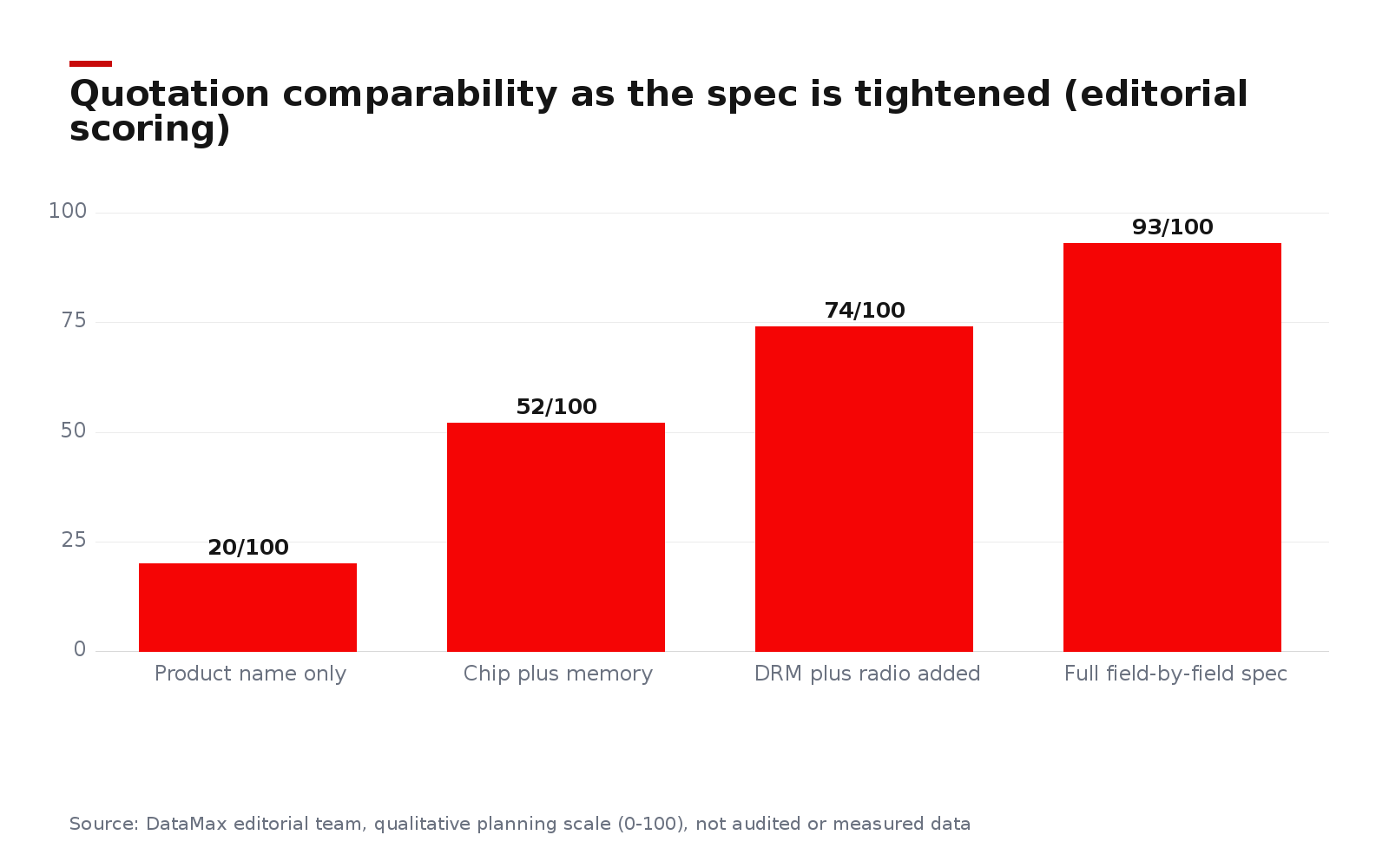
The same figures, in searchable form:
| Quotation basis | Editorial score |
|---|---|
| Product name only | 20 |
| Chip plus memory | 52 |
| DRM plus radio added | 74 |
| Full field-by-field spec | 93 |
The chart’s 20, 52, 74 and 93 values rank specification completeness on an editorial qualitative scale. They do not measure device performance, supplier quality or field reliability. Their procurement use is narrow: they show why adding chipset, memory, DRM and radio fields makes quotations easier to compare, while the full schedule provides the strongest basis for approval.
Deployment scenarios and the spec each needs
A deployment scenario should be defined by the service and operating model, not a generic “hotel box” label. The matrix maps buyer situations to the requirement that should dominate the shortlist. Model direction does not replace a configuration-specific review.
| Situation | Primary requirement | Model direction | RFQ focus |
|---|---|---|---|
| • Operator IPTV with dedicated middleware | • Controlled platform and stable room workflow | • DM21P as the stated operator-middleware fit | • Confirm OS, optional DRM, Ethernet, middleware, remote and update responsibility |
| • IPTV/OTT white-label service | • Android flexibility with operator branding and application control | • DM21S as the stated white-label fit | • Lock codec profile, 100M or optional 1G, application certification and provisioning |
| • Premium UHD or cloud-gaming offer | • Higher stated decode and frame-rate envelope | • DM21T as the stated premium/cloud-gaming fit | • Validate service delivery, display mode, HDMI output, 1G option and thermal operating margin |
| • Gaming-oriented Android TV room | • Gaming software, Android application stack and controlled latency assessment | • DM22Q as the stated gaming-oriented fit | • Validate real service performance, network path, firmware and input method |
| • Integrator-led multi-property deployment | • Replenishment consistency across properties and releases | • Select from the verified platform shortlist | • Freeze hardware revision, accessories, test script, spares and change notification |
| • Wired IPTV property | • Predictable room connectivity and central service control | • DM21P or DM21S according to middleware fit | • Specify Ethernet speed, VLAN, multicast or unicast delivery and recovery test |
| • Wi-Fi-led retrofit | • Reduced cabling with controlled wireless dependency | • Select a platform with the required stated radio configuration | • Test coverage, authentication, interference, load, DHCP and device isolation |
| • Premium room without gaming | • Higher-resolution media path without unnecessary feature scope | • DM21T only where its stated capabilities are used | • Validate panel mode, service frame rate, network delivery and output limitations |
For an operator IPTV programme, the hardware decision follows the service contract. Specify channel delivery, operator middleware, secure playback, identity, update control and network provisioning before comparing decode headlines. For an integrator, the critical issue is repeatability: a model selected for one pilot must be identifiable at every later replenishment.
For a premium UHD or gaming room, the television, network and source must support the claimed experience. A 120 Hz decode field does not guarantee a 120 Hz service path or television mode. Test the complete chain and distinguish processing features from source-delivery capability. For a venue without stable wired connectivity, Wi-Fi becomes part of acceptance: coverage, authentication, roaming, interference and load conditions matter more than the label on the box.
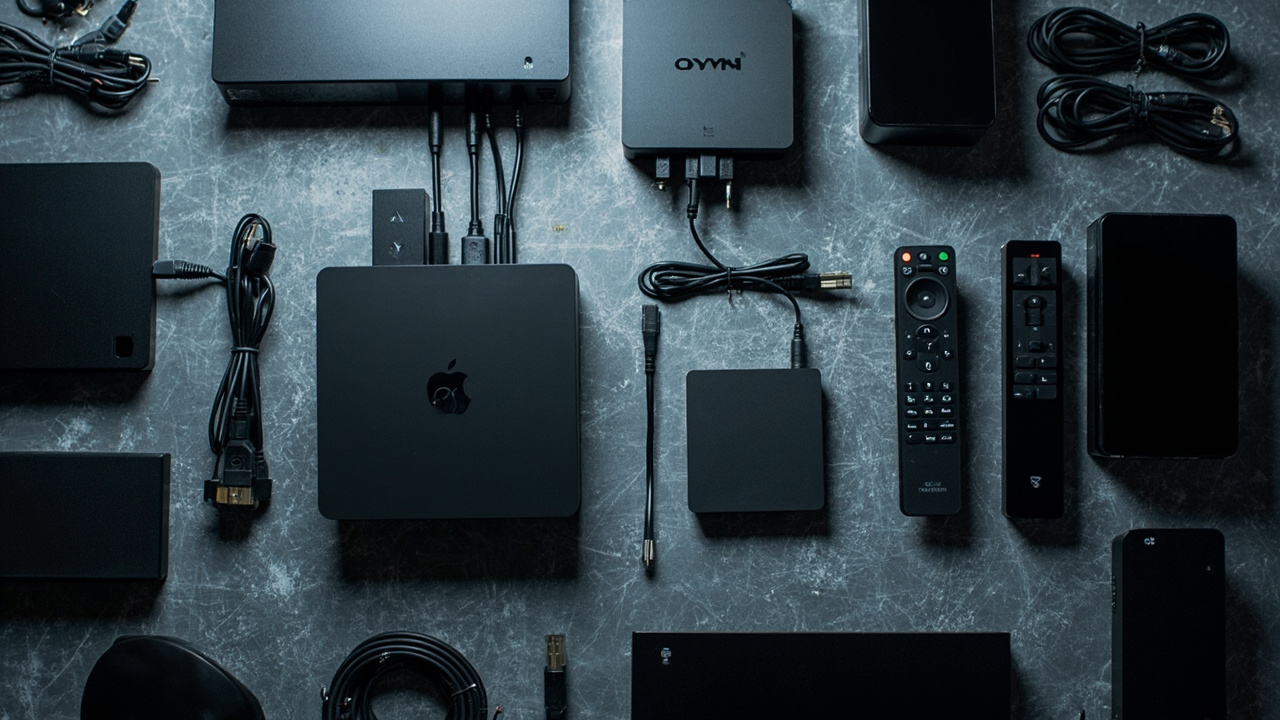
The physical installation also sets constraints. Hide the operator box behind the panel, confirm ventilation, cable reach, power delivery, remote visibility and service access. The photographic reference shows the intended scene: a compact operator box behind a wall-mounted television in a modern room, where physical concealment must not prevent heat dissipation or maintenance.

The final procurement action is to convert the selected scenario into a golden specification, pilot it with real services and preserve the tested configuration. A buyer can request DataMax samples; the first message should identify the room use case, television and HDMI requirements, source service, codec and DRM needs, network configuration, OS and memory baseline, remote-control method, expected volume and evidence required for production approval.
For an in room entertainment hotel programme, separate acceptance into platform, property and service layers. Platform acceptance checks decode, output, memory, OS and interfaces. Property acceptance checks television modes, power, cabling, ventilation and local network conditions. Service acceptance checks live IPTV, OTT applications, identity, DRM, remote operation and recovery. Recording the three results separately makes supplier escalation faster and prevents a successful laboratory test from masking a property installation problem.
Further reading
- Rockchip Android TV boxes
- Edge computing boxes
- 4K 60fps Android TV box guide
- Rockchip Android TV box guide
- Dolby Vision Android TV box guide
- DataMax DM21P specifications and fit
- DataMax DM21S specifications and fit
FAQ
What is the difference between an IPTV set-top box and an OTT box in a hotel room?
An IPTV box may be designed around an operator-controlled television service, middleware and channel or multicast delivery, while an OTT box commonly emphasizes internet applications and unicast streaming. Real deployments can combine both models. Procurement should specify service delivery, operator control, identity, DRM, network policy and update ownership rather than relying on the label alone.
Is a 4K-capable set-top box enough for a hotel room?
No. A 4K label does not establish the codec profile, frame rate, output mode, DRM configuration or television compatibility. The RFQ should separately state hardware decode, HDMI output, secure playback, OS, memory and middleware. A pilot using the actual panel, network and content service is needed to verify the complete chain.
Which DataMax model is intended for operator middleware?
The DM21P is stated as a 4K IPTV and operator-middleware set-top box fit. It uses the Amlogic S905Y4 and AOSP Android 11, with stated 2GB / 8GB memory. Buyers should confirm the exact shipped memory, optional DRM and all production configuration against the datasheet.
Does Wi-Fi 6 remove the need for Ethernet in guest rooms?
No. Wi-Fi 6 can address cabling constraints, but it also introduces coverage, interference, authentication and property-network dependencies. A wired Ethernet connection may remain preferable for predictable service delivery. The specification should state whether 100M Ethernet is sufficient, whether 1G is required and how each path is provisioned.
What should be included in a hotel box RFQ?
Include room count, television and HDMI requirements, source services, codec and frame-rate targets, DRM, OS, RAM/ROM, Ethernet and radio requirements, audio and USB needs, remote, middleware, provisioning, OTA, support, accessories, pilot evidence and configuration-control terms. Include the same field names in every supplier response so quotations can be compared directly.
How can a buyer prevent substitutions after the pilot?
Freeze a golden build configuration covering SoC, memory, OS, ports, radio options, firmware, middleware, remote and accessories, then require written approval for any change. Ask the manufacturer to identify the production records that verify each field and to rerun the agreed regression test whenever the build definition changes.




