

Before the terminology: the AOSP or GMS decision
An RFQ lands with two nearly identical OTT streaming device requests: one says “Android TV box,” while the other specifies “AOSP and GMS.” Before the manufacturer answers, the buyer must separate four decisions: Google certification, Android TV device type, operator middleware ownership, and DRM obligations. Choosing the wrong combination can invalidate an application, block service deployment, or force a software and certification reset before shipment.
The direct answer is conditional but operationally clear. Choose a GMS-certified AOSP build when the commercial channel requires Google Play services, Google certification, and a non-Google-TV Android deployment. Choose AOSP when the operator or integrator controls the application, launcher, update path, account system, and middleware, and does not require those Google elements. For a white-label OTT service, AOSP normally provides more control over the software image, although the operator still has to own updates, security policy, content protection, and device provisioning. For an operator distribution requiring a certified non-Google-TV SKU, the relevant starting point is a platform such as DM21RTD.
The manufacturer should not answer “AOSP or GMS” as a simple binary. It must identify the Android device category, Google certification status, OS release, hardware baseline, codec obligations, DRM level, network interface, operator middleware, update mechanism, and evidence required for acceptance. A buyer who sends only “Android 14” leaves every commercially consequential variable undefined. This article focuses on that angle; the broader selection process is covered in the TV box vendor selection checklist.
The decision gate
| Requirement | Choose the build path | Evidence to request |
|---|---|---|
| Google Play services and Google certification are mandatory | GMS-certified AOSP on an eligible device category | Certification status, device-category statement, OS release, update policy |
| Operator owns launcher, application, accounts, updates, and middleware | AOSP | Image ownership, signing process, OTA procedure, factory provisioning workflow |
| 4K IPTV service with operator middleware | Model selected after codec and DRM mapping | Decode profiles, output mode, Widevine level, HDCP option, Ethernet configuration |
| White-label OTT product with distributor branding | AOSP with controlled software customization | Boot animation, launcher, packaging, serial tracking, update ownership |
A buyer should record the decision as a configuration statement, not as an email preference. “GMS preferred” is not sufficient if the buyer actually needs Google Play services in a specific channel, because the device category and certification scope still need to be named. The commercial requirement, software entitlement, and physical platform should appear as three separate fields in the RFQ.
Procurement shortcut: Require every quotation to identify one platform, one Android release, one certification status, one production image, and one orderable hardware configuration. Any answer that lists alternatives without naming the proposed production option remains a technical sample request, not a commercial quotation.
Deployment scenarios and the specification each scenario needs
The procurement scenario determines which specification fields matter most. An operator buying under a managed-service agreement needs device lifecycle controls, middleware integration, deterministic hardware, and service recovery. An integrator deploying into hospitality or retail estates needs installation flexibility, remote support, recovery behavior, and a stable image. A venue vertical using a customized portal may need neither Google Play nor unrestricted consumer-side installation; it still needs controlled updates, hardened network access, and clear ownership of application failures.
| Situation | Primary requirement | Model direction |
|---|---|---|
| Operator IPTV service | AOSP, operator middleware, DRM, Ethernet, operator provisioning | DM21P for 4K IPTV; verify the production configuration |
| Retail channel needing a Google-certified non-Google-TV SKU | GMS-certified AOSP and documented Google certification | DM21RTD |
| IPTV or OTT white-label program | AOSP, launcher control, branding, flexible memory/storage | DM21S |
| Premium UHD or cloud-gaming route | High-frame-rate 4K decode, stronger SoC, storage and I/O options | DM21T; validate output and workload requirements |
| Hospitality or venue portal | Kiosk behavior, recovery, network deployment, operator-controlled updates | Select by validated software image and interfaces, not by OS label alone |
An operator RFQ should state the service environment, image ownership, update mechanism, and service-level expectations before naming a chip. A distributor RFQ should separate certification from cosmetic branding. An integrator RFQ should define boot behavior, permitted peripherals, network authentication, and recovery procedure.
A manufacturer quoting only SoC and RAM/ROM has not defined the deployment. For example, 2GB/8GB may fit a controlled IPTV image, but storage endurance, update staging space, cached content, and middleware behavior determine whether that combination remains operable over the program’s service life. The buyer should request the image partition plan and update mechanism rather than infer capacity from headline memory.
A staging-warehouse photograph provides context for the physical evidence behind this decision: modern SMT equipment placing components onto black printed circuit boards on a conveyor. The image shows production, not configuration control.

The manufacturer response should map each platform to the intended scenario and identify what remains configurable. That mapping is the first defense against a quotation that meets a laboratory sample but not the deployed service.
A hotel group rolling out 2,000 rooms to a managed-service operator has a different acceptance question from a sports venue installing 12 demonstration displays. The former may prioritize Ethernet stability, image recovery, remote support, and serial-level provisioning. The latter may prioritize HDMI output behavior, display compatibility, application startup, and recovery after power interruption. Neither can be validated from a generic “4K Android box” description.
For a distributor selling through retail, packaging, regulatory declarations, certification status, and the exact retail SKU all affect channel approval. The manufacturer should identify whether the proposed image is production-ready for that channel and whether packaging or branding changes trigger recertification or a revised pro forma specification.
Turning the AOSP or GMS question into a specification line
The shortest reliable RFQ starts by separating software entitlement from platform capability. “AOSP” describes the Android Open Source Project basis. “GMS” describes a bundle of Google mobile services and the associated certification path. Neither term, alone, defines the complete device.
Use the following sequence to convert the decision into procurement language. Each step becomes a line that a manufacturer can quote without inference.
- Declare the commercial requirement State whether Google Play services and Google certification are mandatory, optional, or prohibited. Identify the intended channel and buyer.
- Name the device category Specify whether the product is Android TV or a non-Google-TV Android device. Do not merge “Android TV box” with the certified device-category wording.
- Lock the software baseline Request the Android release, GMS status, launcher, build identity, security patch process, and who signs the image.
- Map media and content protection List required codecs, resolution, frame rate, HDR requirements, Widevine level, HDCP option, and any operator DRM.
- Define connectivity and interfaces Specify Ethernet speed, Wi-Fi configuration, Bluetooth version, HDMI direction, USB count and generation, storage, audio, and tuner needs.
- Define lifecycle control Allocate launcher, application, account, OTA, remote monitoring, recovery, and rollback responsibilities.
- Attach acceptance evidence Name the production revision, firmware hash, test reports, certification documents, and samples that bind the quotation to the delivery configuration.
A pasteable RFQ line can read:
Provide an AOSP Android 14 TV set-top box using the Amlogic S905Y5 platform, 2GB RAM and 16GB storage, AV1 and H.265 [email protected] 4K@60 decode, Widevine L1 and PlayReady, HDMI 2.0b output, two USB2.0 ports, 100M Ethernet, and Wi-Fi 6 2x2 with Bluetooth 5.4. State the launcher, bootloader signing authority, OTA owner, recovery method, production image identifier, and evidence pack. Google Play services are not required unless expressly approved.
That line still needs operator-specific additions, but it removes several common ambiguities. The manufacturer can now identify the closest platform and quote any deviation rather than replacing a requirement with a general Android label.
Use a flow before requesting samples
device category
The flow ends at a production-representative sample, not a generic showroom unit. That distinction matters because the manufacturer may alter components, boot images, middleware, packaging, and certificates between evaluation and volume production.
A second RFQ line should protect the acceptance boundary: state that the sample must identify its hardware revision, installed image identifier, boot signature, storage and RAM configuration, Ethernet option, DRM configuration, and packaging. If the manufacturer changes any item affecting certification, playback, middleware behavior, or connectivity, the buyer should require written notice and a revised sample rather than silently accepting substitution.
Sample rule: The production-representative sample is the contract reference. Record its configuration and image identifiers in the purchase order, then require every delivery lot to match those identifiers or to receive an approved deviation notice.
Where quotations quietly diverge
Quotations often appear equivalent because they use the same OS and memory wording. The divergence may sit in the Android device category, Google certification, bootloader signature, OTA service, codec profile, Ethernet option, or evidence package. A manufacturer that omits these fields has not necessarily rejected the requirement; it has created an acceptance dispute waiting to happen.
Field trap
A quotation saying “AOSP Android 14” does not prove Google certification, Google Play services availability, Android TV classification, operator middleware compatibility, or production OTA support. Ask for each attribute separately. If certification is mandatory, “AOSP” is not an acceptable substitute for a certified GMS build.
Codec wording creates a second divergence. “4K capable” does not identify AV1, VP9, H.265, H.264, profile, level, or frame rate. Likewise, “Widevine enabled” does not establish L1, and an optional HDCP path is not the same as a mandatory production configuration. The manufacturer must identify what is fitted, what is optional, and what was actually tested.
Field trap
HDMI “out” and HDMI “in” are different requirements. A cloud-gaming path may need input latency and a defined capture workflow, but a model with output only cannot satisfy an input requirement. Conversely, unused input changes cost and validation scope without improving the operator case. Resolve interface direction before the **manufacturer** prepares a bill of materials.
RAM and storage also diverge under interpretation. A quoted 2GB/8GB unit may not be the same configuration as 2GB/16GB, and optional Ethernet speed changes the bill of materials. Request the exact ordering code, component part numbers, storage configuration, firmware revision, and sample serial number.
The commercial risk is a mismatched lot rather than a single defective box. A production order accepted against an ambiguous quote can fail at certification, provisioning, or field deployment. The manufacturer should therefore freeze the configuration in a written pro forma specification before purchase-order release.
Three further gaps deserve explicit closure. First, “Wi-Fi 6” does not state the antenna design, regulatory domain, supported bands, coexistence behavior, or whether the quoted configuration supports 2x2 operation. Second, “optional DRM” may mean that a production unit lacks the requested feature; the order must say whether the option is populated. Third, “operator middleware supported” is not a test result unless the manufacturer identifies the middleware version, image, interface contract, and acceptance scenario.
A bootloader statement is equally important. The buyer should know who holds the signing key, where it is stored, how a lost key is handled, whether the operator can authorize its own applications, and whether a failed OTA returns the unit to a recoverable state. These are software-lifecycle questions, not factory cosmetic details.
Change control closes another common gap. A component or driver substitution can alter thermal behavior, wireless performance, memory compatibility, or codec certification even when the visible SKU name remains unchanged. Require the manufacturer to state what engineering change requires prior notice, which fields remain orderable, and which evidence must be regenerated after a change.
The evidence trail from SMT to shipment
Factory capability is not demonstrated by a polished sample room. The manufacturer should show an evidence trail connecting the approved specification to the assembled board, installed image, production configuration, and shipped unit. SMT placement, AOI, firmware flashing, burn-in or aging, dark-room display checks, and audit records answer different questions.
SMT and AOI establish component placement and solder-joint inspection. Firmware flashing proves that an image can be installed, not that the image matches the signed commercial release. Aging exercises thermal, power, and stability behavior over time. A dark-room check identifies display anomalies under controlled conditions. Final functional testing confirms ports, network behavior, storage, remote functions, and the selected output configuration.
- Pre-production review Match the approved specification, schematic or BOM revision, Android image, middleware build, and certification status to the intended order.
- Incoming and board inspection Review component traceability, SMT records, AOI results, and deviations against the controlled BOM.
- Image control Record the firmware image identifier, flashing result, bootloader signature, and configuration written into each device.
- Stress and display checks Apply the defined aging procedure and record dark-room display inspection results.
- Functional acceptance Test network, interfaces, output mode, codecs, DRM where licensed, remote control, storage, and application provisioning.
- Shipment release Bind cartons or serial records to the production lot, retain inspection records, and issue the exact evidence package with the order.
Evidence request: The first message to DataMax inquiry should contain the target market, required AOSP or GMS status, intended device category, OS release, codec and DRM needs, RAM/ROM, Ethernet, HDMI, USB and wireless requirements, expected quantities by market, and whether a factory video audit plus SMT/AOI/aging evidence is required.
A manufacturer should explain which records are retained and how they connect to the shipment. A photo of a production line does not prove the inspected board is the ordered board. The evidence chain needs board, image, serial, configuration, and lot identifiers.
The factory visit can be remote or on-site, but its scope must be technical rather than promotional. Ask to observe SMT placement, AOI operation, firmware flashing, aging racks, and final test. Request a sample report with serial references redacted where necessary. DataMax also invites buyers to request an SMT/AOI/aging evidence pack through factory quality, with the relevant acceptance criteria defined before review.
The evidence review should identify the factory location, line used for the order, inspection stage, defect disposition, and record owner. If several lines or subcontract sites exist, the manufacturer should state which one will execute the controlled build. Otherwise, a valid process at one site does not prove the actual production path.
A useful sample report links one serial number to the AOI result, firmware-flashing result, aging record, display inspection, functional test, and final configuration. The buyer does not need confidential source files, but the report should demonstrate traceability without becoming a disconnected certification collage.
Options placed side by side
The relevant choice is not “cheap AOSP versus expensive GMS.” It is a control model: consumer ecosystem access, operator-controlled software, or a staged commitment with stronger lifecycle evidence. A sourcing agent can coordinate components, but accountability for the integrated product becomes distributed. A component distributor can supply assemblies or boards, but firmware, certification, and field behavior still require separate ownership. A factory-type OEM supplies a product defined by the buyer. A factory-type ODM contributes a larger share of product definition, engineering, software integration, and manufacturing control.
| Option | Buyer controls | Shared responsibility | Primary diligence focus |
|---|---|---|---|
| Sourcing agent | Requirements and supplier selection | Assembly, firmware, certification, quality, logistics | Who owns each technical and acceptance gate? |
| Component distributor | Parts, quantities, delivery window | Board assembly, software, certification, device-level validation | Is the supplied scope a component or a finished device? |
| Factory-type OEM | Product specification and brand | Engineering, BOM, sourcing, manufacture, quality evidence | Configuration control, traceability, change notification |
| Factory-type ODM | Market, branding, commercial requirements | Platform definition, software integration, certification, manufacture | Ownership of platform IP, firmware, updates, and lifecycle support |
The editorial ranking below compares how readily each route can trace a failure through product definition, sourcing, manufacturing, software, and acceptance. It is not measured performance.
The choice changes when the program needs a certified ecosystem. GMS adds a certification and service dependency that cannot be satisfied by a general-purpose board. AOSP gives the software owner a narrower control surface, but it transfers update, security, provisioning, and recovery work to the operator or integrator.
The manufacturer should state which model it is offering, what it signs, which components it procures directly, and which certification artifacts it controls. Hidden subcontracting prevents a buyer from understanding where a failure will stop.
A sourcing agent may suit a narrow hardware assembly with a separately controlled software supplier, but the buyer must designate one party to own the final configuration. A component distributor may suit a mature board with no new industrial design, but certification scope and device-level validation still need named owners. A factory-type OEM may suit a buyer with a detailed specification and strong engineering oversight. A factory-type ODM may suit a buyer seeking broader platform and software contribution, provided the agreement defines update obligations, intellectual-property boundaries, and acceptance rights.
The practical distinction is the handoff. In a distributed model, a playback failure may sit in the decoder driver, a middleware integration layer, a DRM license service, or the operator account flow. The score of 22 for a sourcing agent and 35 for a component distributor reflects that weaker editorial traceability, not a guaranteed outcome. For a factory-type OEM and ODM, the score of 78 and 90 reflects the greater potential to connect those failure points, subject to actual configuration control.
Definitions a buyer cannot outsource
AOSP is the Android Open Source Project foundation. It provides the open-source platform components from which a product image is built. It does not automatically supply Google Play services, Google certification, Google account integration, or a particular commercial launcher. A GMS build adds Google services and is associated with Google’s compatibility and certification process. The procurement team must therefore distinguish the base OS, included services, device category, and certification status.
- Kernel and platform source
- Framework, drivers, HAL integration
- Bootloader, image signing, build provenance
DRM and media processing form a separate requirement set. Widevine L1 supports a protected path under the conditions represented by the implementation and licensing arrangement; L3 is a lower hardware-backed level. The manufacturer must specify which level is implemented and validated. PlayReady is a separate Microsoft DRM. HDCP 2.2 is an optional DataMax feature on the relevant platform, so the buyer must state whether it is mandatory for that order. Content apps also need the correct decoder profile, output resolution, frame rate, and display mode.
Android CDD and CTS are compatibility mechanisms associated with Android device qualification. Their role should be stated precisely by the certification route, not used as interchangeable marketing labels. For commercial Android TV products, EDLA certification may be relevant to Google Play TV and device capabilities; an Android TV application and the device certification are separate layers. A buyer should ask for the certification document, device category, covered model, software version, and expiration or review status rather than relying on a general statement that the product is “certified.”
The architecture below remains valid whichever platform is selected:
The manufacturer owns the implementation evidence for its scope; the buyer owns the service acceptance criteria. No general certification statement substitutes for a traceable requirement.
AOSP and GMS are not competing performance tiers. AOSP names the source foundation; GMS names an added service and certification environment. A device can therefore use an AOSP-derived image with GMS, and a controlled AOSP image can remain outside Google Play services. The procurement error is not choosing one term; it is allowing one term to stand in for device category, application distribution, account behavior, middleware compatibility, and update responsibility.
DRM also operates at several layers. The operating system exposes a protected pipeline, the hardware supports the required security path, the codec implementation matches the requested profile, and the service issues a valid license under the applicable commercial arrangement. Widevine L1 and PlayReady should not be compared as interchangeable marketing names. Likewise, HDCP protects the output path, while HDCP option status on a platform does not establish that every display, source, sink, and application path will negotiate the intended mode.
For operator middleware, the architecture often includes device identity, entitlement discovery, channel lineup delivery, restricted navigation, purchase or billing integration, diagnostics, and recovery. A manufacturer may own the AOSP image and application distribution while the operator owns middleware. The RFQ should identify the API or interface contract, test environment, test vectors, and responsibility for defects at each boundary.
Certification is likewise version-specific. A document may cover a particular model, device category, software build, and certification scope. The buyer should match those fields to the production image. If the manufacturer changes the Android release, Google services package, bootloader, or certification-sensitive hardware, the buyer needs to know whether the prior certificate remains applicable.
Real DataMax platforms, field by field
DataMax provides four relevant AOSP-led platform directions. One explicitly targets operators and retailers requiring a Google-certified non-Google-TV AOSP and GMS SKU; the other three address IPTV, OTT white-label, UHD, and cloud-gaming use cases. The comparison below reproduces only the supplied product facts. Unspecified options require confirmation against the production datasheet and the order-specific pro forma specification.
| Model | SoC and OS | RAM/ROM | Decode and DRM | Interfaces | Intended fit |
|---|---|---|---|---|---|
| DM21RTD | Realtek RTD1325; GMS-certified AOSP | Confirm against the production datasheet | AV1 capable; other DRM details confirm against the production datasheet | Confirm against the production datasheet | Operators/retail requiring a Google-certified non-Google-TV AOSP+GMS SKU |
| DM21P | Amlogic S905Y4, quad Cortex-A35; AOSP Android 11 | 2GB / 8GB; 4GB; 16/32/64GB optional | AV1 [email protected], VP9/H.265 4K@60, H.264 4K@30; Widevine L1 / PlayReady / HDCP 2.2 optional | HDMI 2.0b out x1, USB2.0 x2, TF, S/PDIF, 3.5mm AV, RJ45 100M, Wi-Fi6 2x2 + BT5.4, DC 5V/2A | 4K IPTV / operator middleware set-top box |
| DM21S | Amlogic S905Y5, quad Cortex-A55; AOSP Android 14 | 2GB / 16GB; 2/4/8GB; 16/32/64GB optional | AV1 / H.265 [email protected] 4K@60; Widevine L1 / PlayReady optional; Dolby Vision/DTS | HDMI 2.0b out, S/PDIF, AV, USB2.0 x2, TF, RJ45 100M (1G optional), Wi-Fi6 2x2 + BT5.4 | 4K Android TV box for IPTV/OTT white-label |
| DM21T | Amlogic S905X5, quad Cortex-A510 (ARMv9); AOSP Android 14 | 4GB / 64GB; family options | H.266/VVC [email protected] 4K@120, AV1/VP9/H.265 4K@120, AVS3 4K@120, H.264 4K@60; inline AI-SR; Widevine L1 / PlayReady optional | HDMI 2.0b out (no HDMI in), USB2.0 x1 + USB3.0 x1, TF, S/PDIF, AV, RJ45 100M (1G opt), Wi-Fi6 + BT5.4 | Premium UHD / cloud-gaming box |
DM21RTD addresses the case where the commercial requirement is a Google-certified non-Google-TV AOSP+GMS SKU. Its listed SoC is Realtek RTD1325, its OS is GMS-certified AOSP, and its decode capability is AV1 capable. Other fields must be confirmed against the production datasheet rather than inferred from related platforms.
DM21P and DM21S use different SoCs and Android releases, so they are not interchangeable substitutions. DM21P is specified for AOSP Android 11 and an operator middleware route; DM21S is specified for AOSP Android 14 and an IPTV/OTT white-label route. Their optional DRM, Ethernet, and memory choices must be frozen per order.
DM21T is the premium platform direction, with a different decode envelope and USB mix. Its production specification caps output and decode at 4K, so any “8K” marketing shorthand must not enter the procurement record.
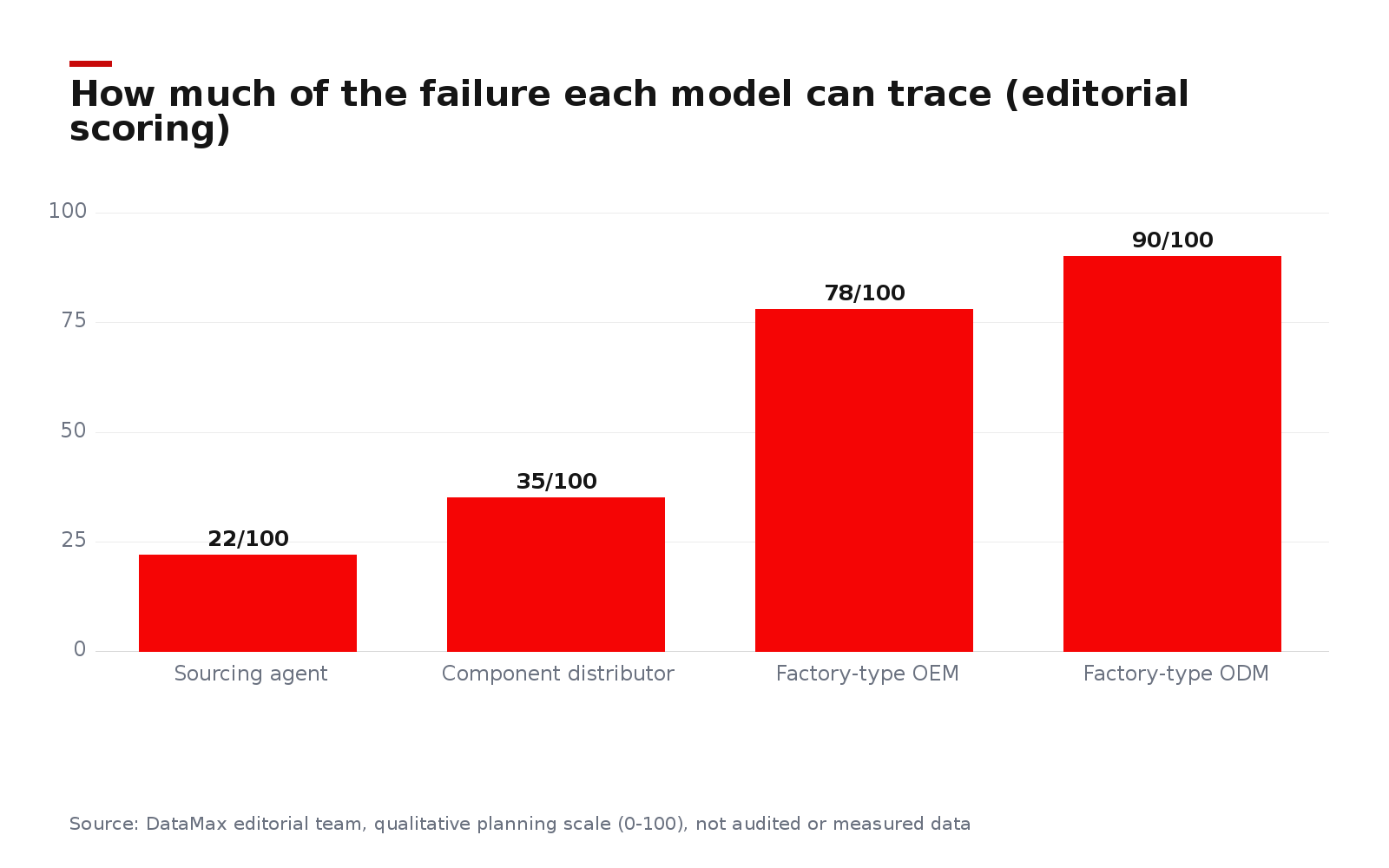
The same figures, in searchable form:
| Model | Editorial score |
|---|---|
| Sourcing agent | 22 |
| Component distributor | 35 |
| Factory-type OEM | 78 |
| Factory-type ODM | 90 |
Source: DataMax editorial team, qualitative planning scale (0-100), not audited or measured data. Suffix: /100.
For an RFQ response, use the inquiry form and include the target market, AOSP or GMS requirement, device category, codec, DRM, memory, connectivity, interface and lifecycle requirements, plus the request for a production-linked evidence pack. If a sample is the next gate, order samples with the exact configuration frozen. The manufacturer should answer each requirement against a named platform rather than redirect the decision into a generic Android category.
A practical sequence for the DataMax RFQ is to select the intended model direction, attach the required software and certification fields, then request a sample that represents the proposed order. For DM21RTD, the buyer should ask for the certification evidence matching the intended non-Google-TV GMS SKU. For DM21P or DM21S, the buyer should specify the exact memory, Ethernet, DRM, and middleware configuration. For DM21T, the buyer should specify the 4K output and decode envelope, absence of HDMI input, and required USB mix.
Further reading
- Guide tv box vendor selection checklist
- RFQ checklist for device procurement
- Nigeria SONCAP compliance support
- Compliance support by market
- Allwinner Android TV boxes
- DataMax DM21RTD specifications and fit
- DataMax DM21P specifications and fit
FAQ
Is GMS the same as AOSP?
No. AOSP is the Android Open Source Project foundation used to build the software platform. GMS adds Google services and involves a separate certification path. A device can be AOSP-based without providing the required Google services or certification. The buyer should specify AOSP or GMS status, the Android device category, and certification evidence as separate fields when requesting a manufacturer quotation.
Can an AOSP TV box later become a GMS product?
Not safely by changing the OS label. The product may need device-category eligibility, Google services integration, compatibility work, certification, and a controlled image rebuild. Some platform choices may be unsuitable, while others may require engineering and validation. Treat GMS as an order-line requirement and request certification evidence for the exact model and production software.
Which DataMax platform is intended for Google-certified deployments?
The DM21RTD is listed for operators and retail requiring a Google-certified non-Google-TV AOSP+GMS SKU. Its listed SoC is Realtek RTD1325, its OS is GMS-certified AOSP, and its decode capability is AV1 capable. Memory, DRM, ports, and other fields must be confirmed against the production datasheet.
Should buyers choose the newest Android release automatically?
No. The OS release must satisfy the applications, middleware, certification path, operator security policy, and update model. AOSP Android 11 on DM21P and AOSP Android 14 on DM21S serve different product directions. A manufacturer should justify the release through compatibility and lifecycle evidence, not release recency alone.
What evidence proves production quality?
Ask for an evidence chain covering SMT records, AOI results, firmware flashing, aging, dark-room display inspection, functional testing, configuration control, and serial-to-lot traceability. For this topic, request a video factory audit or the SMT/AOI/aging evidence pack through DataMax, then bind it to the production sample and the written ordering specification.
Does “4K TV box” define the required specification?
No. “4K TV box” does not identify decode profiles, frame rate, HDMI mode, DRM level, HDCP, Ethernet speed, USB generation, memory, storage, OS, application stack, or update ownership. The RFQ must specify those fields. For DM21T, the production datasheet caps output and decode at 4K despite any broader marketing shorthand, so the manufacturer response should use the datasheet limits.
What should the first RFQ message include?
Include the target market, AOSP or GMS requirement, intended Android device category, OS release, codec and DRM profile, RAM/ROM, Ethernet, HDMI, USB and wireless requirements, middleware ownership, OTA responsibility, and evidence expectations. For a DataMax response, use the inquiry channel or request samples through sample ordering, with the production configuration frozen before evaluation.
How should a buyer compare manufacturing responsibility models?
Compare the party that owns each handoff: product definition, component sourcing, board assembly, firmware, certification, device-level testing, change notification, traceability, and lifecycle updates. A sourcing agent or component distributor may leave more responsibility distributed, while factory-type OEM and ODM models can provide broader integration. Verify contractual ownership and evidence rather than relying on the organizational label alone.




