The short answer first
Before accepting a set-top box quotation for sign-off, confirm five items: the exact regulatory status of the device, the party responsible for certification, the model or SKU covered by the evidence, the tested configuration and date, and the process for evaluating changes to the antenna, radio module, PCB, enclosure, firmware, or labelling. Each item is verified against a different record.
A part 15 test report is commonly requested as evidence that an intentional or unintentional radiator has been evaluated under applicable FCC Part 15 requirements. It is not a universal certificate with one fixed commercial meaning. The buyer must establish whether the document is a Supplier’s Declaration of Conformity, a Certification Report, an FCC ID record, an accredited laboratory report, or an internal RF test summary. That distinction determines who is responsible for market authorization and which record must accompany the product.
Timing matters. Request the preliminary compliance position before artwork approval and tooling release; request formal evidence before the first production shipment; request a change-impact assessment before modifying the radio path, enclosure, or radio-control software. For operator middleware, DRM, and device management, place the RF evidence within a wider production-evidence review rather than treating it as a substitute for security, licensing, and model-compliance review.
A procurement example is to ask the supplier to map every shipmentable SKU to its FCC classification, responsible party, laboratory identifier, report number, radio configuration, and change-control status. If the quotation says only “FCC certified,” request the underlying evidence before comparing commercial terms. DataMax can support that review through a compliance-document request; regulatory responsibility must still be confirmed against the production configuration and production datasheet.
The decision rule is simple: no final SKU is approved until the report, authorization route, and released configuration can be linked in one dated register. A report received after the first shipment is not evidence that the goods already entered the market; it is a document obtained afterward.
Two routes, one bill of differences
The practical choice is between obtaining evidence for a controlled product family and commissioning a project-specific test program. The routes differ in schedule, ownership, and retained evidence. Neither removes the buyer’s duty to verify the shipped configuration.
| Decision field | Controlled-family route | Project-specific route |
|---|---|---|
| Best fit | Stable Android TV or set-top box SKU with known radio and enclosure | New radio path, antenna, enclosure, output configuration, or market entry |
| Evidence request | Existing report, certification record, laboratory details, covered variants, and production configuration | Pre-compliance scan, formal test plan, accredited-laboratory report, and change record |
| Supplier responsibility | Supply traceable evidence and explain production equivalence | Coordinate samples, fixtures, software, retest rules, and report delivery |
| Buyer risk | Over-reliance on a report that does not cover the ordered configuration | Higher engineering spend and longer schedule before production approval |
| Release gate | Document match confirmed before purchase-order approval | Formal report accepted before mass-production release |
| Best procurement owner | Component and compliance engineer with product-management support | RF engineer, test engineer, compliance owner, and programme manager |
| Evidence retention | Reference report, variant matrix, approved configuration statement, and change log | Test plan, raw data package, report, deviation log, retest records, and final SKU map |
The controlled-family route is appropriate when the supplier demonstrates that the tested sample is electrically and mechanically equivalent to the ordered product. The evidence set should include the product name, hardware revision, software build, radio module, antenna specification, test configuration, test dates, laboratory identity, report number, and applicable FCC ID or grant information. A logo or marketing claim without those fields is insufficient for procurement.
The project-specific route becomes necessary when a housing revision alters antenna clearance, a Wi-Fi module or antenna changes, a new market introduces different radio limits, or the production sample differs from the documented reference unit. It creates a controlled sequence: freeze configuration, perform pre-compliance testing, confirm test scope, complete formal testing, review deviations, and bind the approved result to the released SKU.
The figures describe engagement depth, not regulatory performance. A higher score means more joint engineering work; it does not imply a better compliance outcome.
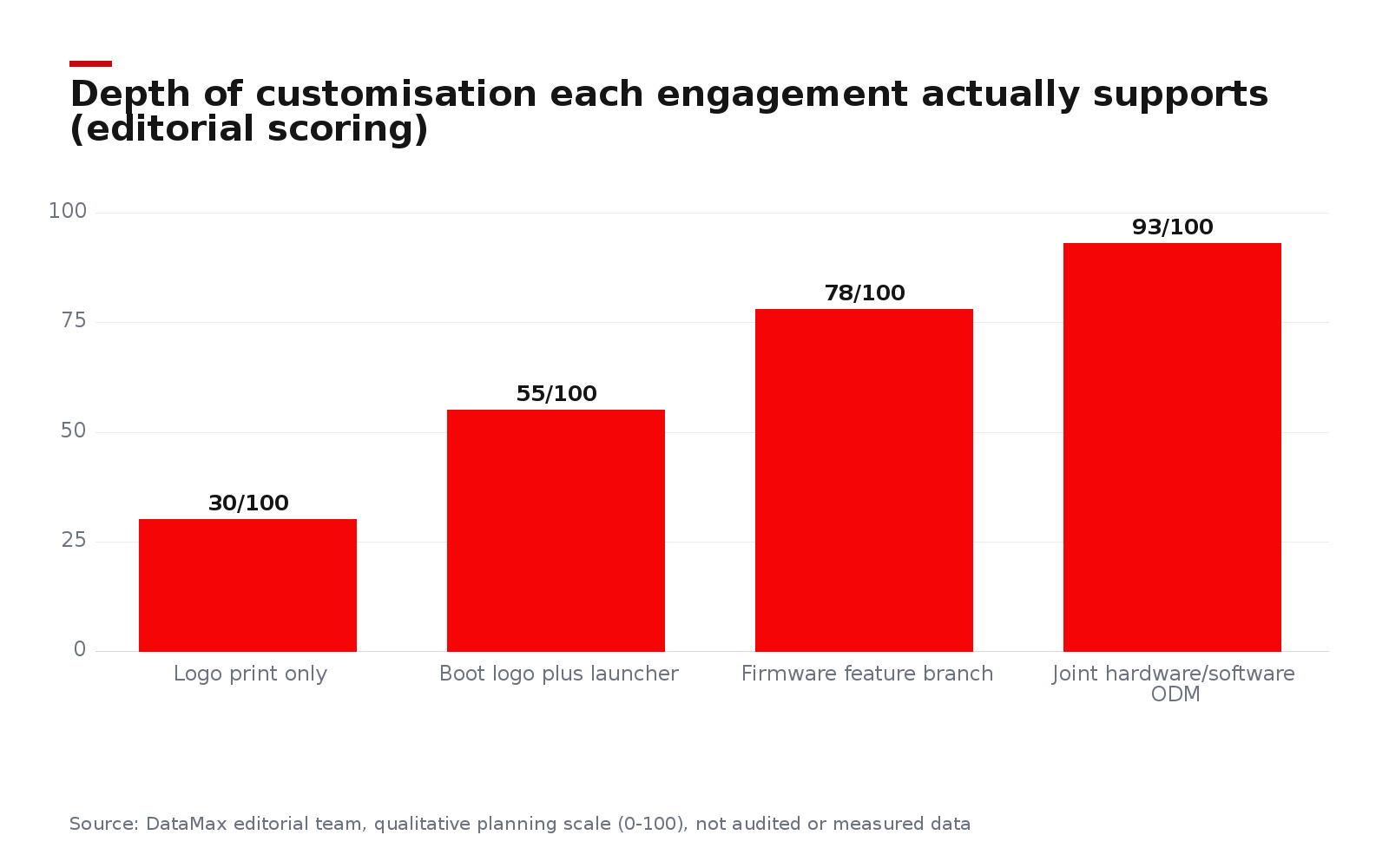
The same figures, in searchable form:
| Engagement option | Editorial score (/100) |
|---|---|
| Logo print only | 30 |
| Boot logo plus launcher | 55 |
| Firmware feature branch | 78 |
| Joint hardware/software ODM | 93 |
For planning, assign the report request to the configuration gate at which the relevant change becomes known. A logo-only request can use the baseline family file. A firmware branch requires identification of radio settings and operating modes. A new enclosure requires a mechanical and antenna assessment. This prevents a project from commissioning duplicate laboratory work when the existing report already covers the selected variant.
A practical example is an operator launch based on an existing Wi-Fi6 platform. If the quote changes only the boot logo and launcher, the buyer should request the existing report, the tested model mapping, and written confirmation that the change does not alter radio settings. If the enclosure, antenna, or radio module changes, the same request becomes a configuration-impact review or new test program.
The family route also requires a variant boundary. A storage option, regional power supply, packaging revision, and software build may be documented separately from the radio configuration. The evidence file should state which changes are outside the report’s scope and which changes require formal notification. A report without that boundary creates an assumption that every production variation inherits coverage.
The project-specific route is more demanding but produces clearer traceability. It should retain the pre-compliance data, formal test plan, sample photographs, wiring diagrams, software versions, measured results, deviations, final report, and the signed production equivalence statement. The procurement team should track each deliverable and its owner rather than asking for one consolidated PDF.
How the requirement actually works
FCC Part 15 regulates radio-frequency devices, including intentional radiators and unintentional radiators. The applicable subpart depends on the device and its emissions. Wi-Fi and Bluetooth equipment generally enters the intentional-radiator route; digital circuitry may create unintentional emissions assessed through the relevant equipment-authorization procedure. Classification and authorization are technical and legal determinations; a generic “Part 15 report” label establishes neither.
For an intentional radiator, the normal evidence chain includes an application to an FCC-recognized certification body, technical examination, equipment authorization, and an FCC ID record. For devices permitted to use a Supplier’s Declaration of Conformity, the responsible party must complete the applicable compliance information and user-manual requirements. Self-testing may support part of the process, but it does not replace any required certification or declaration.
The equipment-authorization record must match the transmitter’s identifying information. The buyer should compare the applicant, grantee, FCC ID, equipment class, antenna or system description, output power, frequency coverage, and conditions of use. The test report normally explains the test scope and measured results, while the public authorization record shows regulatory status. Neither should be substituted for a production-equivalence review.
A report also has a configuration boundary. Test laboratories evaluate the submitted hardware, relevant software, antenna, power, cables, peripherals, and operating modes described in the test plan. A later unit can depart from that boundary through a module substitution, antenna-impedance change, PCB revision, shielding change, firmware radio-control change, enclosure revision, or cable substitution. The response is a documented assessment of whether the change requires a new test, a delta test, a certification amendment, or no regulatory change.
Operator programmes add another evidence layer. A device may need middleware integration, Widevine or PlayReady implementation, HDCP handling, Android device-owner controls, secure update, and operator acceptance. None of those functions replaces FCC evidence. Conversely, an FCC-compliant radio does not establish content security or platform conformity.
The procurement rule is to map evidence to the exact released configuration. For a base hardware platform, request the report before customisation. For custom housings or antennas, request a configuration-impact statement. If the supplier cannot identify which evidence applies to the ordered SKU, the evidence is not ready for sign-off.
A useful distinction is between a compliance assertion and documentary proof. “The radio is designed to comply” describes an engineering position; a report, authorization record, and declaration describe the test and regulatory process. Procurement should preserve both statements because they answer different questions: one concerns design intent, while the other supports market release.
The evidence chain should be read as a set of linked records: tested sample, declared configuration, authorization record, production BOM, and release decision. A gap between any two links creates uncertainty. For example, a valid FCC ID may describe the certified radio module, but the finished set-top box can still differ through antenna selection, enclosure placement, RF cable, or firmware operating mode.
For a Wi-Fi6 set-top box, the buyer can request the radio module identifier, antenna part number, antenna placement, firmware radio-control version, and host-platform configuration as one evidence bundle. If the report identifies only a module-level transmitter, the finished-box assessment still needs to connect the module to the product antenna and enclosure. This is the point where a part 15 test report becomes useful rather than merely attached.
The platform shortlist with datasheet values
The table below records only the supplied DataMax platform facts. It does not state that any model is FCC certified, nor does it substitute a report for a production-configuration check. For each model, request the applicable regulatory evidence and confirm it against the production datasheet.
| Model | SoC and OS | RAM / ROM | Decode and DRM | Ports and connectivity |
|---|---|---|---|---|
| DM21P | Amlogic S905Y4, quad Cortex-A35; AOSP Android 11 | 2GB / 8GB (4GB; 16/32/64GB optional) | AV1 [email protected], VP9/H.265 4K@60, H.264 4K@30; Widevine L1 / PlayReady / HDCP 2.2 optional | HDMI 2.0b out x1, USB2.0 x2, TF, S/PDIF, 3.5mm AV, RJ45 100M, Wi-Fi6 2x2 + BT5.4, DC 5V/2A |
| DM21S | Amlogic S905Y5, quad Cortex-A55; AOSP Android 14 | 2GB / 16GB (2/4/8GB; 16/32/64GB optional) | AV1 / H.265 [email protected] 4K@60; Widevine L1 / PlayReady optional; Dolby Vision/DTS | HDMI 2.0b out, S/PDIF, AV, USB2.0 x2, TF, RJ45 100M (1G optional), Wi-Fi6 2x2 + BT5.4 |
| DM21T | Amlogic S905X5, quad Cortex-A510 (ARMv9); AOSP Android 14 | 4GB / 64GB (family options) | H.266/VVC [email protected] 4K@120, AV1/VP9/H.265 4K@120, AVS3 4K@120, H.264 4K@60; inline AI-SR; Widevine L1 / PlayReady optional | HDMI 2.0b out (no HDMI in), USB2.0 x1 + USB3.0 x1, TF, S/PDIF, AV, RJ45 100M (1G opt), Wi-Fi6 + BT5.4 |
| DM22Q | Amlogic S905X5M, quad Cortex-A55 up to 2.5GHz; AOSP Android 14 | 4GB / 64GB (2/4/8GB; 16/32/64GB optional) | AV1/H.265 L5.1 4K@60; inline AI-SR (no NPU TOPS stated); Widevine L1 / PlayReady optional; Dolby Vision/DTS | HDMI 2.0b out, USB2.0 x2, TF, S/PDIF, AV, RJ45 100M (1G opt), Wi-Fi6 2x2 + BT5.4 |
DM21P fits a 4K IPTV or operator-middleware set-top-box position. Its listed connectivity includes Wi-Fi6 2x2 + BT5.4 and RJ45 100M, so the RF evidence package should identify the exact radio implementation and antenna arrangement. The listed optional Widevine L1, PlayReady, and HDCP 2.2 entries describe configuration choices, not blanket certification status. A buyer should also request the mapping for the selected RAM/ROM option because the production part number must be traceable to the accepted test configuration.
DM21S fits a 4K Android TV box for IPTV or OTT white-label work. It lists AOSP Android 14, Wi-Fi6 2x2 + BT5.4, and an optional 1G Ethernet option. Because the Ethernet option changes the port configuration, request the report revision or equivalence statement covering the selected production build. The 16GB base storage and optional storage configurations should also appear in the SKU-to-evidence register.
DM21T fits a premium UHD or cloud-gaming box. Its datasheet values include H.266/VVC [email protected] 4K@120 and AV1/VP9/H.265 4K@120. No 8K output claim is made. For procurement, the key evidence question remains the released radio, enclosure, and antenna—not the decode format. A cloud deployment that controls the operating system remotely still needs a clear record of which firmware branch was present during testing.
DM22Q fits a gaming-oriented Android TV box. Its listed decode ceiling is 4K@60, despite any wider marketing language outside the supplied facts. The regulatory review should bind the report to its Amlogic S905X5M-based, AOSP Android 14 production configuration. Its optional Ethernet and storage variants should not be grouped under one evidence statement without a written coverage or equivalence decision.
Across the shortlist, the buyer should create one row per shipmentable configuration rather than one row per family name. The row should contain the DataMax model, memory option, Ethernet option, radio/antenna description, housing revision, firmware branch, report or declaration identifier, and approval date. A platform feature may determine commercial fit, but only the released configuration determines evidence applicability.
The shortlist should be treated as a starting point for evidence collection, not as a certification matrix. For each candidate, request the applicable FCC authorization route, the report or declaration matching the market, and the tested radio/antenna description. Then add the DataMax configuration fields to the same register. If a production datasheet later changes, repeat the comparison rather than relying on a prior acceptance record.
Deployment scenarios and the spec each needs
| Situation | Requirement | Model direction | Procurement evidence |
|---|---|---|---|
| IPTV operator deployment | Stable operator middleware, controlled BOM, repeatable SKUs | DM21P for 4K IPTV / operator middleware | Report, covered model list, antenna record, production-equivalence statement |
| OTT white-label launch | Launcher, branding, storage options, wired and wireless connectivity | DM21S for 4K Android TV box for IPTV/OTT white-label | Base-model report plus evidence for logo, boot sequence, storage, Ethernet, and enclosure changes |
| Premium UHD or cloud gaming | High-frame-rate media path and controlled performance configuration | DM21T for Premium UHD / cloud-gaming box | Production-configuration record, radio-module traceability, and report-to-SKU mapping |
| Gaming-oriented TV channel | Android TV platform, optional DRM path, consistent gaming firmware | DM22Q for Gaming-oriented Android TV box | Variant matrix covering storage, Ethernet, Wi-Fi antenna, firmware, and accessory changes |
An operator rollout is the strongest case for a controlled-family route. Require one SKU-level evidence register covering regional Wi-Fi bands, the selected Ethernet option, the enclosure, the antenna supplier and part number, and the production firmware branch. A distributor may request the same pack but should preserve the distinction between distributor responsibility and the manufacturer’s certification responsibility.
A white-label integrator faces a different trigger. Visual branding usually does not determine RF authorization, but a boot-logo asset can accompany other firmware or hardware changes. The RF team should compare the baseline and customised bill of materials, especially if the shell, internal layout, USB/HDMI accessory set, or antenna tape changed. The request should focus on configuration equivalence rather than branding alone.
An AV integrator working across commercial venues needs evidence that travels with the hardware record. If the box is sold with a particular power adapter, HDMI cable, wall bracket, or RF lead, the integrator should avoid representing those accessories as part of the authorised configuration without checking the report conditions. A venue rollout across multiple sites should use the same approved SKU unless a controlled substitution is documented.
For distributor programmes, a compliance file should travel with the commercial dossier. The minimum pack includes the report or authorization evidence, the applicable FCC ID where relevant, the Supplier’s Declaration of Conformity where used, responsible-party details, laboratory identity, model mapping, and an approved change summary. Marketing should describe the evidence accurately and avoid converting a report into a blanket promise.
An effective deployment rule is to request compliance evidence at RFQ stage, then require the supplier to re-confirm it against the production BOM immediately before shipment approval. DataMax product selection can begin with the custom-development route, while the FCC document remains a configuration-specific approval item.
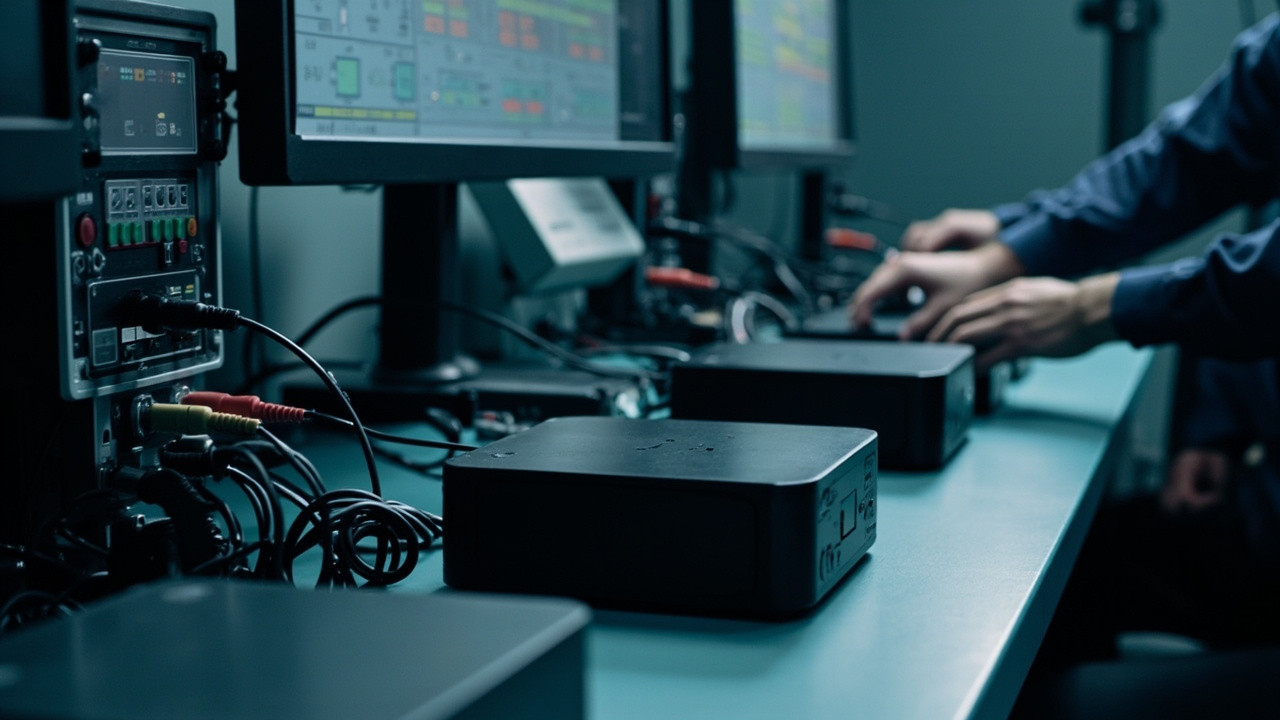
A real-world engineering bench brings the paperwork into the deployment context: technicians compare a set-top box, its radio path, its cables, and its test instruments with the configuration record used for approval.
For an operator programme, the likely buyer asks for two layers of evidence: a reusable platform record for procurement and a fleet-specific release decision for operations. The first supports sourcing across multiple SKUs; the second prevents a permitted production substitution from silently changing the tested product.
A cloud-gaming programme illustrates why the same device name is insufficient. The operator may request a particular firmware branch, remote-management service, network accessory, and venue-specific enclosure. Each item should be classified as relevant to the RF evidence or outside it, with the classification signed by the supplier’s compliance owner. This avoids repeating the full test programme for a change that does not affect the radio and avoids accepting a report whose antenna or firmware boundary does not match the deployed unit.
Turning the question into a spec line
Use a sequence that separates platform selection from regulatory evidence. The output should be pasteable RFQ text, not a request to “send certificates.” A useful sequence has seven steps.
- Define the market State the destination country or countries, operator programme, retail or commercial channel, and expected volume regime without assuming one report covers every market.
- Freeze the SKU List the model, hardware revision, RAM/ROM option, connectivity option, radio module, antenna, enclosure revision, power supply, and shipped accessories.
- Classify the evidence Ask whether the product uses equipment certification, Supplier’s Declaration of Conformity, or another FCC authorization route, and request the document matching that route.
- Bind the report Require the report number, laboratory name, applicant or responsible party, FCC ID where applicable, test date, tested configuration, and production-equivalence statement.
- Define change control Specify which substitutions require notice and retest, including antenna, radio module, PCB, enclosure, firmware radio settings, and labelling.
- Set the evidence gates Require preliminary compliance status before tooling approval, formal evidence before production release, and a final SKU-to-document confirmation before shipment.
- Archive the acceptance record Store the accepted report, manual or labelling evidence, model mapping, approval record, and any delta assessments in the device quality file.
The resulting RFQ line should read like this:
For each shipmentable SKU, provide the applicable FCC Part 15 authorization evidence, report or declaration number, applicant or responsible party, test-lab identity, FCC ID where applicable, tested hardware and software configuration, antenna and radio-module identification, production-equivalence statement, and change-control procedure. Confirm evidence coverage before tooling approval, mass-production release, and shipment.
A separate certification-status line should ask for the current public record and any conditions of use. A separate deliverable line should identify where the compliance statements, user information, labels, and packaging artwork appear. This prevents a report from being delivered while the production manual still uses obsolete wording.
Do not specify “latest FCC report” without a revision rule. “Latest” can select a document for a different hardware revision. The acceptance criterion should be “the accepted report or declaration covering the production configuration,” supported by a revision history and dated configuration statement.
An operator RFQ can add: “List every approved radio module, antenna part number, enclosure, and accessory set for the SKU.” An integrator RFQ can add: “Identify any test-condition restrictions on supplied HDMI, power, or RF cables.” These lines convert a general request into fields that engineering can close.
A label line should also be written as a deliverable: “Provide the production label artwork, model identifier, user-information statement, responsible-party or applicant information, and artwork revision showing where each required statement appears.” This closes the common gap between a technically valid report and inconsistent market-facing documentation.
Add a delivery field for every document. “Provide the report in a searchable PDF with revision history, plus the test-lab contact, issue date, and document owner” makes review measurable. Add an acceptance field: “The compliance owner shall confirm in writing that the report covers the production radio module, antenna, enclosure, and firmware configuration.” The resulting part 15 test report request becomes auditable at RFQ, engineering-change, and shipment gates.
Where quotations quietly diverge
Quotations often collapse several deliverables into one sentence. “FCC,” “Part 15,” “test report,” “certified,” and “CE” are not interchangeable. A seller may mean regulatory testing was performed, that an application was filed, that an FCC ID exists, that a customer owns the certification, or that production units will be supplied under the customer’s authorization. Each statement requires different documentary evidence.
| Quotation wording | Ambiguity | Required clarification |
|---|---|---|
| “Part 15 compliant” | No authorization route, document, or covered model named | Ask for the authorization route, report or declaration, and exact SKU mapping |
| “FCC certified” | Certification status and responsibility are undefined | Request FCC ID and applicant details where certification applies |
| “Test report available” | Report may be preliminary, internal, or unrelated to production | Require laboratory identity, issue date, test scope, and revision |
| “Same platform as certified model” | Equivalence may not address antenna, PCB, enclosure, or firmware | Request a written production-equivalence assessment |
| “Certification included” | May refer only to a factory scan or laboratory quotation | Define deliverables, fees excluded from price discussion, acceptance, and ownership |
| “All Wi-Fi models covered” | Radio module, antenna, and housing differences are hidden | Require a module-by-module and antenna-by-antenna variant matrix |
Field trap
The report filename may match the buyer’s requested part, but the body can identify another radio, antenna, enclosure, or model family. A filename-only review creates release risk because the legal and technical identity of the product remain unverified.
A second trap is the customisation boundary. An operator logo on the boot screen, a different storage option, or a 1G Ethernet variant can coexist with one stable radio design. An enclosure revision or antenna substitution may require a formal change assessment. Ask the supplier’s RF or compliance owner to classify every customisation as “no radio-path impact,” “configuration review,” or “retest required.”
Timing divergence causes another failure. A quote may assume the buyer supplies the FCC ID, supplies the laboratory contact, or accepts responsibility for the final declaration. Put responsibility in writing: who owns the equipment authorization, who signs the Supplier’s Declaration of Conformity, who funds testing, who owns test samples, who handles failed results, and who approves retesting after an engineering change.
The commercial consequence of an unclear line appears after approval: customs holds, operator certification delay, distributor re-labelling, or a production lot that must be quarantined. These are operational costs created before the goods reach the intended market.
A second warning concerns PDF control. A signed report may be valid while the manual, label, and model identifier have changed. Acceptance should therefore include a cross-check between the report, user information, production label, and SKU register. For a part 15 test report supplied during quotation, missing manual or labelling evidence is a gap rather than an administrative afterthought.
A further divergence appears when the same document is assigned to every production phase. A preliminary scan can support engineering exploration, but it is not interchangeable with a formal laboratory report. The quotation should state the document’s stage, issue status, and intended use. This prevents a buyer from accepting a draft because its filename resembles a final report.
A related fault is mismatched revision dates. The report may predate the production BOM, while the SKU register may postdate the label artwork. Require a single “as-shipped” date and identify which configuration fields were verified on that date. If the evidence is older than the last radio-path or enclosure change, hold the release until the supplier documents equivalence or completes the required retest.
Questions to put in the supplier review
The factory should demonstrate how regulatory variables are controlled, not merely attach a PDF. A compliant production process links the tested configuration to the released unit through part numbers, revisions, incoming inspection, and change notices.
- Trace the model Require a bill-of-materials comparison between the tested sample and production SKU, including PCB revision, radio module, antenna, enclosure, labels, power supply, and relevant firmware branch.
- Control incoming materials Review inspection instructions and acceptance criteria for radio modules, antennas, cables, shields, and power components against approved specifications.
- Verify assembly Inspect SMT records and AOI results where applicable, focusing on RF components, antenna connections, shielding, and deviations from the released process.
- Apply functional screening Review production-test limits for connectivity, radio functions, firmware identifiers, port configuration, and serial-number traceability.
- Use aging evidence Check environmental or burn-in procedures where they are part of the released quality plan and link any failure disposition back to the build record.
- Audit evidence Review internal audits, corrective actions, non-conforming-material controls, and sample selection against the production plan.
- Manage changes Require written notification and compliance-impact review before a regulated component, layout, enclosure, antenna, firmware radio setting, or label changes.
For a factory video audit, ask the host to open the regulatory dossier beside the active production line. The walkthrough should trace one finished serial number from the approved SKU definition to the BOM revision, RF-related assembly record, final-test result, and shipment release. The requested package should include the accepted part 15 test report, SKU mapping, responsible-party or applicant record, and change-control procedure.
The review should also separate RF evidence from wider product compliance. A DataMax platform may be selected for its supplied processor, operating-system, memory, decode, DRM, or connectivity values, while the FCC evidence establishes only the radio and emissions position for the released configuration. Android device-owner approval, middleware acceptance, Widevine or PlayReady checks, HDCP requirements, and operator security testing remain separate gates.
Use a dated evidence register rather than scattered email attachments. Each row should identify the SKU, document title, revision, issuing organisation, responsible party, applicability, approval date, approved by, review trigger if applicable, storage location, and change-impact status.
Buyers can request a video factory audit or SMT, AOI, aging, and traceable RF-evidence records through DataMax. Before shipment approval, obtain the final evidence package and email [email protected] with the SKU list, target-market certification requirements, report-to-model mapping, radio/antenna configuration, and the middleware/DRM checklist required for programme approval.
The supplier review should end with a signed release decision, not an informal email saying the configuration is unchanged. The record should identify the reviewer, released SKU, accepted evidence revision, approved variants, unresolved observations, and shipment decision. A part 15 test report then becomes traceable evidence within the factory system rather than an isolated attachment.
A practical audit scorecard can assign five binary checks: configuration identified, laboratory identified, authorization route confirmed, production equivalence documented, and change-control record current. Any failed check should remain open in the release register until corrected or formally accepted by the designated compliance owner.
Ask the factory to demonstrate one closed-loop example. Select a prior antenna, enclosure, or firmware change; show the change notice; identify the compliance assessment; and link the decision to the affected production lots. If no example exists, the process is document control without operational evidence. The review should also establish who can stop a shipment when the released BOM differs from the approved evidence.
Further reading
- Dolby Atmos Android TV box guide
- TV box vendor selection checklist
- AOSP vs GMS solution notes
- Telecom and pay-TV operator solutions
- Allwinner Android TV boxes
- DataMax DM21P specifications and fit
- DataMax DM21S specifications and fit
FAQ
Is a Part 15 test report the same as an FCC certification?
No. A test report documents testing and results, while an FCC certification or equipment authorization has a specific regulatory status and record. A Supplier’s Declaration of Conformity is also a different route. Request the authorization record, responsible-party details, and supporting report matching the product, regulatory route, and released configuration.
When should a buyer request the report?
Request preliminary evidence during RFQ, formal evidence before production approval, and final configuration confirmation before shipment. If the antenna, radio module, PCB, enclosure, radio settings, or label changes, request a documented compliance-impact assessment before modified units are released.
Can one report cover several storage or branding options?
Possibly, but only when the supplier demonstrates that the changed options do not affect the tested configuration or provides the required variant evidence. A storage or branding change may be outside the report’s critical boundary; an antenna, enclosure, or radio-path change may not. Written equivalence is preferable to verbal confirmation.
Who should own the FCC authorization?
The answer depends on the device and business model. The manufacturer, importer, operator, or another party may occupy different roles. Name the applicant or grantee where certification applies, or the responsible party where Supplier’s Declaration of Conformity applies, and ensure the commercial and operational responsibilities agree.
What should be attached to an RFQ?
Attach the target market, candidate SKU list, RAM/ROM and connectivity options, enclosure and antenna requirements, proposed radio module, required report or declaration, certification route, acceptance date, and change-control procedure. Also identify separate Android, DRM, HDCP, middleware, and operator-validation requirements.
How does DataMax handle custom RF or enclosure requirements?
DataMax can evaluate custom hardware and software requirements through its engineering route, but the resulting regulatory path and evidence must be confirmed against the released production configuration and production datasheet. A factory review can verify how the approved BOM, assembly records, and compliance evidence remain linked through production.